
Equation of a Circle Through Three Points
A unique circle passes through any three non-collinear points. We can determine its equation using geometric methods, such as finding the perpendicular bisectors of the segments, or algebraic methods using the coordinates of the points.

When three points are collinear, it is impossible to define a circle that passes through all of them. If two of the points are identical, the problem lacks a unique solution, as infinitely many circles can pass through two distinct points.
Table of Contents
How to Find the Equation of a Circle
To find the equation of a circle passing through three non-collinear points, we start with its general form equation in the Cartesian plane:
$$x^2+y^2+Dx+Ey+F=0$$
Let \(A (x_1, y_1)\), \(B (x_2, y_2)\), and \(C (x_3, y_3)\) be three non-collinear points. Since these points lie on the circle, their coordinates satisfy the general equation.

The procedure is as follows:
1) Substitute each point into the general equation to obtain three equations:
For A: \(x_1^2+y_1^2+D x_1+E y_1+F=0\)
For B: \(x_2^2+y_2^2+D x_2+E y_2+F=0\)
For C: \(x_3^2+y_3^2+D x_3+E y_3+F=0\)
2) Solve the system of three linear equations for the unknowns: the coefficients D, E, and F.
$$\begin{cases} x_1^2+y_1^2+D x_1+E y_1+F=0 \\ x_2^2+y_2^2+D x_2+E y_2+F=0 \\ x_3^2+y_3^2+D x_3+E y_3+F=0 \end{cases}$$
3) Once D, E, and F are determined, substitute them back into the general equation of the circle.
4) Optionally, convert from general form to standard form to find the center and radius of the circle.
Worked Examples
Find the equation, center, and radius of the circle passing through the three given points:
- A(5, 0), B(0, 5), C(-5, 0).
- A(0, 0), B(3, 6), C(7, 0).
- A(2, -2), B(-1, 4), C(4, 6).
- A(9, -1), B(7, 3), C(4, 8).
- A(-1, 1), B(3, 5), C(5, -3).
Solution 1
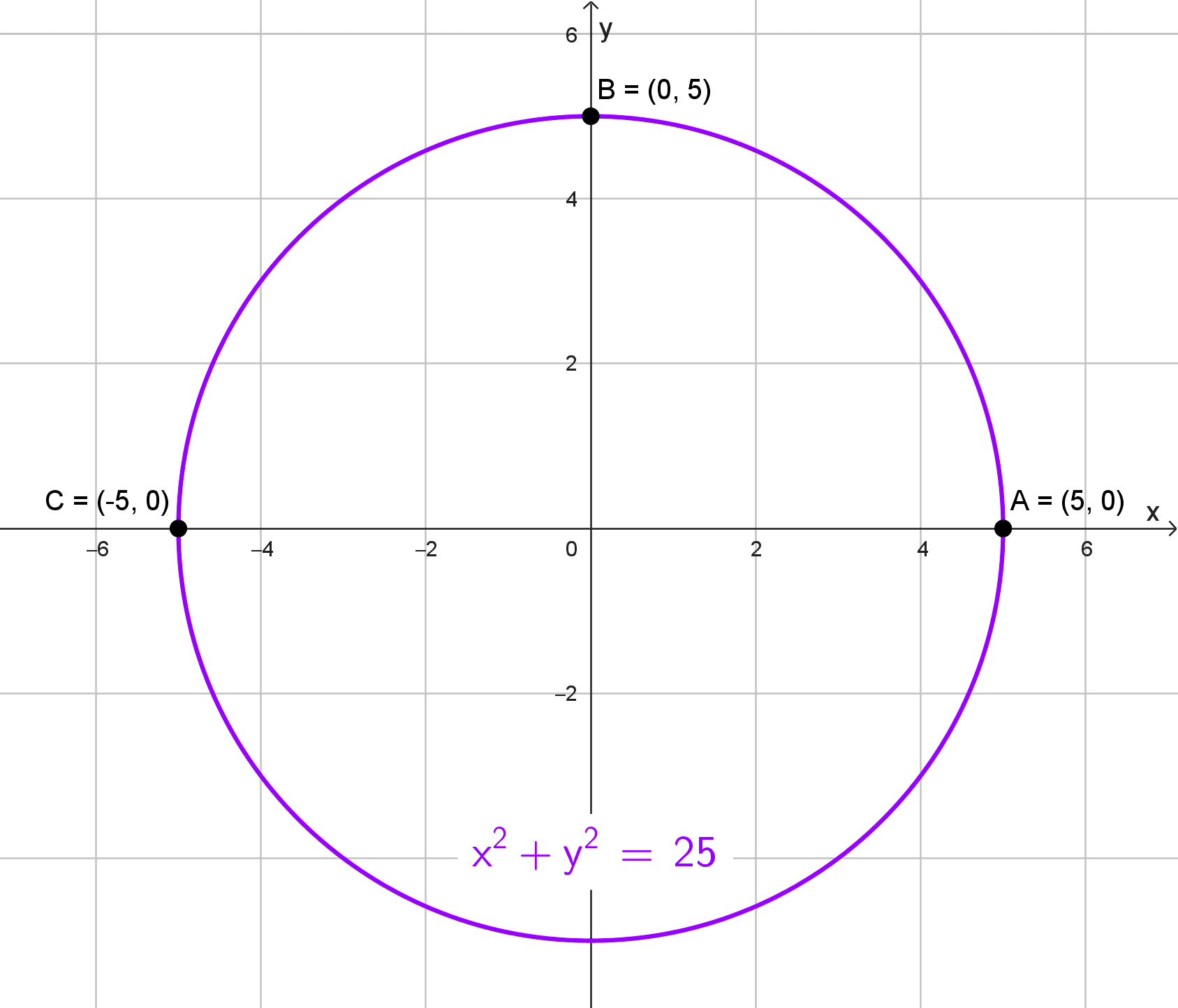
We determine the equation of the circle passing through the points \(A(5, 0)\), \(B(0, 5)\), and \(C(-5, 0).\) Substitute each point into the general equation \(x^2+y^2+Dx+Ey+F=0:\)
For \(A(5, 0):\)
$$5^2+0^2+D \cdot 5+E \cdot 0+F=0 → 25+5D+F=0 \quad (1)$$
For \(B(0, 5):\)
$$0^2+5^2+D \cdot 0+E \cdot 5+F=0 → 25+5E+F=0 \quad (2)$$
For \(C(-5, 0):\)
$$(-5)^2+0^2+D \cdot (-5)+E \cdot 0+F=0 → 25-5D+F=0 \quad (3)$$
Subtract equation (3) from (1):
$$(25+5D+F)-(25-5D+F)=0 → 10D=0 → D=0$$
Substituting \(D=0\) into (1):
$$25+0+F=0 → F=-25$$
Substituting \(F=-25\) into (2):
$$25+5E-25=0 → 5E=0 → E=0$$
The general equation is:
$$x^2+y^2-25=0 → x^2+y^2=25$$
This is in standard form, where the center is \((0, 0)\) and the radius is \(r=5.\)
Solution 2
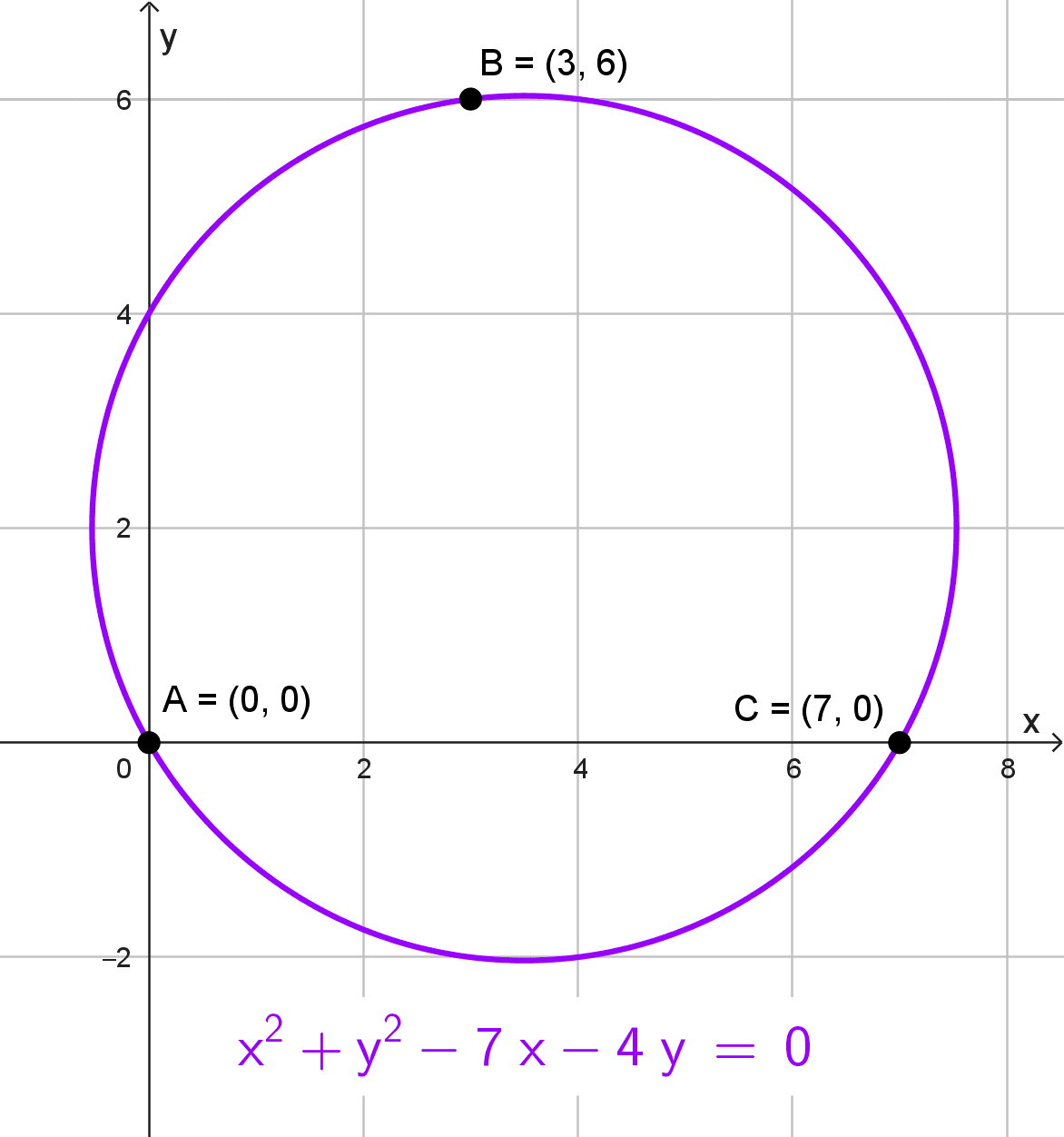
We find the circle passing through \(A(0, 0)\), \(B(3, 6)\), and \(C(7, 0).\) Substitute into the general equation:
For \(A(0, 0):\)
$$0+0+0+0+F=0 → F=0 \quad (1)$$
For \(B(3, 6):\)
$$9+36+3D+6E+0=0 → 3D+6E=-45 \quad (2)$$
For \(C(7, 0):\)
$$49+0+7D+0+0=0 → 7D=-49 → D=-7 \quad (3)$$
Substituting \(D=-7\) into (2):
$$3(-7)+6E=-45 → -21+6E=-45 → 6E=-24 → E=-4$$
The general equation is:
$$x^2+y^2-7x-4y=0$$
Complete the square to obtain the standard form:
$$x^2-7x+\left(\dfrac{7}{2}\right)^2+y^2-4y+4=\left(\dfrac{7}{2}\right)^2+4$$
$$\left(x-\dfrac{7}{2}\right)^2+(y-2)^2=\dfrac{49}{4}+4=\dfrac{65}{4}$$
The center is \(\left(\dfrac{7}{2}, 2\right)\) and the radius is \(r=\sqrt{\dfrac{65}{4}}=\dfrac{\sqrt{65}}{2}.\)
If you are working through problems and want to check your answers, you can use our free tool:
Solution 3
We calculate the circle passing through \(A(2, -2)\), \(B(-1, 4)\), and \(C(4, 6).\) Substituting each point:
For \(A(2, -2):\)
$$4+4+2D-2E+F=0 → 2D-2E+F=-8 \quad (1)$$
For \(B(-1, 4):\)
$$1+16-D+4E+F=0 → -D+4E+F=-17 \quad (2)$$
For \(C(4, 6):\)
$$16+36+4D+6E+F=0 → 4D+6E+F=-52 \quad (3)$$
Subtract (1) from (2):
$$(-D+4E+F)-(2D-2E+F)=-17+8 → -3D+6E=-9 \quad (4)$$
Subtract (2) from (3):
$$(4D+6E+F)-(-D+4E+F)=-52+17 → 5D+2E=-35 \quad (5)$$
Simplify equation (4) by dividing by 3:
$$-D+2E=-3 \quad (4')$$
Subtract (4') from (5):
$$6D=-32 → D=-\dfrac{16}{3}$$
Substituting \(D\) into (4'):
$$\dfrac{16}{3}+2E=-3 → 2E=-\dfrac{25}{3} → E=-\dfrac{25}{6}$$
Substituting \(D\) and \(E\) into (1):
$$2\left(-\dfrac{16}{3}\right)-2\left(-\dfrac{25}{6}\right)+F=-8 → -\dfrac{32}{3}+\dfrac{25}{3}+F=-8 → F=\dfrac{7}{3}-8=-\dfrac{17}{3}$$
The general equation is:
$$x^2+y^2-\dfrac{16}{3}x-\dfrac{25}{6}y-\dfrac{17}{3}=0$$
Multiplying by 6 gives integer coefficients:
$$6x^2+6y^2-32x-25y-34=0$$
To find the center and radius, we complete the square in standard form:
$$\left(x^2-\dfrac{16}{3}x+\dfrac{64}{9}\right)+\left(y^2-\dfrac{25}{6}y+\dfrac{625}{144}\right)=\dfrac{17}{3}+\dfrac{64}{9}+\dfrac{625}{144}$$
$$\left(x-\dfrac{8}{3}\right)^2+\left(y-\dfrac{25}{12}\right)^2=\dfrac{2465}{144}$$
The center is \(\left(\dfrac{8}{3}, \dfrac{25}{12}\right)\) and the radius is \(r=\dfrac{\sqrt{2465}}{12}.\)

Solution 4
We determine the circle passing through the points \(A(9, -1)\), \(B(7, 3)\), and \(C(4, 8).\) Substitute each point into the general equation \(x^2+y^2+Dx+Ey+F=0:\)
For \(A(9, -1):\)
$$81+1+9D-E+F=0 → 9D-E+F=-82 \quad (1)$$
For \(B(7, 3):\)
$$49+9+7D+3E+F=0 → 7D+3E+F=-58 \quad (2)$$
For \(C(4, 8):\)
$$16+64+4D+8E+F=0 → 4D+8E+F=-80 \quad (3)$$
Subtract (1) from (2):
$$(7D+3E+F)-(9D-E+F)=-58+82 → -2D+4E=24 → -D+2E=12 \quad (4)$$
Subtract (2) from (3):
$$(4D+8E+F)-(7D+3E+F)=-80+58 → -3D+5E=-22 \quad (5)$$
From (4), we express \(D\) in terms of \(E\): \(D=2E-12.\)
Substituting into (5):
$$-3(2E-12)+5E=-22 → -6E+36+5E=-22 → -E=-58 → E=58$$
Then, \(D=2(58)-12=104.\)
Substituting \(D=104\) and \(E=58\) into (1):
$$9(104)-58+F=-82 → 936-58+F=-82 → F=-960$$
The general equation is:
$$x^2+y^2+104x+58y-960=0$$
Complete the square:
$$x^2+104x+y^2+58y=960$$
$$(x^2+104x+2704)+(y^2+58y+841)=960+2704+841$$
$$(x+52)^2+(y+29)^2=4505$$
The center is \((-52, -29)\) and the radius is \(r=\sqrt{4505}.\)

Solution 5
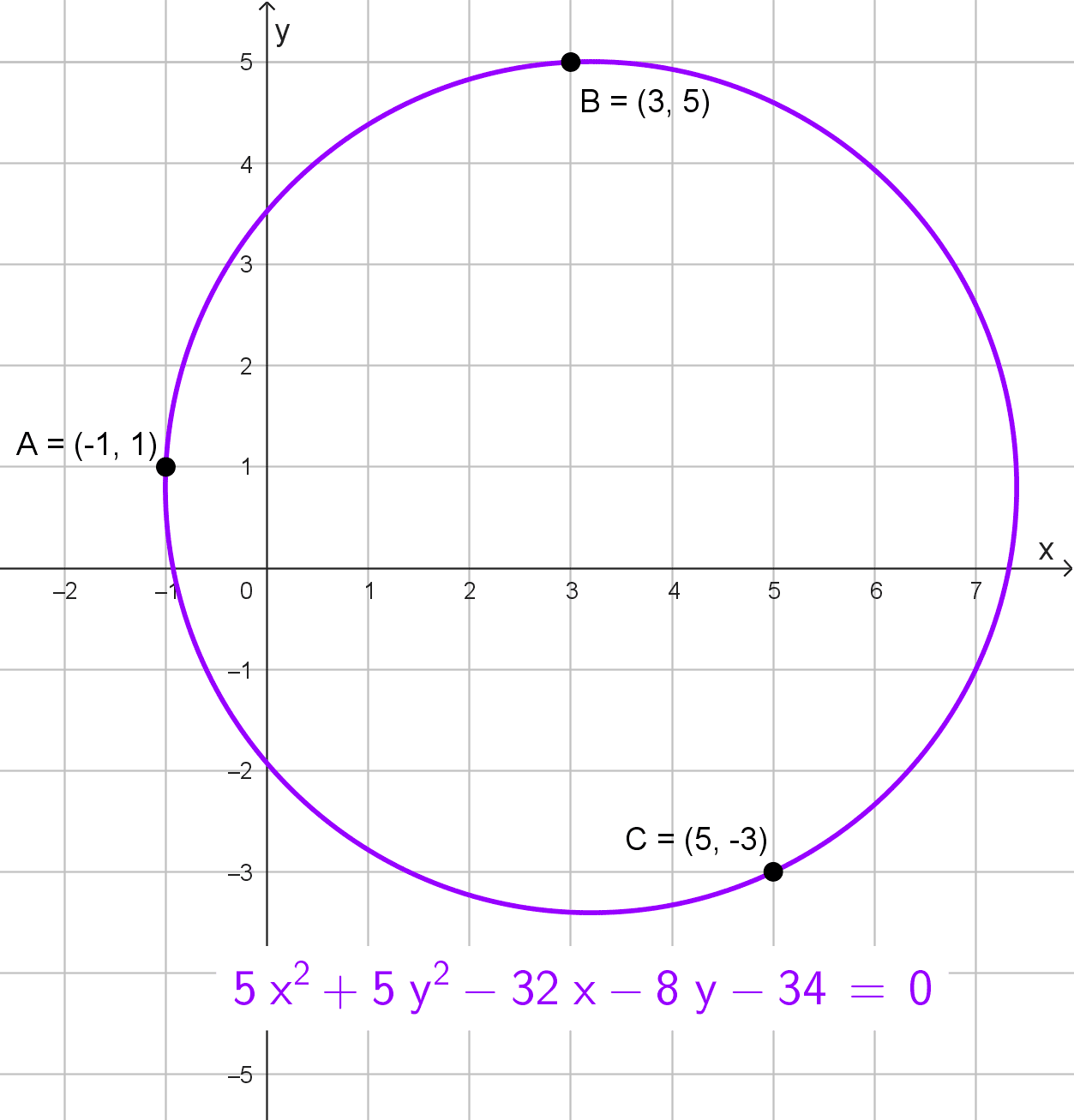
We find the circle passing through \(A(-1, 1)\), \(B(3, 5)\), and \(C(5, -3).\) Substitute into the general equation:
For \(A(-1, 1):\)
$$1+1-D+E+F=0 → -D+E+F=-2 \quad (1)$$
For \(B(3, 5):\)
$$9+25+3D+5E+F=0 → 3D+5E+F=-34 \quad (2)$$
For \(C(5, -3):\)
$$25+9+5D-3E+F=0 → 5D-3E+F=-34 \quad (3)$$
Subtract (1) from (2):
$$(3D+5E+F)-(-D+E+F)=-34+2 → 4D+4E=-32 → D+E=-8 \quad (4)$$
Subtract (2) from (3):
$$(5D-3E+F)-(3D+5E+F)=-34+34 → 2D-8E=0 → D=4E \quad (5)$$
Substituting (5) into (4):
$$4E+E=-8 → 5E=-8 → E=-\dfrac{8}{5}$$
Then, \(D=4\left(-\dfrac{8}{5}\right)=-\dfrac{32}{5}.\)
Substituting \(D\) and \(E\) into (1):
$$-\left(-\dfrac{32}{5}\right)-\dfrac{8}{5}+F=-2 → \dfrac{32}{5}-\dfrac{8}{5}+F=-2 → F=-2-\dfrac{24}{5}=-\dfrac{34}{5}$$
The general equation is:
$$x^2+y^2-\dfrac{32}{5}x-\dfrac{8}{5}y-\dfrac{34}{5}=0$$
Multiplying by 5 gives integer coefficients:
$$5x^2+5y^2-32x-8y-34=0$$
Complete the square directly to find standard form:
$$\left(x^2-\dfrac{32}{5}x+\dfrac{256}{25}\right)+\left(y^2-\dfrac{8}{5}y+\dfrac{16}{25}\right)=\dfrac{34}{5}+\dfrac{256}{25}+\dfrac{16}{25}$$
$$\left(x-\dfrac{16}{5}\right)^2+\left(y-\dfrac{4}{5}\right)^2=\dfrac{442}{25}$$
The center is \(\left(\dfrac{16}{5}, \dfrac{4}{5}\right)\) and the radius is \(r=\sqrt{\dfrac{442}{25}}=\dfrac{\sqrt{442}}{5}.\)
Finding the Circle Using Perpendicular Bisectors
Another way to determine the circle passing through three non-collinear points is through the circumcenter, which is the point of intersection of the perpendicular bisectors of the sides of the triangle formed by those points.
A perpendicular bisector is the line perpendicular to a line segment passing through its midpoint. By finding the perpendicular bisectors of at least two sides, their intersection point gives the center of the required circle. The radius is the distance from this center to any of the three given points.
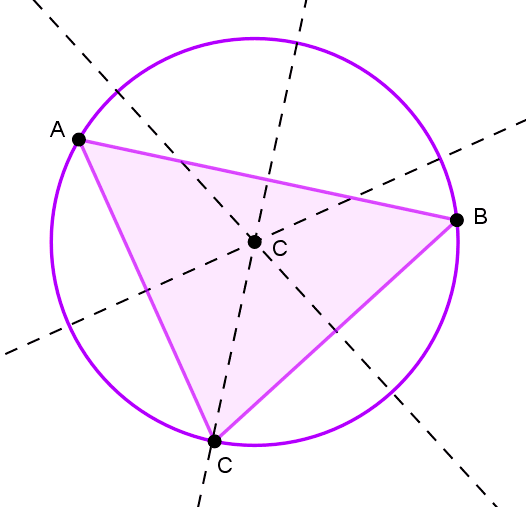
This method can be applied in two ways:
- Geometrically, using a straightedge and compass to construct the perpendicular bisectors accurately on paper.
- Analytically, by computing the equations of the perpendicular bisectors in the Cartesian plane and solving the linear system to find their intersection point (the circumcenter). The radius is then calculated using the distance formula.
Analytical Procedure
Let \(A (x_1, y_1)\), \(B (x_2, y_2)\), and \(C (x_3, y_3)\) be the three given points.
1) Calculate the midpoint of two sides of the triangle.
For example, the midpoints of \(AB\) and \(BC\):
$$M_{AB}=\left (\dfrac{x_1+x_2}{2}, \dfrac{y_1+y_2}{2} \right) \quad M_{BC}=\left (\dfrac{x_2+x_3}{2}, \dfrac{y_2+y_3}{2} \right)$$
2) Find the slopes of segments \(AB\) and \(BC\).
$$m_{AB}=\dfrac{y_2-y_1}{x_2-x_1} \quad m_{BC}=\dfrac{y_3-y_2}{x_3-x_2}$$
3) Obtain the slopes of the perpendicular bisectors.
Since perpendicular bisectors are perpendicular to the segments, their slopes are the negative reciprocals:
$$m_{\perp AB}=-\dfrac{1}{m_{AB}} \quad m_{\perp BC}=-\dfrac{1}{m_{BC}}$$
If a slope is zero or undefined, the bisector is treated as a vertical or horizontal line, respectively.
4) Write the equations of the perpendicular bisectors using point-slope form with the midpoint and the perpendicular slope:
$$y-y_M=m_{\perp} (x-x_M)$$
Perform this step for both perpendicular bisectors.
5) Solve the system of linear equations formed by the two lines. The intersection point is the center \((h, k)\) of the circle.
6) Calculate the radius using the distance formula between the center and any of the three points:
$$r=\sqrt{(x_1-h)^2+(y_1-k)^2}$$
7) Write the equation of the circle in standard form using the center and radius:
$$(x-h)^2+(y-k)^2=r^2$$
Example
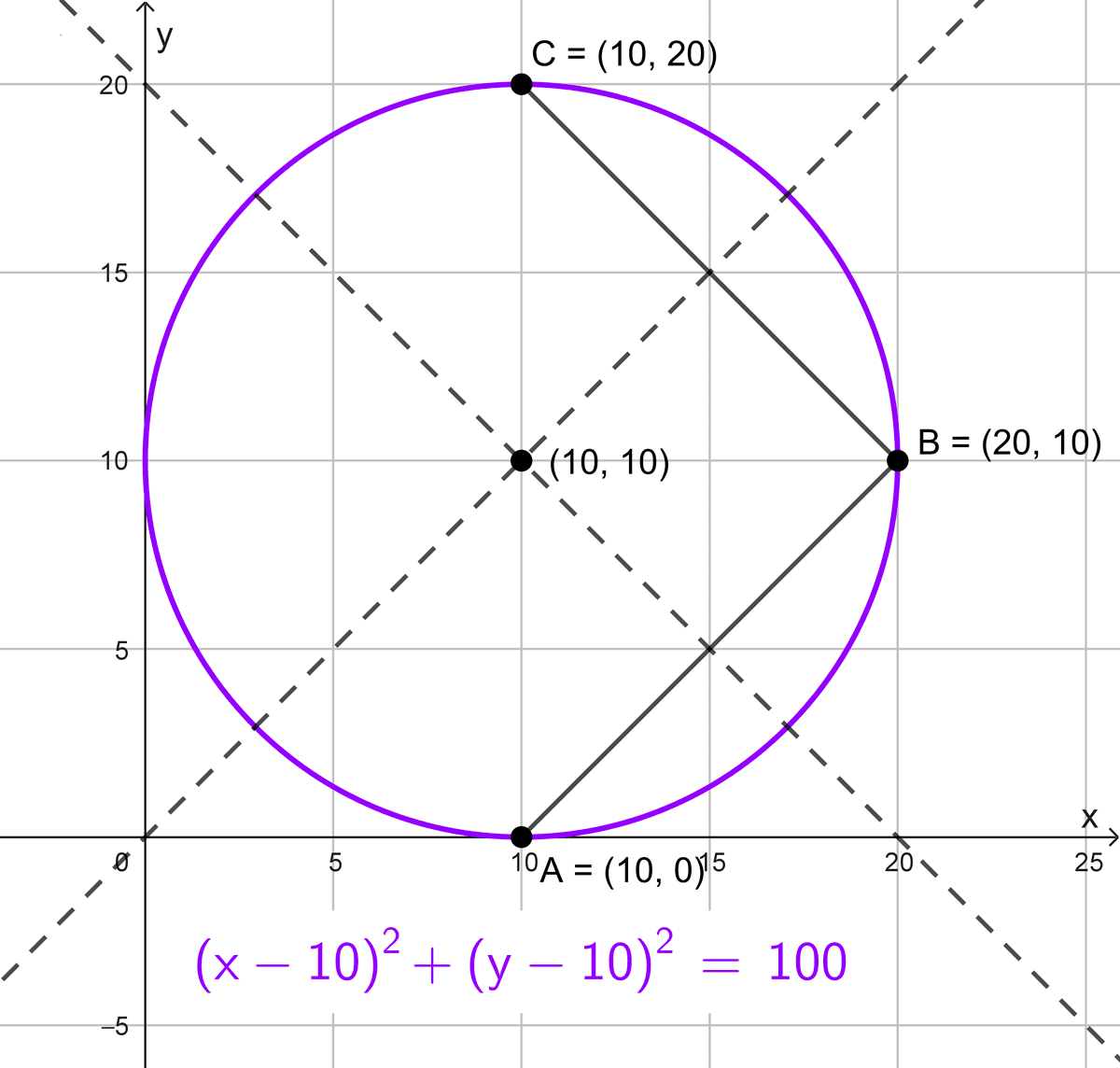
Determine the equation of the circle passing through the points A(10, 0), B(20, 10), and C(10, 20) using perpendicular bisectors.
Solution
First, find the midpoints of segments \(AB\) and \(BC.\) For \(AB,\) the midpoint is:
$$M_{AB}=\left(\dfrac{10+20}{2}, \dfrac{0+10}{2} \right)=(15, 5)$$
For \(BC,\) the midpoint is:
$$M_{BC}=\left(\dfrac{20+10}{2}, \dfrac{10+20}{2} \right)=(15, 15)$$
Next, find the slopes of segments \(AB\) and \(BC.\) The slope of \(AB\) is:
$$m_{AB}=\dfrac{10-0}{20-10}=1$$
The slope of \(BC\) is:
$$m_{BC}=\dfrac{20-10}{10-20}=-1$$
The perpendicular bisectors are perpendicular to these segments, so their slopes are the negative reciprocals:
$$m_{\perp AB}=-\dfrac{1}{m_{AB}}=-1$$
$$m_{\perp BC}=-\dfrac{1}{m_{BC}}=1$$
Now, write the equations of the perpendicular bisectors using point-slope form. For the perpendicular bisector of \(AB,\) which passes through \(M_{AB}(15, 5):\)
$$y-5=-1(x-15) → y=-x+20$$
For the perpendicular bisector of \(BC,\) which passes through \(M_{BC}(15, 15):\)
$$y-15=1(x-15) → y=x$$
Solve the linear system to find the center \((h, k)\) of the circle:
$$y=-x+20$$
$$y=x$$
Substituting the second equation into the first:
$$x=-x+20 → 2x=20 → x=10$$
Then, \(y=10.\) Therefore, the center is \((10, 10).\)
Finally, calculate the radius as the distance between the center and the point \(A(10, 0):\)
$$r=\sqrt{(10-10)^2+(0-10)^2}=\sqrt{0+100}=10$$
The equation of the circle in standard form is:
$$(x-10)^2+(y-10)^2=100$$
Matrix Method
There is also an algebraic method to obtain the equation of a circle passing through three points using determinants.
Given three points \(A (x_1, y_1)\), \(B (x_2, y_2)\), and \(C (x_3, y_3)\), the equation of the circle containing them is given by the following determinant:
$$\begin{vmatrix} x^2 + y^2 & x & y & 1 \\ x_1^2 + y_1^2 & x_1 & y_1 & 1 \\ x_2^2 + y_2^2 & x_2 & y_2 & 1 \\ x_3^2 + y_3^2 & x_3 & y_3 & 1 \\ \end{vmatrix} = 0$$
This same determinant can also test whether four points lie on the same circle—that is, whether they are concyclic. To do this, construct a similar matrix including the fourth point \(D (x_4, y_4)\) as an additional row:
$$\begin{vmatrix} x_1^2 + y_1^2 & x_1 & y_1 & 1 \\ x_2^2 + y_2^2 & x_2 & y_2 & 1 \\ x_3^2 + y_3^2 & x_3 & y_3 & 1 \\ x_4^2 + y_4^2 & x_4 & y_4 & 1 \\ \end{vmatrix} = 0$$
If the determinant equals zero, the four points are concyclic. Otherwise, they do not lie on the same circle.
Did you find this useful? Rate it!
0.0 / 5 — 0 votes

HOW TO CITE THIS ARTICLE
Machado, D. (2026, November 5). Equation of a Circle Through Three Points. Exponty. https://exponty.com/en/three-point-circle-equation
Parts of a Circle
Relative Positions of a Line and a Circle
Tangent Line to a Circle
Equations of Circles: Practice Problems with Solutions
Leave a Reply
Related posts