
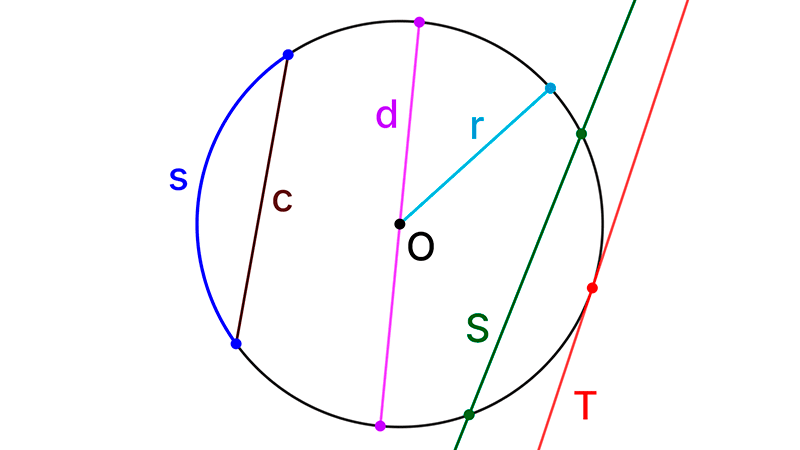
Relative Positions of a Line and a Circle
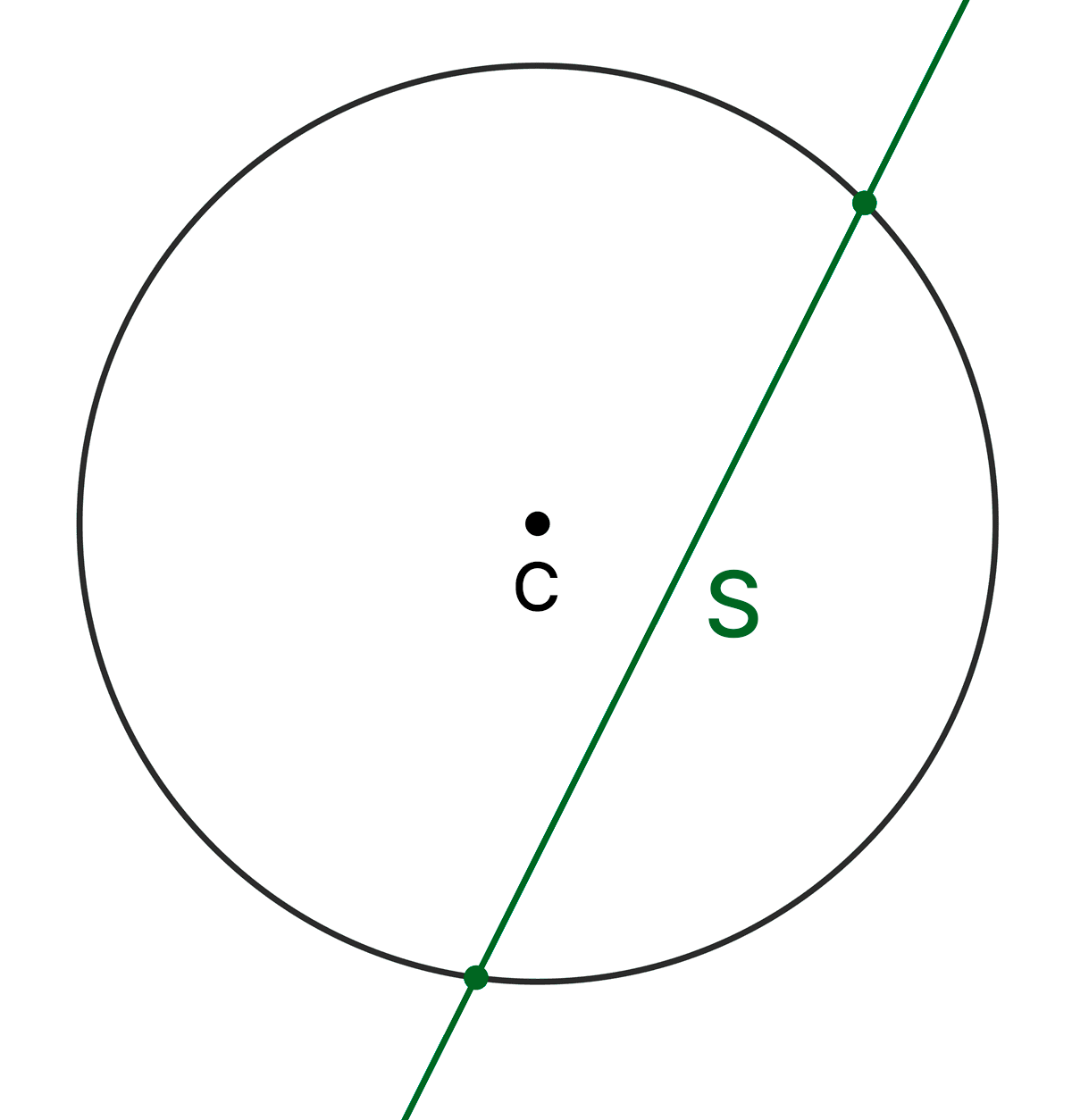
A line can have three relative positions with respect to a circle, determined by the number of points they share. These positions are: exterior (no points in common), tangent (one point in common), and secant (two points in common).
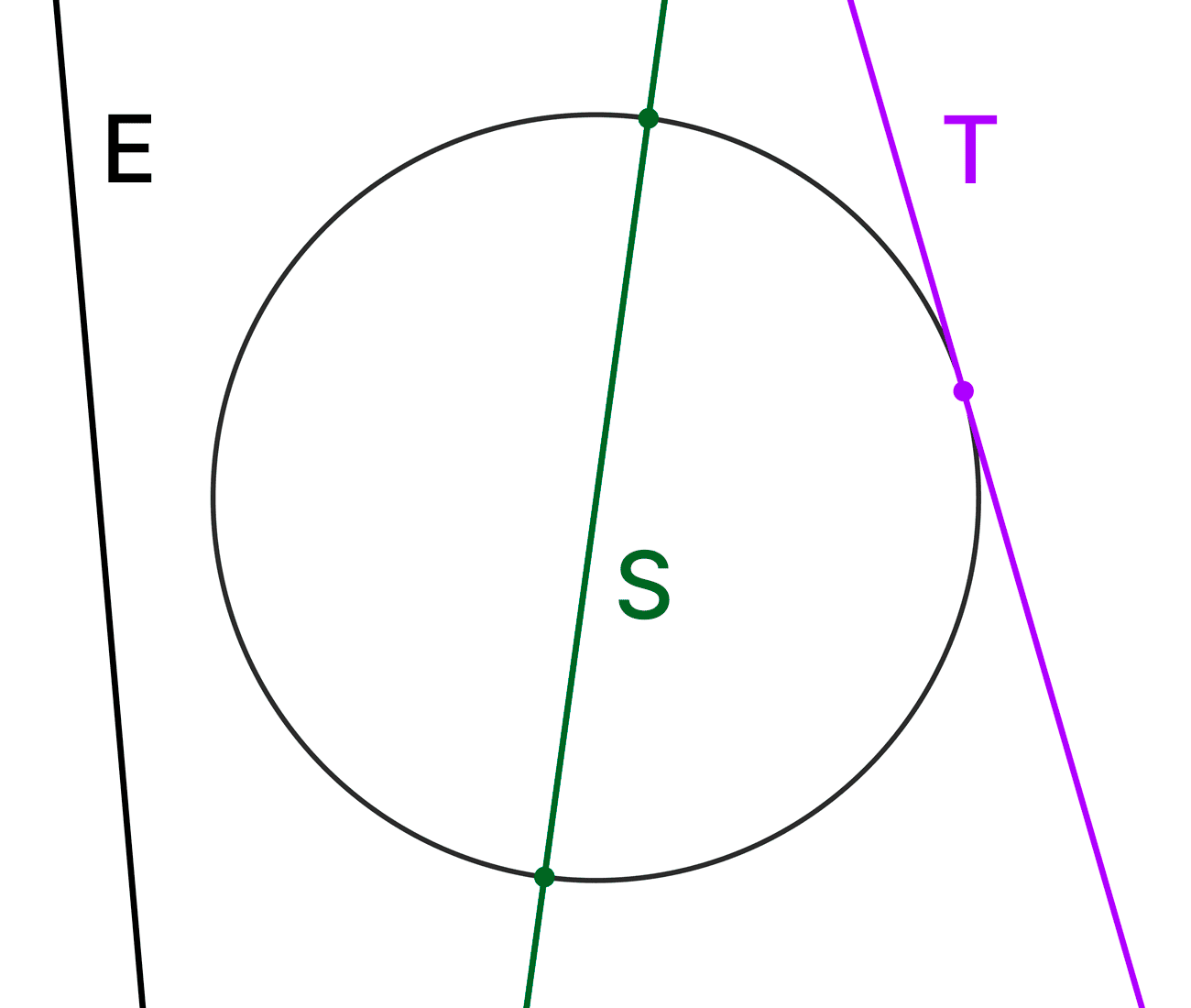
Table of Contents
Exterior Line
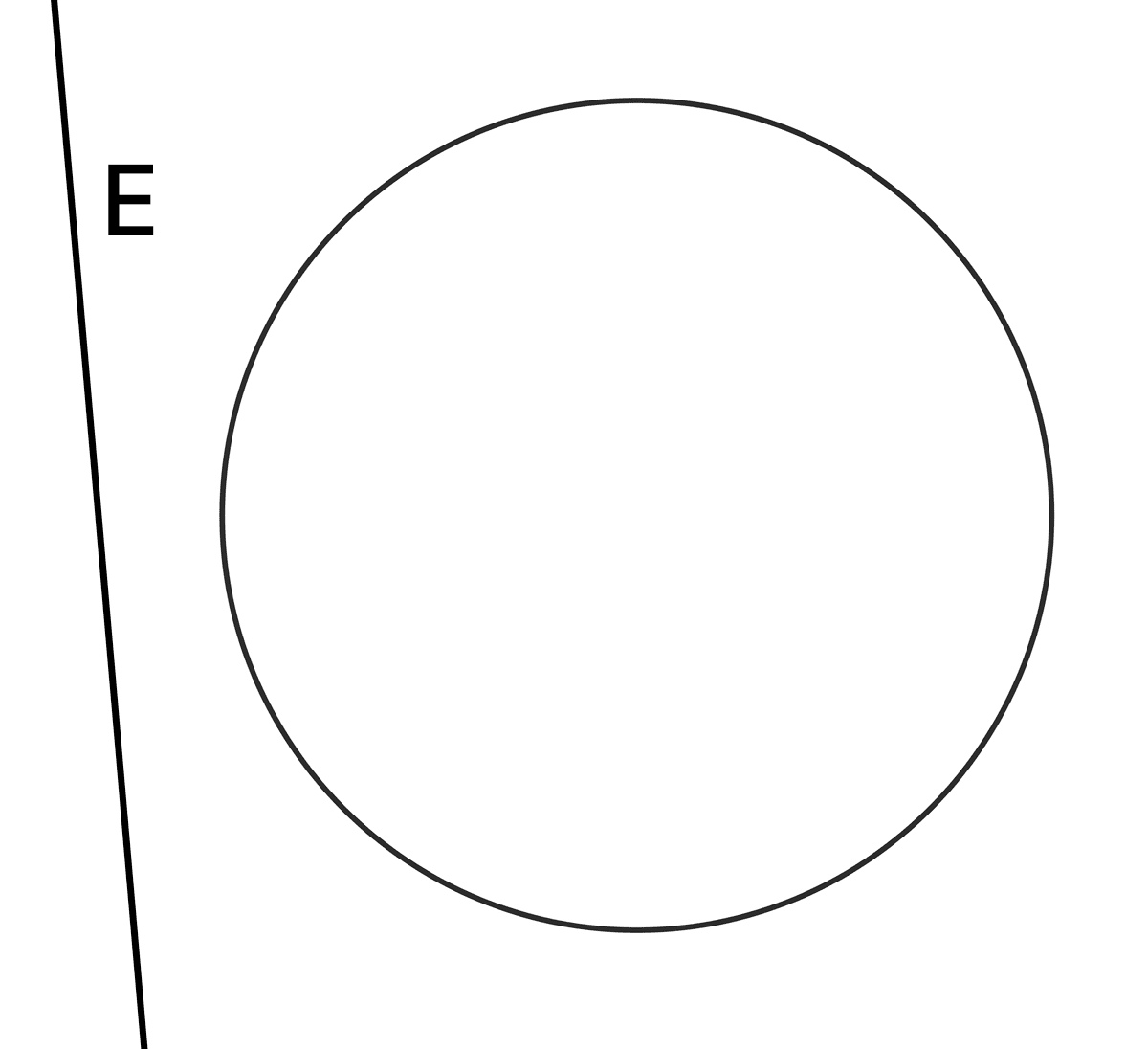
A line is considered exterior to a circle if it does not share any points with it. In this case, the distance from the center of the circle to the line is greater than the radius of the circle.
Tangent Line
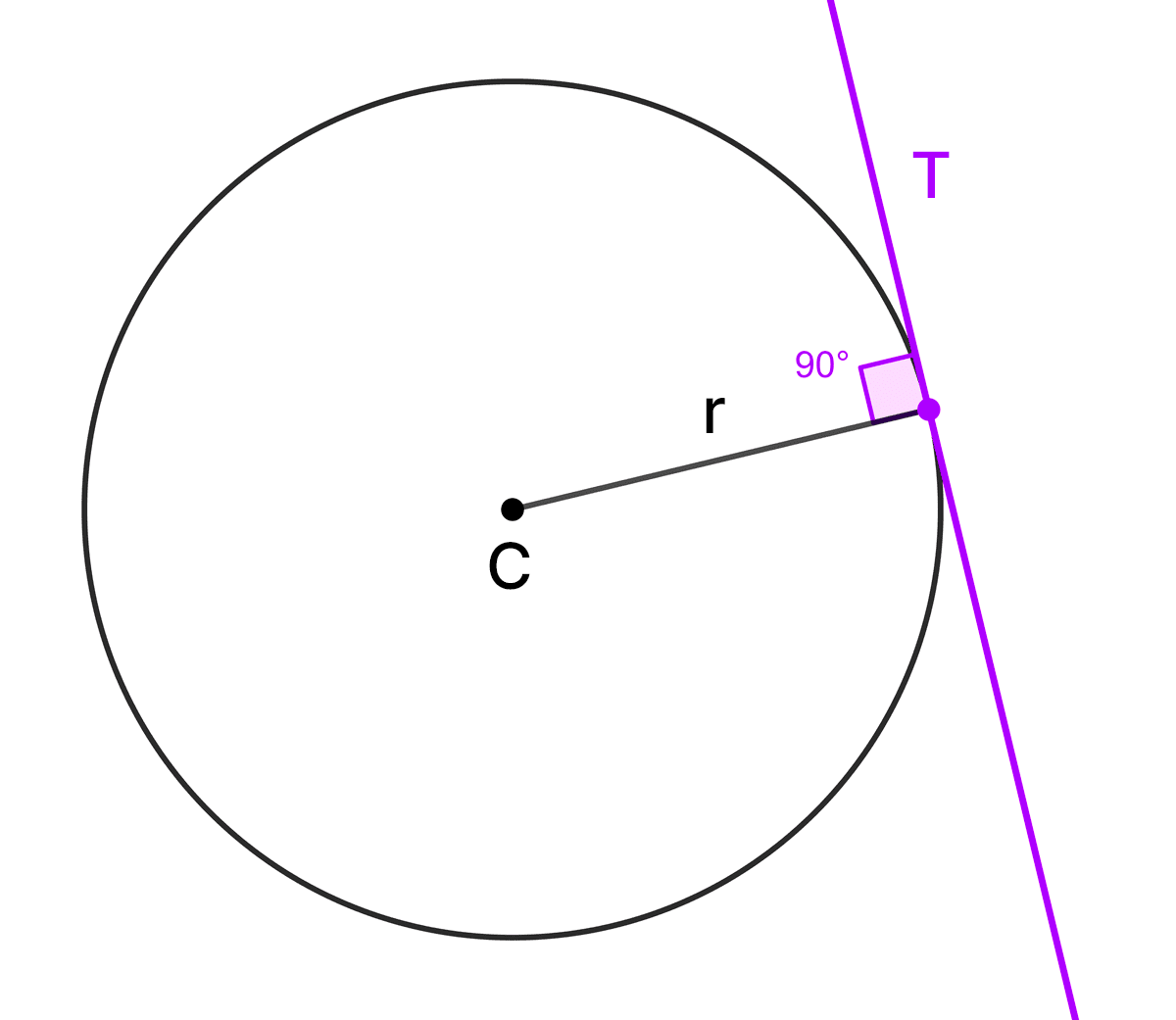
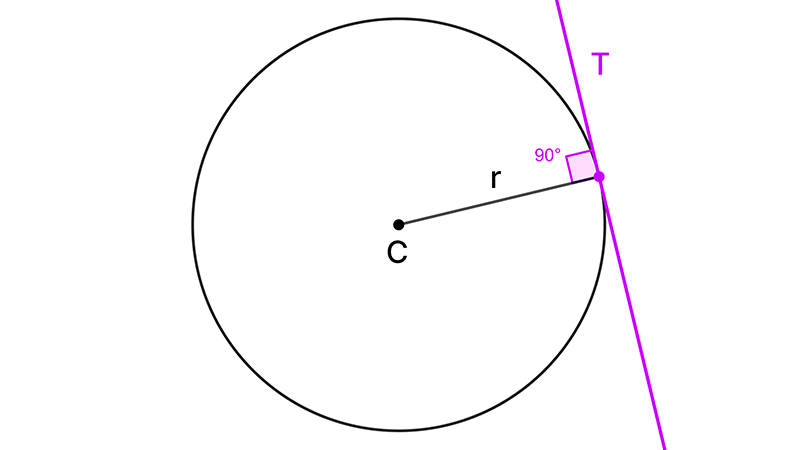
A line is tangent to a circle if it shares only one point with it, known as the point of tangency. The distance from the center of the circle to the tangent line is equal to the radius.
A fundamental property of a tangent line is that it is perpendicular to the radius of the circle at the point of tangency.
Secant Line
A line is secant to a circle if it intersects it at two distinct points. In this case, the distance from the center of the circle to the line is less than the radius. The line segment between these two intersection points is called a chord of the circle.
How to Determine the Relative Position
There are different methods to determine the relative position between a line and a circle given their equations. We will look at two of these methods below.
Method 1: Compare the Distance to the Radius
Given a circle with center C(a, b) and radius r, and a line with general equation Ax + By + C = 0, the distance from the center to the line is calculated using the formula:
$$d=\dfrac{|Aa+Bb+C|}{\sqrt{A^2+B^2}}$$
Then, d is compared with r:
- If d < r, the line is secant.
- If d = r, the line is tangent.
- If d > r, the line is exterior.
Examples
Determine the relative position between the circle and the given line:
- Circle \(x^2+y^2=9;~~\) line \(4x+3y+20=0\)
- Circle \((x-2)^2+(y-3)^2=16;~~\) line \(x=6\)
- Circle \((x+5)^2+(y-1)^2=12;~~\) line \(x+y=0\)
Solution 1
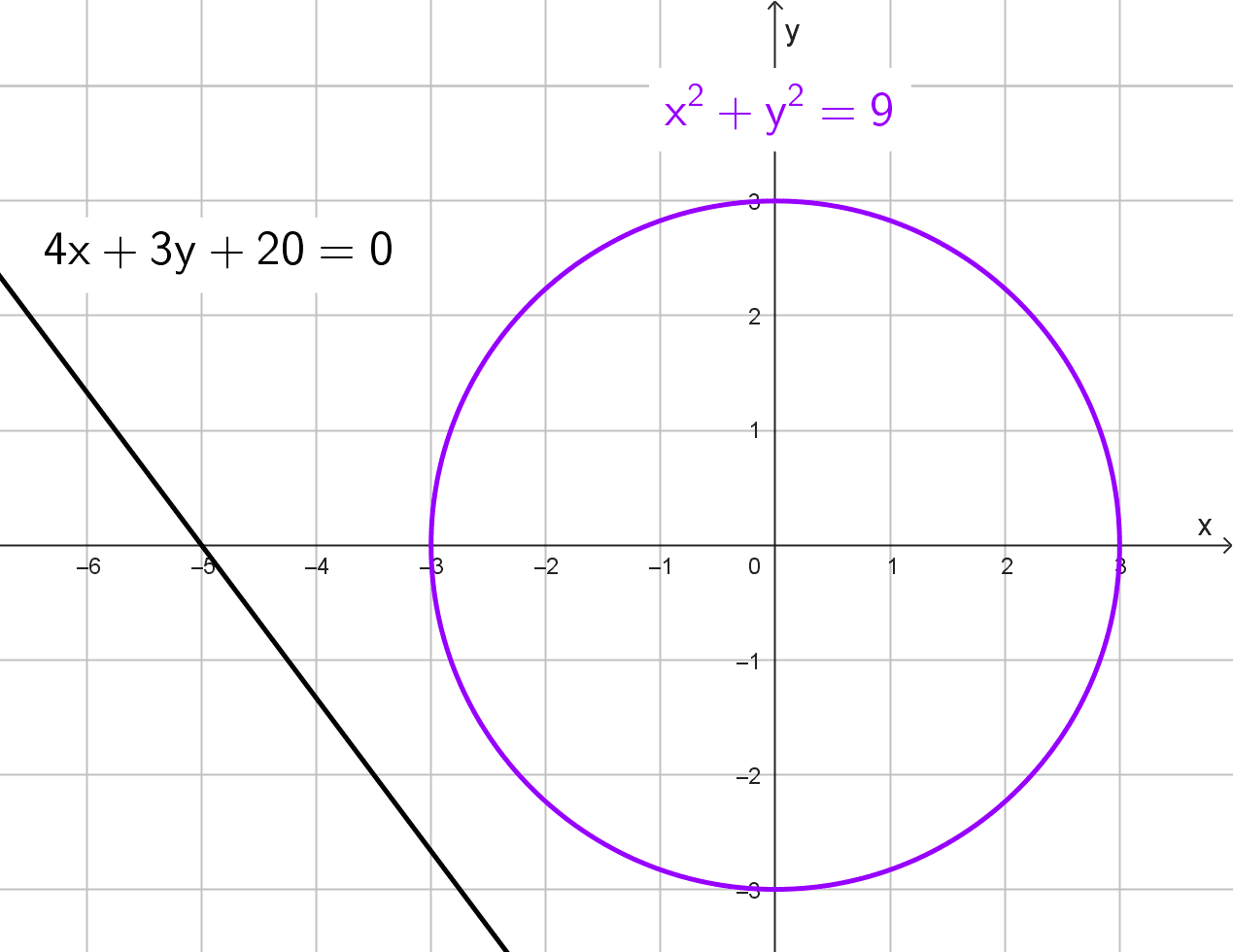
We analyze the circle \(x^2+y^2=9\) and the line \(4x+3y+20=0\). The center of the circle is \((0, 0)\) and its radius is \(r=\sqrt{9}=3\). We calculate the distance \(d\) from the center to the line using the formula:
$$d=\dfrac{|4(0)+3(0)+20|}{\sqrt{4^2+3^2}}=\dfrac{20}{5}=4$$
Since \(d=4>3=r\), the line is exterior to the circle.
Solution 2
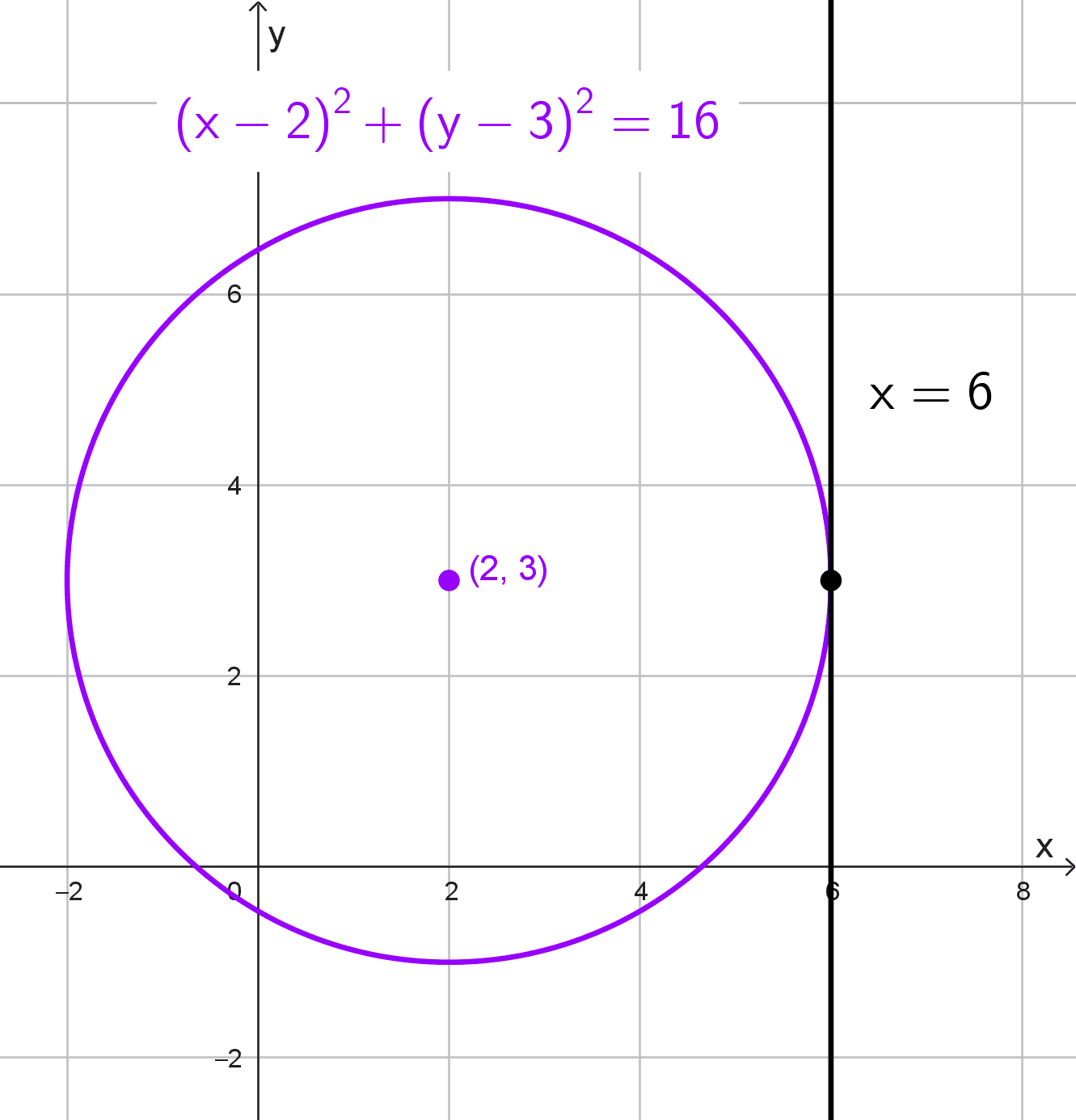
We examine the circle \((x-2)^2+(y-3)^2=16\) and the vertical line \(x=6\). The center is at \((2, 3)\) and the radius is \(r=4\). The distance from the center to the line is simply the horizontal difference:
$$d=|6-2|=4$$
Since \(d=4=r\), the line is tangent to the circle.
Solution 3
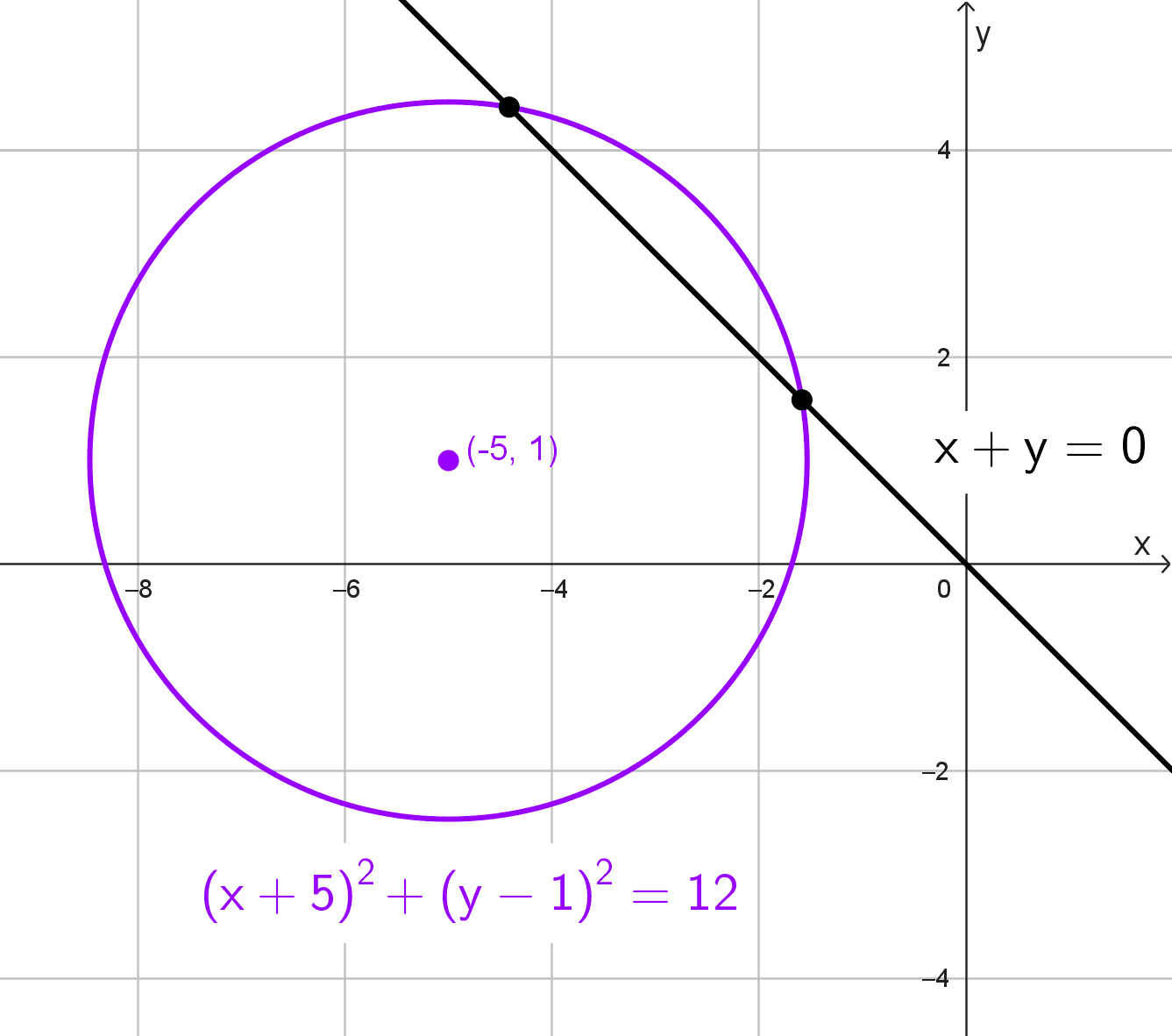
We examine the circle \((x+5)^2+(y-1)^2=12\) and the line \(x+y=0\). The center is \((-5, 1)\) and the radius is \(r=2\sqrt{3} ≈ 3.464\). We calculate the distance:
$$d=\dfrac{|(-5)+1|}{\sqrt{1^2+1^2}}=\dfrac{4}{\sqrt{2}} ≈ 2.828$$
Since \(d ≈ 2.828<3.464 ≈ r\), the line is secant and intersects the circle at two points.
Method 2: Solve a System of Equations
To algebraically determine the position of a line with respect to a circle, we consider the system of equations formed by the equation of the line and the equation of the circle. If the system has no solution, the line is exterior; if it has a single solution, the line is tangent; if it has two solutions, the line is secant.
Step 1
We start with the corresponding equations:
- Circle: \((x-h)^2+(y-k)^2=r^2\)
- Line: \(y=mx+b\)
If the line is given in general form, rewrite it by solving for y to obtain the slope-intercept form; this makes substitution straightforward.
With this, we set up the system of equations:
$$\begin{cases} (x - h)^2 + (y - k)^2 = r^2 \\ y = mx + b \end{cases}$$
Step 2
To solve the system, we substitute the equation of the line into the equation of the circle:
$$(x-h)^2+(mx+b-k)^2=r^2$$
Expanding both terms:
$$x^2-2hx+h^2+m^2x^2+2m (b-k) x+(b-k)^2=r^2$$
Grouping like terms:
$$(1+m^2) x^2+(-2h+2m (b-k)) x+(h^2+(b-k)^2-r^2)=0$$
This is a quadratic equation in \(x\):
$$Ax^2+Bx+C=0$$
where:
- \(A=1+m^2\)
- \(B=-2h+2m (b-k)\)
- \(C=h^2+(b-k)^2-r^2\)
Being a quadratic equation, we can solve it using the quadratic formula:
$$x = \dfrac{ -B \pm \sqrt{B^2 - 4AC} }{2A}$$
The discriminant \(\Delta=B^2-4AC\) tells us whether the equation has no real solutions, one real solution, or two real solutions.
Step 3
We analyze the discriminant \(\Delta=B^2-4AC\) to determine the relative position:
- If Δ > 0, there are two real solutions; therefore, the line is secant (intersects at two points).
- If Δ = 0, there is a single real solution (a repeated root); therefore, the line is tangent (intersects at one point).
- If Δ < 0, there are no real solutions; therefore, the line is exterior (does not intersect the circle).
If, in addition to determining the relative position, you want to find the coordinates of the intersection points between the line and the circle, substitute the calculated root(s) back into the equation of the line or the circle to find the corresponding y-coordinate for each root.
The steps of this procedure can be summarized as follows:
- Set up the system of equations between the circle and the line.
- Substitute the equation of the line into the equation of the circle and expand it.
- Analyze the discriminant of the quadratic equation to determine the relative position.
Examples
Determine the relative position between the circle \((x-2)^2+y^2=25\) and the following lines:
- \(3x+4y-6=0\)
- \(3x+4y-31=0\)
- \(3x+4y-60=0\)
Additionally, find the intersection point(s), if they exist.
Solution 1
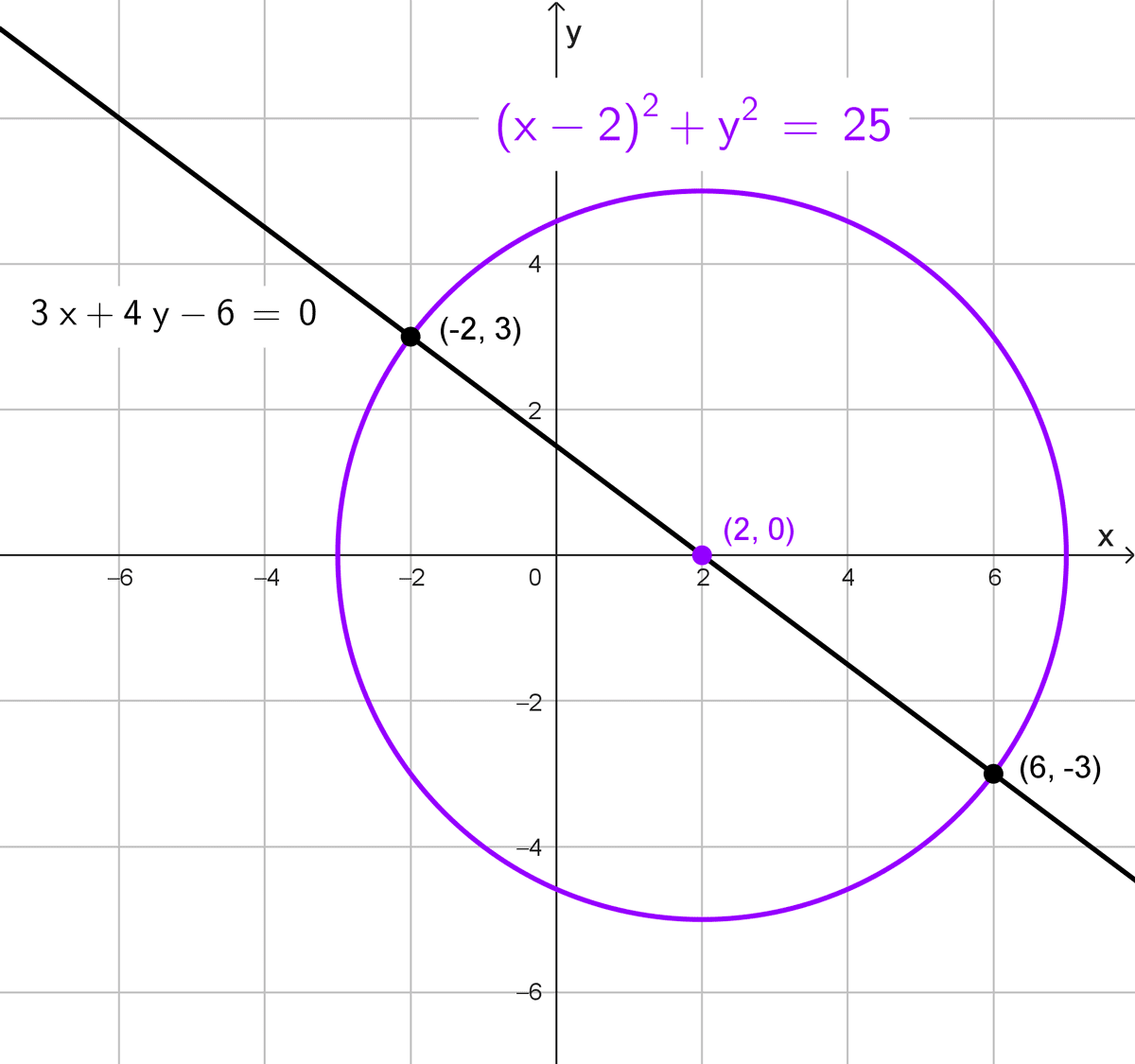
We analyze the circle \((x-2)^2+y^2=25\) and the line \(3x+4y-6=0.\) The system to solve is:
$$\begin{cases} (x-2)^2+y^2=25 \\ 3x+4y-6=0 \end{cases}$$
First, we solve for \(y\) from the equation of the line to substitute into the circle:
$$y=\dfrac{6-3x}{4}$$
Substituting into the equation of the circle:
$$(x-2)^2+\left(\dfrac{6-3x}{4}\right)^2=25$$
Expanding and simplifying:
$$(x^2-4x+4)+\dfrac{(36-36x+9x^2)}{16}=25$$
Multiplying the entire equation by 16 to clear denominators:
$$16x^2-64x+64+36-36x+9x^2=400$$
Grouping like terms:
$$25x^2-100x-300=0 \quad → \quad x^2-4x-12=0$$
We calculate the discriminant:
$$\Delta=(-4)^2-4(1)(-12)=16+48=64 > 0$$
Since \(\Delta>0\), the line is secant and intersects the circle at two points. We find the coordinates by solving for \(x\):
$$x=\dfrac{4 \pm \sqrt{64}}{2}=\dfrac{4 \pm 8}{2} \quad → \quad x=6~ \text{ or }~ x=-2$$
Substituting into the equation of the line to find \(y\):
For \(x=6\): \(y=\dfrac{6-18}{4}=-3\)
For \(x=-2\): \(y=\dfrac{6+6}{4}=3\)
Intersection points: \((6, -3)\) and \((-2, 3)\)
Solution 2
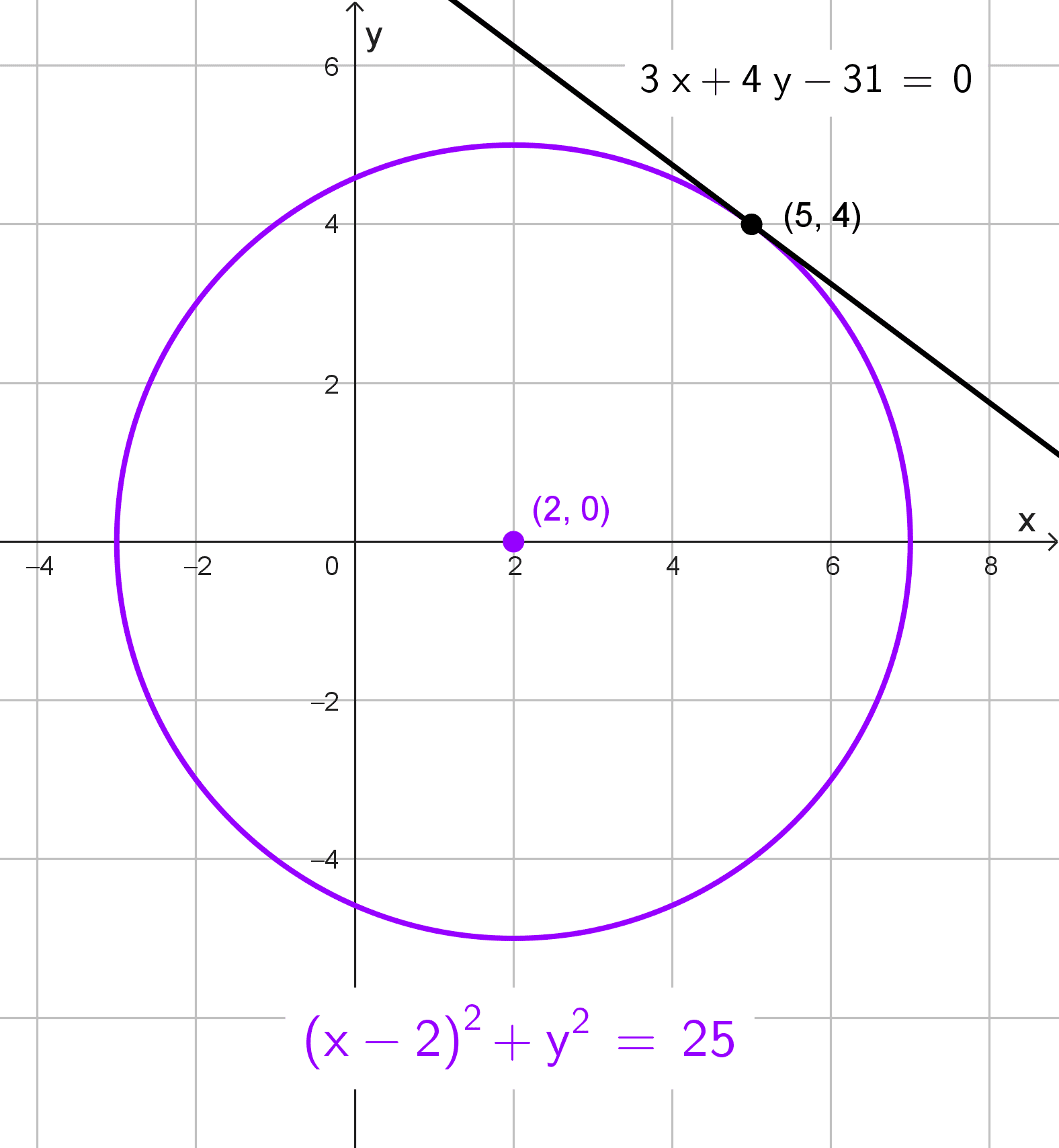
We analyze the circle \((x-2)^2+y^2=25\) and the line \(3x+4y-31=0.\) First, we set up the system of equations:
$$\begin{cases} (x-2)^2+y^2=25 \\ 3x+4y=31 \end{cases}$$
To solve it, we solve for \(y\) from the equation of the line:
$$y=\dfrac{31-3x}{4}$$
Substituting this expression into the equation of the circle:
$$(x-2)^2+\left(\dfrac{31-3x}{4}\right)^2=25$$
Expanding the squared terms:
$$x^2-4x+4+\dfrac{961-186x+9x^2}{16}=25$$
Multiplying the entire equation by 16 to clear denominators:
$$16x^2-64x+64+961-186x+9x^2=400$$
Grouping like terms:
$$25x^2-250x+1025=400$$
$$25x^2-250x+625=0$$
Simplifying by dividing by 25:
$$x^2-10x+25=0$$
We calculate the discriminant to determine the nature of the solutions:
$$\Delta=(-10)^2-4(1)(25)=100-100=0$$
Since the discriminant is zero, the line is tangent to the circle. Solving for \(x\):
$$x=\dfrac{10 \pm \sqrt{0}}{2}=5$$
Finally, we substitute \(x=5\) into the equation of the line to find \(y\):
$$y=\dfrac{31-3(5)}{4}=\dfrac{31-15}{4}=\dfrac{16}{4}=4$$
Point of tangency: \((5, 4)\).
Solution 3
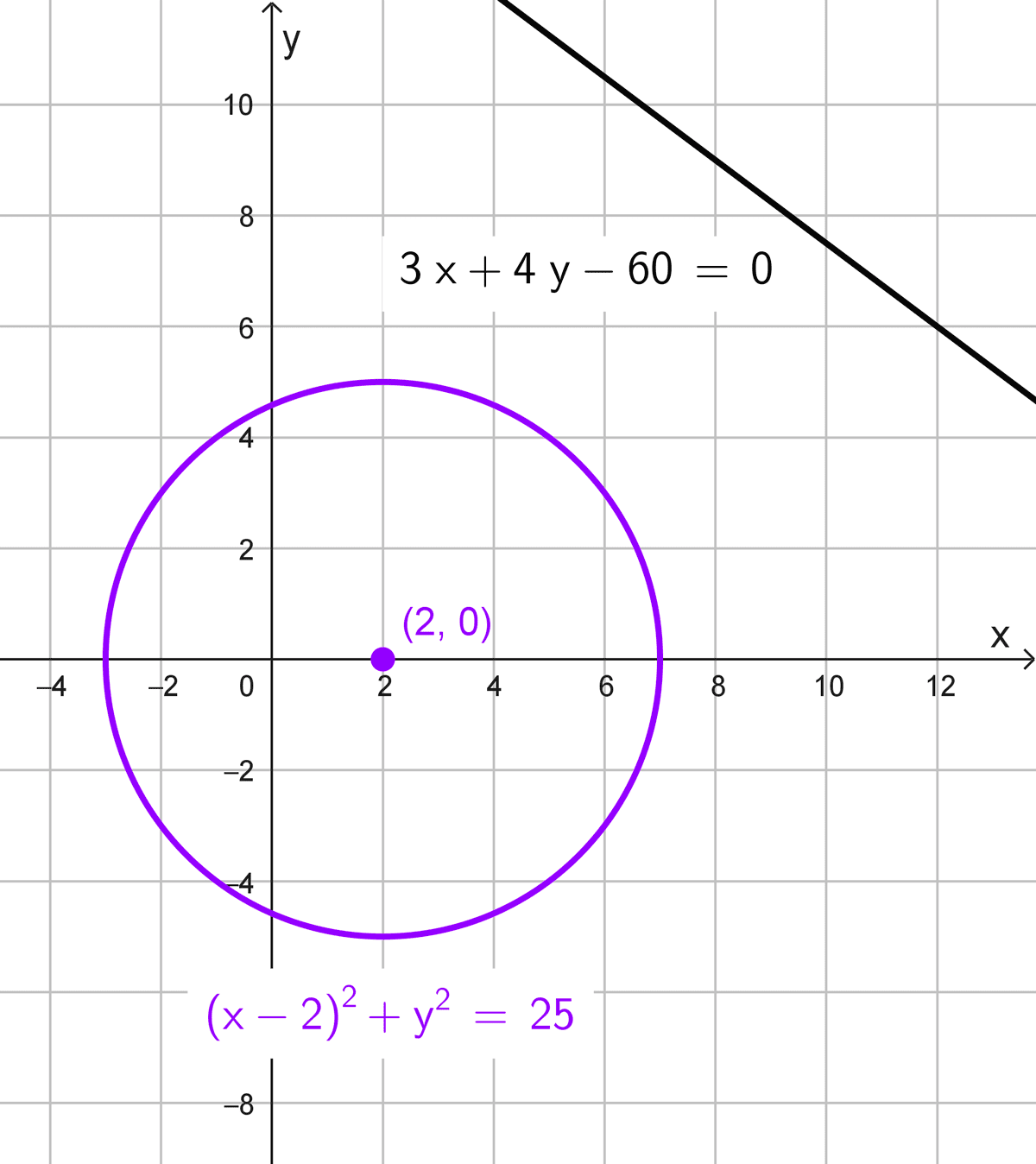
We now evaluate the line \(3x+4y-60=0.\) The system to solve is:
$$\begin{cases} (x-2)^2+y^2=25 \\ 3x+4y-60=0 \end{cases}$$
Solving for \(y\):
$$y=\dfrac{60-3x}{4}$$
Substituting into the equation of the circle:
$$(x-2)^2+\left(\dfrac{60-3x}{4}\right)^2=25$$
Expanding the squared terms:
$$(x^2-4x+4)+\dfrac{3600-360x+9x^2}{16}=25$$
Multiplying the entire equation by 16 to clear denominators:
$$16x^2-64x+64+3600-360x+9x^2=400$$
Grouping like terms:
$$25x^2-424x+3664=400 \quad → \quad 25x^2-424x+3264=0$$
The discriminant is:
$$\Delta=(-424)^2-4(25)(3264)=179776-326400=-146624 < 0$$
Since \(\Delta<0\), the line is exterior and there are no points of intersection.
Did you find this useful? Rate it!
0.0 / 5 — 0 votes

HOW TO CITE THIS ARTICLE
Machado, D. (2026, November 5). Relative Positions of a Line and a Circle. Exponty. https://exponty.com/en/circle-line-positions
Parts of a Circle
Equation of a Circle Through Three Points
Tangent Line to a Circle
Equations of Circles: Practice Problems with Solutions
Leave a Reply
Related posts