
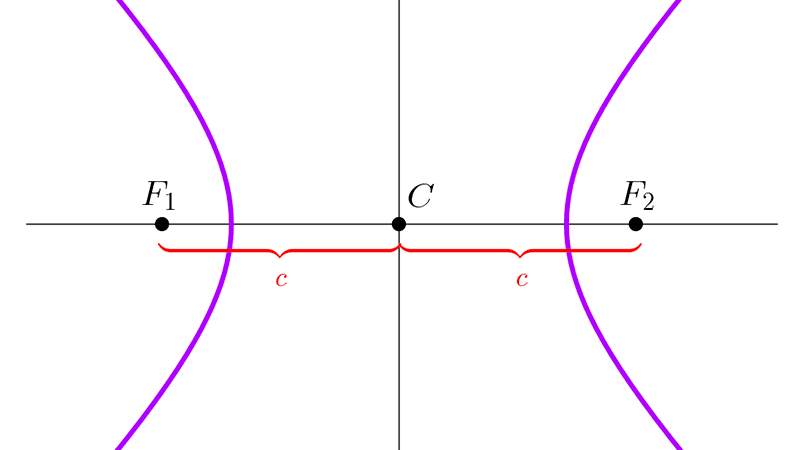
Asymptotes of a Hyperbola
The asymptotes of a hyperbola are straight lines that the branches of the curve approach as the variables increase in absolute value without ever intersecting them. Every hyperbola has two asymptotes that intersect at its center, serving as essential guides to graph the curve and understand its behavior toward infinity.

Below, we will explore the equations of the asymptotes, how to calculate them, and a geometric method to graph them. If you are not yet familiar with the geometric definition and properties of this conic section, we recommend reading our main guide first.
Table of Contents
Equations of the Asymptotes
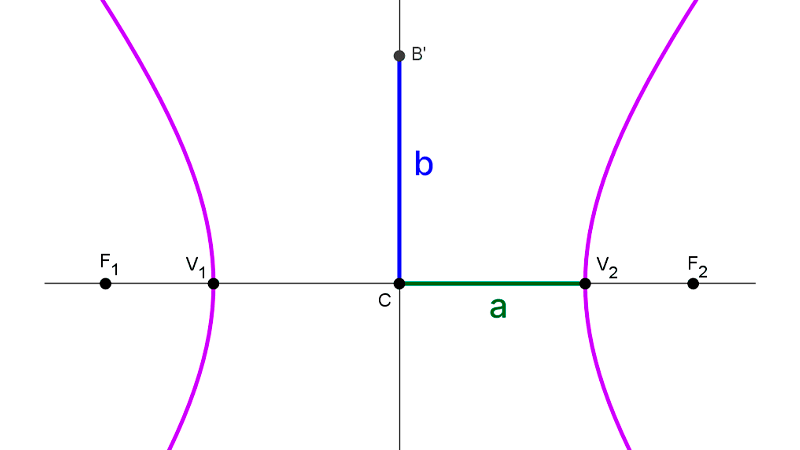
The equations describing the asymptotes of a hyperbola can be determined if the coordinates of the center and the lengths of the semi-transverse axis (a) and semi-conjugate axis (b) are known.
Hyperbolas Centered at (0, 0)
When the center is located at the origin, the equations of the asymptotes depend on whether the transverse axis is horizontal or vertical:
Horizontal hyperbola: \(y=\dfrac{b}{a}x\quad \text{and}\quad y=-\dfrac{b}{a}x\)
Vertical hyperbola: \(y=\dfrac{a}{b}x\quad \text{and}\quad y=-\dfrac{a}{b}x\)


Hyperbolas Centered at (h, k)
When the center is not at the origin, the equations of the asymptotes are obtained by replacing x and y with (x - h) and (y - k), expressing them in point-slope form:
Horizontal hyperbola: \(y-k=\dfrac{b}{a}(x-h)\quad \text{and}\quad y-k=-\dfrac{b}{a}(x-h)\)
Vertical hyperbola: \(y-k=\dfrac{a}{b}(x-h)\quad \text{and}\quad y-k=-\dfrac{a}{b}(x-h)\)


The equations are summarized in the following table:
| Standard Form | Transverse Axis | Center | Asymptotes |
|---|---|---|---|
| \(\dfrac{x^2}{a^2}-\dfrac{y^2}{b^2}=1\) | Along the x-axis | (0, 0) | y = ± (b / a) x |
| \(\dfrac{y^2}{a^2}-\dfrac{x^2}{b^2}=1\) | Along the y-axis | (0, 0) | y = ± (a / b) x |
| \(\dfrac{(x-h)^2}{a^2}-\dfrac{(y-k)^2}{b^2}=1\) | Parallel to the x-axis | (h, k) | y - k = ± (b / a) (x - h) |
| \(\dfrac{(y-k)^2}{a^2}-\dfrac{(x-h)^2}{b^2}=1\) | Parallel to the y-axis | (h, k) | y - k = ± (a / b) (x - h) |
Derivation
We begin by solving for "y" in the standard equation of a horizontal hyperbola centered at the origin:
$$\dfrac{x^2}{a^2}-\dfrac{y^2}{b^2}=1$$
$$\dfrac{y^2}{b^2}=\dfrac{x^2}{a^2}-1$$
$$y^2=b^2\left(\dfrac{x^2}{a^2}-1\right)$$
Assuming x ≠ 0, we factor out \(x^2/a^2\) on the right-hand side:
$$y^2=\dfrac{b^2x^2}{a^2}\left(1-\dfrac{a^2}{x^2}\right)$$
$$y=±\dfrac{bx}{a}\sqrt{1-\dfrac{a^2}{x^2}}$$
Now, as \(x → ∞\) or \(x → -∞\) (that is, as |x| becomes arbitrarily large), the term \(a^2/x^2\) approaches zero, which means the radical factor approaches 1. Consequently, as |x| grows, the value of y approaches \(±\dfrac{bx}{a};\) meaning the branches of the hyperbola approach the straight lines:
$$y=-\dfrac{b}{a}x\quad \text{and}\quad y=\dfrac{b}{a}x$$
These lines are the slant (oblique) asymptotes of the hyperbola. Although they are not part of the curve itself, they serve as boundary lines to sketch the graph accurately.
How to Find the Asymptotes
One way to find the asymptotes of a hyperbola is by using the formulas shown in the table above, for which the center and the values of a and b must be identified directly from the standard form equation.
Another approach consists of taking the standard equation, setting the constant term equal to zero, and solving for y. This directly yields the equations of the asymptotes.
For example, consider the equation of a horizontal hyperbola centered at the origin:
$$\dfrac{x^2}{a^2}-\dfrac{y^2}{b^2}=1$$
Replace the right side with zero:
$$\dfrac{x^2}{a^2}-\dfrac{y^2}{b^2}=0$$
Solve for y:
$$\dfrac{y^2}{b^2}=\dfrac{x^2}{a^2}$$
$$y^2=\dfrac{b^2x^2}{a^2}$$
Take the square root of both sides:
$$\sqrt{y^2}=\sqrt{\dfrac{b^2x^2}{a^2}}$$
$$y=±\dfrac{b}{a}x$$
This yields \(y=\dfrac{b}{a}x~~\) and \(~~y=-\dfrac{b}{a}x,\) which are the asymptote equations for the given hyperbola.
If the hyperbola is centered at (h, k), this method works identically. For instance, consider a vertical hyperbola centered at (h, k):
$$\dfrac{(y-k)^2}{a^2}-\dfrac{(x-h)^2}{b^2}=1$$
Replace the right side with zero and solve for (y - k):
$$\dfrac{(y-k)^2}{a^2}-\dfrac{(x-h)^2}{b^2}=0$$
$$(y-k)^2=\dfrac{a^2(x-h)^2}{b^2}$$
$$y-k=±\dfrac{a}{b}(x-h)$$
Alternatively, replace the constant term with zero and factor the expression as a difference of squares:
$$\dfrac{x^2}{a^2}-\dfrac{y^2}{b^2}=0$$
$$\left(\dfrac{x}{a}+\dfrac{y}{b}\right)\left(\dfrac{x}{a}-\dfrac{y}{b}\right)=0$$
By the zero-product property of real numbers, this is equivalent to solving:
$$\dfrac{x}{a}+\dfrac{y}{b}=0\quad \text{or}\quad \dfrac{x}{a}-\dfrac{y}{b}=0$$
Solving for y in each equation gives:
$$y=\dfrac{b}{a}x\quad \text{and}\quad y=-\dfrac{b}{a}x$$
How to Graph the Asymptotes
Once the equations of the asymptotes are obtained, any standard linear graphing method can be used to plot them on the coordinate plane. However, there is a much simpler geometric approach using a reference box.
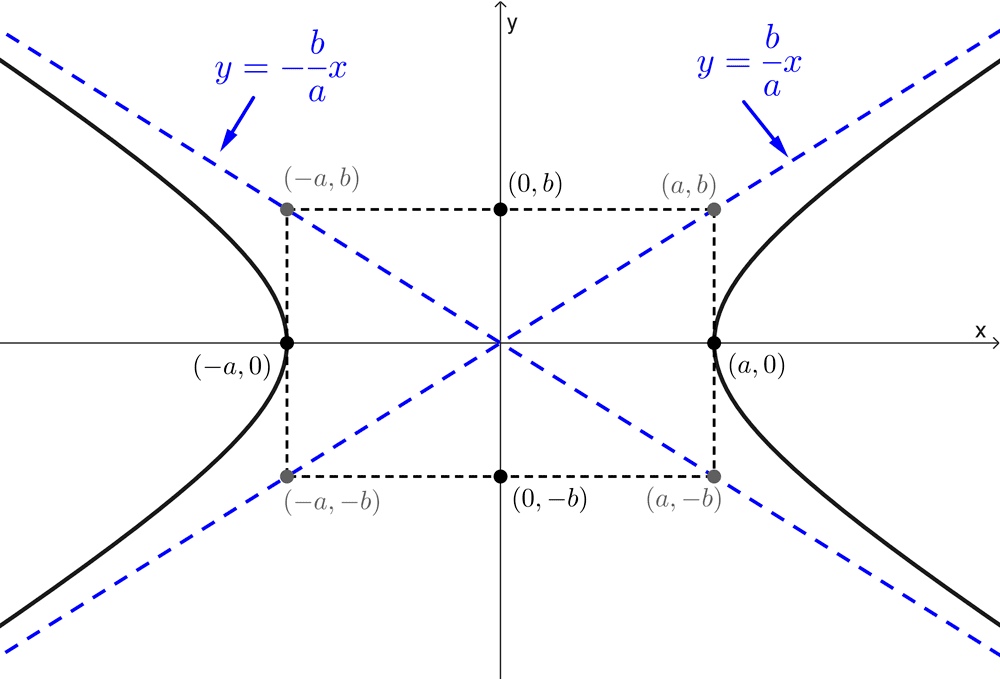
Consider a horizontal hyperbola centered at the origin. Using the semi-axes a and b, plot the vertices V(a, 0) and V’(-a, 0), which are the endpoints of the transverse axis, and the conjugate endpoints B(0, b) and B’(0, -b). Although points B and B’ do not lie on the hyperbola, they define a rectangle along with the vertices, known as the central rectangle (or reference rectangle).
The diagonals of this central rectangle have slopes b/a and -b/a, which match the slopes of the asymptotes. Extending these diagonals across the plane produces the asymptotes y = ±(b / a) x. Once these guidelines are drawn, the branches of the hyperbola can be sketched smoothly approaching them. This method works identically when the hyperbola is centered at (h, k) and when the transverse axis is vertical.
The following figures show the central rectangle and the asymptotes for both orientations:

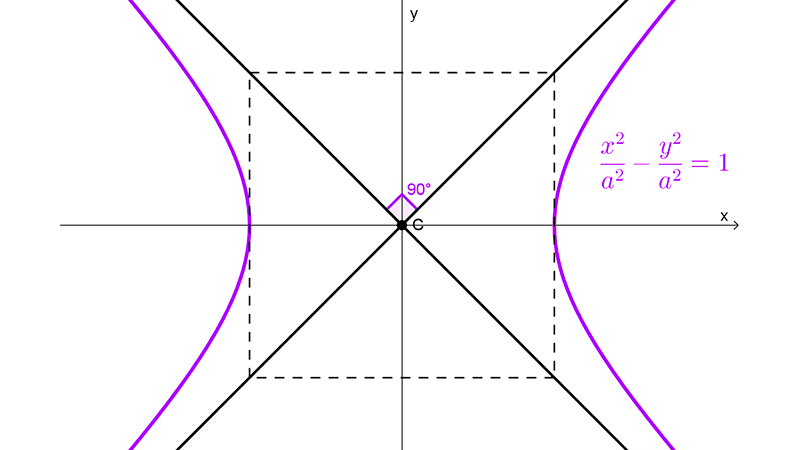
In the case of a rectangular (equilateral) hyperbola, where the transverse and conjugate axes have equal lengths (a = b), the central rectangle is a square, which makes the asymptotes perpendicular to each other.
Worked Examples
Example 1
Find the asymptotes of the hyperbola \(\dfrac{x^2}{4}-\dfrac{y^2}{9}=1\)
Solution: We identify this as a horizontal hyperbola because the positive term contains x2. In addition, the center is at the origin (0, 0).
From the standard formulas, the asymptotes are given by \(y=±\dfrac{b}{a}x,\) where a and b are the lengths of the semi-transverse and semi-conjugate axes, respectively. Extracting these values from the denominators:
$$a^2=4→a=\sqrt{4}=2$$
$$b^2=9→b=\sqrt{9}=3$$
Substituting into the asymptote formula:
$$y=±\dfrac{3}{2}x$$
Therefore, the asymptotes of the hyperbola are:
$$y=\dfrac{3}{2}x\quad \text{and}\quad y=-\dfrac{3}{2}x$$

Example 2
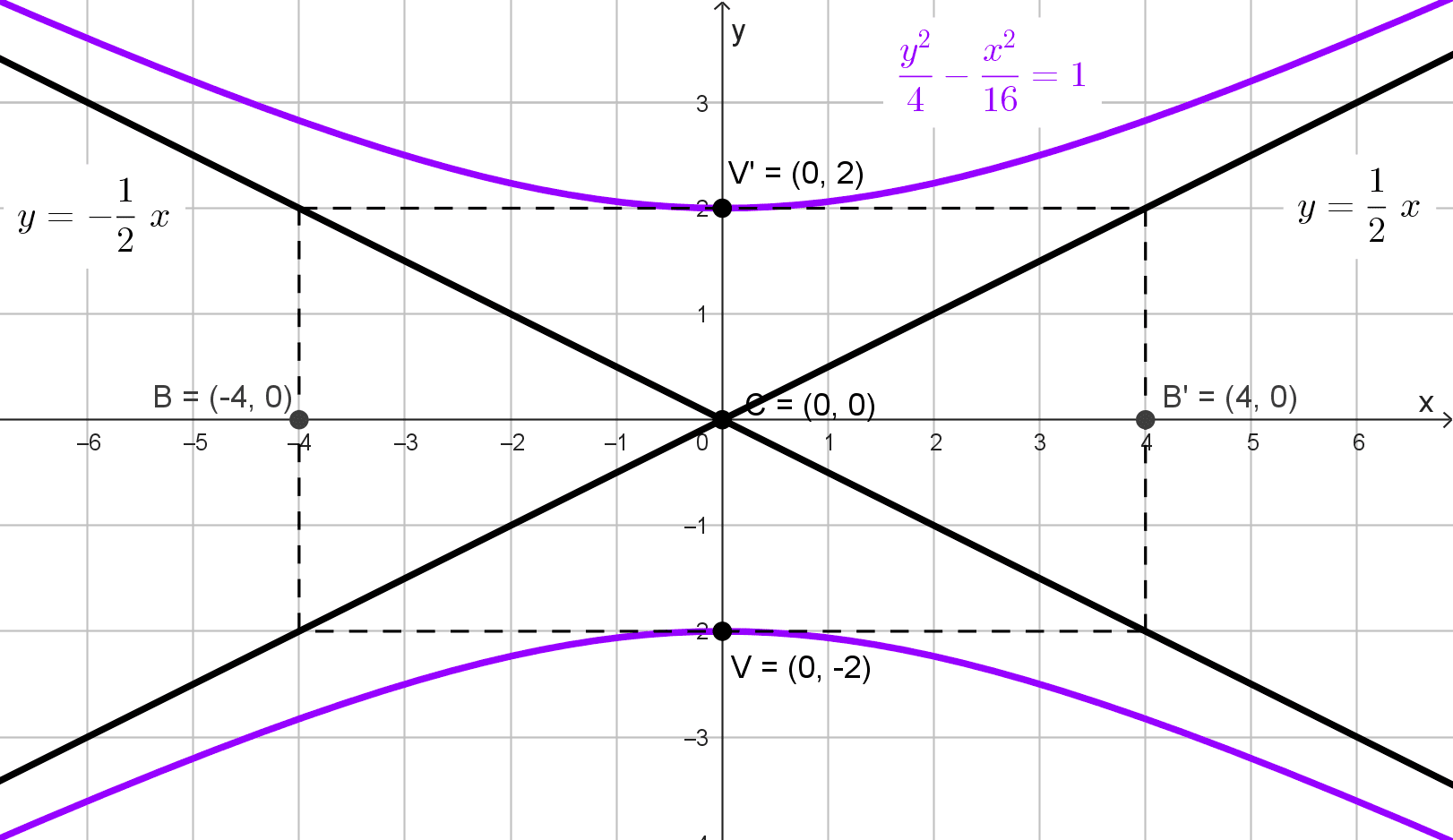
Find the equations of the asymptotes of the hyperbola \(\dfrac{y^2}{4}-\dfrac{x^2}{16}=1\)
Solution: We identify this as a vertical hyperbola because the positive term contains y2. The center is located at the origin (0, 0).
For a vertical hyperbola centered at the origin, the asymptote formula is:
$$y=\pm \dfrac{a}{b}x$$
where a and b are the lengths of the semi-transverse and semi-conjugate axes, respectively. Identifying them from the denominators:
$$a^2=4 → a=\sqrt{4}=2$$
$$b^2=16 → b=\sqrt{16}=4$$
Substituting these values into the formula:
$$y=\pm \dfrac{2}{4}x → y=\pm \dfrac{1}{2}x$$
Therefore, the asymptotes of the hyperbola are:
$$y=\dfrac{1}{2}x\quad \text{and}\quad y=-\dfrac{1}{2}x$$
Example 3
Determine the asymptotes of the hyperbola \(x^2-2y^2=2\)
Solution: The equation is not in standard form. Dividing both sides by 2 yields:
$$\dfrac{x^2}{2}-y^2=1$$
We can solve this algebraically without memorizing the formula. First, set the constant term equal to zero:
$$\dfrac{x^2}{2}-y^2=0$$
Isolate y2:
$$y^2=\dfrac{x^2}{2}$$
Take the square root of both sides:
$$\sqrt{y^2}=\sqrt{\dfrac{x^2}{2}}$$
$$y=\pm \dfrac{\sqrt{x^2}}{\sqrt{2}}$$
Simplify:
$$y=\pm \dfrac{1}{\sqrt{2}}x$$
Rationalize the denominator:
$$y=\pm \dfrac{\sqrt{2}}{2}x$$
Therefore, the equations of the asymptotes are:
$$y=\dfrac{\sqrt{2}}{2}x\quad \text{and}\quad y=-\dfrac{\sqrt{2}}{2}x$$
In this case, it was not necessary to classify the hyperbola as horizontal or vertical beforehand, since this algebraic method works universally.

Example 4
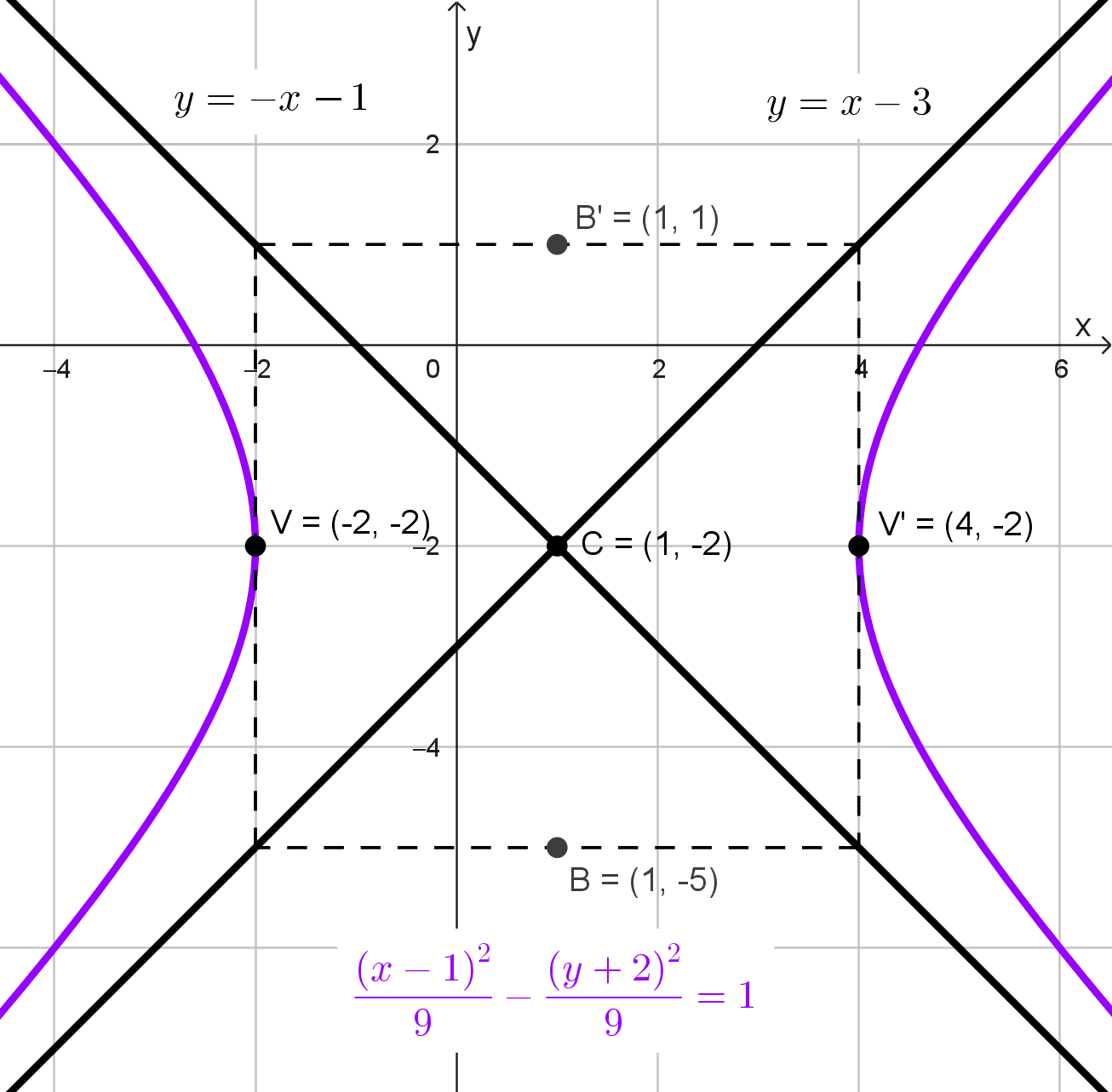
Find the asymptotes of the hyperbola \(\dfrac{(x-1)^2}{9}-\dfrac{(y+2)^2}{9}=1\)
Solution: First, identify the key geometric elements. The positive term contains \((x-1)^2,\) indicating a horizontal hyperbola. The center is (h, k) = (1, -2).
From the general formula for horizontal hyperbolas:
$$y-k=\pm \dfrac{b}{a}(x-h)$$
we find a and b by taking the square roots of the denominators:
$$a^2=9 → a=\sqrt{9}=3$$
$$b^2=9 → b=\sqrt{9}=3$$
Substituting a, b, h, and k into point-slope form:
$$y-(-2)=\pm \dfrac{3}{3}(x-1)$$
Simplify:
$$y+2=\pm (x-1)$$
Now, solve for y to express the equations in slope-intercept form:
For the positive slope (+):
$$y+2=x-1 → y=x-3$$
For the negative slope (-):
$$y+2=-(x-1) → y=-x+1-2 → y = -x-1$$
In conclusion, the asymptotes of the hyperbola are:
$$y=x-3\quad \text{and}\quad y=-x-1$$
Notice that the semi-axes have equal lengths (a = b = 3), making this a rectangular hyperbola. Consequently, the slopes are ±1, the asymptotes intersect at 90°, and the central rectangle is a square.
Example 5
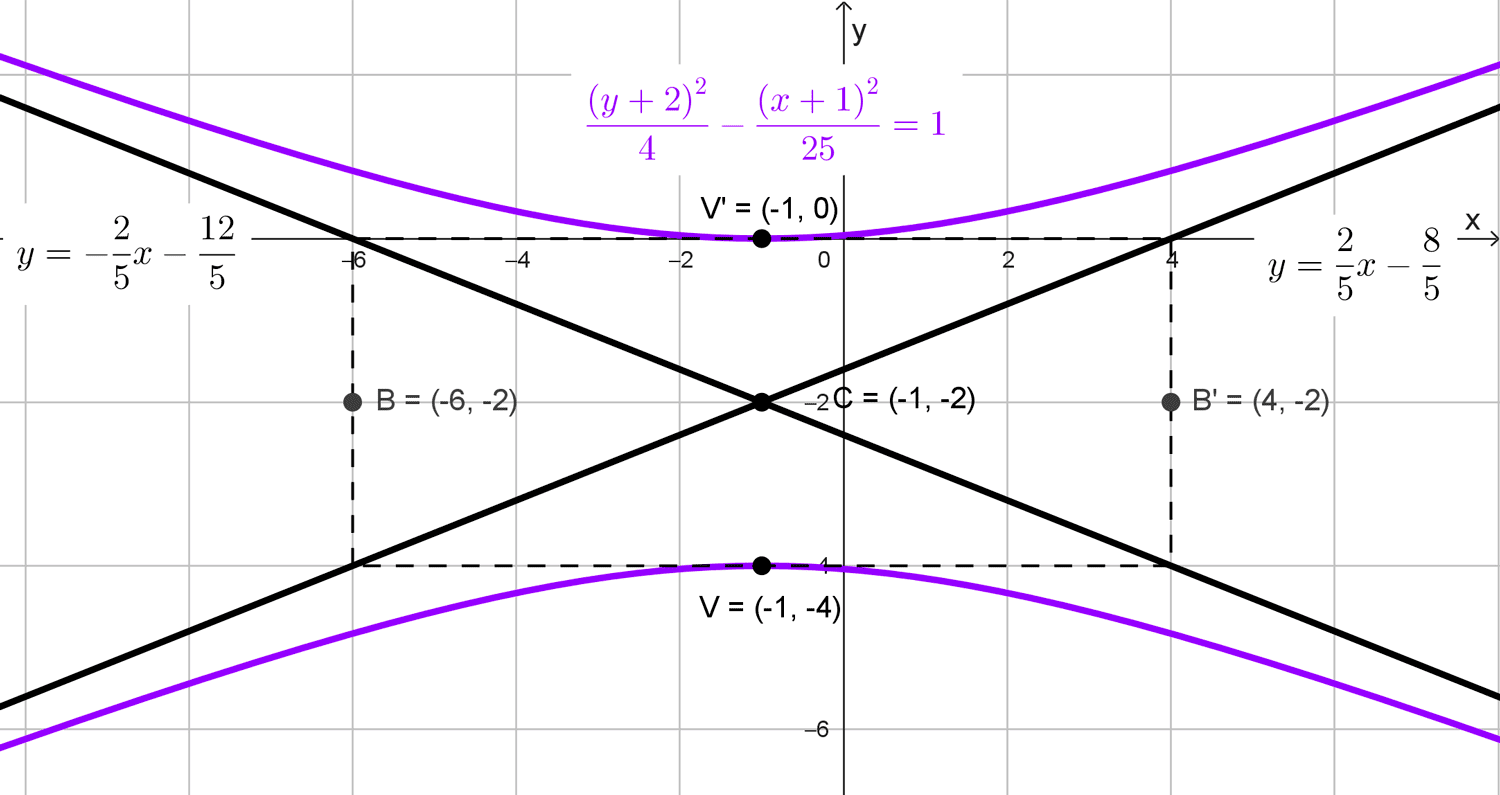
Find the asymptotes of the hyperbola \(\dfrac{(y+2)^2}{4}-\dfrac{(x+1)^2}{25}=1\)
Solution: The positive term contains \((y+2)^2,\) which indicates a vertical hyperbola. The center is (h, k) = (-1, -2).
Using the point-slope asymptote formula for vertical hyperbolas:
$$y-k=\pm \dfrac{a}{b}(x-h)$$
we determine the values of a and b from the denominators:
$$a^2=4 → a=\sqrt{4}=2$$
$$b^2=25 → b=\sqrt{25}=5$$
Substituting a, b, h, and k into the formula:
$$y-(-2)=\pm \dfrac{2}{5}(x-(-1))$$
Simplify into point-slope form:
$$y+2=\pm \dfrac{2}{5}(x+1)$$
Solving for y to write the equations in slope-intercept form:
For the positive slope (+):
$$y+2=\dfrac{2}{5}(x+1) → y=\dfrac{2}{5}x+\dfrac{2}{5}-2 → y=\dfrac{2}{5}x-\dfrac{8}{5}$$
For the negative slope (-):
$$y+2=-\dfrac{2}{5}(x+1) → y=-\dfrac{2}{5}x-\dfrac{2}{5}-2 → y=-\dfrac{2}{5}x-\dfrac{12}{5}$$
In conclusion, the asymptotes of the hyperbola are:
$$y=\dfrac{2}{5}x-\dfrac{8}{5}\quad \text{and}\quad y=-\dfrac{2}{5}x-\dfrac{12}{5}$$
Example 6
Find the equations of the asymptotes of \(-7x^2+12y^2+28x+72y-4=0\)
Solution: The conic is given in general form. Completing the square produces the equivalent standard form:
$$\dfrac{(y+3)^2}{7}-\dfrac{(x-2)^2}{12}=1$$
We can determine the asymptotes directly by replacing the constant on the right side with zero:
$$\dfrac{(y+3)^2}{7}-\dfrac{(x-2)^2}{12}=0$$
Factoring as a difference of squares:
$$\left( \dfrac{y+3}{\sqrt{7}}+\dfrac{x-2}{\sqrt{12}} \right)\left( \dfrac{y+3}{\sqrt{7}}-\dfrac{x-2}{\sqrt{12}} \right)=0$$
By the zero-product property, this splits into two linear equations:
$$\dfrac{y+3}{\sqrt{7}}+\dfrac{x-2}{\sqrt{12}}=0\quad \text{or}\quad \dfrac{y+3}{\sqrt{7}}-\dfrac{x-2}{\sqrt{12}}=0$$
Simplifying and rationalizing the slope ratio:
$$\dfrac{\sqrt{7}}{\sqrt{12}}=\dfrac{\sqrt{7}}{2\sqrt{3}}=\dfrac{\sqrt{21}}{6}$$
Solving for y in each equation:
From \(\dfrac{y+3}{\sqrt{7}}+\dfrac{x-2}{\sqrt{12}}=0:\)
$$\dfrac{y+3}{\sqrt{7}}=-\dfrac{x-2}{\sqrt{12}}$$
$$y+3=-\dfrac{\sqrt{21}}{6}(x-2)$$
$$y=-\dfrac{\sqrt{21}}{6}x+\dfrac{\sqrt{21}}{3}-3$$
From \(\dfrac{y+3}{\sqrt{7}}-\dfrac{x-2}{\sqrt{12}}=0:\)
$$\dfrac{y+3}{\sqrt{7}}=\dfrac{x-2}{\sqrt{12}}$$
$$y+3=\dfrac{\sqrt{21}}{6}(x-2)$$
$$y=\dfrac{\sqrt{21}}{6}x-\dfrac{\sqrt{21}}{3}-3$$
In point-slope form, the equations are:
$$y+3=\pm\dfrac{\sqrt{21}}{6}(x-2)$$
In slope-intercept form, the asymptotes are:
$$y=\dfrac{\sqrt{21}}{6}x-\dfrac{\sqrt{21}}{3}-3\quad \text{and}\quad y=-\dfrac{\sqrt{21}}{6}x+\dfrac{\sqrt{21}}{3}-3$$

Did you find this useful? Rate it!
0.0 / 5 — 0 votes

HOW TO CITE THIS ARTICLE
Machado, D. (2026, November 1). Asymptotes of a Hyperbola. Exponty. https://exponty.com/en/hyperbola-asymptotes
Focal Distance of a Hyperbola
Center of a Hyperbola
Vertices of a Hyperbola
Horizontal and Vertical Hyperbolas
Rectangular Hyperbola
Transverse and Conjugate Axes of a Hyperbola
Foci of a Hyperbola
Hyperbola Practice Problems with Solutions
Leave a Reply
Related posts