
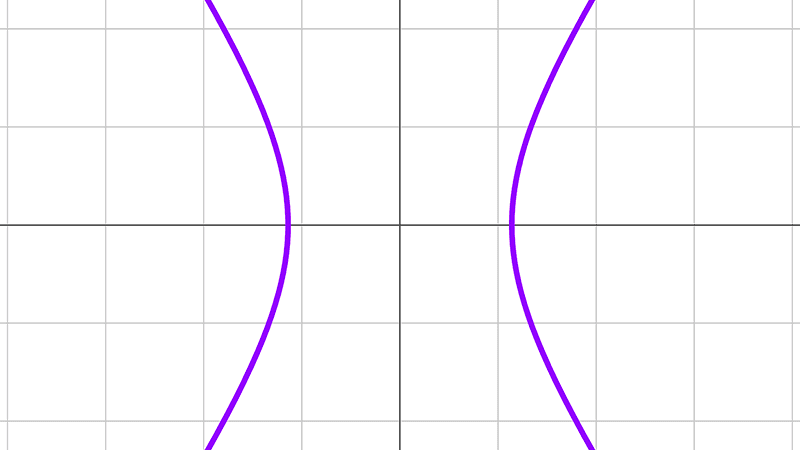
Hyperbola
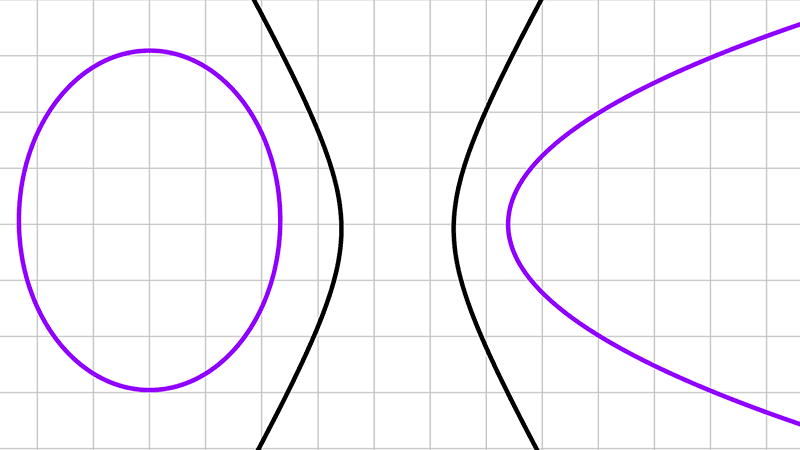
A hyperbola is an open plane curve consisting of two separate branches that extend indefinitely. It is defined as the geometric locus of all points in a plane such that the absolute difference of the distances to two fixed points, called foci, is constant.
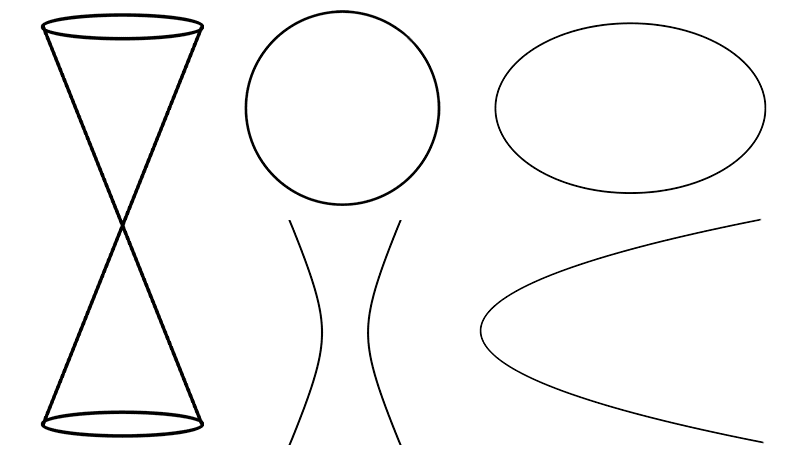
From the perspective of conic sections, a hyperbola is formed by intersecting a double right circular cone with a plane that cuts through both nappes without passing through the apex. The exact shape and curvature depend on the angle of inclination of the plane relative to the cone's central axis.
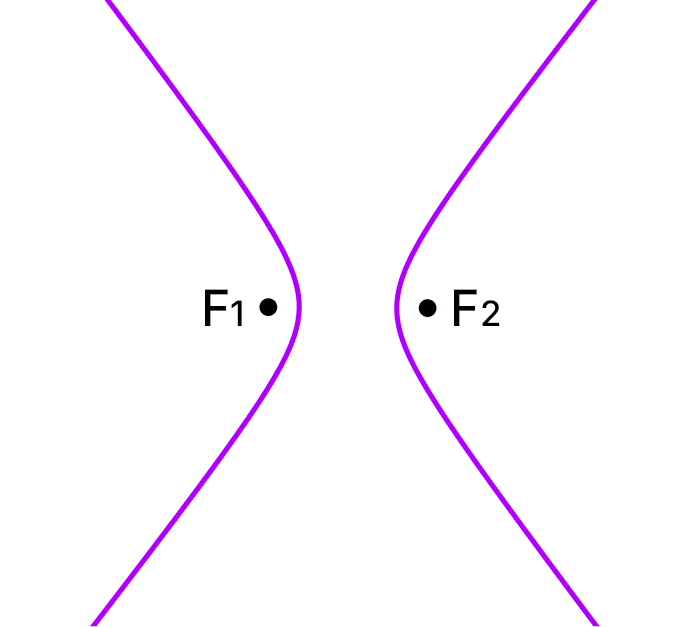
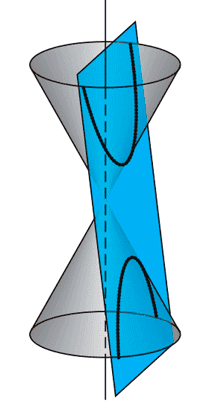
Below, we will explore key aspects of the hyperbola in mathematics: its primary parts and elements, equations, step-by-step examples, geometric properties, and real-world applications, among other topics.
Table of Contents
Parts of a Hyperbola
The primary elements of a hyperbola are:
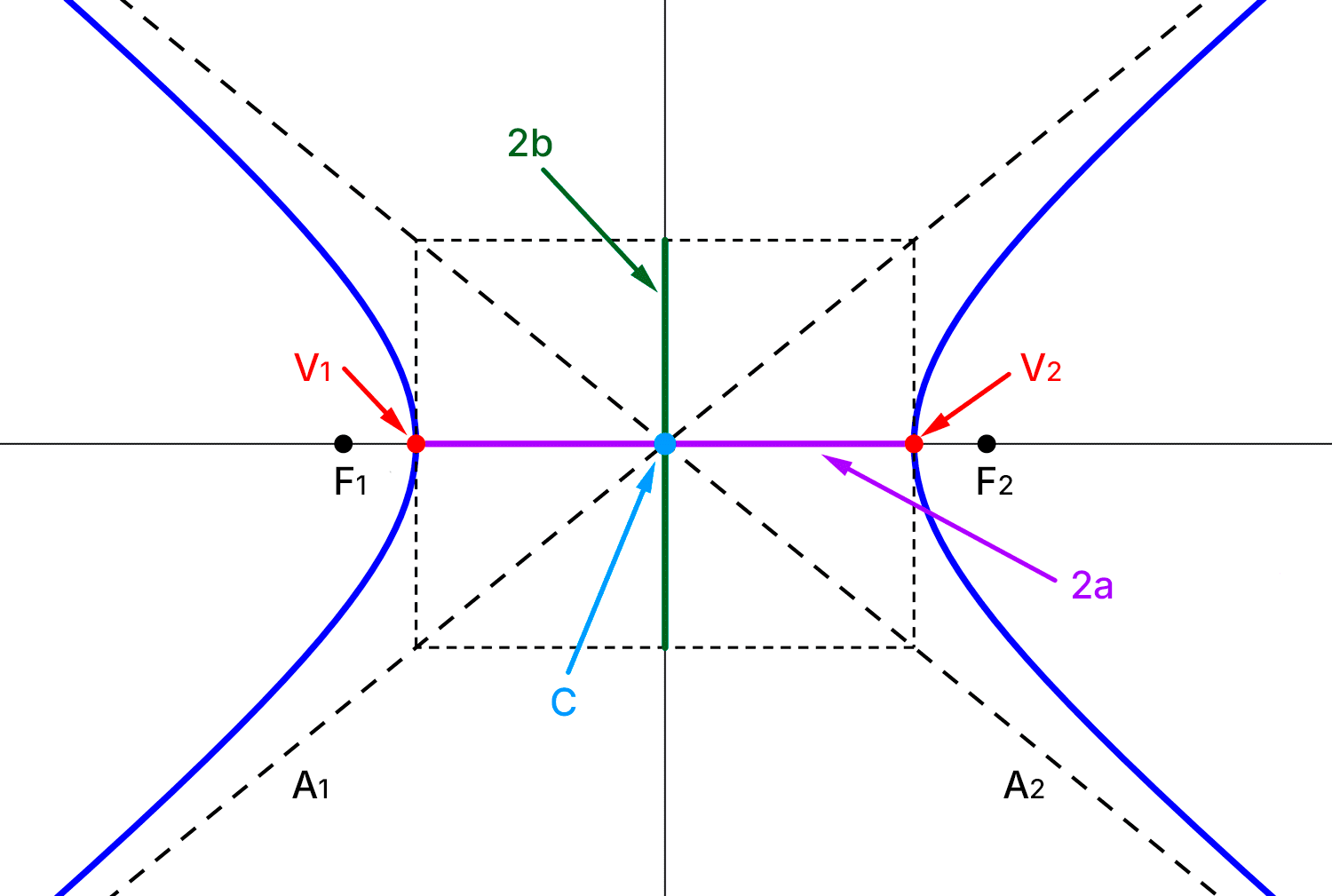
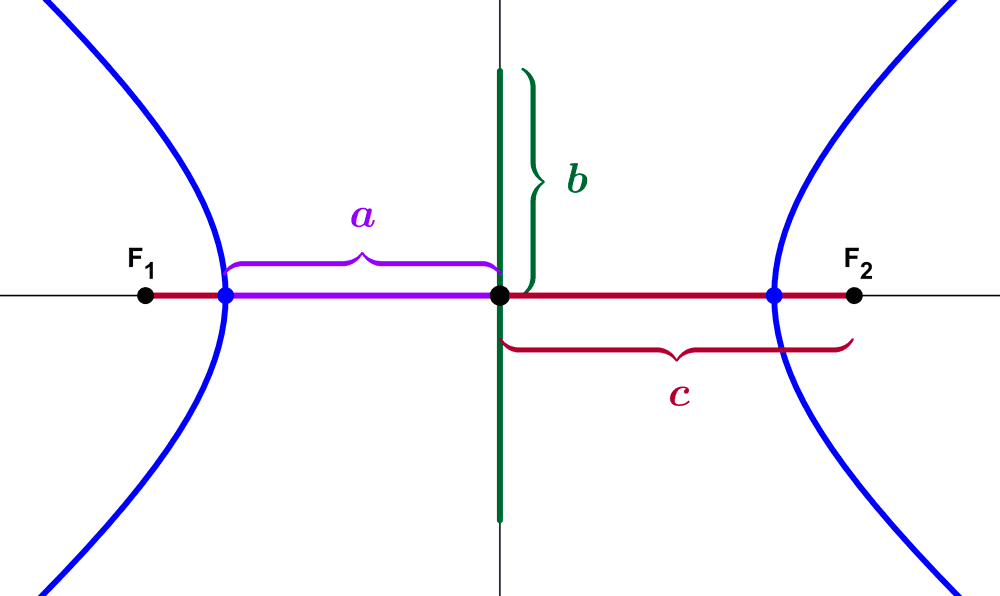
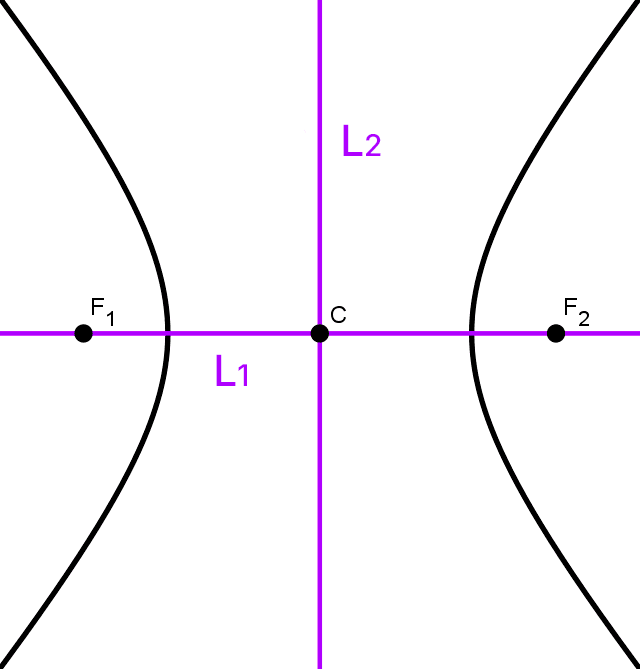
- Foci: Two fixed points in the plane. The straight line containing the foci is called the focal axis or transverse axis line.
- Center: The midpoint of the segment connecting the two foci. The line perpendicular to the focal axis passing through the center is called the conjugate axis line.
- Vertices: The two intersection points where the hyperbola crosses its focal axis.
- Transverse Axis: The line segment connecting the two vertices through the center. Its length is denoted by 2a, where a is the distance from the center to each vertex. Half of this segment is called the semi-transverse axis (a).
- Conjugate Axis: The line segment perpendicular to the transverse axis passing through the center, with a total length of 2b. Half of this segment is known as the semi-conjugate axis (b).
- Focal Distance (2c): The total distance between the two foci, denoted by 2c, where c represents the distance from the center to either focus (focal length). These values are linked by the fundamental relation c2 = a2 + b2. The distance between the foci is always strictly greater than the distance between the vertices (2c > 2a, meaning c > a).
- Asymptotes: Two intersecting straight lines that the branches of the hyperbola approach as they extend toward infinity without ever touching or intersecting them. Their equations are derived directly from the hyperbola's parameters.
- Eccentricity: The ratio of the focal length to the semi-transverse axis: e = c / a. For every hyperbola, the eccentricity is strictly greater than one (e > 1).
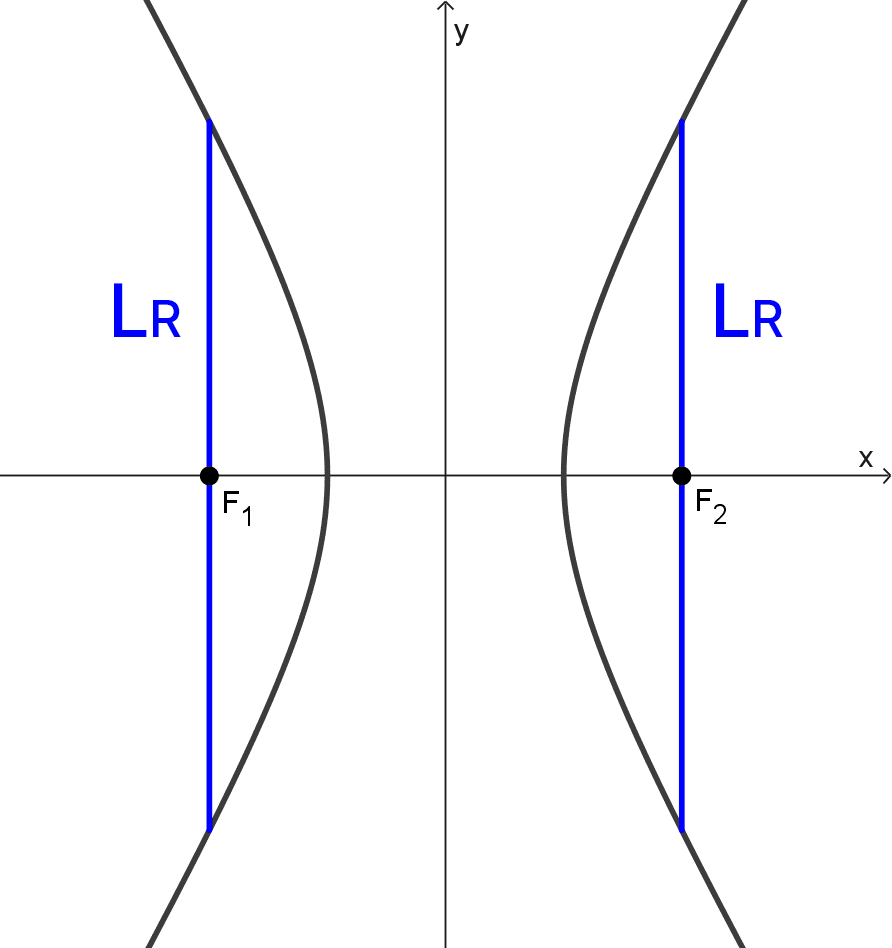
- Latus Rectum (LR): A line segment perpendicular to the transverse axis that passes through a focus with endpoints on the hyperbola. Every hyperbola has two latera recta, each with a length of LR = 2b2 / a.
Standard Form Equation
The standard form equation of a hyperbola in Cartesian coordinates depends on whether the transverse axis is horizontal or vertical, and whether the center lies at the origin or at a translated point.
1) When the center is at the origin (0, 0):
- Horizontal hyperbola: \(\dfrac{x^2}{a^2}-\dfrac{y^2}{b^2}=1\)
- Vertical hyperbola: \(\dfrac{y^2}{a^2}-\dfrac{x^2}{b^2}=1\)
2) When the center is at an arbitrary point (h, k):
- Horizontal hyperbola: \(\dfrac{(x-h)^2}{a^2}-\dfrac{(y-k)^2}{b^2}=1\)
- Vertical hyperbola: \(\dfrac{(y-k)^2}{a^2}-\dfrac{(x-h)^2}{b^2}=1\)
In all four cases, a denotes the length of the semi-transverse axis, and b represents the length of the semi-conjugate axis. Unlike an ellipse, a hyperbola does not require a > b; the value of b can be smaller than, equal to, or greater than a, directly influencing how widely the branches open. Full derivations of these equations are provided later in this article.
Examples
Below are several worked examples of hyperbolas in standard form:
- \(\dfrac{x^2}{4}-\dfrac{y^2}{9}=1\) is a horizontal hyperbola centered at the origin that opens to the left and right. Its semi-transverse axis is \(a=\sqrt{4}=2\) and its semi-conjugate axis is \(b=\sqrt{9}=3.\)
- \(\dfrac{y^2}{4}-\dfrac{x^2}{16}=1\) is a vertical hyperbola centered at (0, 0) opening upward and downward. Its semi-transverse axis is \(a=\sqrt{4}=2\) and its semi-conjugate axis is \(b=\sqrt{16}=4.\)
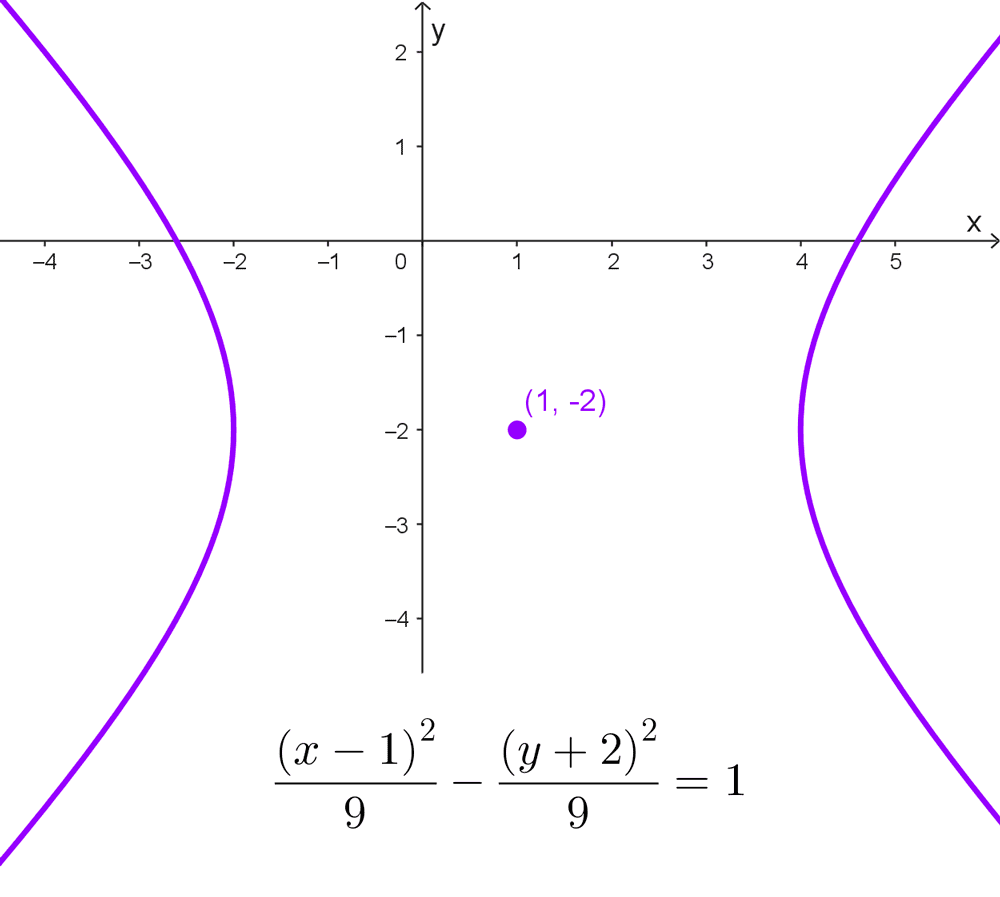
- \(\dfrac{(x-1)^2}{9}-\dfrac{(y+2)^2}{9}=1\) is a horizontal hyperbola centered at (1, -2). Because the semi-axes are equal \((a=b=\sqrt{9}=3),\) it is known as an equilateral or rectangular hyperbola.
- \(\dfrac{(y+2)^2}{4}-\dfrac{(x+1)^2}{25}=1\) is a vertical hyperbola centered at (-1, -2), with semi-axes \(a=\sqrt{4}=2\) and \(b=\sqrt{25}=5.\)

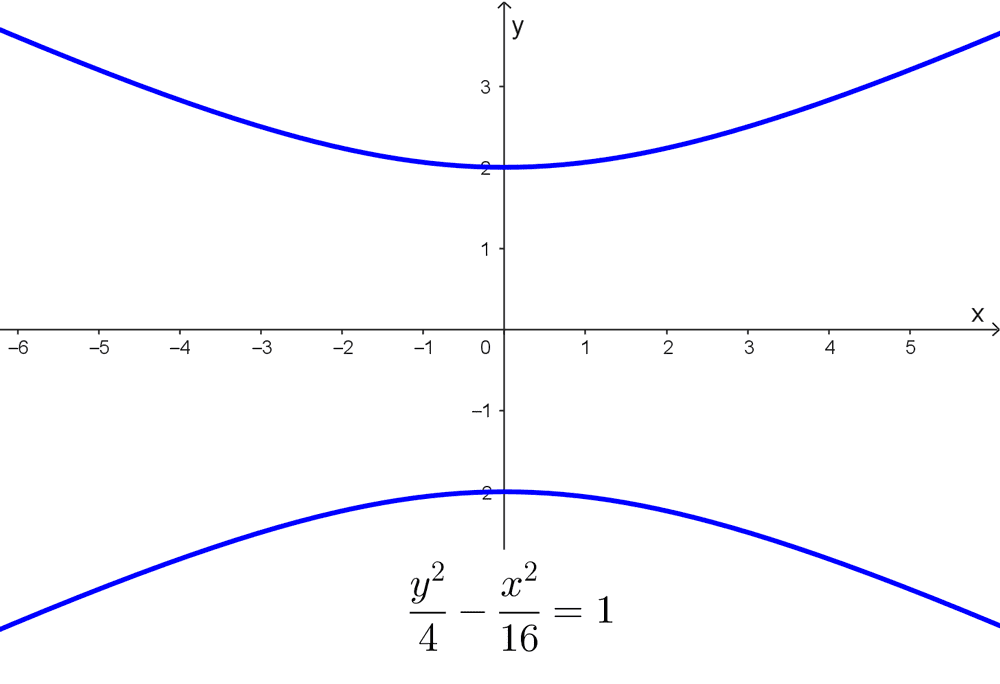
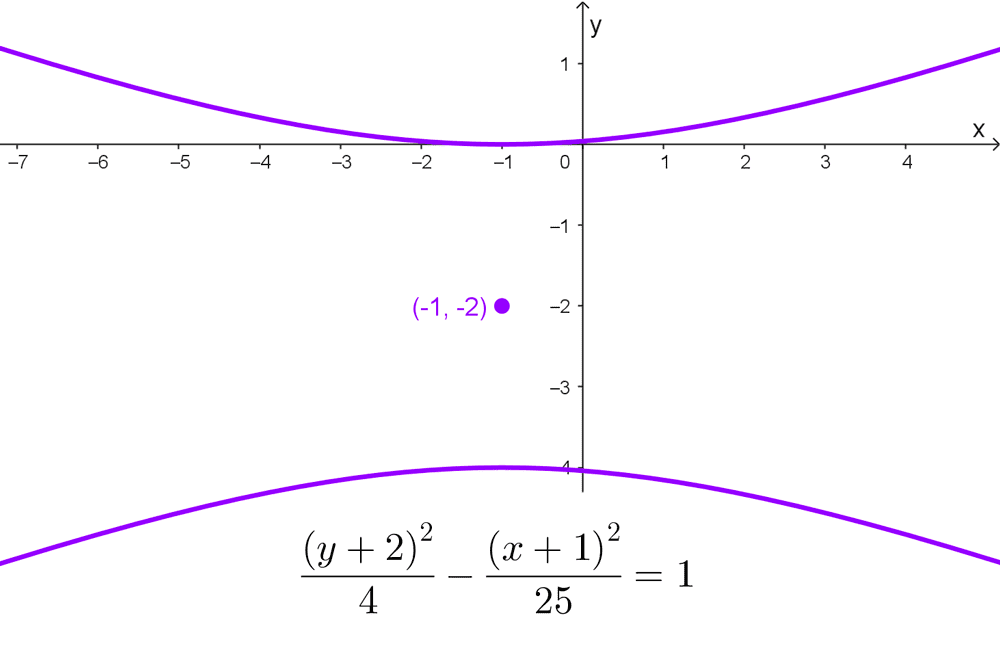
To identify the orientation of the transverse axis, locate the positive squared term in standard form. If the positive term contains x, the hyperbola is horizontal. If the positive term contains y, the hyperbola is vertical.
All core elements (foci, center, vertices, axes, asymptotes, eccentricity, and latus rectum) can be determined directly from the standard form equation. For step-by-step guidance, visit our practice problem set:
General Form Equation
The general equation of a hyperbola is Ax2 + Cy2 + Dx + Ey + F = 0, where the coefficients A and C have opposite signs (A ⋅ C < 0), and the axes of the hyperbola are parallel to the Cartesian coordinate axes. If the hyperbola is rotated relative to the coordinate axes, a cross-product term appears: Ax2 + Bxy + Cy2 + Dx + Ey + F = 0, where the discriminant satisfies B2 - 4AC > 0.
Examples of hyperbolas in general form:
- \(9x^2-4y^2-36=0\)
- \(-4x^2+25y^2-8x+100y-4=0\)
- \(9x^2-4y^2-54x+117=0\)
- \(5x^2-2y^2-10x+8y-13=0\)
- \(-7x^2+12y^2+28x+72y-4=0\)
Properties of a Hyperbola
The hyperbola possesses several distinctive geometric characteristics:
- Fundamental Pythagorean Relation: The distance from the center to each focus (c), the distance from the center to each vertex (a), and the semi-conjugate axis length (b) satisfy the equation c2 = a2 + b2.
- Symmetry: A hyperbola is symmetric with respect to two perpendicular lines intersecting at its center: the focal axis (containing the vertices and foci) and the conjugate axis line. The geometric center serves as a point of central symmetry.
- Asymptotes: Two linear boundaries that pass through the center of the hyperbola. As the curve extends toward infinity, its branches approach these lines arbitrarily closely without ever intersecting them.
- Eccentricity: A measure of the curvature and flare of the branches. Its value is always strictly greater than 1 (e > 1). Larger values of eccentricity correspond to wider, flatter branches, while values closer to 1 produce narrower branches.
- Reflective Property: Similar to other conic sections, any light or acoustic ray directed toward one focus reflects off the hyperbolic surface directly toward or away from the other focus, making it a critical geometry in optical and acoustic reflector design.
Real-World Applications
The geometric properties of the hyperbola give rise to practical applications across science and engineering:
- Navigation Systems: Hyperbolic navigation systems, such as LORAN, determine positions by measuring the time difference of arrival between synchronized signals emitted from two fixed transmitter stations. Because constant time differences correspond to constant path-length differences, the receiver lies on a hyperbola whose foci are the transmitter locations.
- Acoustics and Optics: The reflective property of the hyperbola is utilized in designing Cassegrain reflecting telescopes and satellite relay antennas. A secondary hyperbolic mirror redirects light rays converging toward one focus directly into a detector or eyepiece placed at the second focus.
- Orbital Mechanics and Astronomy: Spacecraft performing gravity-assist flybys or celestial bodies traveling at escape velocity follow open hyperbolic trajectories relative to the central gravitational body.
- Signal Geolocation (TDOA): Modern radio localization techniques use Time Difference of Arrival (TDOA) algorithms. By computing arrival time deltas across multiple receiving antennas, hyperbolic curves are plotted to triangulate the exact coordinates of an unknown radio source.
- Thermal and Structural Engineering: Hyperbolic cooling towers and radiation panels provide high structural integrity with minimal material usage, while facilitating natural chimney-effect air circulation.
- Architecture: Auditoriums and concert halls occasionally implement hyperbolic acoustic panels to disperse sound evenly across wide seating areas without acoustic focusing or dead zones.
Summary of Equations
The table below summarizes the key formulas and equations for a hyperbola. Note that \(c=\sqrt{a^2+b^2}.\)
| Standard Equation | Transverse Axis | Center | Foci | Vertices | Asymptotes |
|---|---|---|---|---|---|
| \(\dfrac{x^2}{a^2}-\dfrac{y^2}{b^2}=1\) | Along x-axis | (0, 0) | (±c, 0) | (±a, 0) | y = ± (b / a) x |
| \(\dfrac{y^2}{a^2}-\dfrac{x^2}{b^2}=1\) | Along y-axis | (0, 0) | (0, ±c) | (0, ±a) | y = ± (a / b) x |
| \(\dfrac{(x-h)^2}{a^2}-\dfrac{(y-k)^2}{b^2}=1\) | Parallel to x-axis | (h, k) | (h ± c, k) | (h ± a, k) | y - k = ± (b / a) (x - h) |
| \(\dfrac{(y-k)^2}{a^2}-\dfrac{(x-h)^2}{b^2}=1\) | Parallel to y-axis | (h, k) | (h, k ± c) | (h, k ± a) | y - k = ± (a / b) (x - h) |
Equation Derivations
Below are step-by-step proofs of the primary equations for a hyperbola.
Derivation of the Standard Form Equation
To derive the standard equation, consider a horizontal hyperbola centered at the origin (0, 0) with its transverse axis aligned along the x-axis.
Let P(x, y) represent an arbitrary point on the hyperbola. The vertices are positioned at V1(-a, 0) and V2(a, 0), and the foci are located at F1(-c, 0) and F2(c, 0).
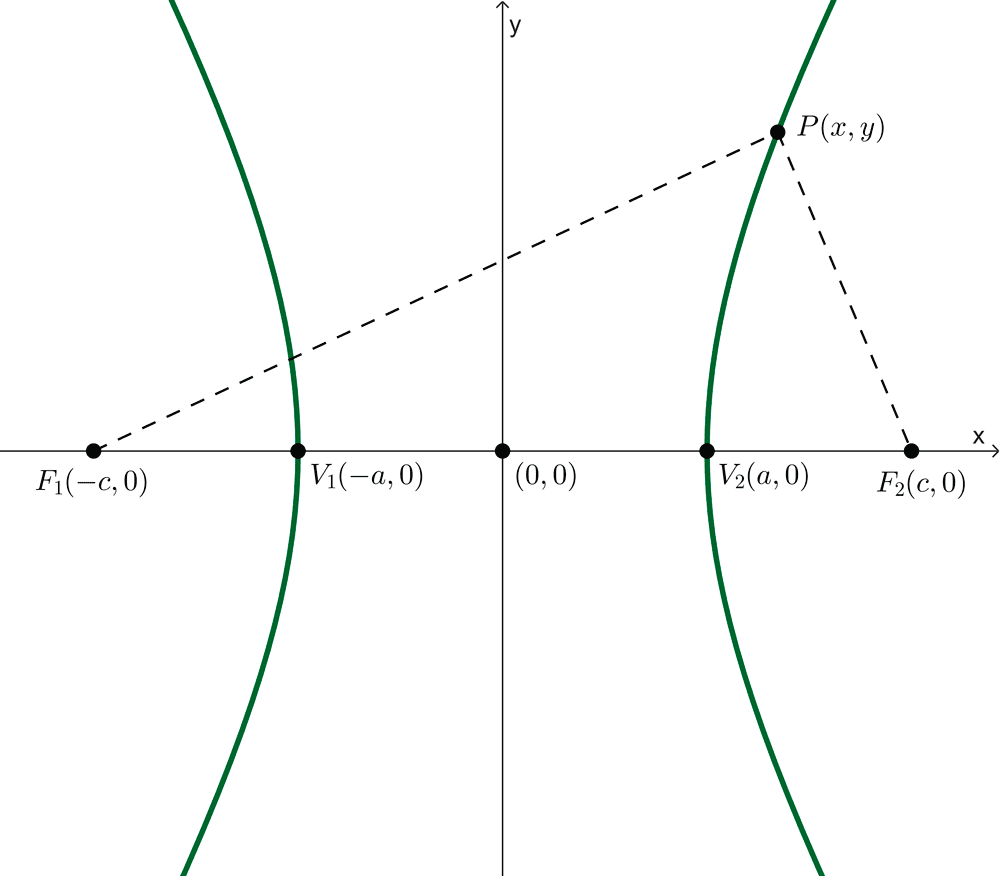
The definition of a hyperbola states that the absolute difference between the distances from any point P(x, y) to both foci F1 and F2 equals a constant:
\(|d(P,F_2)-d(P,F_1)|=k\)
To determine this constant, evaluate the distance difference at vertex V1(-a, 0):
The distance from V1(-a, 0) to focus F1(-c, 0) is: \(d(V_1,F_1)=|-a+c|=c-a\)
The distance from V1(-a, 0) to focus F2(c, 0) is: \(d(V_1,F_2)=|-a-c|=a+c\)
Calculating the absolute difference:
\(|d(V_1,F_2)-d(V_1,F_1)|=|(a+c)-(c-a)|=|a+c-c+a|=|2a|=2a\)
Therefore, the constant k equals 2a (the length of the transverse axis). Substituting this into the definition:
\(|d(P,F_2)-d(P,F_1)|=2a\)
Removing the absolute value bars gives:
\(d(F_1,P)-d(F_2,P)=±2a\)
Applying the distance formula:
\(\sqrt{(x+c)^2+y^2}-\sqrt{(x-c)^2+y^2}=±2a\)
Isolating the first radical:
\(\sqrt{(x+c)^2+y^2}=±2a+\sqrt{(x-c)^2+y^2}\)
Squaring both sides:
\((x+c)^2+y^2=4a^2± 4a\sqrt{(x-c)^2+y^2}+(x-c)^2+y^2\)
Expanding and grouping like terms:
\(x^2+2cx+c^2+y^2=4a^2± 4a\sqrt{(x-c)^2+y^2}+x^2-2cx+c^2+y^2\)
Simplifying to isolate the radical:
\(4cx-4a^2=\pm 4a\sqrt{(x-c)^2+y^2}\)
Dividing both sides by 4:
\(cx-a^2=\pm a\sqrt{(x-c)^2+y^2}\)
Squaring both sides once more:
\((cx-a^2)^2=a^2[(x-c)^2+y^2]\)
Expanding the algebraic expressions:
\(c^2x^2-2ca^2x+a^4=a^2(x^2-2cx+c^2+y^2)\)
Distributing and canceling \(2ca^2x\):
\(c^2x^2+a^4=a^2x^2+a^2c^2+a^2y^2\)
Rearranging the variable terms:
\((c^2-a^2)x^2-a^2y^2=a^2c^2-a^4\)
Factoring \(a^2\) on the right-hand side:
\((c^2-a^2)x^2-a^2y^2=a^2(c^2-a^2)\)
In every hyperbola, the focal distance strictly exceeds the distance between vertices:
\(2a<2c\)
\(a<c\)
Since \(a<c,\) it follows that \(a^2<c^2,\) ensuring that \(c^2-a^2>0.\) Defining \(b^2=c^2-a^2\) (with b > 0) gives:
\(b^2x^2-a^2y^2=a^2b^2\)
Dividing both sides by \(a^2b^2\):
\(\dfrac{x^2}{a^2}-\dfrac{y^2}{b^2}=1\)
This is the standard form equation of a horizontal hyperbola centered at the origin.
For a vertical hyperbola whose transverse axis lies along the y-axis, an analogous derivation yields the equation where the negative term is associated with x. When the center is translated to (h, k), applying translation formulas produces the corresponding shifted standard forms.
Derivation of the General Form Equation
To derive the general form, begin with the standard equation of a horizontal hyperbola centered at (h, k):
\(\dfrac{(x-h)^2}{a^2}-\dfrac{(y-k)^2}{b^2}=1\)
Multiply both sides by \(a^2b^2\) to clear denominators:
\(b^2(x-h)^2-a^2(y-k)^2=a^2b^2\)
Expanding the squared binomials:
\(b^2(x^2-2hx+h^2)-a^2(y^2-2ky+k^2)=a^2b^2\)
\(b^2x^2-2b^2hx+b^2h^2-a^2y^2+2a^2ky-a^2k^2=a^2b^2\)
Rearranging all terms onto the left side:
\(b^2x^2-a^2y^2-2b^2hx+2a^2ky+(b^2h^2-a^2k^2-a^2b^2)=0\)
This matches the general second-degree equation:
\(Ax^2+Cy^2+Dx+Ey+F=0\)
where:
- \(A=b^2\)
- \(C=-a^2\)
- \(D=-2b^2h\)
- \(E=2a^2k\)
- \(F=b^2h^2-a^2k^2-a^2b^2\)
For a vertical hyperbola with transverse axis parallel to the y-axis, the resulting coefficients are:
- \(A=-b^2\)
- \(C=a^2\)
- \(D=2b^2h\)
- \(E=-2a^2k\)
- \(F=a^2k^2-b^2h^2-a^2b^2\)
For any second-degree equation \(Ax^2+Cy^2+Dx+Ey+F=0\) to describe a hyperbola, the quadratic coefficients A and C must satisfy:
AC < 0
This condition guarantees that both quadratic terms are non-zero and possess opposite signs.
Additional Resources
Hyperbolas and Rational Functions
Hyperbolas also emerge as graphs of linear fractional transformations (rational functions), which have the general form:
\(f(x)=\dfrac{ax+b}{cx+d}\quad \text{where } ad-bc≠0\)
Plotting these functions produces rectangular hyperbolas whose transverse axes are rotated 45° relative to the coordinate axes, with vertical and horizontal asymptotes parallel to the Cartesian axes.
Consider the basic reciprocal function: \(y=\dfrac{k}{x}.\) Its graph is an equilateral hyperbola centered at the origin, with asymptotes along the lines x = 0 and y = 0 (the coordinate axes).
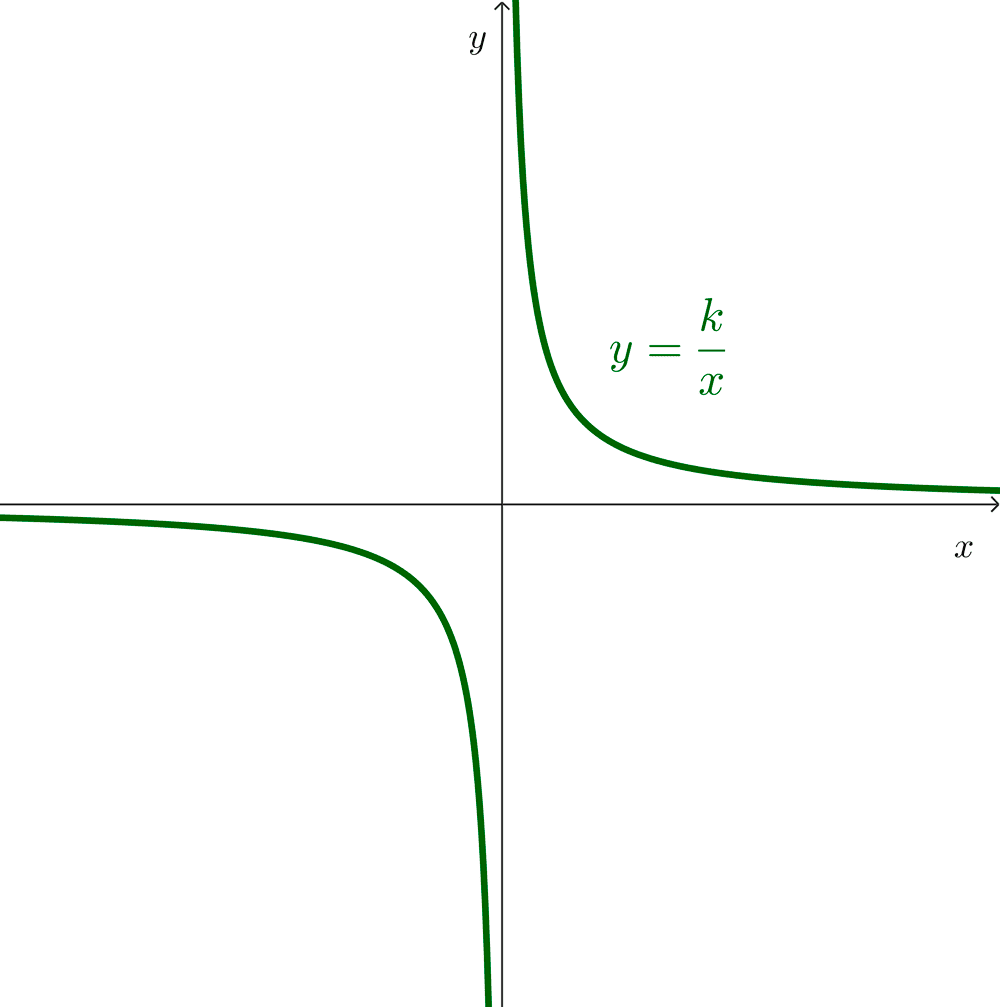
Not all hyperbolas represent functions of x. By the vertical line test, horizontal hyperbolas defined by \(\dfrac{x^2}{a^2}-\dfrac{y^2}{b^2}=1\) fail the function definition, as a single x-value can correspond to two distinct y-values.
Content on Hyperbolas
Did you find this useful? Rate it!
0.0 / 5 — 0 votes

HOW TO CITE THIS ARTICLE
Machado, D. (2026, October 27). Hyperbola. Exponty. https://exponty.com/en/hyperbola
Leave a Reply
Related posts