
Equations of Circles: Practice Problems with Solutions
In this article, we work through step-by-step circle practice problems with accompanying graphs. If you are not yet familiar with the core concepts, make sure to review our primary guide on foundational theory:
Table of Contents
Writing the standard equation of a circle from given conditions
Problem 1: Find the standard form equation of the circle that satisfies the given conditions in each case, and graph it.
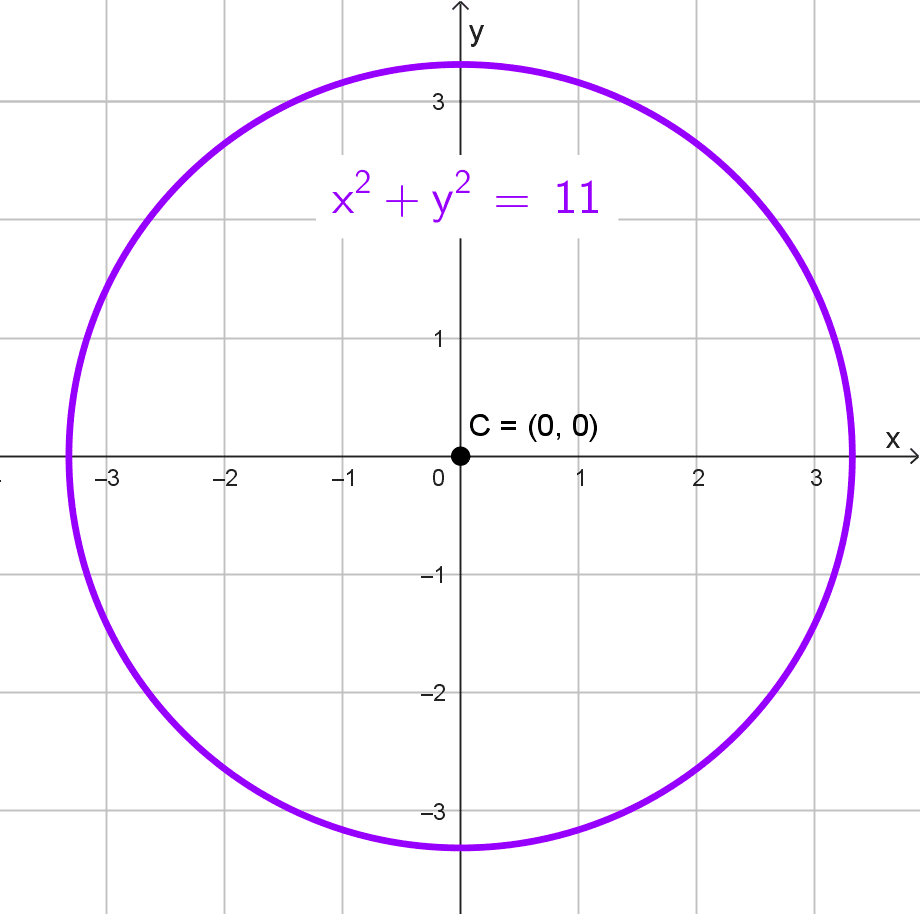
- Center at the origin and diameter 2√11.
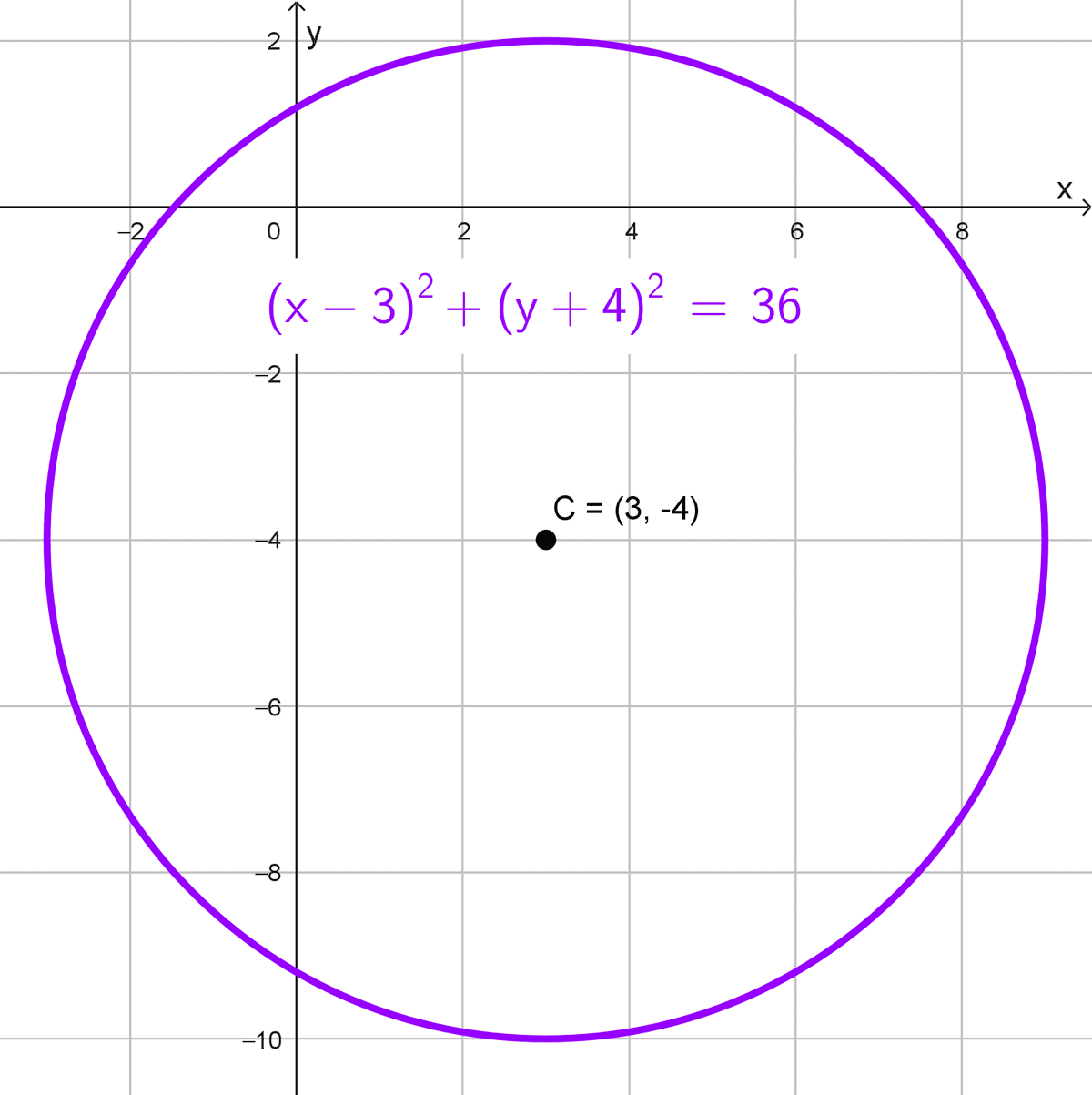
- Center at (3, -4), radius 6.
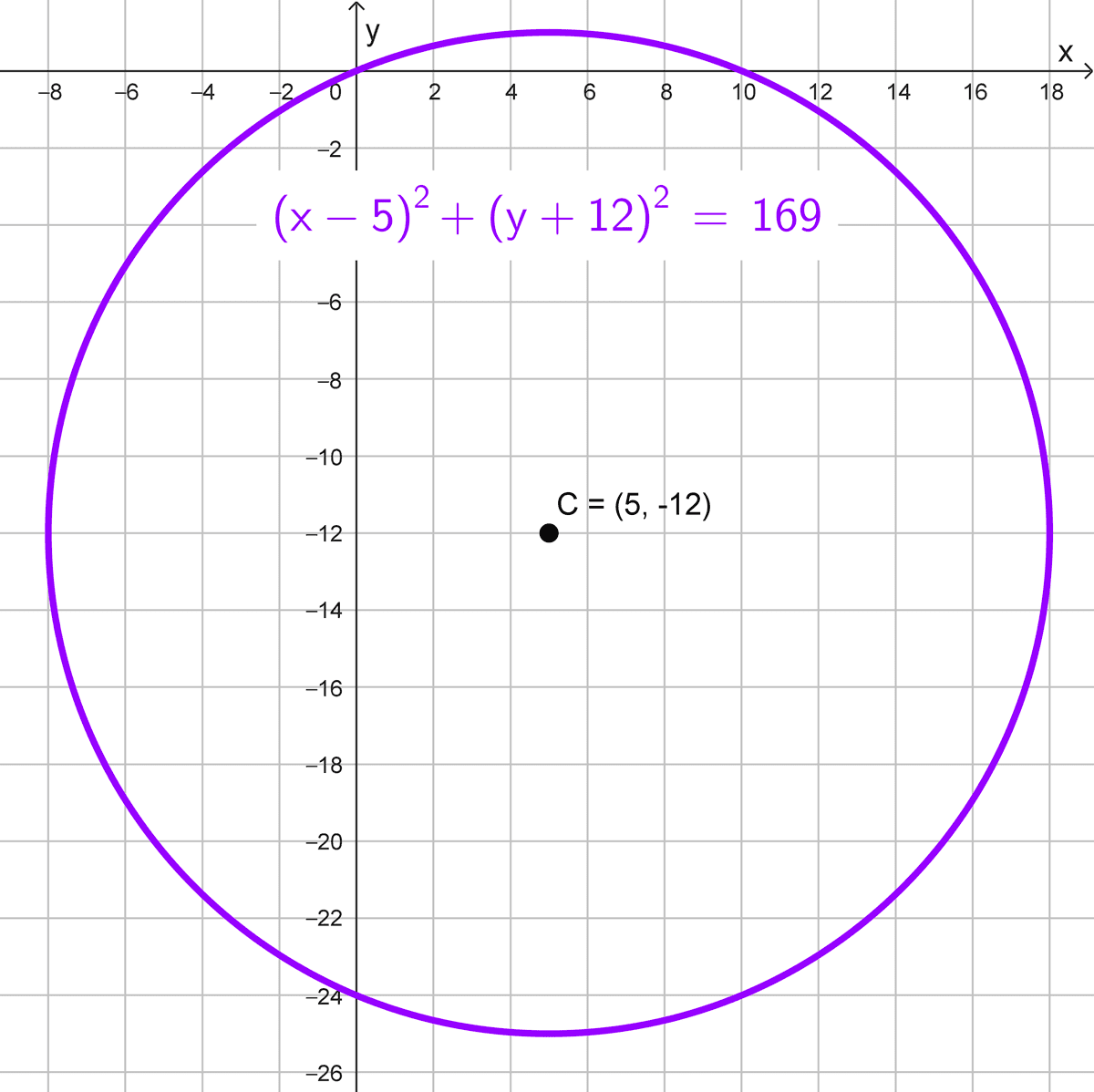
- Center at (5, -12), radius 13.
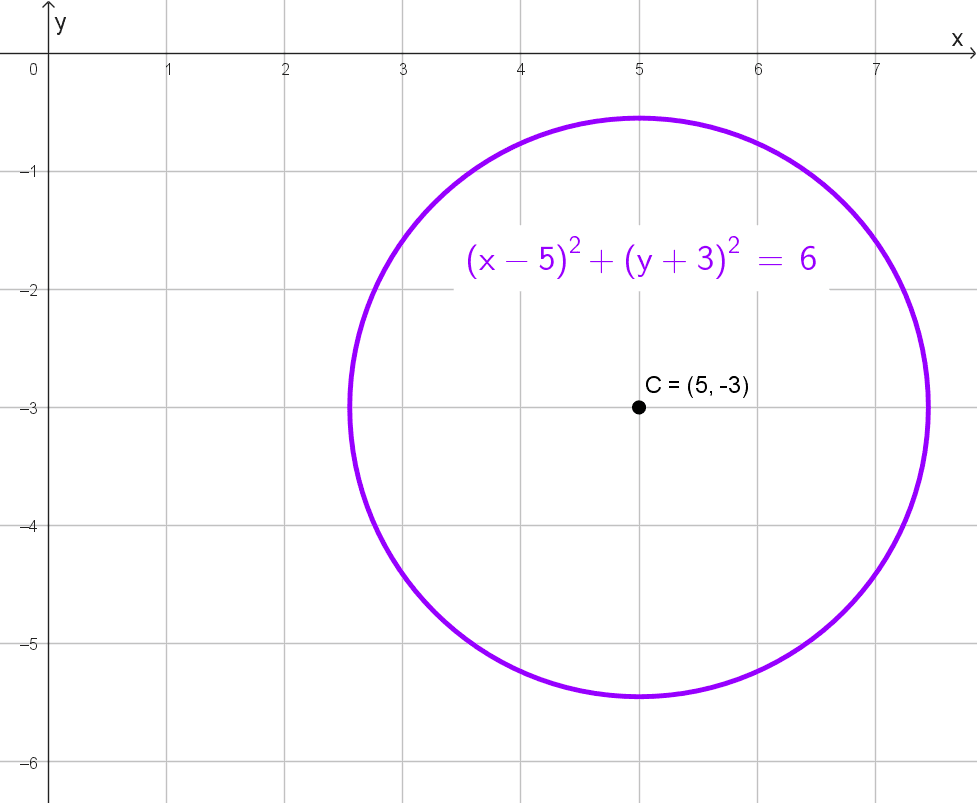
- Center at (5, -3), radius √6.
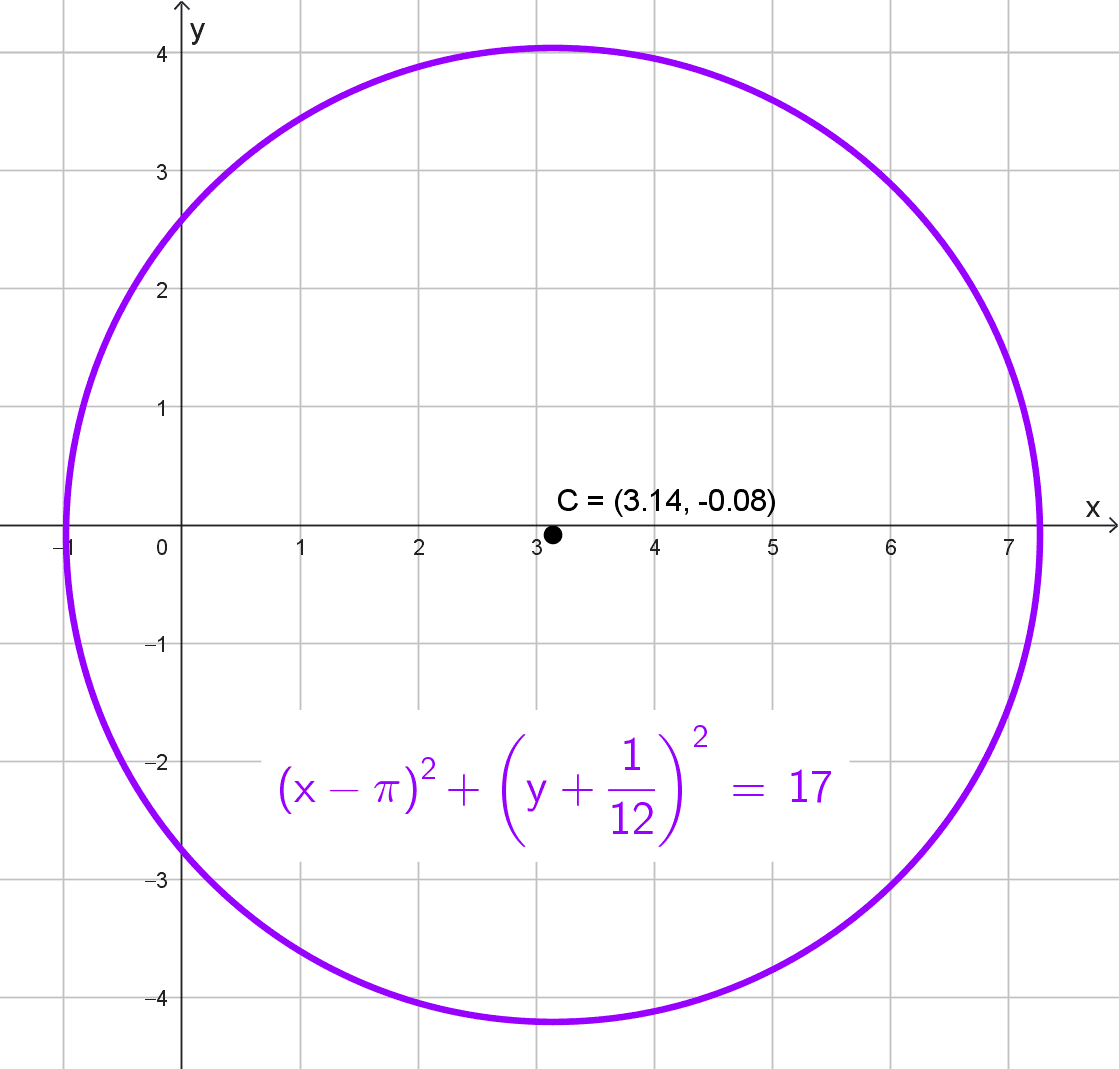
- Center at (π, -1/12), radius √17.
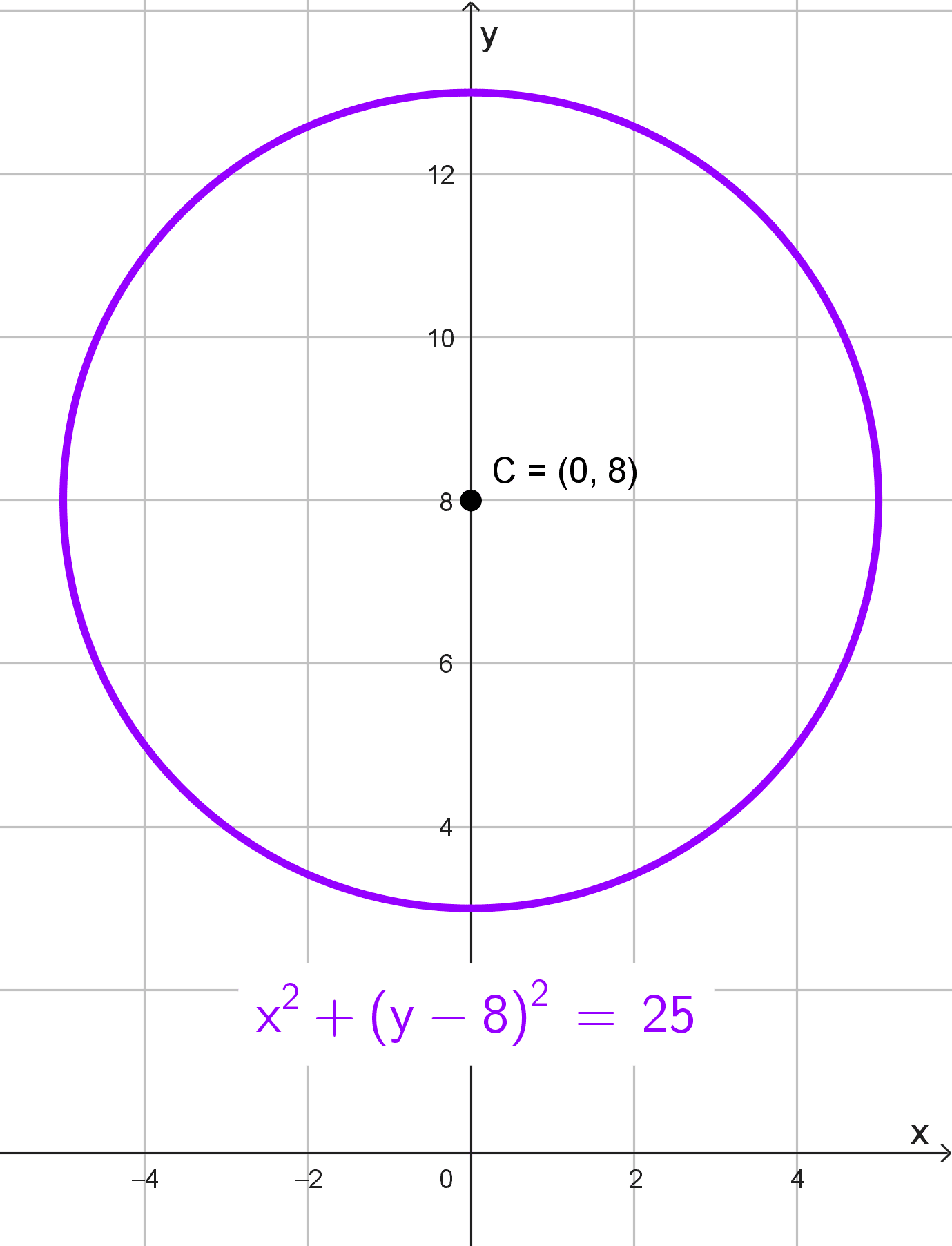
- Center at (0, 8), radius 5.
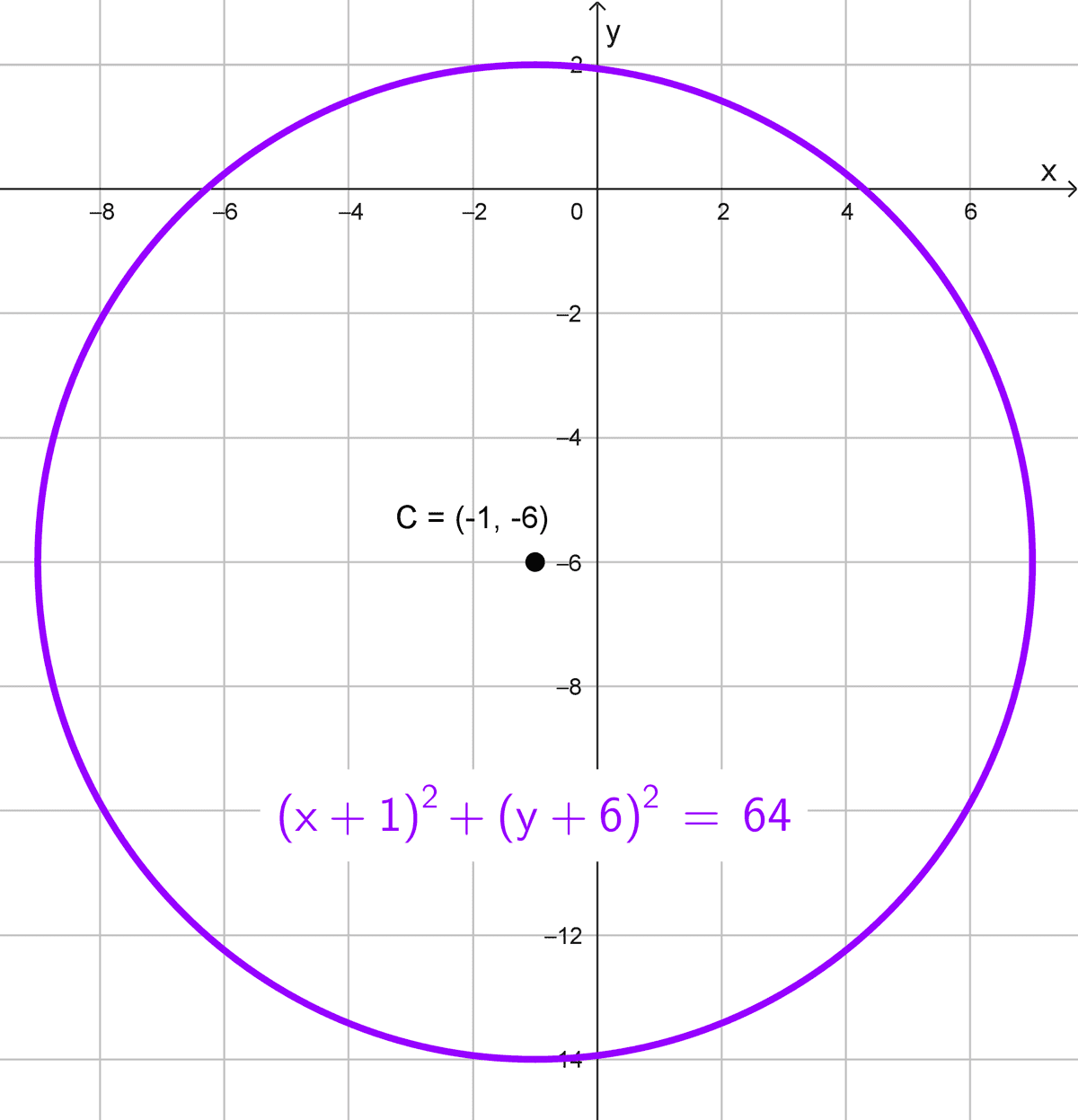
- Center at (-1, -6), radius 8.
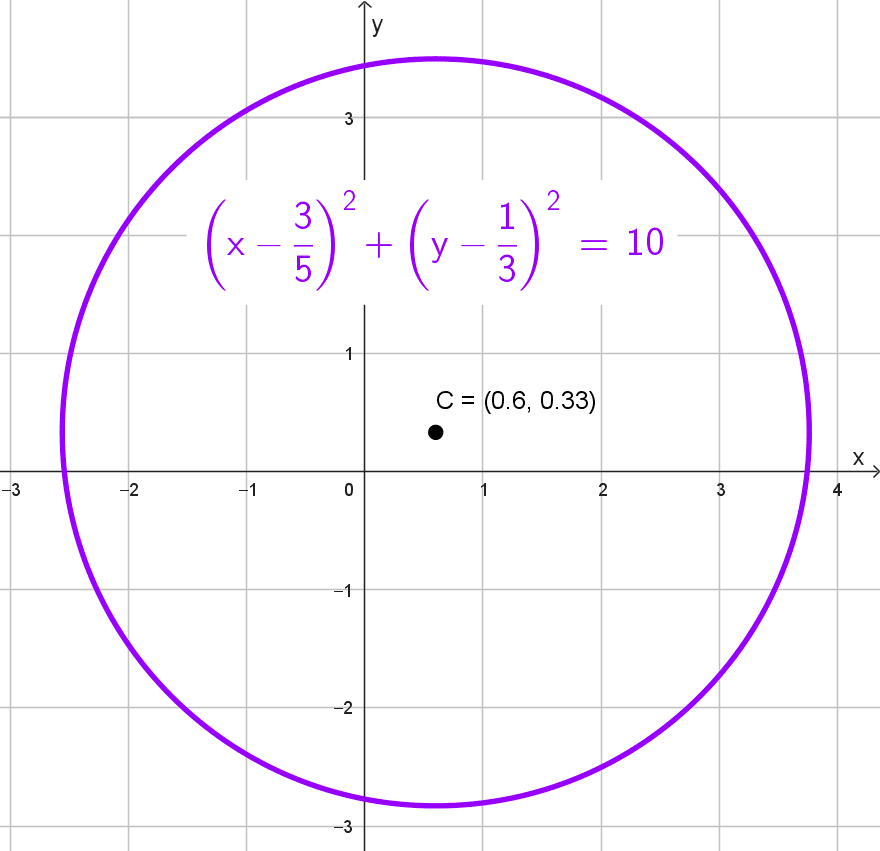
- Center at (3/5, 1/3), radius √10.
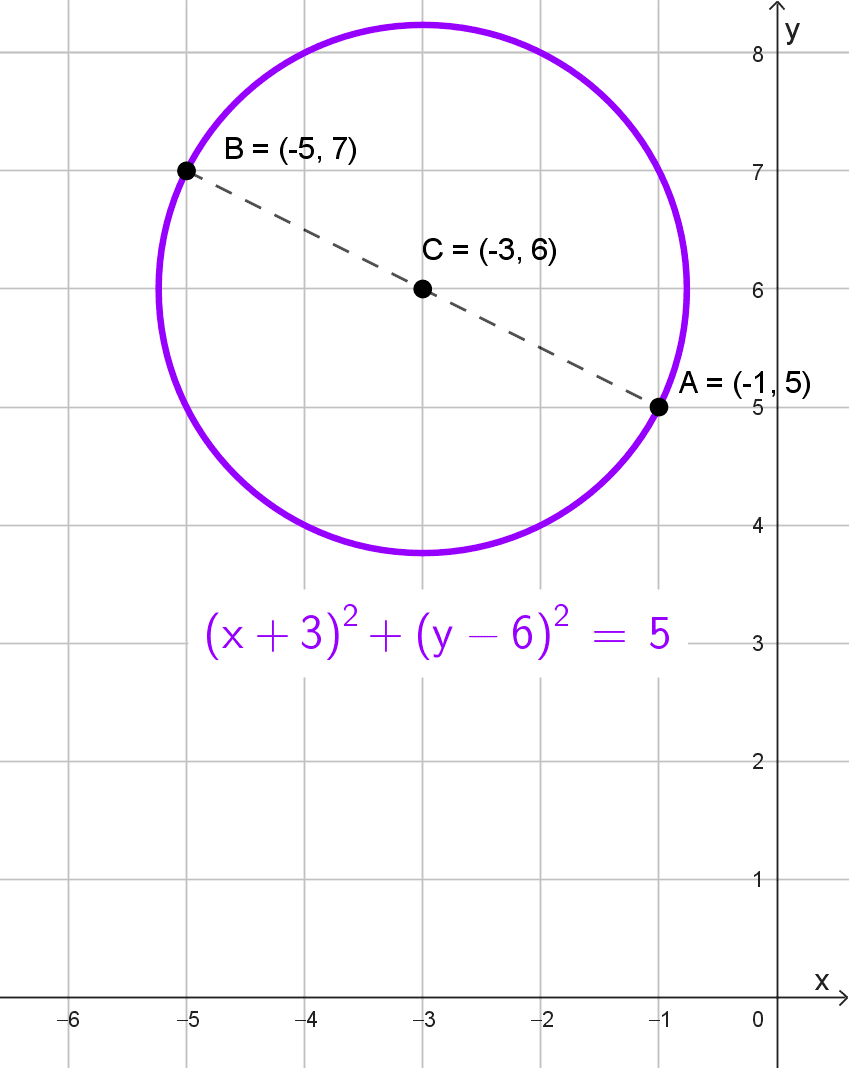
- The line segment connecting A(-1, 5) and B(-5, 7) is a diameter.
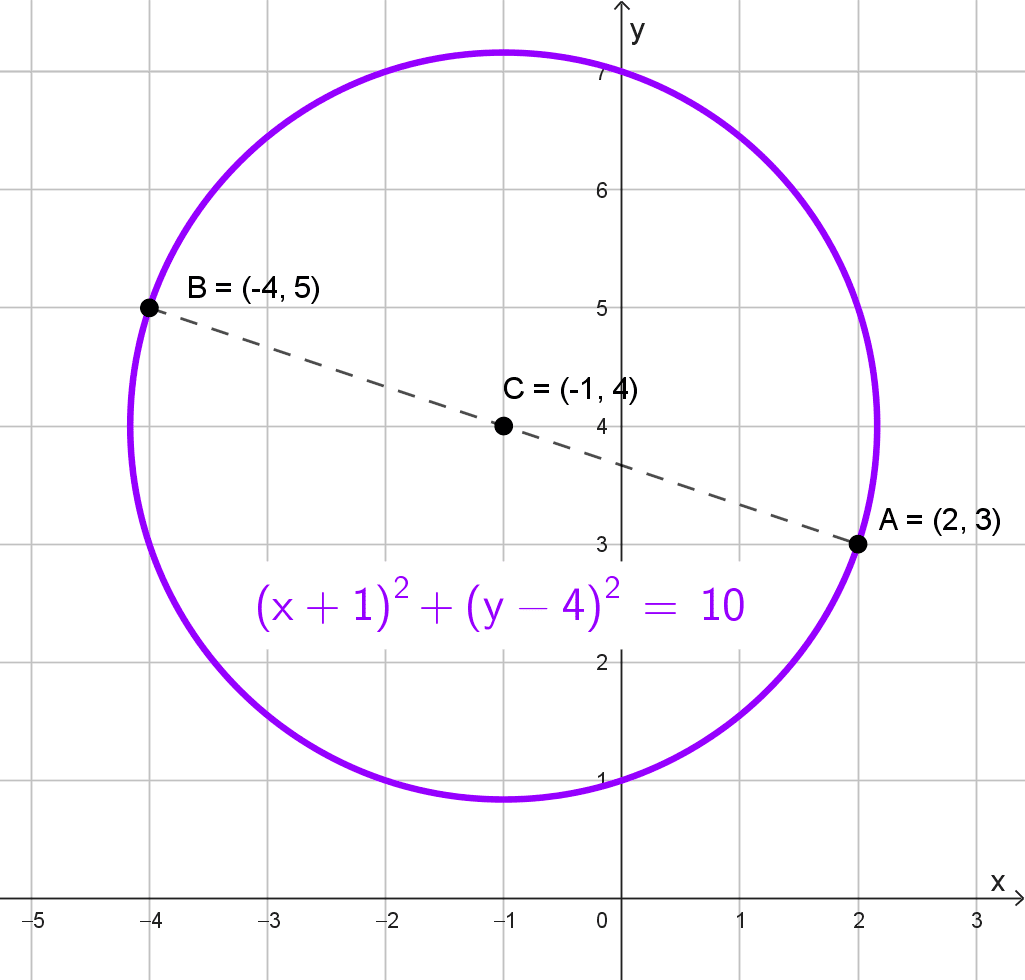
- The endpoints of a diameter are A(2, 3) and B(-4, 5).
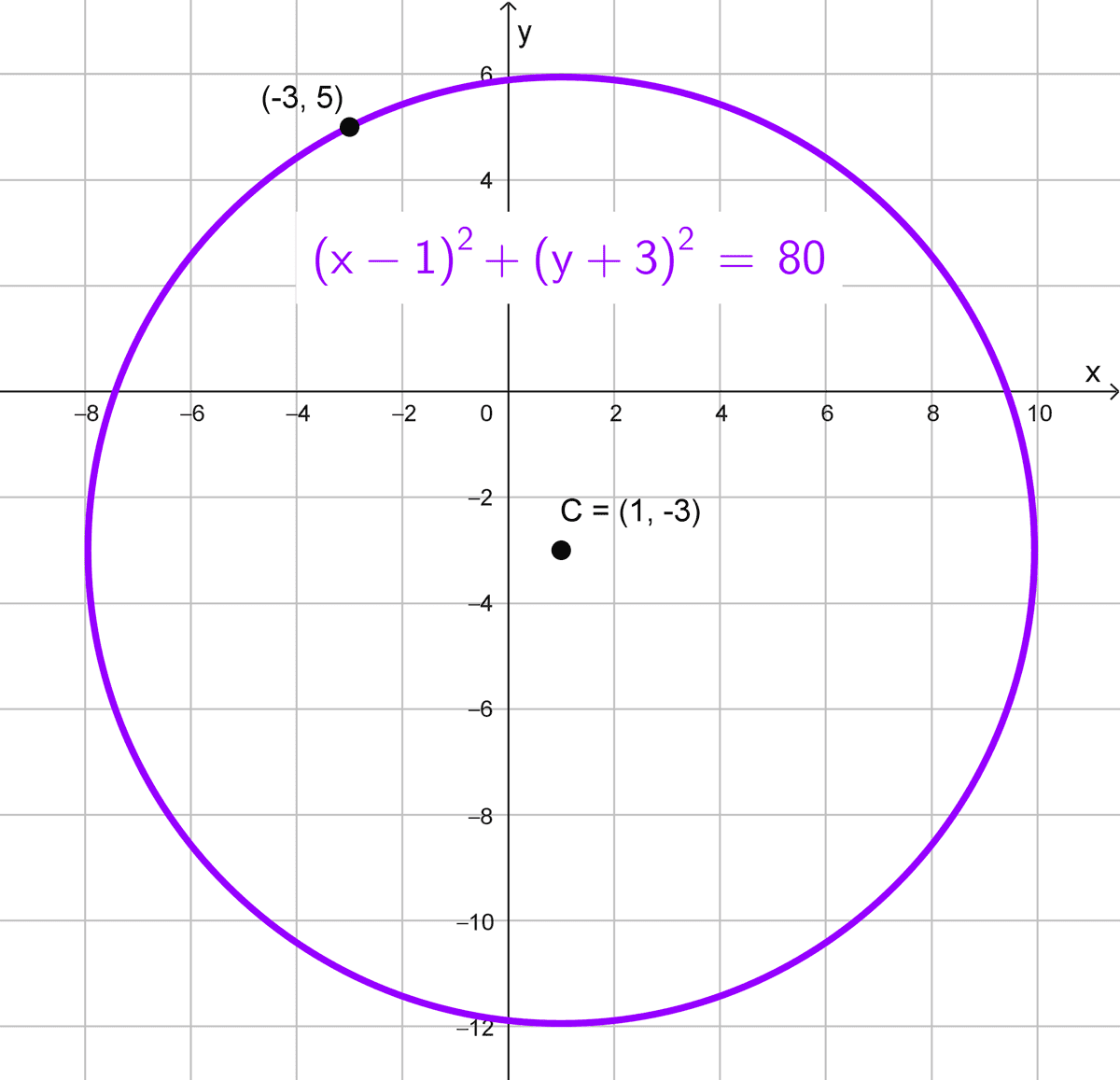
- The center is at (1, -3) and the circle passes through (-3, 5).
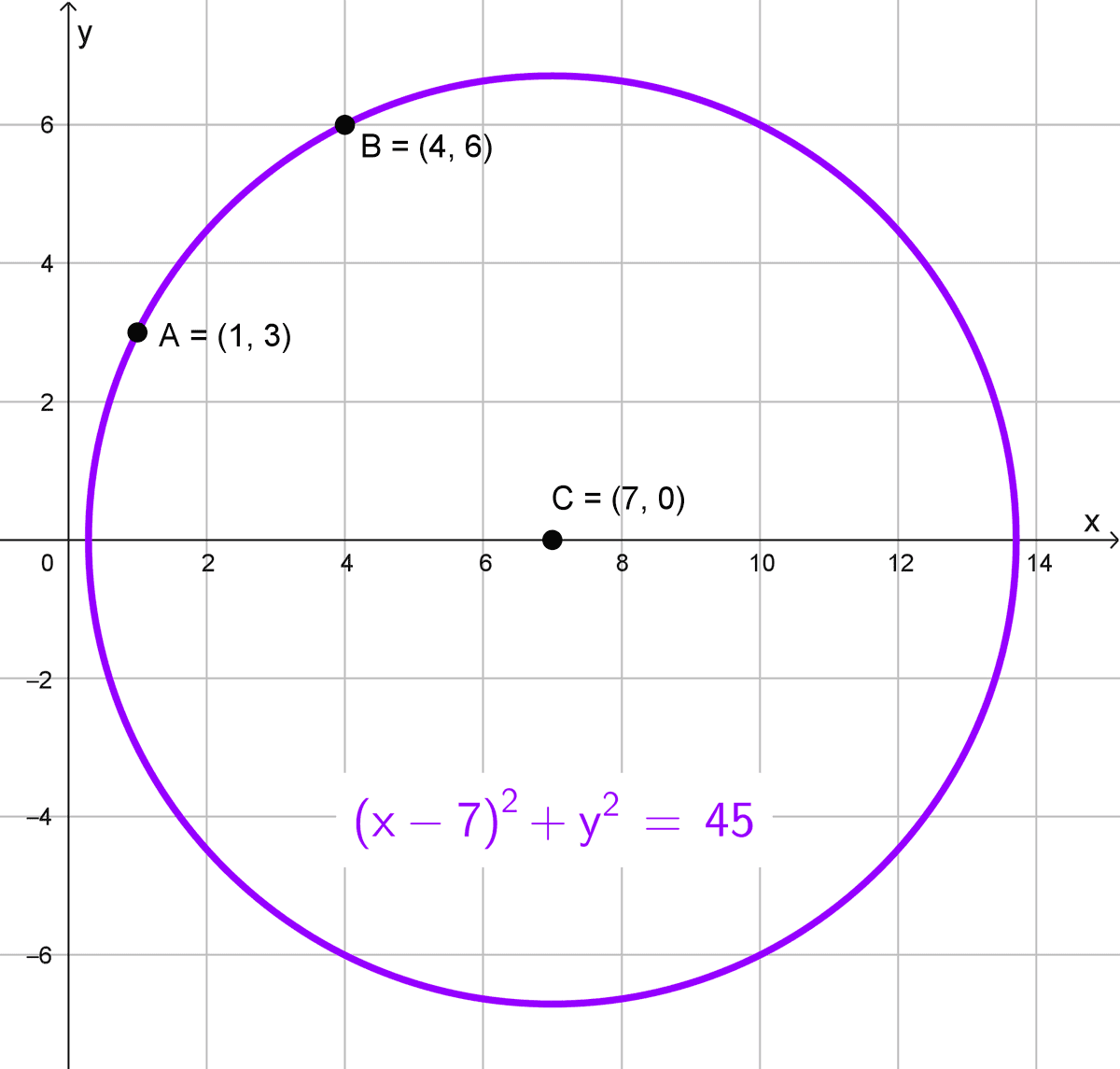
- The center lies on the x-axis and the circle passes through points A(1, 3) and B(4, 6).
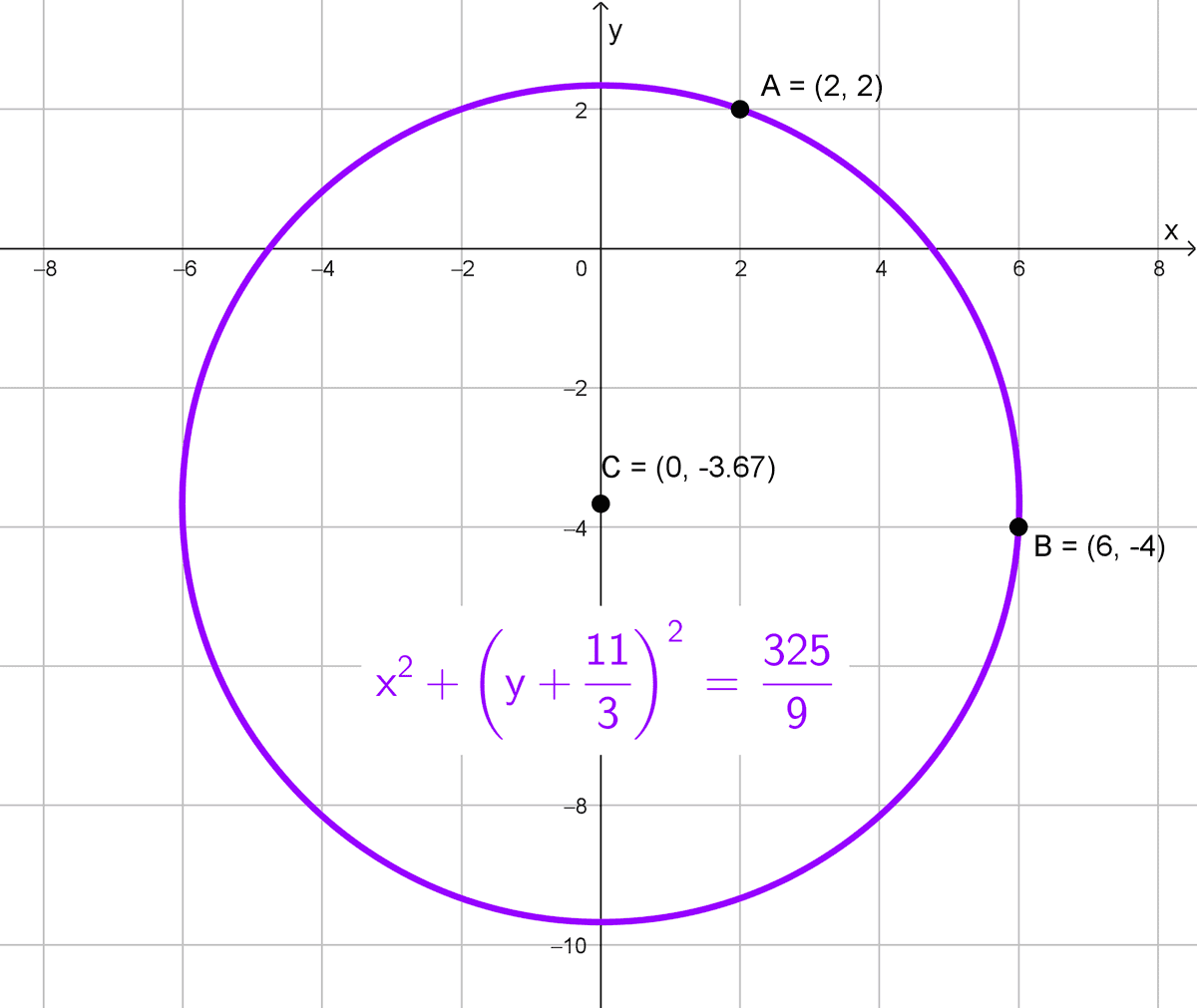
- The center lies on the y-axis and the circle passes through points A(2, 2) and B(6, -4).
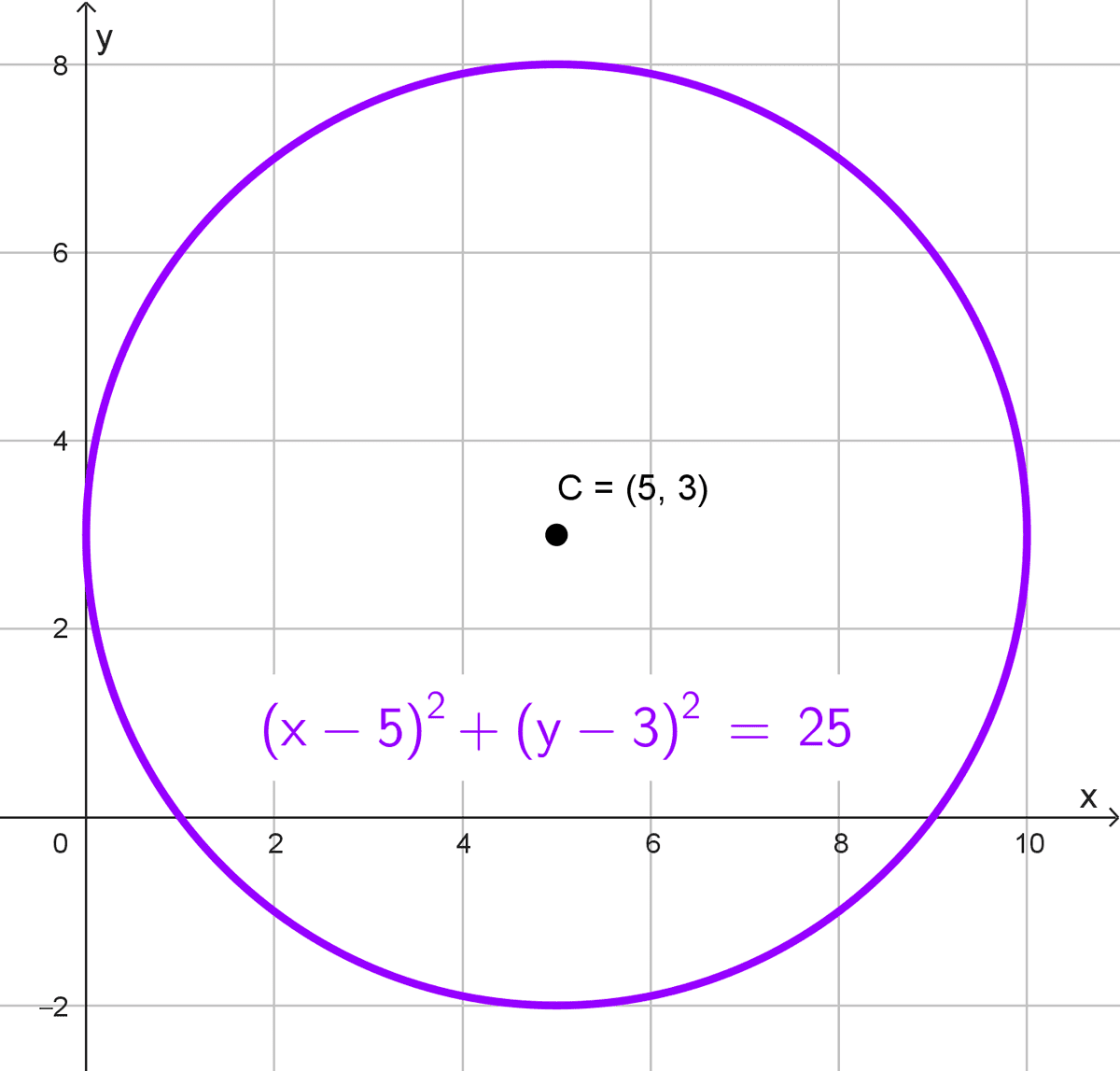
- The circle is tangent to the y-axis and has its center at (5, 3).
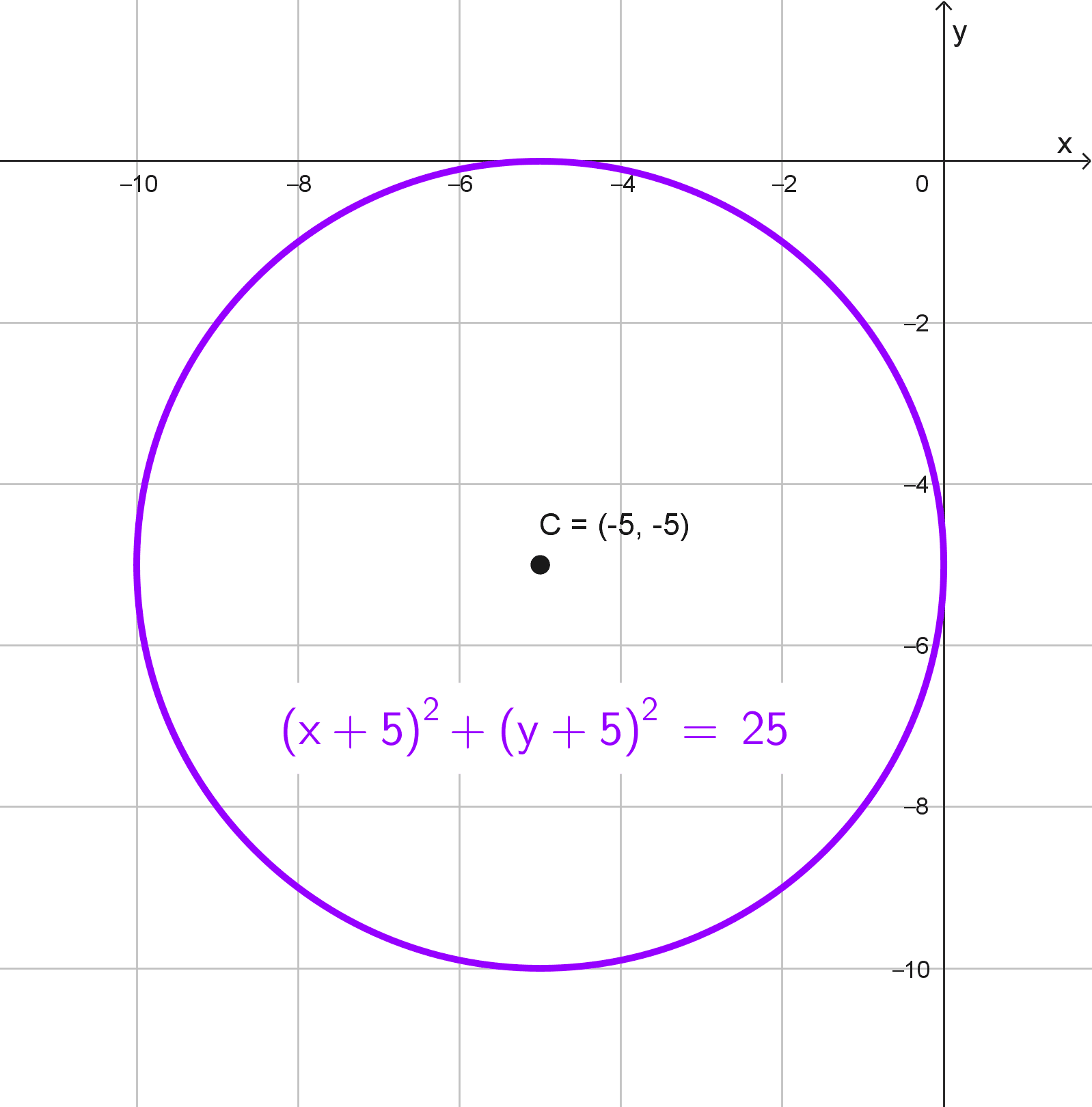
- The circle is tangent to both coordinate axes, has radius 5, and lies in the third quadrant.
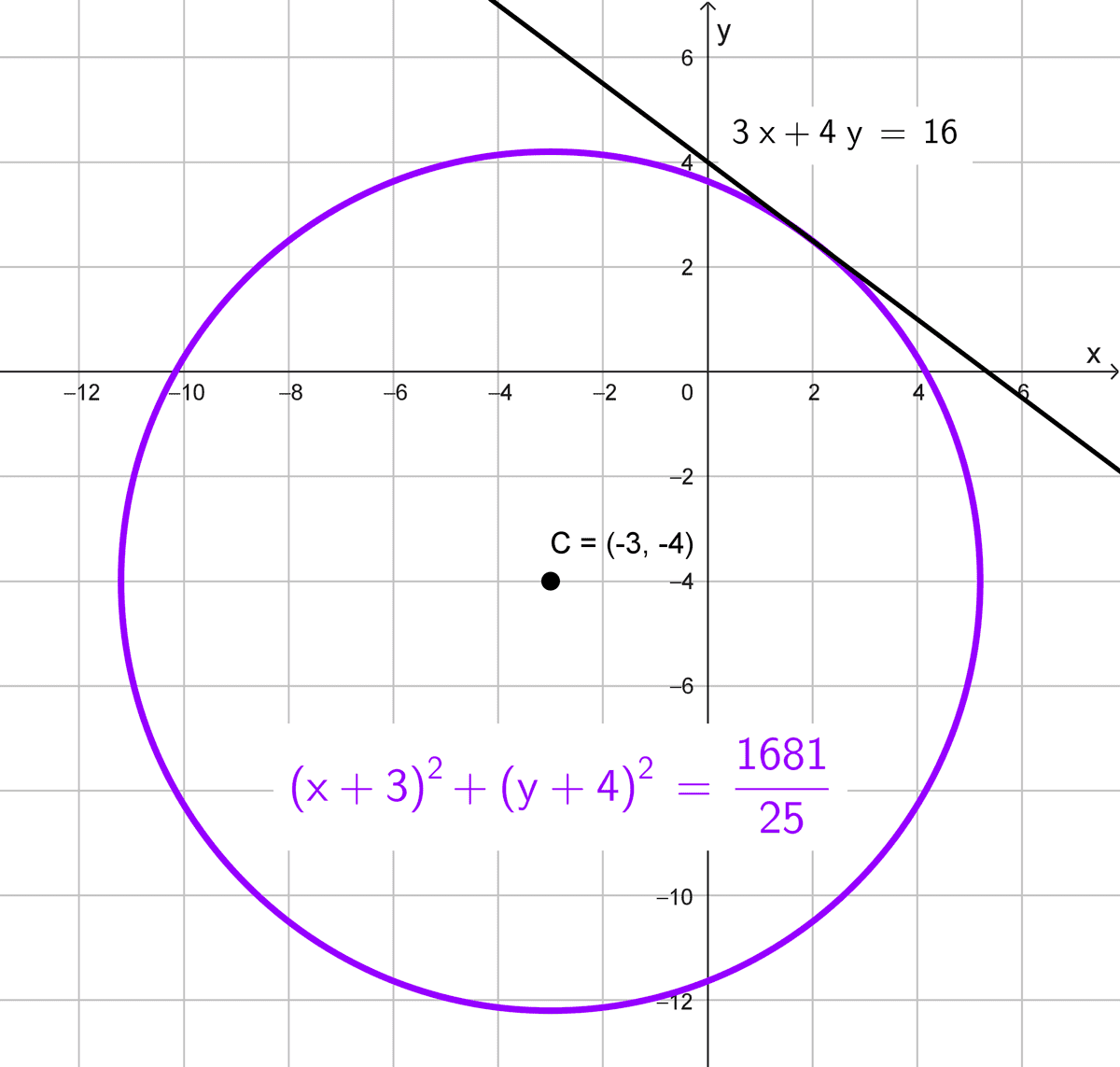
- The circle is tangent to the line 3x + 4y = 16 and has its center at (-3, -4).
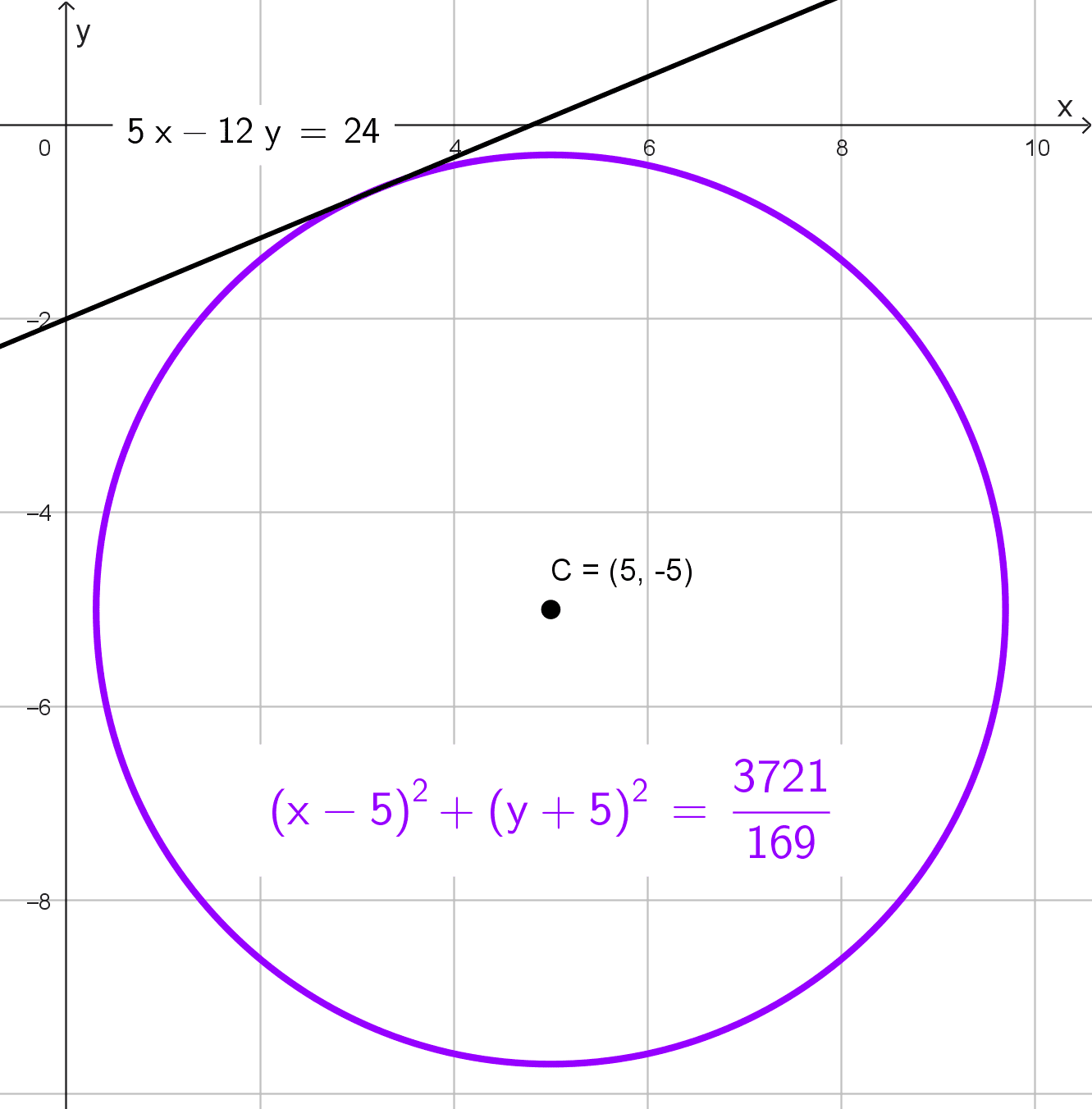
- The circle is tangent to the line 5x - 12y = 24 and has its center at (5, -5).
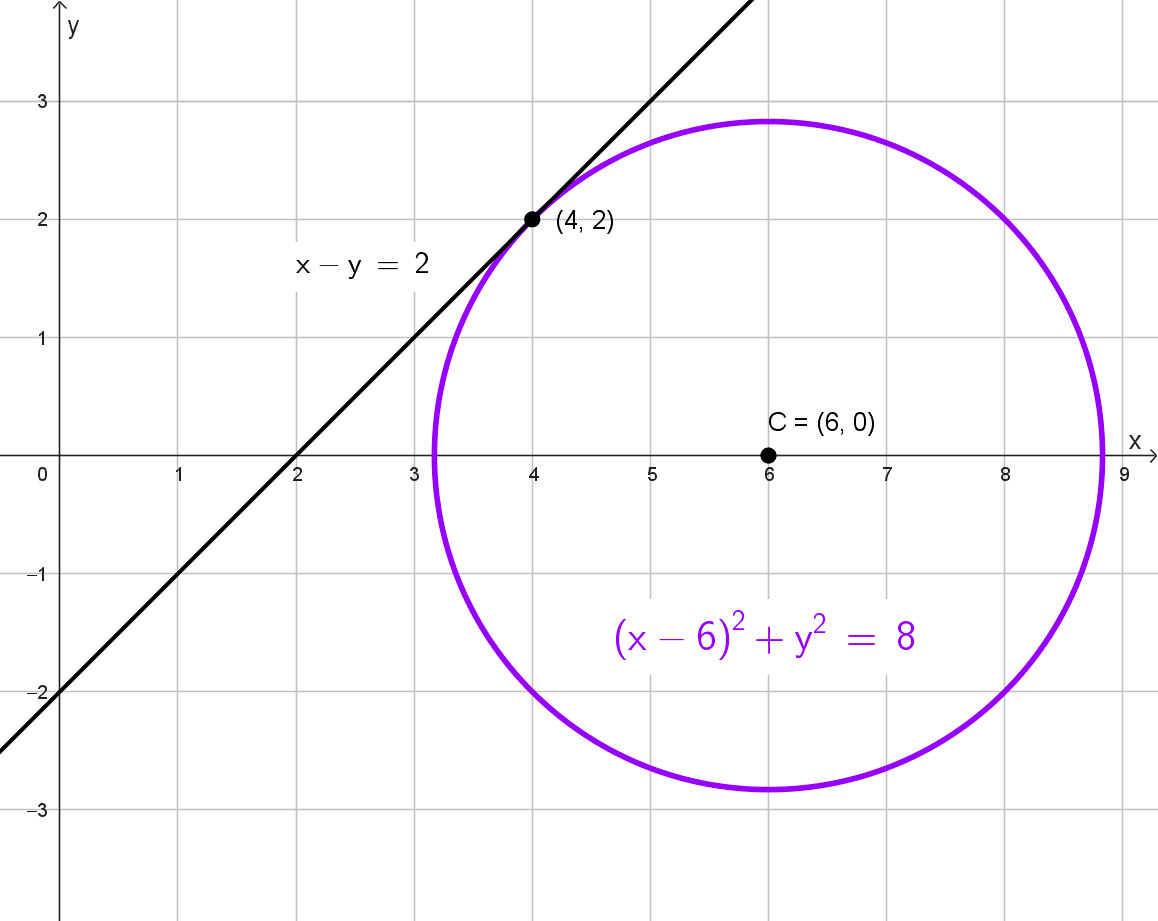
- The circle is tangent to the line x - y = 2 at the point (4, 2), and its center lies on the x-axis.
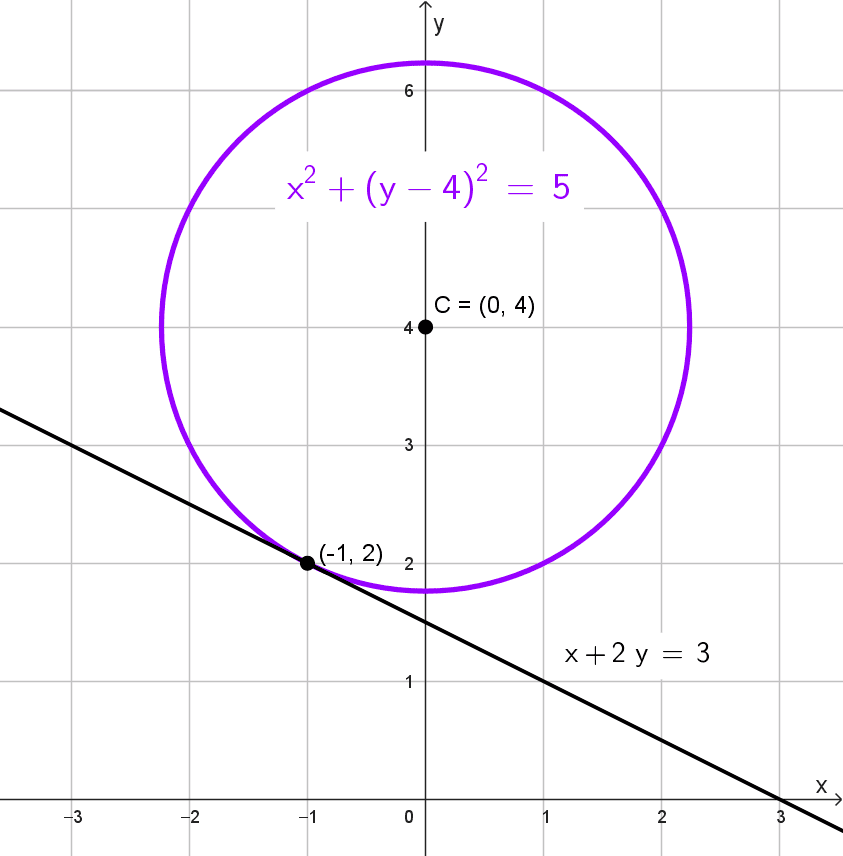
- The circle is tangent to the line x + 2y = 3 at the point (-1, 2), and its center lies on the y-axis.
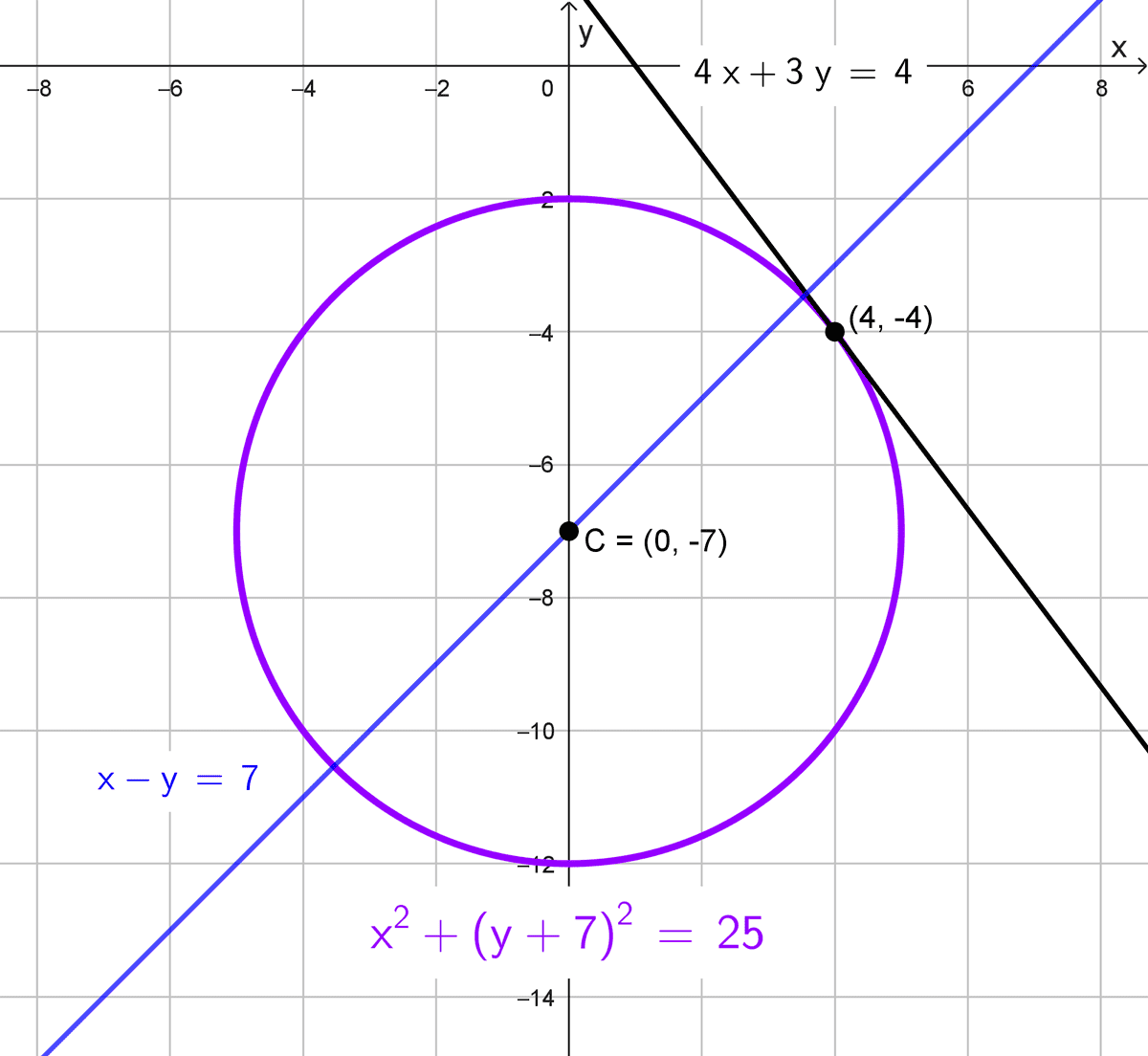
- The circle is tangent to the line 4x + 3y = 4 at the point (4, -4), and its center lies on the line x - y = 7.
Solutions
Solution 1
The standard equation of a circle centered at the origin (0, 0) is \(x^2+y^2=r^2,\) where \(r\) represents the radius. Given that the diameter is \(2\sqrt{11},\) the radius is half of that value:
\(r=\dfrac{2\sqrt{11}}{2}=\sqrt{11}\)
Substituting into the standard form:
\(x^2+y^2=(\sqrt{11})^2 \implies x^2+y^2=11\)
Solution 2
For a circle with center \((h, k)=(3,-4)\) and radius \(r=6,\) the standard equation is:
\((x-h)^2+(y-k)^2=r^2\)
Substituting the given parameters:
\((x-3)^2+(y-(-4))^2=6^2\)
\((x-3)^2+(y+4)^2=36\)
Solution 3
With center at \((5,-12)\) and radius \(r=13,\) we apply standard form directly:
\((x-5)^2+(y-(-12))^2=13^2\)
Simplifying the squared terms:
\((x-5)^2+(y+12)^2=169\)
Solution 4
Given the center \((5,-3)\) and radius \(\sqrt{6},\) the equation yields:
\((x-5)^2+(y+3)^2=(\sqrt{6})^2\)
Squaring the radical on the right side:
\((x-5)^2+(y+3)^2=6\)
Solution 5
The circle with center \((h, k)=\left(\pi,-\dfrac{1}{12}\right)\) and radius \(r=\sqrt{17}\) has standard form:
\((x-\pi)^2+\left(y-\left(-\dfrac{1}{12}\right)\right)^2=(\sqrt{17})^2\)
Simplifying:
\((x-\pi)^2+\left(y+\dfrac{1}{12}\right)^2=17\)
Solution 6
For a circle centered at \((0, 8)\) with radius \(5,\) we set up the equation as:
\((x-0)^2+(y-8)^2=5^2\)
Simplifying the \(x\)-term and squaring the radius:
\(x^2+(y-8)^2=25\)
Solution 7
If the center is located at \((-1,-6)\) and the radius is \(8,\) we have:
\((x+1)^2+(y+6)^2=8^2\)
Evaluating the right side:
\((x+1)^2+(y+6)^2=64\)
Solution 8
For center \(\left(\dfrac{3}{5}, \dfrac{1}{3}\right)\) and radius \(\sqrt{10},\) the standard form is:
\(\left(x-\dfrac{3}{5}\right)^2+\left(y-\dfrac{1}{3}\right)^2=(\sqrt{10})^2\)
Simplifying the radius:
\(\left(x-\dfrac{3}{5}\right)^2+\left(y-\dfrac{1}{3}\right)^2=10\)
Solution 9
Given endpoints of a diameter at \(A(-1, 5)\) and \(B(-5, 7).\)
We find the center \((h, k)\) as the midpoint of segment \(AB:\)
\(h=\dfrac{-1+(-5)}{2}=-3, \quad k=\dfrac{5+7}{2}=6\)
The radius is half the length of diameter \(AB:\)
\(\text{Distance } AB=\sqrt{(-5-(-1))^2+(7-5)^2}=\sqrt{16+4}=\sqrt{20}=2\sqrt{5}\)
\(r=\dfrac{2\sqrt{5}}{2}=\sqrt{5}\)
Therefore, the standard equation is:
\((x+3)^2+(y-6)^2=5\)
Solution 10
Given endpoints of a diameter at \(A(2, 3)\) and \(B(-4, 5).\)
First, find the center by calculating the midpoint:
\(h=\dfrac{2+(-4)}{2}=-1, \quad k=\dfrac{3+5}{2}=4\)
The radius is half the distance between \(A\) and \(B:\)
\(\text{Distance } AB=\sqrt{(-4-2)^2+(5-3)^2}=\sqrt{36+4}=\sqrt{40}=2\sqrt{10}\)
\(r=\dfrac{2\sqrt{10}}{2}=\sqrt{10}\)
The standard equation is:
\((x+1)^2+(y-4)^2=10\)
Helpful Tool: If you are practicing these problems and want to verify your answers, check out our free calculator:
Solution 11
Given: Center at \((1, -3)\) and the circle passes through \((-3, 5).\)
The radius equals the distance between the center and the given point on the circle:
\(r=\sqrt{(-3-1)^2+(5-(-3))^2}=\sqrt{16+64}=\sqrt{80}=4\sqrt{5}\)
Writing in standard form with \(r^2 = 80:\)
\((x-1)^2+(y+3)^2=80\)
Solution 12
Given: Center lies on the x-axis (meaning \(k=0\)) and passes through \(A(1, 3)\) and \(B(4, 6).\)
Because the center \((h, 0)\) is equidistant from points \(A\) and \(B,\) we set up the distance equality:
\(\sqrt{(1-h)^2+(3-0)^2}=\sqrt{(4-h)^2+(6-0)^2}\)
Squaring both sides and simplifying:
\((1-h)^2+9=(4-h)^2+36\)
\(1-2h+h^2+9=16-8h+h^2+36\)
\(-2h+10=-8h+52 \implies 6h=42 \implies h=7\)
The center is \((7, 0).\) We calculate the radius using point \(A(1, 3):\)
\(r=\sqrt{(1-7)^2+(3-0)^2}=\sqrt{36+9}=\sqrt{45}=3\sqrt{5}\)
The standard equation is:
\((x-7)^2+y^2=45\)
Solution 13
Given: Center lies on the y-axis (meaning \(h=0\)) and passes through \(A(2, 2)\) and \(B(6,-4).\)
Since the center \((0, k)\) is equidistant from \(A\) and \(B:\)
\(\sqrt{(2-0)^2+(2-k)^2}=\sqrt{(6-0)^2+(-4-k)^2}\)
Squaring both sides and expanding:
\(4+(2-k)^2=36+(-4-k)^2\)
\(4+4-4k+k^2=36+16+8k+k^2\)
\(8-4k=52+8k \implies -12k=44 \implies k=-\dfrac{11}{3}\)
The center is \(\left(0,-\dfrac{11}{3}\right).\) Using point \(A(2, 2)\) to determine \(r^2:\)
\(r^2=(2-0)^2+\left(2-\left(-\dfrac{11}{3}\right)\right)^2=4+\left(\dfrac{17}{3}\right)^2=4+\dfrac{289}{9}=\dfrac{325}{9}\)
Thus, the standard equation is:
\(x^2+\left(y+\dfrac{11}{3}\right)^2=\dfrac{325}{9}\)
Solution 14
Given: Center at \((5, 3)\) and tangent to the y-axis.
When a circle is tangent to the y-axis (line \(x=0\)), the radius is equal to the absolute value of the center's x-coordinate:
\(r=|h|=|5|=5\)
Substituting center \((5, 3)\) and radius \(r=5\) into standard form:
\((x-5)^2+(y-3)^2=5^2\)
\((x-5)^2+(y-3)^2=25\)
Solution 15
Given: Tangent to both coordinate axes, radius \(5,\) and located in the third quadrant.
In the third quadrant, both coordinates are negative. Since the circle is tangent to both axes, \(|h|=r\) and \(|k|=r:\)
\(h=-5, \quad k=-5\)
Substituting into standard form:
\((x-(-5))^2+(y-(-5))^2=5^2\)
\((x+5)^2+(y+5)^2=25\)
Solution 16
Given: Center at \((-3, -4)\) and tangent to the line \(3x+4y=16.\)
The radius is the perpendicular distance from the center to the tangent line \(3x+4y-16=0.\) Using the point-to-line distance formula:
\(r=\dfrac{|Ax_0+By_0+C|}{\sqrt{A^2+B^2}}=\dfrac{|3(-3)+4(-4)-16|}{\sqrt{3^2+4^2}}=\dfrac{|-9-16-16|}{5}=\dfrac{41}{5}\)
With center \((-3, -4)\) and \(r=\dfrac{41}{5},\) the standard equation is:
\((x+3)^2+(y+4)^2=\left(\dfrac{41}{5}\right)^2\)
\((x+3)^2+(y+4)^2=\dfrac{1681}{25}\)
Solution 17
Given: Center at \((5, -5)\) and tangent to the line \(5x-12y=24.\)
We find the radius using the distance from \((5, -5)\) to \(5x-12y-24=0:\)
\(r=\dfrac{|5(5)-12(-5)-24|}{\sqrt{5^2+(-12)^2}}=\dfrac{|25+60-24|}{13}=\dfrac{61}{13}\)
Substituting into standard form:
\((x-5)^2+(y+5)^2=\left(\dfrac{61}{13}\right)^2\)
\((x-5)^2+(y+5)^2=\dfrac{3721}{169}\)
Solution 18
Given: Center lies on the x-axis and the circle is tangent to the line \(x-y=2\) at the point \((4, 2).\)
Because the center is on the x-axis, its coordinates are \((h, 0).\) The distance from \((h, 0)\) to the line \(x-y-2=0\) must equal the distance from \((h, 0)\) to the point of tangency \((4, 2):\)
\(\dfrac{|h-0-2|}{\sqrt{1^2+(-1)^2}}=\sqrt{(h-4)^2+(0-2)^2}\)
\(\dfrac{|h-2|}{\sqrt{2}}=\sqrt{(h-4)^2+4}\)
Squaring both sides:
\(\dfrac{(h-2)^2}{2}=(h-4)^2+4 \implies (h-2)^2=2(h-4)^2+8\)
Expanding and collecting like terms:
\(h^2-4h+4=2(h^2-8h+16)+8\)
\(h^2-4h+4=2h^2-16h+40 \implies h^2-12h+36=0\)
\((h-6)^2=0 \implies h=6\)
The center is \((6, 0).\) We calculate the radius using the point of tangency \((4, 2):\)
\(r=\sqrt{(6-4)^2+(0-2)^2}=\sqrt{4+4}=\sqrt{8}=2\sqrt{2}\)
Thus, the standard equation is:
\((x-6)^2+y^2=8\)
Solution 19
Given: The circle is tangent to the line \(x+2y=3\) at \((-1, 2),\) and the center lies on the y-axis.
Because the center is on the y-axis, it has coordinates \((0, k).\) The distance from \((0, k)\) to \(x+2y-3=0\) equals the distance from \((0, k)\) to the tangency point \((-1, 2):\)
\(\dfrac{|0+2k-3|}{\sqrt{1^2+2^2}}=\sqrt{(0-(-1))^2+(k-2)^2}\)
\(\dfrac{|2k-3|}{\sqrt{5}}=\sqrt{1+(k-2)^2}\)
Squaring both sides and simplifying:
\(\dfrac{(2k-3)^2}{5}=1+(k-2)^2 \implies 4k^2-12k+9=5\left(1+k^2-4k+4\right)\)
\(4k^2-12k+9=5k^2-20k+25 \implies k^2-8k+16=0\)
\((k-4)^2=0 \implies k=4\)
The center is \((0, 4).\) The radius is:
\(r=\sqrt{(0+1)^2+(4-2)^2}=\sqrt{1+4}=\sqrt{5}\)
The standard equation is:
\(x^2+(y-4)^2=5\)
Solution 20
Given: Tangent to the line \(4x+3y=4\) at \((4, -4),\) with its center lying on the line \(x-y=7.\)
Since the center \((h, k)\) lies on \(x-y=7,\) we have \(h-k=7,\) which means \(h=k+7.\) The radius is both the distance from \((h, k)\) to \(4x+3y-4=0\) and the distance from \((h, k)\) to \((4, -4):\)
\(\dfrac{|4h+3k-4|}{\sqrt{4^2+3^2}}=\sqrt{(h-4)^2+(k+4)^2}\)
Substituting \(h=k+7:\)
\(\dfrac{|4(k+7)+3k-4|}{5}=\sqrt{(k+7-4)^2+(k+4)^2}\)
\(\dfrac{|7k+24|}{5}=\sqrt{(k+3)^2+(k+4)^2}\)
Squaring both sides:
\(\dfrac{49k^2+336k+576}{25}=2k^2+14k+25\)
\(49k^2+336k+576=50k^2+350k+625 \implies k^2+14k+49=0\)
\((k+7)^2=0 \implies k=-7\)
Since \(h=k+7,\) we find \(h=-7+7=0.\) The center is \((0, -7).\) We calculate the radius:
\(r=\sqrt{(0-4)^2+(-7+4)^2}=\sqrt{16+9}=5\)
The standard equation is:
\(x^2+(y+7)^2=25\)
Finding the center and radius of a circle from its equation
Problem 2: Determine the center and radius for each of the following circle equations, and graph each circle.
- \(x^2+y^2=25\)
- \(x^2+y^2+6x-4x-12=0\)
- \(x^2+y^2+4x+12y+36=0\)
- \(x^2+y^2-8x-2y+1=0\)
- \(x^2+y^2-10x+4y-7=0\)
- \(x^2+y^2-10x-24y+25=0\)
- \(2x^2+2y^2+12x-2y-3=0\)
- \(3x^2+3y^2-6x+5y=0\)
Solutions
Solution 1
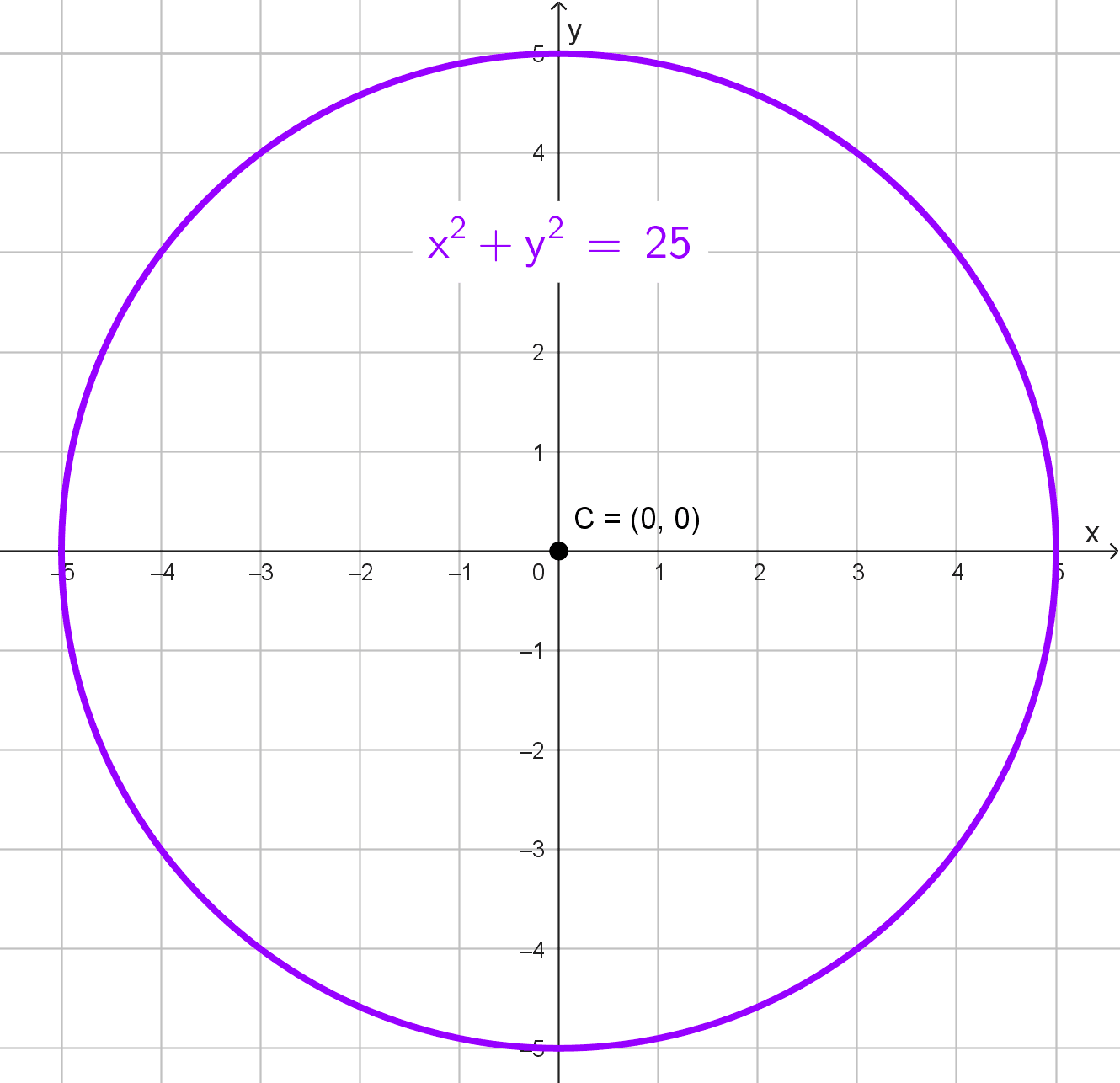
Given equation: \(x^2+y^2=25.\) This matches the standard form of a circle centered at the origin \((h, k)=(0, 0).\) Comparing it with \((x-h)^2+(y-k)^2=r^2,\) we see that \(r^2=25,\) which means \(r=\sqrt{25}=5.\)
Key parameters:
- Center: (0, 0)
- Radius: 5
Solution 2
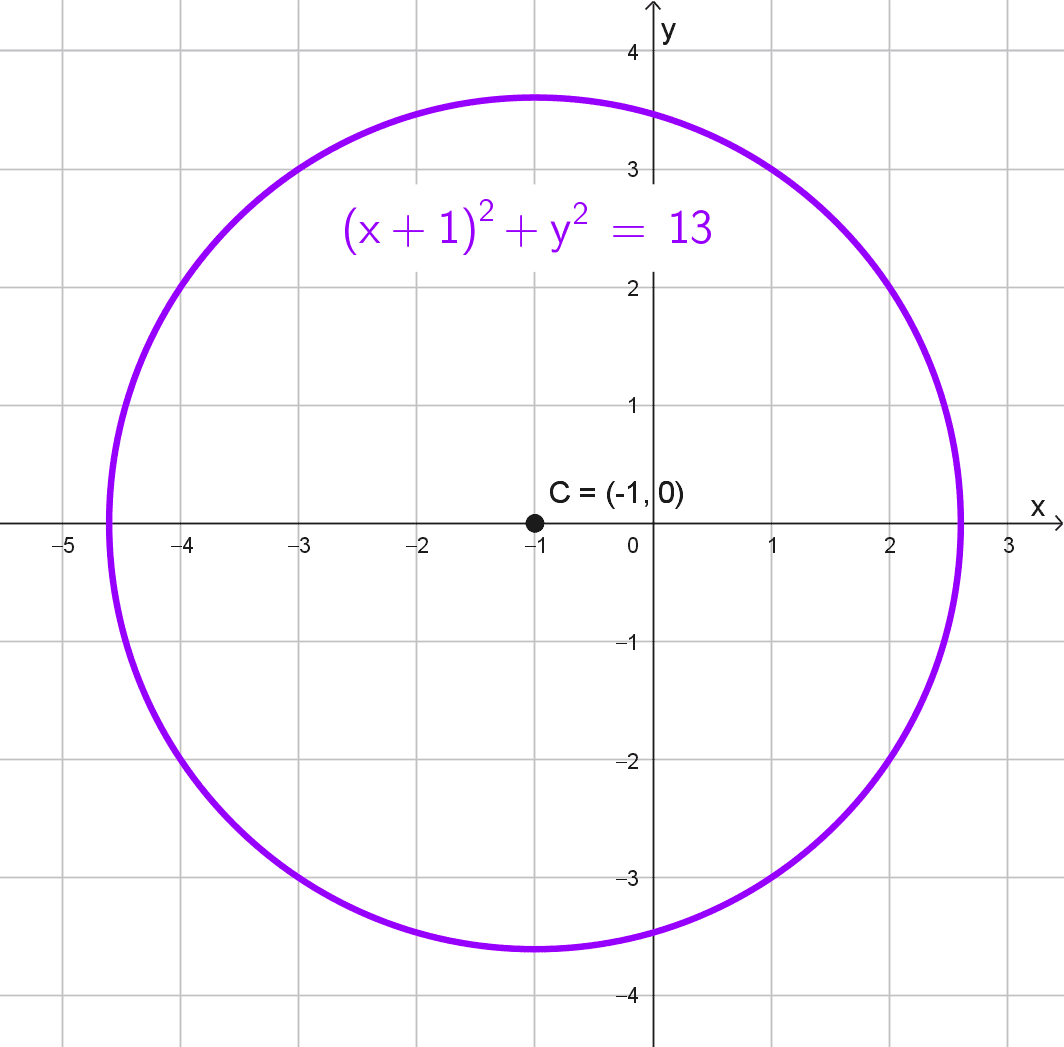
Given equation: \(x^2+y^2+6x-4x-12=0.\) Combining like terms gives \(x^2+y^2+2x-12=0.\) Completing the square yields:
\((x+1)^2+y^2=13\)
Writing this in standard form \((x-h)^2+(y-k)^2=r^2,\) we express \((x+1)^2\) as \((x-(-1))^2,\) giving \(h=-1.\) Because there is no linear \(y\)-term, \(k=0.\) Hence, the center is \((-1, 0).\) Since \(r^2=13,\) the radius is \(r=\sqrt{13} \approx 3.61.\)
Key parameters:
- Center: (-1, 0)
- Radius: \(\sqrt{13} \approx 3.61\)
Solution 3
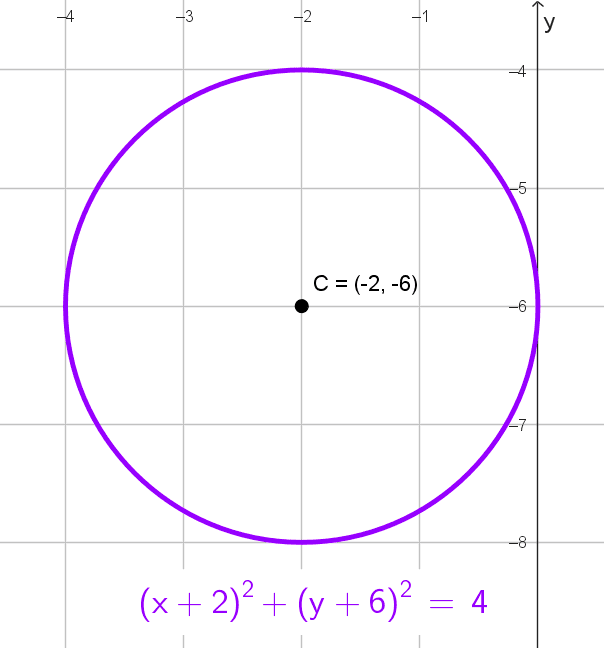
Given equation: \(x^2+y^2+4x+12y+36=0.\) Completing the square for both variables:
\((x+2)^2+(y+6)^2=4\)
We read off the center directly as \((h, k)=(-2, -6).\) The radius squared is \(r^2=4,\) so \(r=2.\)
Key parameters:
- Center: (-2, -6)
- Radius: 2
Solution 4
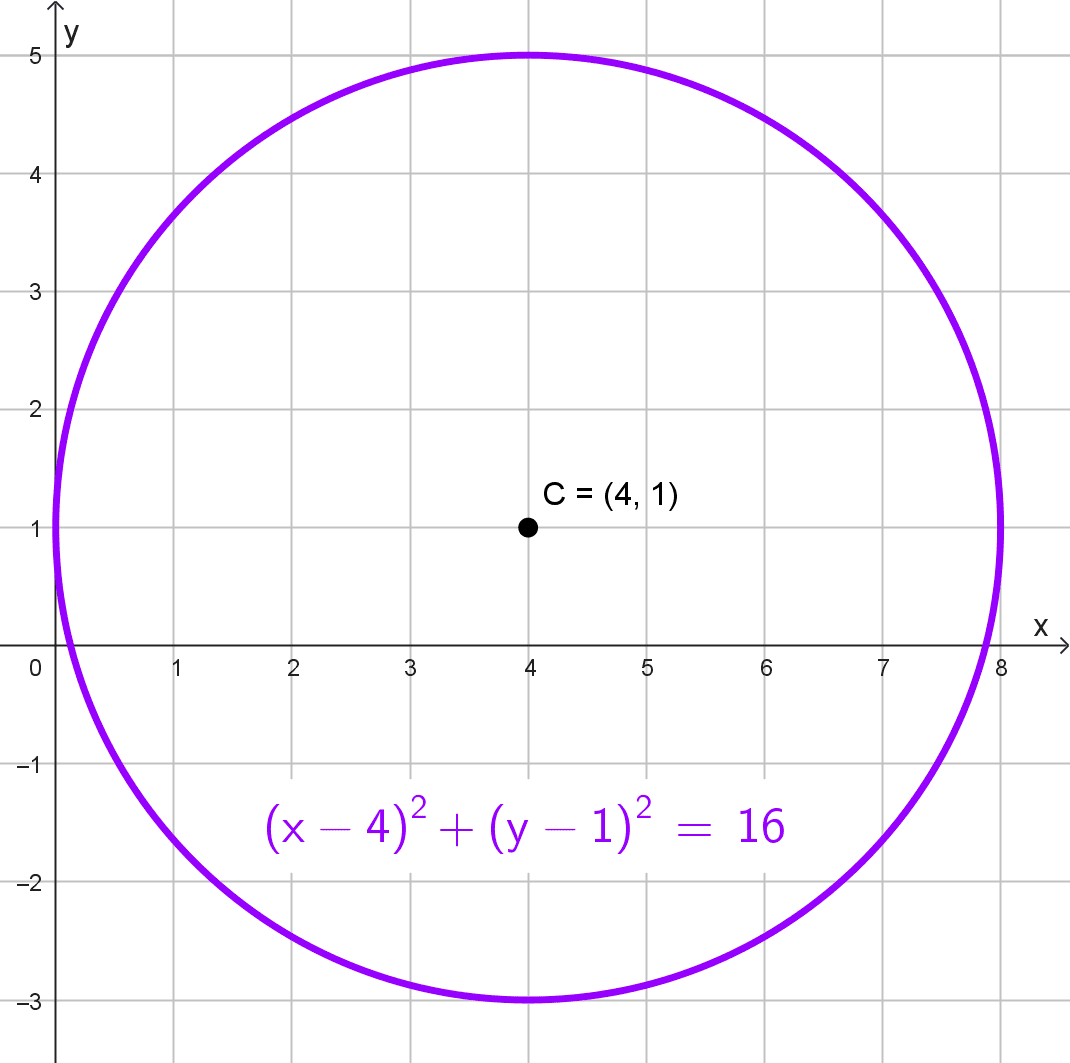
Given equation: \(x^2+y^2-8x-2y+1=0.\) Completing the square:
\((x-4)^2+(y-1)^2=16\)
This is in standard form with center \((h, k)=(4, 1)\) and radius \(r=\sqrt{16}=4.\)
Key parameters:
- Center: (4, 1)
- Radius: 4
Solution 5
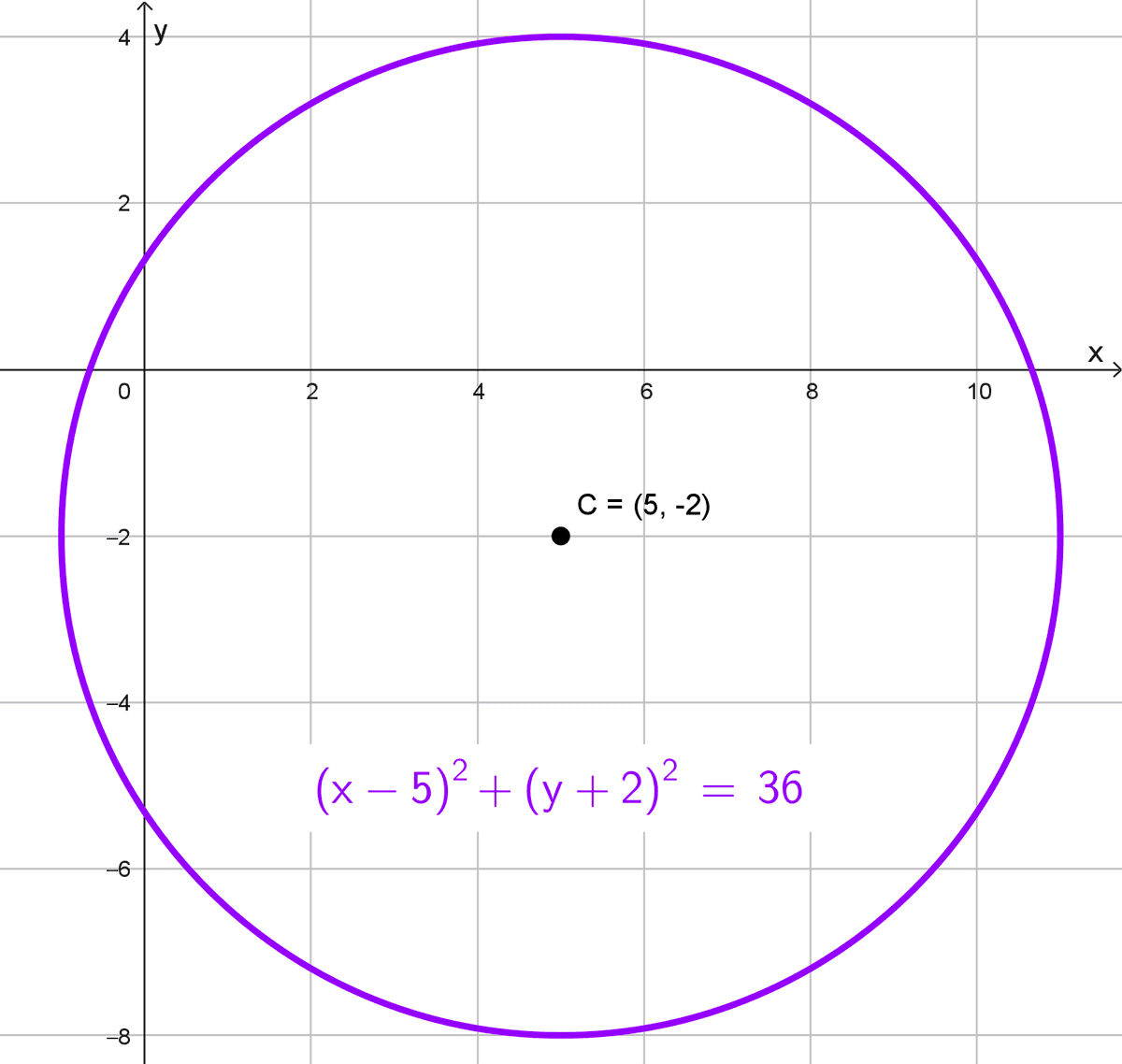
Given equation: \(x^2+y^2-10x+4y-7=0.\) Completing the square produces:
\((x-5)^2+(y+2)^2=36\)
The center is \((5, -2)\) and the radius is \(r=\sqrt{36}=6.\)
Key parameters:
- Center: (5, -2)
- Radius: 6
Solution 6
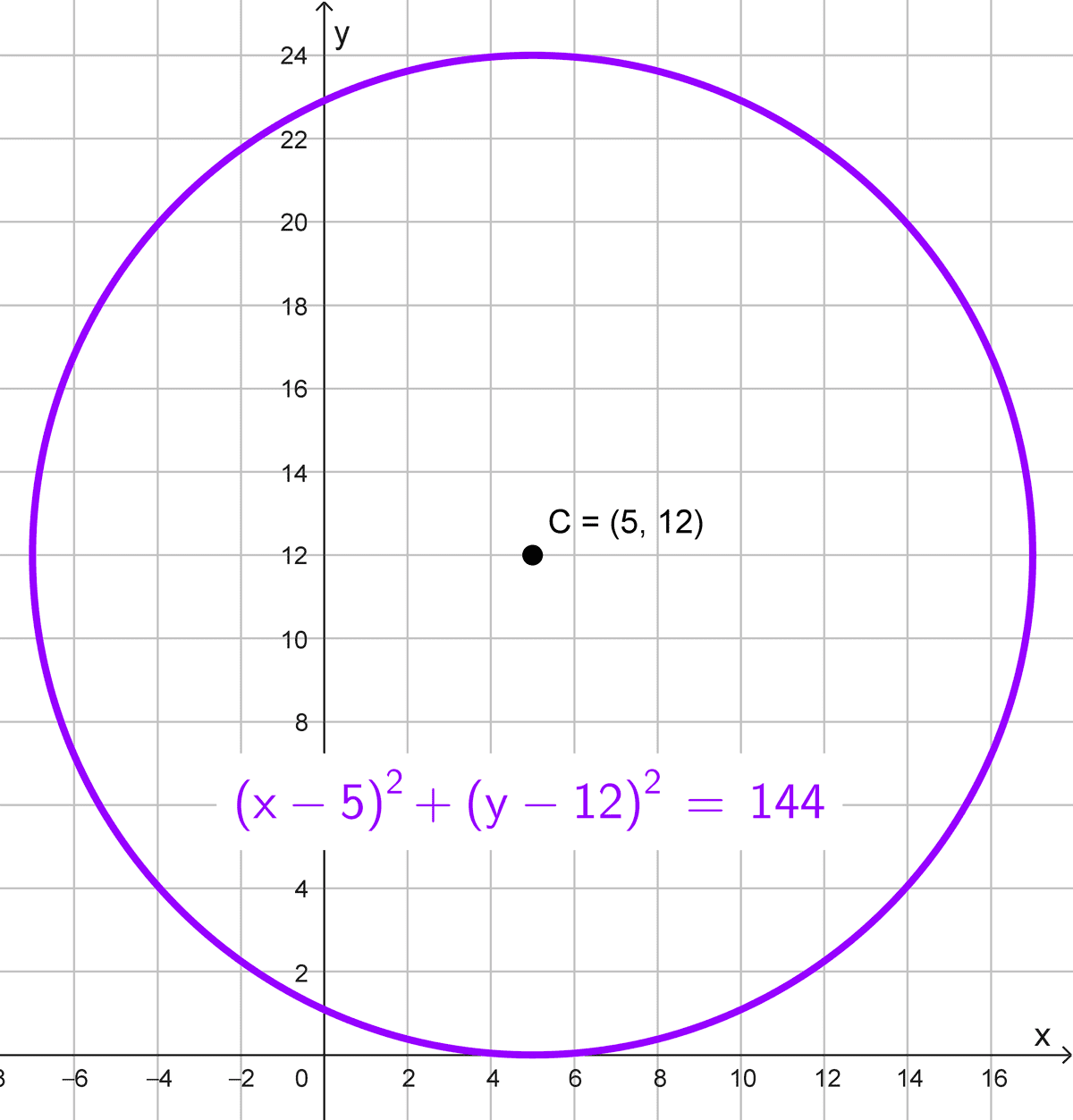
Given equation: \(x^2+y^2-10x-24y+25=0.\) Completing the square:
\((x-5)^2+(y-12)^2=144\)
The center is \((5, 12)\) and the radius is \(r=\sqrt{144}=12.\)
Key parameters:
- Center: (5, 12)
- Radius: 12
Solution 7
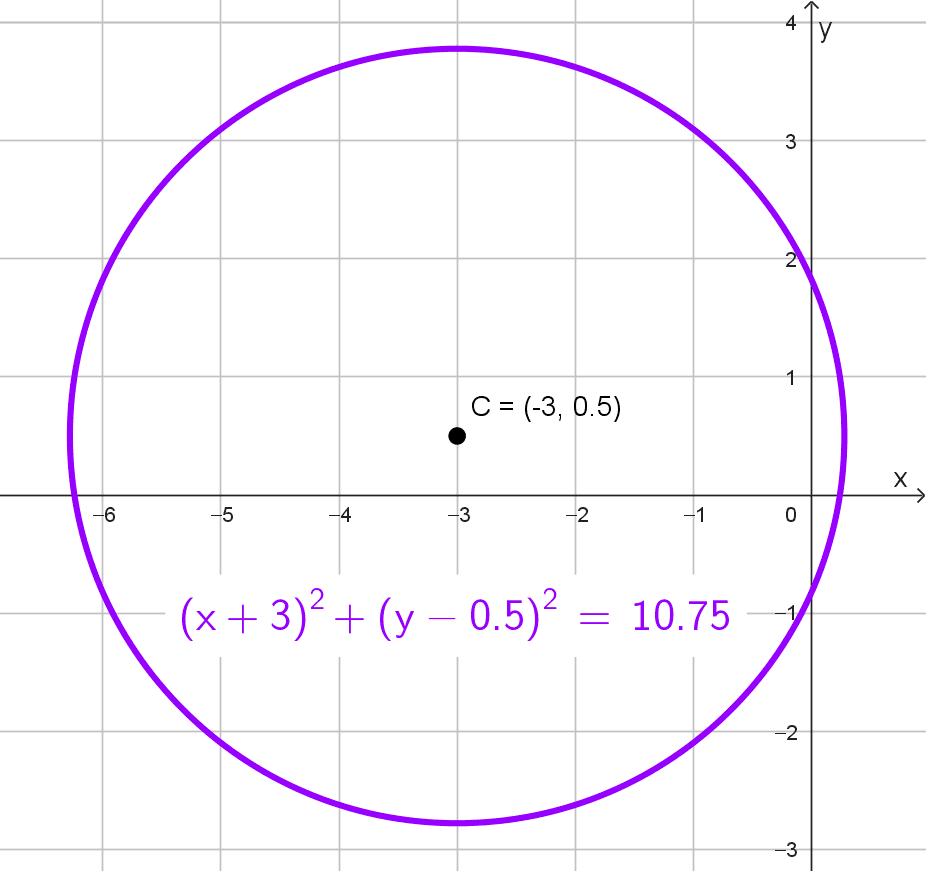
Given equation: \(2x^2+2y^2+12x-2y-3=0.\) Dividing by 2 and completing squares gives:
\((x+3)^2+\left(y-\dfrac{1}{2}\right)^2=\dfrac{43}{4} \implies (x+3)^2+(y-0.5)^2=10.75\)
The center is \((-3, 0.5)\) and the radius is \(r=\sqrt{10.75} \approx 3.28.\)
Key parameters:
- Center: (-3, 0.5)
- Radius: \(\sqrt{10.75} \approx 3.28\)
Solution 8
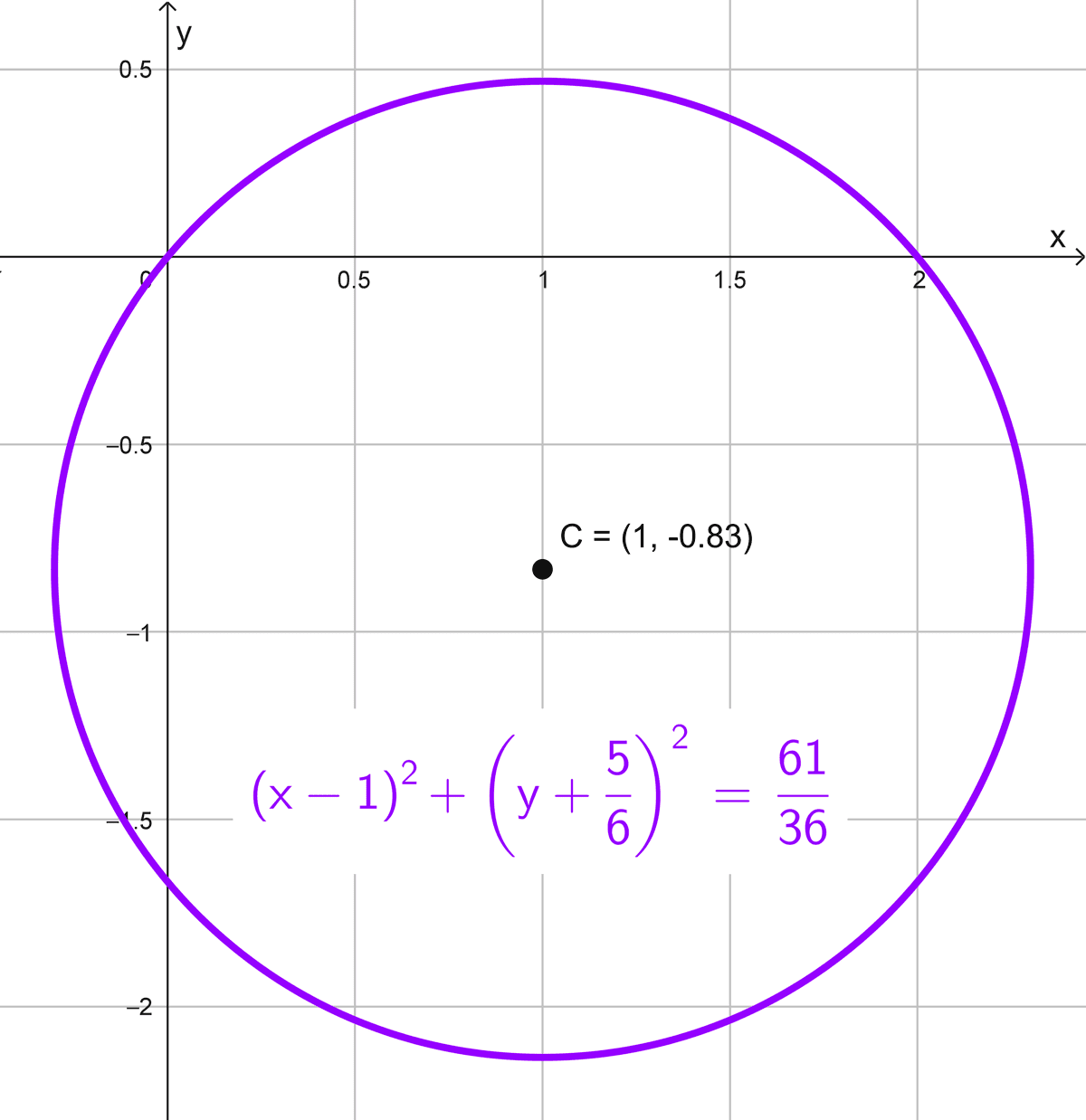
Given equation: \(3x^2+3y^2-6x+5y=0.\) Dividing by 3 and completing the square:
\((x-1)^2+\left(y+\dfrac{5}{6}\right)^2=\dfrac{61}{36}\)
The center is \(\left(1, -\dfrac{5}{6}\right)\) and the radius is \(r=\sqrt{\dfrac{61}{36}}=\dfrac{\sqrt{61}}{6} \approx 1.30.\)
Key parameters:
- Center: \(\left(1, -\dfrac{5}{6}\right)\)
- Radius: \(\dfrac{\sqrt{61}}{6} \approx 1.30\)
Determining whether an equation represents a circle, a point, or no graph
Problem 3: Determine whether each of the following equations represents a circle, a single point (degenerate circle), or has no graph.
- \(x^2+y^2-2x+4y+5=0\)
- \(x^2+y^2-6x+2y+36=0\)
- \(x^2+y^2+4x-8y-5=0\)
- \(x^2+y^2+10y=0\)
- \(x^2+y^2-x=0\)
- \(x^2+y^2+8x+15=0\)
- \(x^2+y^2-4x-4y+9=0\)
- \(x^2+y^2+7x+5y+16=0\)
Solutions
Solution 1
Starting with \(x^2+y^2-2x+4y+5=0,\) complete the square for \(x\) and \(y:\)
For \(x:\) \(x^2-2x = (x-1)^2-1\)
For \(y:\) \(y^2+4y = (y+2)^2-4\)
Substituting into the original equation:
\((x-1)^2-1+(y+2)^2-4+5=0 \implies (x-1)^2+(y+2)^2=0\)
The sum of two real squares equals zero if and only if both expressions are zero: \(x-1=0\) and \(y+2=0.\) Thus, the equation represents a single point: \((1, -2).\) It is not a circle with positive radius, nor is it an empty graph.
Solution 2
Given \(x^2+y^2-6x+2y+36=0,\) completing the square yields:
\((x-3)^2-9+(y+1)^2-1+36=0 \implies (x-3)^2+(y+1)^2=-26\)
Because the sum of squares of real numbers cannot be negative, there are no real solutions. The equation has no graph (empty set).
Solution 3
Given \(x^2+y^2+4x-8y-5=0,\) completing the square produces:
\((x+2)^2-4+(y-4)^2-16-5=0 \implies (x+2)^2+(y-4)^2=25\)
Since the right side is strictly positive (\(r^2=25 > 0\)), this equation represents a circle with center \((-2, 4)\) and radius \(r=5.\)
Solution 4
For \(x^2+y^2+10y=0,\) we complete the square for \(y:\)
\(x^2+(y+5)^2-25=0 \implies x^2+(y+5)^2=25\)
The equation represents a circle with center \((0, -5)\) and radius \(r=5.\)
Solution 5
For \(x^2+y^2-x=0,\) completing the square for \(x\) gives:
\(\left(x-\dfrac{1}{2}\right)^2-\dfrac{1}{4}+y^2=0 \implies \left(x-\dfrac{1}{2}\right)^2+y^2=\dfrac{1}{4}\)
This equation represents a circle with center \(\left(\dfrac{1}{2}, 0\right)\) and radius \(r=\dfrac{1}{2}.\)
Solution 6
Given \(x^2+y^2+8x+15=0,\) completing the square on \(x:\)
\((x+4)^2-16+y^2+15=0 \implies (x+4)^2+y^2=1\)
The equation represents a circle centered at \((-4, 0)\) with radius \(r=1.\)
Solution 7
Given \(x^2+y^2-4x-4y+9=0,\) completing the square on both variables:
\((x-2)^2-4+(y-2)^2-4+9=0 \implies (x-2)^2+(y-2)^2=-1\)
The right side is negative, which is impossible for the sum of two real squares. Hence, the equation has no graph.
Solution 8
For \(x^2+y^2+7x+5y+16=0,\) completing squares:
\(\left(x+\dfrac{7}{2}\right)^2-\dfrac{49}{4}+\left(y+\dfrac{5}{2}\right)^2-\dfrac{25}{4}+16=0 \implies \left(x+\dfrac{7}{2}\right)^2+\left(y+\dfrac{5}{2}\right)^2=\dfrac{5}{2}\)
Because \(\dfrac{5}{2} > 0,\) this represents a circle with center \(\left(-\dfrac{7}{2}, -\dfrac{5}{2}\right)\) and radius \(r=\sqrt{\dfrac{5}{2}}=\dfrac{\sqrt{10}}{2}.\)
Converting general form to standard form
Problem 4: Convert each of the following general form circle equations into standard form by completing the square.
- \(x^2+y^2+6x-4x-12=0\)
- \(x^2+y^2+4x+12y+36=0\)
- \(x^2+y^2-8x-2y+1=0\)
- \(x^2+y^2-10x+4y-7=0\)
- \(x^2+y^2-10x-24y+25=0\)
- \(x^2+y^2+4x+12y+3=0\)
- \(x^2+y^2-3x-4y=0\)
- \(2x^2+2y^2+12x-2y-3=0\)
- \(3x^2+3y^2-6x+5y=0\)
Solutions
Solution 1
Combine like terms in \(x:\) \(x^2+y^2+2x-12=0.\) Move the constant to the right and group the \(x\)-terms:
\((x^2+2x)+y^2=12\)
To complete the square for \(x^2+2x,\) take half of 2, which is 1, and square it (\(1^2=1\)). Add 1 to both sides:
\((x^2+2x+1)+y^2=12+1\)
Factoring into a binomial squared gives the standard form:
\((x+1)^2+y^2=13\)
Solution 2
From \(x^2+y^2+4x+12y+36=0,\) group terms and isolate the constant:
\((x^2+4x)+(y^2+12y)=-36\)
Complete the square for each group by adding \(\left(\dfrac{4}{2}\right)^2=4\) and \(\left(\dfrac{12}{2}\right)^2=36\) to both sides:
\((x^2+4x+4)+(y^2+12y+36)=-36+4+36\)
Factoring into perfect squares gives standard form:
\((x+2)^2+(y+6)^2=4\)
Solution 3
Given \(x^2+y^2-8x-2y+1=0,\) regroup terms:
\((x^2-8x)+(y^2-2y)=-1\)
Add \((-4)^2=16\) and \((-1)^2=1\) to both sides:
\((x^2-8x+16)+(y^2-2y+1)=-1+16+1\)
Factoring produces the standard form:
\((x-4)^2+(y-1)^2=16\)
Solution 4
Starting with \(x^2+y^2-10x+4y-7=0:\)
\((x^2-10x)+(y^2+4y)=7\)
Add \((-5)^2=25\) and \(2^2=4\) to both sides:
\((x^2-10x+25)+(y^2+4y+4)=7+25+4\)
The standard form is:
\((x-5)^2+(y+2)^2=36\)
Solution 5
Given \(x^2+y^2-10x-24y+25=0:\)
\((x^2-10x)+(y^2-24y)=-25\)
Complete the squares by adding \(25\) and \(144\) to both sides:
\((x^2-10x+25)+(y^2-24y+144)=-25+25+144\)
Standard form:
\((x-5)^2+(y-12)^2=144\)
Solution 6
For \(x^2+y^2+4x+12y+3=0:\)
\((x^2+4x)+(y^2+12y)=-3\)
Adding \(4\) and \(36\) to both sides:
\((x^2+4x+4)+(y^2+12y+36)=-3+4+36\)
Standard form:
\((x+2)^2+(y+6)^2=37\)
Solution 7
From \(x^2+y^2-3x-4y=0,\) group terms:
\((x^2-3x)+(y^2-4y)=0\)
Add \(\left(-\dfrac{3}{2}\right)^2=2.25\) and \((-2)^2=4\) to both sides:
\((x^2-3x+2.25)+(y^2-4y+4)=0+2.25+4\)
Standard form:
\((x-1.5)^2+(y-2)^2=6.25 \quad \text{or} \quad \left(x-\dfrac{3}{2}\right)^2+(y-2)^2=\dfrac{25}{4}\)
Solution 8
Given \(2x^2+2y^2+12x-2y-3=0,\) divide the entire equation by 2 first:
\(x^2+y^2+6x-y=\dfrac{3}{2}\)
Group terms and complete the squares by adding \(3^2=9\) and \((-0.5)^2=0.25:\)
\((x^2+6x+9)+(y^2-y+0.25)=1.5+9+0.25\)
Standard form:
\((x+3)^2+(y-0.5)^2=10.75 \quad \text{or} \quad (x+3)^2+\left(y-\dfrac{1}{2}\right)^2=\dfrac{43}{4}\)
Solution 9
Given \(3x^2+3y^2-6x+5y=0,\) divide by 3:
\(x^2+y^2-2x+\dfrac{5}{3}y=0\)
Group terms and add \(1^2=1\) and \(\left(\dfrac{5}{6}\right)^2=\dfrac{25}{36}\) to both sides:
\((x^2-2x+1)+\left(y^2+\dfrac{5}{3}y+\dfrac{25}{36}\right)=0+1+\dfrac{25}{36}\)
Standard form:
\((x-1)^2+\left(y+\dfrac{5}{6}\right)^2=\dfrac{61}{36}\)
Converting standard form to general form
Problem 5: Expand each of the following standard form equations into general form \(Ax^2+Ay^2+Dx+Ey+F=0.\)
- \((x-3)^2+(y+2)^2=9\)
- \((x+1)^2+y^2=\dfrac{25}{4}\)
- \((x-4)^2+(y+3)^2=\dfrac{1}{9}\)
Solutions
Solution 1
From \((x-3)^2+(y+2)^2=9,\) expand each squared binomial:
\(x^2-6x+9+y^2+4y+4=9\)
Collect terms on the left side:
\(x^2+y^2-6x+4y+(13-9)=0 \implies x^2+y^2-6x+4y+4=0\)
Solution 2
From \((x+1)^2+y^2=\dfrac{25}{4},\) expand the first binomial:
\(x^2+2x+1+y^2=\dfrac{25}{4}\)
Multiply the entire equation by 4 to eliminate denominators:
\(4x^2+8x+4+4y^2=25 \implies 4x^2+4y^2+8x-21=0\)
In normalized form (dividing by 4): \(x^2+y^2+2x-\dfrac{21}{4}=0.\)
Solution 3
Starting with \((x-4)^2+(y+3)^2=\dfrac{1}{9},\) expand the squared binomials:
\(x^2-8x+16+y^2+6y+9=\dfrac{1}{9}\)
Multiply through by 9:
\(9x^2-72x+144+9y^2+54y+81=1 \implies 9x^2+9y^2-72x+54y+224=0\)
In normalized form: \(x^2+y^2-8x+6y+\dfrac{224}{9}=0.\)
Finding circumference and area of a circle
Problem 6: Calculate the perimeter (circumference) and the area enclosed by each of the following circles.
- \(x^2+y^2=25\)
- \(x^2+y^2+6x-4x-12=0\)
- \(x^2+y^2+4x+12y+36=0\)
- \(x^2+y^2-8x-2y+1=0\)
- \(x^2+y^2-10x+4y-7=0\)
Solutions
Solution 1
From \(x^2+y^2=25,\) we have \(r^2=25,\) so \(r=5.\)
Using the circumference formula \(C=2\pi r:\)
\(C=2\pi(5)=10\pi \text{ units}\)
Using the area formula \(A=\pi r^2:\)
\(A=\pi(5^2)=25\pi \text{ square units}\)
Solution 2
Completing the square on \(x^2+y^2+6x-4x-12=0\) gives \((x+1)^2+y^2=13,\) which gives \(r=\sqrt{13}.\)
The circumference is:
\(C=2\pi\sqrt{13}=2\sqrt{13}\pi \text{ units}\)
The area is:
\(A=\pi(\sqrt{13})^2=13\pi \text{ square units}\)
Solution 3
Completing the square on \(x^2+y^2+4x+12y+36=0\) gives \((x+2)^2+(y+6)^2=4,\) so \(r=2.\)
Circumference:
\(C=2\pi(2)=4\pi \text{ units}\)
Area:
\(A=\pi(2^2)=4\pi \text{ square units}\)
Solution 4
Completing the square on \(x^2+y^2-8x-2y+1=0\) yields \((x-4)^2+(y-1)^2=16,\) so \(r=4.\)
Circumference:
\(C=2\pi(4)=8\pi \text{ units}\)
Area:
\(A=\pi(4^2)=16\pi \text{ square units}\)
Solution 5
Completing the square on \(x^2+y^2-10x+4y-7=0\) yields \((x-5)^2+(y+2)^2=36,\) so \(r=6.\)
Circumference:
\(C=2\pi(6)=12\pi \text{ units}\)
Area:
\(A=\pi(6^2)=36\pi \text{ square units}\)
Real-world circle word problems
The following problems illustrate practical applications of circles in everyday scenarios, physical sciences, and geometry.
Problem 7
A bicycle wheel has a diameter of 70 cm. How many meters does the bicycle travel after 50 complete wheel rotations without slipping?
Solution
Each complete rotation covers a distance equal to the wheel's circumference \(C:\)
\(C=\pi d = 70\pi \approx 219.91 \text{ cm}\)
For 50 full rotations, the total distance traveled is:
\(\text{Total distance}=50 \times 219.91 \approx 10995.5 \text{ cm}\)
Converting centimeters to meters:
\(\dfrac{10995.5}{100} = 109.955 \approx 109.96 \text{ m}\)
The bicycle travels approximately 109.96 meters.
Problem 8
A round banquet table has a diameter of 1.5 m. Circular tablecloths are placed over the tables, overhanging by 20 cm along the entire edge. What is the area of fabric required for each tablecloth?
Solution
The table has a radius of \(r_{\text{table}} = \dfrac{1.5}{2} = 0.75\text{ m}.\) The overhang is \(20\text{ cm} = 0.2\text{ m},\) so the radius of the tablecloth is:
\(r_{\text{cloth}} = 0.75 + 0.2 = 0.95 \text{ m}\)
Calculating the circular area:
\(A = \pi r^2 = \pi (0.95)^2 = 0.9025\pi \approx 2.835 \text{ m}^2\)
Approximately 2.835 square meters of fabric are needed for each tablecloth.
Problem 9
A circular billboard has an area of 15.7 m². What is the radius of the billboard?
Solution
Using the area formula \(A=\pi r^2:\)
\(r^2 = \dfrac{A}{\pi} = \dfrac{15.7}{\pi} \approx \dfrac{15.7}{3.1416} \approx 4.9975\)
Taking the square root:
\(r = \sqrt{4.9975} \approx 2.24 \text{ m}\)
The radius of the billboard is approximately 2.24 meters.
Problem 10
A circular manhole cover has a radius of 0.3 m. How much paint is required to coat it completely with two coats if each liter of paint covers 3 m²?
Solution
The area of the cover is:
\(A = \pi r^2 = \pi (0.3)^2 = 0.09\pi \approx 0.2827 \text{ m}^2\)
Applying two full coats doubles the coverage required:
\(A_{\text{total}} = 2 \times 0.2827 \approx 0.5655 \text{ m}^2\)
Since 1 liter covers \(3 \text{ m}^2:\)
\(\text{Paint needed} = \dfrac{0.5655}{3} \approx 0.1885 \text{ L}\)
Approximately 0.19 liters of paint are required.
Problem 11
An automated irrigation sprinkler covers a circular area with a radius of 12 m. What is the total area irrigated? By how much does the irrigated area decrease if the spray radius is reduced to 10 m?
Solution
With an initial radius \(r_1 = 12\text{ m}:\)
\(A_1 = \pi (12)^2 = 144\pi \text{ m}^2\)
When the radius is reduced to \(r_2 = 10\text{ m}:\)
\(A_2 = \pi (10)^2 = 100\pi \text{ m}^2\)
The reduction in coverage is the difference between both areas:
\(\Delta A = 144\pi - 100\pi = 44\pi \approx 138.23 \text{ m}^2\)
Answers:
- Total coverage at \(r = 12\text{ m}:\) \(144\pi \approx 452.39 \text{ m}^2\)
- Area reduction at \(r = 10\text{ m}:\) \(44\pi \approx 138.23 \text{ m}^2\)
Problem 12
A town square has a circular fountain in the center surrounded by a circular walkway. If the fountain's diameter is 6 m and the outer edge of the walkway has a diameter of 12 m, what is the walking area?
Solution
The inner radius (fountain) is \(r = \dfrac{6}{2} = 3\text{ m},\) and the outer radius (walkway edge) is \(R = \dfrac{12}{2} = 6\text{ m}.\)
The walkable area forms an annulus (circular ring):
\(A = \pi R^2 - \pi r^2 = \pi (6^2 - 3^2) = \pi (36 - 9) = 27\pi \approx 84.82 \text{ m}^2\)
The area available for walking is \(27\pi \approx \mathbf{84.82\text{ square meters}}.\)
Problem 13
A cellular transmission tower has a circular signal range with a radius of 10 km. If two towers are placed 15 km apart, is there any dead zone between them along the line segment connecting them?
Solution
Place tower \(A\) at the origin \((0, 0)\) with signal boundary \(x^2+y^2=100,\) and tower \(B\) at \((15, 0)\) with boundary \((x-15)^2+y^2=100.\)
The distance between the two centers is \(d = 15\text{ km}.\) The sum of their coverage radii is \(r_1 + r_2 = 10 + 10 = 20\text{ km}.\)
Because \(d < r_1 + r_2\) (\(15 < 20\)), their circular ranges intersect and overlap by \(5\text{ km}\) along the straight line connecting them. The midpoint between the towers is \(7.5\text{ km}\) from each tower, which is within the \(10\text{ km}\) broadcast limit of both towers.
Therefore, there is no dead zone between the two towers.
Problem 14
A communications satellite orbits Earth at a constant altitude of 600 km above the surface. If the Earth's radius is approximately 6,378 km, what is the satellite's orbital path length during one complete orbit?
Solution
The orbital radius is the sum of the Earth's radius and the satellite's altitude:
\(r = 6378 + 600 = 6978 \text{ km}\)
The distance traveled during one complete circular orbit equals the circumference:
\(C = 2\pi r = 2\pi (6978) \approx 2 \times 3.14159 \times 6978 \approx 43844.1 \text{ km}\)
The orbital path length is approximately 43,844.1 kilometers.
Did you find this useful? Rate it!

Leave a Reply