
Ellipse
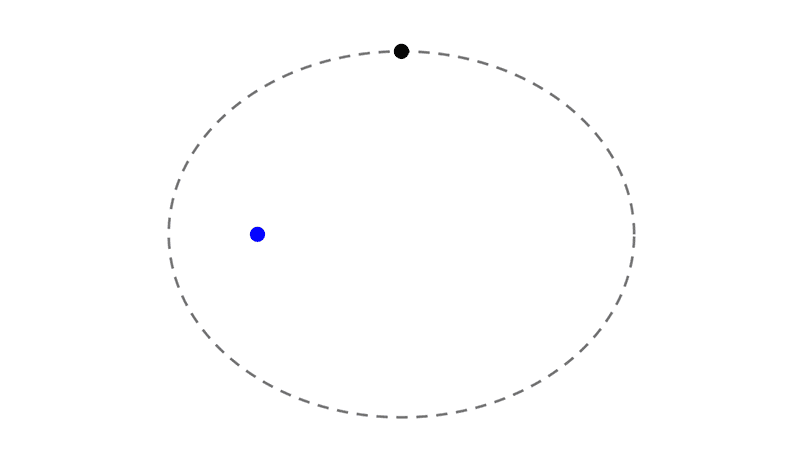
An ellipse is a smooth, closed, simple plane curve defined as the geometric locus of all points in a plane such that the sum of their distances to two fixed points, called foci, is constant.
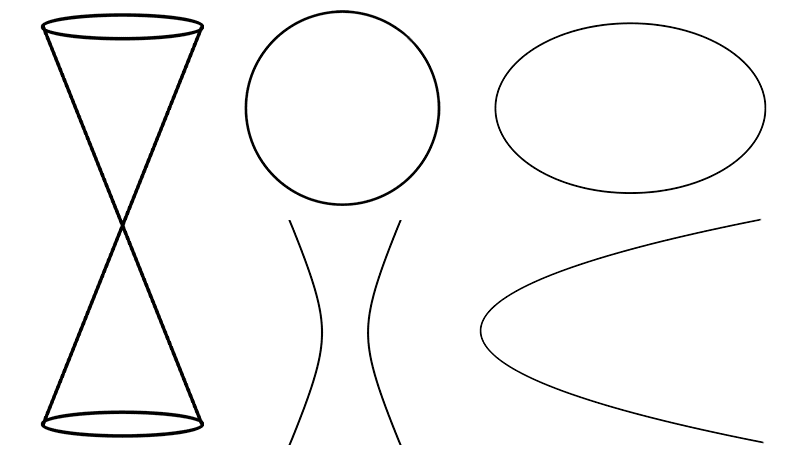
An ellipse is also a conic section formed by intersecting a right circular cone with a plane that passes through all of its generatrices without being perpendicular to the axis of the cone. The orientation and inclination of the plane determine the exact shape of the resulting ellipse.

Below, we will explore key aspects of the ellipse in mathematics: its primary parts and elements, equations, examples, geometric properties, and real-world applications, among other topics.
Table of Contents
Parts of an Ellipse
An ellipse possesses characteristic geometric elements that allow us to define its shape, analyze its orientation, and understand its properties. The fundamental components of an ellipse are:
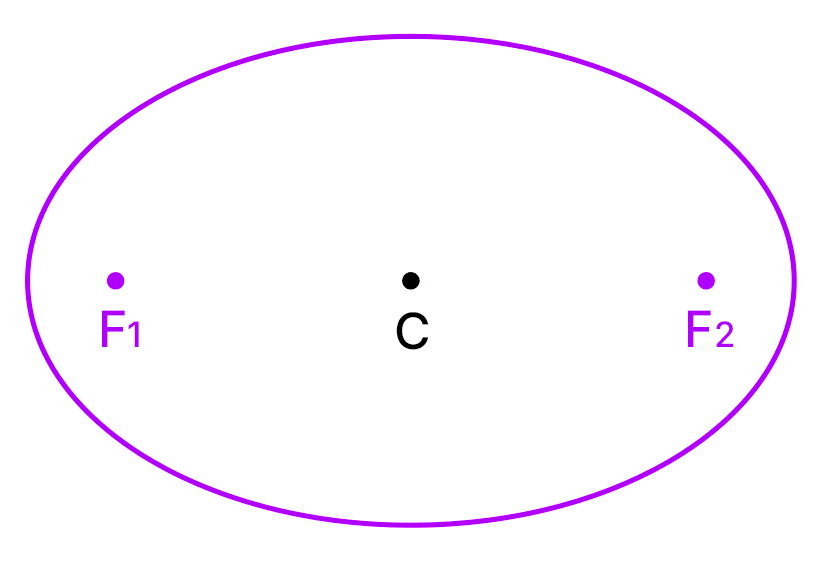
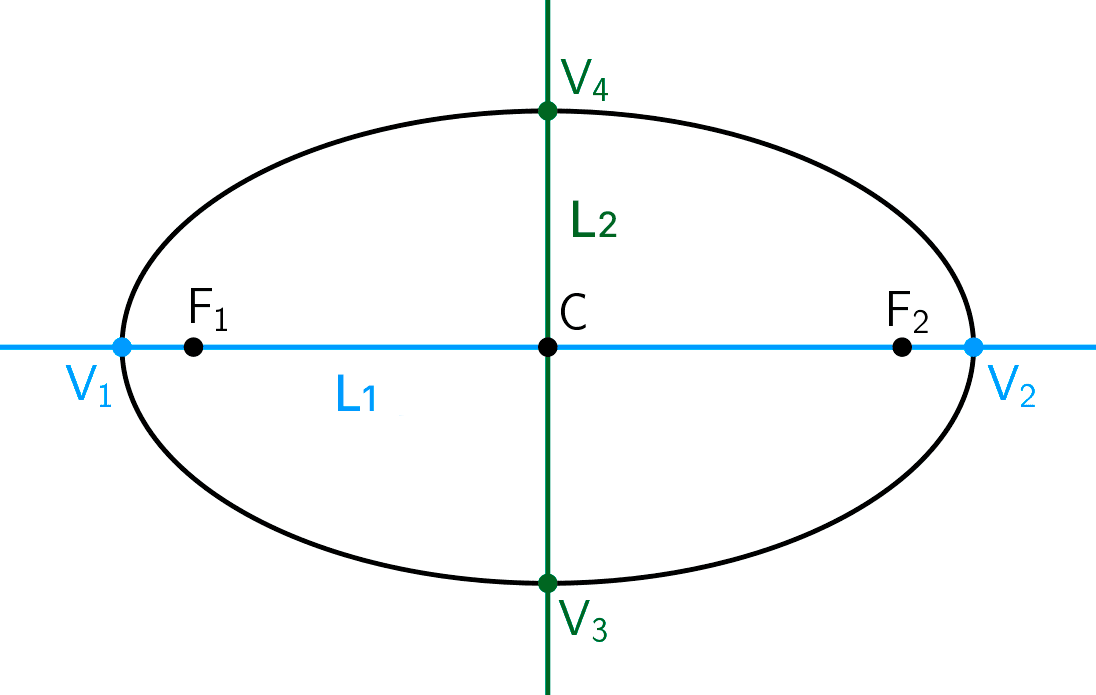
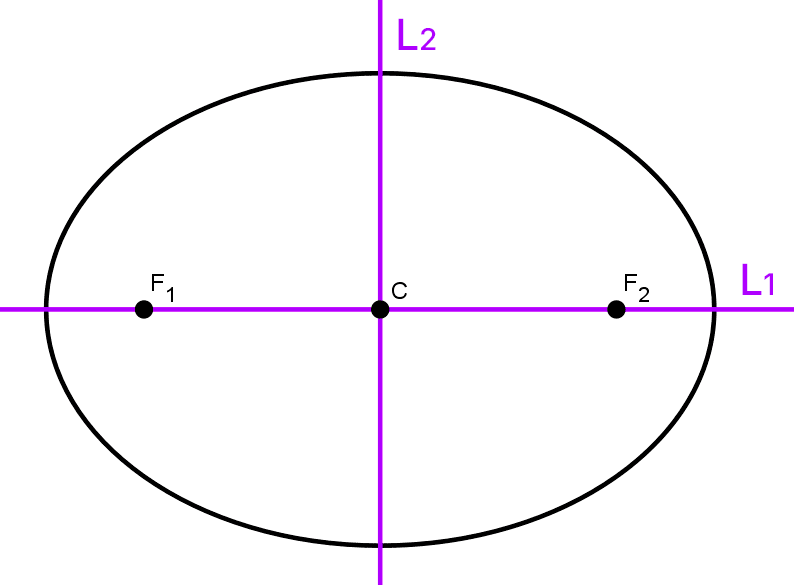
- Foci (F1 and F2): Two fixed points in the plane. The defining property of an ellipse is that the sum of the distances from any point on the curve to these two foci remains constant.
- Center (C): The midpoint of the segment joining the two foci, which serves as the center of symmetry for the curve.
- Focal Axis (Principal Axis): The line passing through the foci and the center. It is a primary axis of symmetry for the ellipse.
- Conjugate Axis (Minor Axis Line): The line perpendicular to the focal axis that passes through the center. It represents the second axis of symmetry.
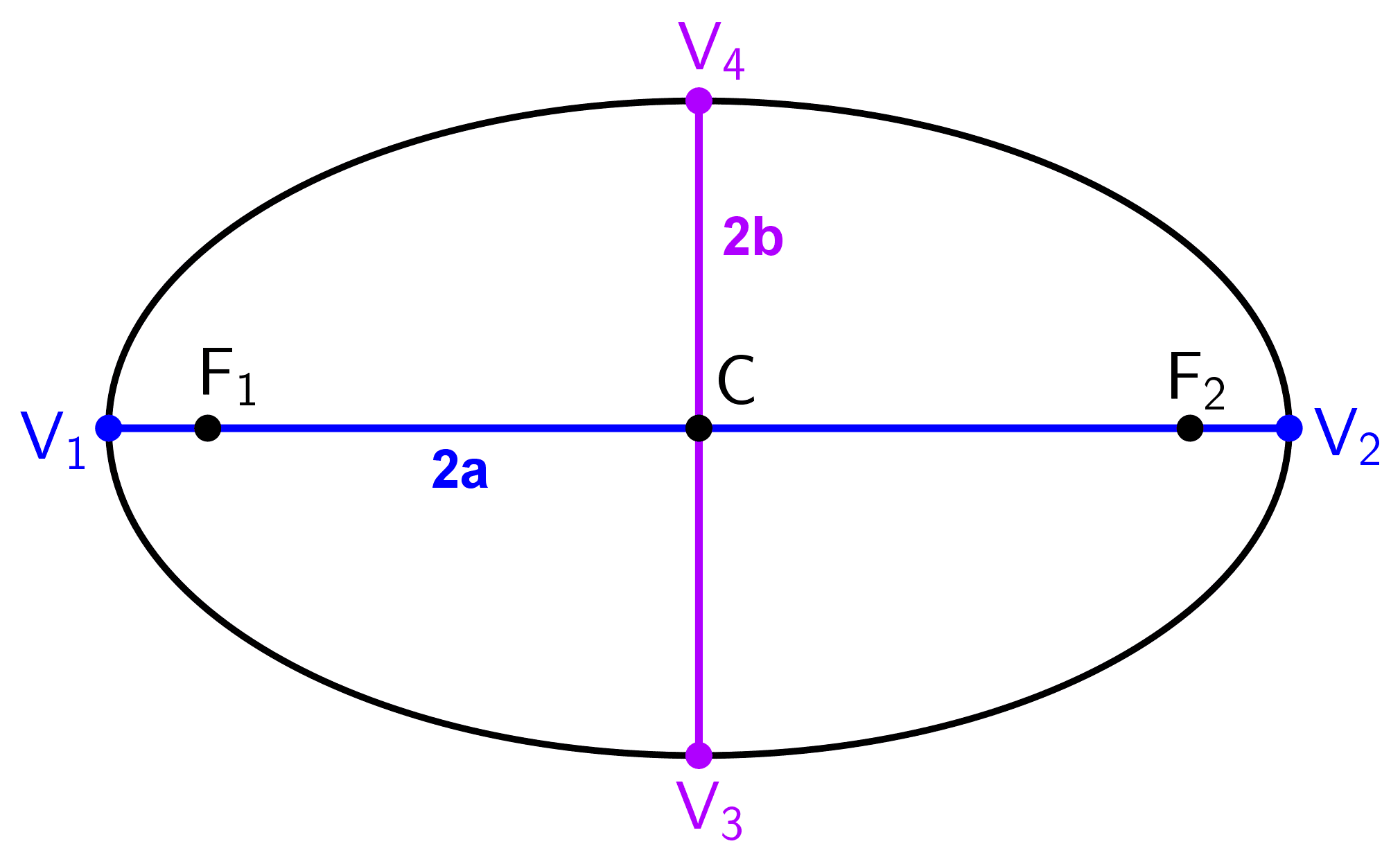
- Major Axis (2a): The longest line segment passing through the center and foci, terminating at the curve's outer boundaries. It represents the maximum distance between two opposing points on the ellipse, and its total length is 2a. Half of this segment is called the semi-major axis (a). The major axis lies directly along the focal axis.
- Minor Axis (2b): The line segment perpendicular to the major axis that passes through the center and connects opposing points on the curve. It represents the minimum width of the ellipse, and its total length is 2b. Half of this segment is known as the semi-minor axis (b). The minor axis lies along the conjugate axis.
- Focal Radii: The line segments connecting an arbitrary point P on the ellipse to each of the two foci. The sum of the lengths of these focal radii is always constant and equal to the length of the major axis (2a): d(P, F1) + d(P, F2) = 2a.
- Vertices and Co-vertices: The four points where the ellipse intersects its axes of symmetry. The endpoints of the major axis are called vertices (V1 and V2), while the endpoints of the minor axis are referred to as co-vertices (V3 and V4).
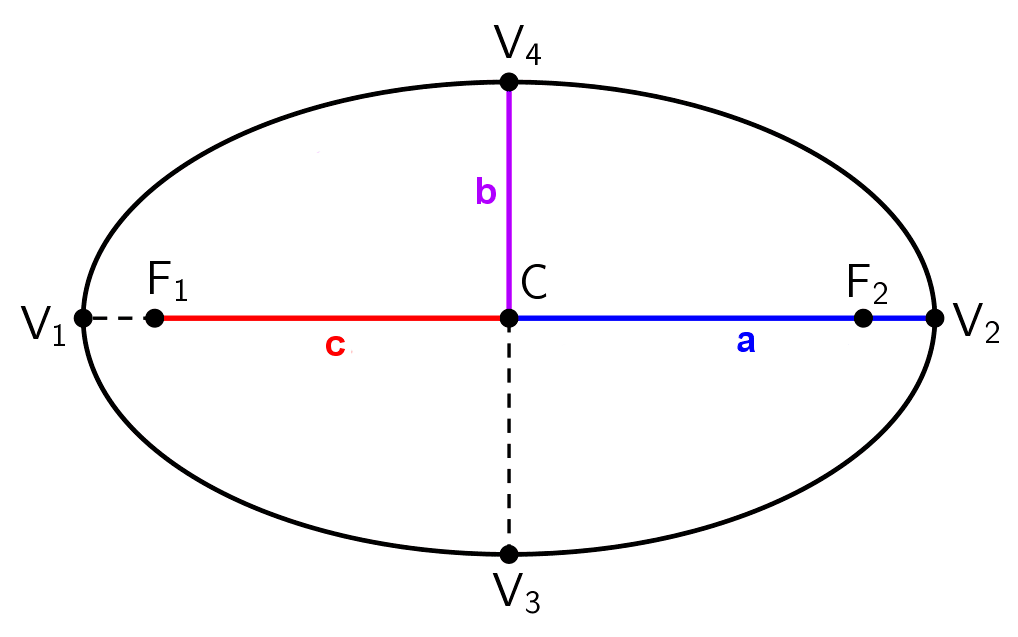
- Focal Distance (2c): The total distance between the two foci, denoted as 2c, where c represents the distance from the center to either focus (the focal length). This distance is related to the semi-axes through the equation c2 = a2 - b2.
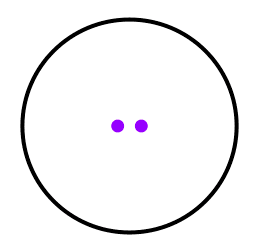
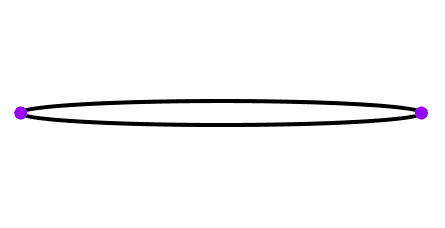
- Eccentricity (e): The ratio of the focal length to the semi-major axis: e = c / a. This dimensionless value measures how elongated or "flattened" the ellipse is compared to a circle, always satisfying 0 ≤ e < 1.
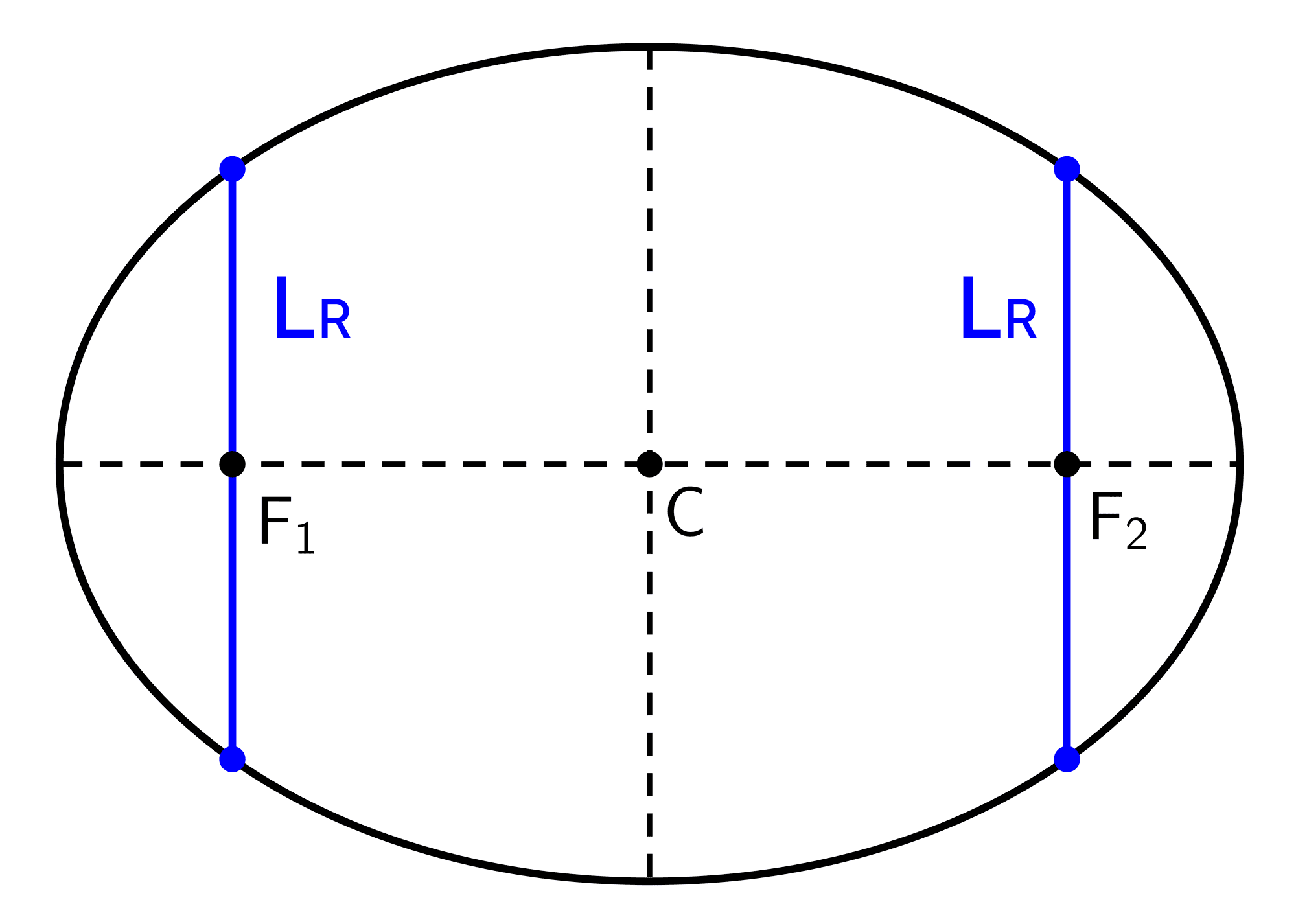
- Latus Rectum (LR): A line segment perpendicular to the major axis that passes through a focus and terminates on the curve. Every ellipse has two latera recta, each with a length given by LR = 2b2 / a.

An ellipse, like any conic section, can be expressed using various mathematical forms (general, parametric, polar, etc.). Among these, the most widely used is the standard form equation in Cartesian coordinates, which allows key geometric parameters to be identified by inspection.
The standard equation isolates the coordinates of the center and the squared semi-axes, providing direct information needed to graph the ellipse and calculate its geometric properties.
Below, we examine the standard form in detail. Later in this article, we will also explore the general, parametric, and polar equations.
Standard Form Equation
The standard equation of an ellipse depends on the position of its center and whether its major axis is oriented horizontally or vertically.
1) When the center is at the origin (0, 0):
- Horizontal ellipse (major axis along the x-axis): \(\dfrac{x^2}{a^2}+\dfrac{y^2}{b^2}=1\)
- Vertical ellipse (major axis along the y-axis): \(\dfrac{x^2}{b^2}+\dfrac{y^2}{a^2}=1\)
2) When the center is translated to a point (h, k):
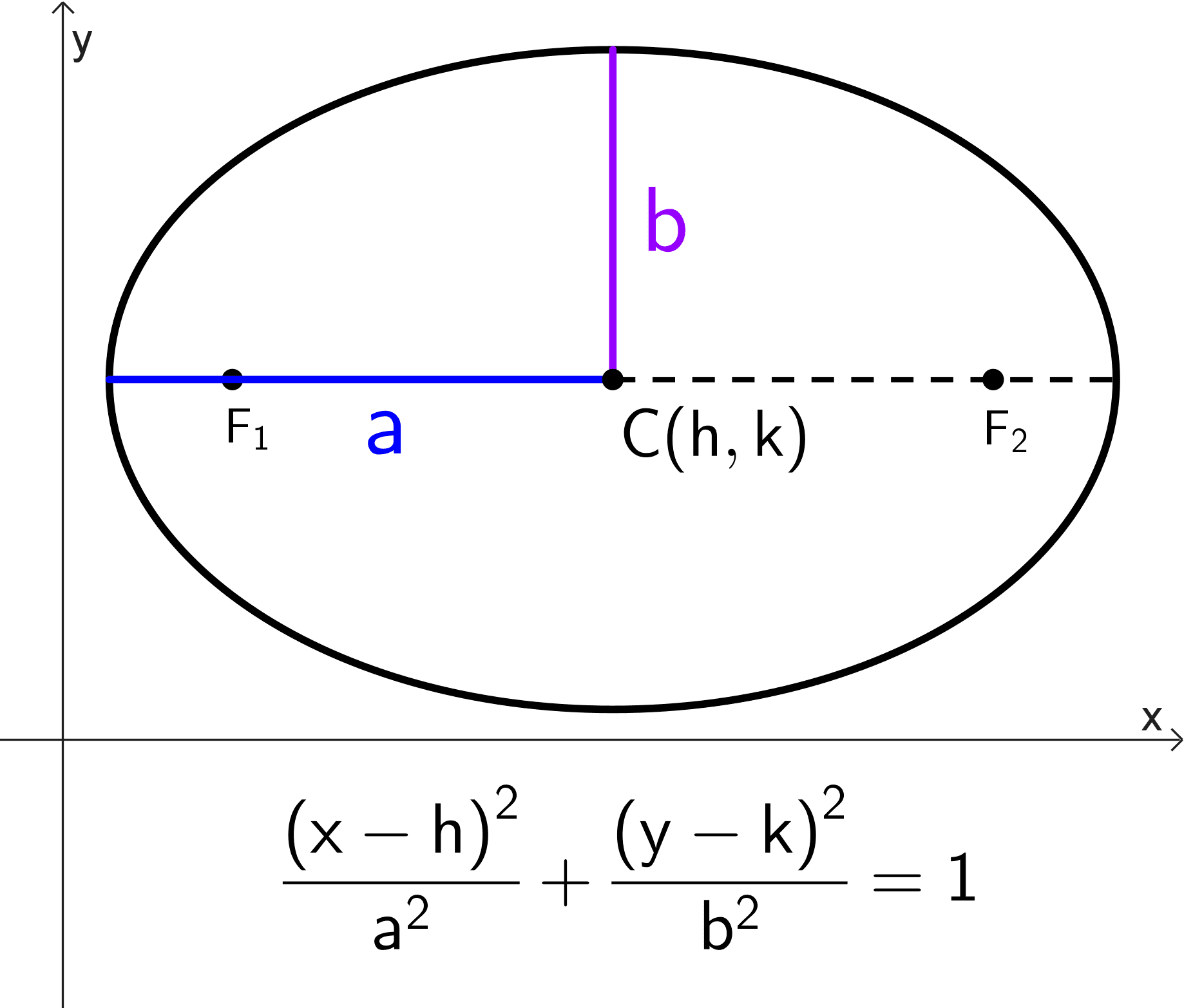
- Horizontal ellipse (major axis parallel to the x-axis): \(\dfrac{(x-h)^2}{a^2}+\dfrac{(y-k)^2}{b^2}=1\)
- Vertical ellipse (major axis parallel to the y-axis): \(\dfrac{(x-h)^2}{b^2}+\dfrac{(y-k)^2}{a^2}=1\)
In all cases, a denotes the length of the semi-major axis, b represents the length of the semi-minor axis, and a > b. Derivations for these formulas are detailed further down in this guide. Below are graphs illustrating each orientation.



Identifying Elements from the Equation
- Orientation: Determined by which denominator is larger. If the larger denominator is located under the x-term, the ellipse is horizontal. If the larger denominator is under the y-term, the ellipse is vertical.
- Semi-axes: Determined by taking the square root of the denominators. The square root of the larger denominator yields the semi-major axis (a), while the square root of the smaller denominator yields the semi-minor axis (b).
- Center: Extracted directly from the linear shifts inside the squared binomials. The x-coordinate (h) is paired with x, and the y-coordinate (k) is paired with y, reversing the signs in (x - h) and (y - k). When a variable appears without an added or subtracted constant, that coordinate is 0.
The foci and vertices can be determined directly from the parameters extracted from standard form, as organized in the reference table below. Remember that the focal distance (c) is calculated using \(c=\sqrt{a^2-b^2}.\)
| Equation | Major Axis | Center | Foci | Vertices & Co-vertices |
|---|---|---|---|---|
| \(\dfrac{x^2}{a^2}+\dfrac{y^2}{b^2}=1\) | Along x-axis | (0, 0) | (±c, 0) | Vertices: (±a, 0) Co-vertices: (0, ±b) |
| \(\dfrac{x^2}{b^2}+\dfrac{y^2}{a^2}=1\) | Along y-axis | (0, 0) | (0, ±c) | Vertices: (0, ±a) Co-vertices: (±b, 0) |
| \(\dfrac{(x-h)^2}{a^2}+\dfrac{(y-k)^2}{b^2}=1\) | Parallel to x-axis | (h, k) | (h ± c, k) | Vertices: (h ± a, k) Co-vertices: (h, k ± b) |
| \(\dfrac{(x-h)^2}{b^2}+\dfrac{(y-k)^2}{a^2}=1\) | Parallel to y-axis | (h, k) | (h, k ± c) | Vertices: (h, k ± a) Co-vertices: (h ± b, k) |
Examples
Below are step-by-step examples of analyzing ellipse equations, extracting their main components, and reviewing their graphs.
Example 1
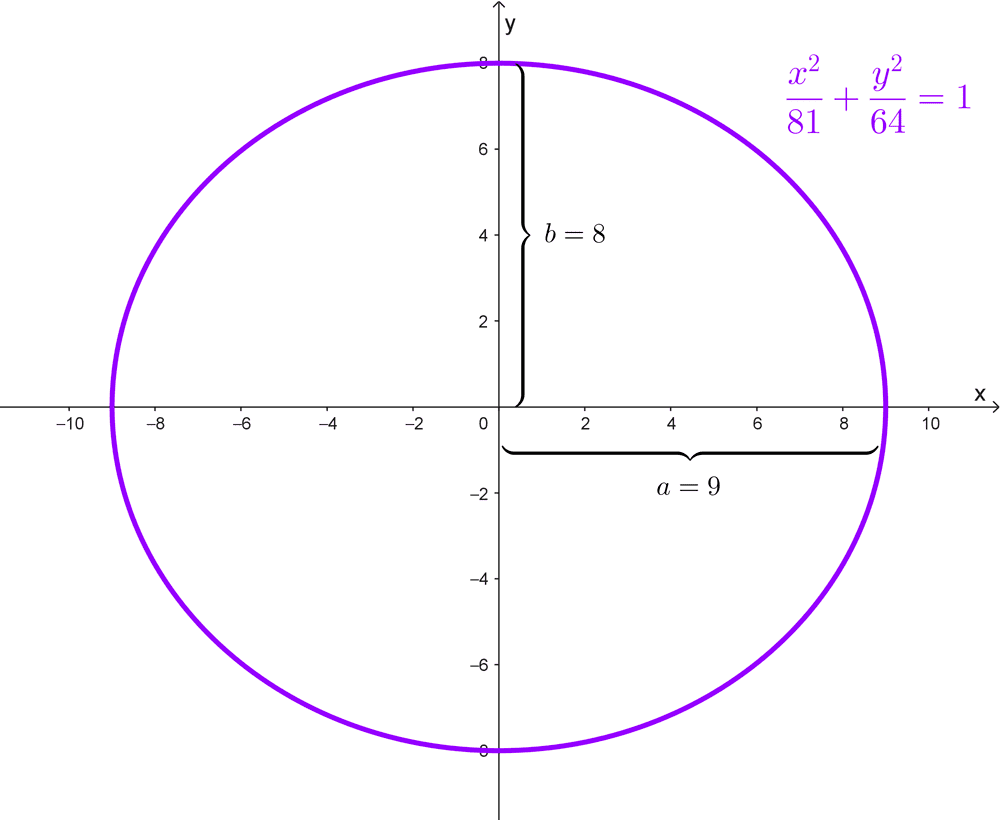
\(\dfrac{x^2}{81}+\dfrac{y^2}{64}=1\)
This equation corresponds to an ellipse centered at the origin, because no constants are subtracted from x or y in the numerators. The denominators are 81 and 64. Since the denominator under x2 is larger, the ellipse has a horizontal orientation (major axis on the x-axis).
We extract the semi-axis lengths by taking the square root of both denominators. The larger value corresponds to the semi-major axis (a) and the smaller to the semi-minor axis (b):
\(a=\sqrt{81}=9\)
\(b=\sqrt{64}=8\)
Therefore, the ellipse is horizontal, with semi-axes \(a=9,\) \(b=8,\) and center at the origin (0, 0). Its graph is shown below.
Example 2
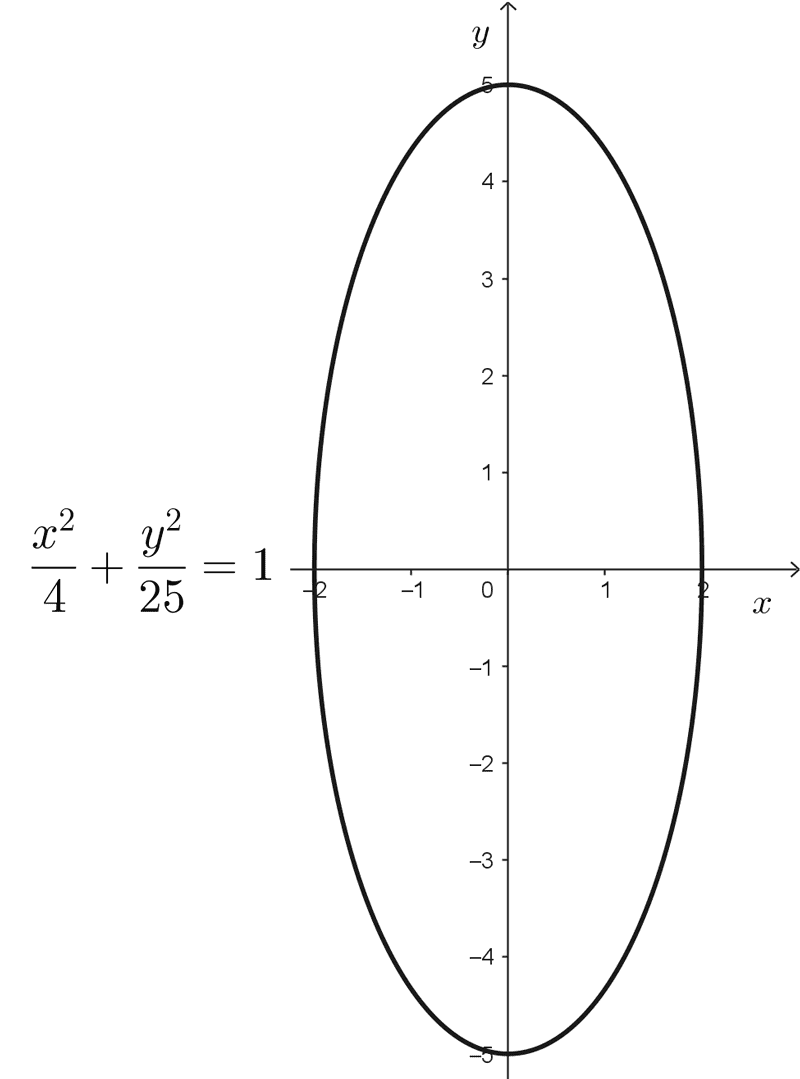
\(\dfrac{x^2}{4}+\dfrac{y^2}{25}=1\)
This equation represents an ellipse centered at the origin. The denominators are 4 and 25. Since the denominator under y2 is larger than the one under x2, the ellipse has a vertical orientation (its major axis lies along the y-axis).
Finding the semi-axis lengths:
\(a=\sqrt{25}=5\)
\(b=\sqrt{4}=2\)
Thus, the ellipse is vertical, with semi-axes \(a=5, b=2,\) and center at (0, 0).
Example 3
\(\dfrac{x^2}{16}+\dfrac{y^2}{9}=1\)
This ellipse is centered at the origin with denominators 16 and 9. Because 16 > 9 and sits under x2, the major axis is on the x-axis, making this a horizontal ellipse.
Computing the semi-axes:
\(a=\sqrt{16}=4, \quad b=\sqrt{9}=3\)
Consequently, the ellipse is horizontal, with semi-axes \(a=4\), \(b=3,\) and center at (0, 0).

Example 4
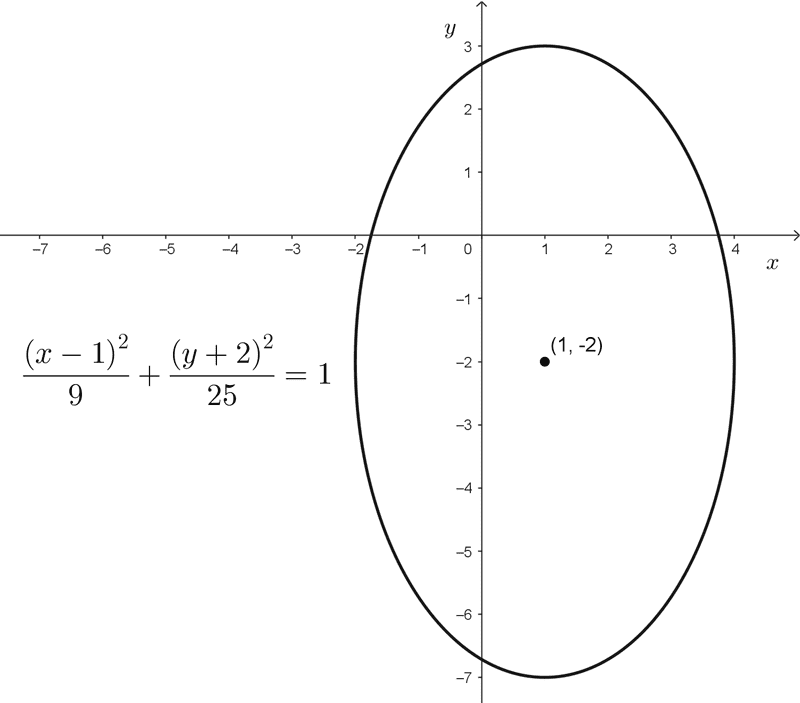
\(\dfrac{(x-1)^2}{9}+\dfrac{(y+2)^2}{25}=1\)
This equation corresponds to an ellipse shifted away from the origin. The denominators are 9 and 25. Since the larger denominator is under the y-term, the major axis is parallel to the y-axis, indicating a vertical ellipse.
To identify the center, compare with \((x-h)^2\) and \((y-k)^2\):
\(x-h=x-1 \quad → \quad h=1\)
\(y-k=y+2 \quad → \quad k=-2\)
Thus, the center is at C(1, -2).
Calculating the semi-axes:
\(a=\sqrt{25}=5, \quad b=\sqrt{9}=3\)
In conclusion, the ellipse is vertical, centered at \((1,-2),\) with semi-major axis \(a=5\) and semi-minor axis \(b=3.\)
Example 5
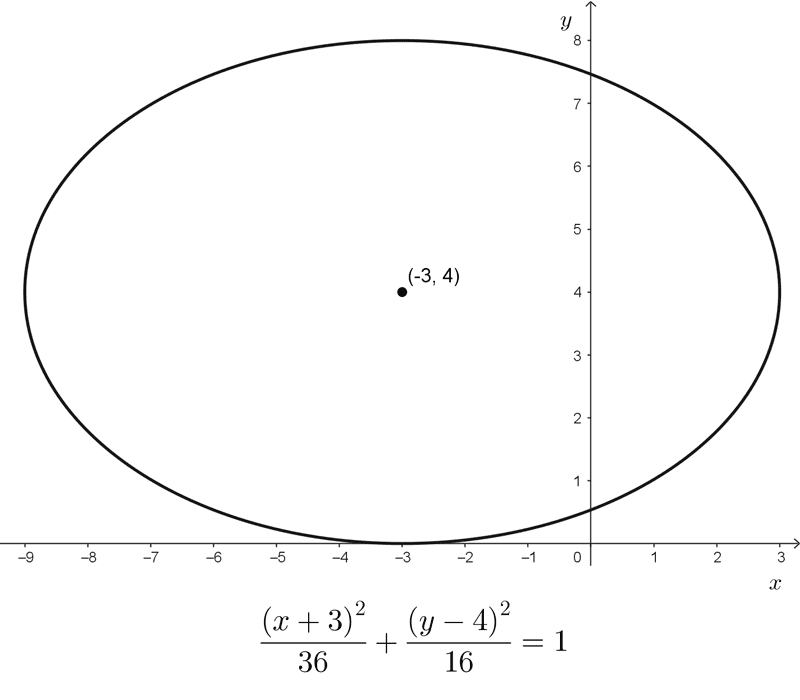
\(\dfrac{(x+3)^2}{36}+\dfrac{(y-4)^2}{16}=1\)
Observing the denominators 36 and 16, the larger value is located under the x-term. Therefore, the major axis is parallel to the x-axis, making this a horizontal ellipse. Next, determine the center:
\(x-h=x+3 \quad → \quad h=-3\)
\(y-k=y-4 \quad → \quad k=4\)
The center is located at (-3, 4).
Extracting the semi-axes:
\(a=\sqrt{36}=6, \quad b=\sqrt{16}=4\)
This gives a horizontal ellipse with center \((-3, 4),\) semi-major axis \(a=6,\) and semi-minor axis \(b=4.\)
Example 6
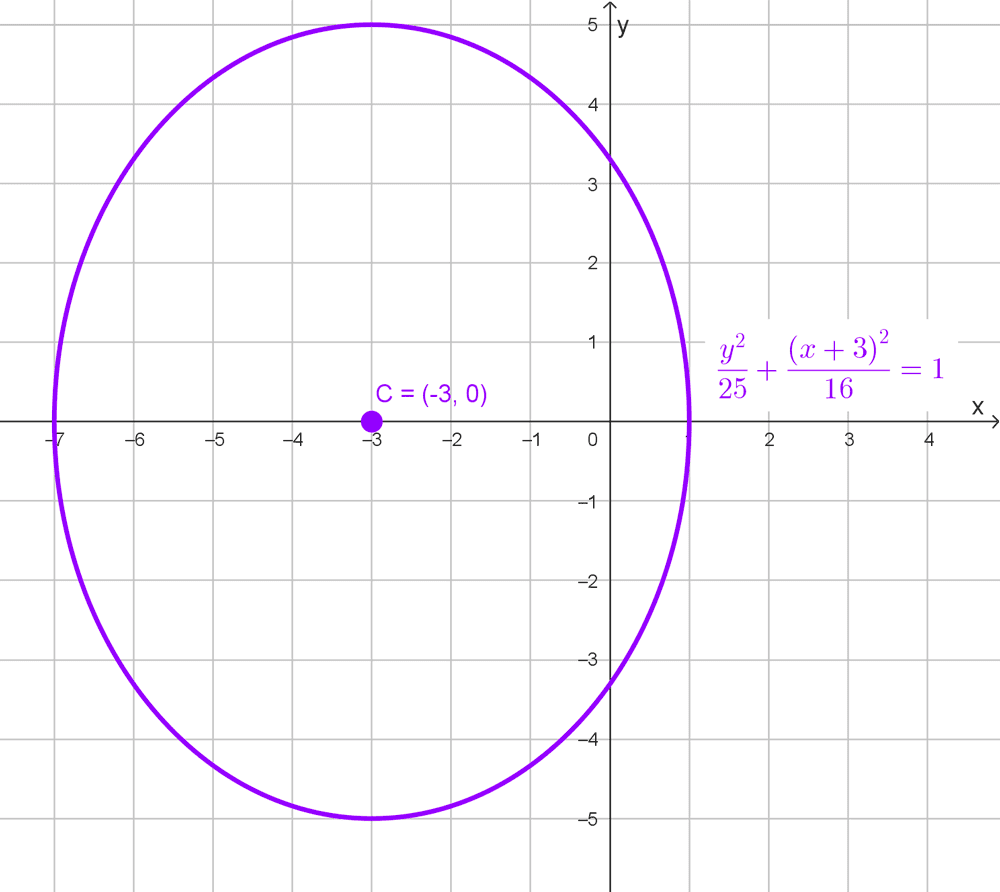
\(\dfrac{y^2}{25}+\dfrac{(x+3)^2}{16}=1\)
The denominators are 25 and 16. Because 25 sits under \(y^2,\) the major axis is parallel to the y-axis, indicating a vertical ellipse.
Determining the center coordinates:
\(x-h=x+3 \quad \rightarrow \quad h=-3\)
\(y-k=y-0 \quad \rightarrow \quad k=0\)
The center is \(C(-3, 0),\) positioned directly on the x-axis.
Semi-axes:
\(a=\sqrt{25}=5\)
\(b=\sqrt{16}=4\)
Thus, we have a vertical ellipse with center \((-3, 0),\) semi-major axis \(a=5,\) and semi-minor axis \(b=4.\)
Example 7
\(\dfrac{(x+1)^2}{35}+\dfrac{(y-2)^2}{10}=1\)
Comparing denominators: 35 > 10, with 35 situated under \((x+1)^2.\) This confirms a horizontal ellipse.
Finding the center:
\(x-h=x+1 \quad \rightarrow \quad h=-1\)
\(y-k=y-2 \quad \rightarrow \quad k=2\)
Center: \(C(-1, 2).\)
Semi-axes (irrational lengths):
\(a=\sqrt{35} ≈ 5.92\)
\(b=\sqrt{10} ≈ 3.16\)
In conclusion, the ellipse is horizontal, centered at \((-1, 2),\) with semi-major axis \(a=\sqrt{35} ≈ 5.916\) and semi-minor axis \(b=\sqrt{10} ≈ 3.162.\)

Example 8
\(\dfrac{(x+2)^2}{10}+\dfrac{(y-3)^2}{18}=1\)
Here, 18 > 10 and sits beneath the y-term. This describes a vertical ellipse.
Identifying the center:
\(x-h=x+2 \quad \rightarrow \quad h=-2\)
\(y-k=y-3 \quad \rightarrow \quad k=3\)
Center: \((-2, 3).\)
Semi-axes:
\(a=\sqrt{18} ≈ 4.24\)
\(b=\sqrt{10} ≈ 3.16\)
This gives a vertical ellipse centered at \((-2, 3),\) with semi-major axis \(a=\sqrt{18}\) and semi-minor axis \(b=\sqrt{10}.\)

From the standard equation parameters, all other features (foci, vertices, co-vertices, eccentricity, etc.) can be calculated. For guided practice, check out our collection of step-by-step practice problems:
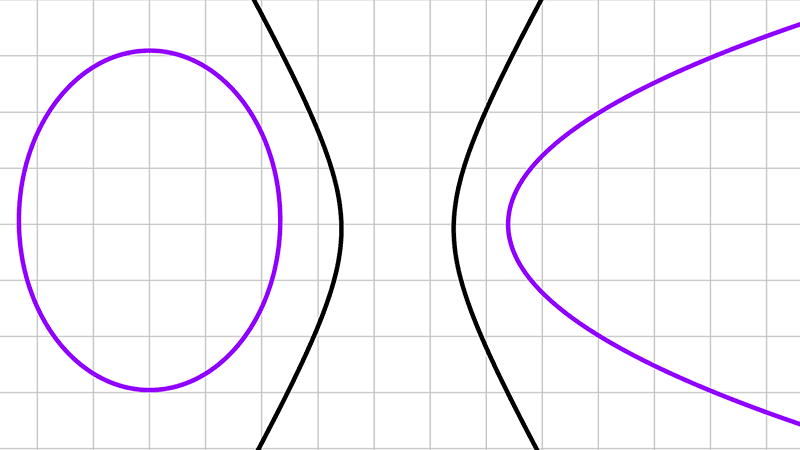
Note on Ellipses vs. Hyperbolas: The standard equations for an ellipse and a hyperbola look very similar, but have one fundamental difference:
- In an ellipse, both squared terms are added: \(\dfrac{x^2}{a^2}+\dfrac{y^2}{b^2}=1\)
- In a hyperbola, one of the squared terms is subtracted: \(\dfrac{x^2}{a^2}-\dfrac{y^2}{b^2}=1\)
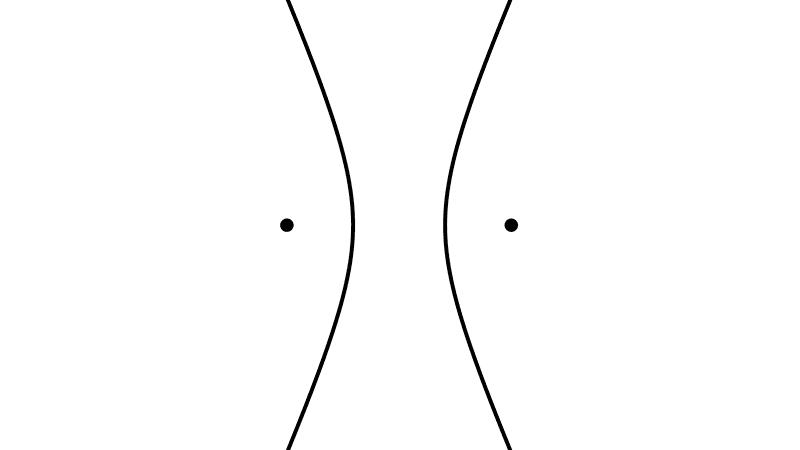
This sign change fundamentally transforms the geometric locus: rather than forming a bounded, closed curve (an ellipse), it produces two unbounded open branches (a hyperbola).
General Form Equation
The general equation of an ellipse (and of conic sections in general) is a second-degree polynomial equation in two variables:
Ax2 + Bxy + Cy2 + Dx + Ey + F = 0
where A, B, C, D, E, and F are real numbers. For this quadratic equation to describe an ellipse, the discriminant B2 - 4AC must be strictly negative:
B2 - 4AC < 0
When this condition holds, the equation can yield a real ellipse, a degenerate conic (a single point), or an imaginary ellipse (with no real solutions).
When the symmetry axes of the ellipse are parallel to the coordinate axes, the cross-product term is absent (B = 0). In this case, the general form simplifies to:
Ax2 + Cy2 + Dx + Ey + F = 0
For this equation to describe an ellipse, A and C must share the same algebraic sign (both positive or both negative, satisfying -4AC < 0 → AC > 0). Assuming it represents a real ellipse:
- If A < C, the ellipse is horizontal (major axis parallel to the x-axis).
- If C < A, the ellipse is vertical (major axis parallel to the y-axis).
- If A = C, the equation defines a circle.
- If D = 0 and E = 0, the center lies at the origin (0, 0).
- If D = 0 but E ≠ 0, the center is translated along the y-axis.
- If E = 0 but D ≠ 0, the center is translated along the x-axis.
- If both D ≠ 0 and E ≠ 0, the center is translated both horizontally and vertically.
If the axes of the ellipse are rotated relative to the Cartesian axes, the cross-product term appears (B ≠ 0), which signifies a rotated conic.
Here are several examples of ellipses in general form:
- \(3x^2+4y^2-12=0\)
- \(25x^2+16y^2-400=0\)
- \(4x^2+9y^2-16x-32=0\)
- \(16x^2+9y^2-64x-54y+1=0\)
- \(8x^2+25y^2-48x+50y+47=0\)
- \(36x^2+25y^2+72x-200y-464=0\)
- \(2x^2+4x+7y^2-28y-40=0\)
The general form does not immediately reveal key parameters like the center or semi-axes. In practice, we convert the general form into standard form by completing the square for both the x and y terms.
Worked Example: Converting General Form to Standard Form
Convert the following general equation into standard form: \(8x^2+25y^2-48x+50y+47=0.\)
Solution
We group terms by variable and complete the square. First, rearrange the equation and move the constant term to the right side:
\((8x^2-48x)+(25y^2+50y)=-47\)
Factor out the leading coefficients of the quadratic terms:
\(8(x^2-6x)+25(y^2+2y)=-47\)
Complete the square inside each set of parentheses. For \(x^2-6x,\) take half of -6 (which is -3) and square it to get 9: \(x^2-6x+9=(x-3)^2.\) For \(y^2+2y,\) take half of 2 (which is 1) and square it to get 1: \(y^2+2y+1=(y+1)^2.\)
Add these terms inside the parentheses while balancing the equation on the right side by multiplying each added constant by its respective factored coefficient. For x, adding 9 inside adds \(8 \times 9 = 72.\) For y, adding 1 inside adds \(25 \times 1 = 25.\)
\(8(x^2-6x+9)+25(y^2+2y+1)=-47+72+25\)
Simplify both sides:
\(8(x-3)^2+25(y+1)^2=50\)
Divide both sides by 50 to set the right side equal to 1:
\(\dfrac{8(x-3)^2}{50}+\dfrac{25(y+1)^2}{50}=1\)
Simplify the fractions:
\(\dfrac{(x-3)^2}{50/8}+\dfrac{(y+1)^2}{50/25}=1\)
\(\dfrac{(x-3)^2}{25/4}+\dfrac{(y+1)^2}{2}=1\)
This is the standard form equation of a horizontal ellipse centered at \((3,-1),\) with semi-major axis \(a=\sqrt{25/4}=5/2\) and semi-minor axis \(b=\sqrt{2}.\)
To perform the reverse operation—converting from standard form to general form—simply expand the squared binomials, eliminate denominators, and collect all terms on one side equal to zero.
Eccentricity
The eccentricity of an ellipse measures its degree of flattening or elongation, indicating how closely the curve resembles a circle. It is denoted by the letter e (not to be confused with Euler's number e, the base of the natural logarithm).
By definition, eccentricity is the ratio of the focal length (c) to the semi-major axis (a):
\(e=\dfrac{c}{a}\)
Using the fundamental relation \(a^2=b^2+c^2,\) it can also be calculated as:
\(e=\sqrt{\dfrac{a^2-b^2}{a^2}}=\sqrt{1-\dfrac{b^2}{a^2}}\)
The eccentricity of any real ellipse strictly satisfies 0 ≤ e < 1. This follows because 0 ≤ c < a, which ensures that 0 ≤ c/a < 1. The geometric interpretation is direct:
- As eccentricity approaches 0 (e → 0), the ellipse becomes more circular as the foci converge toward the center. When e = 0, the ellipse becomes a circle with equal semi-axes.
- As eccentricity approaches 1 (e → 1), the ellipse becomes increasingly flattened, stretching into an elongated oval approaching a line segment.
Features and Properties
The ellipse possesses unique mathematical and physical properties:
Fundamental Pythagorean Relation
A constant relationship links the semi-major axis (a), semi-minor axis (b), and focal length (c):
a2 = b2 + c2
This formula allows you to determine any one parameter given the other two. It can be easily recalled by visualizing a right triangle where a forms the hypotenuse, and b and c serve as legs.

Reflective Property
The ellipse possesses an important acoustic and optical reflection property: any wave (sound or light) emitted from one focus will reflect off the boundary curve and pass directly through the other focus.
Geometrically, the focal radii drawn from both foci to any point P on the ellipse form equal angles with the tangent line at that point. Specifically, if θ1 is the angle between the tangent at P and line segment PF1, and θ2 is the angle between the tangent and PF2, then: θ1 = θ2.

Practical applications of this principle include:
- Medicine (Lithotripsy): Extracorporeal shock wave lithotripsy treats kidney stones by placing an acoustic shockwave generator at one focus of an ellipsoidal reflector. The reflected waves converge with pinpoint accuracy at the second focus (where the kidney stone is situated), shattering it without damaging surrounding tissue.
- Whispering Galleries: In elliptical rooms (such as the dome of St. Paul's Cathedral in London or Grand Central Terminal in New York), a faint whisper spoken at one focus travels across the room and is clearly audible at the other focus, even across large distances.
Symmetry
An ellipse features two mutually perpendicular axes of symmetry: the focal axis L1 (containing the foci, center, and vertices) and the conjugate axis L2 (passing through the center and co-vertices). Its geometric center also serves as a point of point-symmetry.
Area
The area enclosed by an ellipse is computed using the semi-major axis (a) and semi-minor axis (b):
A = π ⋅ a ⋅ b

When both semi-axes are equal (a = b = r), the ellipse becomes a circle, and the formula simplifies to the familiar area of a circle:
A = π ⋅ r2
Perimeter (Circumference of an Ellipse)
Calculating the exact perimeter of an ellipse has no elementary algebraic solution. An exact calculation requires complete elliptic integrals of the second kind or infinite series expansions (such as the Gauss-Kummer hypergeometric series), which are computationally intensive.
To solve this practically, mathematicians rely on approximation formulas. Among the most popular and accurate are those developed by Srinivasa Ramanujan.
The first Ramanujan approximation provides a simple, accurate estimate when the semi-axes a and b are reasonably close in value:
\(P ≈ \pi \left[ 3(a+b)-\sqrt{(3a+b)(a+3b)} \right]\)
For greater precision across a wider range of shapes, Ramanujan developed his second approximation (Ramanujan II), introducing the auxiliary parameter h:
\(h=\dfrac{(a-b)^2}{(a+b)^2}\)
Using this value, the refined perimeter formula is:
\(P ≈ \pi (a+b)\left(1+\dfrac{3h}{10+\sqrt{4-3h}} \right)\)
While Ramanujan II is remarkably accurate for most ellipses, it exhibits slight deviations as eccentricity approaches 1 (e → 1). To address this, mathematician David W. Cantrell modified Ramanujan's second formula to reduce error even in highly elongated ellipses down to 0.00145%.
The Cantrell-modified Ramanujan formula is:
\(P ≈ \pi(a+b)\left(1+\dfrac{3h}{10+\sqrt{4-3h}}+\left(\dfrac{4}{\pi}-\dfrac{14}{11}\right)h^{12}\right)\)
where \(h=\dfrac{(a-b)^2}{(a+b)^2}\)
Guidelines for choosing an approximation:
- For highly elongated, high-eccentricity ellipses, use Cantrell's modified formula.
- For nearly circular ellipses, Ramanujan's first approximation is more than sufficient.
- For typical ellipses of intermediate proportions, Ramanujan's second approximation provides an ideal balance of speed and precision.
Conic Section Derivation
As noted earlier, the ellipse is a conic section formed by intersecting a plane with a double right circular cone. The resulting curve depends strictly on the angle of the plane relative to the axis of the cone and whether the plane intersects the cone's vertex.
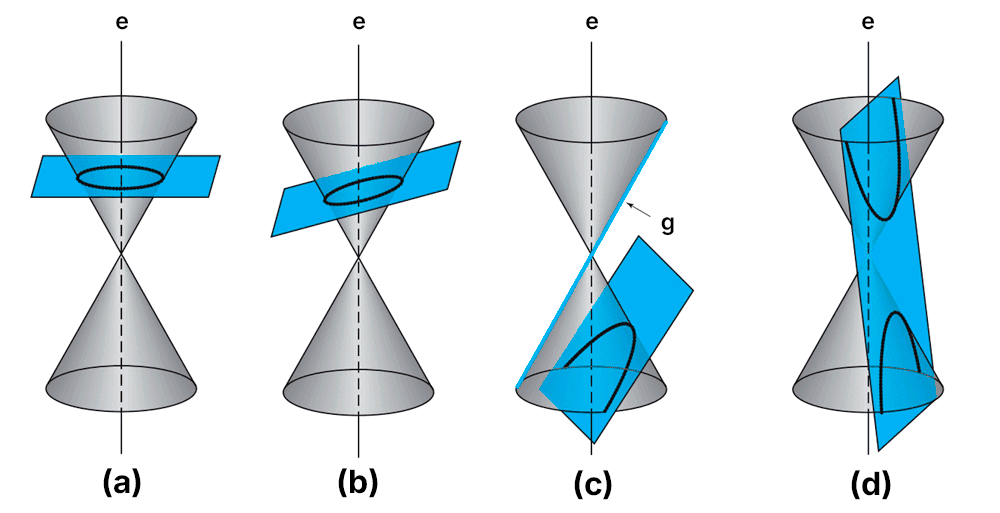
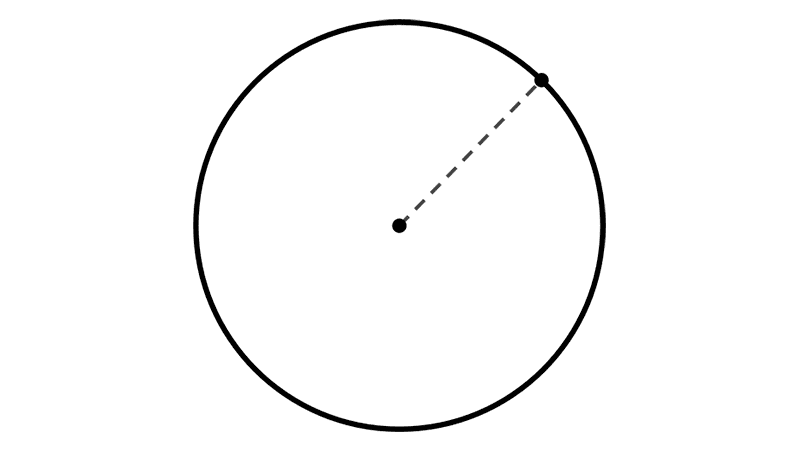
Let α represent the semi-vertical angle of the cone (the angle between the central axis and a generator line), and let φ denote the angle between the cutting plane and the central axis. An ellipse occurs when the plane cuts through only one nappe of the cone, forming a closed curve. Geometrically, this happens when α < φ ≤ 90° without passing through the vertex. When φ = 90°, the plane is strictly perpendicular to the cone axis, producing a circle (a special ellipse with e = 0).
Varying the plane angle generates other conic sections:
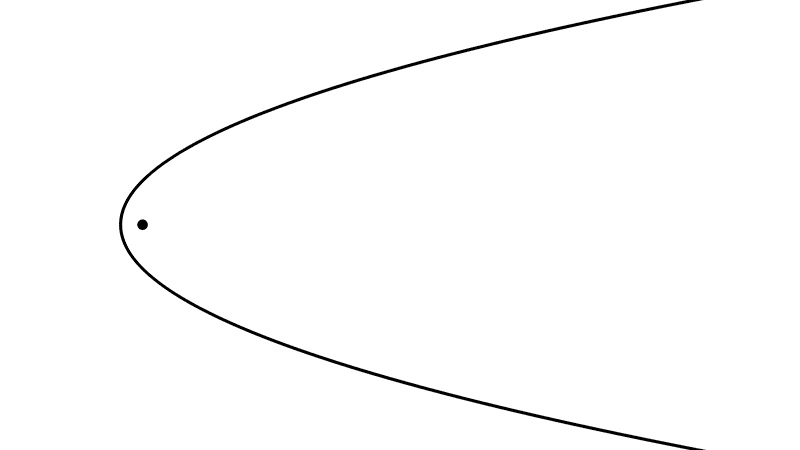
- When the plane is parallel to a generator line (φ = α), the intersection is unbounded, yielding a parabola.
- When the plane is steeper than the generator line (φ < α), it intersects both nappes of the cone, forming a hyperbola.
If the plane intersects the vertex, the conic degenerates into a single point, a line, or intersecting lines.
Equation Derivations
Below are step-by-step proofs of the primary equations for an ellipse.
Derivation of the Standard Form Equation
To derive the standard equation, consider a horizontal ellipse centered at the origin with its major axis lying along the x-axis.

The foci are located at F1(-c, 0) and F2(c, 0), the vertices are at (a, 0) and (-a, 0), the co-vertices are at (0, b) and (0, -b), and the center is (0, 0). Let P(x, y) represent any point on the ellipse. By definition, the sum of the distances to the foci is constant:
\(d(F_1, P)+d(F_2, P)=k\)
To find the constant k, evaluate the sum at vertex V2(a, 0):
\(d(V_2, F_1)=a+c\)
\(d(V_2, F_2)=a-c\)
Summing these two distances:
\(d(V_2,F_1)+d(V_2,F_2)=(a+c)+(a-c)=2a\)
Thus, k = 2a (the length of the major axis). Substituting back into the geometric definition:
\(d(F_1,P)+d(F_2,P)=2a\)
Applying the distance formula:
\(\sqrt{(x+c)^2+y^2}+\sqrt{(x-c)^2+y^2}=2a\)
Isolate one square root:
\(\sqrt{(x+c)^2+y^2}=2a-\sqrt{(x-c)^2+y^2}\)
Square both sides:
\((\sqrt{(x+c)^2+y^2})^2=(2a-\sqrt{(x-c)^2+y^2})^2\)
Expand the expressions:
\((x+c)^2+y^2=4a^2-4a\sqrt{(x-c)^2+y^2}+(x-c)^2+y^2\)
Expand the squared terms and isolate the remaining radical:
\(x^2+2cx+c^2+y^2=4a^2-4a\sqrt{(x-c)^2+y^2}+x^2-2cx+c^2+y^2\)
\(4cx-4a^2=-4a\sqrt{(x-c)^2+y^2}\)
Divide through by 4:
\(cx-a^2=-a\sqrt{(x-c)^2+y^2}\)
Square both sides once more:
\((cx-a^2)^2=a^2[(x-c)^2+y^2]\)
Expand both sides:
\(c^2x^2-2a^2cx+a^4=a^2(x^2-2cx+c^2+y^2)\)
Group terms containing x and y:
\(c^2x^2-a^2x^2+a^2y^2=a^2c^2-a^4\)
Multiply by -1 and factor the right-hand side:
\((a^2-c^2)x^2+a^2y^2=a^2(a^2-c^2)\)
By the triangle inequality applied to points F1, F2, and P, the sum of two side lengths exceeds the third side: \(d(F_1,P)+d(F_2,P)>d(F_1,F_2),\) which simplifies to \(2a > 2c\) or \(a > c.\) Consequently, \(a^2 - c^2 > 0.\) Defining \(b^2 = a^2 - c^2\) (with b > 0) and substituting gives:
\(b^2x^2+a^2y^2=a^2b^2\)
Dividing both sides by \(a^2b^2\) yields:
\(\dfrac{x^2}{a^2}+\dfrac{y^2}{b^2}=1\)
This is the standard form equation of an ellipse centered at (0, 0) with a horizontal major axis.
Through an analogous procedure with foci on the y-axis, the vertical ellipse equation is derived as:
\(\dfrac{x^2}{b^2}+\dfrac{y^2}{a^2}=1\)
When the center is translated to (h, k), applying horizontal and vertical coordinate shifts (replacing x with x - h, and y with y - k) yields:
Horizontal ellipse: \(\dfrac{(x-h)^2}{a^2}+\dfrac{(y-k)^2}{b^2}=1\)
Vertical ellipse: \(\dfrac{(x-h)^2}{b^2}+\dfrac{(y-k)^2}{a^2}=1\)
Derivation of the General Form Equation
To derive the general form, start from the standard equation centered at (h, k):
\(\dfrac{(x-h)^2}{a^2}+\dfrac{(y-k)^2}{b^2}=1\)
Multiply through by \(a^2b^2\) to eliminate fractions:
\(b^2(x-h)^2+a^2(y-k)^2=a^2b^2\)
Expand the binomial expressions:
\(b^2(x^2-2hx+h^2)+a^2(y^2-2ky+k^2)=a^2b^2\)
Distribute coefficients:
\(b^2x^2-2b^2hx+b^2h^2+a^2y^2-2a^2ky+a^2k^2=a^2b^2\)
Collect all terms on the left-hand side in descending degree order:
\(b^2x^2+a^2y^2-2b^2hx-2a^2ky+b^2h^2+a^2k^2-a^2b^2=0\)
This matches the general second-degree equation:
\(Ax^2+Cy^2+Dx+Ey+F=0\)
where:
- \(A=b^2\)
- \(C=a^2\)
- \(D=-2b^2h\)
- \(E=-2a^2k\)
- \(F=b^2h^2+a^2k^2-a^2b^2\)
Converting back from general form to standard form requires completing the square.
Other Coordinate Representations
In addition to Cartesian forms, an ellipse can be represented in parametric and polar coordinates.
Parametric Equations
Parametric equations describe geometric curves using an independent parameter t rather than relating x and y directly.
Starting from the standard equation centered at the origin:
\(\dfrac{x^2}{a^2}+\dfrac{y^2}{b^2}=1\)
Recognizing the trigonometric identity \(\cos^2(t)+\sin^2(t)=1,\) we set:
\(\dfrac{x}{a}=\cos(t), \quad \dfrac{y}{b}=\sin(t)\)
This yields the parametric equations of an ellipse:
\(x=a \cos(t), \quad y=b \sin(t),\quad \text{where } 0≤t≤2\pi\)
When the center is translated to (h, k), the shift parameters are added directly:
\(x=h+a \cos(t), \quad y=k+b \sin(t), \quad 0≤t≤2\pi\)
As t varies from 0 to 2π, these functions trace out the entire curve. In the special case where a = b = r, the equations reduce to the parameterization of a circle:
\(x=r \cos(t), \quad y=r \sin(t),\quad 0 ≤t≤2\pi\)
Parametric forms are especially useful in physics and calculus for computing arc lengths, evaluating line integrals, and modeling orbital trajectories in astronomy.
Polar Coordinates Equation
In the polar coordinate system, points are represented as (r, θ), where r is the radial distance from the origin (pole) and θ is the angle measured counterclockwise from the polar axis (positive x-axis).
To formulate an ellipse in polar coordinates, we use the focus-directrix definition: a conic section is the locus of points where the ratio of the distance to a focus to the distance to a directrix line is constant and equals the eccentricity e. When e < 1, the curve is an ellipse.
Placing one focus at the pole, the polar equation of an ellipse is:
\(r=\dfrac{ep}{1±e \cos \theta} \quad \text{or} \quad r=\dfrac{ep}{1±e \sin \theta}\)
where p is the distance from the pole to the directrix, and e is the eccentricity. The choice of trigonometric function depends on the orientation of the directrix:
- If the directrix is perpendicular to the polar axis, the denominator uses cos θ (+ for a directrix to the right of the pole, - for a directrix to the left).
- If the directrix is parallel to the polar axis, the denominator uses sin θ (+ for a directrix above the pole, - for a directrix below).
Real-World Applications
Ellipses play a critical role across various fields of science, engineering, and architecture.
Astronomy and Orbital Mechanics
While planetary orbits were long assumed to be circular, Johannes Kepler proved in the early 17th century that planetary paths are actually elliptical, with the Sun situated at one focus. This is formulated as Kepler's First Law.
Because the Sun occupies a focus rather than the center, a planet's distance to the Sun varies continuously, reaching its closest point at perihelion and its farthest point at aphelion.
In 1705, Edmond Halley proved that the comet bearing his name follows a highly eccentric elliptical orbit around the Sun, enabling him to predict its periodic return. In classical two-body gravitational mechanics, bound orbits are always ellipses.
According to Kepler's Second Law, a line segment connecting a planet to the Sun sweeps out equal areas in equal intervals of time. Consequently, orbital speed varies along the ellipse, moving fastest at perihelion and slowest at aphelion.
Together, Kepler's Laws provide the foundation for modern celestial mechanics and satellite trajectory planning.
Architecture and Structural Design
Architects have long used the geometry of the ellipse to balance aesthetic elegance with structural load-bearing performance.
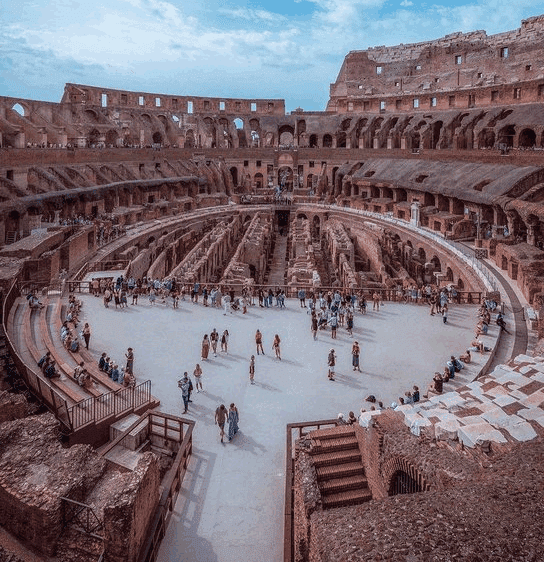
In Ancient Rome, the Colosseum was constructed on a layout of concentric ellipses. This design maximized seating capacity for tens of thousands of spectators while preserving clear sightlines toward the arena floor.
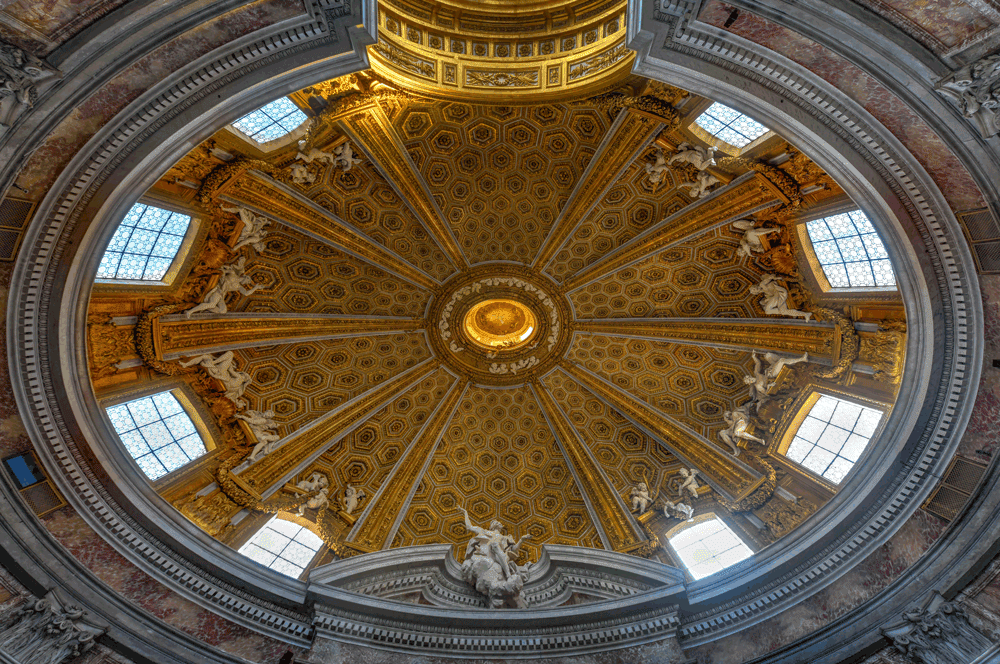
During the Baroque era, architect Gian Lorenzo Bernini designed the church of Sant'Andrea al Quirinale in Rome using an elliptical floor plan. The geometric configuration draws focus directly to the high altar positioned along the major axis.
In structural engineering, the 16th-century Ponte Santa Trinita in Florence, designed by Bartolomeo Ammanati, became the first bridge to utilize elliptical arches. These arches provided greater clearance and reduced horizontal thrust compared to standard semi-circular arches.

Acoustics
The reflective properties of the ellipse make it valuable in architectural acoustics. Sound waves emitted from one focus reflect off the curved boundary and converge at the opposite focus, allowing soft whispers to carry across large halls.
A classic example is the Whispering Gallery beneath the dome of St. Paul's Cathedral in London, where a whisper near the perimeter wall is clearly audible to a listener stationed at the opposite focal point.
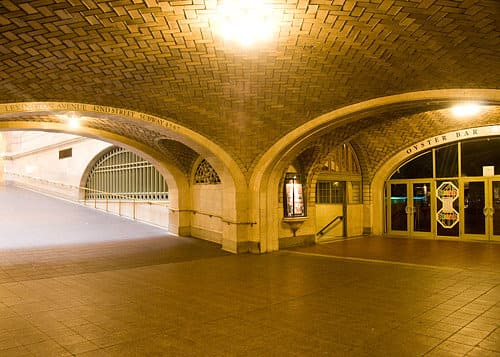
Similar principles guide the construction of acoustic reflectors in concert halls, sound projection shells, and specialized directional microphones.
Everyday Curiosities
A simple everyday example of an ellipse is the tilted surface of liquid in a cylindrical glass. While horizontal at rest, tilting the glass causes the water line against the cylindrical wall to form a perfect ellipse.
Similarly, shining a flashlight at an angle against a flat wall produces an elliptical beam of light, as the conical light beam intersects an oblique plane.

Elliptical billiard tables provide another entertaining application of the reflection property: a ball shot through one focus will rebound off the cushion and travel directly into a pocket located at the other focus.
Additional Resources
Gardener's Construction Method
One of the most intuitive ways to construct a physical ellipse is the pins-and-string method (often called the gardener's method), used for centuries in landscape design and masonry.
This approach relies directly on the geometric definition of an ellipse: keeping the sum of the distances from two fixed points constant using a taut loop of string.
Step-by-step instructions:
- Fix two pins, nails, or stakes into the surface to serve as the foci.
- Cut a non-stretching string with a total length equal to the major axis (2a).
- Fasten the ends of the string to the two pins.
- Pull the string taut with a pencil and trace smoothly around the pins while maintaining tension.
Because the string's length is fixed, the sum of the distances from the pencil point to each focus remains constant at 2a, tracing an exact ellipse.
Frequently Asked Questions
Is an ellipse the same as an oval?
No, an ellipse and an oval are not the same. An ellipse is a mathematically precise geometric figure with two axes of symmetry and a strict algebraic definition. An oval is a general, non-technical term used to describe any egg-shaped or elongated closed curve without strict mathematical symmetry.
Is an ellipse the same as an ellipsoid?
No. An ellipse is a two-dimensional plane curve, whereas an ellipsoid is a three-dimensional surface formed by revolving an ellipse around one of its principal axes.
What is the difference between a circle and an ellipse?
A circle is a special case of an ellipse where the eccentricity is zero (e = 0). In a circle, both foci coincide at the center, and the semi-major and semi-minor axes are equal (a = b = r).
How do you determine if a point lies on an ellipse?
Substitute the point's coordinates (x, y) into either the standard form or general form equation. If the left-hand side equals the right-hand side, the point lies on the curve. If the sum is less than 1 (in standard form), the point lies inside; if greater than 1, it lies outside.
Content on Ellipses
Did you find this useful? Rate it!
0.0 / 5 — 0 votes

HOW TO CITE THIS ARTICLE
Machado, D. (2026, October 27). Ellipse. Exponty. https://exponty.com/en/ellipse
Leave a Reply
Related posts