
Hyperbola Practice Problems with Solutions
Here you will find hyperbola practice problems with step-by-step solutions and graphs for all skill levels. If you are not yet familiar with the core concepts, we recommend reviewing our main guide covering foundational theory first:
Table of Contents
Finding the Equation of a Hyperbola from Given Data
The following practice problems involve finding the standard or general equation of a hyperbola given key information such as the coordinates of its foci, vertices, asymptotes, or axes lengths.
Center at the Origin
Problem 1
Find the standard equation of the hyperbola with its center at the origin, a focus at (0, 2), and a vertical transverse axis of length 2.
Solution
The standard equation of a hyperbola centered at the origin with a vertical transverse axis is:
$$\dfrac{y^2}{a^2}-\dfrac{x^2}{b^2}=1$$
where:
- a is the distance from the center to each vertex.
- c is the distance from the center to each focus.
- b is obtained using the relationship \(c^2=a^2+b^2.\)
Since the transverse axis is vertical and has a length of 2, we have \(2a=2,\) which gives a=1.
In addition, the focus is at (0, 2), which indicates that \(c=2.\)
Now, we solve for b2 using the fundamental relationship:
$$c^2=a^2+b^2$$
$$2^2=1^2+b^2$$
$$4=1+b^2$$
$$b^2=3$$
With these values, the equation of the hyperbola is:
$$\dfrac{y^2}{1^2}-\dfrac{x^2}{3}=1$$
$$\dfrac{y^2}{1}-\dfrac{x^2}{3}=1$$
$$y^2-\dfrac{x^2}{3}=1$$

Problem 2
Find the standard equation of the hyperbola centered at (0, 0) with a focus at (3, 0) and a vertex at (1, 0).
Solution
The standard equation of a hyperbola centered at (0, 0) with a horizontal focal axis is:
$$\dfrac{x^2}{a^2}-\dfrac{y^2}{b^2}=1$$
We are given that one of the vertices is (1, 0), which means the vertices are at \((\pm a, 0).\) Therefore:
a=1
We are also given that one of the foci is at (3, 0), so the foci are at \((\pm c, 0).\) This gives:
$$c=3$$
For any hyperbola, the relation between a, b, and c is:
$$c^2=a^2+b^2$$
Substituting the known values:
$$3^2=1^2+b^2$$
$$9=1+b^2$$
$$b^2=8$$
Substituting these values into the standard equation:
$$\dfrac{x^2}{1^2}-\dfrac{y^2}{8}=1$$
$$\dfrac{x^2}{1}-\dfrac{y^2}{8}=1$$
$$x^2-\dfrac{y^2}{8}=1$$
Therefore, the standard equation of the hyperbola is:
$$x^2-\dfrac{y^2}{8}=1$$

Problem 3
A hyperbola has its foci at (±5, 0) and a vertex at (3, 0). Find its standard equation.
Solution
The standard equation of a hyperbola centered at the origin (0, 0) with a horizontal focal axis is:
$$\dfrac{x^2}{a^2}-\dfrac{y^2}{b^2}=1$$
Here, the foci are at \((\pm 5, 0),\) so the focal distance c from the center is:
$$c=5$$
Furthermore, one vertex is at (3, 0), which gives:
$$a=3$$
Using the hyperbola relationship between a, b, and c:
$$c^2=a^2+b^2$$
Substituting c and a:
$$5^2=3^2+b^2$$
$$25=9+b^2$$
$$b^2=16$$
Now we write the equation of the hyperbola using \(a^2=9\) and \(b^2=16:\)
$$\dfrac{x^2}{3^2}-\dfrac{y^2}{4^2}=1$$
$$\dfrac{x^2}{9}-\dfrac{y^2}{16}=1$$

Problem 4
Determine the standard equation of a hyperbola whose vertices are at (0, -6) and (0, 6) and one of whose asymptotes has the equation y = 2x.
Solution
First, the standard equation of a hyperbola with a vertical transverse axis along the y-axis has the form:
$$\dfrac{y^2}{a^2}-\dfrac{x^2}{b^2}=1$$
where a is the distance from the center to the vertices and b is related to the slope of the asymptotes. The vertices are given at (0, -6) and (0, 6), which implies that the distance between the vertices is \(2a=12.\) Therefore:
$$a=6$$
The next step is to find b. The asymptote equations for a vertical hyperbola centered at the origin are:
$$y=\pm \dfrac{a}{b}x$$
Since one asymptote is \(y=2x,\) we set the slope \(\dfrac{a}{b}\) equal to 2:
$$\dfrac{a}{b}=2$$
Substituting \(a=6\) into this equation:
$$\dfrac{6}{b}=2$$
Solving for b:
$$b=3$$
Finally, substituting a=6 and b=3 into the standard equation:
$$\dfrac{y^2}{6^2}-\dfrac{x^2}{3^2}=1$$
which simplifies to:
$$\dfrac{y^2}{36}-\dfrac{x^2}{9}=1$$

Problem 5
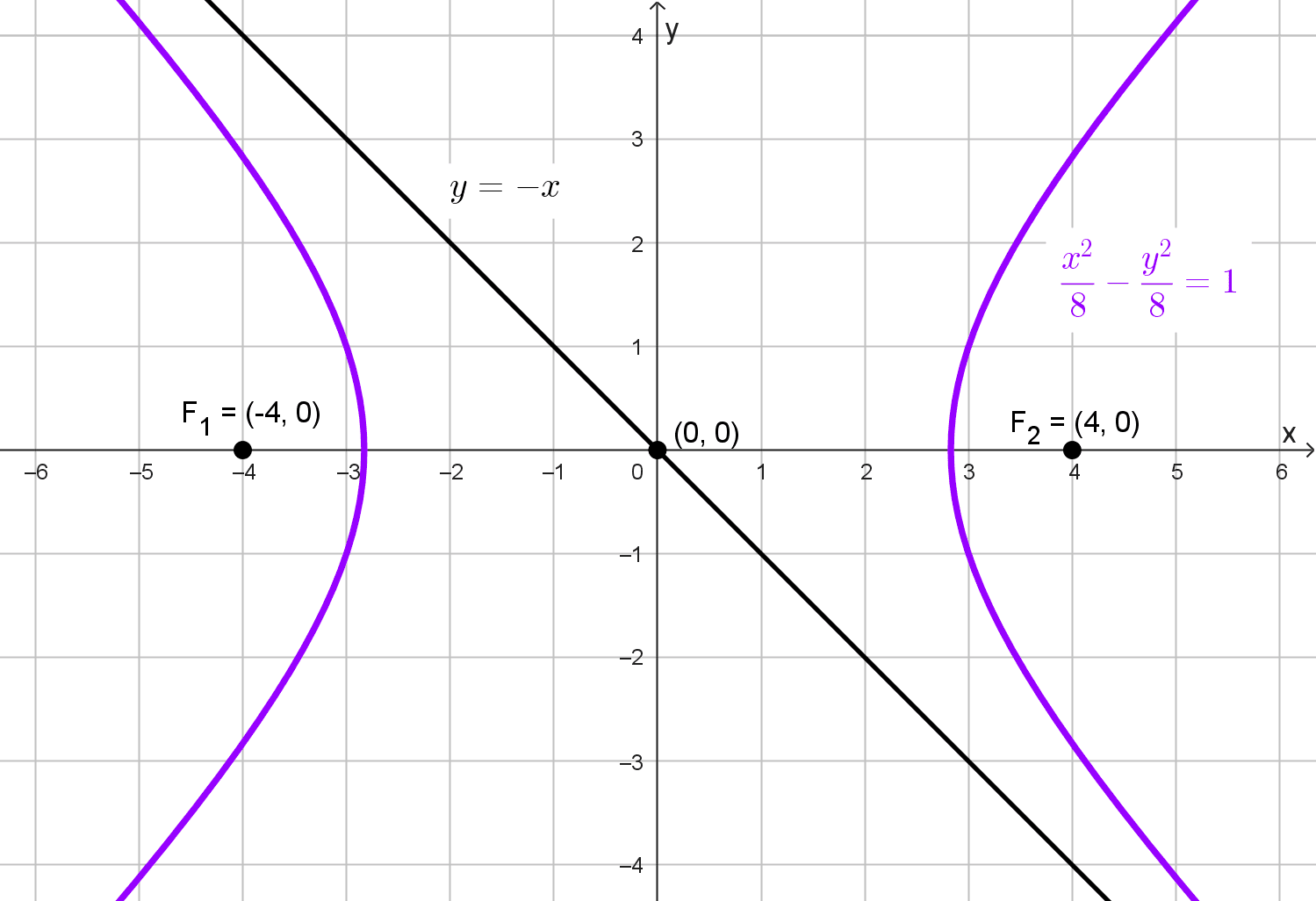
Find the equation of the hyperbola whose foci are (-4, 0) and (4, 0) and one asymptote is y = -x.
Solution
The foci are at (-4, 0) and (4, 0), indicating that the transverse axis lies on the x-axis and the center is at the midpoint of the foci, (0, 0).
The standard equation of a horizontal hyperbola centered at the origin is:
$$\dfrac{x^2}{a^2}-\dfrac{y^2}{b^2}=1$$
With foci at (-4, 0) and (4, 0), the focal distance 2c is 8. Thus:
$$c=4$$
Using the fundamental relationship:
$$c^2=a^2+b^2$$
Since \(c=4,\) we have \(c^2=16.\) This gives:
$$a^2+b^2=16$$
The equations of the asymptotes for a horizontal hyperbola centered at the origin are:
$$y=\pm \dfrac{b}{a}x$$
One asymptote is given as \(y=-x,\) which means the slope magnitude is 1. Therefore:
$$\dfrac{b}{a}=1$$
Solving for b gives:
$$b=a$$
Substituting b=a into \(a^2+b^2=16:\)
$$a^2+a^2=16$$
$$2a^2=16$$
$$a^2=8$$
Since b=a, we also have \(b^2=8.\) With \(a^2=8\) and \(b^2=8,\) the standard equation is:
$$\dfrac{x^2}{8}-\dfrac{y^2}{8}=1$$
Problem 6
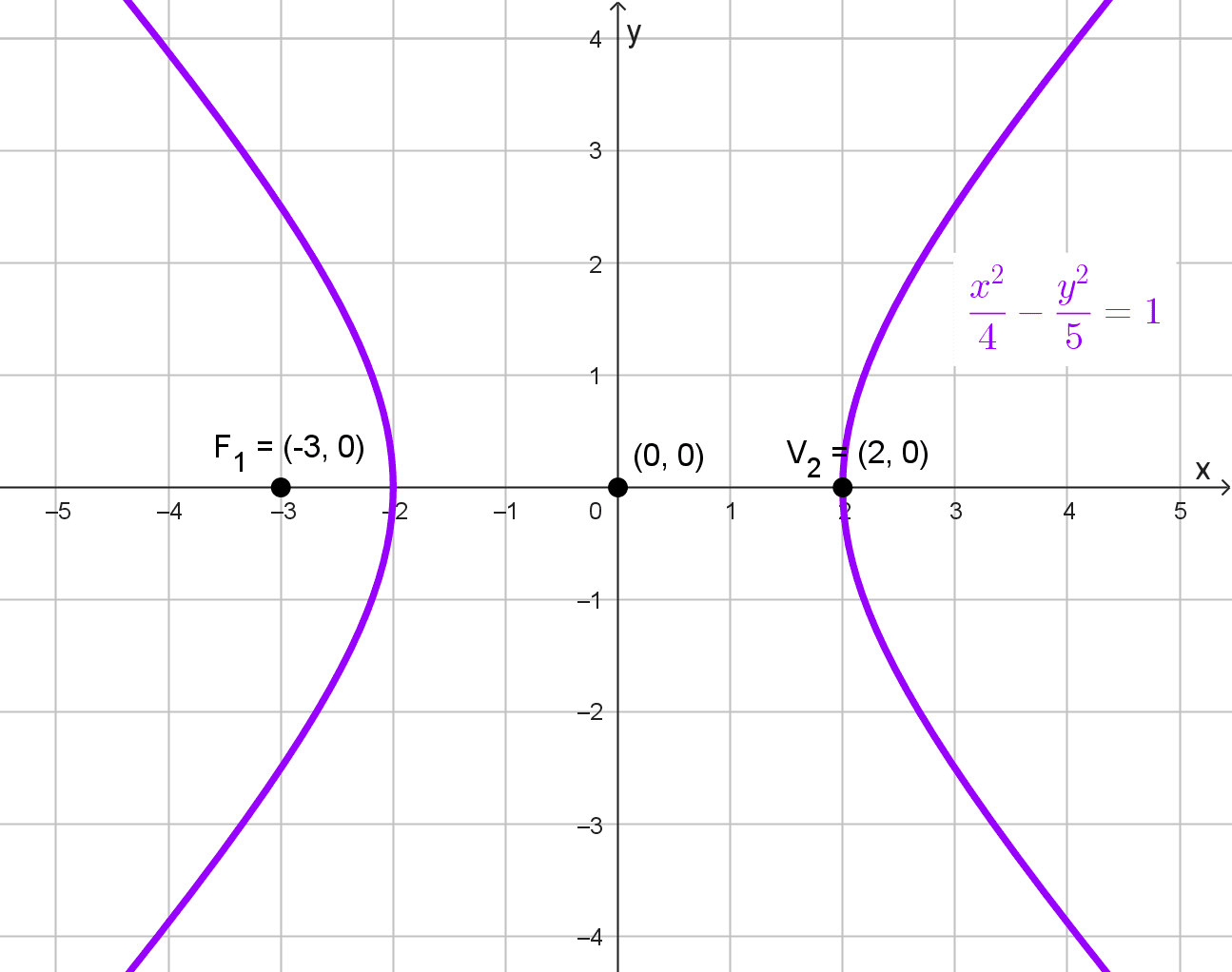
Find the standard equation of the hyperbola centered at the origin with a focus at (-3, 0) and a vertex at (2, 0).
Solution
First, we note that the hyperbola is centered at (0, 0) and its foci and vertices lie on the x-axis. This confirms a horizontal orientation, whose standard form is:
$$\dfrac{x^2}{a^2}-\dfrac{y^2}{b^2}=1$$
Since a vertex is at (2, 0), the distance a is 2. Thus, a=2. Since a focus is at (-3, 0), the distance c is 3. Thus, c=3.
The relationship between a, b, and c is:
$$c^2=a^2+b^2$$
Substituting the values of a and c:
$$3^2=2^2+b^2$$
$$9=4+b^2$$
$$b^2=9-4$$
$$b^2=5$$
With \(a^2=4\) and \(b^2=5,\) we substitute into the standard equation:
$$\dfrac{x^2}{4}-\dfrac{y^2}{5}=1$$
Problem 7
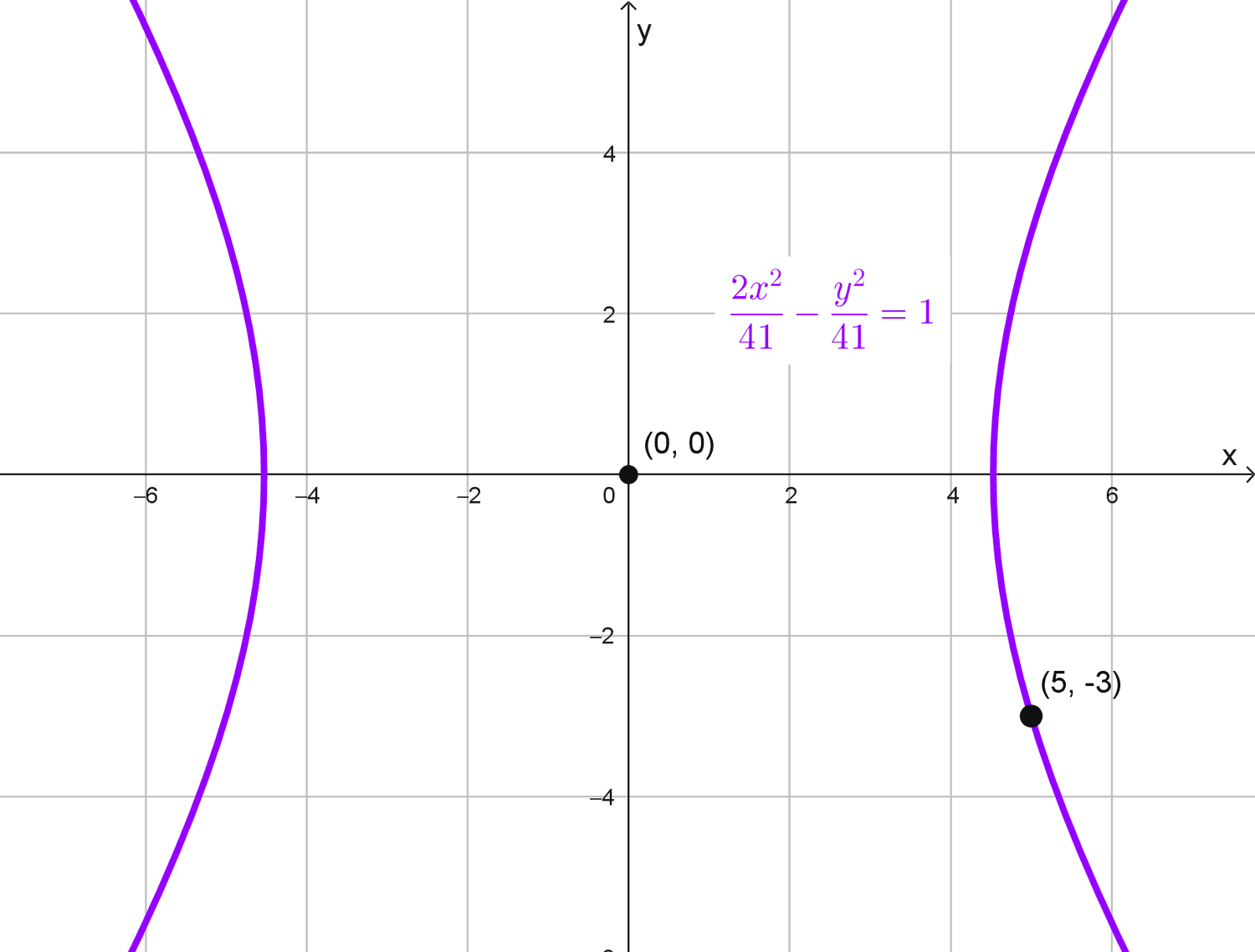
A horizontal hyperbola centered at the origin passes through the point (5, -3) and has eccentricity \(\sqrt{3}.\) What is its standard equation?
Solution
Recall that the standard equation of a horizontal hyperbola centered at the origin is:
$$\dfrac{x^2}{a^2}-\dfrac{y^2}{b^2}=1$$
The eccentricity e of a hyperbola is defined as:
$$e=\dfrac{c}{a}$$
where c is the distance from the center to each focus, satisfying:
$$c^2=a^2+b^2$$
We are given \(e=\sqrt{3}\) and that the curve passes through (5, -3). First, relate a and c using the eccentricity:
$$e=\dfrac{c}{a} → \sqrt{3}=\dfrac{c}{a} → c=a\sqrt{3}$$
Substituting \(c=a\sqrt{3}\) into \(c^2=a^2+b^2:\)
$$(a\sqrt{3})^2=a^2+b^2 → 3a^2=a^2+b^2 → b^2=2a^2$$
Now, substitute \(b^2=2a^2\) into the standard equation:
$$\dfrac{x^2}{a^2}-\dfrac{y^2}{2a^2}=1$$
Since the hyperbola passes through (5, -3), substitute \(x=5\) and \(y=-3:\)
$$\dfrac{5^2}{a^2}-\dfrac{(-3)^2}{2a^2}=1 → \dfrac{25}{a^2}-\dfrac{9}{2a^2}=1$$
Multiply the entire equation by \(2a^2:\)
$$2 \cdot 25-9=2a^2 → 50-9=2a^2 → 41=2a^2 → a^2=\dfrac{41}{2}$$
With \(a^2=\dfrac{41}{2},\) find \(b^2:\)
$$b^2=2a^2=2 \cdot \dfrac{41}{2}=41$$
Finally, substitute \(a^2\) and \(b^2\) into the equation:
$$\dfrac{x^2}{\dfrac{41}{2}}-\dfrac{y^2}{41}=1$$
We can rewrite the first fraction to obtain:
$$\dfrac{2x^2}{41}-\dfrac{y^2}{41}=1$$
Problem 8
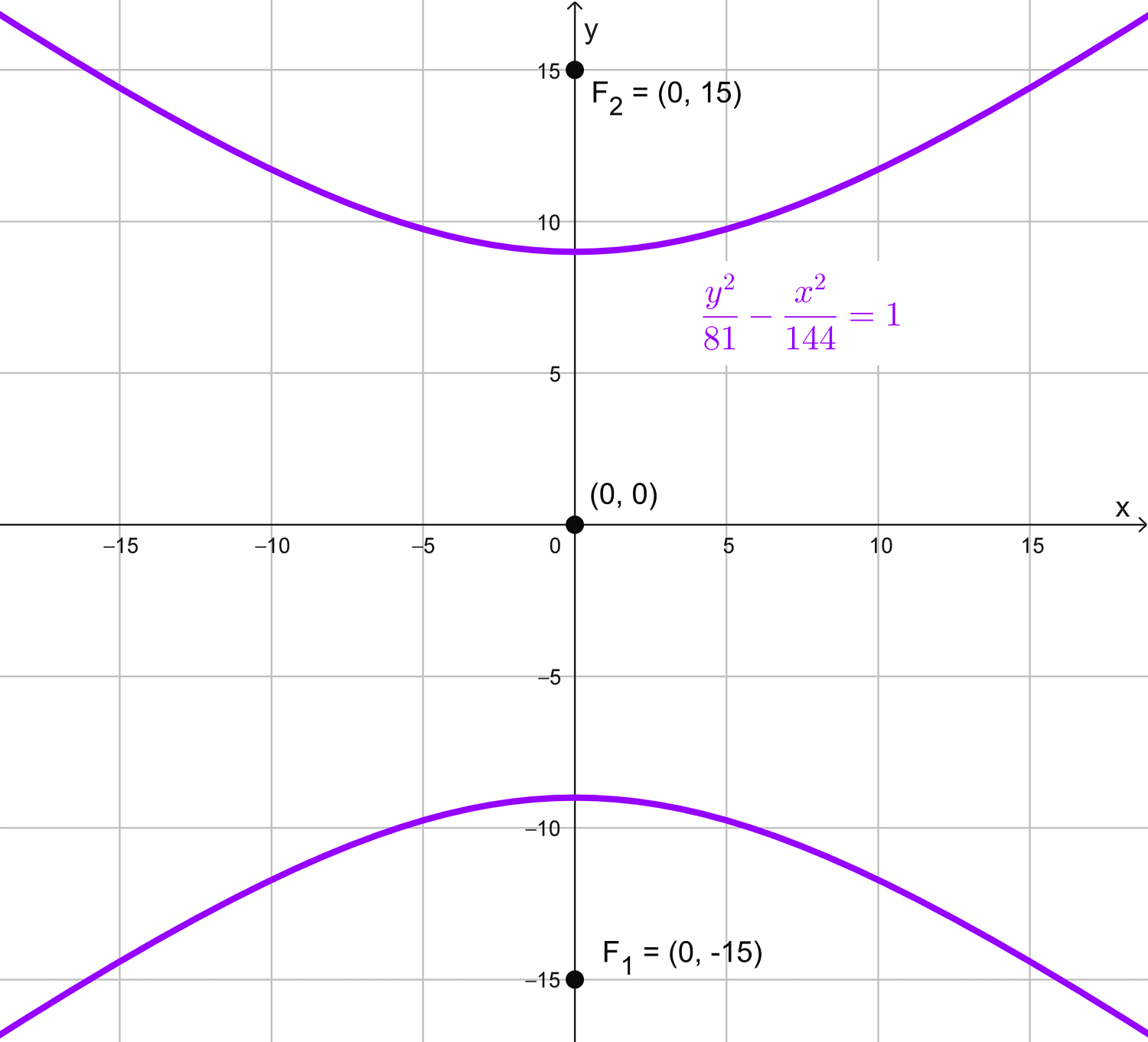
The focal distance of a hyperbola is 30, its center is (0, 0), and its vertical transverse axis has a length of 18. Find its standard equation.
Solution
For a hyperbola centered at (0, 0) with a vertical transverse axis, the standard equation is:
$$\dfrac{y^2}{a^2}-\dfrac{x^2}{b^2}=1$$
The transverse axis is vertical and has length 2a, so:
$$2a=18 → a=9$$
The distance between the foci is 2c. Since this distance is 30:
$$2c=30 → c=15$$
Using the relation \(c^2=a^2+b^2:\)
$$15^2=9^2+b^2 → 225=81+b^2 → b^2=225-81=144$$
Therefore, b=12.
Substituting a and b into the standard equation:
$$\dfrac{y^2}{81}-\dfrac{x^2}{144}=1$$
This is the standard equation of the hyperbola under the given conditions.
Problem 9
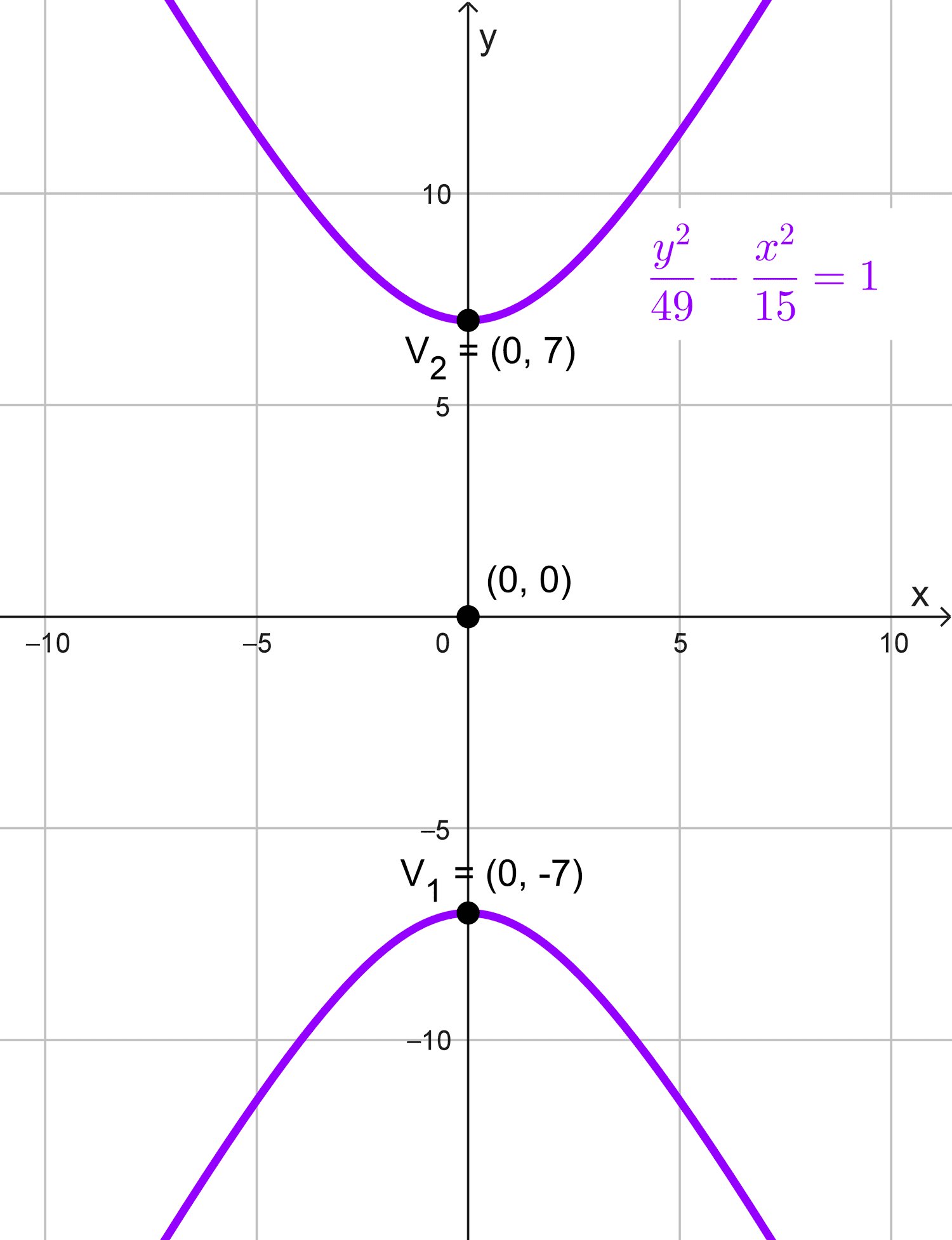
Find the standard equation of the hyperbola with vertices at (0, ±7) and eccentricity e = 8/7.
Solution
Since the vertices are at \((0, \pm7),\) the transverse axis is vertical and the center is at the origin (0, 0). The distance from the center to each vertex is a=7.
A vertical hyperbola centered at the origin has the standard equation:
$$\dfrac{y^2}{a^2}-\dfrac{x^2}{b^2}=1$$
where a is the semi-transverse axis length and b is the semi-conjugate axis length.
The eccentricity e is given by:
$$e=\dfrac{c}{a}$$
Since \(e=\dfrac{8}{7}\) and \(a=7,\) we can solve for c:
$$\dfrac{8}{7}=\dfrac{c}{7} → c=8$$
Using the relationship \(c^2=a^2+b^2:\)
$$8^2=7^2+b^2 → 64=49+b^2 → b^2=64-49=15$$
Therefore, \(b=\sqrt{15}.\)
Substituting a and b into the standard equation:
$$\dfrac{y^2}{49}-\dfrac{x^2}{15}=1$$
This is the standard equation of the hyperbola with the given conditions.
Resource: If you are working through practice problems and want to verify your answers, you can use our free tool:
Problem 10
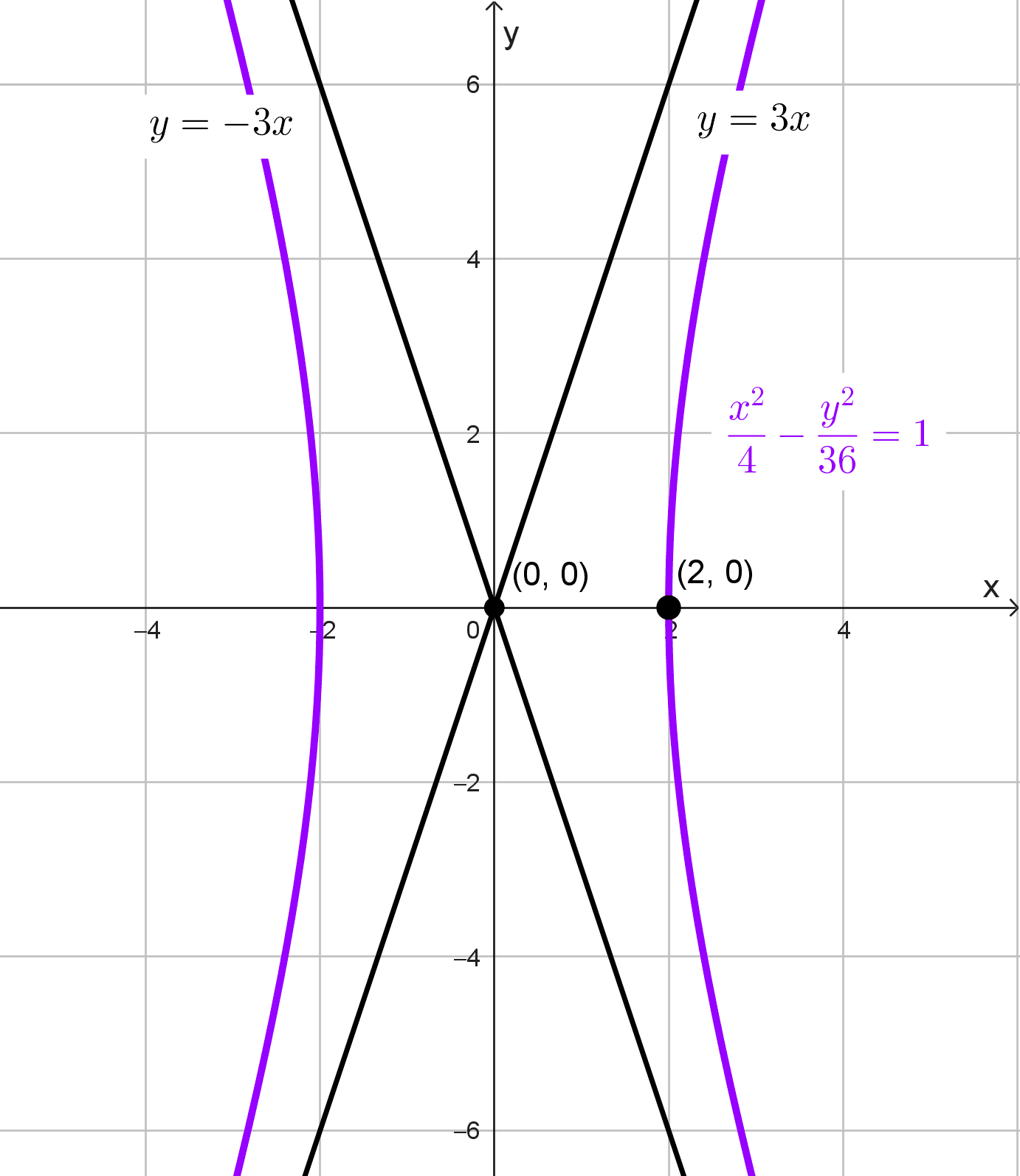
A hyperbola passes through the point (2, 0) and its asymptotes are the lines y = ±3x. Determine its equation.
Solution
The asymptotes provide key information about orientation and parameters. Because the point (2, 0) lies on the x-axis, the hyperbola opens horizontally.
For a horizontal hyperbola centered at the origin (0, 0), the asymptote equations are:
$$y=\pm\dfrac{b}{a}x$$
Comparing this with the given asymptotes \(y=\pm3x,\) we find:
$$\dfrac{b}{a}=3 → b=3a$$
Since the hyperbola passes through (2, 0), this point must satisfy the standard equation:
$$\dfrac{x^2}{a^2}-\dfrac{y^2}{b^2}=1$$
Substituting (2, 0) into the equation:
$$\dfrac{2^2}{a^2}-\dfrac{0^2}{b^2}=1 → \dfrac{4}{a^2}=1 → a^2=4 → a=2$$
Since \(b=3a:\)
$$b=3 \cdot 2=6 → b^2=36$$
Substituting a and b into the standard equation:
$$\dfrac{x^2}{4}-\dfrac{y^2}{36}=1$$
This is the standard equation of the hyperbola with the given conditions.
Problem 11
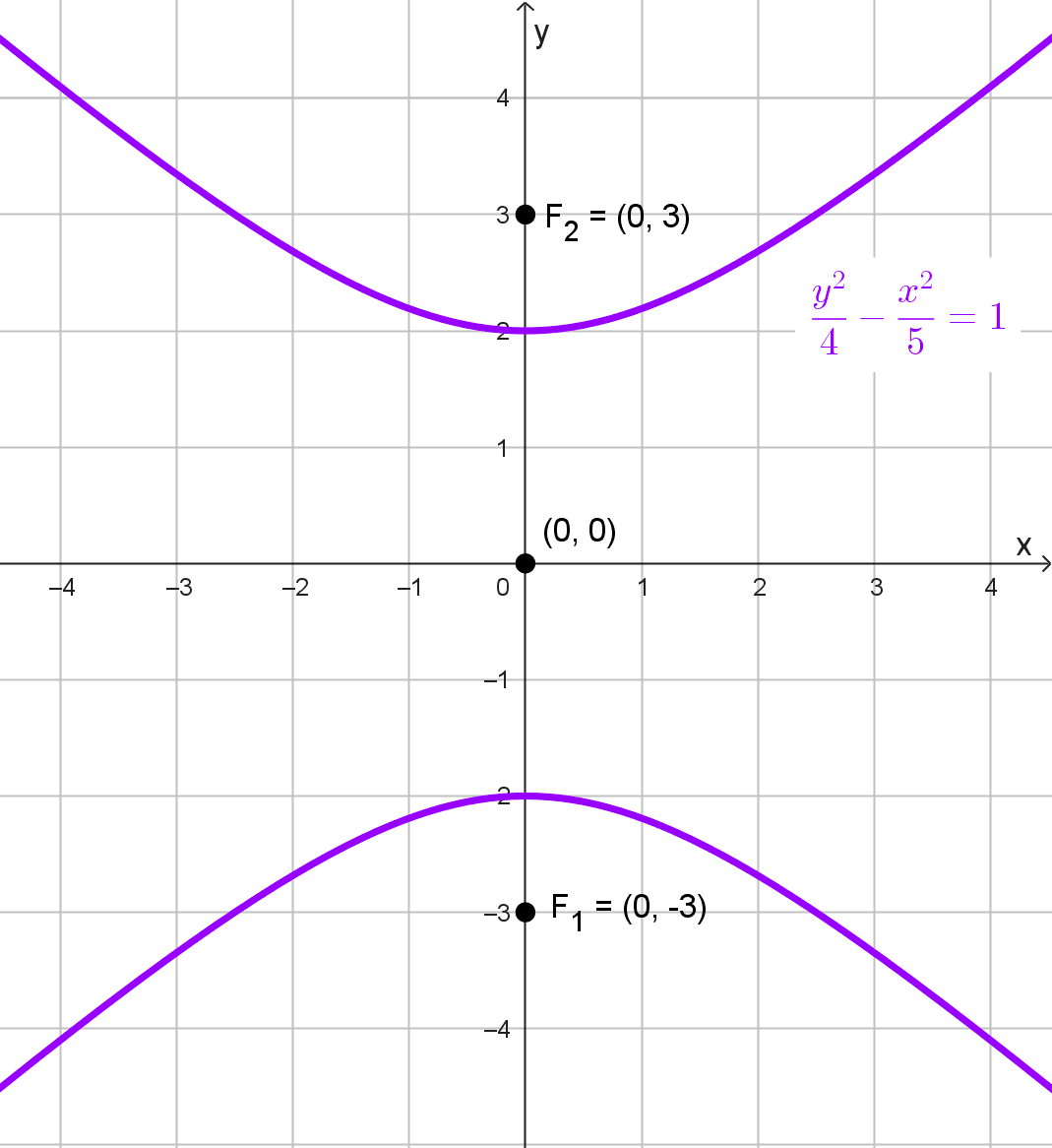
The foci of a hyperbola are located at (0, -3) and (0, 3), and the distance between its vertices is 4. Find its standard equation.
Solution
First, notice that the foci lie on the y-axis, indicating a vertical transverse axis. Therefore, the standard equation is of the form:
$$\dfrac{y^2}{a^2}-\dfrac{x^2}{b^2}=1$$
Given the foci at (0, -3) and (0, 3), the focal distance between them is \(2c=6,\) so:
$$c=3$$
We are also given that the distance between the vertices is 4, which means \(2a=4,\) so:
$$a=2$$
Using the hyperbola relationship:
$$c^2=a^2+b^2$$
Substituting the values of a and c:
$$3^2=2^2+b^2 → 9=4+b^2 → b^2=9-4=5$$
Therefore, \(b=\sqrt{5}.\)
Finally, substituting a and b into the standard equation:
$$\dfrac{y^2}{4}-\dfrac{x^2}{5}=1$$
This is the standard equation of the hyperbola under the given conditions.
Problem 12
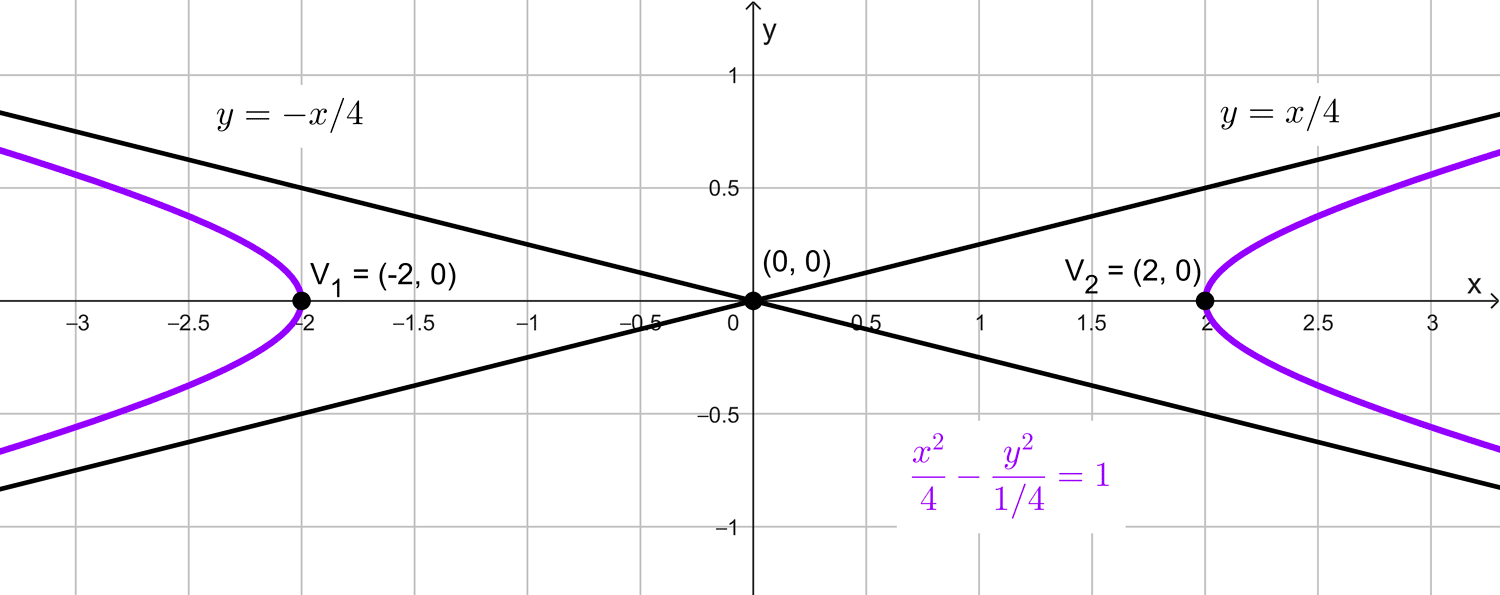
Find the standard equation of the hyperbola if its x-intercepts are at ±2 and its asymptotes are y = ±x / 4.
Solution
The x-intercepts indicate that the vertices of the hyperbola are at (±2, 0). Because the vertices lie on the x-axis, the hyperbola has a horizontal transverse axis. Its standard form is:
$$\dfrac{x^2}{a^2}-\dfrac{y^2}{b^2}=1$$
Since the vertices are at \((\pm2, 0):\)
$$a=2$$
The asymptotes of a horizontal hyperbola centered at the origin are given by:
$$y=\pm\dfrac{b}{a}x$$
Comparing this with the given asymptotes \(y=\pm\dfrac{x}{4},\) we have:
$$\dfrac{b}{a}=\dfrac{1}{4}$$
Substitute \(a=2\) to find b:
$$\dfrac{b}{2}=\dfrac{1}{4} → b=\dfrac{2}{4}=\dfrac{1}{2}$$
Therefore, \(b^2=\left (\dfrac{1}{2}\right)^2=\dfrac{1}{4}.\)
Finally, substituting a and b into the standard equation:
$$\dfrac{x^2}{4}-\dfrac{y^2}{1/4}=1$$
This is the standard equation of the hyperbola with the given conditions.
Problem 13
The endpoints of the conjugate axis of a hyperbola are (0, -3) and (0, 3), and one of its foci is at (5, 0). Calculate its standard equation.
Solution
The endpoints of the conjugate axis give \(b=3.\) Since these endpoints lie on the y-axis, the transverse axis must be horizontal along the x-axis. Therefore, the standard equation is:
$$\dfrac{x^2}{a^2}-\dfrac{y^2}{b^2}=1$$
Given that one focus is at (5, 0), the focal distance from the center is c=5.
Using the relation \(c^2=a^2+b^2:\)
$$5^2=a^2+3^2 → 25=a^2+9 → a^2=25-9=16 → a=4$$
Thus, \(a^2=16\) and \(b^2=9.\)
Substituting into the standard equation:
$$\dfrac{x^2}{16}-\dfrac{y^2}{9}=1$$
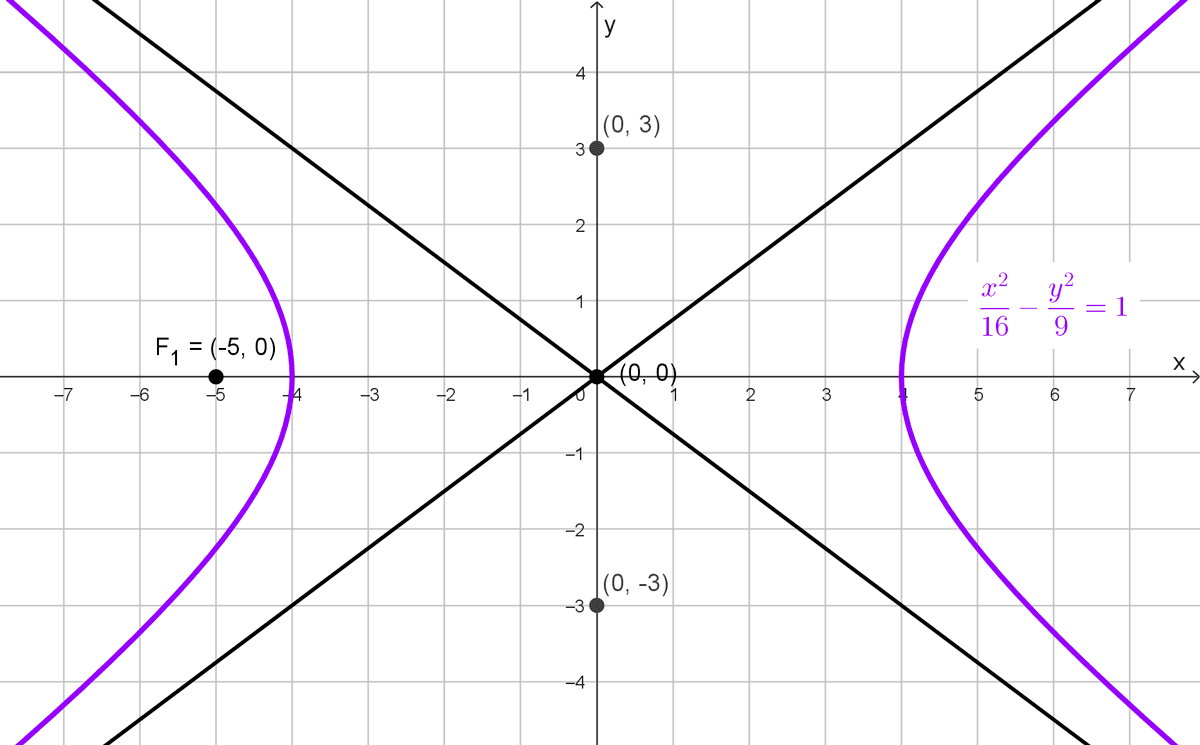
Problem 14
Find the equation for the set of all points in the xy-plane such that the difference of the distances from a point (x, y) to the points F(13, 0) and F’(-13, 0) is constant and equal to k = 24.
Solution
By definition, a hyperbola is the set of all points where the absolute difference of distances to two fixed points (the foci) is constant. The foci are F(13, 0) and F'(-13, 0), and the constant difference is k = 24.
In any hyperbola, this constant difference is equal to 2a, where a is the distance from the center to each vertex. Therefore:
$$2a=24 → a=12$$
The center of the hyperbola is the midpoint between the two foci:
$$\left (\dfrac{13+(-13)}{2}, \dfrac{0+0}{2} \right)=(0, 0)$$
The distance c from the center to each focus is:
$$c=13$$
Now, to find b, we use the fundamental hyperbola relationship:
$$c^2=a^2+b^2$$
Substituting the known values:
$$13^2=12^2+b^2 → 169=144+b^2 → b^2=25 → b=5$$
Since the foci lie on the x-axis, the hyperbola is horizontal with center (0, 0):
$$\dfrac{x^2}{a^2}-\dfrac{y^2}{b^2}=1$$
Substituting \(a=12\) and \(b=5:\)
$$\dfrac{x^2}{144}-\dfrac{y^2}{25}=1$$
This equation describes the set of points (x, y) whose difference of distances to F(13, 0) and F'(-13, 0) is 24.
Center Away from the Origin
Problem 15
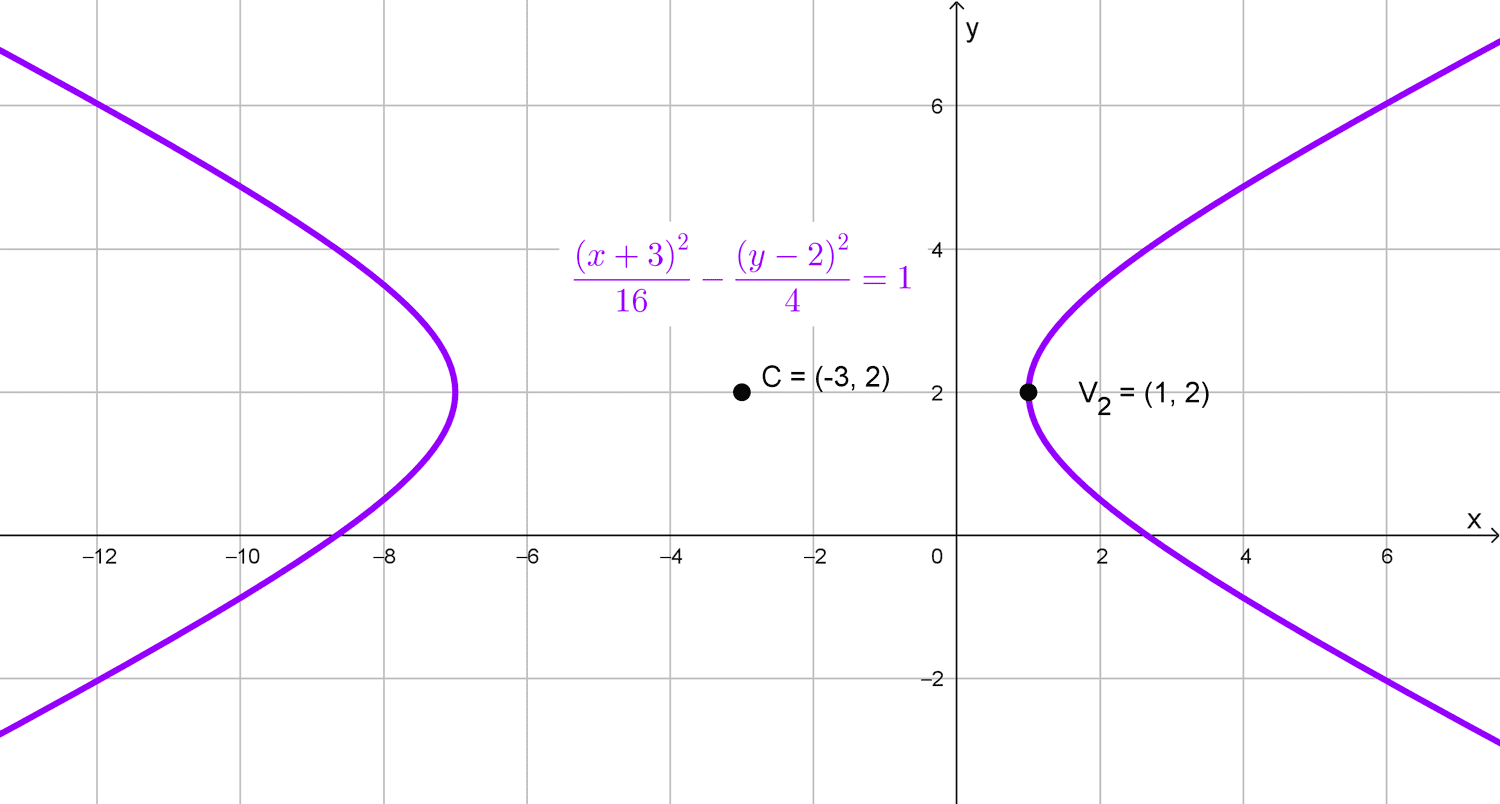
A hyperbola is centered at (-3, 2), one of its vertices is at (1, 2), and the length of its conjugate axis is 4. What is its standard equation?
Solution
The standard equation of a horizontal hyperbola centered at (h, k) is:
$$\dfrac{(x-h)^2}{a^2}-\dfrac{(y-k)^2}{b^2}=1$$
The center is (-3, 2), so \(h=-3\) and \(k=2.\) We are given a vertex at (1, 2). Since the center and vertex share the same y-coordinate, the transverse axis is horizontal, and a is the distance between them:
$$a=|1-(-3)|=|1+3|=4$$
The length of the conjugate axis is 2b, which is given as 4. Therefore:
$$2b=4 → b=2$$
Substituting the values of h, k, a, and b into the standard form:
$$\dfrac{(x+3)^2}{4^2}-\dfrac{(y-2)^2}{2^2}=1$$
$$\dfrac{(x+3)^2}{16}-\dfrac{(y-2)^2}{4}=1$$
Therefore, the standard equation of the hyperbola is:
$$\dfrac{(x+3)^2}{16}-\dfrac{(y-2)^2}{4}=1$$
Problem 16
Find the standard equations of the following hyperbolas, identify all their key features, and sketch their graphs.
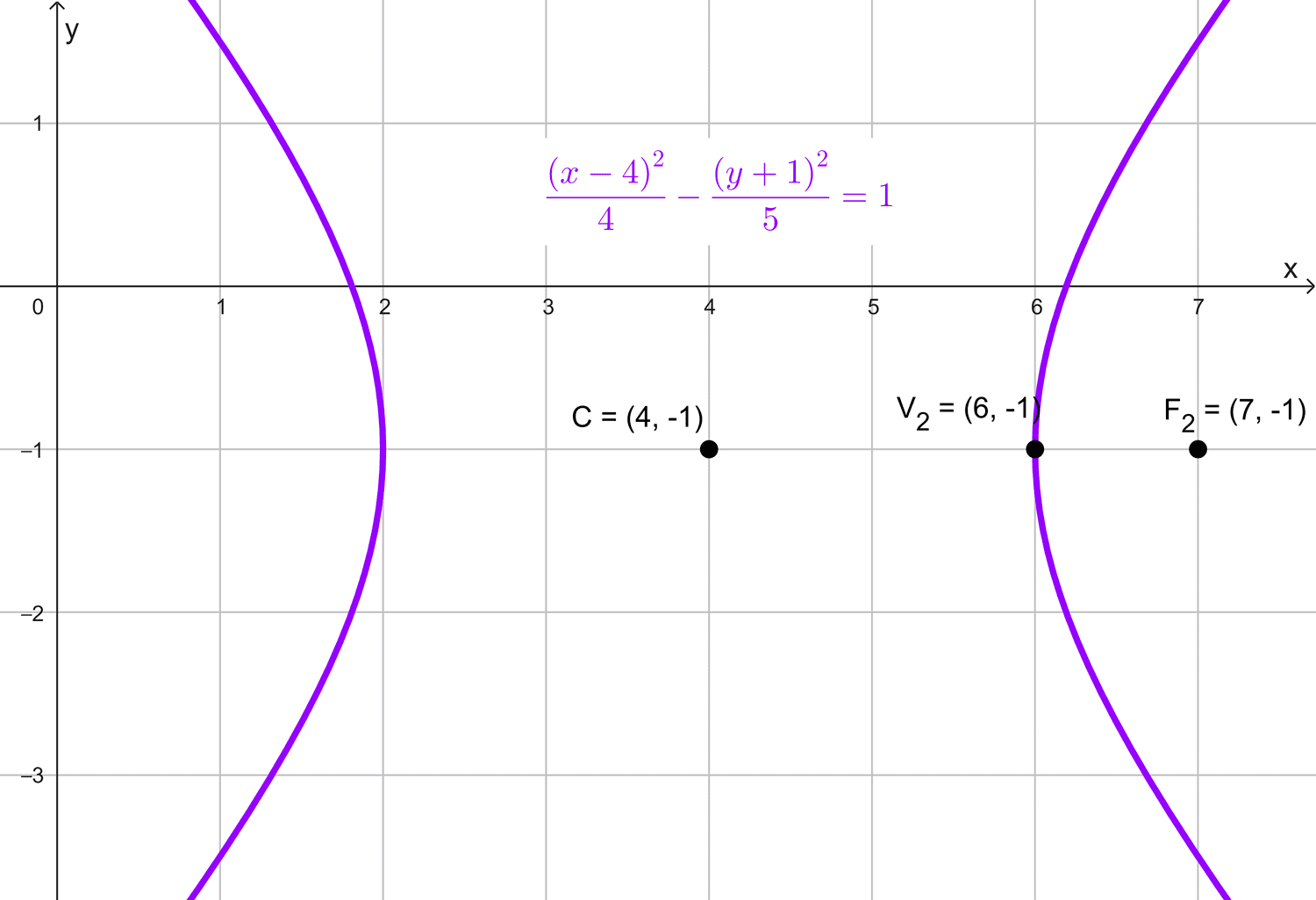
- C(4, -1); focus (7, -1); vertex (6, -1).
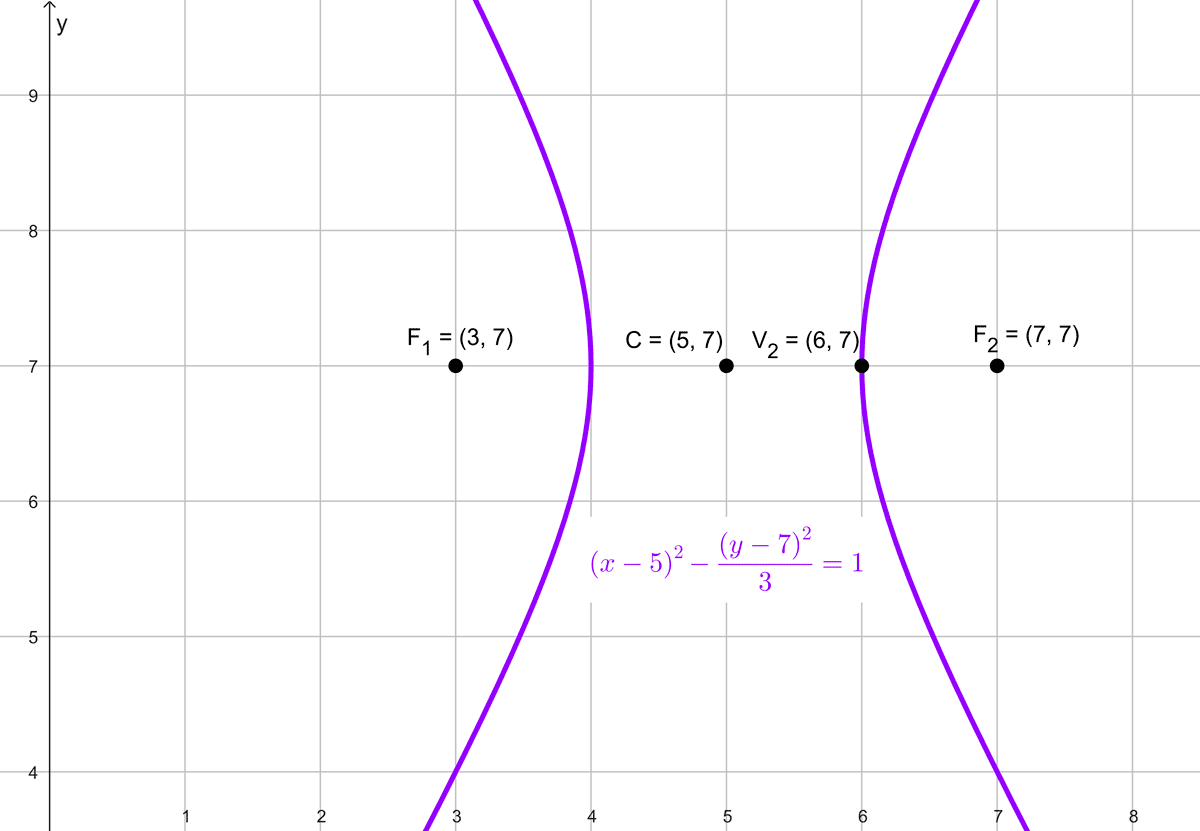
- Foci at (3, 7) and (7, 7); vertex at (6, 7).
- Vertices at (-1, -1) and (3, -1); asymptote y + 1 = (3 / 2) (x - 1).
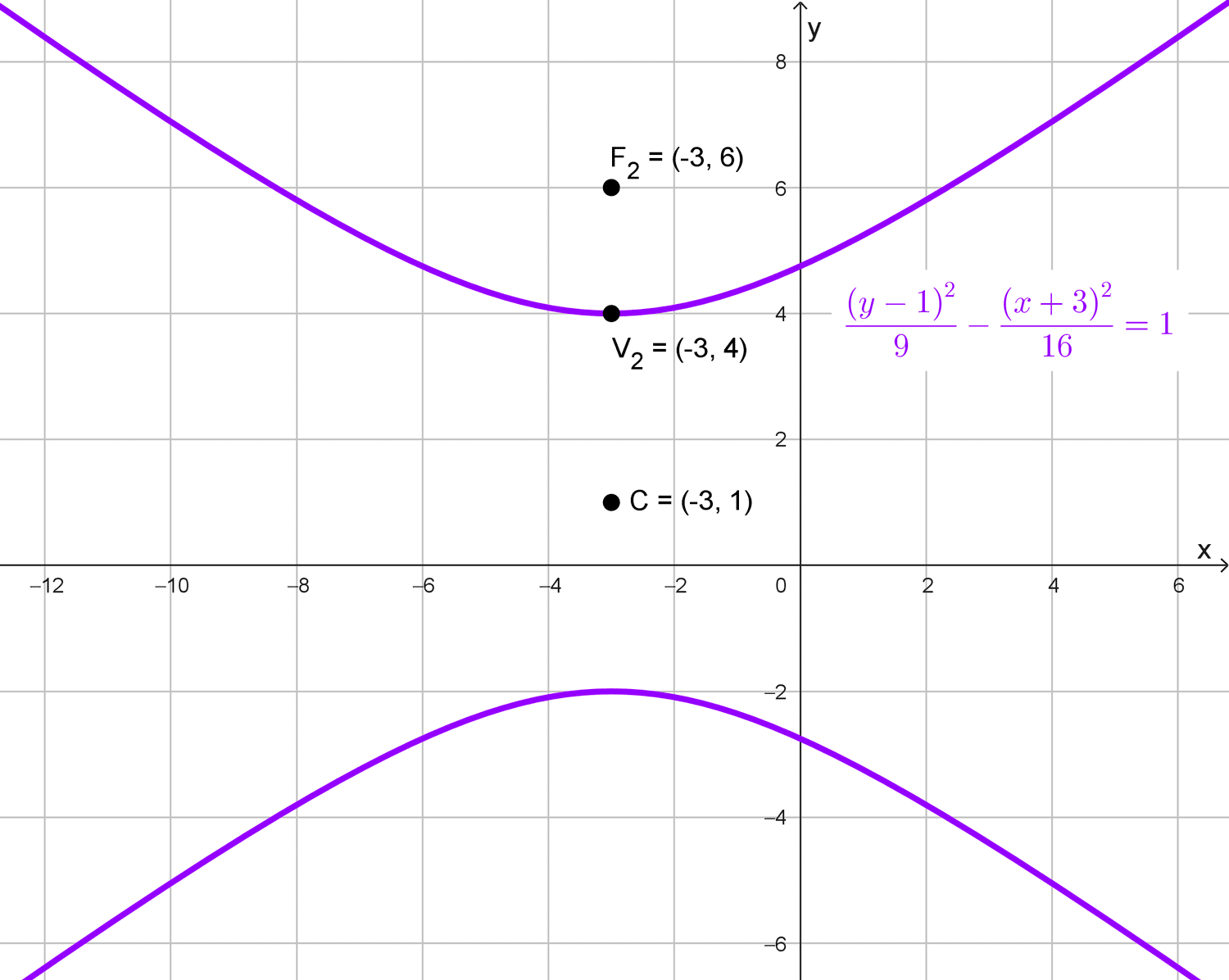
- Center (-3, 1); focus (-3, 6); vertex (-3, 4).
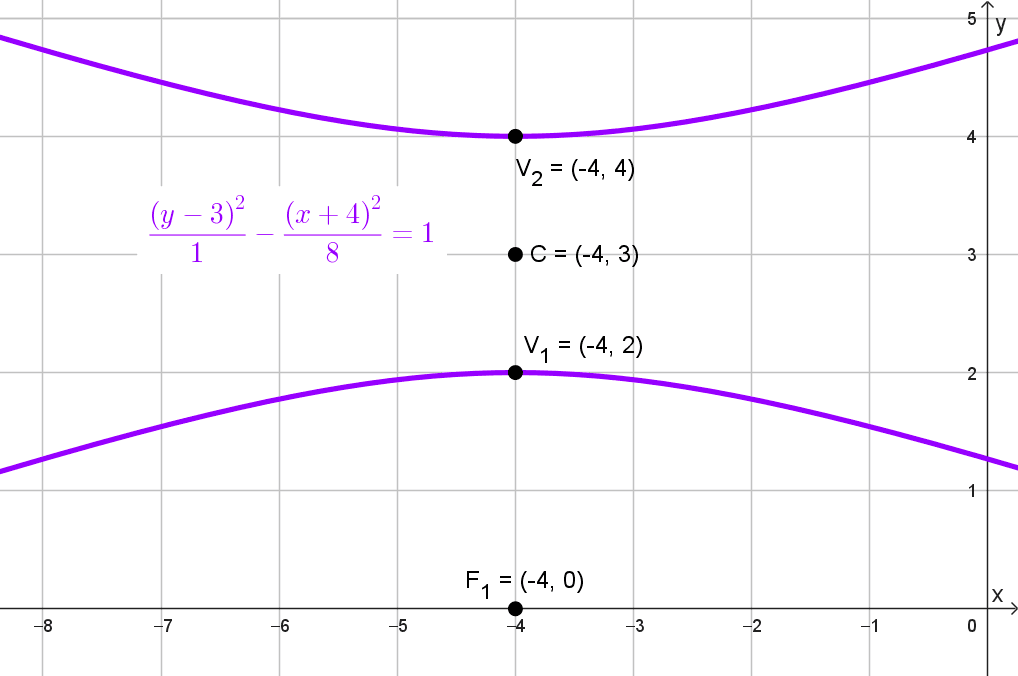
- Focus (-4, 0); vertices (-4, 4) and (-4, 2).
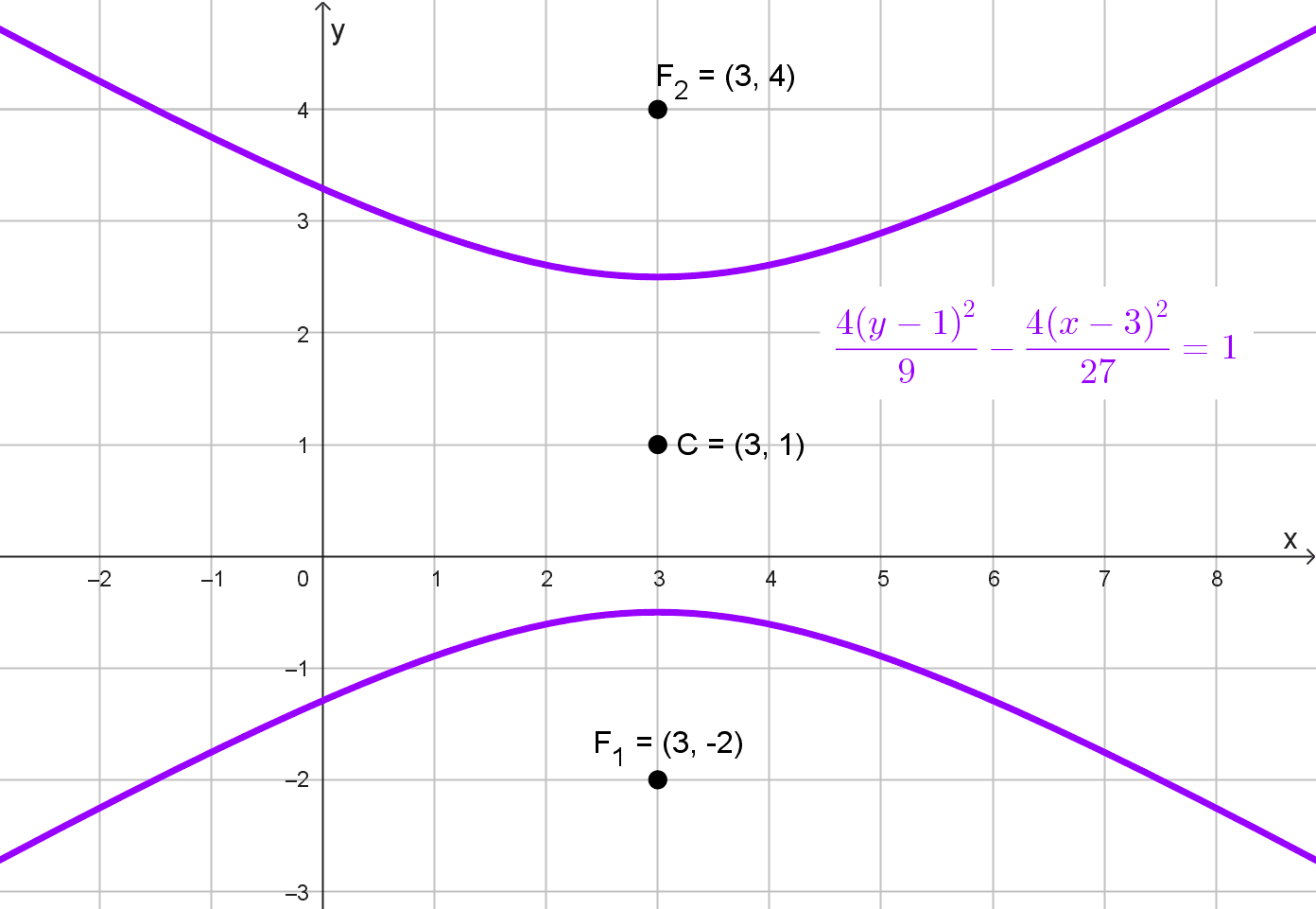
- Foci (3, 4) and (3, -2); eccentricity equal to 2.
Solution 1
Given Data:
- Center: C(4, -1)
- Focus: (7, -1)
- Vertex: (6, -1)
The center, focus, and vertex all share the same y-coordinate, indicating a horizontal hyperbola. Its standard equation is:
$$\dfrac{(x-h)^2}{a^2}-\dfrac{(y-k)^2}{b^2}=1$$
where (h, k) is the center. Since C is (4, -1), \(h=4\) and \(k=-1.\)
The distance between the center and the vertex is a:
$$a=6-4=2$$
The distance between the center and the focus is c:
$$c=7-4=3$$
Using the hyperbola relationship \(c^2=a^2+b^2:\)
$$3^2=2^2+b^2 → 9=4+b^2 → b^2=5 → b=\sqrt{5}$$
Substituting h, k, a, and b into the equation:
$$\dfrac{(x-4)^2}{4}-\dfrac{(y+1)^2}{5}=1$$
For a horizontal hyperbola, the asymptote equations are:
$$y-k=\pm \dfrac{b}{a}(x-h)$$
Substituting the values:
$$y+1=\pm \dfrac{\sqrt{5}}{2}(x-4)$$
The eccentricity e is:
$$e=\dfrac{c}{a}$$
$$e=\dfrac{3}{2}=1.5$$
The latus rectum LR is:
$$L_R=\dfrac{2b^2}{a}$$
$$L_R=\dfrac{2 \cdot 5}{2}=5$$
Key Features:
- Center: (4, -1)
- Foci: (7, -1) and (1, -1)
- Vertices: (6, -1) and (2, -1)
- Semi-transverse axis: \(a=2\)
- Semi-conjugate axis: \(b=\sqrt{5}\)
- Asymptotes: \(y+1=\pm \dfrac{\sqrt{5}}{2}(x-4)\)
- Eccentricity: \(e=1.5\)
- Latus rectum: \(L_R=5\)
Equation: \(\dfrac{(x-4)^2}{4}-\dfrac{(y+1)^2}{5}=1\)
Solution 2
Given Data:
- Foci: (3, 7) and (7, 7)
- Vertex: (6, 7)
The foci and vertex share the line y = 7, indicating a horizontal hyperbola with standard equation:
$$\dfrac{(x-h)^2}{a^2}-\dfrac{(y-k)^2}{b^2}=1$$
The center is the midpoint between the foci:
$$h=\dfrac{3+7}{2}=5, \quad k=\dfrac{7+7}{2}=7$$
Thus, the center is C(5, 7).
The distance from the center (5, 7) to the vertex (6, 7) is a:
$$a=6-5=1$$
The distance from the center (5, 7) to the focus (7, 7) is c:
$$c=7-5=2$$
Using \(c^2=a^2+b^2:\)
$$2^2=1^2+b^2 → 4=1+b^2 → b^2=3 → b=\sqrt{3}$$
Substituting \(h=5, k=7, a=1,\) and \(b=\sqrt{3}:\)
$$\dfrac{(x-5)^2}{1}-\dfrac{(y-7)^2}{3}=1$$
Simplifying:
$$(x-5)^2-\dfrac{(y-7)^2}{3}=1$$
The asymptote equations are:
$$y-k=\pm \dfrac{b}{a}(x-h)$$
$$y-7=\pm \dfrac{\sqrt{3}}{1}(x-5) → y-7=\pm \sqrt{3}(x-5)$$
The eccentricity is:
$$e=\dfrac{c}{a}=\dfrac{2}{1}=2$$
The latus rectum is:
$$L_R=\dfrac{2b^2}{a}=\dfrac{2 \cdot 3}{1}=6$$
Key Features:
- Center: (5, 7)
- Foci: (7, 7) and (3, 7)
- Vertices: (6, 7) and (4, 7)
- Semi-transverse axis: \(a=1\)
- Semi-conjugate axis: \(b=\sqrt{3}\)
- Asymptotes: \(y-7=\pm \sqrt{3}(x-5)\)
- Eccentricity: \(e=2\)
- Latus rectum: \(L_R=6\)
Equation: \((x-5)^2-\dfrac{(y-7)^2}{3}=1\)
Solution 3
Given Data:
- Vertices: (-1, -1) and (3, -1)
- Asymptote: \(y+1=\dfrac{3}{2}(x-1)\)
The vertices share the line \(y=-1,\) showing a horizontal orientation:
$$\dfrac{(x-h)^2}{a^2}-\dfrac{(y-k)^2}{b^2}=1$$
The center is the midpoint between the vertices:
$$h=\dfrac{-1+3}{2}=1, \quad k=\dfrac{-1+(-1)}{2}=-1$$
So the center is C(1, -1).
The distance from the center (1, -1) to the vertex (3, -1) gives a:
$$a=3-1=2$$
The asymptotes of a horizontal hyperbola have slopes \(\pm \dfrac{b}{a}:\)
$$y-k=\pm \dfrac{b}{a}(x-h)$$
Comparing with the given asymptote \(y+1=\dfrac{3}{2}(x-1),\) we have:
$$\dfrac{b}{a}=\dfrac{3}{2}$$
Since a = 2:
$$\dfrac{b}{2}=\dfrac{3}{2} → b=3$$
Now find c using \(c^2=a^2+b^2:\)
$$c^2=2^2+3^2=4+9=13 → c=\sqrt{13}$$
The foci lie c units to the left and right of the center: \((1+\sqrt{13}, -1)\) and \((1-\sqrt{13}, -1).\)
Substituting \(h=1, k=-1, a=2,\) and \(b=3\) into the standard equation:
$$\dfrac{(x-1)^2}{4}-\dfrac{(y+1)^2}{9}=1$$
The asymptote equations are:
$$y+1=\pm \dfrac{3}{2}(x-1)$$
The eccentricity is:
$$e=\dfrac{c}{a}=\dfrac{\sqrt{13}}{2}$$
The latus rectum is:
$$L_R=\dfrac{2b^2}{a}=\dfrac{2 \cdot 9}{2}=9$$
Key Features:
- Center: (1, -1)
- Foci: \((1+\sqrt{13}, -1)\) and \((1-\sqrt{13}, -1)\)
- Vertices: (3, -1) and (-1, -1)
- Semi-transverse axis: \(a=2\)
- Semi-conjugate axis: \(b=3\)
- Asymptotes: \(y+1=\pm \dfrac{3}{2}(x-1)\)
- Eccentricity: \(e=\dfrac{\sqrt{13}}{2}\)
- Latus rectum: \(L_R=9\)
Equation: \(\dfrac{(x-1)^2}{4}-\dfrac{(y+1)^2}{9}=1\)

Solution 4
Given Data:
- Center: (-3, 1)
- Focus: (-3, 6)
- Vertex: (-3, 4)
The center, focus, and vertex share the line \(x=-3,\) which indicates a vertical hyperbola. Its standard equation is:
$$\dfrac{(y-k)^2}{a^2}-\dfrac{(x-h)^2}{b^2}=1$$
With center (-3, 1), we have:
$$h=-3, \quad k=1$$
The distance from the center (-3, 1) to the vertex (-3, 4) is a:
$$a=4-1=3$$
The distance from the center (-3, 1) to the focus (-3, 6) is c:
$$c=6-1=5$$
Calculate b using \(c^2=a^2+b^2:\)
$$c^2=a^2+b^2 → 5^2=3^2+b^2 → 25=9+b^2 → b^2=16 → b=4$$
Substituting \(h=-3, k=1, a=3,\) and \(b=4\) into the standard equation:
$$\dfrac{(y-1)^2}{9}-\dfrac{(x+3)^2}{16}=1$$
For a vertical hyperbola, the asymptotes are given by:
$$y-k=\pm \dfrac{a}{b}(x-h)$$
Substituting the values:
$$y-1=\pm \dfrac{3}{4}(x+3)$$
The eccentricity is:
$$e=\dfrac{c}{a}=\dfrac{5}{3}$$
The latus rectum is:
$$L_R=\dfrac{2b^2}{a}=\dfrac{2 \cdot 16}{3}=\dfrac{32}{3}$$
Key Features:
- Center: (-3, 1)
- Foci: (-3, 6) and (-3, -4)
- Vertices: (-3, 4) and (-3, -2)
- Semi-transverse axis: a=3
- Semi-conjugate axis: b=4
- Asymptotes: \(y-1=\pm \dfrac{3}{4}(x+3)\)
- Eccentricity: \(e=\dfrac{5}{3}\)
- Latus rectum: \(L_R=\dfrac{32}{3}\)
Equation: \(\dfrac{(y-1)^2}{9}-\dfrac{(x+3)^2}{16}=1\)
Solution 5
Given Data:
- Focus: (-4, 0)
- Vertices: (-4, 4) and (-4, 2)
The focus and vertices share the vertical line \(x=-4,\) confirming a vertical hyperbola with standard equation:
$$\dfrac{(y-k)^2}{a^2}-\dfrac{(x-h)^2}{b^2}=1$$
The center is the midpoint between the vertices (-4, 4) and (-4, 2):
$$h=\dfrac{-4+(-4)}{2}=-4, \quad k=\dfrac{4+2}{2}=3$$
Thus, the center is C(-4, 3).
The distance from the center (-4, 3) to the vertex (-4, 4) is a:
$$a=4-3=1$$
The distance from the center (-4, 3) to the focus (-4, 0) is c:
$$c=3-0=3$$
Solving for b using \(c^2=a^2+b^2:\)
$$c^2=a^2+b^2 → 3^2=1^2+b^2 → 9=1+b^2 → b^2=8 → b=2\sqrt{2}$$
Substituting \(h=-4, k=3, a=1,\) and \(b=2\sqrt{2}\) into the equation:
$$\dfrac{(y-3)^2}{1}-\dfrac{(x+4)^2}{8}=1$$
The asymptote equations are:
$$y-k=\pm \dfrac{a}{b}(x-h)$$
$$y-3=\pm \dfrac{1}{2\sqrt{2}}(x+4)$$
$$y-3=\pm \dfrac{\sqrt{2}}{4}(x+4)$$
The eccentricity is:
$$e=\dfrac{c}{a}=\dfrac{3}{1}=3$$
The latus rectum is:
$$L_R=\dfrac{2b^2}{a}=\dfrac{2 \cdot 8}{1}=16$$
Key Features:
- Center: (-4, 3)
- Foci: (-4, 6) and (-4, 0)
- Vertices: (-4, 4) and (-4, 2)
- Semi-transverse axis: \(a=1\)
- Semi-conjugate axis: \(b=2\sqrt{2}\)
- Asymptotes: \(y-3=\pm \dfrac{\sqrt{2}}{4}(x+4)\)
- Eccentricity: \(e=3\)
- Latus rectum: \(L_R=16\)
Equation: \(\dfrac{(y-3)^2}{1}-\dfrac{(x+4)^2}{8}=1\)
Solution 6
Given Data:
- Foci: (3, 4) and (3, -2)
- Eccentricity: e = 2
The foci share the vertical line x = 3, indicating a vertical hyperbola:
$$\dfrac{(y-k)^2}{a^2}-\dfrac{(x-h)^2}{b^2}=1$$
The center is the midpoint between the foci:
$$h=\dfrac{3+3}{2}=3, \quad k=\dfrac{4+(-2)}{2}=1$$
Thus, the center is C(3, 1).
The distance from the center (3, 1) to the focus (3, 4) is c:
$$c=4-1=3$$
Using the eccentricity e = 2:
$$e=\dfrac{c}{a} → 2=\dfrac{3}{a} → a=\dfrac{3}{2}$$
Calculate b using \(c^2=a^2+b^2:\)
$$c^2=a^2+b^2 → 3^2=\left (\dfrac{3}{2}\right)^2+b^2 → 9=\dfrac{9}{4}+b^2 → b^2=9-\dfrac{9}{4}=\dfrac{27}{4} → b=\dfrac{3\sqrt{3}}{2}$$
Substituting \(h=3, k=1, a=\dfrac{3}{2},\) and \(b=\dfrac{3\sqrt{3}}{2}\) into the standard equation:
$$\dfrac{(y-1)^2}{\left (\dfrac{3}{2}\right)^2}-\dfrac{(x-3)^2}{\left (\dfrac{3\sqrt{3}}{2}\right)^2}=1$$
Simplifying:
$$\dfrac{(y-1)^2}{\dfrac{9}{4}}-\dfrac{(x-3)^2}{\dfrac{27}{4}}=1$$
Rewriting fractions:
$$\dfrac{4 (y-1)^2}{9}-\dfrac{4 (x-3)^2}{27}=1$$
The asymptote equations are:
$$y-k=\pm \dfrac{a}{b}(x-h)$$
$$y-1=\pm \dfrac{\dfrac{3}{2}}{\dfrac{3\sqrt{3}}{2}}(x-3) → y-1=\pm \dfrac{1}{\sqrt{3}}(x-3)$$
$$y-1=\pm \dfrac{\sqrt{3}}{3}(x-3)$$
The latus rectum is:
$$L_R=\dfrac{2b^2}{a}=\dfrac{2 \cdot \dfrac{27}{4}}{\dfrac{3}{2}}=\dfrac{\dfrac{54}{4}}{\dfrac{3}{2}}=\dfrac{54}{4} \cdot \dfrac{2}{3}=\dfrac{108}{12}=9$$
Key Features:
- Center: (3, 1)
- Foci: (3, 4) and (3, -2)
- Vertices: \((3, 1+a)=(3, 2.5)\) and \((3, 1-a)=(3, -0.5)\)
- Semi-transverse axis: \(a=\dfrac{3}{2}\)
- Semi-conjugate axis: \(b=\dfrac{3\sqrt{3}}{2}\)
- Asymptotes: \(y-1=\pm \dfrac{\sqrt{3}}{3}(x-3)\)
- Eccentricity: \(e=2\)
- Latus rectum: \(L_R=9\)
Equation: \(\dfrac{4 (y-1)^2}{9}-\dfrac{4 (x-3)^2}{27}=1\)
Problem 17
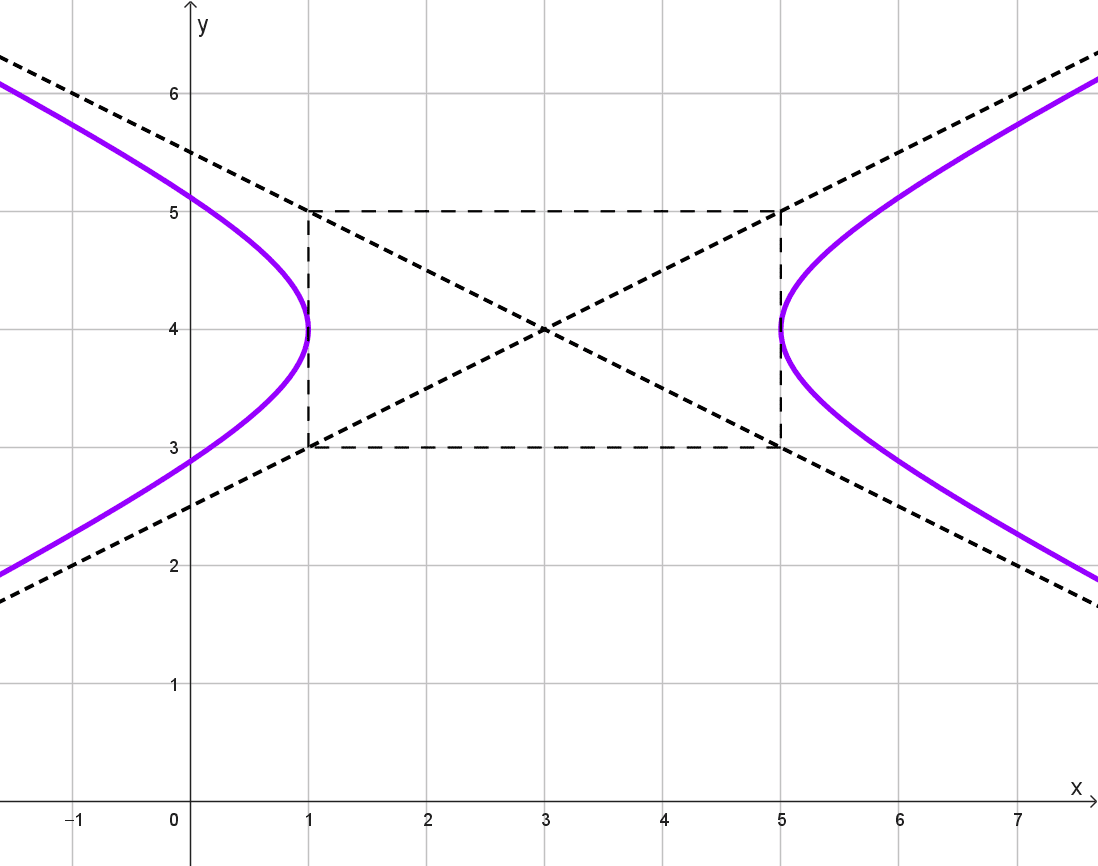
Write the equations of the hyperbolas shown in the following graphs.
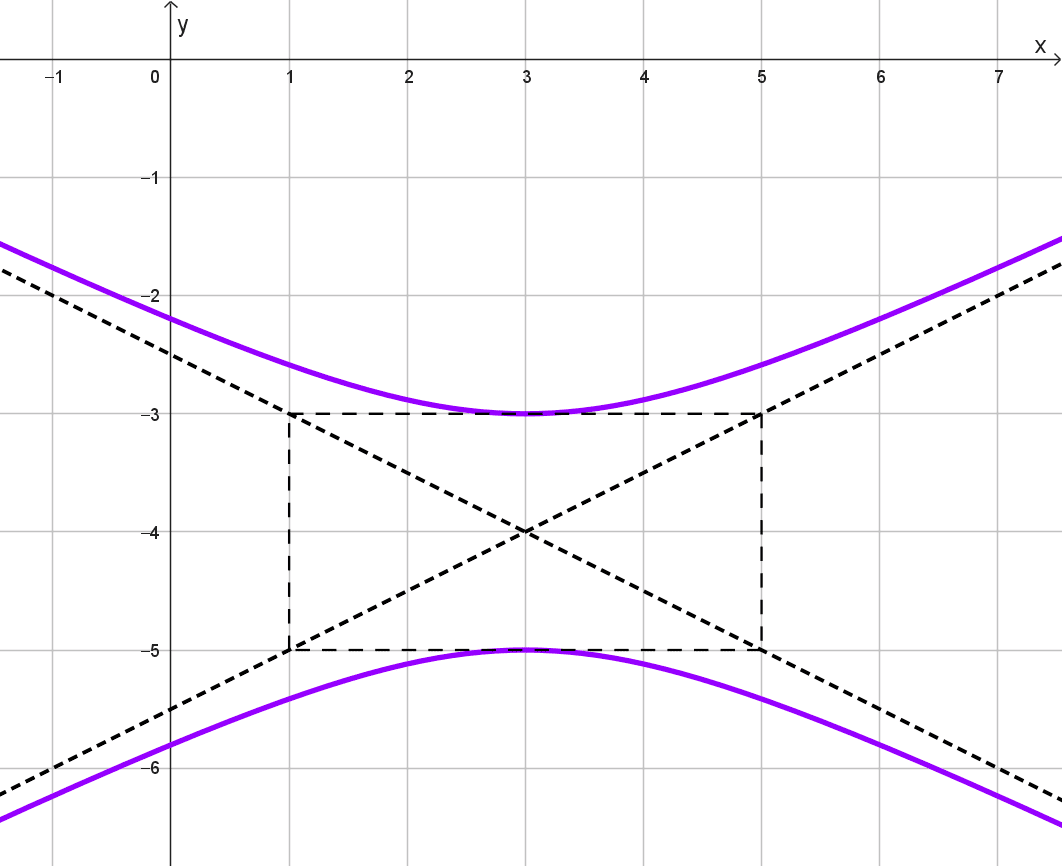
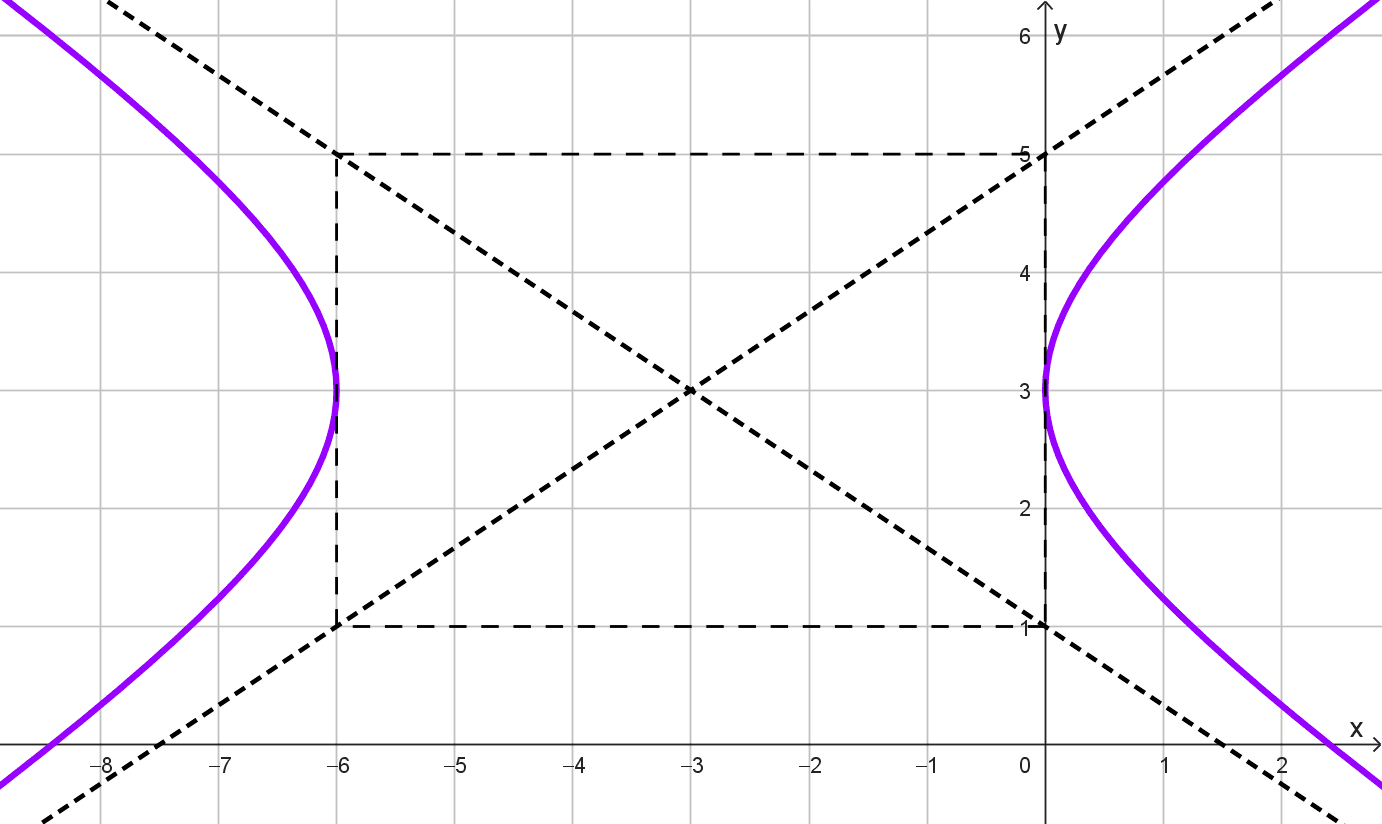
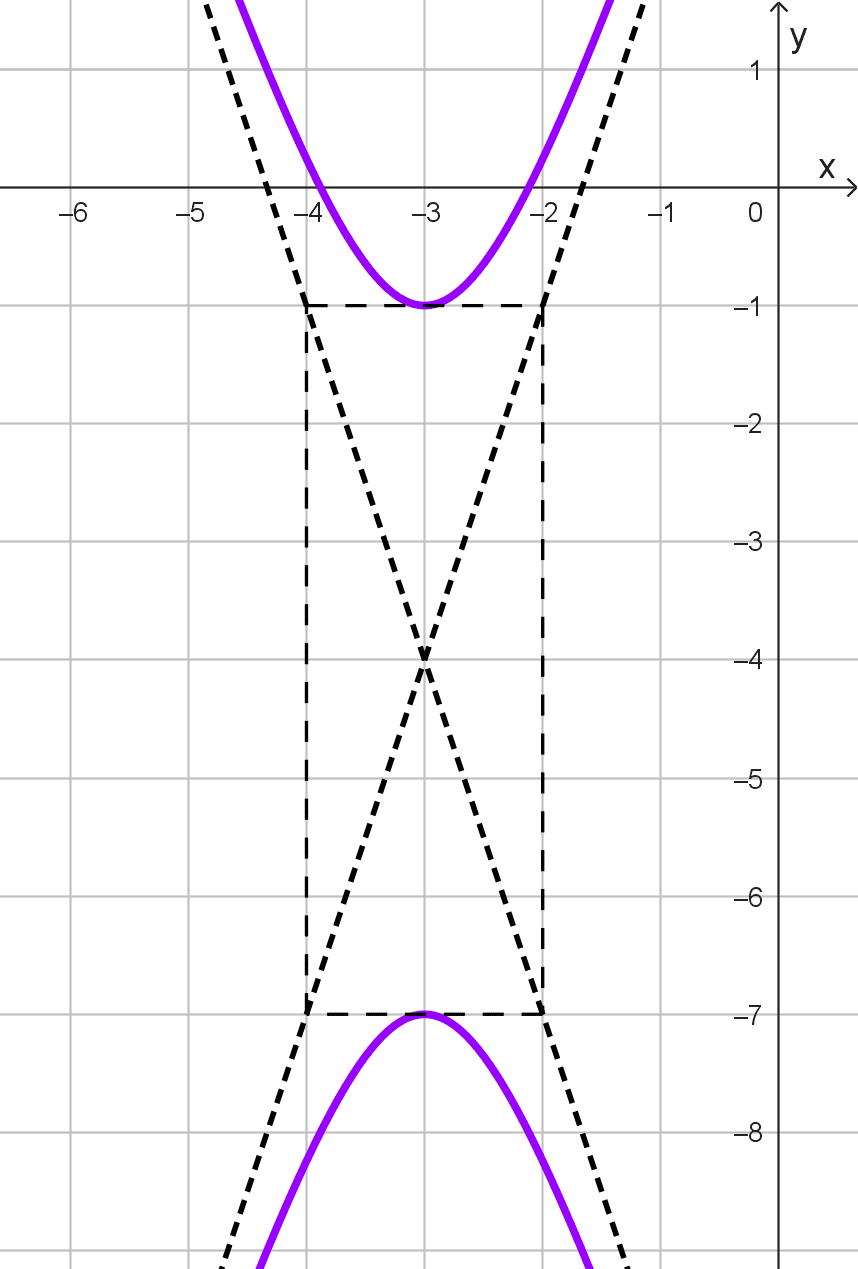
Solutions
Hyperbola A
The hyperbola opens horizontally, and its asymptotes intersect at (3, 4), which is its center. Thus, its equation is:
$$\dfrac{(x-h)^2}{a^2}-\dfrac{(y-k)^2}{b^2}=1$$
$$\dfrac{(x-3)^2}{a^2}-\dfrac{(y-4)^2}{b^2}=1$$
The central reference rectangle has a height of 2 units (conjugate axis length) and a width of 4 units (transverse axis length). Therefore, \(2b=2→b=1\) and \(2a=4→a=2.\) Substituting these values:
$$\dfrac{(x-3)^2}{2^2}-\dfrac{(y-4)^2}{1^2}=1$$
$$\dfrac{(x-3)^2}{4}-\dfrac{(y-4)^2}{1}=1$$
$$\dfrac{(x-3)^2}{4}-(y-4)^2=1$$
Hyperbola B
The hyperbola opens vertically, and the asymptotes intersect at (3, -4), which is its center. Therefore, the equation is:
$$\dfrac{(y-k)^2}{a^2}-\dfrac{(x-h)^2}{b^2}=1$$
$$\dfrac{(y-(-4))^2}{a^2}-\dfrac{(x-3)^2}{b^2}=1$$
$$\dfrac{(y+4)^2}{a^2}-\dfrac{(x-3)^2}{b^2}=1$$
The reference rectangle has a height of 2 units (transverse axis length) and a width of 4 units (conjugate axis length). Therefore, \(2a=2→a=1\) and \(2b=4→b=2.\) Substituting these values:
$$\dfrac{(y+4)^2}{1^2}-\dfrac{(x-3)^2}{2^2}=1$$
$$\dfrac{(y+4)^2}{1}-\dfrac{(x-3)^2}{4}=1$$
$$(y+4)^2-\dfrac{(x-3)^2}{4}=1$$
Hyperbola C
The hyperbola opens horizontally, and the asymptotes intersect at (-3, 3), which gives the center. The equation is:
$$\dfrac{(x-h)^2}{a^2}-\dfrac{(y-k)^2}{b^2}=1$$
$$\dfrac{(x+3)^2}{a^2}-\dfrac{(y-3)^2}{b^2}=1$$
The reference rectangle has a height of 4 units (conjugate axis length) and a width of 6 units (transverse axis length). Thus, \(2b=4→b=2\) and \(2a=6→a=3.\) Substituting these values:
$$\dfrac{(x+3)^2}{3^2}-\dfrac{(y-3)^2}{2^2}=1$$
$$\dfrac{(x+3)^2}{9}-\dfrac{(y-3)^2}{4}=1$$
Hyperbola D
The hyperbola opens vertically, and the asymptotes intersect at (-3, -4), which gives the center. The equation is:
$$\dfrac{(y-k)^2}{a^2}-\dfrac{(x-h)^2}{b^2}=1$$
$$\dfrac{(y+4)^2}{a^2}-\dfrac{(x+3)^2}{b^2}=1$$
The reference rectangle has a height of 6 units (transverse axis length) and a width of 2 units (conjugate axis length). Therefore, \(2a=6→a=3\) and \(2b=2→b=1.\) Substituting these values:
$$\dfrac{(y+4)^2}{3^2}-\dfrac{(x+3)^2}{1^2}=1$$
$$\dfrac{(y+4)^2}{9}-\dfrac{(x+3)^2}{1}=1$$
$$\dfrac{(y+4)^2}{9}-(x+3)^2=1$$
Finding the Key Features of a Hyperbola from Its Equation
Problem 18: Given the following hyperbola equations, find the coordinates of the center, vertices, and foci, the lengths of the transverse and conjugate axes, the eccentricity, the latus rectum, and the equations of the asymptotes.
- \(\dfrac{x^2}{25}-\dfrac{y^2}{9}=1\)
- \(\dfrac{y^2}{16}-\dfrac{x^2}{4}=1\)
- \(\dfrac{(x-2)^2}{4}-\dfrac{(y+3)^2}{9}=1\)
- \(\dfrac{(y+3)^2}{10}-\dfrac{(x-2)^2}{20}=1\)
- \(y^2-\dfrac{x^2}{5}=1\)
- \(4x^2-y^2=16\)
- \(y^2-x^2=25\)
- \(2x^2-y^2+4x+4y-4=0\)
- \(2y^2-x^2+2x+8y+3=0\)
- \(25x^2-9y^2+100x-54y+10=0\)
Solutions
Equation 1
Equation: \(\dfrac{x^2}{25}-\dfrac{y^2}{9}=1\)
This equation corresponds to a hyperbola centered at the origin following the standard form:
$$\dfrac{x^2}{a^2}-\dfrac{y^2}{b^2}=1$$
Here, \(a^2=25\) and \(b^2=9,\) so \(a=5\) and \(b=3.\) The orientation is horizontal because the positive term contains x.
The vertices lie a distance a from the center along the transverse axis (the x-axis). Therefore, the vertices are \((\pm a, 0),\) namely (5, 0) and (-5, 0).
To find the foci, find the focal distance c using \(c^2=a^2+b^2:\)
$$c^2=25+9=34 \quad → \quad c=\sqrt{34}$$
The foci are at \((\pm c, 0),\) giving \((\sqrt{34}, 0)\) and \((-\sqrt{34}, 0).\)
The eccentricity is \(e=\dfrac{c}{a}:\)
$$e=\dfrac{\sqrt{34}}{5}$$
The latus rectum is given by \(\dfrac{2b^2}{a}:\)
$$L_R=\dfrac{2 \cdot 9}{5}=\dfrac{18}{5}=3.6$$
The asymptotes pass through the center with slopes \(\pm \dfrac{b}{a}:\)
$$y=\pm \dfrac{3}{5}x$$
Summary:
- Center: (0, 0)
- Vertices: (5, 0) and (-5, 0)
- Foci: \((\sqrt{34}, 0)\) and \((-\sqrt{34}, 0)\)
- Transverse axis length: \(2a=10\)
- Conjugate axis length: \(2b=6\)
- Eccentricity: \(e=\dfrac{\sqrt{34}}{5}\)
- Latus rectum: \(L_R=3.6\)
- Asymptotes: \(y=\pm \dfrac{3}{5}x\)
Equation 2
Equation: \(\dfrac{y^2}{16}-\dfrac{x^2}{4}=1\)
This equation represents a hyperbola centered at the origin opening vertically because the positive term contains y:
$$\dfrac{y^2}{a^2}-\dfrac{x^2}{b^2}=1$$
From the equation, \(a^2=16\) and \(b^2=4,\) so \(a=4\) and \(b=2.\)
The center is at (0, 0).
The vertices lie a distance a from the center along the transverse axis (the y-axis). Thus, the vertices are \((0, \pm a),\) giving (0, 4) and (0, -4).
Calculate c using \(c^2=a^2+b^2:\)
$$c^2=16+4=20 \quad \rightarrow \quad c=\sqrt{20}=2\sqrt{5}$$
The foci are at \((0, \pm c),\) which gives \((0, 2\sqrt{5})\) and \((0, -2\sqrt{5}).\)
The eccentricity is:
$$e=\dfrac{c}{a}=\dfrac{2\sqrt{5}}{4}=\dfrac{\sqrt{5}}{2}$$
The latus rectum is:
$$L_R=\dfrac{2b^2}{a}=\dfrac{2 \cdot 4}{4}=\dfrac{8}{4}=2$$
The asymptotes have slopes \(\pm \dfrac{a}{b}:\)
$$y=\pm \dfrac{4}{2}x=\pm 2x$$
Key Features:
- Center: (0, 0)
- Vertices: (0, 4) and (0, -4)
- Foci: \((0, 2\sqrt{5})\) and \((0, -2\sqrt{5})\)
- Transverse axis length: \(2a=8\)
- Conjugate axis length: \(2b=4\)
- Eccentricity: \(e=\dfrac{\sqrt{5}}{2}\)
- Latus rectum: \(L_R=2\)
- Asymptotes: \(y=\pm 2x\)
Equation 3
Equation: \(\dfrac{(x-2)^2}{4}-\dfrac{(y+3)^2}{9}=1\)
This equation corresponds to a hyperbola with center away from the origin. The orientation is horizontal because the positive term contains x. The standard form is:
$$\dfrac{(x-h)^2}{a^2}-\dfrac{(y-k)^2}{b^2}=1$$
Here, \(a^2=4\) and \(b^2=9,\) so \(a=2\) and \(b=3.\)
The center (h, k) is (2, -3).
The vertices lie a distance a from the center along the horizontal transverse axis at \((h \pm a, k):\) \((2+2, -3)=(4, -3)\) and \((2-2, -3)=(0, -3).\)
Find c using \(c^2=a^2+b^2:\)
$$c^2=4+9=13 \quad \rightarrow \quad c=\sqrt{13}$$
The foci are located at \((h \pm c, k):\) \((2+\sqrt{13}, -3)\) and \((2-\sqrt{13}, -3).\)
The eccentricity is:
$$e=\dfrac{c}{a}=\dfrac{\sqrt{13}}{2}$$
The latus rectum is:
$$L_R=\dfrac{2b^2}{a}=\dfrac{2 \cdot 9}{2}=\dfrac{18}{2}=9$$
The asymptotes have slopes \(\pm \dfrac{b}{a}:\)
$$y-k=\pm \dfrac{b}{a}(x-h) \quad \rightarrow \quad y+3=\pm \dfrac{3}{2}(x-2)$$
In slope-intercept form, the asymptote equations are:
$$y=\dfrac{3}{2}x-6 \quad \text{and} \quad y=-\dfrac{3}{2}x$$
Key Features:
- Center: (2, -3)
- Vertices: (4, -3) and (0, -3)
- Foci: \((2+\sqrt{13}, -3)\) and \((2-\sqrt{13}, -3)\)
- Transverse axis length: \(2a=4\)
- Conjugate axis length: \(2b=6\)
- Eccentricity: \(e=\dfrac{\sqrt{13}}{2}\)
- Latus rectum: \(L_R=9\)
- Asymptotes: \(y=\dfrac{3}{2}x-6\) and \(y=-\dfrac{3}{2}x\)
Equation 4
Equation: \(\dfrac{(y+3)^2}{10}-\dfrac{(x-2)^2}{20}=1\)
This equation represents a vertical hyperbola centered away from the origin:
$$\dfrac{(y-k)^2}{a^2}-\dfrac{(x-h)^2}{b^2}=1$$
From the equation, \(a^2=10\) and \(b^2=20,\) so \(a=\sqrt{10}\) and \(b=\sqrt{20}=2\sqrt{5}.\)
The center (h, k) is (2, -3).
The vertices lie a distance a from the center along the vertical transverse axis at \((h, k \pm a):\) \((2, -3+\sqrt{10})\) and \((2, -3-\sqrt{10}).\)
Find the focal distance c using \(c^2=a^2+b^2:\)
$$c^2=10+20=30 \quad \rightarrow \quad c=\sqrt{30}$$
The foci are at \((h, k \pm c):\) \((2, -3+\sqrt{30})\) and \((2, -3-\sqrt{30}).\)
The eccentricity is:
$$e=\dfrac{c}{a}=\dfrac{\sqrt{30}}{\sqrt{10}}=\sqrt{3}$$
The latus rectum is:
$$L_R=\dfrac{2b^2}{a}=\dfrac{2 \cdot 20}{\sqrt{10}}=\dfrac{40}{\sqrt{10}}=4\sqrt{10}$$
The asymptotes have slopes \(\pm \dfrac{a}{b}:\)
$$y-k=\pm \dfrac{a}{b}(x-h) \quad \rightarrow \quad y+3=\pm \dfrac{\sqrt{10}}{2\sqrt{5}}(x-2)$$
Key Features:
- Center: (2, -3)
- Vertices: \((2, -3+\sqrt{10})\) and \((2, -3-\sqrt{10})\)
- Foci: \((2, -3+\sqrt{30})\) and \((2, -3-\sqrt{30})\)
- Transverse axis length: \(2a=2\sqrt{10}\)
- Conjugate axis length: \(2b=4\sqrt{5}\)
- Eccentricity: \(e=\sqrt{3}\)
- Latus rectum: \(L_R=4\sqrt{10}\)
- Asymptotes: \(y+3=\pm \dfrac{\sqrt{10}}{2\sqrt{5}}(x-2)\)
Equation 5
Equation: \(y^2-\dfrac{x^2}{5}=1\)
This equation corresponds to a hyperbola centered at the origin opening vertically because the positive term contains y. We identify that \(a^2=1\) and \(b^2=5,\) so \(a=\sqrt{1}=1\) and \(b=\sqrt{5}.\)
The vertices lie along the vertical transverse axis at \((h, k \pm a):\) \((0, 0+1)=(0, 1)\) and \((0, 0-1)=(0, -1).\)
Find the focal distance c using \(c^2=a^2+b^2:\)
$$c^2=1+5=6 \quad \rightarrow \quad c=\sqrt{6}$$
The foci are at \((h, k \pm c):\) \((0, 0+\sqrt{6})=(0, \sqrt{6})\) and \((0, 0-\sqrt{6})=(0, -\sqrt{6}).\)
The eccentricity is:
$$e=\dfrac{c}{a}=\dfrac{\sqrt{6}}{1}=\sqrt{6}$$
The latus rectum is:
$$L_R=\dfrac{2b^2}{a}=\dfrac{2 \cdot 5}{1}=10$$
The asymptotes have slopes \(\pm \dfrac{a}{b}:\)
$$y-k=\pm \dfrac{a}{b}(x-h) \quad \rightarrow \quad y=\pm \dfrac{1}{\sqrt{5}}x$$
Key Features:
- Center: (0, 0)
- Vertices: (0, 1) and (0, -1)
- Foci: \((0, \sqrt{6})\) and \((0, -\sqrt{6})\)
- Transverse axis length: \(2a=2 \cdot 1=2\)
- Conjugate axis length: \(2b=2 \cdot \sqrt{5}=2\sqrt{5}\)
- Eccentricity: \(e=\sqrt{6}\)
- Latus rectum: \(L_R=10\)
- Asymptotes: \(y=\pm \dfrac{1}{\sqrt{5}}x\)
Equation 6
Equation: \(4x^2-y^2=16\)
Dividing both sides by 16 yields the standard equation:
$$\dfrac{x^2}{4}-\dfrac{y^2}{16}=1$$
This is a hyperbola centered at the origin opening horizontally because the positive term contains x. We identify \(a^2=4\) and \(b^2=16,\) so \(a=\sqrt{4}=2\) and \(b=\sqrt{16}=4.\)
The vertices lie along the x-axis at \((h \pm a, k):\) \((0+2, 0)=(2, 0)\) and \((0-2, 0)=(-2, 0).\)
Find the focal distance c using \(c^2=a^2+b^2:\)
$$c^2=4+16=20 \quad \rightarrow \quad c=\sqrt{20}=2\sqrt{5}$$
The foci are at \((h \pm c, k):\) \((0+2\sqrt{5}, 0)=(2\sqrt{5}, 0)\) and \((0-2\sqrt{5}, 0)=(-2\sqrt{5}, 0).\)
The eccentricity is:
$$e=\dfrac{c}{a}=\dfrac{2\sqrt{5}}{2}=\sqrt{5}$$
The latus rectum is:
$$L_R=\dfrac{2b^2}{a}=\dfrac{2 \cdot 16}{2}=16$$
The asymptotes have slopes \(\pm \dfrac{b}{a}:\)
$$y-k=\pm \dfrac{b}{a}(x-h) \quad \rightarrow \quad y=\pm \dfrac{4}{2}x \quad \rightarrow \quad y=\pm 2x$$
Key Features:
- Center: (0, 0)
- Vertices: (2, 0) and (-2, 0)
- Foci: \((2\sqrt{5}, 0)\) and \((-2\sqrt{5}, 0)\)
- Transverse axis length: \(2a=2 \cdot 2=4\)
- Conjugate axis length: \(2b=2 \cdot 4=8\)
- Eccentricity: \(e=\sqrt{5}\)
- Latus rectum: \(L_R=16\)
- Asymptotes: \(y=\pm 2x\)
Equation 7
Equation: \(y^2-x^2=25\)
Dividing both sides by 25 gives the standard form:
$$\dfrac{y^2}{25}-\dfrac{x^2}{25}=1$$
This is a vertical hyperbola centered at the origin because the positive term contains y. Here \(a^2=25\) and \(b^2=25,\) so \(a=5\) and \(b=5.\)
The vertices lie along the y-axis at \((0, \pm 5):\) (0, 5) and (0, -5).
Calculate the focal distance c using \(c^2=a^2+b^2:\)
$$c^2=25+25=50 \quad → \quad c=\sqrt{50}=5\sqrt{2}$$
The foci are at \((0, \pm c):\) \((0, 5\sqrt{2})\) and \((0, -5\sqrt{2}).\)
The eccentricity is:
$$e=\dfrac{c}{a}=\dfrac{5\sqrt{2}}{5}=\sqrt{2}$$
The latus rectum is:
$$L_R=\dfrac{2b^2}{a}=\dfrac{2 \cdot 25}{5}=\dfrac{50}{5}=10$$
The asymptotes have slopes \(\pm \dfrac{a}{b}.\) Since \(a=b=5,\) the slope is \(\pm 1:\)
$$y=\pm x$$
Key Features:
- Center: (0, 0)
- Vertices: (0, 5) and (0, -5)
- Foci: \((0, 5\sqrt{2})\) and \((0, -5\sqrt{2})\)
- Transverse axis length: \(2a=10\)
- Conjugate axis length: \(2b=10\)
- Eccentricity: \(e=\sqrt{2}\)
- Latus rectum: \(L_R=10\)
- Asymptotes: \(y=\pm x\)
Equation 8
Equation: \(2x^2-y^2+4x+4y-4=0\)
Completing the square yields the standard equation:
$$(x+1)^2-\dfrac{(y-2)^2}{2}=1$$
The positive term contains x, so this is a horizontal hyperbola centered away from the origin:
$$\dfrac{(x-h)^2}{a^2}-\dfrac{(y-k)^2}{b^2}=1$$
Since the first term has an implied denominator of 1, \(a^2=1,\) meaning \(a=1.\) Additionally, \(b^2=2,\) which means \(b=\sqrt{2}.\)
From \((x+1)^2=(x-(-1))^2\) and \((y-2)^2,\) the center is (-1, 2).
The vertices lie along the horizontal transverse axis at \((-1 \pm 1, 2),\) which gives (0, 2) and (-2, 2).
Now find the focal distance c using:
$$c^2=a^2+b^2$$
$$c^2=1+2=3 \quad → \quad c=\sqrt{3}$$
The foci lie at \((-1 \pm \sqrt{3}, 2),\) yielding \((-1+\sqrt{3}, 2)\) and \((-1-\sqrt{3}, 2).\)
The eccentricity is:
$$e=\dfrac{c}{a}=\dfrac{\sqrt{3}}{1}=\sqrt{3}$$
The latus rectum is:
$$L_R=\dfrac{2b^2}{a}=\dfrac{2 \cdot 2}{1}=4$$
The asymptotes pass through (-1, 2) with slopes \(\pm \dfrac{b}{a}=\pm \sqrt{2}:\)
$$y-2=\pm \sqrt{2} (x+1)$$
Summary of Features:
- Center: (-1, 2)
- Vertices: (0, 2) and (-2, 2)
- Foci: \((-1+\sqrt{3}, 2)\) and \((-1-\sqrt{3}, 2)\)
- Transverse axis length: \(2a=2\)
- Conjugate axis length: \(2b=2\sqrt{2}\)
- Eccentricity: \(e=\sqrt{3}\)
- Latus rectum: \(L_R=4\)
- Asymptotes: \(y-2=\pm \sqrt{2} (x+1)\)
Equation 9
Equation: \(2y^2-x^2+2x+8y+3=0\)
Completing the square gives:
$$\dfrac{(y+2)^2}{2}-\dfrac{(x-1)^2}{4}=1$$
The positive term contains y, which indicates a vertical hyperbola centered away from the origin:
$$\dfrac{(y-k)^2}{a^2}-\dfrac{(x-h)^2}{b^2}=1$$
Here, \(a^2=2\) and \(b^2=4,\) so \(a=\sqrt{2}\) and \(b=2.\)
From \((y+2)^2=(y-(-2))^2\) and \((x-1)^2,\) the center is (1, -2).
The vertices lie along the vertical transverse axis at \((1, -2 \pm \sqrt{2}):\) \((1, -2+\sqrt{2})\) and \((1, -2-\sqrt{2}).\)
Find the focal distance c using \(c^2=a^2+b^2:\)
$$c^2=2+4=6 \quad → \quad c=\sqrt{6}$$
The foci are at \((1, -2 \pm \sqrt{6}):\) \((1, -2+\sqrt{6})\) and \((1, -2-\sqrt{6}).\)
The eccentricity is:
$$e=\dfrac{c}{a}=\dfrac{\sqrt{6}}{\sqrt{2}}=\sqrt{3}$$
The latus rectum is:
$$L_R=\dfrac{2b^2}{a}=\dfrac{2 \cdot 4}{\sqrt{2}}=\dfrac{8}{\sqrt{2}}=4\sqrt{2}$$
The asymptotes pass through (1, -2) with slopes \(\pm \dfrac{a}{b}=\pm \dfrac{\sqrt{2}}{2}:\)
$$y+2=\pm \dfrac{\sqrt{2}}{2} (x-1)$$
Key Features:
- Center: (1, -2)
- Vertices: \((1, -2+\sqrt{2})\) and \((1, -2-\sqrt{2})\)
- Foci: \((1, -2+\sqrt{6})\) and \((1, -2-\sqrt{6})\)
- Transverse axis length: \(2a=2\sqrt{2}\)
- Conjugate axis length: \(2b=4\)
- Eccentricity: \(e=\sqrt{3}\)
- Latus rectum: \(L_R=4\sqrt{2}\)
- Asymptotes: \(y+2=\pm \dfrac{\sqrt{2}}{2} (x-1)\)
Equation 10
Equation: \(25x^2-9y^2+100x-54y+10=0\)
Completing the square yields the standard form:
$$\dfrac{(x+2)^2}{9/25}-(y+3)^2=1$$
The positive term contains x, so this is a horizontal hyperbola:
$$\dfrac{(x-h)^2}{a^2}-\dfrac{(y-k)^2}{b^2}=1$$
We identify \(a^2=\dfrac{9}{25},\) which gives \(a=\dfrac{3}{5},\) and \(b^2=1,\) giving \(b=1.\)
From \((x+2)^2=(x-(-2))^2\) and \((y+3)^2=(y-(-3))^2,\) the center is (-2, -3).
The vertices lie along the horizontal transverse axis at \((-2 \pm \dfrac{3}{5}, -3),\) giving \(\left (-2+\dfrac{3}{5}, -3\right)\) and \(\left (-2-\dfrac{3}{5}, -3\right),\) which simplify to:
$$\left (-\dfrac{7}{5}, -3\right)\quad \text{and} \quad \left (-\dfrac{13}{5}, -3\right)$$
Find the focal distance c using \(c^2=a^2+b^2:\)
$$c^2=\dfrac{9}{25}+1=\dfrac{9}{25}+\dfrac{25}{25}=\dfrac{34}{25} \quad → \quad c=\dfrac{\sqrt{34}}{5}$$
The foci are located at \((-2 \pm \dfrac{\sqrt{34}}{5}, -3):\)
$$\left (-2+\dfrac{\sqrt{34}}{5}, -3\right) \text{ and } \left (-2-\dfrac{\sqrt{34}}{5}, -3\right)$$
The eccentricity is:
$$e=\dfrac{c}{a}=\dfrac{\dfrac{\sqrt{34}}{5}}{\dfrac{3}{5}}=\dfrac{\sqrt{34}}{3}$$
The latus rectum is:
$$L_R=\dfrac{2b^2}{a}=\dfrac{2 \cdot 1}{\dfrac{3}{5}}=\dfrac{2}{\dfrac{3}{5}}=\dfrac{10}{3}$$
The asymptotes pass through (-2, -3) with slopes \(\pm \dfrac{b}{a}=\pm \dfrac{1}{3/5}=\pm \dfrac{5}{3}:\)
$$y+3=\pm \dfrac{5}{3} (x+2)$$
Summary of Features:
- Center: (-2, -3)
- Vertices: \(\left (-\dfrac{7}{5}, -3\right)\) and \(\left (-\dfrac{13}{5}, -3\right)\)
- Foci: \(\left (-2+\dfrac{\sqrt{34}}{5}, -3\right)\) and \(\left (-2-\dfrac{\sqrt{34}}{5}, -3\right)\)
- Transverse axis length: \(2a=\dfrac{6}{5}\)
- Conjugate axis length: \(2b=2\)
- Eccentricity: \(e=\dfrac{\sqrt{34}}{3}\)
- Latus rectum: \(L_R=\dfrac{10}{3}\)
- Asymptotes: \(y+3=\pm \dfrac{5}{3} (x+2)\)
Converting from General Form to Standard Form
Problem 19: Convert each general equation of a hyperbola into standard form.
- \(4x^2-y^2=16\)
- \(2x^2-y^2+4x+4y-4=0\)
- \(2y^2-x^2+2x+8y+3=0\)
- \(25x^2-9y^2+100x-54y+10=0\)
Solutions
Equation 1
Equation: \(4x^2-y^2=16\)
First, divide both sides of the equation by 16 so the right-hand side equals 1:
$$\dfrac{4x^2}{16}-\dfrac{y^2}{16}=1$$
Simplifying the first fraction:
$$\dfrac{x^2}{4}-\dfrac{y^2}{16}=1$$
This gives the desired standard form.
Equation 2
Equation: \(2x^2-y^2+4x+4y-4=0\)
Begin by grouping terms by variable and factoring leading coefficients:
$$2 (x^2+2x)-\bigl (y^2-4y\bigr)-4=0$$
Next, complete the square inside each set of parentheses. For \(x^2+2x,\) add and subtract 1 since \((x+1)^2=x^2+2x+1:\)
$$x^2+2x=(x+1)^2-1$$
For \(y^2-4y,\) add and subtract 4 since \((y-2)^2=y^2-4y+4:\)
$$y^2-4y=(y-2)^2-4$$
Substitute back into the equation:
$$2\bigl[(x+1)^2-1\bigr]-\Bigl[(y-2)^2-4\Bigr]-4=0$$
Distribute and combine constants:
$$2 (x+1)^2-2-(y-2)^2+4-4=0$$
$$2 (x+1)^2-(y-2)^2-2=0$$
Add 2 to both sides and divide the entire equation by 2:
$$(x+1)^2-\dfrac{(y-2)^2}{2}=1$$
This is the standard form of the hyperbola.
Equation 3
Equation: \(2y^2-x^2+2x+8y+3=0\)
Group terms by variable, factoring out coefficients:
$$2 (y^2+4y)-\bigl (x^2-2x\bigr)+3=0$$
Complete the square for each variable. For \(y^2+4y,\) add and subtract 4 since \((y+2)^2=y^2+4y+4:\)
$$y^2+4y=(y+2)^2-4$$
For \(x^2-2x,\) add and subtract 1 since \((x-1)^2=x^2-2x+1:\)
$$x^2-2x=(x-1)^2-1$$
Substitute back into the equation:
$$2\Bigl[(y+2)^2-4\Bigr]-\Bigl[(x-1)^2-1\Bigr]+3=0$$
Expand and simplify the constants:
$$2 (y+2)^2-8-(x-1)^2+1+3=0$$
Combining \(-8+1+3=-4:\)
$$2 (y+2)^2-(x-1)^2-4=0$$
Add 4 to both sides and divide by 4 to set the right-hand side to 1:
$$\dfrac{2 (y+2)^2}{4}-\dfrac{(x-1)^2}{4}=1$$
Simplifying:
$$\dfrac{(y+2)^2}{2}-\dfrac{(x-1)^2}{4}=1$$
Equation 4
Equation: \(25x^2-9y^2+100x-54y+10=0\)
First, rearrange and group terms by variable:
$$25x^2+100x-9y^2-54y+10=0$$
Factor out 25 from the x-terms and -9 from the y-terms:
$$25 (x^2+4x)-9 (y^2+6y)+10=0$$
Complete the square in each set of parentheses. For \(x^2+4x,\) add and subtract 4 since \((x+2)^2=x^2+4x+4:\)
$$x^2+4x=(x+2)^2-4$$
For \(y^2+6y,\) add and subtract 9 since \((y+3)^2=y^2+6y+9:\)
$$y^2+6y=(y+3)^2-9$$
Substitute back into the expression:
$$25\Bigl[(x+2)^2-4\Bigr]-9\Bigl[(y+3)^2-9\Bigr]+10=0$$
Distribute the outer factors:
$$25 (x+2)^2-100-9 (y+3)^2+81+10=0$$
Combine the constant terms (\(-100+81+10=-9\)):
$$25 (x+2)^2-9 (y+3)^2-9=0$$
Add 9 to both sides:
$$25 (x+2)^2-9 (y+3)^2=9$$
Divide the entire equation by 9:
$$\dfrac{25 (x+2)^2}{9}-\dfrac{9 (y+3)^2}{9}=1$$
Simplifying:
$$\dfrac{25(x+2)^2}{9}-(y+3)^2=1$$
Rewriting the first coefficient as a denominator:
$$\dfrac{(x+2)^2}{9/25}-(y+3)^2=1$$
Converting from Standard Form to General Form
Problem 20: Convert each standard equation of a hyperbola into general form.
- \(\dfrac{x^2}{25}-\dfrac{y^2}{9}=1\)
- \(\dfrac{(x-2)^2}{4}-\dfrac{(y+3)^2}{9}=1\)
- \(\dfrac{(y+3)^2}{10}-\dfrac{(x-2)^2}{20}=1\)
Solutions
Equation 1
Equation: \(\dfrac{x^2}{25}-\dfrac{y^2}{9}=1\)
Multiply both sides by 225 (the least common multiple of 25 and 9) to clear the denominators:
$$225\cdot\dfrac{x^2}{25}-225\cdot\dfrac{y^2}{9}=225$$
Simplifying:
$$9x^2-25y^2=225$$
Subtract 225 from both sides to obtain the general form:
$$9x^2-25y^2-225=0$$
Equation 2
Equation: \(\dfrac{(x-2)^2}{4}-\dfrac{(y+3)^2}{9}=1\)
First, expand the squared binomials: \((x-2)^2=x^2-4x+4\) and \((y+3)^2=y^2+6y+9.\) Rewriting the equation:
$$\dfrac{x^2-4x+4}{4}-\dfrac{y^2+6y+9}{9}=1$$
Multiply both sides by 36 (the LCM of 4 and 9) to eliminate the denominators:
$$9 (x^2-4x+4)-4 (y^2+6y+9)=36$$
Distribute the constants:
$$9x^2-36x+36-4y^2-24y-36=36$$
The constants +36 and -36 cancel out:
$$9x^2-36x-4y^2-24y=36$$
Subtract 36 from both sides:
$$9x^2-36x-4y^2-24y-36=0$$
Equation 3
Equation: \(\dfrac{(y+3)^2}{10}-\dfrac{(x-2)^2}{20}=1\)
First, multiply both sides by 20 (the LCM of 10 and 20) to clear the denominators:
$$2 (y+3)^2-(x-2)^2=20$$
Expand the squared terms: \((y+3)^2=y^2+6y+9\) and \((x-2)^2=x^2-4x+4.\) Substituting these in:
$$2\bigl (y^2+6y+9\bigr)-\bigl (x^2-4x+4\bigr)=20$$
Distribute:
$$2y^2+12y+18-x^2+4x-4=20$$
Combine like terms (\(18-4=14\)):
$$-x^2+2y^2+4x+12y+14=20$$
Subtract 20 from both sides:
$$-x^2+2y^2+4x+12y-6=0$$
Multiplying the entire equation by -1 to keep the leading x2 term positive gives:
$$x^2-2y^2-4x-12y+6=0$$
Real-World Applications
The following word problems demonstrate practical applications of hyperbolas in architecture, navigation, and science.
Problem 21
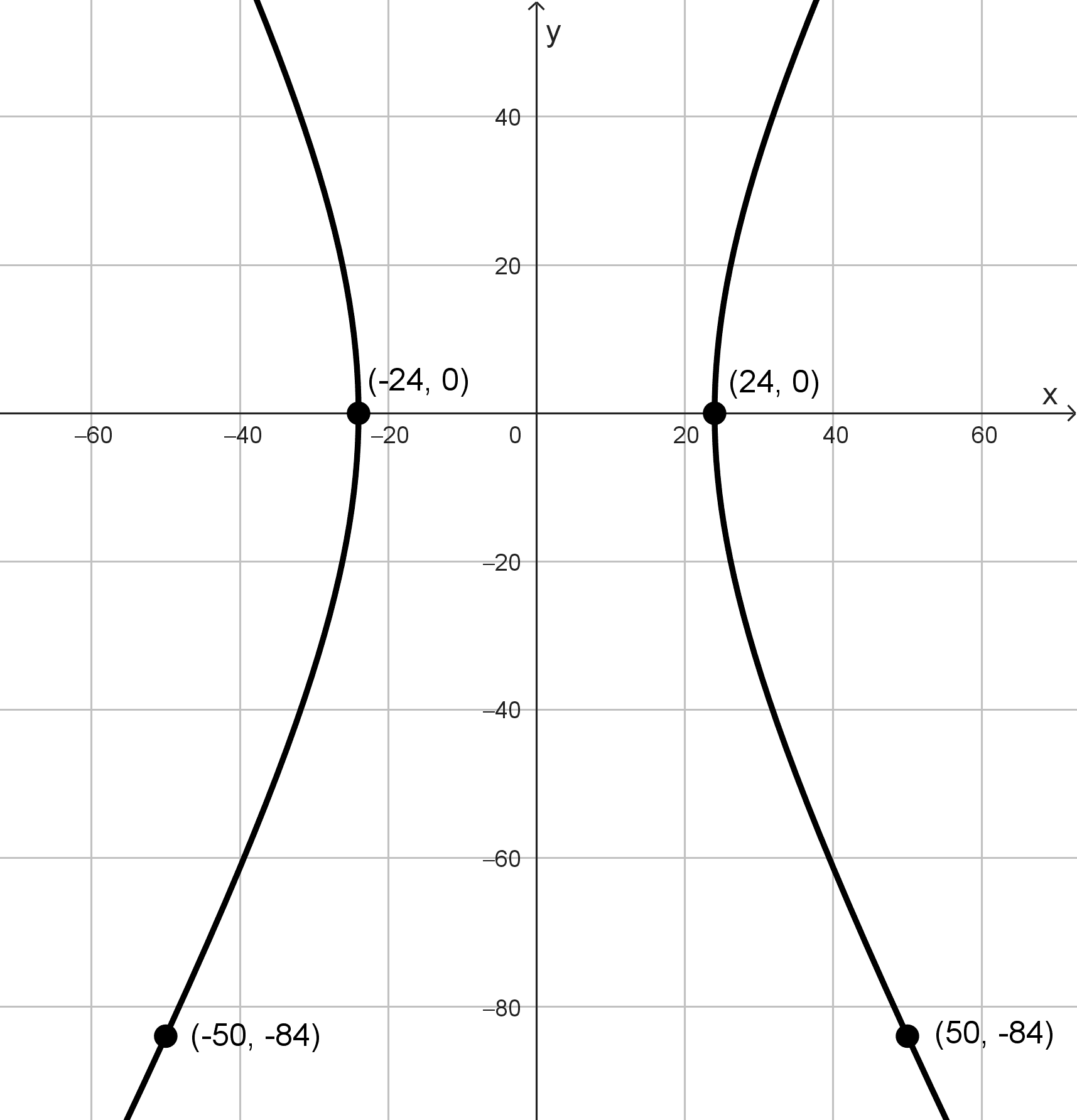
A natural draft cooling tower is a hyperboloid structure. Suppose the diameter of its base is 100 meters, and its narrowest diameter is 48 meters, located 84 meters above the base. If the tower is 120 meters tall, calculate the diameter at the very top.

Solution
We place the hyperbola conveniently on the Cartesian plane. We place the narrowest diameter along the x-axis, so the vertices are at (24, 0) and (-24, 0), with a total distance between them of 48 units.
The base has a diameter of 100 meters and is located 84 units below the narrowest point, meaning the hyperbola passes through the points (-50, -84) and (50, -84).
We need to find the diameter at the top of the tower. Since the total height of the tower is 120 meters, we evaluate the diameter at \(y=120-84=36.\)
Using the standard equation for a horizontal hyperbola centered at the origin:
$$\dfrac{x^2}{a^2}-\dfrac{y^2}{b^2}=1$$
The distance between the vertices is \(2a=48,\) so \(a=24.\) To find b, substitute the point (-50, -84) into the equation:
$$\dfrac{(-50)^2}{24^2}-\dfrac{(-84)^2}{b^2}=1$$
$$\dfrac{625}{144}-\dfrac{7056}{b^2}=1$$
$$-\dfrac{7056}{b^2}=1-\dfrac{625}{144}$$
$$-\dfrac{7056}{b^2}=-\dfrac{481}{144}$$
$$b^2=\dfrac{7056\cdot 144}{481}$$
$$b^2=\dfrac{1016064}{481}$$
Substitute \(a^2=576\) and \(b^2\) into the equation:
$$\dfrac{x^2}{576}-\dfrac{481 y^2}{1016064}=1$$
Setting \(y=36:\)
$$\dfrac{x^2}{576}-\dfrac{481\cdot 36^2}{1016064}=1$$
$$\dfrac{x^2}{576}=1+\dfrac{623376}{1016064}$$
$$x^2=576\cdot \left(1+\dfrac{623376}{1016064}\right)$$
$$x=\sqrt{576\cdot \left(1+\dfrac{623376}{1016064}\right)}$$
$$x≈30.49$$
Since \(x≈30.49\) represents the radius at the top, multiply by 2 to find the total diameter: \(2\cdot x=60.97\)
In conclusion, the diameter at the top of the tower is approximately 60.97 meters.
Problem 22
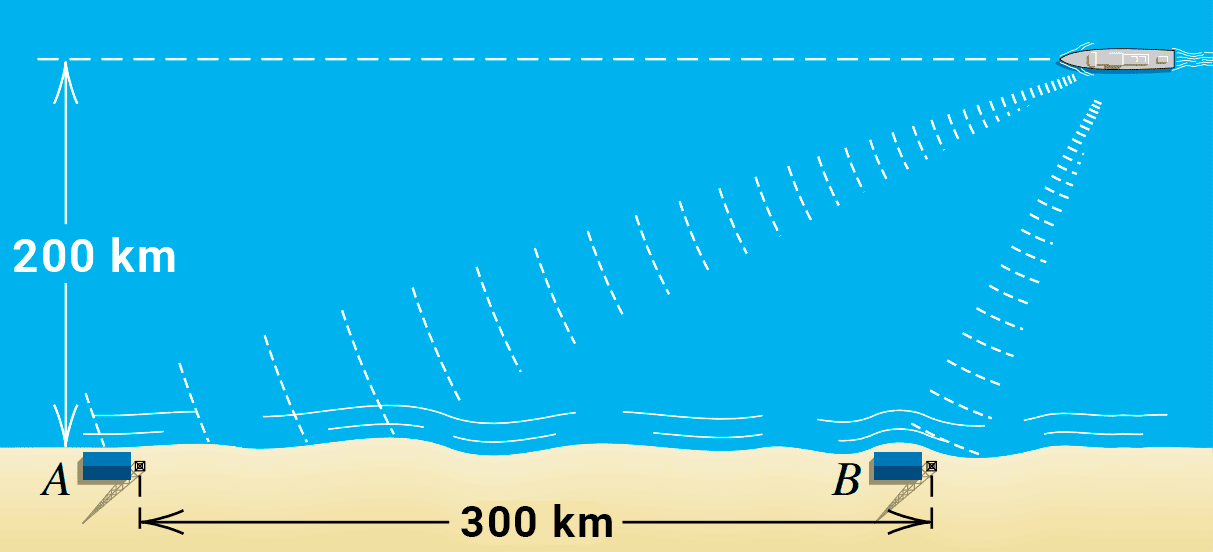
A ship is cruising on a path that is 200 km from and parallel to a straight coastline. The ship transmits a distress signal that is received by two Coast Guard stations, A and B, located 300 km apart along the coast. By measuring the difference in signal arrival times, it is determined that the ship is 250 km closer to B than to A. Where is the ship located?
Solution
We set up a coordinate plane with the coastline along the x-axis. Place station A at (-150, 0) and station B at (150, 0), placing them 300 km apart with the origin at their midpoint. The ship moves along the horizontal line y = 200.
Let P(x, y) represent the ship. Since the ship is 250 km closer to B than to A:
$$d(A,P)=250+d(B,P)$$
Rearranging:
$$d(A,P)-d(B,P)=250$$
This constant difference defines a hyperbola branch with \(2a=250.\) Therefore, \(a=125\) and \(a^2=15625.\)
Stations A and B act as the foci. The focal distance is \(2c=300,\) so \(c=150.\) Using the relationship \(c^2=a^2+b^2:\)
$$150^2=125^2+b^2→b^2=6875$$
The equation of the hyperbola branch is:
$$\dfrac{x^2}{a^2}-\dfrac{y^2}{b^2}=1$$
$$\dfrac{x^2}{15625}-\dfrac{y^2}{6875}=1$$
Since the ship moves along the line \(y=200,\) substitute \(y=200\) into the equation:
$$\dfrac{x^2}{15625}-\dfrac{200^2}{6875}=1$$
$$\dfrac{x^2}{15625}=1+\dfrac{40000}{6875}$$
$$\dfrac{x^2}{15625}=\dfrac{75}{11}$$
$$x^2=15625\cdot \dfrac{75}{11}$$
$$x=\sqrt{\dfrac{15625\cdot 75}{11}}$$
$$x=125\cdot \dfrac{\sqrt{75}}{\sqrt{11}}$$
$$x=125\cdot \dfrac{5\sqrt{3}}{\sqrt{11}}$$
$$x=625\dfrac{\sqrt{3}}{\sqrt{11}}≈326.4$$
Thus, in this coordinate system, the ship is located at \(\left(625\dfrac{\sqrt{3}}{\sqrt{11}}, 200\right) \approx (326.4, 200).\)
We can compute the exact distances from each station to the ship using \(x \approx 326.4:\)
Distance from station A to the ship: \(\sqrt{(326.4+150)^2+(200-0)^2} \approx 516.68\text{ km}\)
Distance from station B to the ship: \(\sqrt{(326.4-150)^2+(200-0)^2} \approx 266.68\text{ km}\)
As expected, the difference between these distances is \(516.68 - 266.68 = 250\text{ km}.\)
Conclusion: In this reference system, the ship is located at coordinates \(\left(625\dfrac{\sqrt{3}}{\sqrt{11}}, 200\right),\) approximately 516.68 km from station A and 266.68 km from station B.
Problem 23
Two LORAN stations are located 200 kilometers apart along a straight shoreline. A ship records a time difference of 0.00038 seconds between the incoming LORAN signals.
- Set up an appropriate Cartesian coordinate system to determine where the ship would reach the coastline if it followed the hyperbolic path corresponding to this time difference.
- If the ship is 50 km offshore when the time difference is recorded, what is its approximate location?
Solution
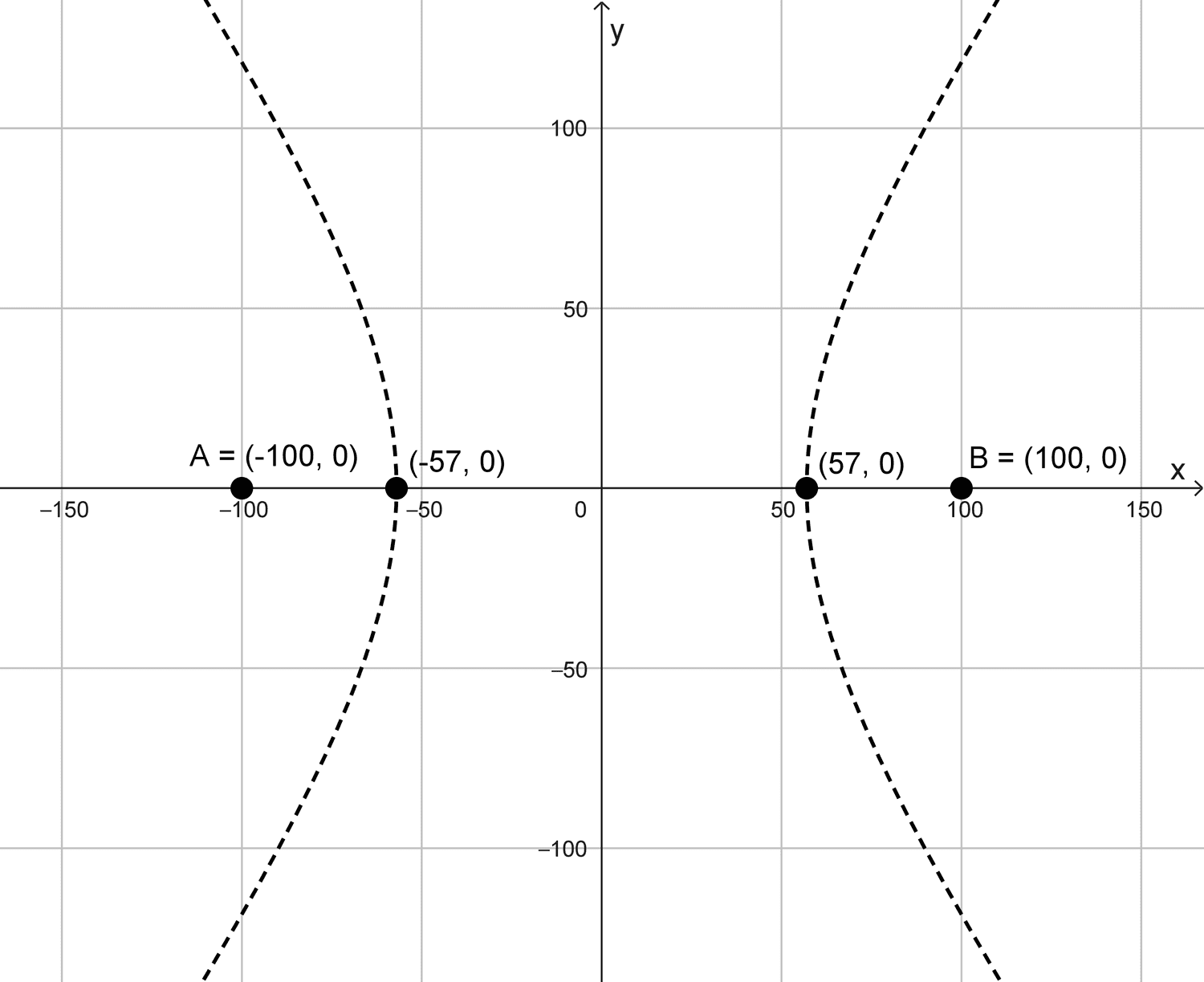
1) Place stations A and B along the x-axis at (-100, 0) and (100, 0), placing them 200 km apart centered at the origin.
The time difference is \(Δt=0.00038\text{ s}.\) Since radio signals travel at approximately the speed of light (\(300000\text{ km/s}\)), convert this time difference into a distance difference:
$$Δd = 0.00038\text{ s} \cdot 300000\text{ km/s} = 114\text{ km}$$
This difference corresponds to the hyperbola constant 2a: \(2a=114 → a=57 → a^2=3249.\) The distance between the stations is \(2c=200 → c=100.\) Using \(c^2=a^2+b^2:\)
$$100^2=57^2+b^2→b^2=6751$$
The equation of the hyperbola is:
$$\dfrac{x^2}{3249}-\dfrac{y^2}{6751}=1$$
The shoreline is represented by \(y=0.\) Substituting \(y=0\) into the equation:
$$\dfrac{x^2}{3249}-\dfrac{0}{6751}=1$$
$$\dfrac{x^2}{3249}=1$$
$$x^2=3249$$
$$x=\pm 57$$
Therefore, the ship would reach the coast at either (57, 0) or (-57, 0), which is 57 km east or west of the midpoint between the two stations. If the ship is closer to station B, it lands at (57, 0); if it is closer to station A, it lands at (-57, 0).
2) If the ship is 50 km offshore, its y-coordinate is \(y=50.\) We find x by substituting \(y=50\) into the hyperbola equation:
$$\dfrac{x^2}{3249}-\dfrac{y^2}{6751}=1$$
$$\dfrac{x^2}{3249}-\dfrac{50^2}{6751}=1$$
$$\dfrac{x^2}{3249}=1+\dfrac{2500}{6751}$$
$$x^2=3249\left(1+\dfrac{2500}{6751}\right)$$
$$x≈\pm 66.72$$
Therefore, the approximate position of the ship is \((\pm 66.72, 50)\) in this coordinate system, depending on whether it is closer to station A or station B.
Did you find this useful? Rate it!

Leave a Reply