
Conic Sections
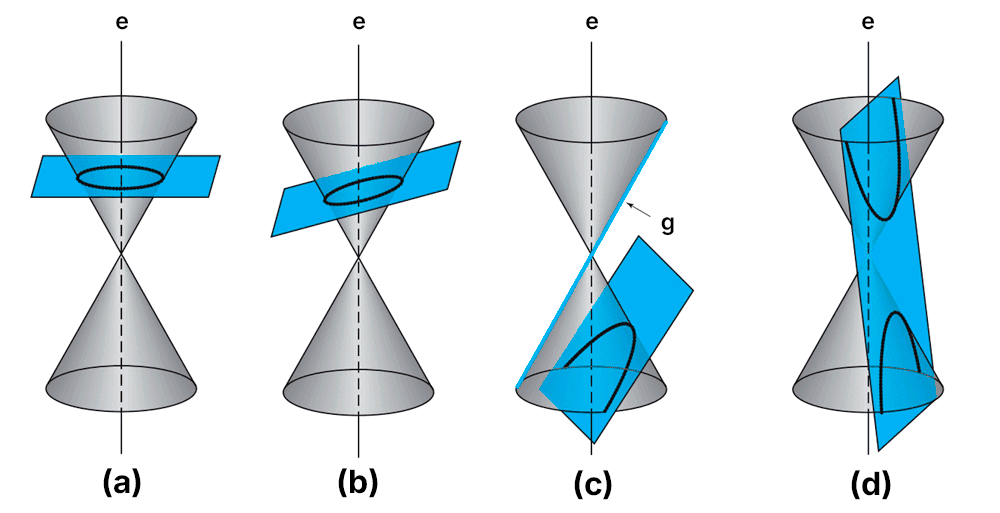
Conic sections are geometric shapes formed by the intersection of a plane with a double-napped cone. Depending on the angle between the plane and the axis of the cone, different types of conics can be obtained: circle, ellipse, parabola, and hyperbola.
Conics can be defined as geometric loci in the plane, that is, sets of points that satisfy specific mathematical conditions. From this definition, we can derive through algebra the equations that precisely describe each of these curves.
Each type of conic section has distinct elements and properties that can be analyzed from its graph or algebraic equation. Throughout this article, we will examine how these curves originate, their formal definitions, how they are expressed through equations, examples, and some of their most important applications.
Table of Contents
How Conic Sections Are Formed
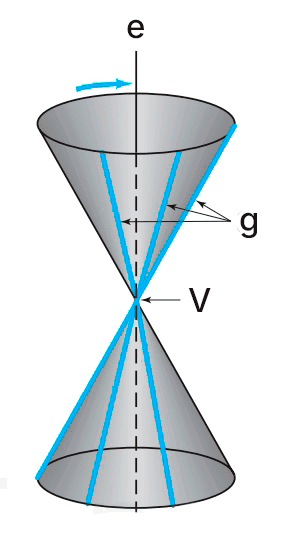
The term conic comes from cone, a three-dimensional geometric figure formed as follows: consider two distinct lines, e and g, intersecting at a point V. Line e remains fixed while line g rotates around e, maintaining a constant angle between them. The collection of points generated by line g is called a right circular cone.
The fixed line is called the axis, and the lines passing through V that make the same angle with e as g does are called the generators of the cone. Each generator is a straight line lying entirely on the surface of the cone. The cone is divided into two parts, called nappes, which intersect at the vertex.
Conic sections are curves obtained by intersecting a right circular cone with a plane. Think of the plane as a blade slicing through the cone at various angles and positions. Depending on the orientation of the plane relative to the cone, different types of conic sections are produced:
- Circle: when the plane is perpendicular to the axis of the cone and intersects all generators.
- Ellipse: when the plane is slightly tilted, intersecting all generators across only one nappe of the cone.
- Parabola: when the plane is parallel to a generator line and cuts through only one nappe of the cone.
- Hyperbola: when the plane cuts through both nappes.
If the plane passes through the vertex, the intersection of the plane and the cone results in a point, a single line, or a pair of intersecting lines. These cases are called degenerate conics.
The concept of conics dates back to the studies of the ancient Greeks, but it was not until the 17th century that their algebraic properties were formalized and systematically studied. Euclidean geometry provides an intuitive and visual understanding of conics, whereas analytic geometry enables the study of conics through equations, providing powerful algebraic tools for analyzing and solving geometric problems.
Conic shapes have extensive applications across science, engineering, and architecture. Ellipses model planetary orbits, optimize architectural acoustics, and distribute structural loads; parabolas are essential in satellite dishes, reflective headlights, and projectile motion; and hyperbolas enable signal-based geolocation, wave focusing, and the modeling of open celestial trajectories.
Circle
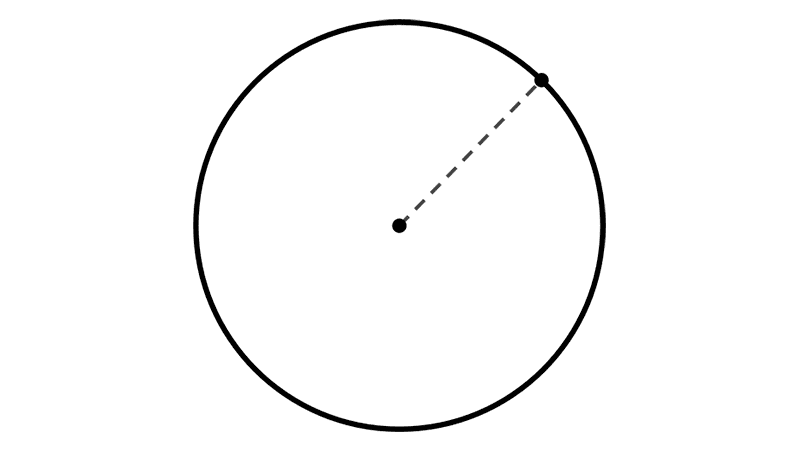
A circle is formed when a plane cuts through a cone perpendicular to the cone's axis. It is defined as the set of all points that are at a fixed distance, called the radius, from a fixed point, called the center.
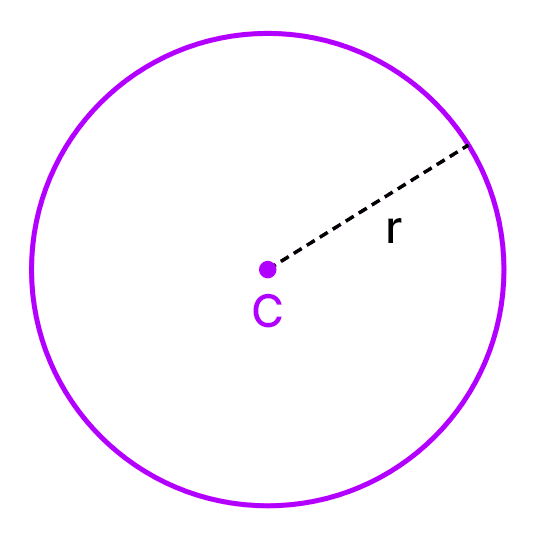
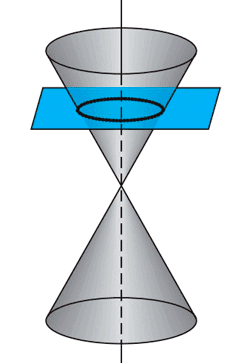
The fundamental elements of a circle are:
- Center: a fixed point located inside the circle from which all points on the curve are equidistant.
- Radius: the distance from the center to any point on the circle.
The radius can be any positive real number. On a Cartesian plane, the center of the circle can be located at any point. Another key element is the diameter, whose length is twice the radius; it is a line segment that connects two points on the circle and passes through the center.
The standard equation of a circle centered at the origin is:
x2 + y2 = r2
where x and y are the coordinates of any point P(x, y) on the circle, and r is the radius.
If the circle is centered at an arbitrary point (h, k), the equation becomes:
(x - h)2 + (y - k)2 = r2
Examples
- x2 + y2 = 4 represents a circle centered at (0, 0) with a radius of 2.
- (x + 3)2 + (y + 2)2 = 9 is the equation of a circle centered at (-3, -2) with a radius of 3.
- x2 + (y - 1)2 = 5 is the equation of a circle centered at (0, 1) with a radius of √5 ≈ 2.24.
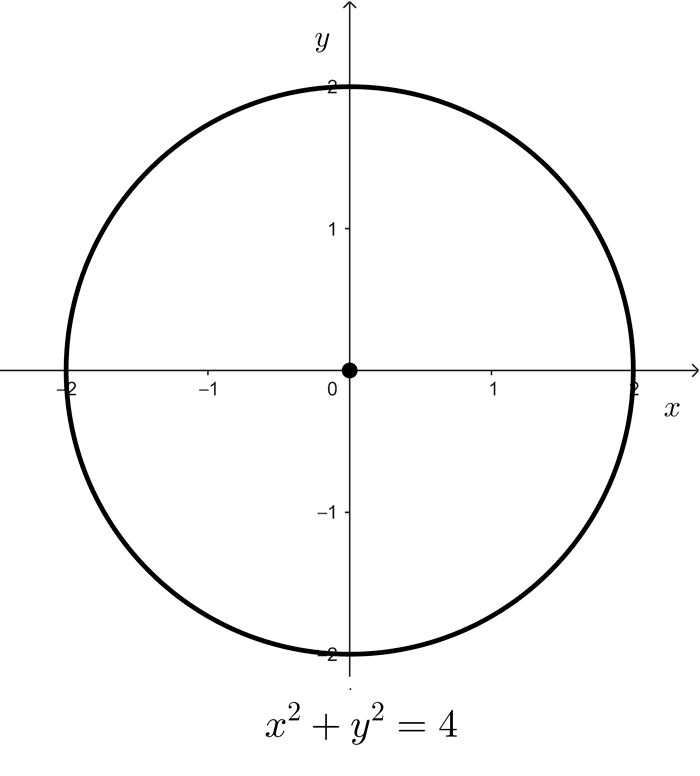
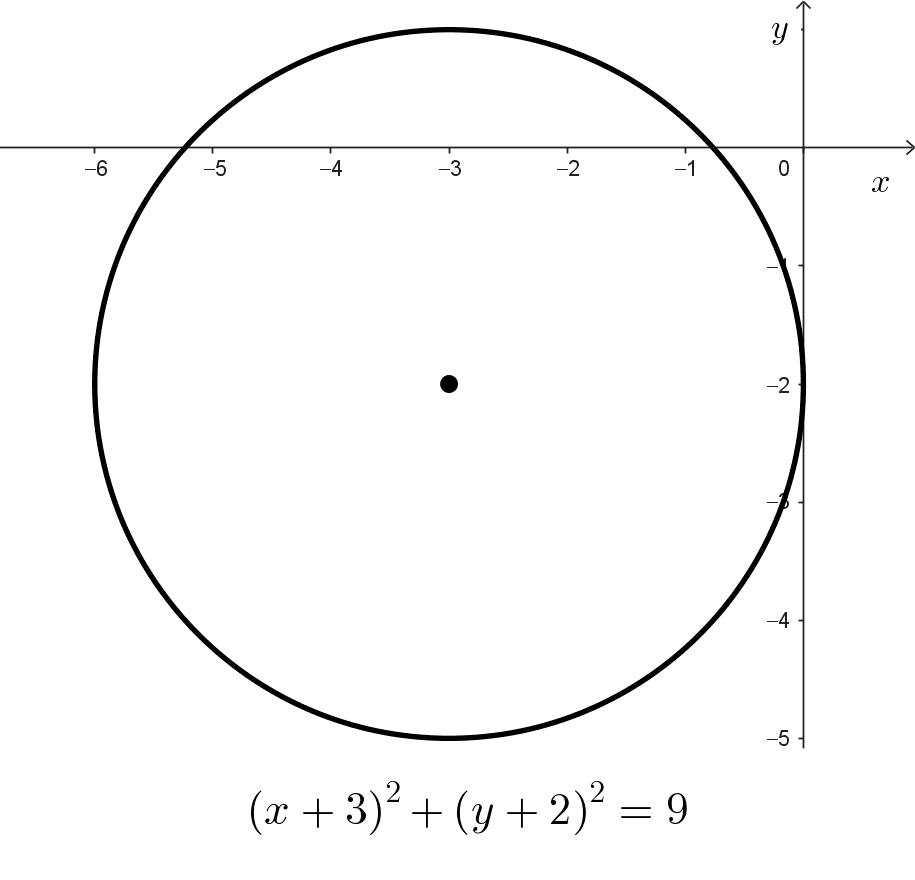
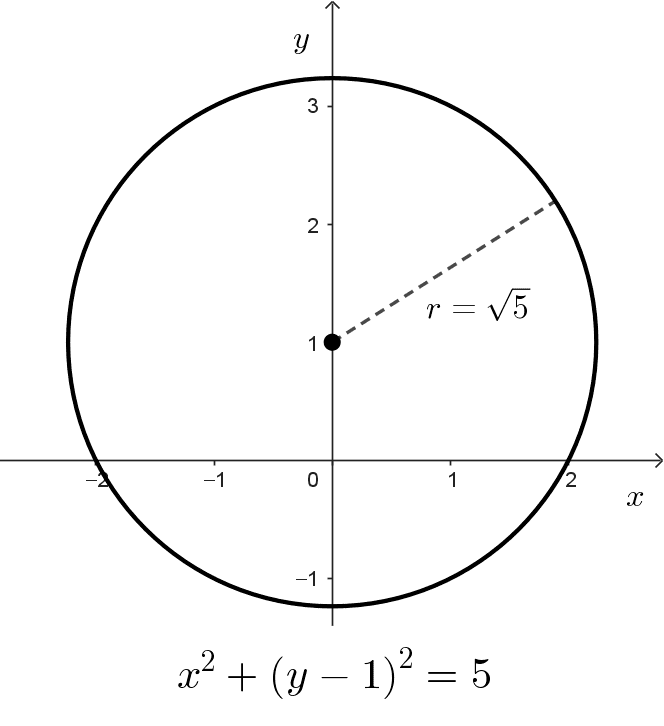
Some key properties of circles include:
- Any line passing through the center divides the circle into two equal halves.
- The circumference (perimeter) is related to its radius by the formula: C = 2πr, where π is approximately 3.141592.
- The area enclosed by the circle is calculated using the formula: A = πr2.
A circle is sometimes conflated with the boundary curve itself versus the interior region. Strictly speaking, the disk represents the complete geometric region including both the boundary and interior area, while the circle refers specifically to the perimeter or boundary curve.
Circles have practical applications in the design of gears, wheels, architectural arches, and physical calculations, where their perfect symmetry ensures uniform rotational movement, efficient stress distribution, and mechanical precision.
Ellipse
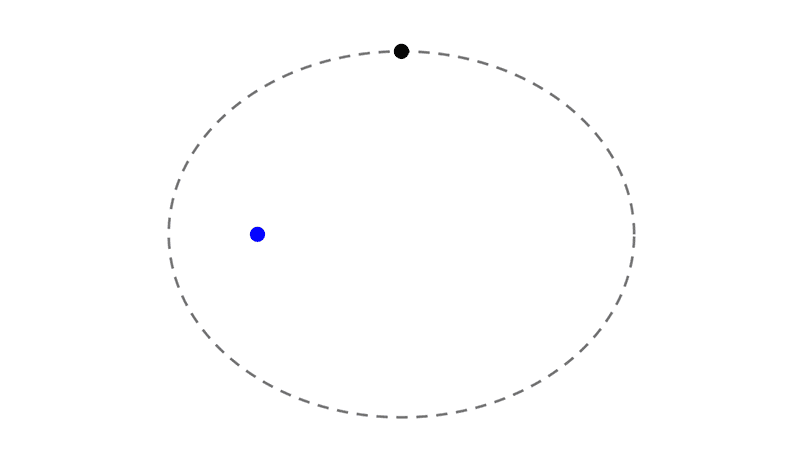
An ellipse is obtained when a slightly tilted plane cuts across a single nappe of a cone, without being parallel to any generator. Geometrically, an ellipse is defined as the set of all points for which the sum of the distances to two fixed points, called foci, is constant.
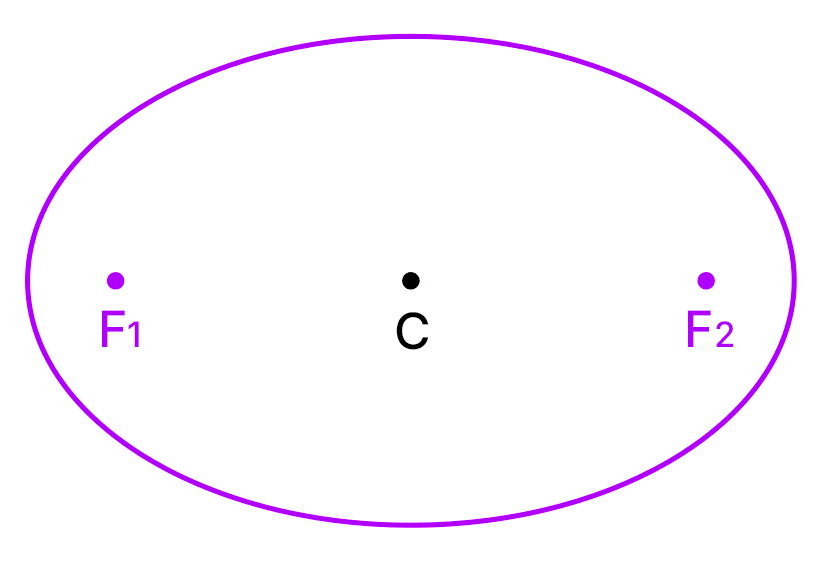

The fundamental elements of an ellipse are:
- Foci: two fixed points located inside the ellipse. The sum of the distances from any point on the ellipse to both foci remains constant.
- Center: the midpoint of the line segment joining the two foci.
- Major axis: the longest segment passing through both foci, terminating at the ellipse boundary. The length of the major axis is 2a, which represents the maximum distance between two points on the ellipse. Half of this segment is the semi-major axis, with length a.
- Minor axis: the shortest segment passing through the center perpendicular to the major axis. The length of the minor axis is denoted by 2b, representing the minimum distance across the ellipse. Half of this segment is the semi-minor axis, with length b.
The standard equation of an ellipse depends on the orientation of its major axis (horizontal or vertical) and the position of its center (at the origin or another point). The four standard forms are summarized in the following table:
| Standard equation | Major axis orientation | Center |
|---|---|---|
| \(\dfrac{x^2}{a^2}+\dfrac{y^2}{b^2}=1\) | Horizontal | (0, 0) |
| \(\dfrac{x^2}{b^2}+\dfrac{y^2}{a^2}=1\) | Vertical | (0, 0) |
| \(\dfrac{(x-h)^2}{a^2}+\dfrac{(y-k)^2}{b^2}=1\) | Horizontal | (h, k) |
| \(\dfrac{(x-h)^2}{b^2}+\dfrac{(y-k)^2}{a^2}=1\) | Vertical | (h, k) |
In all cases, a represents the length of the semi-major axis, b represents the length of the semi-minor axis, and a > b. When the orientation is horizontal, the ellipse is wider than it is tall; conversely, when the orientation is vertical, the ellipse is taller than it is wide.
Examples
- The equation \(\dfrac{x^2}{16}+\dfrac{y^2}{9}=1\) represents a horizontal ellipse centered at the origin where the semi-major axis is 4 and the semi-minor axis is 3.
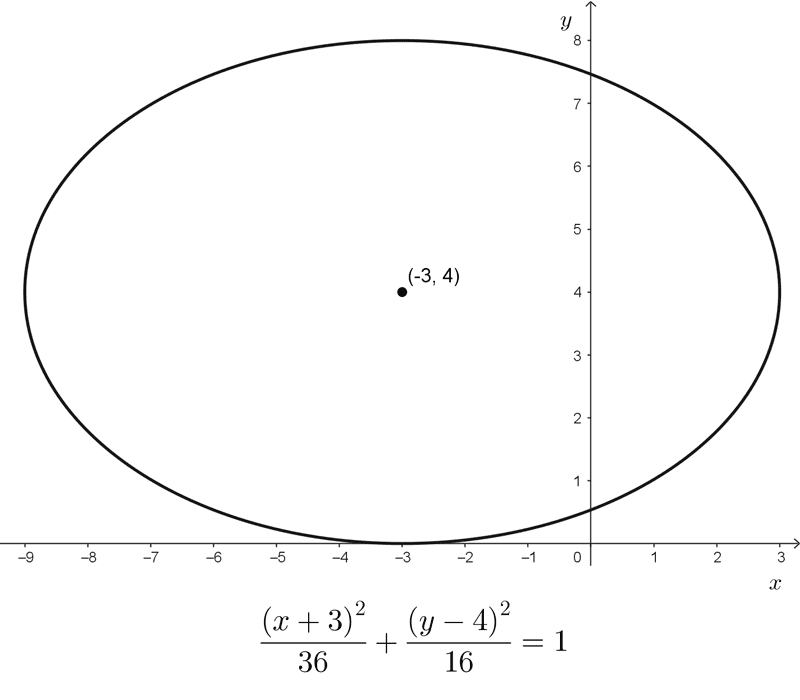
- \(\dfrac{(x+3)^2}{36}+\dfrac{(y-4)^2}{16}=1\) represents an ellipse with a horizontal major axis, centered at (-3, 4), with semi-major axis a = 6 and semi-minor axis b = 4.
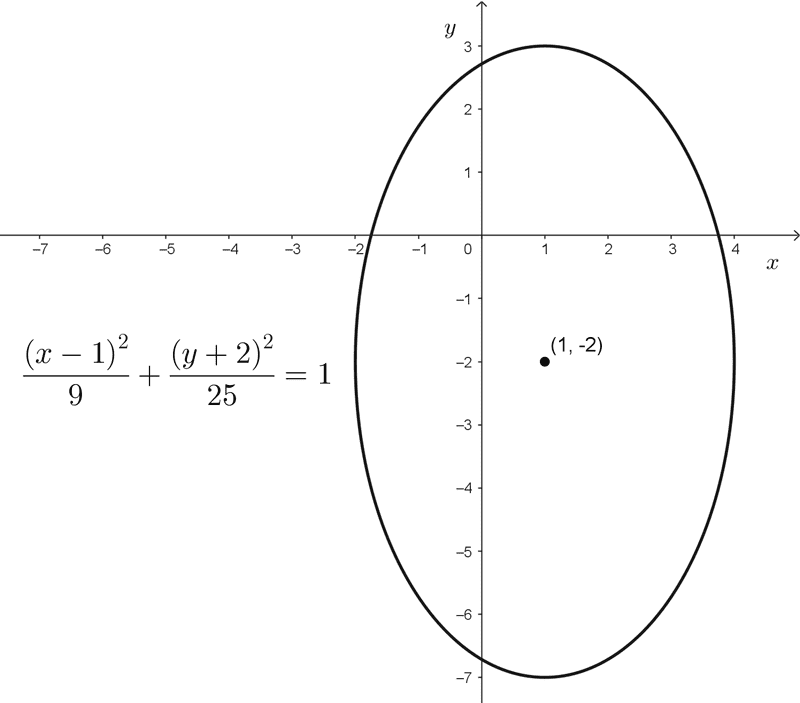
- The equation \(\dfrac{(x-1)^2}{9}+\dfrac{(y+2)^2}{25}=1\) represents a vertical ellipse centered at (1, -2) where the semi-major axis is 5 and the semi-minor axis is 3.

A circle can be considered a special case of an ellipse where the two foci coincide at the same point.
Ellipses have essential applications in fields such as astronomy, engineering, architecture, and optics, where their reflective geometry allows describing planetary orbits, balancing load distributions across structural arches, optimizing acoustic whisper galleries, and focusing light or sound waves.
Parabola
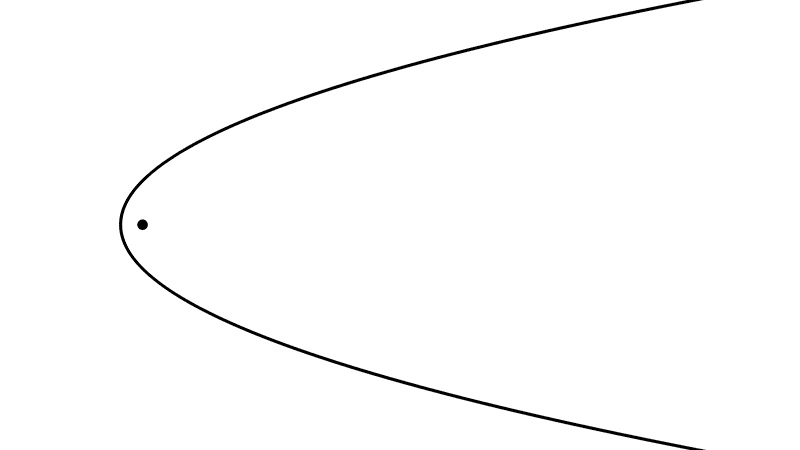
A parabola is formed when a plane slices a cone parallel to one of its generators. It is defined as the set of all points that are equidistant from a fixed point, called the focus, and a fixed line, called the directrix.
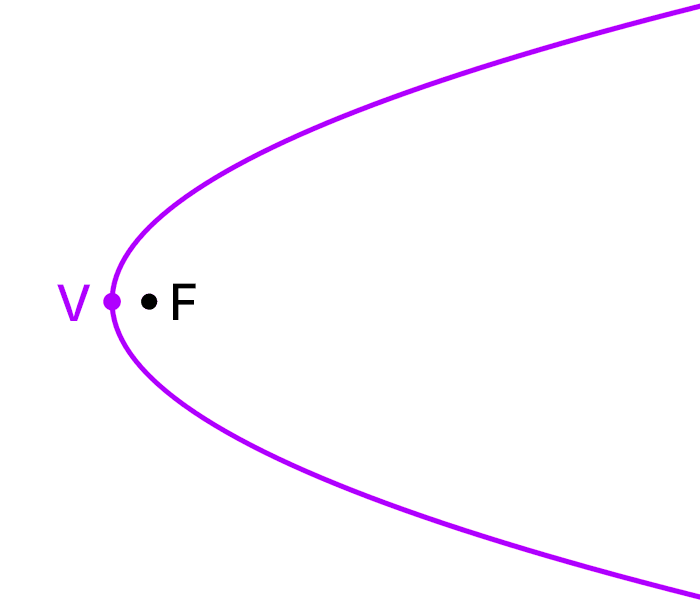
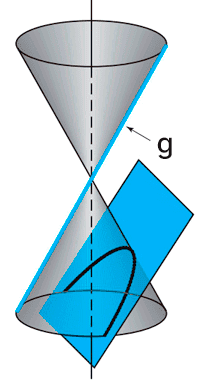
The fundamental elements of a parabola are:
- Focus: the fixed point in the plane.
- Directrix: a fixed line that does not pass through the focus. The distance from any point on the parabola to the directrix equals the distance from that point to the focus.
- Vertex: the point on the parabola closest to both the focus and the directrix.
- Focal distance: the distance between the focus and the vertex, or between the vertex and the directrix. Its value is |p|, where p is a directional parameter that appears in the equation.
A parabola can open upward, downward, to the right, or to the left, depending on the orientation of the directrix and focus.
The standard equation of a parabola with its vertex at the origin opening horizontally (left or right) is:
\(y^2=4px\)
where |p| is the focal distance. When p > 0, the curve opens to the right; when p < 0, the curve opens to the left.
If the parabola opens vertically (upward or downward), the equation is:
\(x^2=4py\)
When p > 0, the curve opens upward; when p < 0, the curve opens downward.
For a parabola with its vertex at an arbitrary point (h, k), the equations become:
- \((y-k)^2=4p(x-h)\) for parabolas opening horizontally (left or right).
- \((x-h)^2=4p(y-k)\) for parabolas opening vertically (upward or downward).
Examples
- The equation \(y^2=-6x\) represents a parabola with its vertex at (0, 0) where the distance from the vertex to the focus is 1.5. The curve opens to the left.
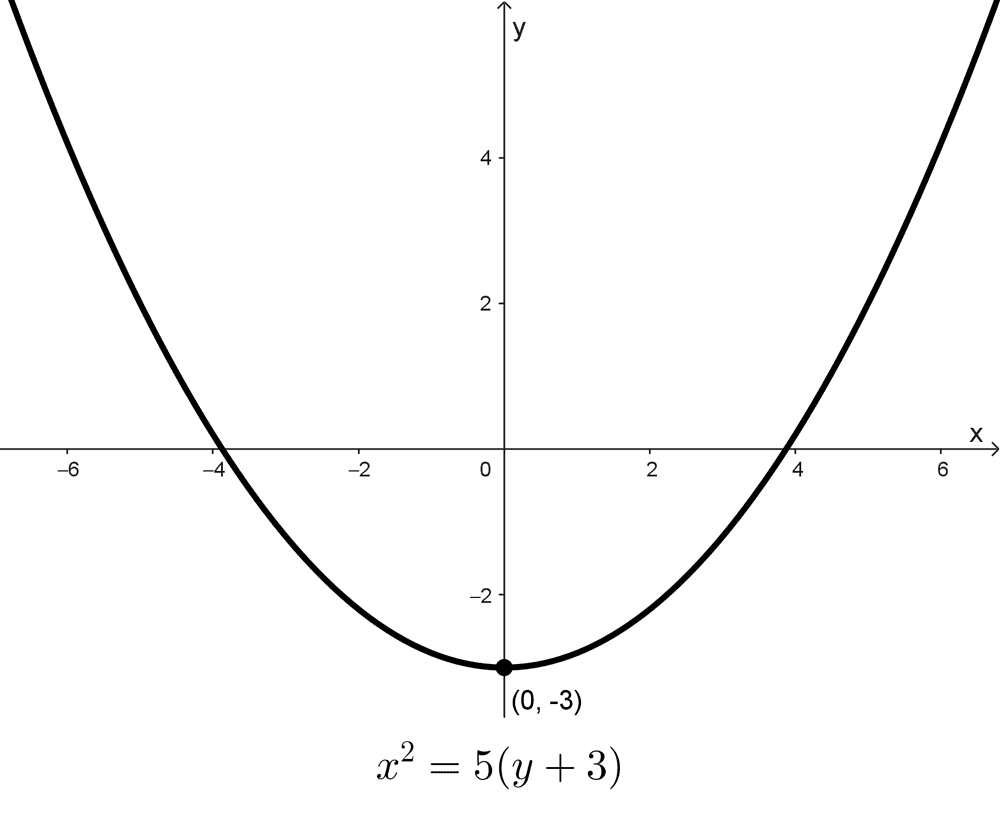
- The equation \(x^2=5(y+3)\) represents a parabola with its vertex at (0, -3) where the distance from the vertex to the focus is 5/4. The curve opens upward.
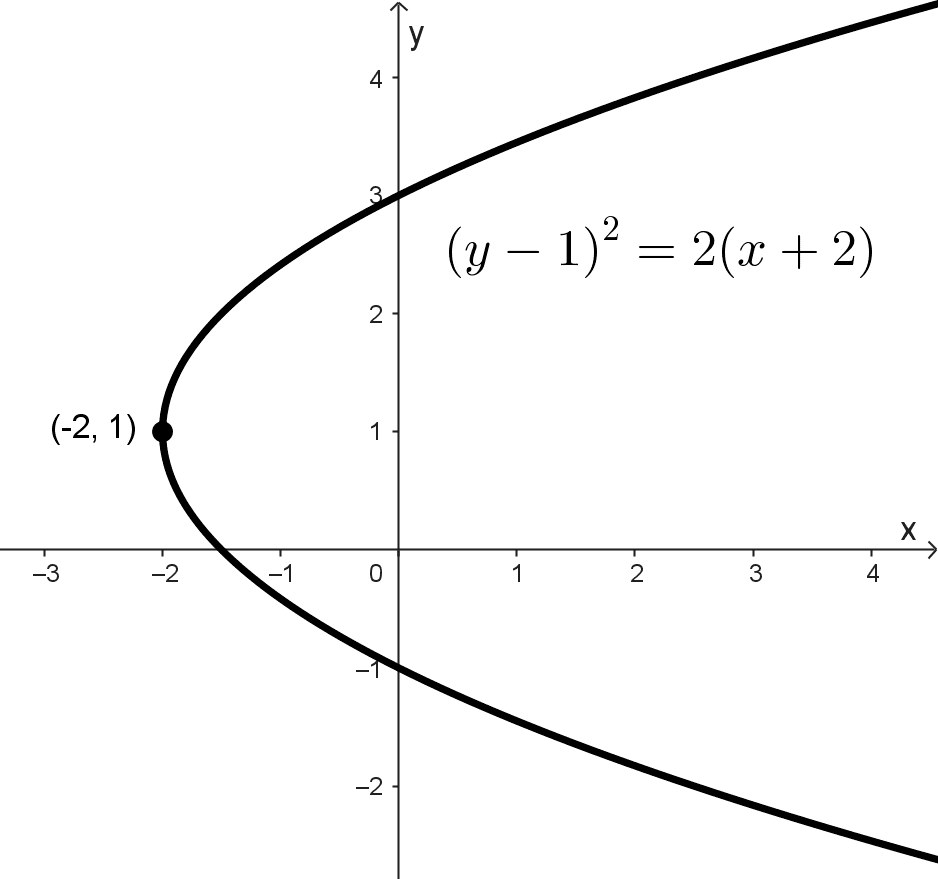
- The equation \((y-1)^2=2(x+2)\) represents a parabola with its vertex at (-2, 1) where the distance from the vertex to the focus is 1/2. The curve opens to the right.

The parabola has widespread applications across science and engineering due to its unique reflective property, which concentrates parallel incoming rays at a single focus point. This makes it indispensable for satellite dishes, optical systems, acoustic collectors, and reflecting telescopes. It is also used to model projectile trajectories and specific economic optimization curves.
Hyperbola
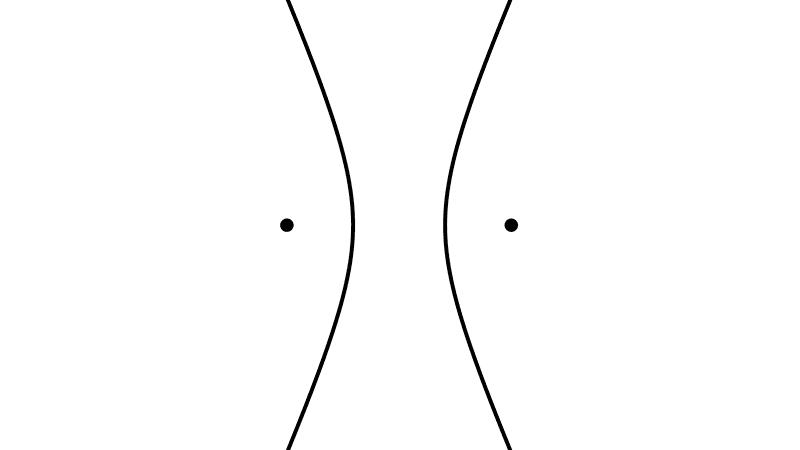
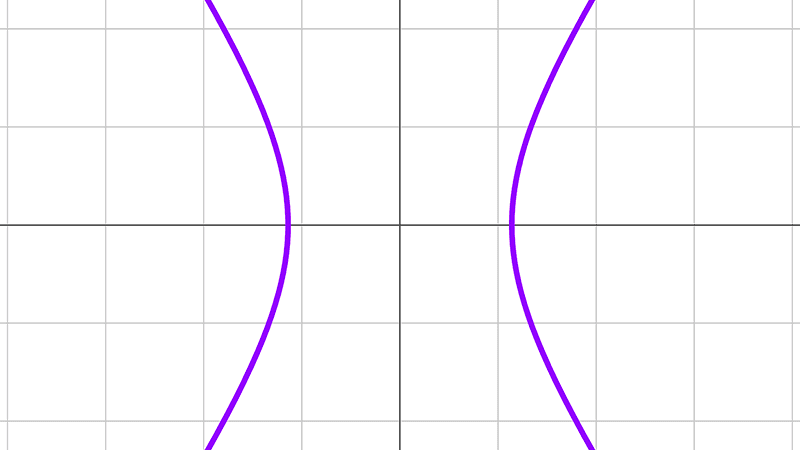
A hyperbola is formed when a plane intersects both nappes of a cone. It is also defined as the set of all points for which the absolute difference of the distances to two fixed points, called foci, is constant.
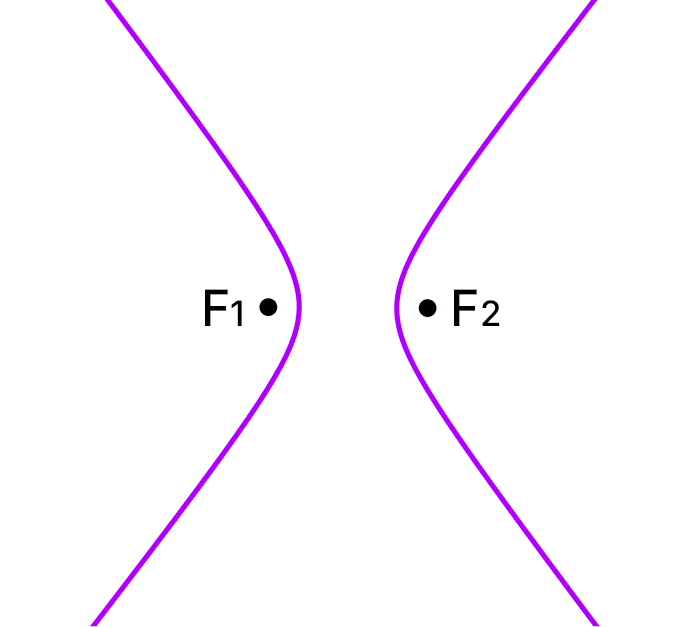
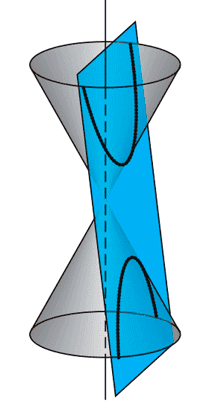
The fundamental elements of a hyperbola are:
- Foci: two fixed points located along a line known as the transverse (or focal) axis. The absolute difference between the distances from any point on the hyperbola to these two foci is constant.
- Center: the midpoint of the line segment connecting the two foci.
- Vertices: the two points where the hyperbola intersects the transverse axis, positioned equidistant from the center.
- Transverse axis: the segment joining the two vertices, with a total length of 2a. Half of this segment is the semi-transverse axis, with length a.
- Conjugate axis: the segment perpendicular to the transverse axis passing through the center, with a length of 2b. Half of this segment is the semi-conjugate axis, with length b.
A hyperbola has two branches opening in opposite directions. The orientation of the curve depends on whether the foci and transverse axis are positioned horizontally or vertically.
The standard equation of a hyperbola is structured similarly to that of an ellipse, but features a negative quadratic term in the first member. The equation varies according to the orientation of the transverse axis (horizontal or vertical) and the position of its center (at the origin or an arbitrary point).
| Standard equation | Transverse axis orientation | Center |
|---|---|---|
| \(\dfrac{x^2}{a^2}-\dfrac{y^2}{b^2}=1\) | Horizontal | (0, 0) |
| \(\dfrac{y^2}{a^2}-\dfrac{x^2}{b^2}=1\) | Vertical | (0, 0) |
| \(\dfrac{(x-h)^2}{a^2}-\dfrac{(y-k)^2}{b^2}=1\) | Horizontal | (h, k) |
| \(\dfrac{(y-k)^2}{a^2}-\dfrac{(x-h)^2}{b^2}=1\) | Vertical | (h, k) |
In all four cases, a represents the length of the semi-transverse axis, and b represents the length of the semi-conjugate axis. Unlike in an ellipse, b can be greater than, less than, or equal to a. When the orientation is horizontal, the branches open left and right; when vertical, the branches open upward and downward.
Examples
- The equation \(\dfrac{x^2}{4}-\dfrac{y^2}{9}=1\) represents a horizontal hyperbola centered at the origin where the semi-transverse axis is 2 and the semi-conjugate axis is 3.
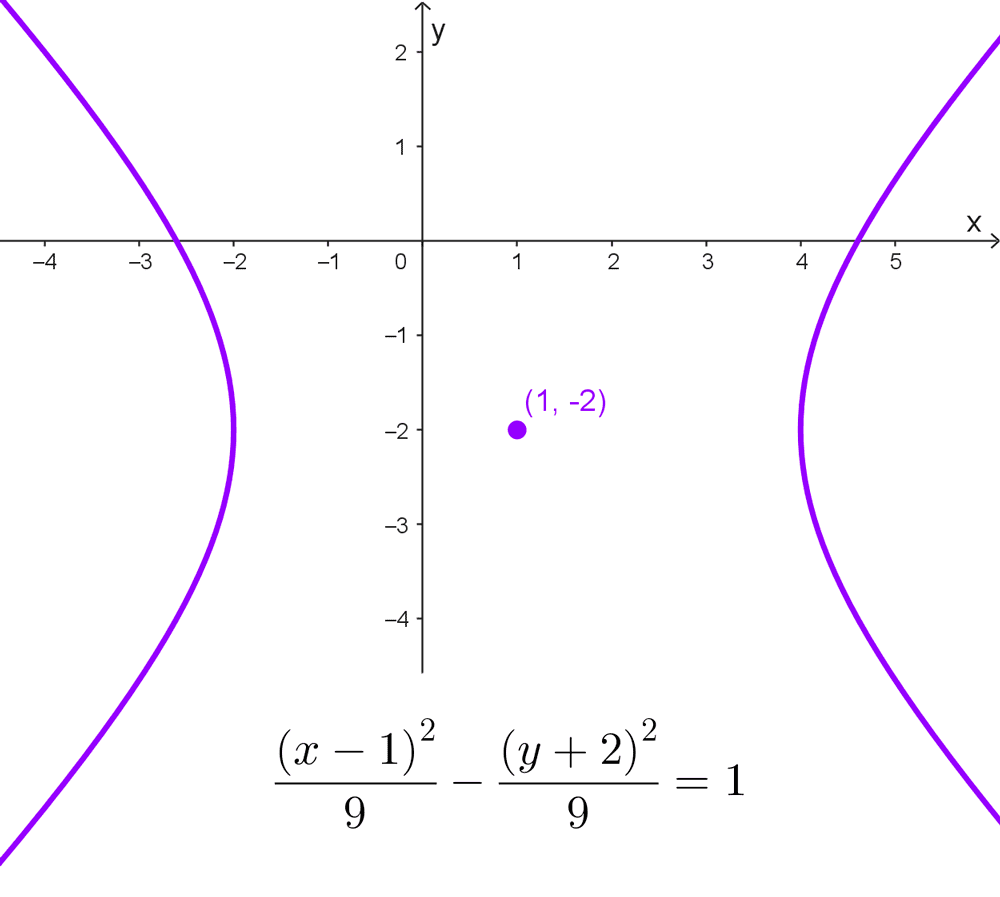
- The equation \(\dfrac{(x-1)^2}{9}-\dfrac{(y+2)^2}{9}=1\) represents a hyperbola with a horizontal transverse axis and center at (1, -2). The lengths of both semi-axes are equal: a = b = 3.
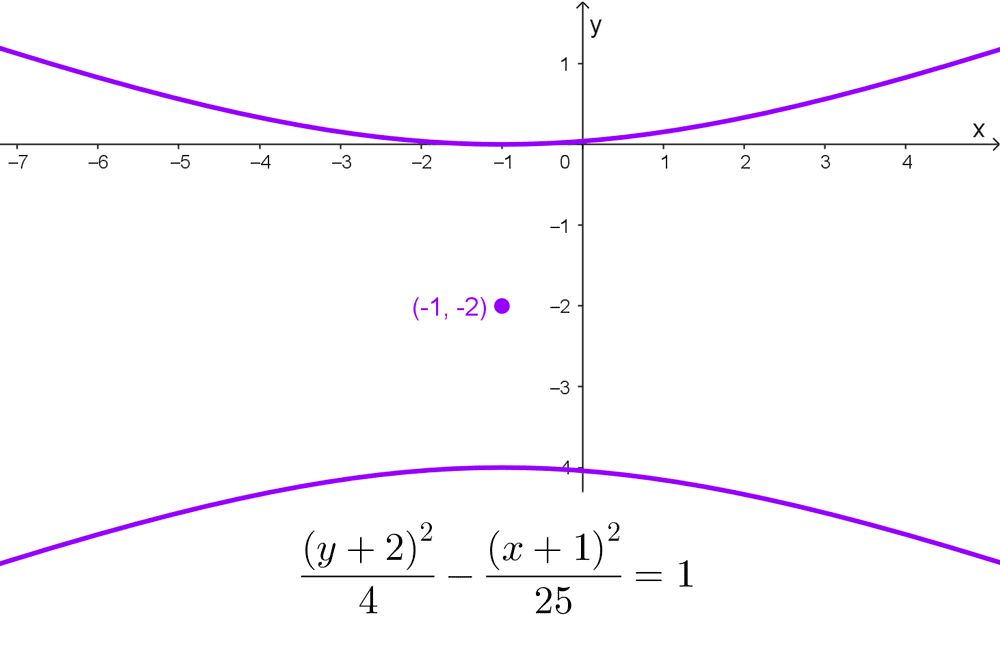
- The equation \(\dfrac{(y+2)^2}{4}-\dfrac{(x+1)^2}{25}=1\) represents a vertical hyperbola centered at (-1, -2) where the semi-transverse axis is 2 and the semi-conjugate axis is 5.

The hyperbola has vital applications in long-range radio navigation, signal-based geolocation, optics, acoustics, and orbital mechanics. Notably used in LORAN/GPS hyperbolic positioning systems, radar dishes, and reflective telescope secondary mirrors, its geometric properties allow tracking signals and determining positions with high precision.
Summary of Equations
The key geometric elements and formulas for each conic section are summarized in the table below.
| Conic section | Key elements | Standard equation |
|---|---|---|
| Circle | Radius (r). Center (h, k). | \((x-h)^2+(y-k)^2=r^2\) |
| Ellipse | Center (h, k). Semi-major axis (a). Semi-minor axis (b). | Horizontal \(\dfrac{(x-h)^2}{a^2}+\dfrac{(y-k)^2}{b^2}=1\) Vertical \(\dfrac{(x-h)^2}{b^2}+\dfrac{(y-k)^2}{a^2}=1\) |
| Parabola | Focus. Directrix. Vertex (h, k). Focal distance, |p|. | Horizontal \((y-k)^2=4p(x-h)\) Vertical \((x-h)^2=4p(y-k)\) |
| Hyperbola | Center (h, k). Semi-transverse axis (a). Semi-conjugate axis (b). | Horizontal \(\dfrac{(x-h)^2}{a^2}-\dfrac{(y-k)^2}{b^2}=1\) Vertical \(\dfrac{(y-k)^2}{a^2}-\dfrac{(x-h)^2}{b^2}=1\) |
Note: The standard form (also referred to as canonical or vertex form depending on the conic) provides a simplified algebraic representation that directly reveals key geometric properties. For instance, in a circle one can immediately read the center and radius; in an ellipse or hyperbola, the center, semi-axes, and orientation; and in a parabola, the orientation and focal distance. There is also a broader form that describes all conics, explained in this article: general equation of conic sections.
Conic Sections Topics
Did you find this useful? Rate it!
0.0 / 5 — 0 votes

HOW TO CITE THIS ARTICLE
Machado, D. (2026, October 27). Conic Sections. Exponty. https://exponty.com/en/conic-sections
Leave a Reply
Related posts