
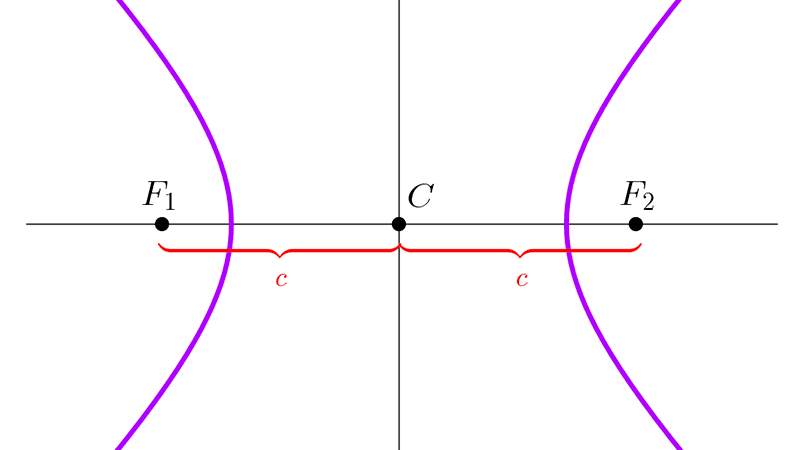
Horizontal and Vertical Hyperbolas
In this article, we explain horizontal and vertical hyperbolas along with their equations, graphs, examples, and key features.
Table of Contents
Horizontal Hyperbola
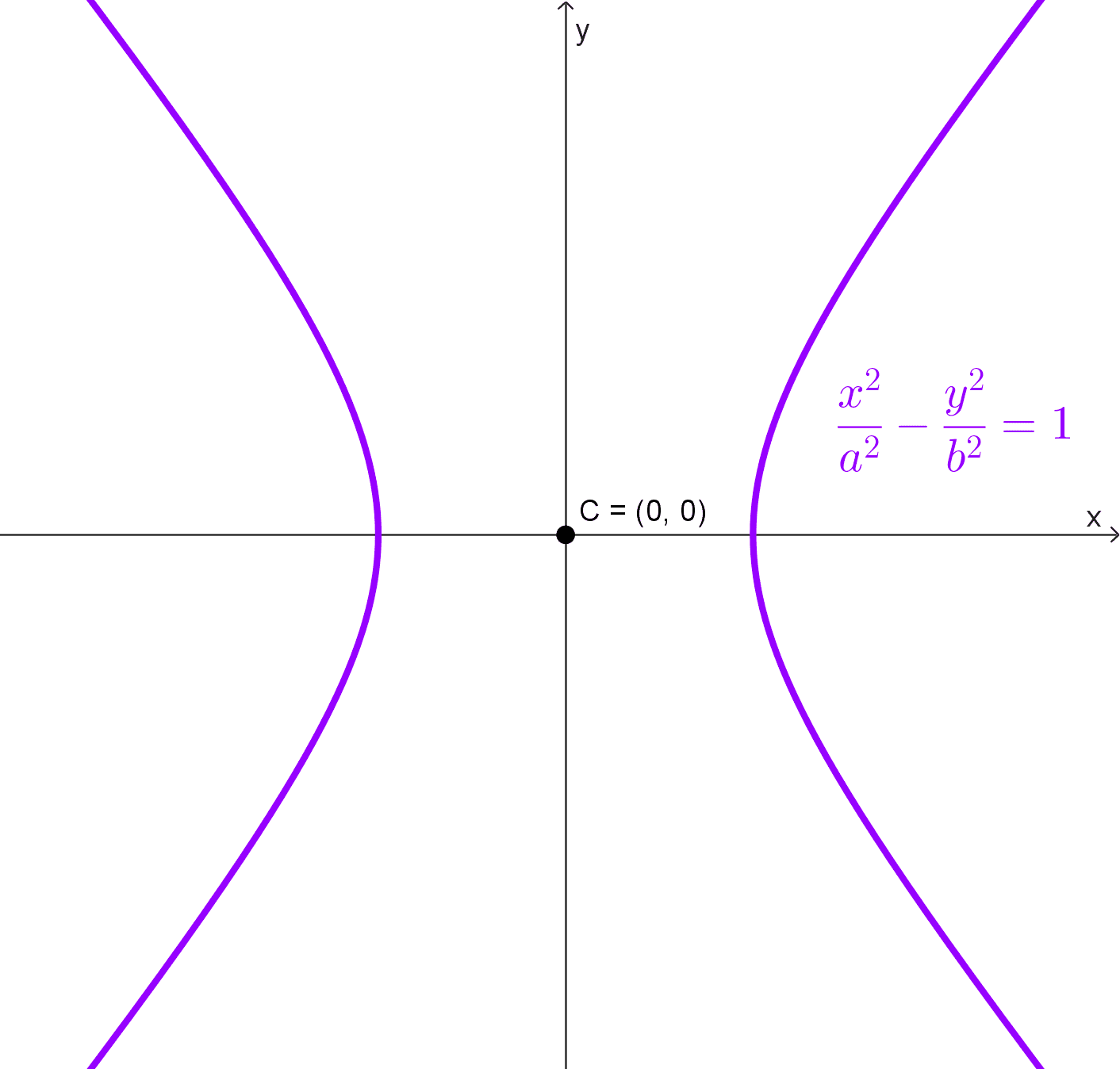
A horizontal hyperbola is one whose focal axis (which contains the transverse axis) is parallel to or lies on the x-axis. The branches of the hyperbola open left and right.
The standard equation varies depending on whether the center is at the origin or off the origin:
Center at (0, 0): \(\dfrac{x^2}{a^2}-\dfrac{y^2}{b^2}=1\)
Center at (h, k): \(\dfrac{(x-h)^2}{a^2}-\dfrac{(y-k)^2}{b^2}=1\)
where:
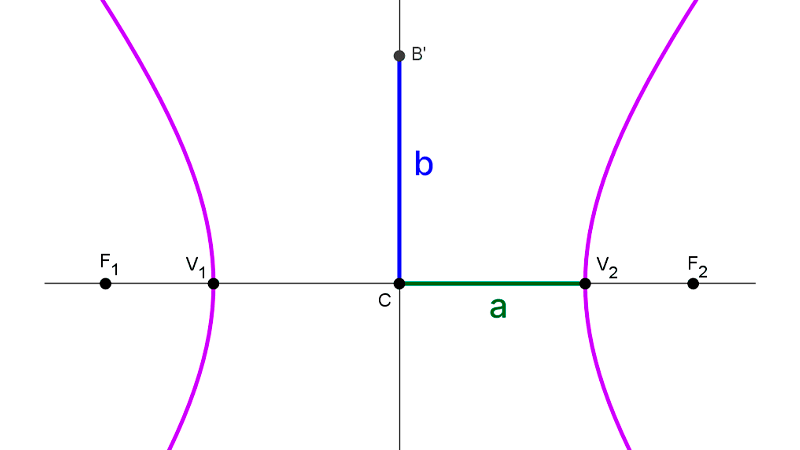
- The length of the semi-transverse axis is a.
- The length of the semi-conjugate axis is b.
Notice that in a horizontal hyperbola, the positive term on the left side of the equation contains the variable x, while the negative term contains the variable y. If the center is at the origin, the focal axis lies on the x-axis; if the center is at another point, the focal axis is parallel to the x-axis.
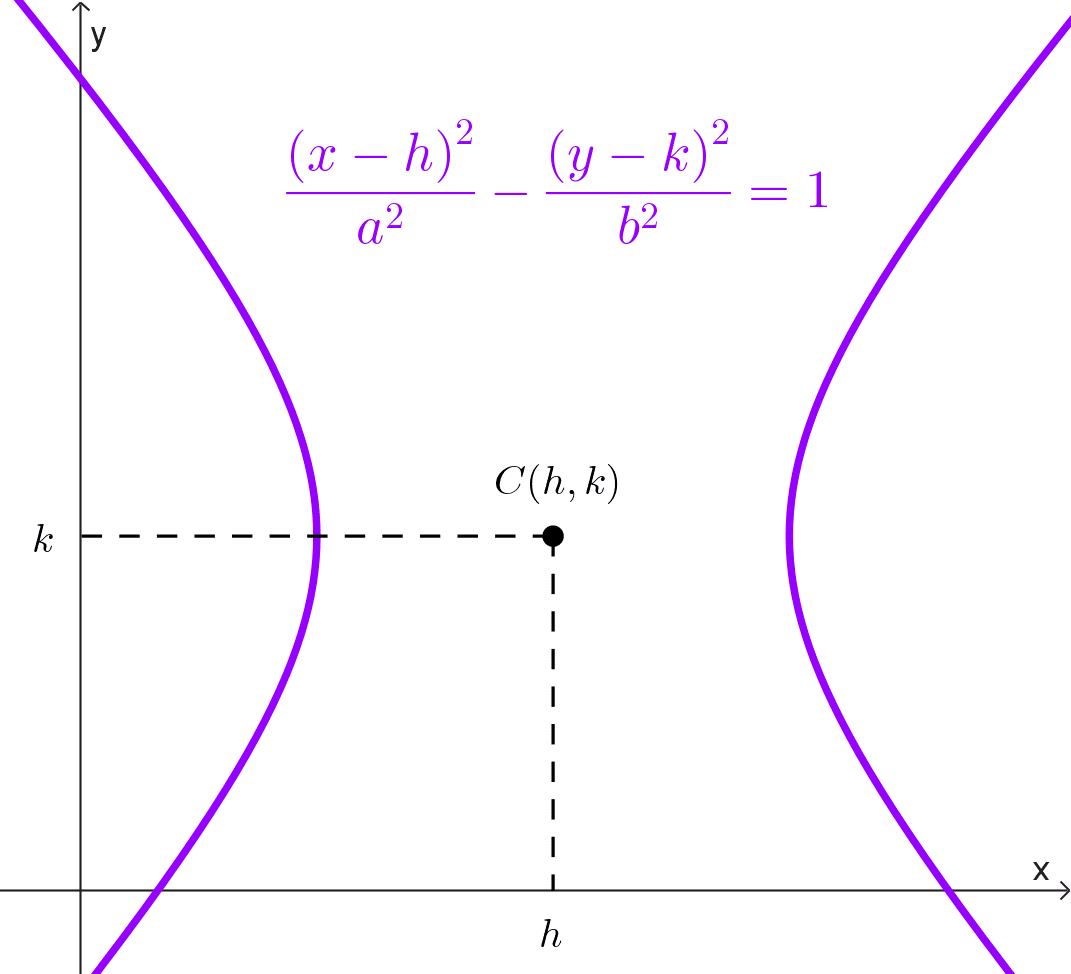
The key features of a horizontal hyperbola can be determined from its standard equation:
| Equation | Center | Foci | Vertices | Co-vertices | Asymptotes |
|---|---|---|---|---|---|
| \(\dfrac{x^2}{a^2}-\dfrac{y^2}{b^2}=1\) | (0, 0) | (±c, 0) c = √(a² + b²) | (±a, 0) | (0, ±b) | y = ± (b / a) x |
| \(\dfrac{(x-h)^2}{a^2}-\dfrac{(y-k)^2}{b^2}=1\) | (h, k) | (h ± c, k) c = √(a² + b²) | (h ± a, k) | (h, k ± b) | y - k = ± (b / a) (x - h) |
Examples
- \(\dfrac{x^2}{4}-\dfrac{y^2}{9}=1\) has its transverse axis along the x-axis, center at the origin, and semi-axes a = √4 = 2 and b = √9 = 3.
- \(\dfrac{(x-1)^2}{16}-\dfrac{(y+3)^2}{25}=1\) is centered at (1, -3), with semi-axis lengths a = √16 = 4 and b = √25 = 5.
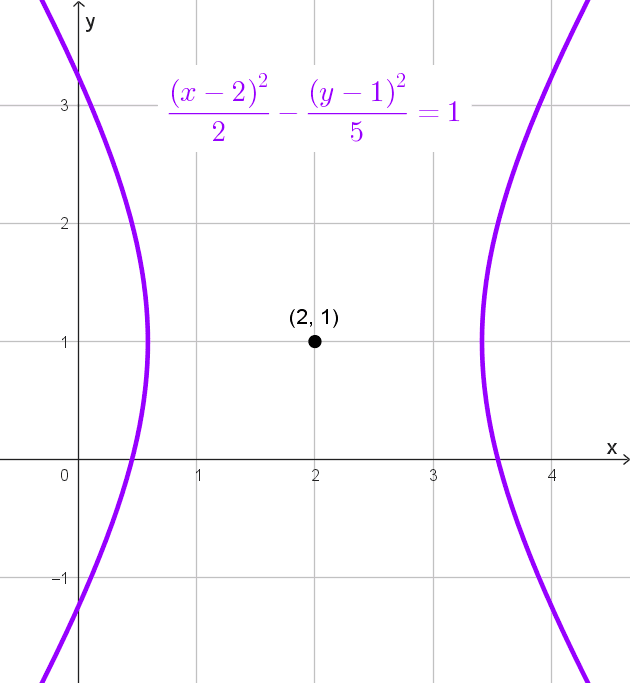
- \(\dfrac{(x-2)^2}{2}-\dfrac{(y-1)^2}{5}=1\) is a horizontal hyperbola centered at (2, 1), with a = √2 and b = √5.
- \(x^2-2y^2-2=0\) is the general form of a horizontal hyperbola; it can be rewritten as \(\dfrac{x^2}{2}-y^2=1\), from which we determine that the center is (0, 0), a = √2, and b = 1.



Vertical Hyperbola
A vertical hyperbola is one whose focal axis (which contains the transverse axis) is parallel to or lies on the y-axis. The branches of the hyperbola open up and down.
Similarly, the standard equation changes depending on whether the hyperbola is centered at the origin or shifted off the origin:
Center at (0, 0): \(\dfrac{y^2}{a^2}-\dfrac{x^2}{b^2}=1\)
Center at (h, k): \(\dfrac{(y-k)^2}{a^2}-\dfrac{(x-h)^2}{b^2}=1\)
where:
- The length of the semi-transverse axis is a.
- The length of the semi-conjugate axis is b.
Unlike the horizontal orientation, in a vertical hyperbola, the positive term on the left side of the equation contains the variable y, while the negative term contains the variable x. When the center is at the origin, the focal axis lies on the y-axis, whereas the focal axis is parallel to the y-axis if the center is at any other point.
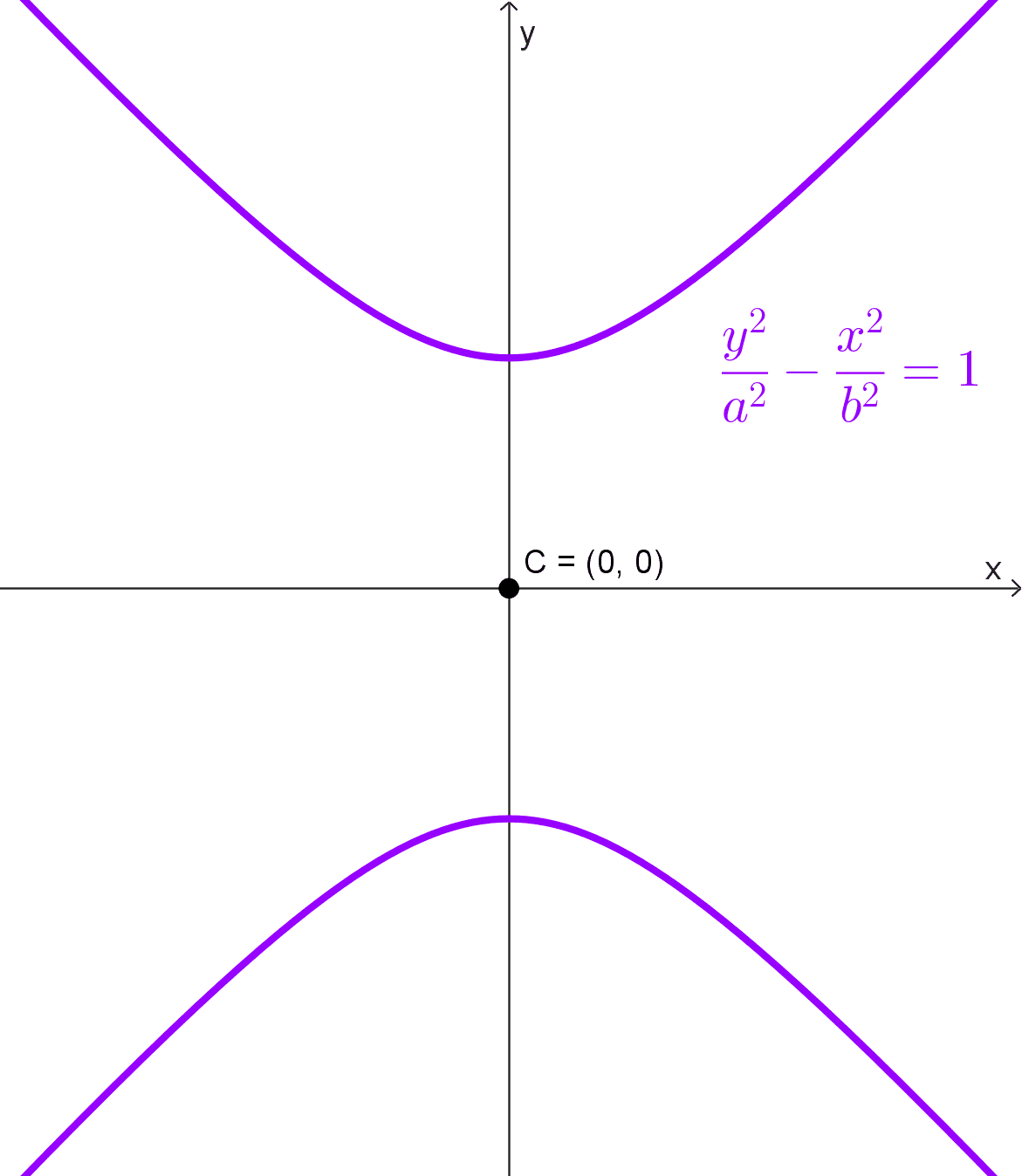
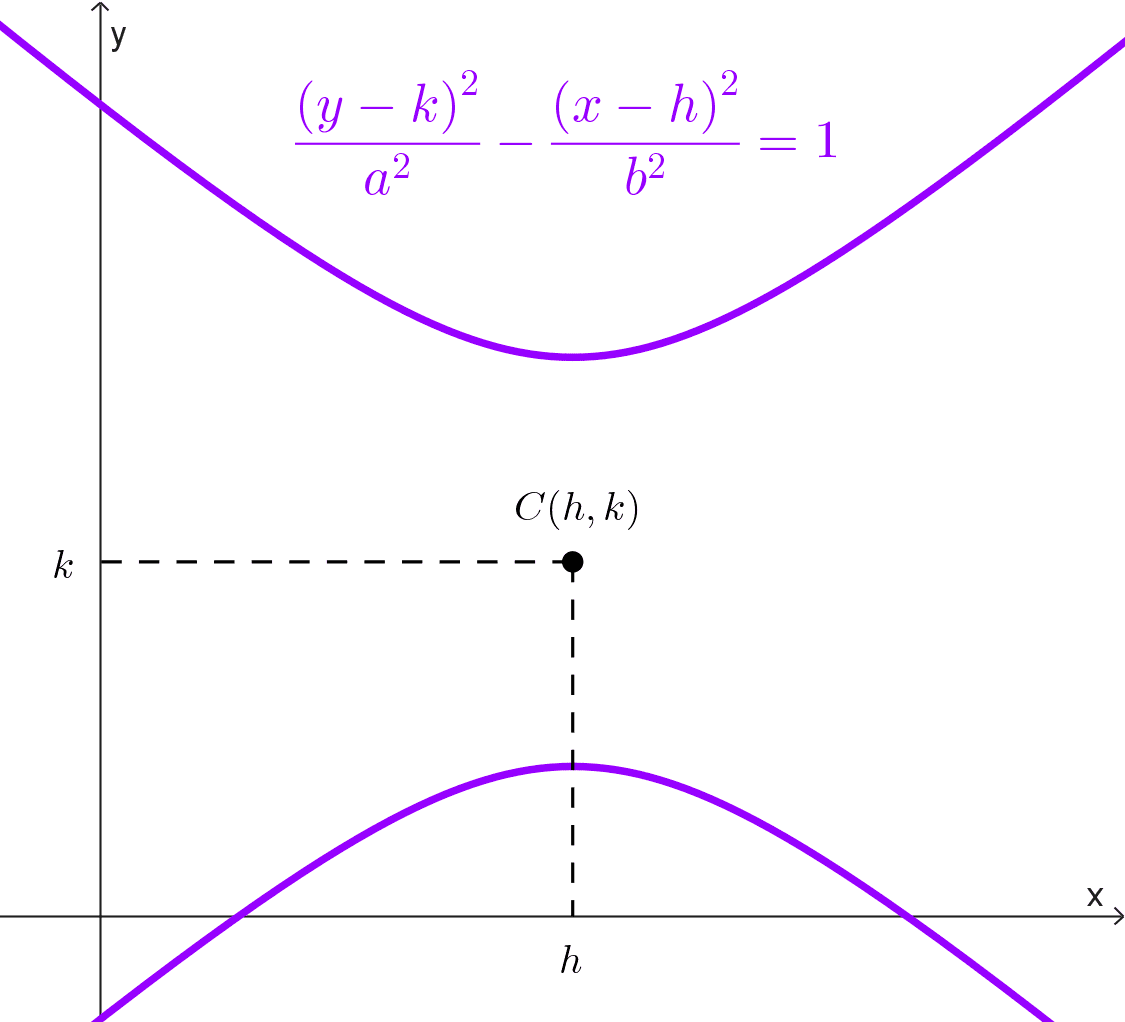
In an analogous manner, the key features of a vertical hyperbola can be obtained from its standard equation:
| Equation | Center | Foci | Vertices | Co-vertices | Asymptotes |
|---|---|---|---|---|---|
| \(\dfrac{y^2}{a^2}-\dfrac{x^2}{b^2}=1\) | (0, 0) | (0, ±c) c = √(a² + b²) | (0, ±a) | (±b, 0) | y = ± (a / b) x |
| \(\dfrac{(y-k)^2}{a^2}-\dfrac{(x-h)^2}{b^2}=1\) | (h, k) | (h, k ± c) c = √(a² + b²) | (h, k ± a) | (h ± b, k) | y - k = ± (a / b) (x - h) |
Examples
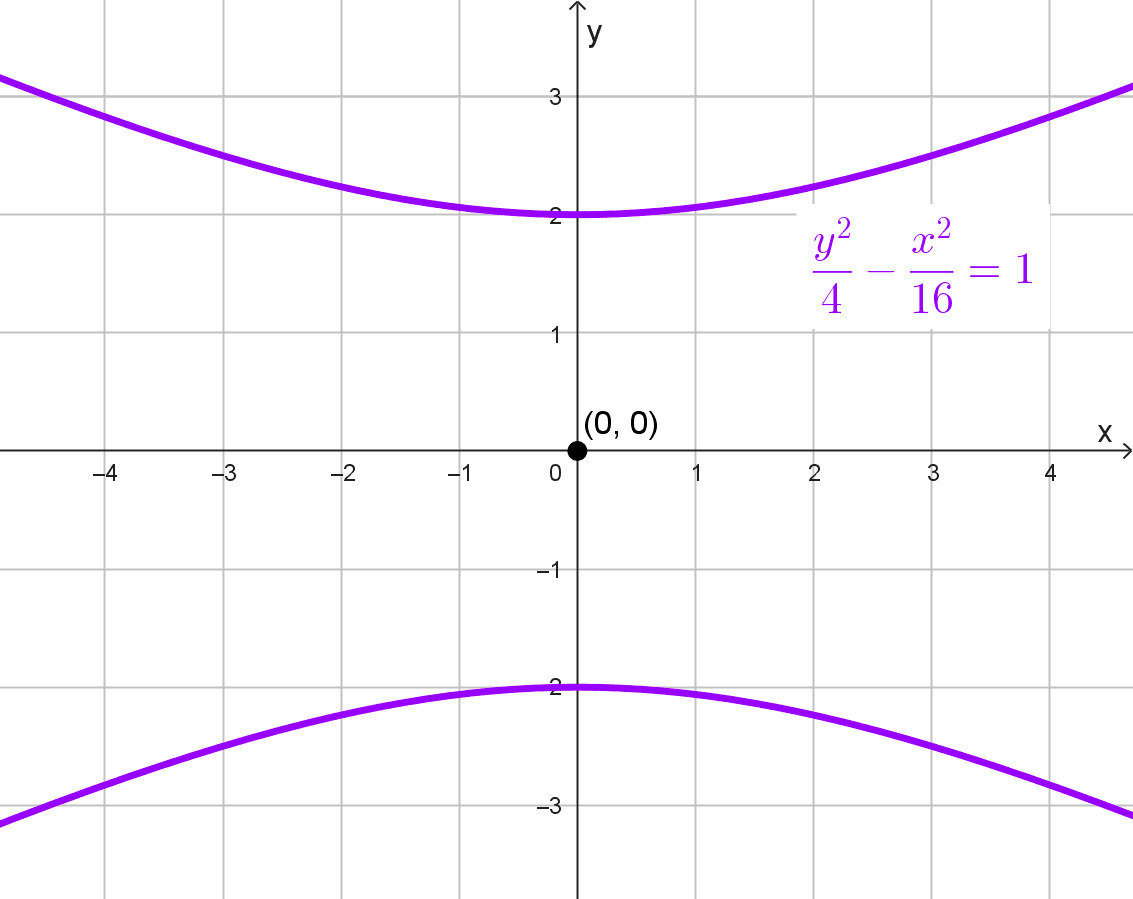
- \(\dfrac{y^2}{4}-\dfrac{x^2}{16}=1\) has its center at (0, 0) and semi-axes a = √4 = 2, b = √16 = 4.
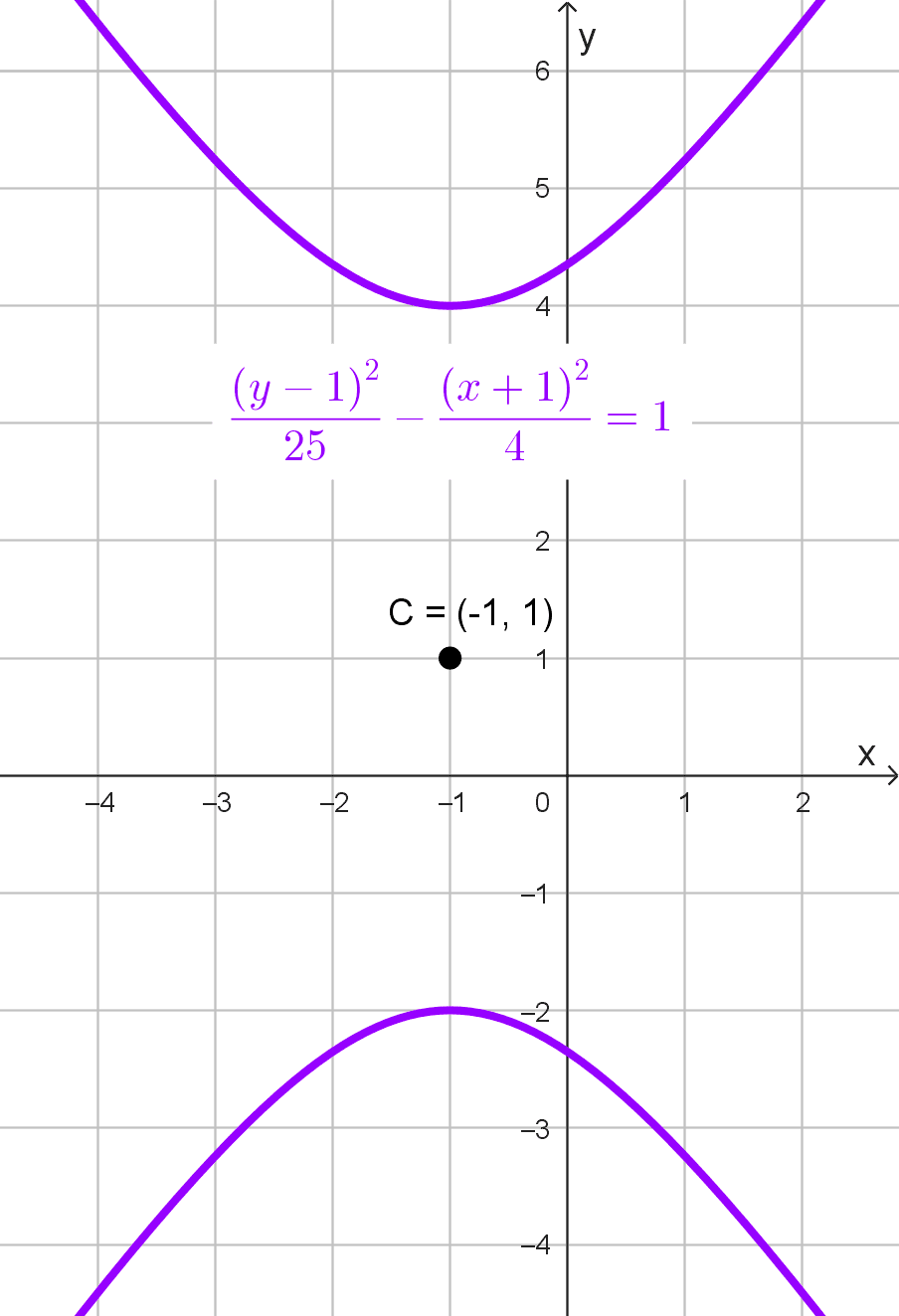
- \(\dfrac{(y-1)^2}{25}-\dfrac{(x+1)^2}{4}=1\) has its center at (-1, 1), a = √25 = 5, and b = √4 = 2.
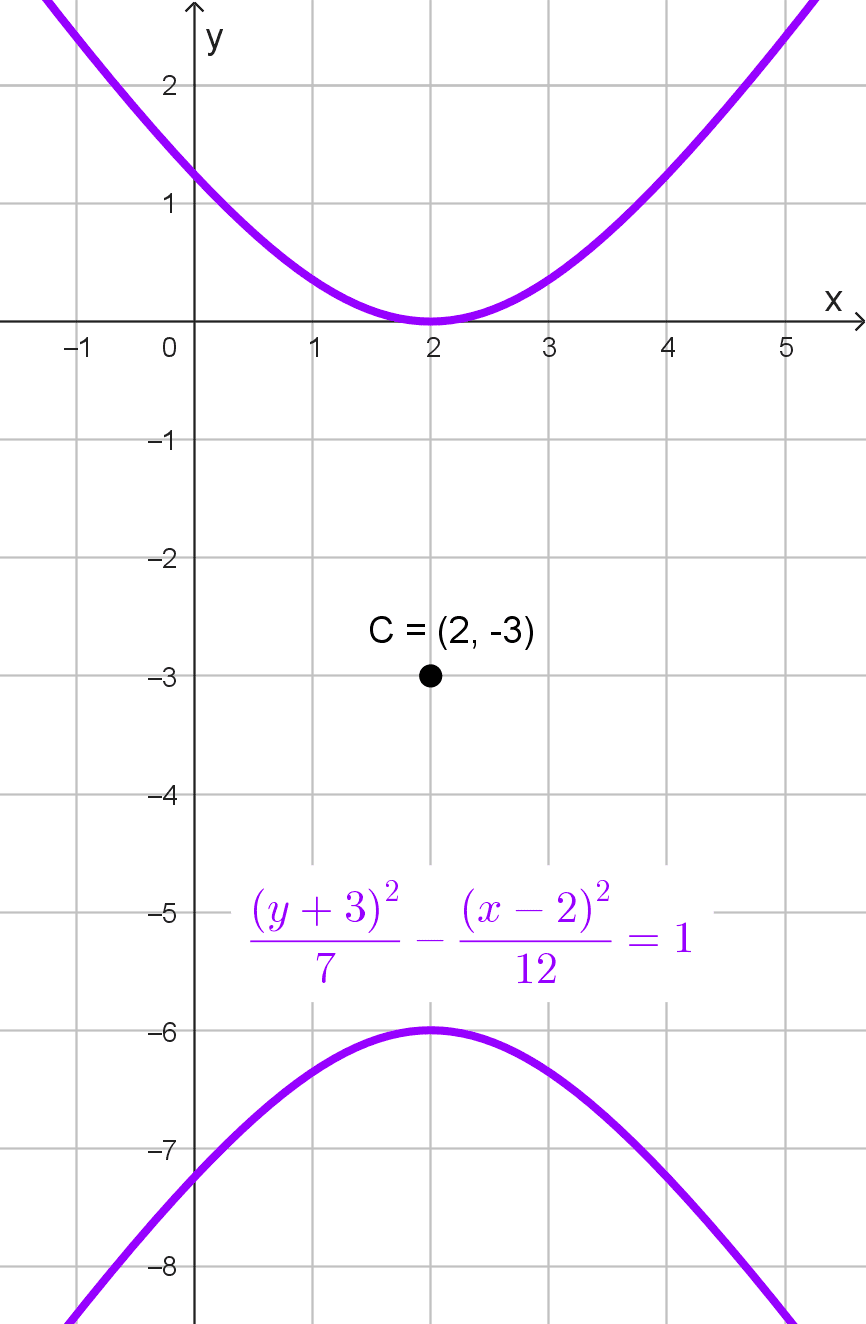
- \(-7x^2+12y^2+28x+72y-4=0\) is the general form of a vertical hyperbola; it can be rewritten as \(\dfrac{(y+3)^2}{7}-\dfrac{(x-2)^2}{12}=1,\) from which we find that the center is (2, -3), a = √7, and b = √12.
How to Tell if a Hyperbola Is Horizontal or Vertical
To determine the orientation of a hyperbola, we can look at its standard equation. As previously mentioned, the positive term indicates which coordinate axis the focal axis is parallel to:
- If the positive term on the left side of the standard equation contains the variable x, then it is a horizontal hyperbola; its focal and transverse axes are parallel to the x-axis.
- If the positive term on the left side of the standard equation contains the variable y, then it is a vertical hyperbola; its focal and transverse axes are parallel to the y-axis.
When the equation is given in general form rather than standard form, it is necessary to complete the square and rearrange the expression into its standard form. Note that determining the orientation does not follow the same process as in an ellipse, where one looks for the larger denominator; in a hyperbola, the semi-transverse axis does not need to be greater than the semi-conjugate axis.
The other features of hyperbolas remain the same regardless of whether the hyperbola is horizontal or vertical:
- Eccentricity: \(e=\dfrac{c}{a}\)
- Latus rectum: \(L_R=\dfrac{2b^2}{a}\)
- Distance to each focus: \(c=\sqrt{a^2+b^2}\)
Practice Problems
Determine whether the following hyperbolas are horizontal or vertical.
- \(\dfrac{y^2}{10}-\dfrac{x^2}{20}=1\)
- \(\dfrac{x^2}{3}-\dfrac{y^2}{5}=1\)
- \(\dfrac{(y-1)^2}{10}-\dfrac{x^2}{5}=1\)
- \(x^2-y^2-2x-4y-12=0\)
- \(9x^2-4y^2-54x+117=0\)
Solutions
- The equation is in standard form and the positive term contains y2; therefore, the hyperbola is vertical.
- The equation is in standard form. The positive term contains x2, which means that the focal axis of the hyperbola is horizontal; therefore, this hyperbola is horizontal.
- The positive term contains the variable y in \((y-1)^2,\) so the transverse axis is vertical. Consequently, this hyperbola is vertical.
- In this case, the equation is not in standard form, so we must complete the square to determine its orientation. Once done, we obtain \(\dfrac{(x-1)^2}{9}-\dfrac{(y+2)^2}{9}=1,\) where we can see that the positive term contains \((x-1)^2,\) indicating that the focal axis is horizontal. Therefore, this hyperbola is horizontal.
- After completing the square, we obtain the expression \(\dfrac{y^2}{9}-\dfrac{(x-3)^2}{4}=1.\) The positive term is associated with the variable y; therefore, the hyperbola is vertical.
Did you find this useful? Rate it!
0.0 / 5 — 0 votes

HOW TO CITE THIS ARTICLE
Machado, D. (2026, November 2). Horizontal and Vertical Hyperbolas. Exponty. https://exponty.com/en/horizontal-vertical-hyperbolas
Focal Distance of a Hyperbola
Center of a Hyperbola
Vertices of a Hyperbola
Rectangular Hyperbola
Transverse and Conjugate Axes of a Hyperbola
Foci of a Hyperbola
Asymptotes of a Hyperbola
Hyperbola Practice Problems with Solutions
Leave a Reply
Related posts