
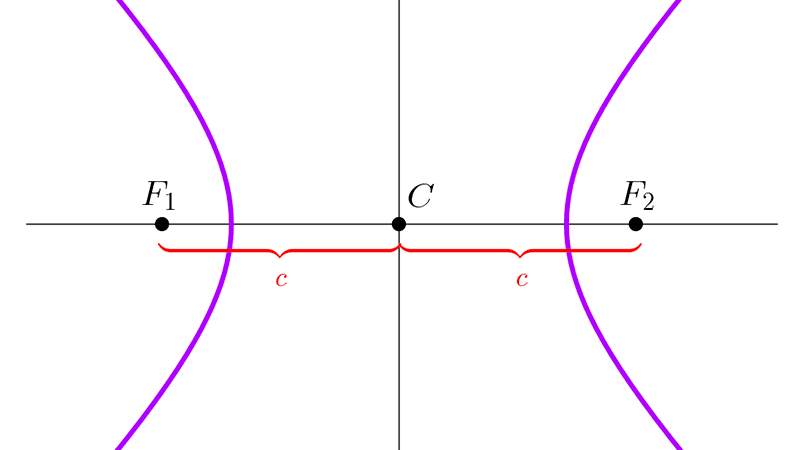
Rectangular Hyperbola
A rectangular hyperbola (also known as an equilateral hyperbola) is a hyperbola whose transverse and conjugate semi-axes have equal lengths, that is, a = b. Its asymptotes have slopes of ±1, making them perpendicular to each other and forming a 90° angle.


Below, we will examine the equations and properties of the rectangular hyperbola. If you are not yet familiar with hyperbolas in mathematics, feel free to check out our main article first, where we cover their concept, definition, formulas, and properties.
Table of Contents
Equations of a Rectangular Hyperbola
The standard equations for rectangular hyperbolas take a simpler form than general hyperbolas. Starting with the standard equation of a horizontal hyperbola:
$$\dfrac{x^2}{a^2}-\dfrac{y^2}{b^2}=1$$
Since \(a=b,\) it follows that \(a^2=b^2.\) Substituting:
$$\dfrac{x^2}{a^2}-\dfrac{y^2}{a^2}=1$$
Multiplying both sides by \(a^2\) and simplifying:
$$a^2\dfrac{x^2}{a^2}-a^2\dfrac{y^2}{a^2}=a^2$$
$$x^2-y^2=a^2$$
Similarly, starting from the standard equation of a vertical hyperbola, we arrive at:
$$y^2-x^2=a^2$$
Therefore, the equations for each case are:
- Horizontal rectangular hyperbola: \(x^2-y^2=a^2\)
- Vertical rectangular hyperbola: \(y^2-x^2=a^2\)
The asymptotes in both cases are \(y=x\) and \(y=-x.\) The key features of these hyperbolas are summarized in the following table:
| Standard Equation | Orientation | Center | Foci | Vertices | Asymptotes |
|---|---|---|---|---|---|
| \(x^2-y^2=a^2\) | Horizontal | (0, 0) | (±c, 0) c = a ⋅ √2 | (±a, 0) | y = ±x |
| \(y^2-x^2=a^2\) | Vertical | (0, 0) | (0, ±c) c = a ⋅ √2 | (0, ±a) | y = ±x |
We typically work with rectangular hyperbolas centered at the origin, although the definition also applies if the center is translated to a point (h, k). In that case, the standard equations are:
- Horizontal rectangular hyperbola: \((x-h)^2-(y-k)^2=a^2\)
- Vertical rectangular hyperbola: \((y-k)^2-(x-h)^2=a^2\)
Examples
The following are examples of rectangular hyperbolas:
- \(x^2-y^2=4\) is horizontal with semi-axes \(a=b=\sqrt{4}=2.\)
- \(y^2-x^2=16\) is vertical with \(a=b=\sqrt{16}=4.\)
- \(y^2-x^2=2\) is vertical with \(a=b=\sqrt{2}.\)
- \(x^2-y^2=1\) is horizontal with semi-axes \(a=b=1.\) This is also known as the unit hyperbola.
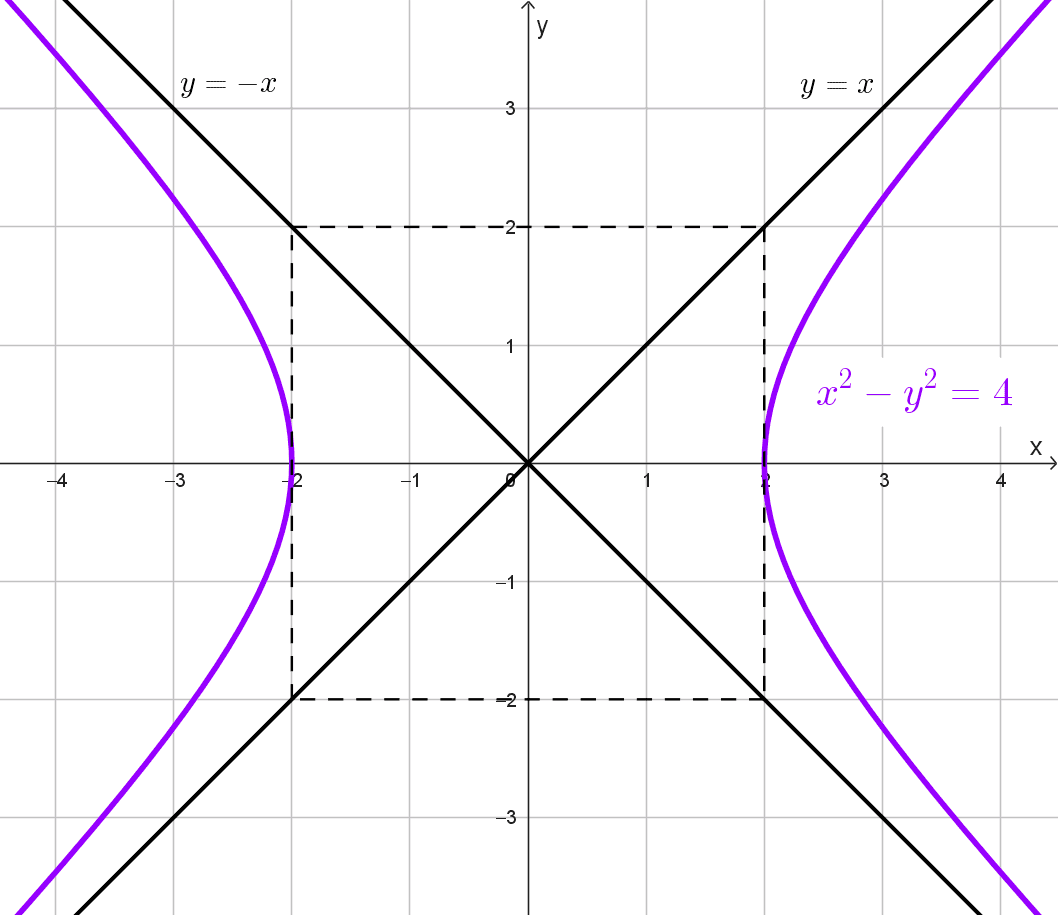


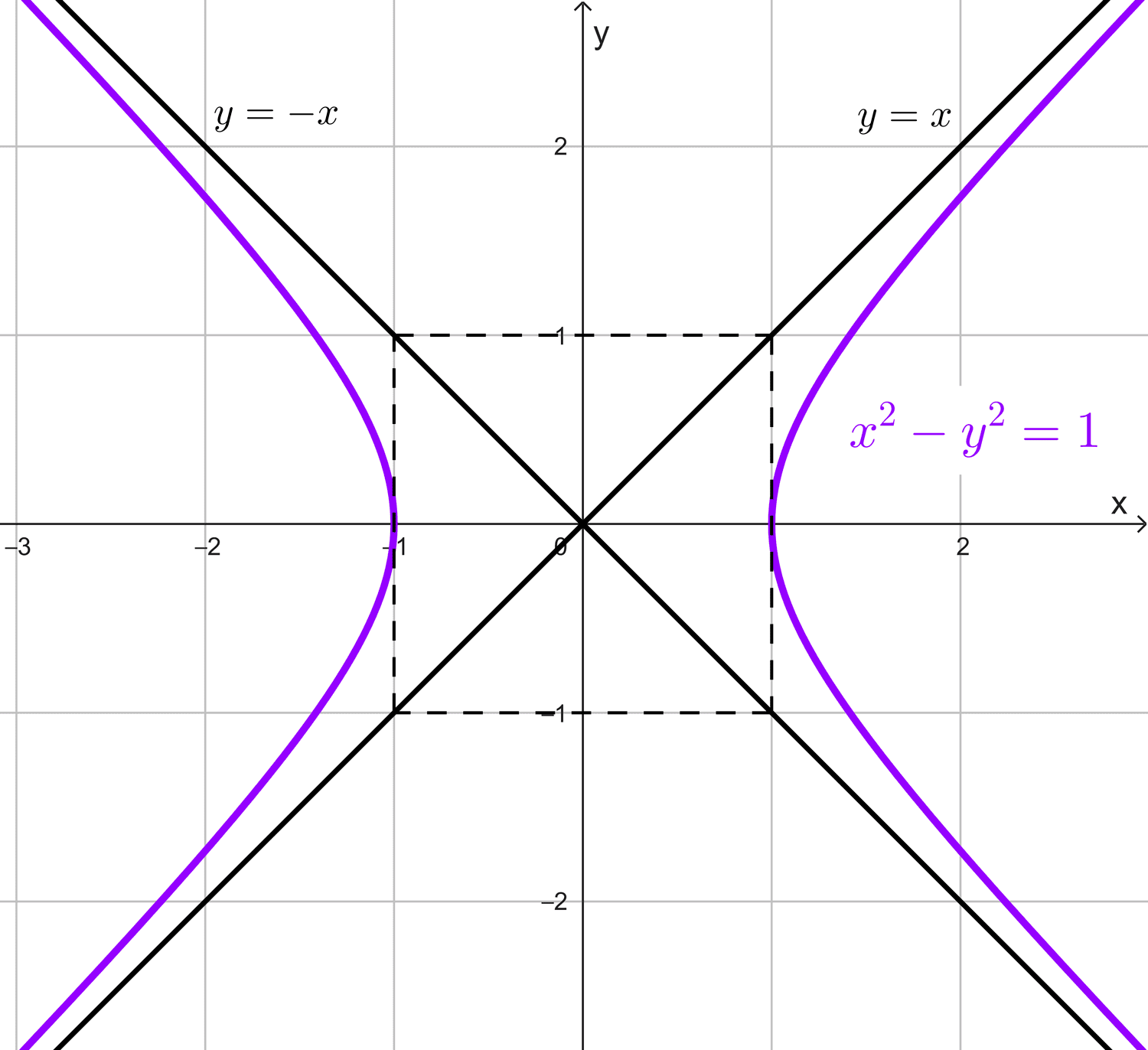
One way to identify a rectangular hyperbola is by checking the lengths of its semi-axes. If they are equal, the hyperbola is rectangular; otherwise, it is non-rectangular. For example, the hyperbola \(\dfrac{x^2}{4}-\dfrac{y^2}{9}=1\) is not rectangular because a = 2 and b = 3, so a ≠ b. Another way is to verify whether its asymptotes form a 90° angle, in which case we can be certain that its semi-axes have equal lengths.
Properties of a Rectangular Hyperbola
The following are key properties of rectangular hyperbolas:
- The eccentricity of a rectangular hyperbola is always the square root of 2: \(e=\sqrt{2}.\) This is verified using the eccentricity formula: \(e=\sqrt{1+\dfrac{b^2}{a^2}}=\sqrt{1+1}=\sqrt{2}.\)
- The asymptotes have slopes of +1 and -1, meaning they are mutually perpendicular (forming a 90° angle). This right angle is the reason behind the name rectangular hyperbola. Consequently, the central rectangle used to sketch the curve is a square.
- The distance from the center to each focus in a rectangular hyperbola is \(c=\sqrt{2}a,\) and the focal distance between both foci is \(2c=2\sqrt{2}a.\) Applying the focal relationship: \(c=\sqrt{a^2+b^2}=\sqrt{2a^2}=\sqrt{2}\sqrt{a^2}=\sqrt{2}a\) since a > 0.
Rectangular Hyperbola Referred to Its Asymptotes
We have seen that the asymptotes of a rectangular hyperbola are \(y=x\) and \(y=-x.\) By applying a rotation of axes so that the asymptotes align with the coordinate axes, the equation of the hyperbola simplifies significantly.
Starting from the standard equation of the vertical rectangular hyperbola \(y^2-x^2=a^2\) and rotating the coordinate axes by 45°, we obtain:
$$xy=\dfrac{a^2}{2}$$
Letting the constant \(\dfrac{a^2}{2}\) be denoted by k:
$$xy=k$$
Solving for y:
$$y=\dfrac{k}{x}$$
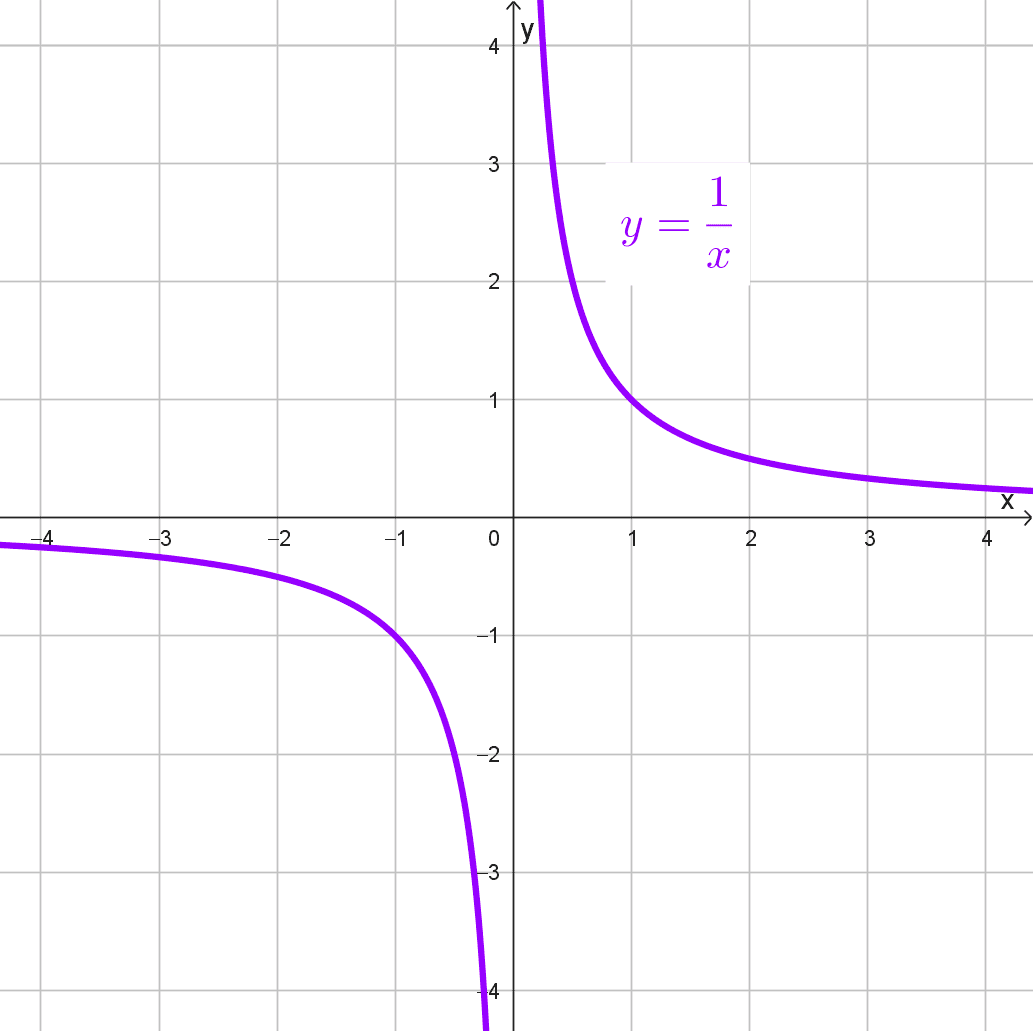
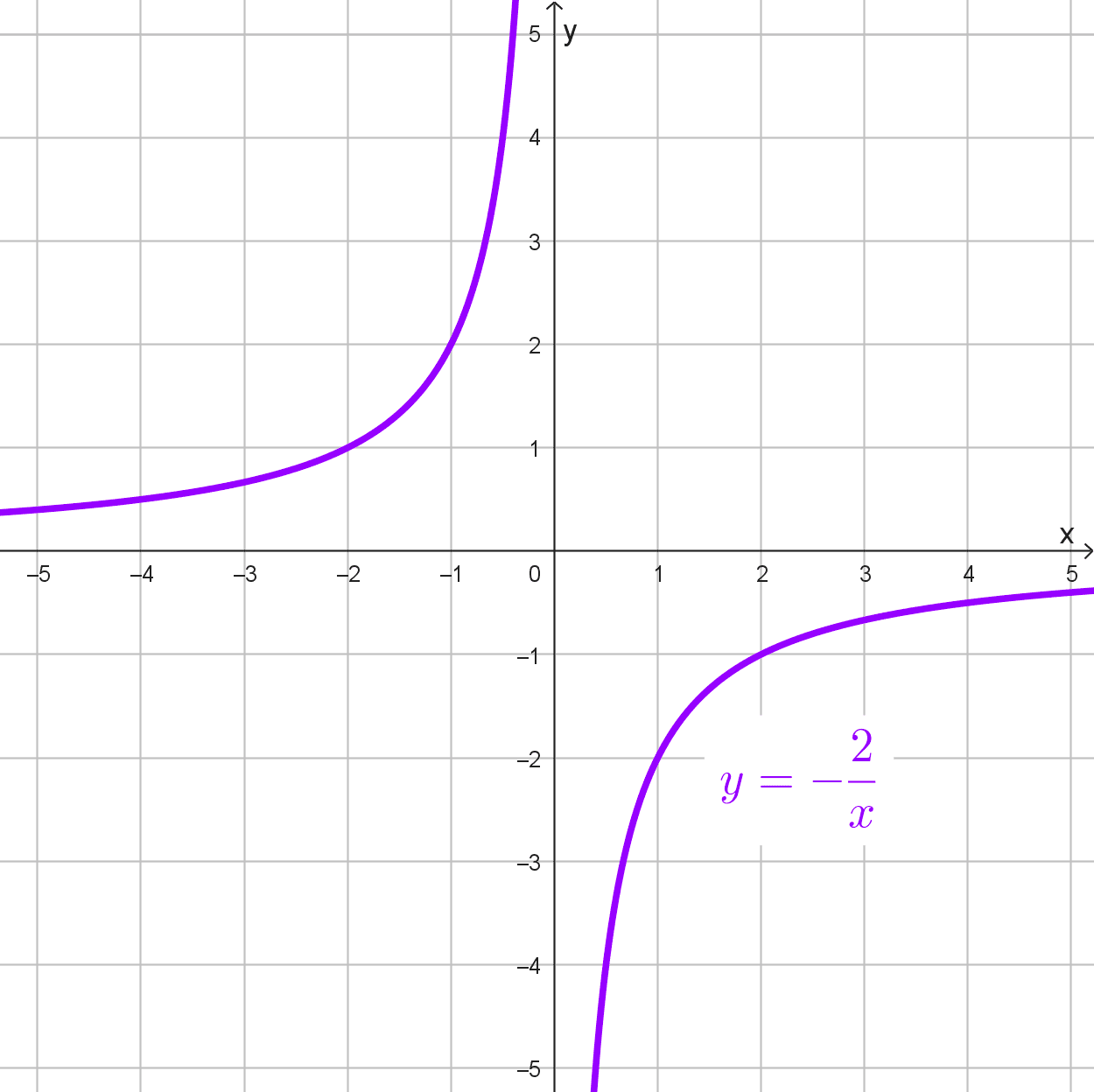
This is known as the equation of a rectangular hyperbola referred to its asymptotes, since the coordinate axes serve as its asymptotes. The constant k can be positive or negative; starting with \(x^2-y^2=a^2\) and applying a 45° rotation results in a negative value of k.
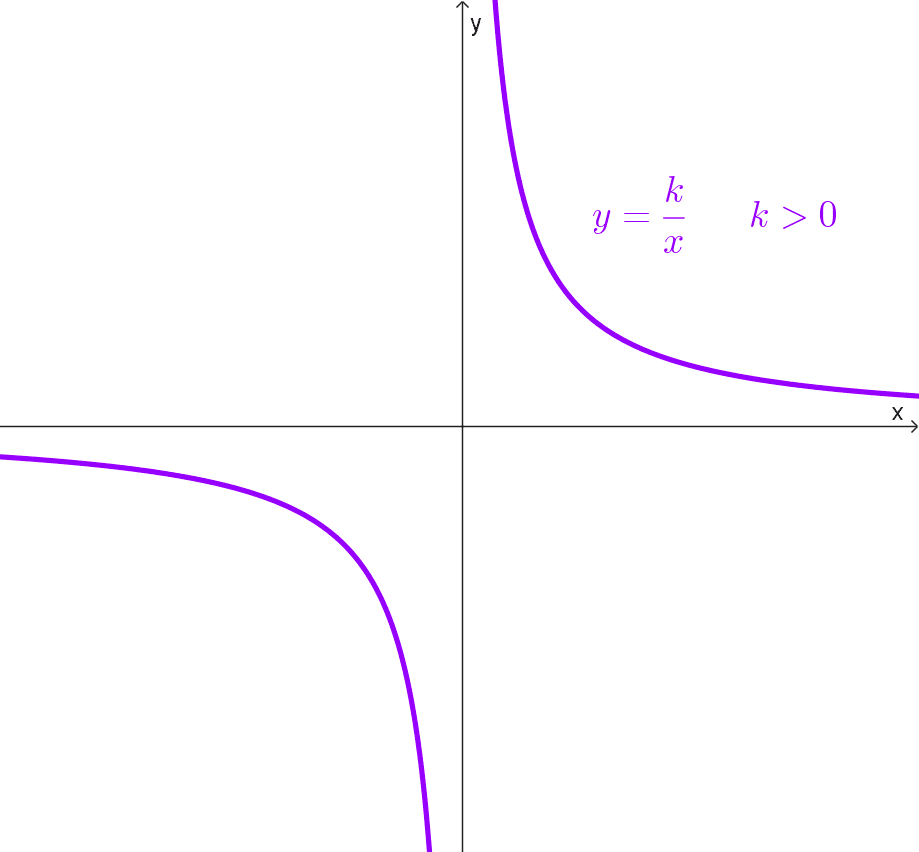

Note that while general hyperbolas fail the vertical line test and are not functions, the equation y = k/x represents a mathematical function known as an inverse variation function.
Examples
- \(xy=1\)
- \(y=-\dfrac{2}{x}\)
- \(y=\dfrac{3}{4x}\)
- \(y=-\dfrac{5}{x}\)
Derivation of the Equation
We apply a 45° rotation of axes to the standard equation \(y^2-x^2=a^2\) to derive its transformed equation. We begin with the standard rotation formulas:
$$x=x'\cos\theta-y'\sin\theta, \quad y=x'\sin\theta+y'\cos\theta$$
Setting \(\theta=45^\circ,\) we have \(\cos 45^\circ=\sin 45^\circ=\dfrac{\sqrt{2}}{2}.\)
Substituting:
$$x=\dfrac{\sqrt{2}}{2}(x'-y')\quad y=\dfrac{\sqrt{2}}{2}(x'+y')$$
Substituting x and y into \(y^2-x^2=a^2:\)
$$\left(\dfrac{\sqrt{2}}{2}(x'+y')\right)^2-\left(\dfrac{\sqrt{2}}{2}(x'-y')\right)^2=a^2$$
Expanding the binomials:
$$\dfrac{2}{4} \left((x')^2+2x'y'+(y')^2\right)-\dfrac{2}{4} \left((x')^2-2x'y'+(y')^2\right)=a^2$$
$$\dfrac{1}{2} \left((x')^2+2x'y'+(y')^2\right)-\dfrac{1}{2} \left((x')^2-2x'y'+(y')^2\right)=a^2$$
Distributing and grouping like terms:
$$\dfrac{1}{2}\left((x')^2+2x'y'+(y')^2-(x')^2+2x'y'-(y')^2\right)=a^2$$
$$\dfrac{1}{2} \left(4x'y'\right)=a^2$$
Simplifying:
$$2x'y'=a^2$$
$$x'y'=\dfrac{a^2}{2}$$
Worked Examples
Example 1
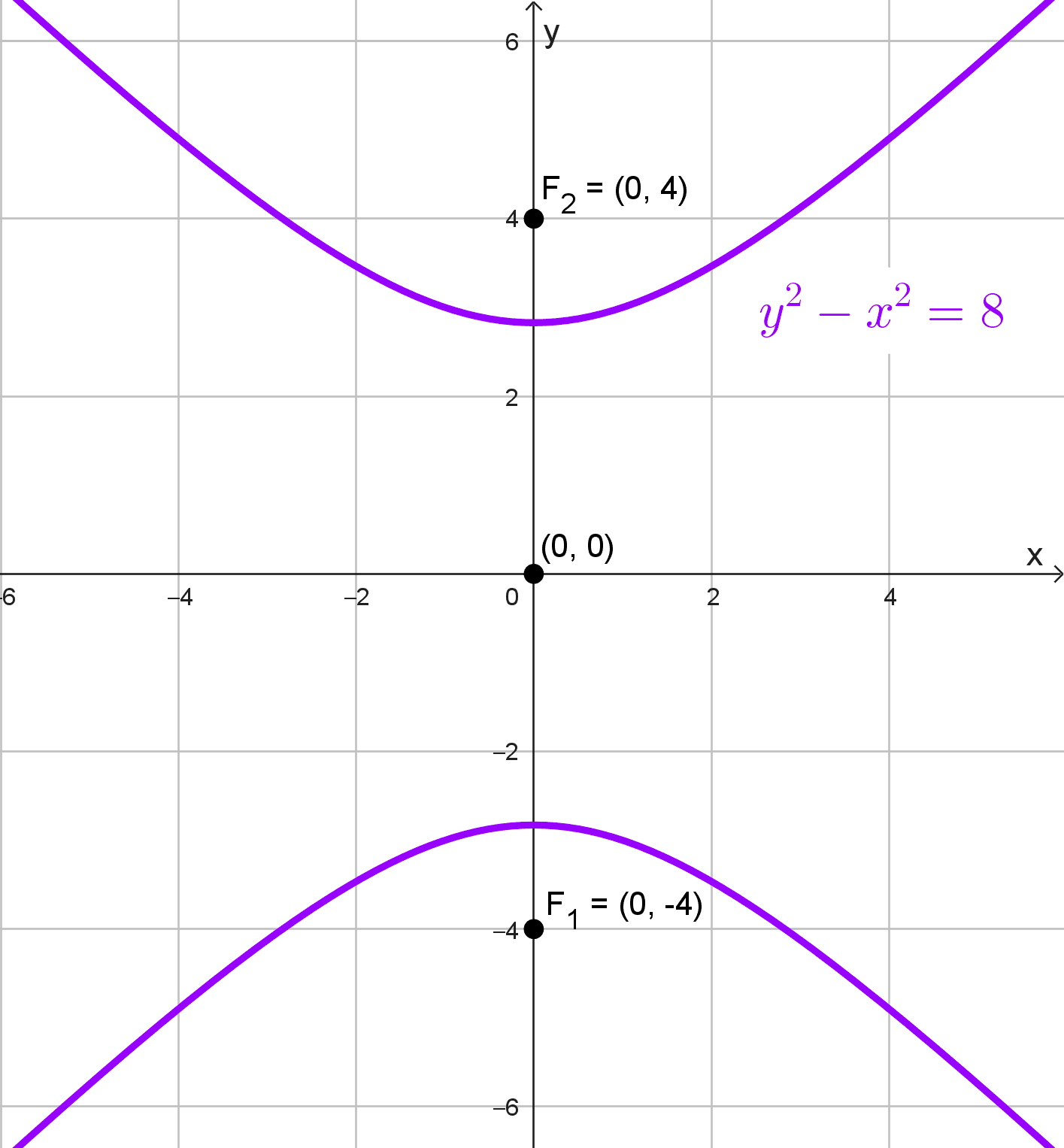
Given the foci F1(0, -4) and F2(0, 4) of a rectangular hyperbola, find its equation.
Solution
First, note that the distance between the foci is 2c = 8, which gives c = 4.
For a rectangular hyperbola, the relation \(c=\sqrt{2}a\) holds. Solving for a:
$$a=\dfrac{c}{\sqrt{2}}=\dfrac{4}{\sqrt{2}}=2\sqrt{2}$$
Since the foci lie on the y-axis, the hyperbola is vertical and its equation takes the form \(y^2-x^2=a^2.\)
Substituting \(a^2=(2\sqrt{2})^2=8:\)
$$y^2-x^2=8$$
Therefore, the equation of the hyperbola is:
$$\boxed{y^2-x^2=8}$$
Example 2
A rectangular hyperbola has vertices at V1(3, 0) and V2(-3, 0). Find its equation.
Solution
The distance between the vertices is 2a = 6, so a = 3. Since the transverse axis is horizontal, its equation is:
$$x^2-y^2=a^2$$
Substituting \(a^2=3^2=9:\)
$$x^2-y^2=9$$
The equation of the hyperbola is:
$$\boxed{x^2-y^2=9}$$

Example 3
Determine the equation of the horizontal rectangular hyperbola that passes through the point (3, 2).
Solution
The equation of a horizontal rectangular hyperbola is: \(x^2-y^2=a^2.\)
Substitute the coordinates of the given point (x, y) = (3, 2):
$$3^2-2^2=a^2$$
Solving for \(a^2:\)
$$9-4=a^2 → a^2=5.$$
Therefore, the equation of the hyperbola is:
$$\boxed{x^2-y^2=5}$$

Example 4
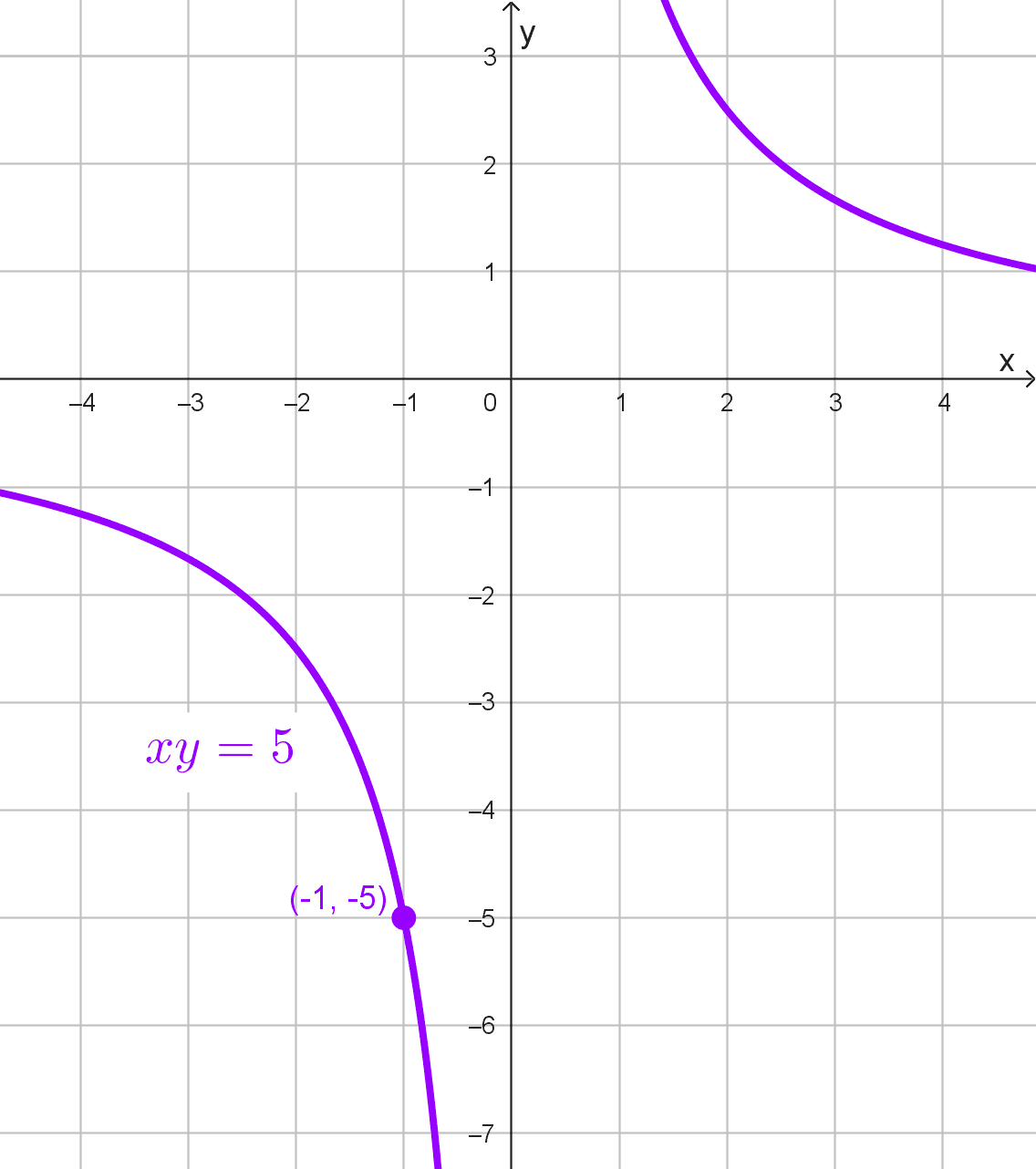
Find the equation of the rectangular hyperbola that passes through the point (-1, -5) and has the coordinate axes as its asymptotes.
Solution
When the asymptotes are the coordinate axes, the equation of the hyperbola is: xy = k.
Substitute the coordinates of the given point (x, y) = (-1, -5) to find k:
$$(-1)(-5)=k → k=5$$
Therefore, the equation of the hyperbola is:
$$\boxed{xy=5}$$
Did you find this useful? Rate it!
0.0 / 5 — 0 votes

HOW TO CITE THIS ARTICLE
Machado, D. (2026, November 2). Rectangular Hyperbola. Exponty. https://exponty.com/en/rectangular-hyperbola
Focal Distance of a Hyperbola
Center of a Hyperbola
Vertices of a Hyperbola
Horizontal and Vertical Hyperbolas
Transverse and Conjugate Axes of a Hyperbola
Foci of a Hyperbola
Asymptotes of a Hyperbola
Hyperbola Practice Problems with Solutions
Leave a Reply
Related posts