
Vertices of an Ellipse
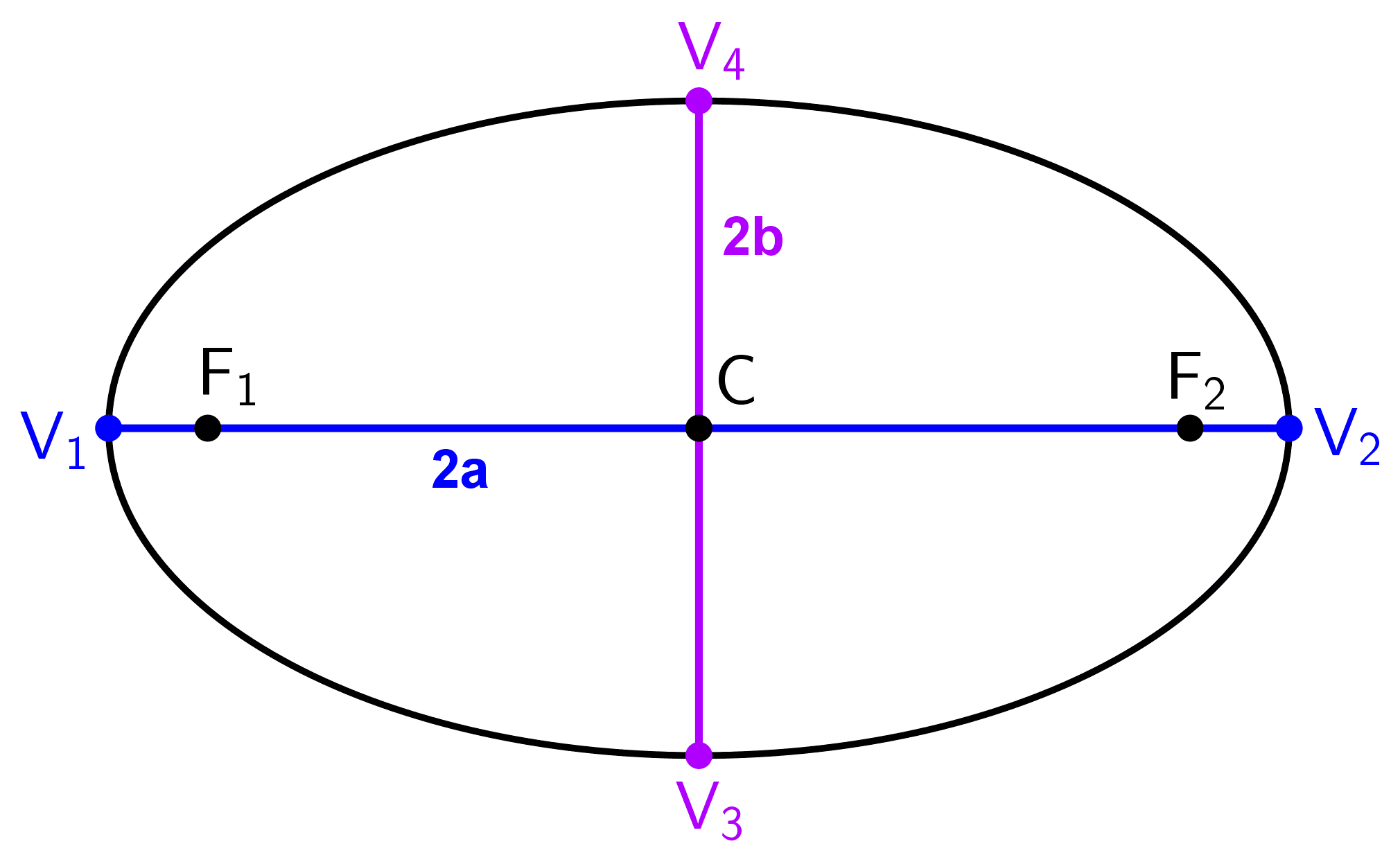
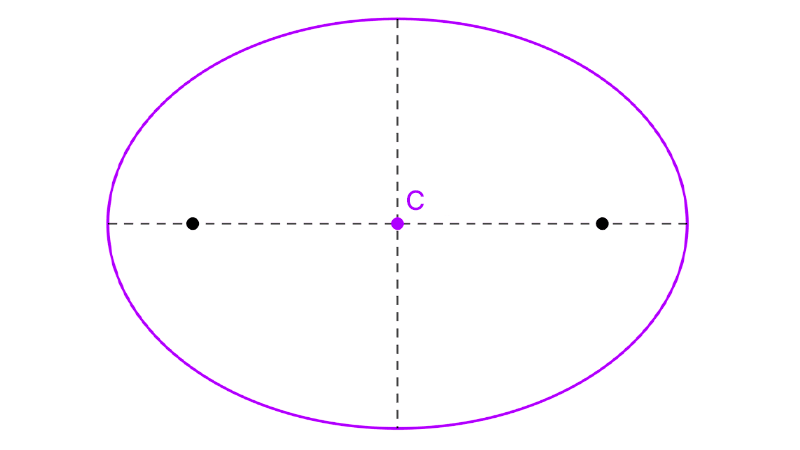
The vertices of an ellipse are the points on the curve that are closest to and farthest from the center. An ellipse has two vertices (or major vertices), which are the points farthest from the center and endpoints of the major axis; and two co-vertices, which are the points closest to the center and endpoints of the minor axis.
The distance between the vertices is equal to the length of the major axis, 2a, while the distance between the co-vertices equals the length of the minor axis, 2b.

Below, we will explore how to find the vertices of an ellipse through step-by-step worked examples.
Important: This article focuses specifically on one component of the ellipse. If you are not yet familiar with its mathematical definition, we recommend reviewing our main guide first, where we cover its equation, parts, formulas, and types.
How to Find the Vertices of an Ellipse
To determine the coordinates of the vertices, you first need to find the center and the lengths of the semi-axes. These values can be extracted directly from the standard equation of the ellipse, as summarized in the table below.
| Orientation | Equation | Center | Vertices | Co-vertices |
|---|---|---|---|---|
| Horizontal | \(\dfrac{x^2}{a^2}+\dfrac{y^2}{b^2}=1\) | (0, 0) | (-a, 0) and (a, 0) | (0, -b) and (0, b) |
| Vertical | \(\dfrac{x^2}{b^2}+\dfrac{y^2}{a^2}=1\) | (0, 0) | (0, -a) and (0, a) | (-b, 0) and (b, 0) |
| Horizontal | \(\dfrac{(x-h)^2}{a^2}+\dfrac{(y-k)^2}{b^2}=1\) | (h, k) | (h - a, k) and (h + a, k) | (h, k - b) and (h, k + b) |
| Vertical | \(\dfrac{(x-h)^2}{b^2}+\dfrac{(y-k)^2}{a^2}=1\) | (h, k) | (h, k - a) and (h, k + a) | (h - b, k) and (h + b, k) |


Worked Examples
Below, we solve several examples demonstrating how to calculate the vertices and co-vertices of an ellipse.
Example 1
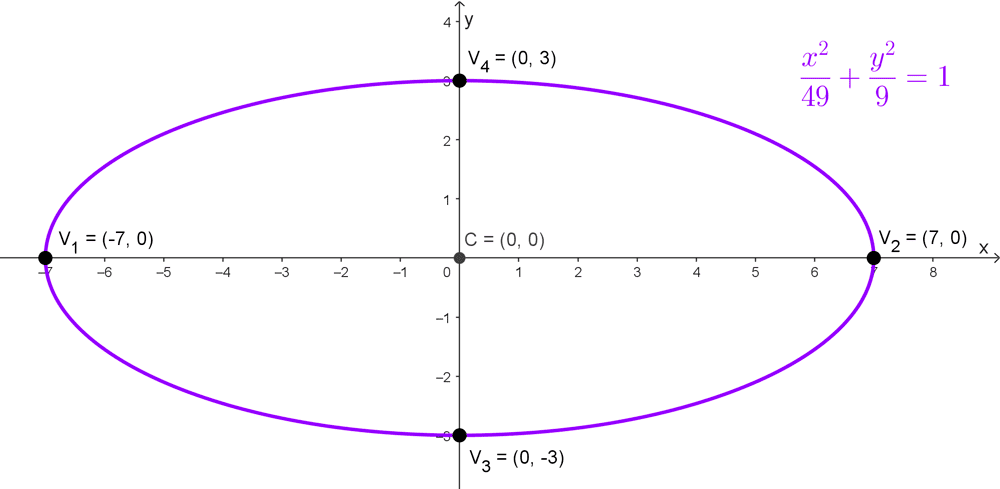
Find the vertices and co-vertices of the ellipse \(\dfrac{x^2}{49}+\dfrac{y^2}{9}=1\)
Solution: First, determine the center of the ellipse. From the equation, we find that it is centered at the origin, (0, 0). Next, identify the lengths of the semi-axes:
$$a^2=49→a=\sqrt{49}=7$$
$$b^2=9→b=\sqrt{9}=3$$
Since the denominator of x2 is greater than the denominator of y2, the ellipse is horizontal. Using the semi-major axis a = 7, we find the vertices, and using the semi-minor axis b = 3, we find the co-vertices.
- Vertices: (-7, 0) and (7, 0)
- Co-vertices: (0, -3) and (0, 3)
Example 2
Determine the coordinates of the vertices and co-vertices of the ellipse given by the equation \(\dfrac{x^2}{4}+\dfrac{y^2}{25}=1\)
Solution: From the standard equation, we determine that the center is at the origin and the ellipse is vertical because the denominator of y2 is greater than the denominator of x2. Next, find the semi-axes:
$$a^2=25→a=\sqrt{25}=5$$
$$b^2=4→b=\sqrt{4}=2$$
Now, determine the coordinates:
- Vertices: (0, -5) and (0, 5)
- Co-vertices: (-2, 0) and (2, 0)

Example 3
Find the vertices and co-vertices of the ellipse \(\dfrac{(x+2)^2}{10}+\dfrac{(y-3)^2}{18}=1\)
Solution: First, identify that the center is not at the origin, but at (-2, 3), and the ellipse is vertical because 18 > 10. Next, calculate the semi-axes:
$$a^2=18→a=\sqrt{18}$$
$$b^2=10→b=\sqrt{10}$$
Now, use the standard formulas from the table to write the vertices. Graphing the ellipse can also help visualize these points. The center is (-2, 3), so h = -2 and k = 3.
Vertices (major vertices):
- \((h, k - a)=(-2, 3-\sqrt{18})≈(-2, -1.24)\)
- \((h, k + a)=(-2, 3+\sqrt{18})≈(-2, 7.24)\)
Co-vertices (minor vertices):
- \((h - b, k)=(-2-\sqrt{10}, 3)≈(-5.16, 3)\)
- \((h + b, k)=(-2+\sqrt{10}, 3)≈(1.16, 3)\)

Example 4
Find the vertices and co-vertices of the ellipse \(2x^2+4x+7y^2-28y-40=0\)
Solution: The equation is given in general form rather than standard form, so we must first complete the square and rearrange terms to obtain the standard equation. Doing so yields:
$$\dfrac{(x+1)^2}{35}+\dfrac{(y-2)^2}{10}=1$$
From this equation, we find that the center is (-1, 2) and the ellipse is horizontal. Next, calculate the semi-axes:
$$a^2=35→a=\sqrt{35}$$
$$b^2=10→b=\sqrt{10}$$
Now, calculate the vertices knowing that h = -1 and k = 2.
Vertices:
- \((h - a, k)=(-1-\sqrt{35}, 2)≈(-6.92, 2)\)
- \((h + a, k)=(-1+\sqrt{35}, 2)≈(4.92, 2)\)
Co-vertices:
- \((h, k - b)=(-1, 2-\sqrt{10})≈(-1, -1.16)\)
- \((h, k + b)=(-1, 2+\sqrt{10})≈(-1, 5.16)\)

Did you find this useful? Rate it!
0.0 / 5 — 0 votes

HOW TO CITE THIS ARTICLE
Machado, D. (2026, November 1). Vertices of an Ellipse. Exponty. https://exponty.com/en/ellipse-vertices
Focal Distance of an Ellipse
Horizontal and Vertical Ellipses
Major and Minor Axes of an Ellipse
Center of an Ellipse
Foci of an Ellipse
Area of an Ellipse
Ellipse Practice Problems with Solutions
Leave a Reply
Related posts