
Foci of an Ellipse
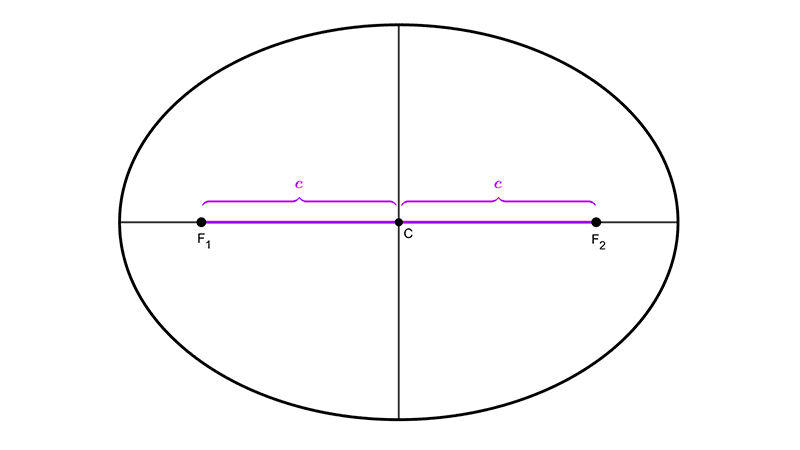
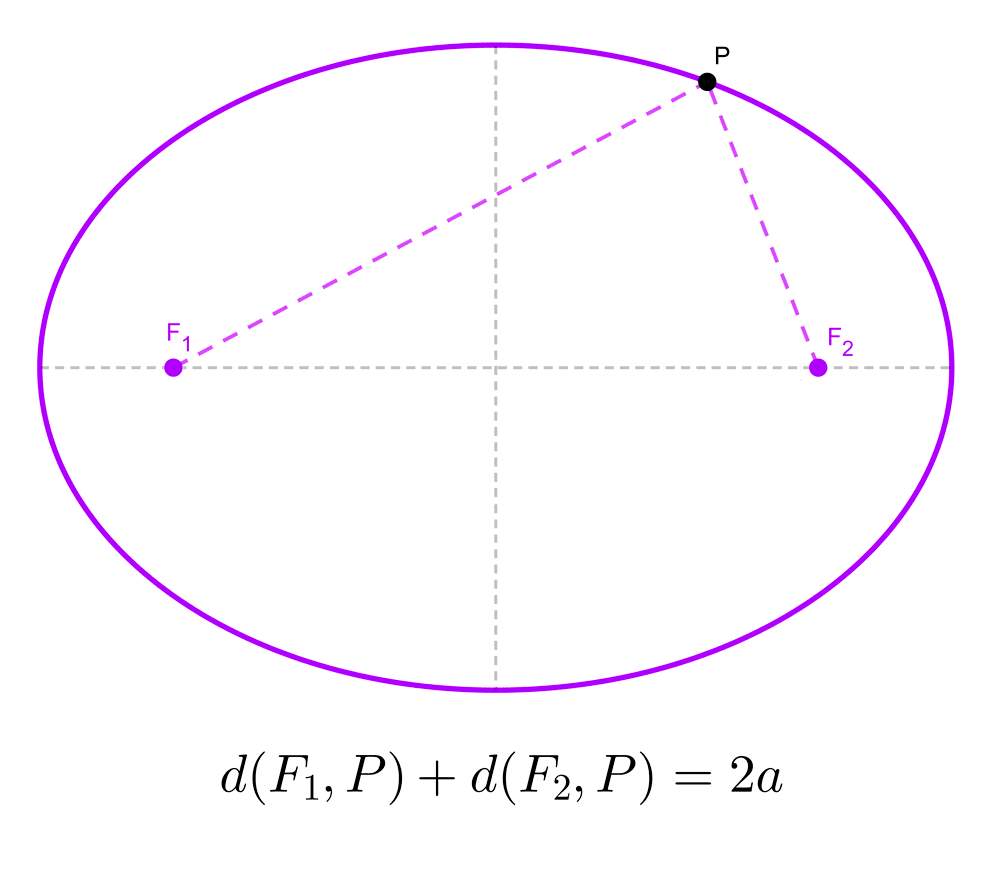
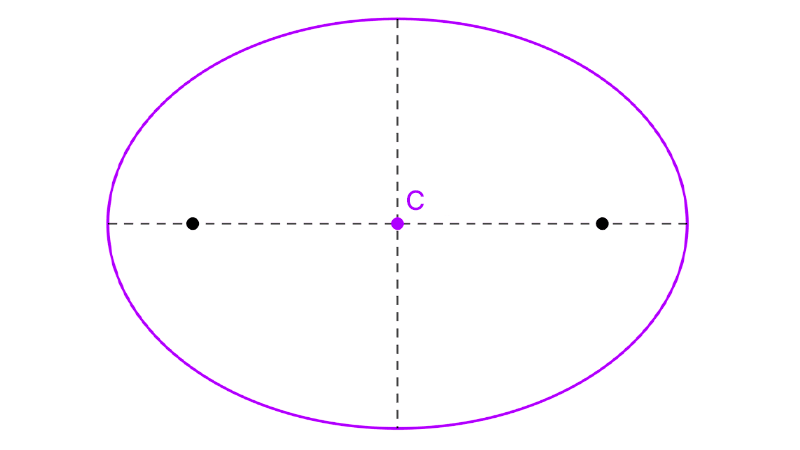
The foci of an ellipse are two fixed points in the plane located on the major axis. The fundamental defining property of an ellipse is that the sum of the distances from any point on the ellipse to these two foci is constant. The midpoint between the foci is the center of the ellipse.
Below, we will cover how to find the foci of an ellipse from its equation with step-by-step worked examples.
Note: This article focuses specifically on one key feature of the ellipse. If you are not yet familiar with the basic concepts, we recommend reviewing our main pillar guide first, where we cover its definition, standard equations, key parts, types, and real-world applications.
Table of Contents
How to Find the Foci
You can find the coordinates of the foci directly from the standard form of the ellipse equation. This form consists of the sum of two quadratic terms in x and y equal to 1, represented as follows:
| Equation | Key Characteristics |
|---|---|
| \(\dfrac{x^2}{a^2}+\dfrac{y^2}{b^2}=1\) \(\dfrac{y^2}{a^2}+\dfrac{x^2}{b^2}=1\) | The center is at the origin (0, 0). a is the semi-major axis. b is the semi-minor axis. |
| \(\dfrac{(x-h)^2}{a^2}+\dfrac{(y-k)^2}{b^2}=1\) \(\dfrac{(y-k)^2}{a^2}+\dfrac{(x-h)^2}{b^2}=1\) | The center is at (h, k). a is the semi-major axis. b is the semi-minor axis. |
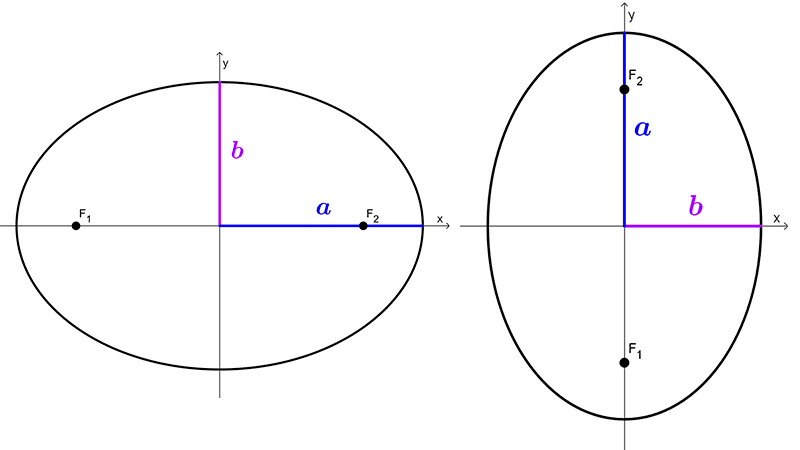
By definition, a2 is always greater than b2; if they are equal, the curve is a circle. If the denominator of the x-term is greater than that of the y-term, the ellipse is horizontal (its major axis is parallel to the x-axis). In this case, the denominator under x is a2 and the denominator under y is b2.
Similarly, if the denominator of the y-term is greater than that of the x-term, the ellipse is vertical (its major axis is parallel to the y-axis). Here, the denominator under y is a2 and the denominator under x is b2.

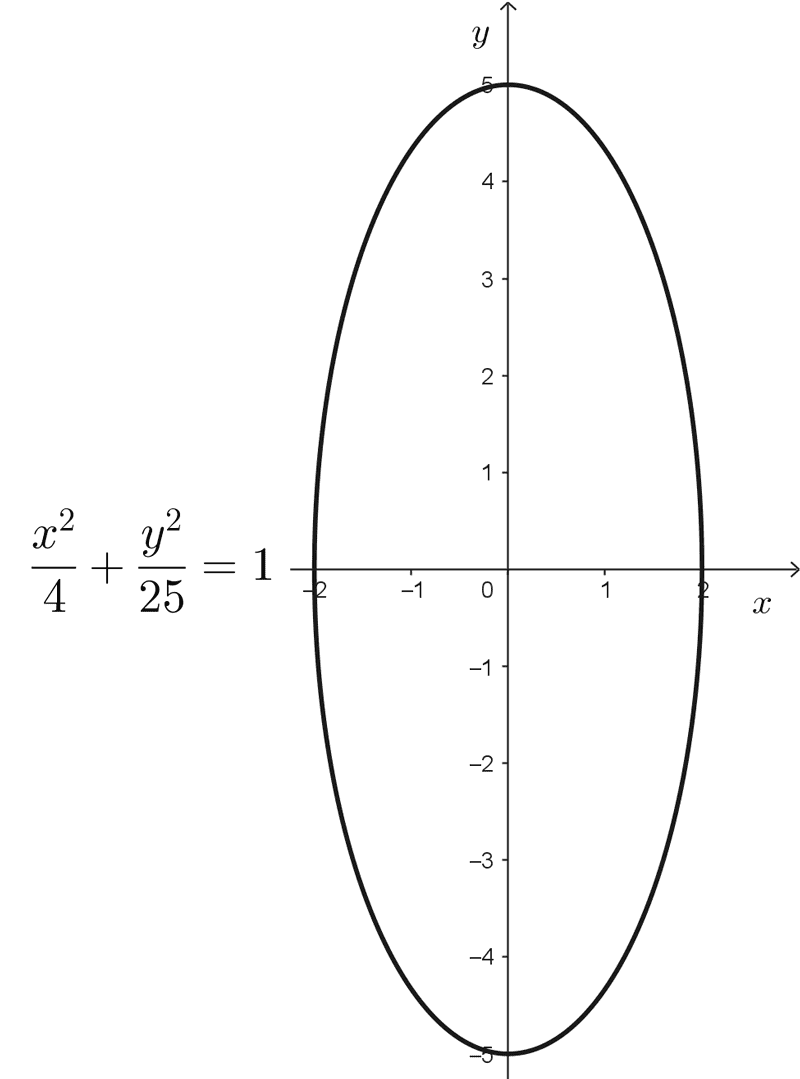
Identifying the center, the values of a2 and b2, and whether the ellipse is horizontal or vertical is essential to find the coordinates of the foci. To do this, we use the relationship c2 = a2 - b2 → c = √(a2 - b2). The value c represents the distance from the center to each focus. Once c is known, you can determine the exact location of both foci. The complete procedure is outlined below.
How to Find the Foci of an Ellipse Step by Step
1) Identify the center of the ellipse, determine the values of a2 and b2, and establish whether the ellipse is horizontal or vertical.
2) Calculate the distance from the center to each focus using the formula \(c=\sqrt{a^2-b^2}.\)
3) Find the coordinates of the foci based on orientation:
- If the ellipse is horizontal, the foci are F1(h - c, k) and F2(h + c, k).
- If the ellipse is vertical, the foci are F1(h, k - c) and F2(h, k + c).
If the center is at the origin, the coordinates simplify to F1(-c, 0) and F2(c, 0) for horizontal ellipses, and F1(0, -c) and F2(0, c) for vertical ellipses.
Worked Examples
Example 1
Find the foci of the ellipse \(\dfrac{x^2}{25}+\dfrac{y^2}{9}=1\)
Solution: The larger denominator is under x2, which indicates that the ellipse is horizontal. In addition, its center is at the origin, (0, 0).
Identify the values from the denominators:
$$a^2=25$$
$$b^2=9$$
Calculate the distance from the center to each focus:
$$c=\sqrt{a^2-b^2}$$
$$c=\sqrt{25-9}$$
$$c=\sqrt{16}$$
$$c=4$$
The distance from the center to each focus is c = 4 units. Since this is a horizontal ellipse centered at the origin, the foci F1 and F2 are located at:
$$F_1(-4,0)\quad \text{and} \quad F_2(4,0)$$

Example 2
Find the foci of the ellipse given by \(\dfrac{y^2}{64}+\dfrac{x^2}{16}=1\)
Solution: Because the denominator under y2 is greater than the one under x2, the ellipse is vertical. The equation also indicates that the center is at the origin. We identify the squared semi-axes:
$$a^2=64$$
$$b^2=16$$
Calculate the distance from the center to each focus:
$$c=\sqrt{a^2-b^2}$$
$$c=\sqrt{64-16}$$
$$c=\sqrt{48}=4\sqrt{3}$$
$$c≈6.93$$
Because the ellipse is vertical, we locate the foci by adding and subtracting c from the y-coordinate of the center:
$$F_1(0,-\sqrt{48})\quad \text{and}\quad F_2(0,\sqrt{48})$$
In simplified radical form and decimal approximation:
$$F_1(0, -4\sqrt{3})\quad \text{and}\quad F_2(0, 4\sqrt{3})$$
$$F_1(0, -6.93)\quad \text{and}\quad F_2(0, 6.93)$$

Interactive Tool: If you are practicing problems and want to check your answers, you can use our free calculator:
Example 3
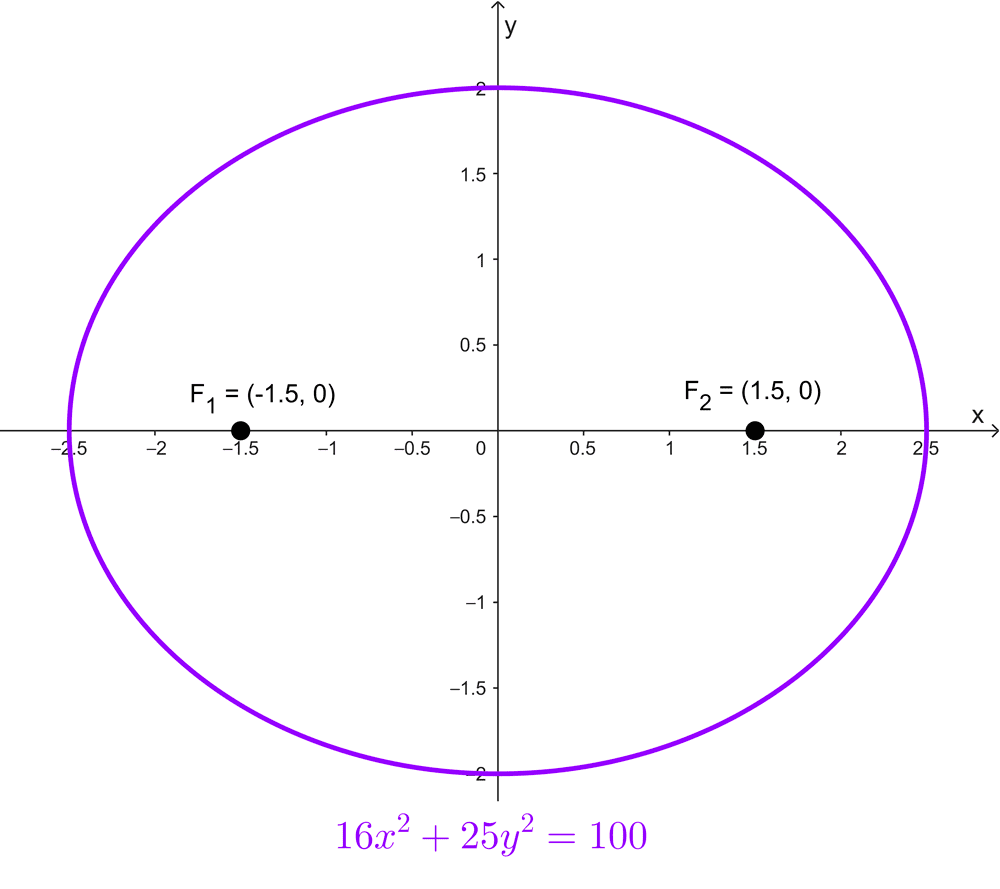
Find the foci of the ellipse \(16x^2+25y^2=100\)
Solution: This equation is not in standard form, so we must rewrite it algebraically. Divide both sides of the equation by 100 to set the right side equal to 1, then simplify each fraction:
$$16x^2+25y^2=100$$
$$\dfrac{16x^2+25y^2}{100}=\dfrac{100}{100}$$
$$\dfrac{16x^2}{100}+\dfrac{25y^2}{100}=1$$
$$\dfrac{x^2}{100/16}+\dfrac{y^2}{100/25}=1$$
$$\dfrac{x^2}{25/4}+\dfrac{y^2}{4}=1$$
The ellipse is centered at the origin. Since 25/4 = 6.25, which is greater than 4, the ellipse is horizontal. We identify the denominators:
$$a^2=25/4$$
$$b^2=4$$
Now, calculate the distance from the center to each focus:
$$c=\sqrt{a^2-b^2}$$
$$c=\sqrt{\dfrac{25}{4}-4}$$
$$c=\sqrt{\dfrac{9}{4}}$$
$$c=\dfrac{3}{2}=1.5$$
Therefore, the foci of the ellipse are:
$$F_1(-1.5, 0)\quad \text{and}\quad F_2(1.5, 0)$$
Example 4
Find the foci of the ellipse \(\dfrac{(x-3)^2}{4}+\dfrac{(y+4)^2}{36}=1\)
Solution: From the equation, the center is not at the origin but at the point (3, -4). Since the denominator of the y-term is greater than that of the x-term, this is a vertical ellipse.
Identify the values of the denominators:
$$a^2=36$$
$$b^2=4$$
Calculate the distance from the center to each focus:
$$c=\sqrt{a^2-b^2}$$
$$c=\sqrt{36-4}$$
$$c=\sqrt{32}=4\sqrt{2}$$
$$c≈5.66$$
To find the coordinates of the foci, add and subtract c from the y-coordinate of the center:
$$F_1(3, -4-\sqrt{32})\quad \text{and} \quad F_2(3,-4+\sqrt{32})$$
In exact simplified radical form:
$$F_1(3, -4-4\sqrt{2})\quad \text{and} \quad F_2(3, -4+4\sqrt{2})$$
Using decimal approximations:
$$F_1(3, -9.66)\quad \text{and} \quad F_2(3, 1.66)$$

Example 5
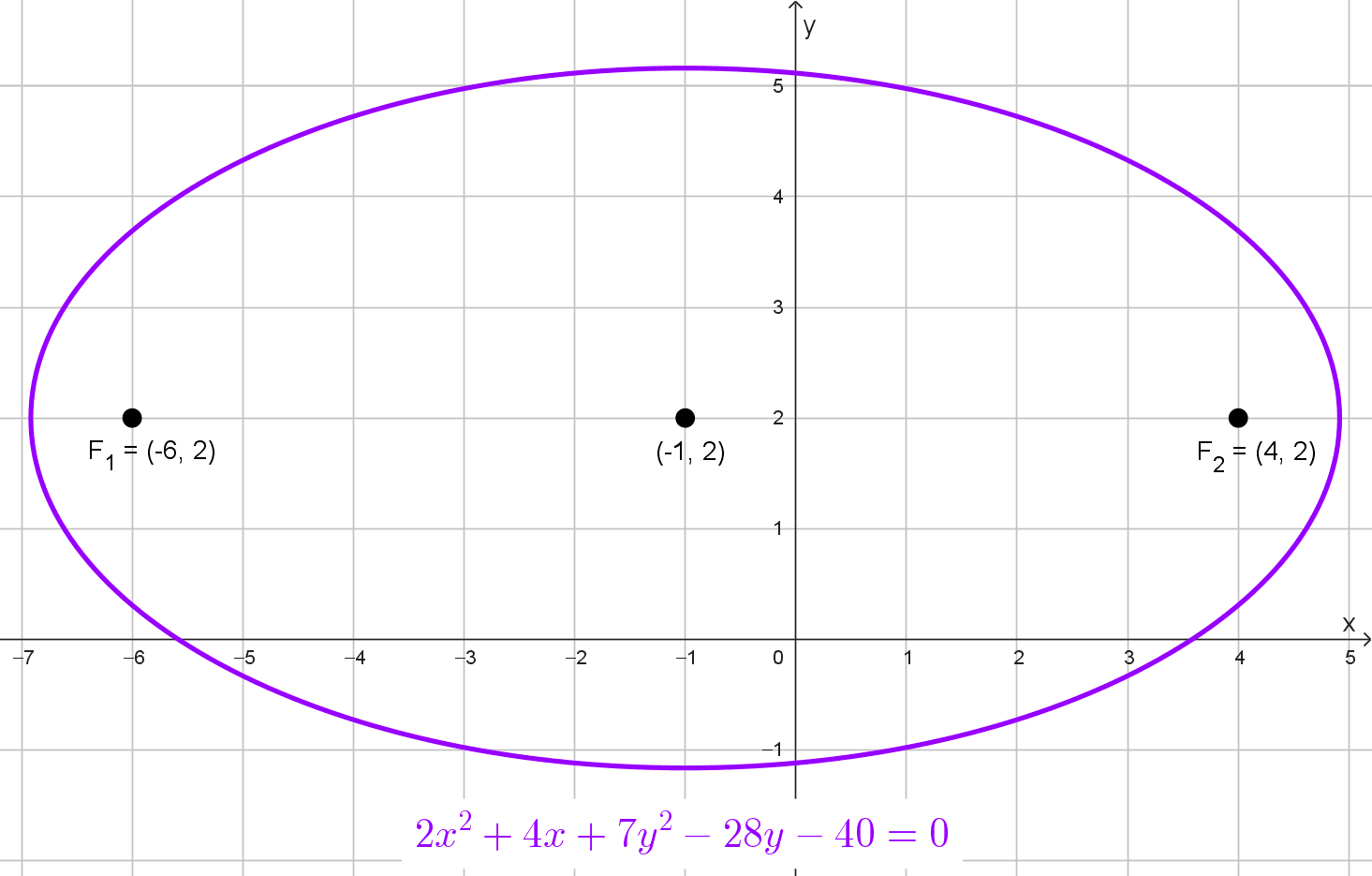
Find the foci of the ellipse \(2x^2+4x+7y^2-28y-40=0\)
Solution: The equation is given in general form rather than standard form. We must rewrite it by completing the square to find its center, orientation, and foci.
Start with the given general equation:
$$2x^2+4x+7y^2-28y-40=0$$
Group the variable terms together and move the constant term to the right side:
$$2x^2+4x+7y^2-28y=40$$
Factor out the leading coefficient from each group:
$$2(x^2+2x)+7(y^2-4y)=40$$
For \(x^2+2x,\) the coefficient of x is 2. Divide this coefficient by 2 and square the result to get 1:
$$x^2+2x=(x+1)^2-1$$
Substituting this in gives:
$$2((x+1)^2-1)$$
For \(y^2-4y,\) the coefficient of y is -4. Divide this coefficient by 2 and square the result to get 4:
$$y^2-4y=(y-2)^2-4$$
Substituting this in gives:
$$7((y-2)^2-4)$$
Now, substitute both rewritten expressions back into the equation:
$$2((x+1)^2-1)+7((y-2)^2-4)=40$$
Distribute the constants 2 and 7:
$$2(x+1)^2-2+7(y-2)^2-28=40$$
Combine the constant terms on the left side:
$$2(x+1)^2+7(y-2)^2-30=40$$
Add 30 to both sides:
$$2(x+1)^2+7(y-2)^2=70$$
Divide the entire equation by 70 to obtain the standard form of the ellipse:
$$\dfrac{(x+1)^2}{35}+\dfrac{(y-2)^2}{10}=1$$
In standard form, we can see that the center is at (-1, 2). Since 35 is greater than 10, the ellipse is horizontal. Extract the squared semi-axes:
$$a^2=35$$
$$b^2=10$$
Calculate the distance from the center to each focus:
$$c=\sqrt{a^2-b^2}$$
$$c=\sqrt{35-10}$$
$$c=\sqrt{25}$$
$$c=5$$
Because the ellipse is horizontal, determine the foci by adding and subtracting c from the x-coordinate of the center:
$$F_1(-1-5, 2)\quad \text{and}\quad F_2(-1+5,2)$$
$$F_1(-6, 2)\quad \text{and}\quad F_2(4,2)$$
Did you find this useful? Rate it!
0.0 / 5 — 0 votes

HOW TO CITE THIS ARTICLE
Machado, D. (2026, October 29). Foci of an Ellipse. Exponty. https://exponty.com/en/ellipse-foci
Focal Distance of an Ellipse
Horizontal and Vertical Ellipses
Vertices of an Ellipse
Major and Minor Axes of an Ellipse
Center of an Ellipse
Area of an Ellipse
Ellipse Practice Problems with Solutions
Leave a Reply
Related posts