
Center of an Ellipse
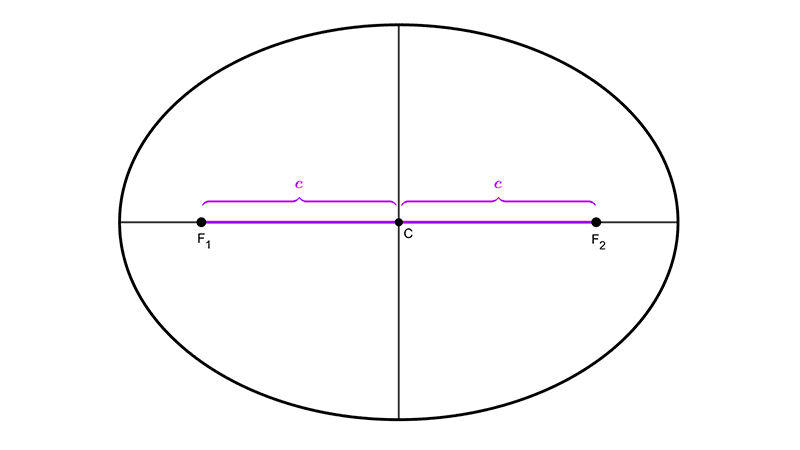
The center of an ellipse is the midpoint of the segment joining its foci; it is also the point where the major axis and the minor axis intersect.
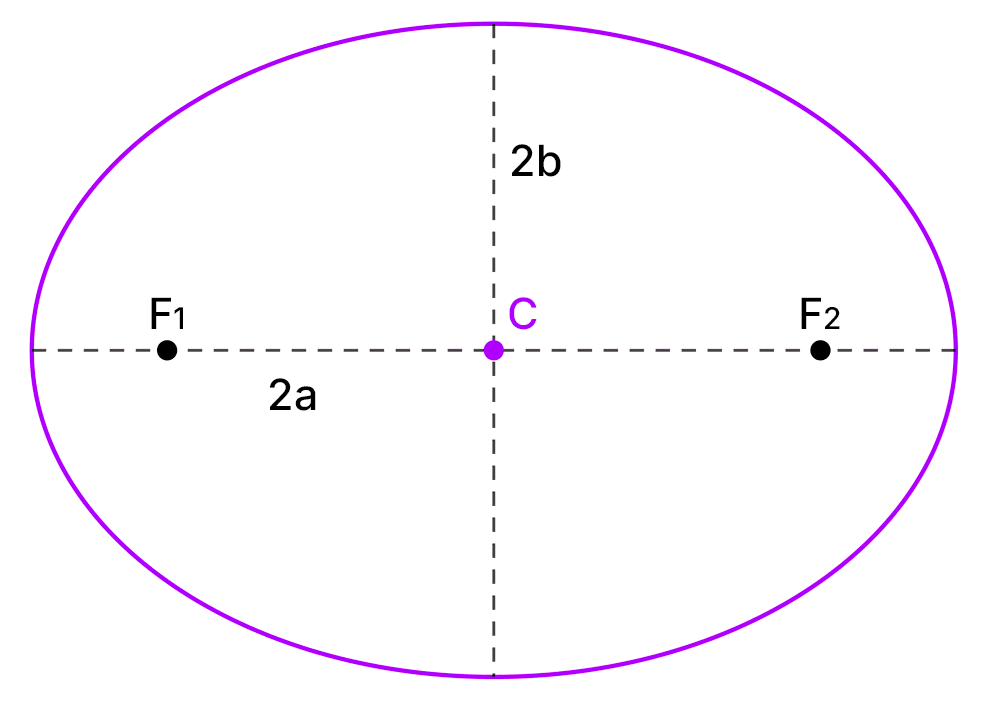
The center can be located at the origin (0, 0) or at any other point in the plane, typically denoted as (h, k). In the second case, the ellipse is shifted h units horizontally and k units vertically.
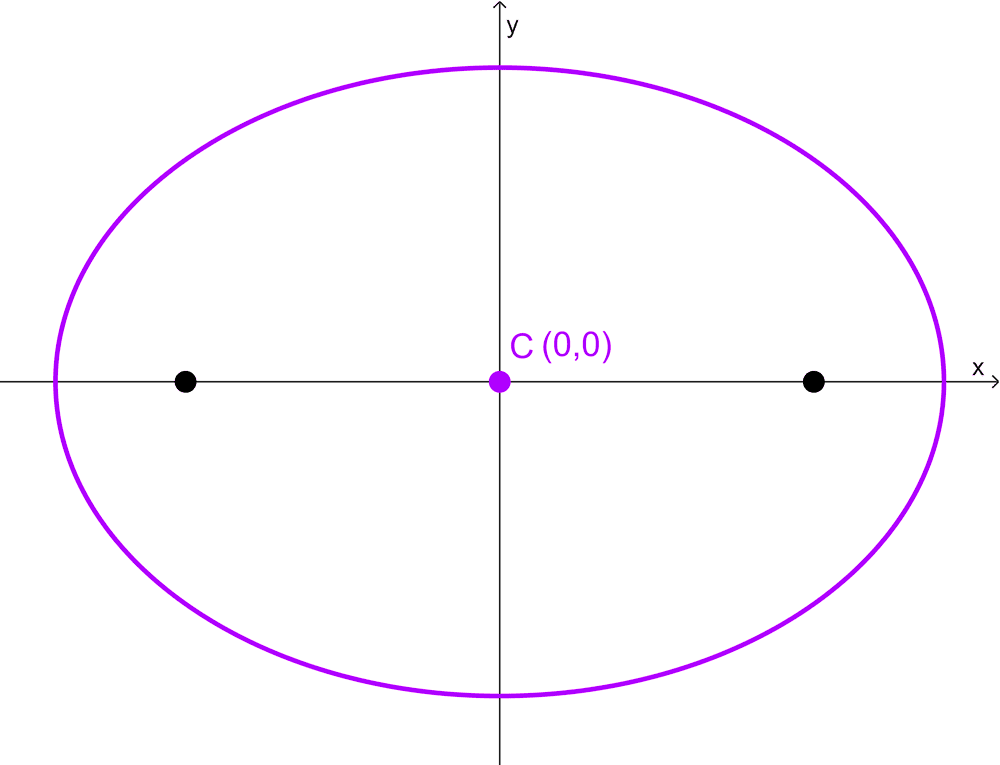
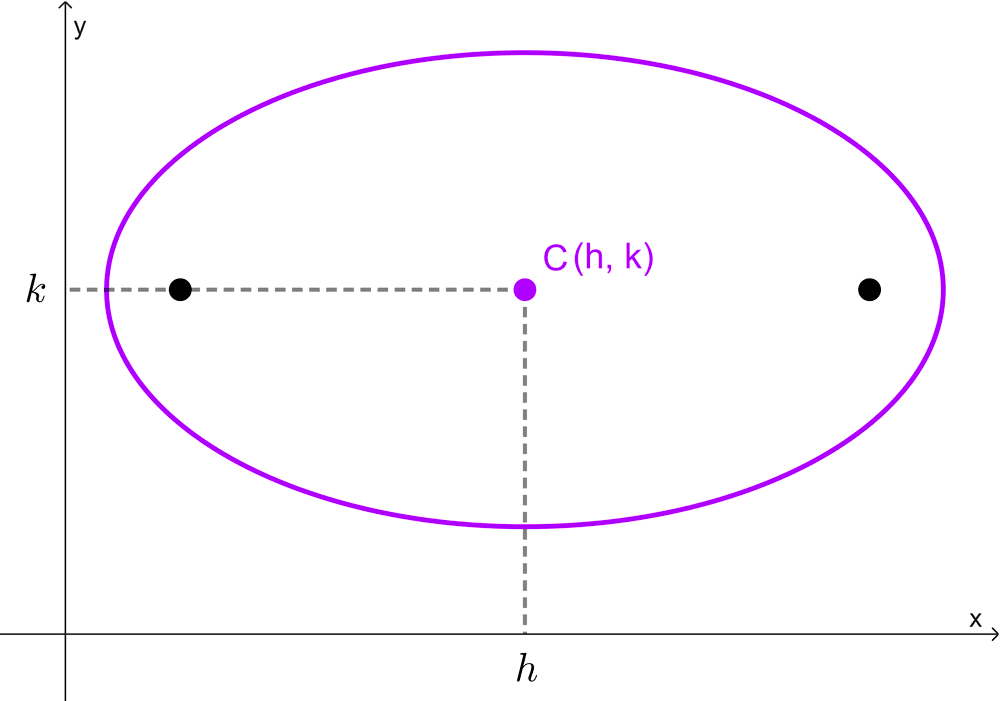
To determine whether the center is at the origin or shifted, we can look at the standard form of the equation, which changes depending on each case. The general form also looks different depending on the center. This is shown in the following table:
| Center | Standard Form | General Form |
|---|---|---|
| At the origin, point (0, 0) | \(\dfrac{x^2}{a^2}+\dfrac{y^2}{b^2}=1\) \(\dfrac{x^2}{b^2}+\dfrac{y^2}{a^2}=1\) | Ax² + Cy² + F = 0 A and C have the same sign. |
| Not at the origin, point (h, k) | \(\dfrac{(x-h)^2}{a^2}+\dfrac{(y-k)^2}{b^2}=1\) \(\dfrac{(x-h)^2}{b^2}+\dfrac{(y-k)^2}{a^2}=1\) | Ax² + Cy² + Dx + Ey + F = 0 A and C have the same sign. |
The standard equation of an ellipse centered at the origin has both variables squared on their own, whereas if the center is at (h, k), those coordinates are subtracted from the corresponding variable. Additionally, the general form of an ellipse with its center not at the origin includes at least one linear term (Dx or Ey, or both if neither h nor k is zero), unlike the centered case where neither linear term exists.
If the foci of an ellipse coincide with the center, the ellipse is a circle, and the semi-axes have the same length, equal to the radius.
Below, we will look at different ways to find the center of an ellipse given its equation, foci, vertices, or graph.
Important: This article focuses solely on one element of the ellipse. If you are not yet familiar with its fundamental concepts, we recommend reviewing the main article first, where we cover its definition, equations, parts, types, and properties.
Table of Contents
How to Find the Center
There are several ways to find the center depending on the given information.
From the Equation
Finding the center of an ellipse from its equation requires inspecting its algebraic form. You can follow these steps:
- If the equation is not in standard form, rearrange it algebraically until it is.
- Identify the value h, which appears in the binomial with the variable x.
- Identify the value k, which appears in the binomial with the variable y.
- The center of the ellipse is the point C(h, k).
If the standard equation contains variables in the form x2 and y2, the center is at the origin.
Example 1
Find the center of the ellipse with equation \(\dfrac{x^2}{16}+\dfrac{y^2}{9}=1\)
Solution: The equation is in standard form, and we can observe that both variables are squared individually without being inside parentheses with constants. Therefore, the center of the ellipse is the origin: C(0, 0).

Example 2
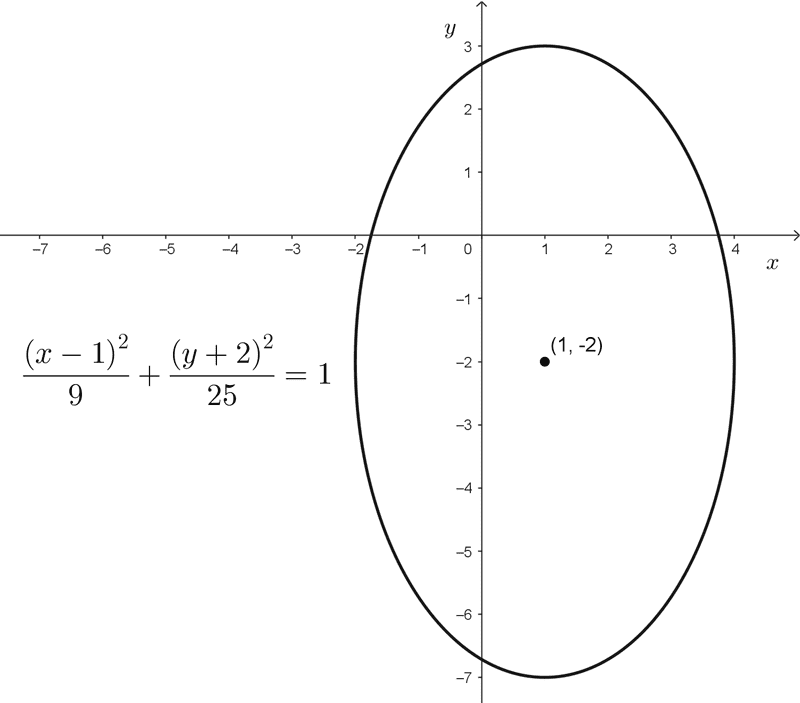
Determine the center of the ellipse \(\dfrac{(x-1)^2}{9}+\dfrac{(y+2)^2}{25}=1\)
Solution: The equation is in standard form, and we can see that the center is not at the origin. We can find the coordinates h and k of the center from the binomials x - 1 and y + 2 by setting them equal to the standard form:
$$x-h=x-1 → -h=-1 → h=1$$
$$y-k=y+2 → -k=2 → k=-2$$
Another way to see this is by changing the sign of the constant term next to each variable. For instance, in x - 1 the variable is paired with -1, so h = 1; in y + 2 the variable is paired with +2, so changing the sign gives k = -2.
In conclusion, the center of the ellipse is C(1, -2).
Example 3
Find the center of the ellipse \(\dfrac{(x+2)^2}{10}+\dfrac{(y-3)^2}{18}=1\)
Solution: The ellipse is in standard form. We identify the coordinates of the center directly from the equation:
$$x-h=x+2 → -h=2 → h=-2$$
$$y-k=y-3 → -k=-3 → k=3$$
Therefore, the center is the point C(-2, 3).

Example 4
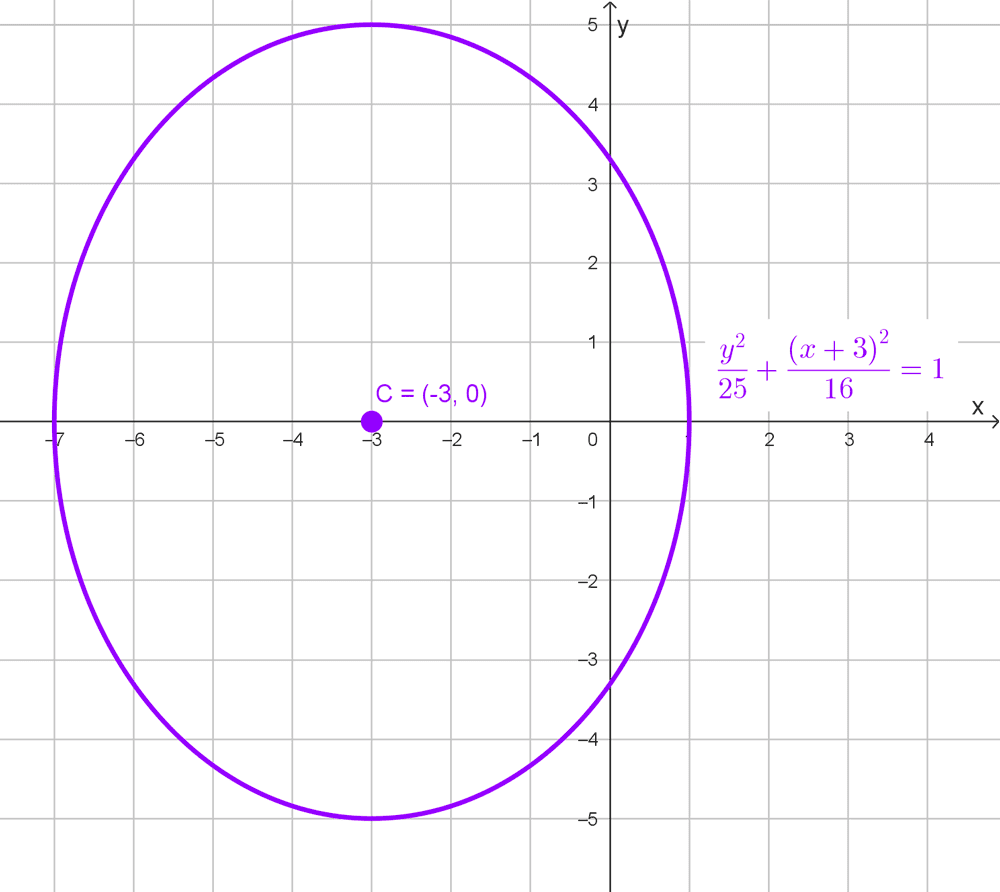
Find the center of \(\dfrac{y^2}{25}+\dfrac{(x+3)^2}{16}=1\)
Solution: The equation is in standard form; however, the variable x appears in a binomial while y does not. We can proceed as before:
$$x-h=x+3 → -h=3 → h=-3$$
$$y-k=y → -k=0 → k=0$$
Therefore, the center is the point C(-3, 0), which lies on the x-axis.
Example 5
Find the center of the ellipse \(2x^2+4x+7y^2-28y-40=0\)
Solution: The ellipse is given in general form rather than standard form. To find the center, we must first complete the square to write it in standard form. Doing so gives the equivalent equation:
$$\dfrac{(x+1)^2}{35}+\dfrac{(y-2)^2}{10}=1$$
From here, we determine that h = -1 and k = 2; therefore, the center of the ellipse is C(-1, 2).

From the Foci
If the foci of the ellipse F1(x1, y1) and F2(x2, y2) are known, the center is by definition the midpoint between them. Its coordinates can be calculated using the midpoint formula, adding the corresponding coordinates of the foci and dividing by two:
$$C\left(\dfrac{x_1+x_2}{2}, \dfrac{y_1+y_2}{2}\right)$$
Example 1
An ellipse has foci at (2, 4) and (-2, 4). Find the coordinates of its center.
Solution: Since the center is the midpoint between the foci, we use the midpoint formula:
$$C\left(\dfrac{2+(-2)}{2}, \dfrac{4+4}{2}\right) → C\left(\dfrac{0}{2}, \dfrac{8}{2}\right) → C(0, 4)$$
Therefore, the center is the point C(0, 4).
Example 2
The foci of an ellipse have coordinates (1, 5) and (1, -1). Find the center.
Solution: Applying the midpoint formula:
$$C\left(\dfrac{x_1+x_2}{2}, \dfrac{y_1+y_2}{2}\right)→C\left(\dfrac{1+1}{2}, \dfrac{5+(-1)}{2}\right)→C\left(\dfrac{2}{2}, \dfrac{4}{2}\right) → C(1, 2)$$
In conclusion, the center is the point C(1, 2).
This formula also works for a rotated ellipse—that is, one whose major axis is tilted relative to the coordinate axes.
From the Vertices
The vertices are equidistant from the center, just like the foci, so the midpoint formula can be used to find the center from the vertices, whether using the vertices (endpoints of the major axis) or the co-vertices (endpoints of the minor axis).
Given the two vertices or two co-vertices V1(x1, y1) and V2(x2, y2) of an ellipse, the center is:
$$C\left(\dfrac{x_1+x_2}{2}, \dfrac{y_1+y_2}{2}\right)$$
Example
The vertices of an ellipse have coordinates (-1, 3) and (9, 3). Find its center.
Solution: Applying the midpoint formula, we find the center:
$$C\left(\dfrac{-1+9}{2}, \dfrac{3+3}{2}\right) → C\left(\dfrac{8}{2}, \dfrac{6}{2}\right) → C(4, 3)$$
Therefore, the center is the point C(4, 3).
If, instead of both vertices or both co-vertices, you are given one vertex and one co-vertex, the midpoint formula cannot be used. Instead, the center coordinates can be determined as follows.
For a non-rotated ellipse (with axes parallel to the coordinate axes), given a vertex V(xV, yV) and a co-vertex B(xB, yB): if the ellipse is horizontal (|xV - xB| > |yV - yB|), the center is C(xB, yV). If instead the ellipse is vertical (|xV - xB| < |yV - yB|), the center is C(xV, yB). This geometric relationship can be seen more clearly by plotting the points on the Cartesian plane.
From the Graph
If the graph of the ellipse displays the axes, foci, or vertices, the center can be identified as the intersection of the axes or as the midpoint between the foci or vertices.
Example
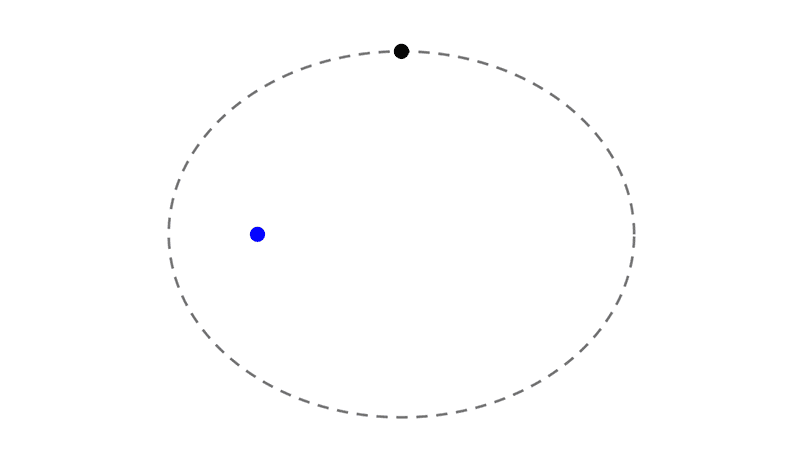
The graph of an ellipse is shown below. What is its center?
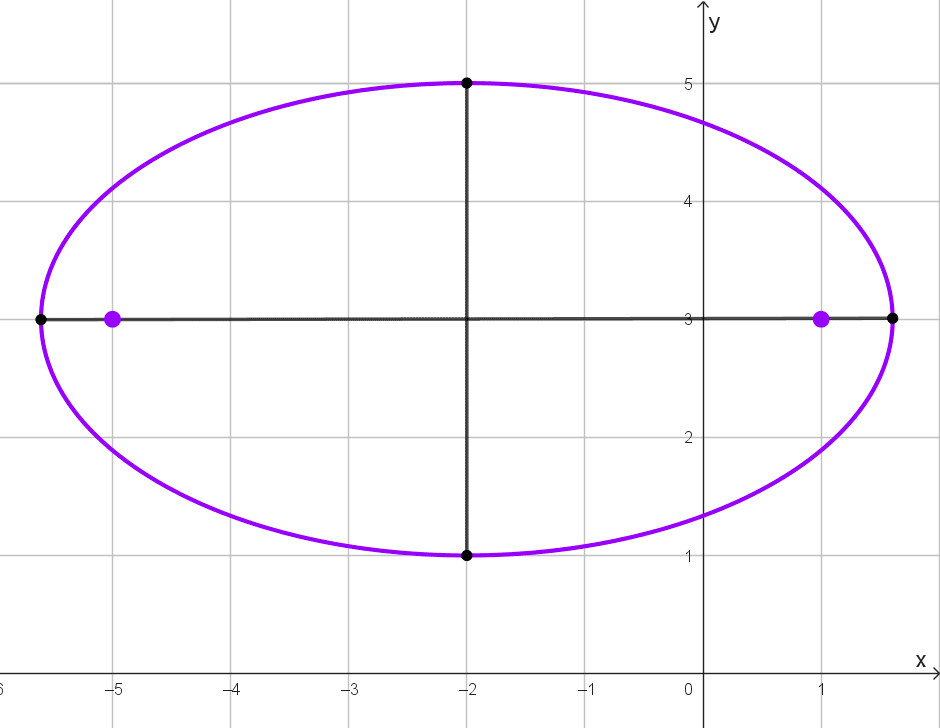
The intersection of the axes occurs at (-2, 3); therefore, that is the center.
Did you find this useful? Rate it!
0.0 / 5 — 0 votes

HOW TO CITE THIS ARTICLE
Machado, D. (2026, October 31). Center of an Ellipse. Exponty. https://exponty.com/en/ellipse-center
Focal Distance of an Ellipse
Horizontal and Vertical Ellipses
Vertices of an Ellipse
Major and Minor Axes of an Ellipse
Foci of an Ellipse
Area of an Ellipse
Ellipse Practice Problems with Solutions
Leave a Reply
Related posts