
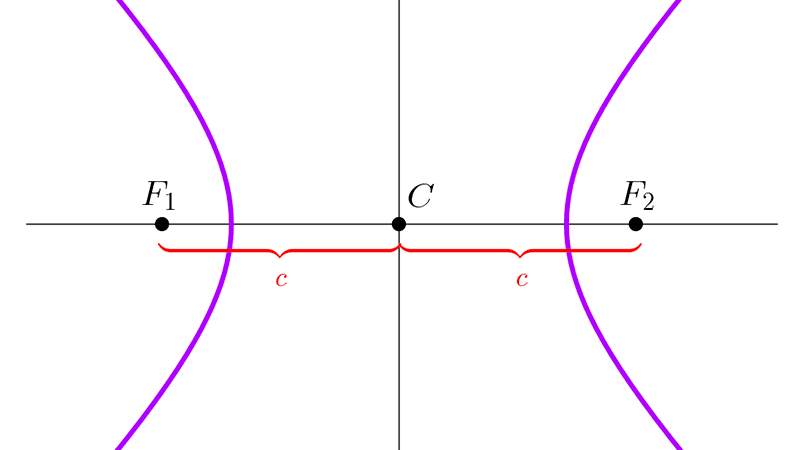
Foci of a Hyperbola
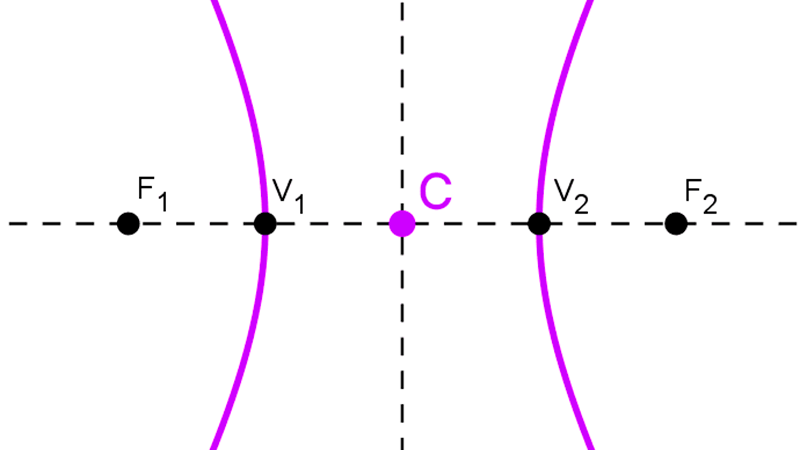
The foci of a hyperbola are two fixed points in the plane lying on the focal axis, separated by a distance of 2c called the focal distance. The midpoint between the foci is the center of the hyperbola. The defining property of a hyperbola is that the absolute value of the difference between the distances from any point on the hyperbola to its foci is a constant.
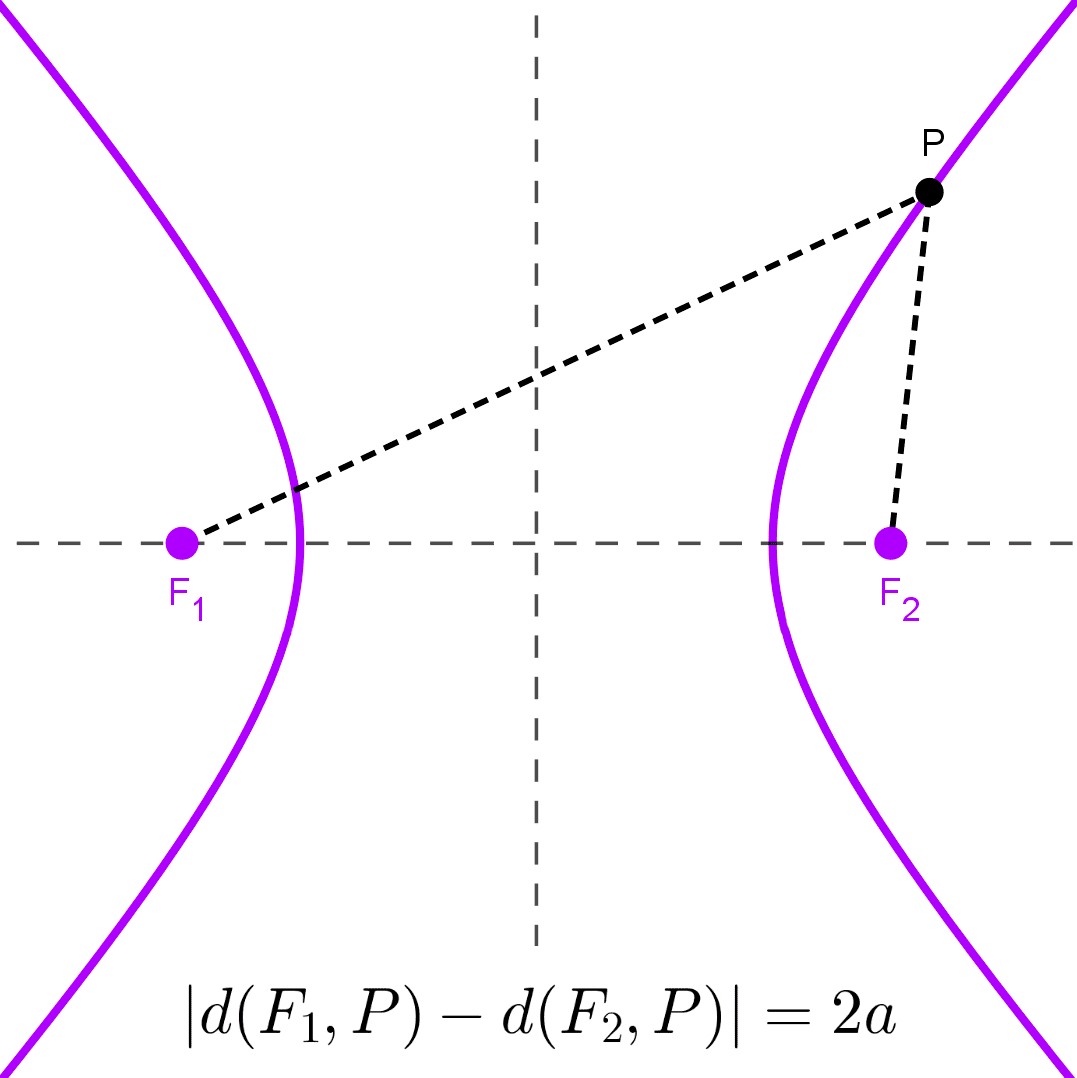
Important: If you are not yet familiar with what a hyperbola is in mathematics, we recommend reviewing our main article first, where we cover its concept, definition, formulas, and properties.
Table of Contents
How to Find the Foci
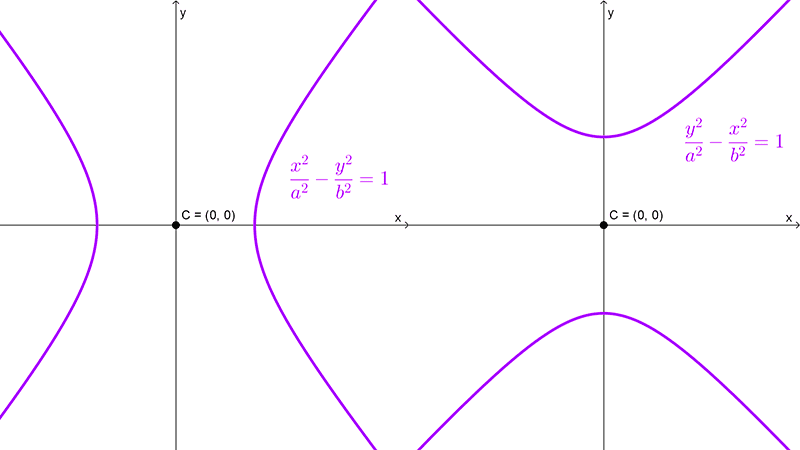
Finding the coordinates of the foci of a hyperbola is relatively straightforward when working from its standard form equation. First, determine whether the hyperbola is horizontal (transverse axis on or parallel to the x-axis) or vertical (transverse axis on or parallel to the y-axis).
This orientation is determined by the positive term in the standard equation: if the positive term contains the variable x, the hyperbola is horizontal; conversely, if the positive term contains the variable y, the hyperbola is vertical.
The distance from the center to either focus is represented by c and is related to the semi-axes by the formula: \(c=\sqrt{a^2+b^2}.\) Remember that a2 is always the denominator of the positive term and b2 is the denominator of the negative term in the standard form. We use the value of c to calculate the coordinates of the foci, as summarized in the table below:
| Standard Form | Transverse Axis | Center | Foci |
|---|---|---|---|
| \(\dfrac{x^2}{a^2}-\dfrac{y^2}{b^2}=1\) | Along the x-axis | (0, 0) | (±c, 0) |
| \(\dfrac{y^2}{a^2}-\dfrac{x^2}{b^2}=1\) | Along the y-axis | (0, 0) | (0, ±c) |
| \(\dfrac{(x-h)^2}{a^2}-\dfrac{(y-k)^2}{b^2}=1\) | Parallel to the x-axis | (h, k) | (h ± c, k) |
| \(\dfrac{(y-k)^2}{a^2}-\dfrac{(x-h)^2}{b^2}=1\) | Parallel to the y-axis | (h, k) | (h, k ± c) |
Step-by-Step Examples
Below, we solve several examples demonstrating how to find the foci of a hyperbola.
Example 1
Find the foci of the hyperbola given by the equation \(\dfrac{x^2}{4}-\dfrac{y^2}{9}=1\)
Solution: From the standard equation, we see that the center is at the origin and the hyperbola is horizontal, since the positive term contains the variable x.
Based on the formula for the foci of a horizontal hyperbola, they are located c units to the left and right of the center.
To find the value of c, we first identify the denominators corresponding to the squared semi-axes:
$$a^2=4$$
$$b^2=9$$
Using these values, we calculate c using the fundamental relation:
$$c=\sqrt{a^2+b^2}=\sqrt{4+9}=\sqrt{13}$$
As noted, the foci are located at a distance of c units to the left and right of the center:
$$F_1(-c, 0)\quad \text{and}\quad F_2(c, 0)$$
Substituting \(c=\sqrt{13}:\)
$$F_1(-\sqrt{13},0)\quad \text{and}\quad F_2(\sqrt{13},0)$$
Approximating to two decimal places: \(F_1(-3.61, 0) \quad \text{and}\quad F_2(3.61, 0)\)

Example 2
Find the foci of the hyperbola \(\dfrac{y^2}{4}-\dfrac{x^2}{16}=1\)
Solution: This equation is in standard form for a vertical hyperbola, because the positive term contains y2. The center of the hyperbola is at the origin, (0, 0).
First, we identify the squared semi-axes from the denominators of the equation:
$$a^2=4$$
$$b^2=16$$
Next, we calculate the focal distance parameter c using the hyperbola relationship:
$$c^2=a^2+b^2$$
Substituting the values:
$$c^2=4+16=20$$
Therefore:
$$c=\sqrt{20}=2\sqrt{5}$$
Next, we determine the coordinates of the foci. For a vertical hyperbola, the foci lie at a distance c above and below the center. Their coordinates are given by:
$$F_1(0, -c)\quad \text{and}\quad F_2(0, c)$$
Substituting \(c=2\sqrt{5}:\)
$$F_1(0, -2\sqrt{5}) \quad \text{and}\quad F_2(0, 2\sqrt{5})$$
Finally, approximating numerically:
$$2\sqrt{5}≈4.47$$
This gives the approximate coordinates of the foci:
$$F_1(0, -4.47) \quad \text{and}\quad F_2(0, 4.47)$$

Example 3
Find and plot the foci of the hyperbola given by the equation \(\dfrac{(x-2)^2}{16}-\dfrac{(y+3)^2}{9}=1.\)
Solution: This equation is in standard form for a horizontal hyperbola, since the positive term is associated with \((x-2)^2.\) The center of the hyperbola is at (h, k) = (2, -3).
First, we identify the values of the squared semi-axes from the denominators:
$$a^2=16\quad \text{and}\quad b^2=9$$
Next, we compute the value of c using the characteristic hyperbola equation:
$$c^2=a^2+b^2$$
Substituting the values:
$$c^2=16+9=25$$
Therefore:
$$c=\sqrt{25}=5$$
For a horizontal hyperbola, the foci are located c units to the left and right of the center. Their coordinates are given by:
$$F_1(h-c, k) \quad \text{and}\quad F_2(h+c, k)$$
Substituting h = 2, k = -3, and c = 5:
$$F_1(2-5, -3)=(-3, -3)\quad \text{and}\quad F_2(2+5, -3)=(7, -3)$$

Example 4
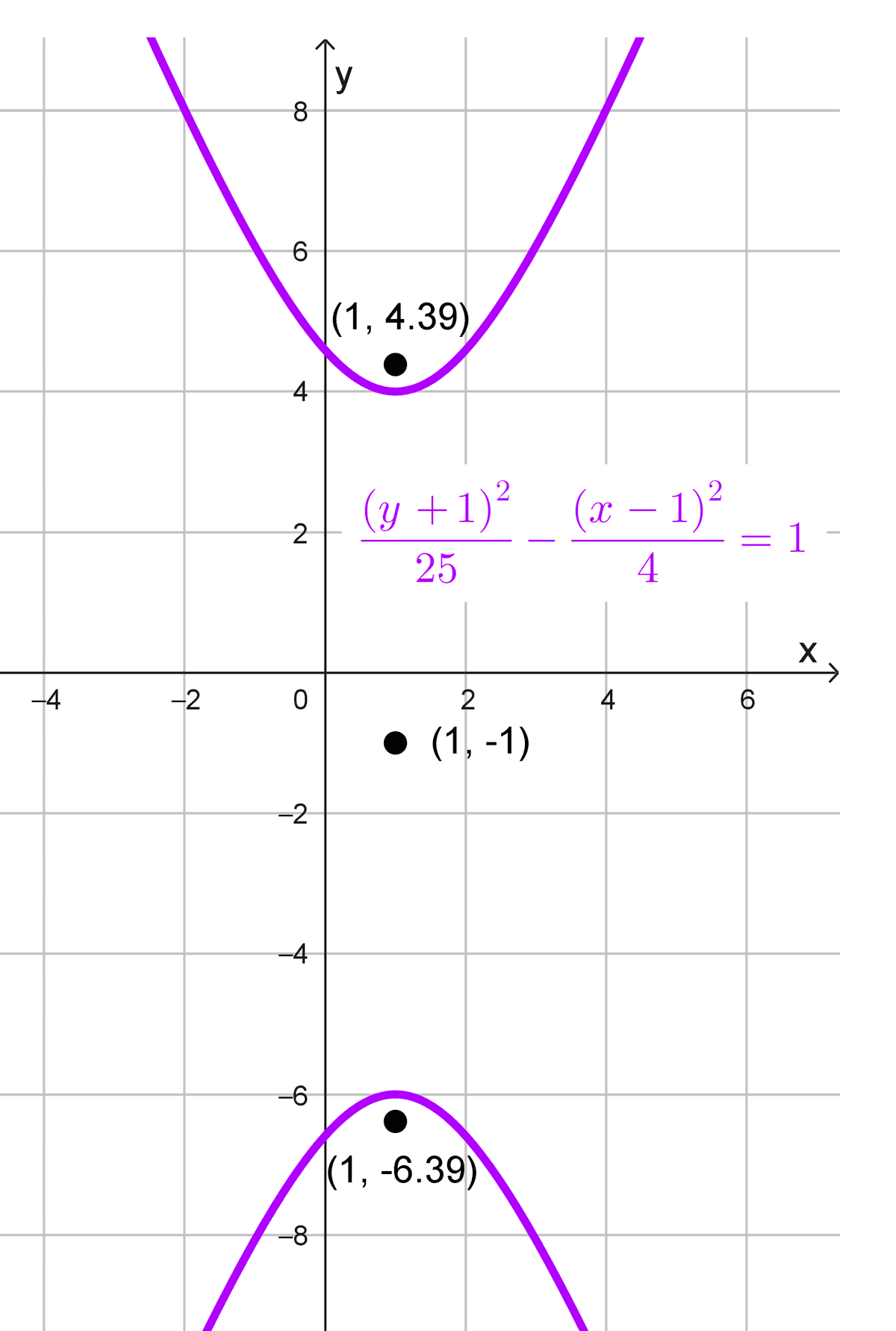
Determine the foci of the hyperbola \(\dfrac{(y+1)^2}{25}-\dfrac{(x-1)^2}{4}=1.\)
Solution: This equation represents a vertical hyperbola, since the positive term contains \((y+1)^2.\) The center of the hyperbola is at (h, k) = (1, -1).
We identify the values of the squared semi-axes from the denominators:
$$a^2=25\quad \text{and}\quad b^2=4$$
To find c, we use the characteristic relation for hyperbolas:
$$c^2=a^2+b^2$$
Substituting the corresponding values:
$$c^2=25+4=29$$
Therefore:
$$c=\sqrt{29}$$
Now we determine the coordinates of the foci. Because this is a vertical hyperbola, the foci lie at a distance c above and below the center. This means their coordinates are:
$$F_1(h, k-c)\quad \text{and}\quad F_2(h, k+c)$$
Substituting \(h = 1, k = -1, c=\sqrt{29}:\)
$$F_1(1, -1-\sqrt{29}) \quad \text{and}\quad F_2(1, -1+\sqrt{29})$$
Finally, computing numerical approximations gives:
$$F_1(1, -6.39)\quad \text{and}\quad F_2(1, 4.39)$$
Example 5
Find the foci of \(9x^2-4y^2-54x+117=0\)
Solution: The equation is given in general form and cannot be used directly. However, by completing the square, we obtain its equivalent standard form:
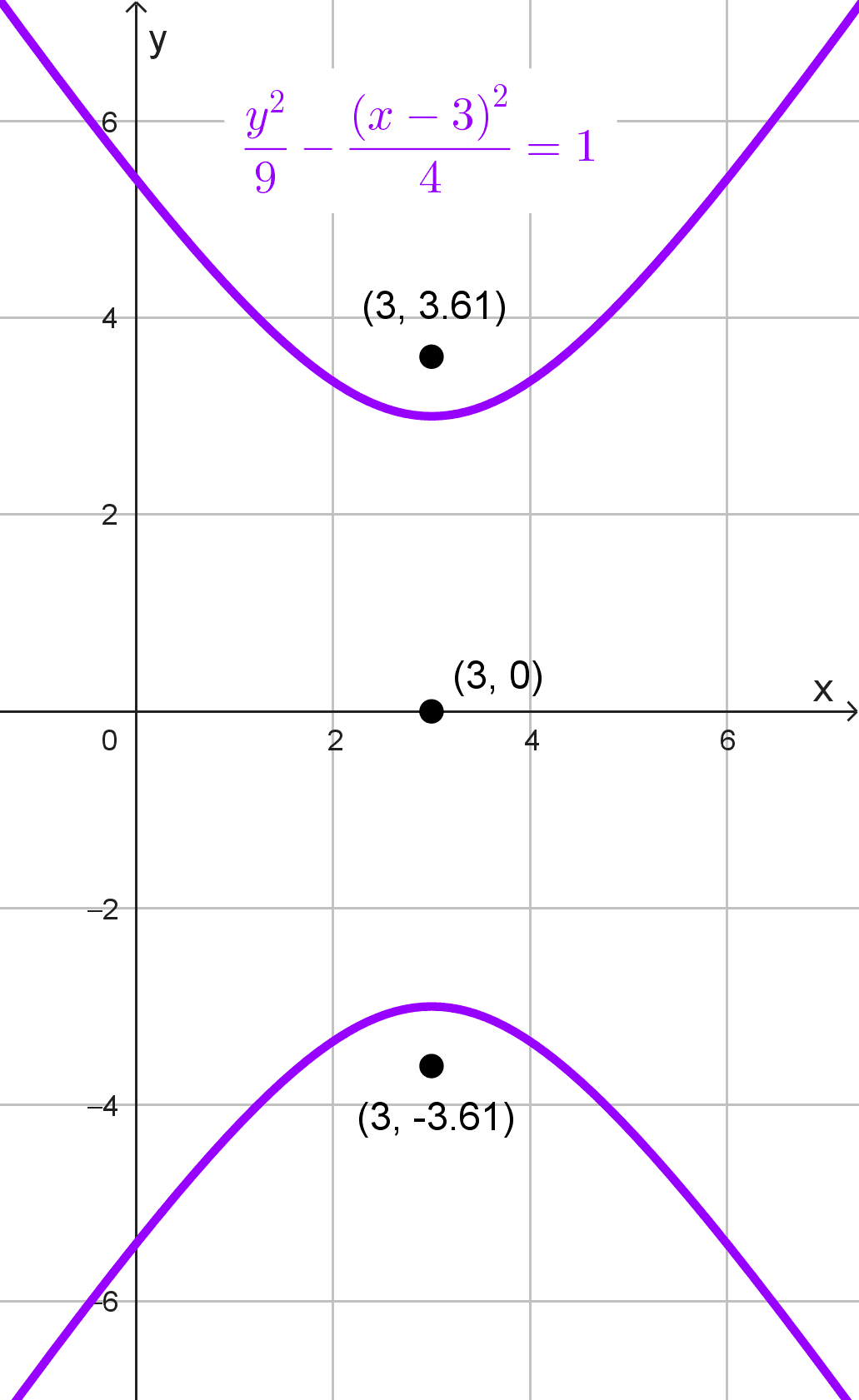
$$\dfrac{y^2}{9}-\dfrac{(x-3)^2}{4}=1$$
We recognize that this equation represents a vertical hyperbola, because the positive term contains y2. The center of the hyperbola is at (h, k) = (3, 0).
We identify the squared semi-axes from the denominators:
$$a^2=9\quad \text{and}\quad b^2=4$$
We find c using the fundamental hyperbola equation:
$$c^2=a^2+b^2$$
Substituting the values:
$$c^2=9+4=13$$
Therefore:
$$c=\sqrt{13}$$
Since this is a vertical hyperbola, the foci are located at a distance c above and below the center. Thus, their coordinates are:
$$F_1(h, k-c)\quad \text{and}\quad F_2(h, k+c)$$
Substituting \(h=3, k=0, c=\sqrt{13}:\)
$$F_1(3, 0-\sqrt{13})=F_1(3,-\sqrt{13})$$
$$F_2(3, 0+\sqrt{13})=F_2(3, \sqrt{13})$$
Approximating numerically, \(\sqrt{13}≈3.61.\) Therefore:
$$F_1(3, -3.61)\quad \text{and}\quad F_2(3, 3.61)$$
Example 6
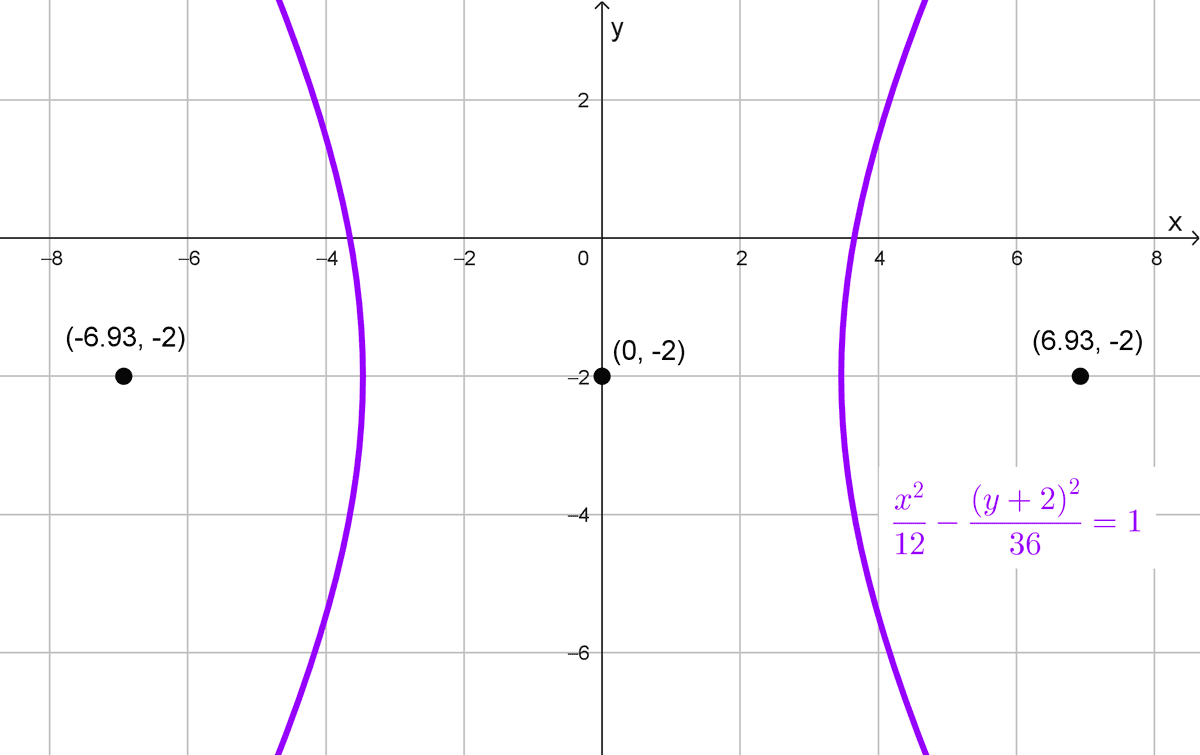
Find the foci of the hyperbola with equation \(3x^2-y^2-4y-40=0\)
Solution: Here the equation is given in general form. As in the previous example, we complete the square to write it in standard form:
$$\dfrac{x^2}{12}-\dfrac{(y+2)^2}{36}=1$$
This equation corresponds to a horizontal hyperbola, since the positive term contains x2. The center of the hyperbola is at (h, k) = (0, -2).
We determine the squared semi-axes from the denominators:
$$a^2=12\quad \text{and}\quad b^2=36$$
Next, we find the focal distance c using the formula:
$$c^2=a^2+b^2$$
Substituting the values:
$$c^2=12+36=48$$
Therefore:
$$c=\sqrt{48}=4\sqrt{3}$$
Now we determine the coordinates of the foci. In a horizontal hyperbola, the foci are placed at a distance c to the left and right of the center. Their coordinates are given by:
$$F_1(h-c, k) \quad \text{and}\quad F_2(h+c, k)$$
Substituting \(h=0, k=-2, c=4\sqrt{3}:\)
$$F_1(0-4\sqrt{3}, -2)=F_1(-4\sqrt{3}, -2)$$
$$F_2(0+4\sqrt{3}, -2)=F_2(4\sqrt{3}, -2)$$
Finally, approximating numerically:
$$F_1(-6.93, -2)\quad \text{and}\quad F_2(6.93, -2)$$
Did you find this useful? Rate it!
0.0 / 5 — 0 votes

HOW TO CITE THIS ARTICLE
Machado, D. (2026, November 1). Foci of a Hyperbola. Exponty. https://exponty.com/en/hyperbola-foci
Focal Distance of a Hyperbola
Center of a Hyperbola
Vertices of a Hyperbola
Horizontal and Vertical Hyperbolas
Rectangular Hyperbola
Transverse and Conjugate Axes of a Hyperbola
Asymptotes of a Hyperbola
Hyperbola Practice Problems with Solutions
Leave a Reply
Related posts