
Focal Distance of a Hyperbola
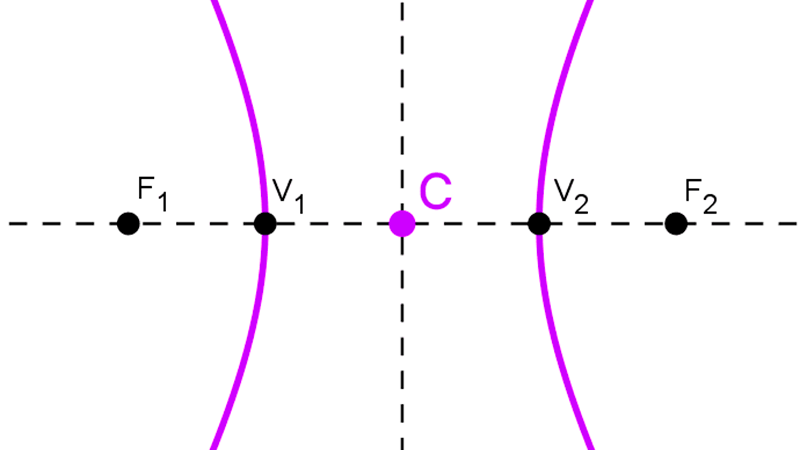
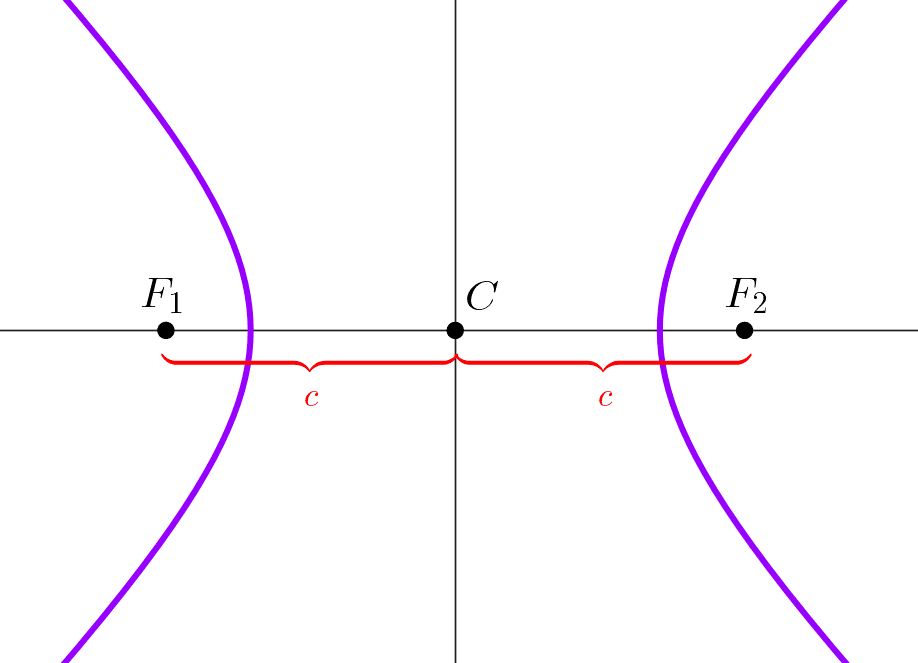
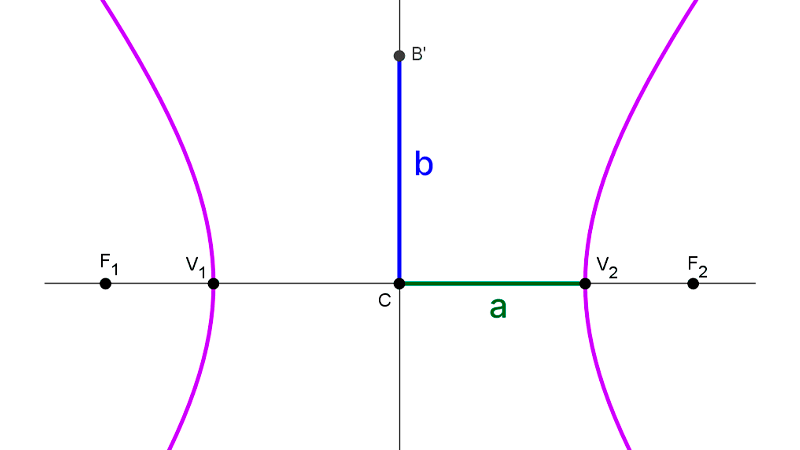
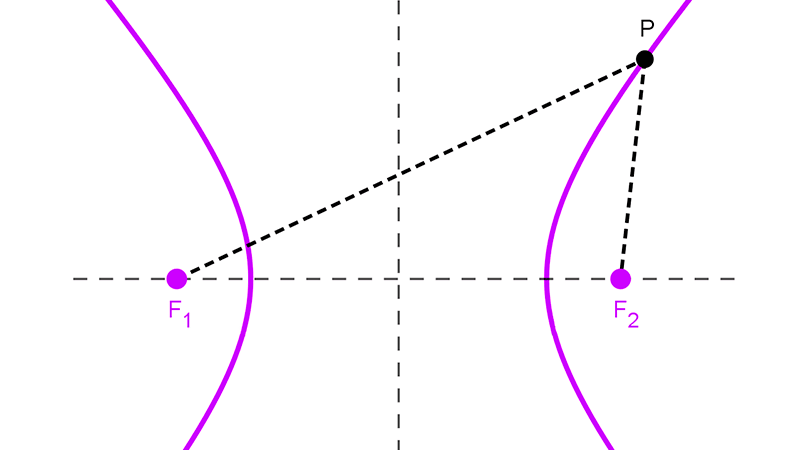
The focal distance of a hyperbola is the distance between its foci. Half of this value is the distance from the center to each focus (denoted by c), which is related to the semi-axes a and b by the following formula:
c2 = a2 + b2
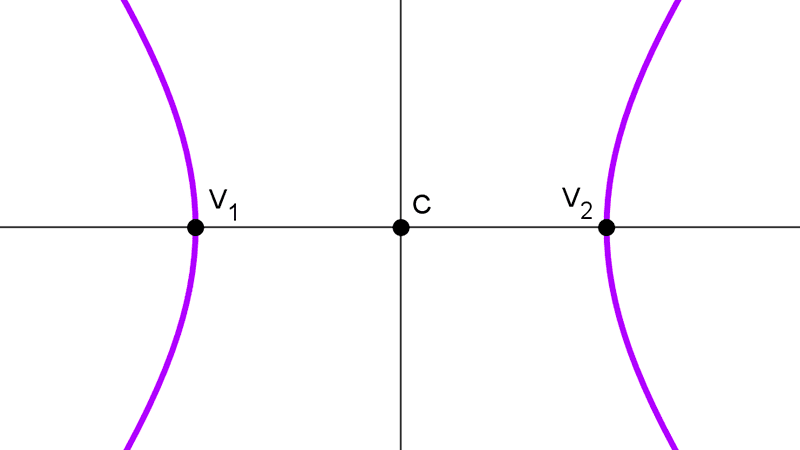
In any hyperbola, unlike an ellipse, the focal distance is greater than the distance between the vertices.
Important: If you are not yet familiar with the geometric definition of a hyperbola, we recommend reviewing our main guide covering its concept, standard equation, elements, and properties.
How to Calculate the Focal Distance
As noted earlier, the distance from the center to each focus (c) is related to the semi-transverse axis (a) and semi-conjugate axis (b) by the following formula:
c2 = a2 + b2
$$c=\sqrt{a^2+b^2}$$
This expression allows us to find the value of c from a and b, which can be identified from the standard equation of the hyperbola. Multiplying c by two gives the focal distance.
If the coordinates of the foci F1(x1, y1) and F2(x2, y2) are known, we can use the distance formula between two points to find the focal distance:
$$2c=\sqrt{(x_2-x_1)^2+(y_2-y_1)^2}$$
Step-by-Step Examples
Example 1
Find the focal distance of the hyperbola \(\dfrac{x^2}{4}-\dfrac{y^2}{9}=1\)
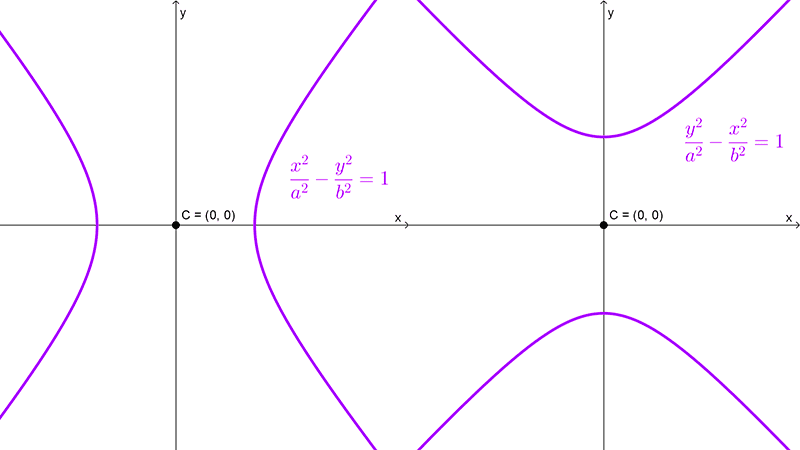
Solution: From the equation, we observe that the hyperbola has a horizontal transverse axis along the x-axis, as the positive term contains x2. The values of a2 and b2 are the denominators of the quadratic terms: \(a^2=4\quad \text{and}\quad b^2=9.\)
To calculate c, we use the formula:
$$c=\sqrt{a^2+b^2}$$
Substituting the values of \(a^2\quad \text{and}\quad b^2:\)
$$c=\sqrt{4+9}$$
$$c=\sqrt{13}$$
Therefore, the focal distance of the hyperbola is twice c: \(2c=2\sqrt{13}.\)
Example 2
Given the equation of the hyperbola \(\dfrac{(y-1)^2}{25}-\dfrac{(x+1)^2}{4}=1\), calculate its focal distance.
Solution: We identify that the equation is in standard form for a hyperbola with a vertical transverse axis. The center of the hyperbola is (-1, 1), and the values of a2 and b2 are:
$$a^2=25$$
$$b^2=4$$
To find c, we use the relationship:
$$c=\sqrt{a^2+b^2}$$
Substituting the values of \(a^2\quad \text{and}\quad b^2:\)
$$c=\sqrt{25+4}=\sqrt{29}$$
The focal distance of the hyperbola is twice c; that is:
$$2c=2\sqrt{29}$$
Example 3
Determine the distance between the foci of the hyperbola \(\dfrac{x^2}{12}-\dfrac{(y+2)^2}{36}=1\)
Solution: We identify that the equation is in standard form for a hyperbola with a horizontal transverse axis, with its center at (0, -2), and values:
$$a^2=12$$
$$b^2=36$$
To find c, we use the formula:
$$c=\sqrt{a^2+b^2}$$
Substituting the values of \(a^2 \quad \text{and}\quad b^2:\)
$$c=\sqrt{12+36}=\sqrt{48}$$
Simplifying \(\sqrt{48}:\)
$$c=\sqrt{16 \cdot 3}=4\sqrt{3}$$
The focal distance of the hyperbola is twice c; that is:
$$2c=2 \cdot 4\sqrt{3}=8\sqrt{3}$$
Example 4
Find the focal distance of the hyperbola whose equation is \(5x^2-2y^2-10x+8y-13=0\)
Solution: The equation is not in standard form, so we cannot read the lengths of the semi-axes directly. However, we can complete the square to obtain an equivalent form:
$$\dfrac{(x-1)^2}{2}-\dfrac{(y-2)^2}{5}=1$$
First, we identify that the equation represents a hyperbola with a horizontal transverse axis, centered at (1, 2), where:
$$a^2=2\quad \text{and}\quad b^2=5$$
To calculate c, we use the formula:
$$c=\sqrt{a^2+b^2}$$
Substituting the values of \(a^2\quad \text{and}\quad b^2:\)
$$c=\sqrt{2+5}=\sqrt{7}$$
The focal distance of the hyperbola is twice c; that is:
$$2c=2\sqrt{7}$$
Did you find this useful? Rate it!
0.0 / 5 — 0 votes

HOW TO CITE THIS ARTICLE
Machado, D. (2026, November 2). Focal Distance of a Hyperbola. Exponty. https://exponty.com/en/hyperbola-focal-distance
Center of a Hyperbola
Vertices of a Hyperbola
Horizontal and Vertical Hyperbolas
Rectangular Hyperbola
Transverse and Conjugate Axes of a Hyperbola
Foci of a Hyperbola
Asymptotes of a Hyperbola
Hyperbola Practice Problems with Solutions
Leave a Reply
Related posts