
General Equation of Conic Sections
The general equation of a conic section is Ax2 + Bxy + Cy2 + Dx + Ey + F = 0, also known as the second-degree equation in two variables, where:
- x and y are the variables.
- Ax2 and Cy2 are the quadratic terms in x and y, respectively.
- Bxy is called the xy-term (or cross-product term) and contains the product of the variables.
- Dx and Ey are the linear terms in x and y, respectively.
- F is the constant term, so called because it does not depend on any variable.
The capital letters are called coefficients and are real numbers; for the equation to be of the second degree, A, B, and C cannot all be zero simultaneously.
Every second-degree equation of the form above represents a nondegenerate conic section or a degenerate conic (a point, two lines, or the empty set). When it represents a conic section, analyzing its coefficients allows us to determine its type. Depending on the values and relationships among A, B, and C, we can identify whether the conic is an ellipse, a parabola, or a hyperbola.
In many cases, the coefficient B equals zero, meaning the equation has no Bxy cross-product term, simplifying to Ax2 + Cy2 + Dx + Ey + F = 0. This occurs whenever the axes of the conic section are parallel to the coordinate axes, which simplifies both its algebraic analysis and graphing. If B is nonzero, the principal axes of the conic section are rotated relative to the coordinate axes.
Table of Contents
Discriminant of the General Equation
The discriminant is a mathematical expression used to determine the type of conic section represented by a general second-degree equation. Given the general equation Ax2 + Bxy + Cy2 + Dx + Ey + F = 0, the discriminant, denoted by Δ, is defined as:
Δ = B2 - 4AC
When the general formula represents a nondegenerate conic section, the sign of the discriminant identifies the curve it describes:
- If Δ > 0: the equation represents a hyperbola.
- If Δ = 0: the equation represents a parabola.
- If Δ < 0: the equation represents an ellipse or a circle.
In other words, a positive discriminant indicates a hyperbola, a discriminant equal to zero indicates a parabola, and a negative discriminant corresponds to an ellipse or a circle.
| Conic Section | Discriminant |
|---|---|
| Hyperbola | B2 - 4AC > 0 |
| Parabola | B2 - 4AC = 0 |
| Ellipse | B2 - 4AC < 0 |
Examples
Evaluate the discriminant of the following equations to determine which type of conic section they represent:
- \(3x^2+4xy+5y^2-6x+8y+1=0\)
- \(2x^2-6xy+3y^2+7x-2y-10=0\)
- \(10xy+5x^2+5y^2-x+4y=0\)
- \(16y^2+8xy+x^2-9x+y+12=0\)
- \(7x^2+12xy+5y^2+4x-3y-9=0\)
Solutions
1) Consider the general equation \(3x^2+4xy+5y^2-6x+8y+1=0\). From this equation, we identify the coefficients A=3, B=4, and C=5. Computing the discriminant:
$$B^2-4AC=4^2-4\cdot3\cdot5=16-60=-44$$
Since the discriminant is negative, we conclude that this equation represents an ellipse.
2) Consider the equation \(2x^2-6xy+3y^2+7x-2y-10=0.\) Here, the coefficients are A=2, B=-6, and C=3. Calculating the discriminant yields:
$$B^2-4AC=(-6)^2-4\cdot2\cdot3=36-24=12$$
Because the discriminant is positive, this equation corresponds to a hyperbola.
3) In the equation \(10xy+5x^2+5y^2-x+4y=0\), identifying the quadratic coefficients gives A=5, B=10, and C=5. Computing the discriminant:
$$B^2-4AC=10^2-4\cdot5\cdot5=100-100=0$$
Since the discriminant is zero, the equation represents a parabola.
4) Analyze the conic equation: \(16y^2+8xy+x^2-9x+y+12=0.\) Writing the terms in order, the coefficients are A=1, B=8, and C=16. Evaluating the discriminant:
$$B^2-4AC=8^2-4\cdot1\cdot16=64-64=0$$
Because the discriminant equals zero, the equation describes a parabola.
5) Examining the equation \(7x^2+12xy+5y^2+4x-3y-9=0,\) the coefficients are A=7, B=12, and C=5. Calculating the discriminant:
$$B^2-4AC=12^2-4\cdot7\cdot5=144-140=4$$
Since the discriminant is greater than zero, we conclude that the equation represents a hyperbola.
When the general form of a conic section contains no Bxy term (that is, when B = 0), the equation simplifies to Ax2 + Cy2 + Dx + Ey + F = 0. In this case, assuming the equation represents a nondegenerate conic, calculating the discriminant is unnecessary; simply inspecting the signs of coefficients A and C suffices:
- If A and C have the same sign (both positive or both negative), the equation represents an ellipse (or a circle when A = C).
- If A and C have opposite signs (one positive and one negative), the equation represents a hyperbola.
- If either coefficient is zero (A = 0 or C = 0), the equation represents a parabola.
| Conic Section | Coefficients |
|---|---|
| Ellipse | A and C have the same sign: A ⋅ C > 0 |
| Hyperbola | A and C have opposite signs: A ⋅ C < 0 |
| Parabola | A is zero or C is zero: A ⋅ C = 0 |
Examples
Classify the following conic sections by inspecting their coefficients:
- \(3x^2-7y^2+2x+5y+1=0\)
- \(4x^2+9y^2-8x+6y-12=0\)
- \(x^2-6x+4y-5=0\)
Solutions
1) Consider the equation \(3x^2-7y^2+2x+5y+1=0.\) Here, A=3 and C=-7. Notice that A and C have opposite signs, which allows us to determine that this equation represents a hyperbola.
2) In the equation \(4x^2+9y^2-8x+6y-12=0\), we observe that A=4 and C=9. Since both coefficients are positive (same sign), the equation describes an ellipse.
3) For the equation \(x^2-6x+4y-5=0,\) the coefficients are A=1 and C=0. Since C=0, we identify this as the equation of a parabola.
Note: While discriminant analysis is a reliable tool to identify the type of conic, this test assumes that the equation represents a nondegenerate conic. In certain degenerate cases, the general second-degree equation may represent a single point, a pair of intersecting lines, parallel lines, or no graph at all.
Identifying degenerate conics requires analyzing the full determinant of the 3×3 matrix of coefficients. For the scope of this guide, we focus on equations that describe true, nondegenerate conic sections.
How to Convert from General Form to Standard Form
So far, we have classified conic sections from their general equation using the discriminant. However, graphing and geometric analysis also require finding key features of the conic section, such as its center, vertices, foci, principal axes, eccentricity, and semi-axis lengths.
When the Bxy term is absent, finding these features is straightforward using the technique of completing the square. However, when the Bxy term is present, an additional step is required: rotating the axes to eliminate the cross-product term before completing the square to reach standard form.
The goal is always to rewrite the general equation into an easy-to-graph standard form:
| Conic Section | Standard Equation | Details |
|---|---|---|
| Circle | \((x-h)^2+(y-k)^2=r^2\) | Center is (h, k). Radius is r. |
| Horizontal Ellipse | \(\dfrac{(x-h)^2}{a^2}+\dfrac{(y-k)^2}{b^2}=1\) | Center is (h, k). a is the length of the semi-major axis. b is the length of the semi-minor axis. |
| Vertical Ellipse | \(\dfrac{(y-k)^2}{a^2}+\dfrac{(x-h)^2}{b^2}=1\) | Center is (h, k). a is the length of the semi-major axis. b is the length of the semi-minor axis. |
| Horizontal Parabola (opens left or right) | \((y-k)^2=4p(x-h)\) | (h, k) is the vertex. |p| is the distance between the focus and the vertex. |
| Vertical Parabola (opens up or down) | \((x-h)^2=4p(y-k)\) | (h, k) is the vertex. |p| is the distance between the focus and the vertex. |
| Horizontal Hyperbola (opens left and right) | \(\dfrac{(x-h)^2}{a^2}-\dfrac{(y-k)^2}{b^2}=1\) | Center is (h, k). a is the length of the semi-transverse axis. b is the length of the semi-conjugate axis. |
| Vertical Hyperbola (opens up and down) | \(\dfrac{(y-k)^2}{a^2}-\dfrac{(x-h)^2}{b^2}=1\) | Center is (h, k). a is the length of the semi-transverse axis. b is the length of the semi-conjugate axis. |
When B = 0
Example 1
Convert the following equation to standard form: \(36x^2 + 25y^2 + 72x - 200y - 464 = 0\)
Solution: To transform the equation, follow these steps:
First, group the x and y terms together and move the constant term to the other side of the equation:
$$36x^2+72x+25y^2-200y=464$$
Next, factor out the leading coefficient from each group of terms:
$$36(x^2+2x)+25(y^2-8y)=464$$
To complete the square for x and y, add and subtract the required constants inside each set of parentheses.
For x: Take the linear coefficient 2. Complete the square by adding \(\left(\dfrac{2}{2}\right)^2=1:\)
$$x^2+2x=(x+1)^2-1$$
Multiply by 36:
$$36[(x+1)^2-1]=36(x+1)^2-36$$
For y: Take the linear coefficient -8. Complete the square by adding \(\left(\dfrac{-8}{2}\right)^2=16:\)
$$y^2-8y=(y-4)^2-16$$
Multiply by 25:
$$25[(y-4)^2-16]=25(y-4)^2-400$$
Substitute these completed expressions back into the equation:
$$36(x+1)^2-36+25(y-4)^2-400=464$$
Combine constant terms on the left side:
$$36(x+1)^2+25(y-4)^2-436=464$$
Add 436 to both sides:
$$36(x+1)^2+25(y-4)^2=900$$
Divide the entire equation by 900 to reach standard form:
$$\dfrac{36(x+1)^2}{900}+\dfrac{25(y-4)^2}{900}=1$$
Simplify each fraction:
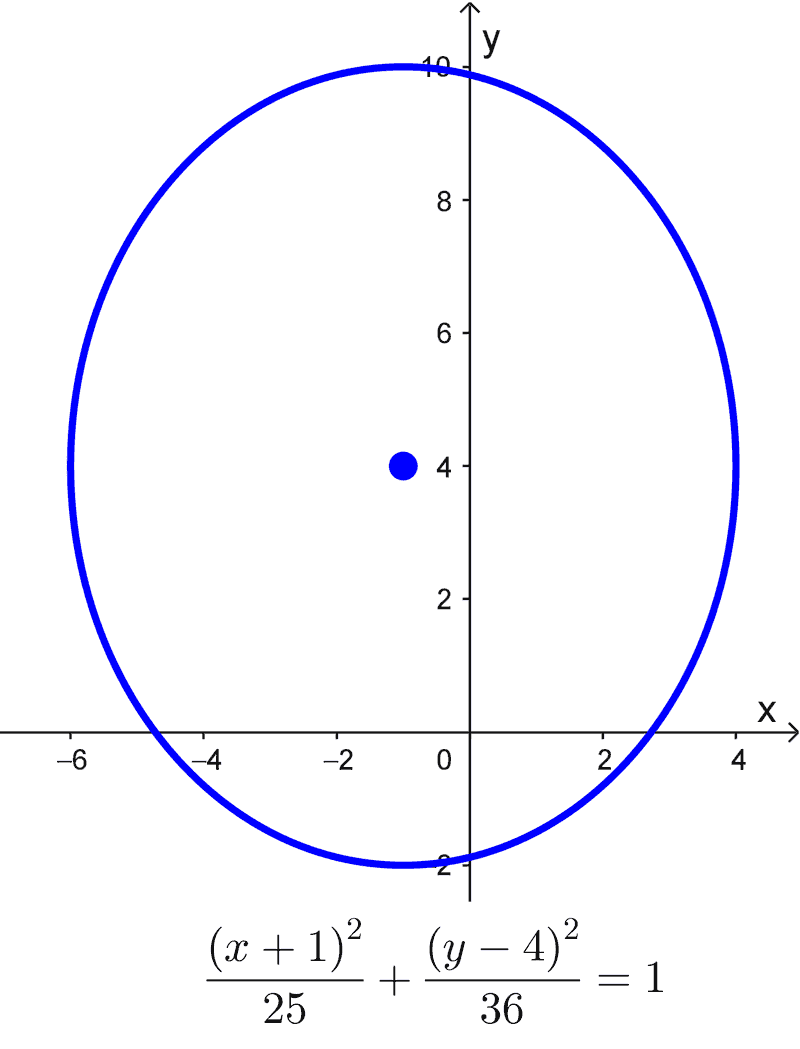
$$\dfrac{(x+1)^2}{25}+\dfrac{(y-4)^2}{36}=1$$
This shows that the equation represents a vertical ellipse with center at (-1, 4), semi-major axis length of 6, and semi-minor axis length of 5.
Example 2
Convert the equation \(-25x^2+4y^2-150x-8y-321=0\) to standard form.
Solution: Follow a similar procedure:
First, group the x and y terms and move the constant term to the right side:
$$-25x^2-150x+4y^2-8y=321$$
Factor out the leading coefficients:
$$-25(x^2+6x)+4(y^2-2y)=321$$
Complete the square for each variable.
For x: Take the linear coefficient 6. Complete the square by adding \(\left(\dfrac{6}{2}\right)^2=9:\)
$$x^2+6x=(x+3)^2-9$$
Multiply by -25:
$$-25[(x+3)^2-9]=-25(x+3)^2+225$$
For y: Take the linear coefficient -2. Complete the square by adding \(\left(\dfrac{-2}{2}\right)^2=1:\)
$$y^2-2y=(y-1)^2-1$$
Multiply by 4:
$$4[(y-1)^2-1]=4(y-1)^2-4$$
Substitute these results back into the equation:
$$-25(x+3)^2+225+4(y-1)^2-4=321$$
Combine the constants:
$$-25(x+3)^2+4(y-1)^2+221=321$$
Subtract 221 from both sides:
$$-25(x+3)^2+4(y-1)^2=100$$
Rearrange with the positive term first and divide by 100:
$$\dfrac{4(y-1)^2}{100}-\dfrac{25(x+3)^2}{100}=1$$
Simplify each fraction:
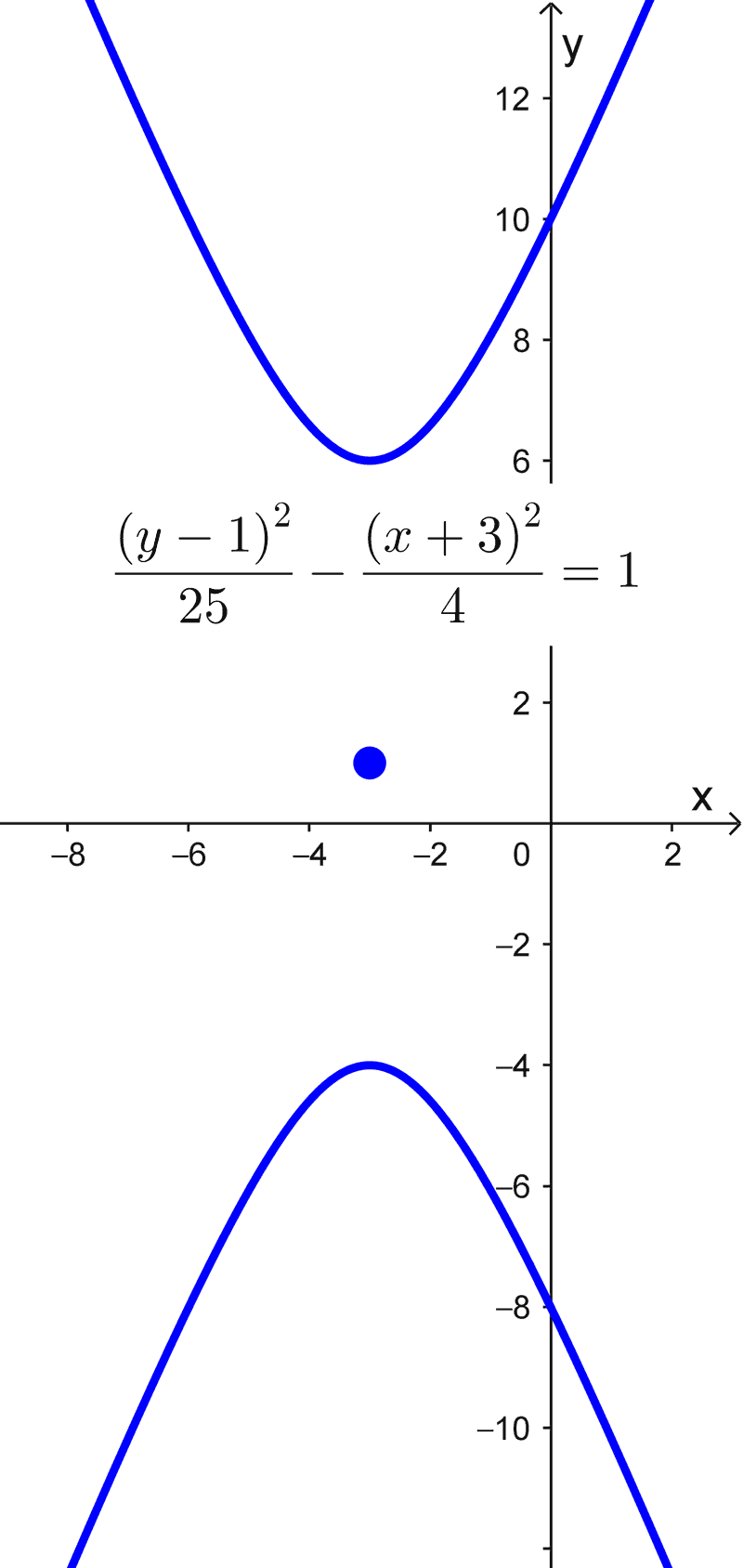
$$\dfrac{(y-1)^2}{25}-\dfrac{(x+3)^2}{4}=1$$
This reveals that the equation represents a vertical hyperbola centered at (-3, 1), opening upward and downward, with semi-axis lengths of 5 along the y-direction and 2 along the x-direction.
Resource: If you are working with the general equation and want to check your conic classification and graph, you can use our free tool:
Example 3
Find the standard form of the equation \(x^2-4x-12y-8=0\)
Solution: Proceed as follows:
First, isolate the x terms on one side and move the y term and constant to the other side:
$$x^2-4x=12y+8$$
Now, complete the square on the x terms. Take the linear coefficient -4 and add \(\left(\dfrac{-4}{2}\right)^2=4:\)
$$x^2-4x=(x-2)^2-4$$
Substitute this into the equation:
$$(x-2)^2-4=12y+8$$
Add 4 to both sides to isolate the squared binomial:
$$(x-2)^2=12y+12$$
Factor out 12 on the right side:
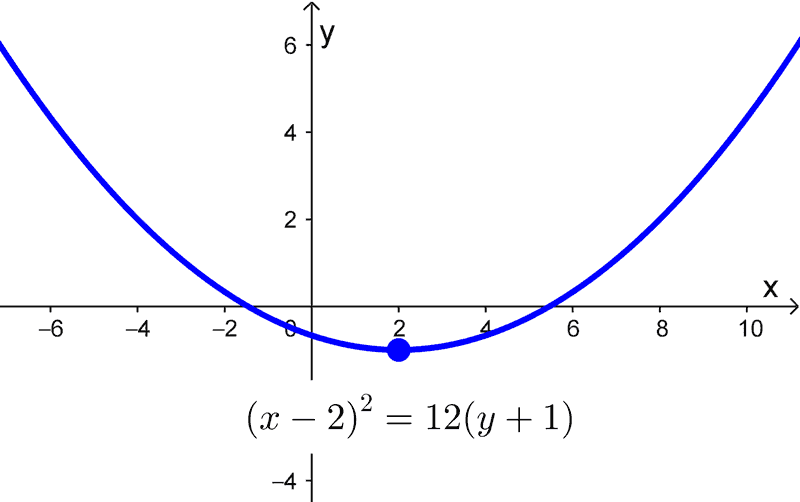
$$(x-2)^2=12(y+1)$$
This equation represents a vertical parabola with vertex at (2, -1) opening upward, since the squared term is in x and the coefficient on the linear y term is positive.
When B ≠ 0
When the Bxy term is present in the general equation of a conic section, a rotation of axes is required to eliminate the cross-product term and simplify the equation. Rotating the coordinate system yields a new equation expressed in transformed variables, x' and y', whose axes align with the principal axes of the conic.
After rotation, the new equation takes the form:
A'x'2 + C'y'2 + D'x' + E'y' + F' = 0
To perform this rotation, express the original coordinates x and y in terms of the new coordinates x’ and y’ using the standard coordinate rotation formulas:
$$x=x' \cos\alpha-y'\sin\alpha$$
$$y=x' \sin\alpha+y'\cos\alpha$$
The angle of rotation α is selected specifically to eliminate the cross-product term. This angle can be calculated using the double-angle tangent formula:
$$\tan(2α)=\dfrac{B}{A-C}$$
Once tan(2α) is known, use the following trigonometric identities to find the exact values of cos(α) and sin(α):
$$\cos(2\alpha)=\pm \dfrac{1}{\sqrt{\tan^2(2\alpha)+1}}$$
$$\sin\alpha=\sqrt{\dfrac{1-\cos(2\alpha)}{2}}$$
$$\cos\alpha=\sqrt{\dfrac{1+\cos(2\alpha)}{2}}$$
Choose cos(2α) to have the same sign as tan(2α). A special case occurs when A = C; here, the rotation angle is exactly 45°.
Once this rotation is applied, the cross-product term disappears, and we can complete the square in the transformed equation to find the standard form of the conic section.
Example 1
Perform a rotation of axes to eliminate the xy-term from the equation \(3x^2+3xy-y^2=9\)
Solution: Identify the relevant coefficients: A=3, B=3, and C=-1. First, find the rotation angle α that eliminates the xy-term using the double-angle formula:
$$\tan(2\alpha)=\dfrac{B}{A-C}=\dfrac{3}{3-(-1)}=\dfrac{3}{4}$$
Using this result, calculate \(\cos(2\alpha):\)
$$\cos(2\alpha)=\dfrac{1}{\sqrt{\tan^2(2\alpha)+1}}=\dfrac{1}{\sqrt{\left(\dfrac{3}{4}\right)^2+1}}=\dfrac{1}{\sqrt{\dfrac{9}{16}+1}}=\dfrac{1}{\sqrt{\dfrac{25}{16}}}=\dfrac{4}{5}$$
Now find the half-angle values for \(\sin\alpha\) and \(\cos\alpha\):
$$\sin\alpha=\sqrt{\dfrac{1-\cos(2\alpha)}{2}}=\sqrt{\dfrac{1-\dfrac{4}{5}}{2}}=\sqrt{\dfrac{\dfrac{1}{5}}{2}}=\sqrt{\dfrac{1}{10}}=\dfrac{1}{\sqrt{10}}$$
$$\cos\alpha=\sqrt{\dfrac{1+\cos(2\alpha)}{2}}=\sqrt{\dfrac{1+\dfrac{4}{5}}{2}}=\sqrt{\dfrac{\dfrac{9}{5}}{2}}=\sqrt{\dfrac{9}{10}}=\dfrac{3}{\sqrt{10}}$$
Substitute these values into the coordinate rotation formulas:
$$x=x'\cos\alpha-y'\sin\alpha=x'\left(\dfrac{3}{\sqrt{10}}\right)-y'\left(\dfrac{1}{\sqrt{10}}\right)=\dfrac{3x'-y'}{\sqrt{10}}$$
$$y=x'\sin\alpha+y'\cos\alpha=x'\left(\dfrac{1}{\sqrt{10}}\right)+y'\left(\dfrac{3}{\sqrt{10}}\right)=\dfrac{x'+3y'}{\sqrt{10}}$$
Substitute these expressions into the original equation \(3x^2+3xy-y^2=9\):
$$3\left(\dfrac{3x'-y'}{\sqrt{10}}\right)^2+3\left(\dfrac{3x'-y'}{\sqrt{10}}\right)\left(\dfrac{x'+3y'}{\sqrt{10}}\right)-\left(\dfrac{x'+3y'}{\sqrt{10}}\right)^2=9$$
Expanding and collecting like terms:
$$7x'^2-3y'^2=18$$
The resulting equation corresponds to a hyperbola, as the squared terms have opposite signs. To convert it into standard form in the rotated system, divide the entire equation by 18:
$$\dfrac{7x'^2}{18}-\dfrac{3y'^2}{18}=1$$
Simplifying the fractions:
$$\dfrac{x'^2}{\dfrac{18}{7}}-\dfrac{y'^2}{6}=1$$
This is the standard form of the hyperbola relative to the rotated axes x' and y', showing semi-axes of lengths \(\sqrt{\dfrac{18}{7}}\) and \(\sqrt{6},\) respectively.

Example 2
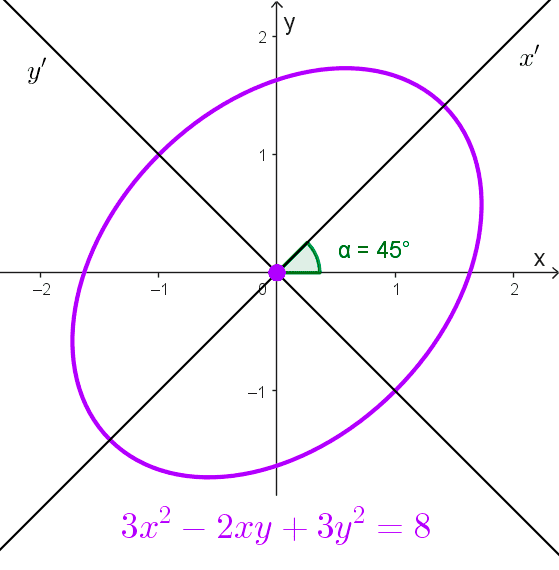
Eliminate the xy-term by rotating axes and identify the curve given by: \(3x^2-2xy+3y^2=8\)
Solution
Comparing with the general equation yields A=3, B=-2, and C=3. Since A = C, the angle of rotation is 45°. Therefore, the rotation equations become:
$$x=x'\cos45^\circ-y'\sin45^\circ=\dfrac{1}{\sqrt{2}}x'-\dfrac{1}{\sqrt{2}}y'=\dfrac{x'-y'}{\sqrt{2}}$$
$$y=x'\sin45^\circ+y'\cos45^\circ=\dfrac{1}{\sqrt{2}}x'+\dfrac{1}{\sqrt{2}}y'=\dfrac{x'+y'}{\sqrt{2}}$$
Substitute these expressions into \(3x^2-2xy+3y^2=8:\)
$$3\left(\dfrac{x'-y'}{\sqrt{2}}\right)^2-2\left(\dfrac{x'-y'}{\sqrt{2}}\right)\left(\dfrac{x'+y'}{\sqrt{2}}\right)+3\left(\dfrac{x'+y'}{\sqrt{2}}\right)^2=8$$
Expanding and simplifying the equation:
$$3\left(\dfrac{x'^2}{2}-2\dfrac{x'y'}{2}+\dfrac{y'^2}{2}\right)-2\left(\dfrac{x'^2}{2}-\dfrac{y'^2}{2}\right)+3\left(\dfrac{x'^2}{2}+2\dfrac{x'y'}{2}+\dfrac{y'^2}{2}\right)=8$$
$$\dfrac{3x'^2}{2}-3x'y'+\dfrac{3y'^2}{2}-x'^2+y'^2+\dfrac{3x'^2}{2}+3x'y'+\dfrac{3y'^2}{2}=8$$
$$\dfrac{6x'^2}{2}+\dfrac{6y'^2}{2}-x'^2+y'^2=8$$
$$2x'^2+4y'^2=8$$
Dividing by 2:
$$x'^2+2y'^2=4$$
This equation represents an ellipse. To put it in standard form, divide both sides by 4:
$$\dfrac{x'^2}{4}+\dfrac{2y'^2}{4}=1$$
Simplifying:
$$\dfrac{x'^2}{4}+\dfrac{y'^2}{2}=1$$
We see that the ellipse has semi-axes \(a=2\) and \(b=\sqrt{2}.\)
Did you find this useful? Rate it!
0.0 / 5 — 0 votes

HOW TO CITE THIS ARTICLE
Machado, D. (2026, October 28). General Equation of Conic Sections. Exponty. https://exponty.com/en/general-equation-conic-sections
Parametric Equations of Conic Sections
Polar Equations of Conic Sections
History of Conic Sections
Applications of Conic Sections
Eccentricity of Conic Sections
Degenerate Conic Sections
Conic Sections Practice Problems with Solutions
Parabola
Hyperbola
Ellipse
Leave a Reply
Related posts