
Center of a Hyperbola
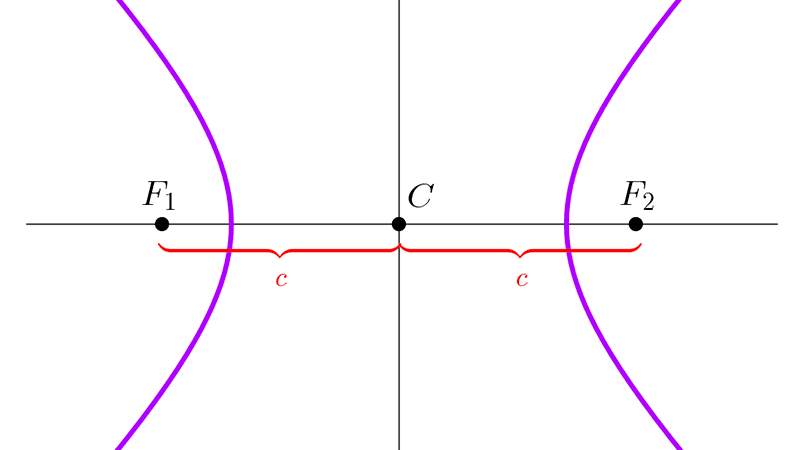
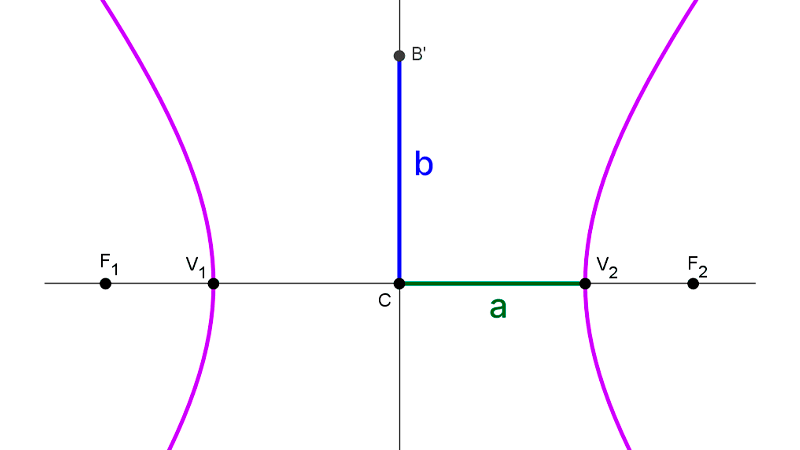
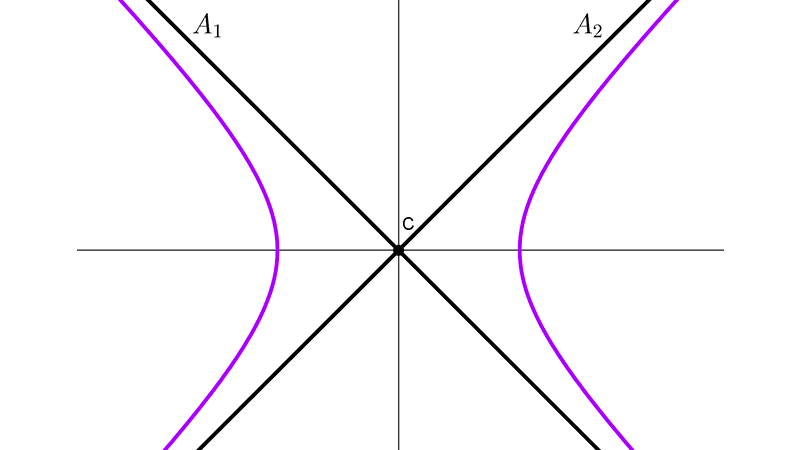
The center of a hyperbola is the midpoint between its foci, as well as the midpoint between its vertices, and the intersection of the transverse and conjugate axes. It is also the point where the asymptotes of the curve intersect.
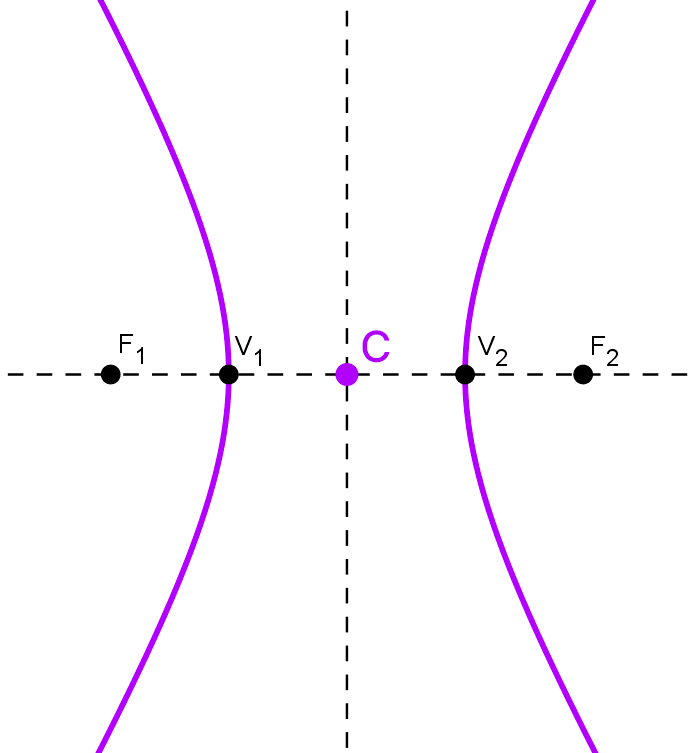
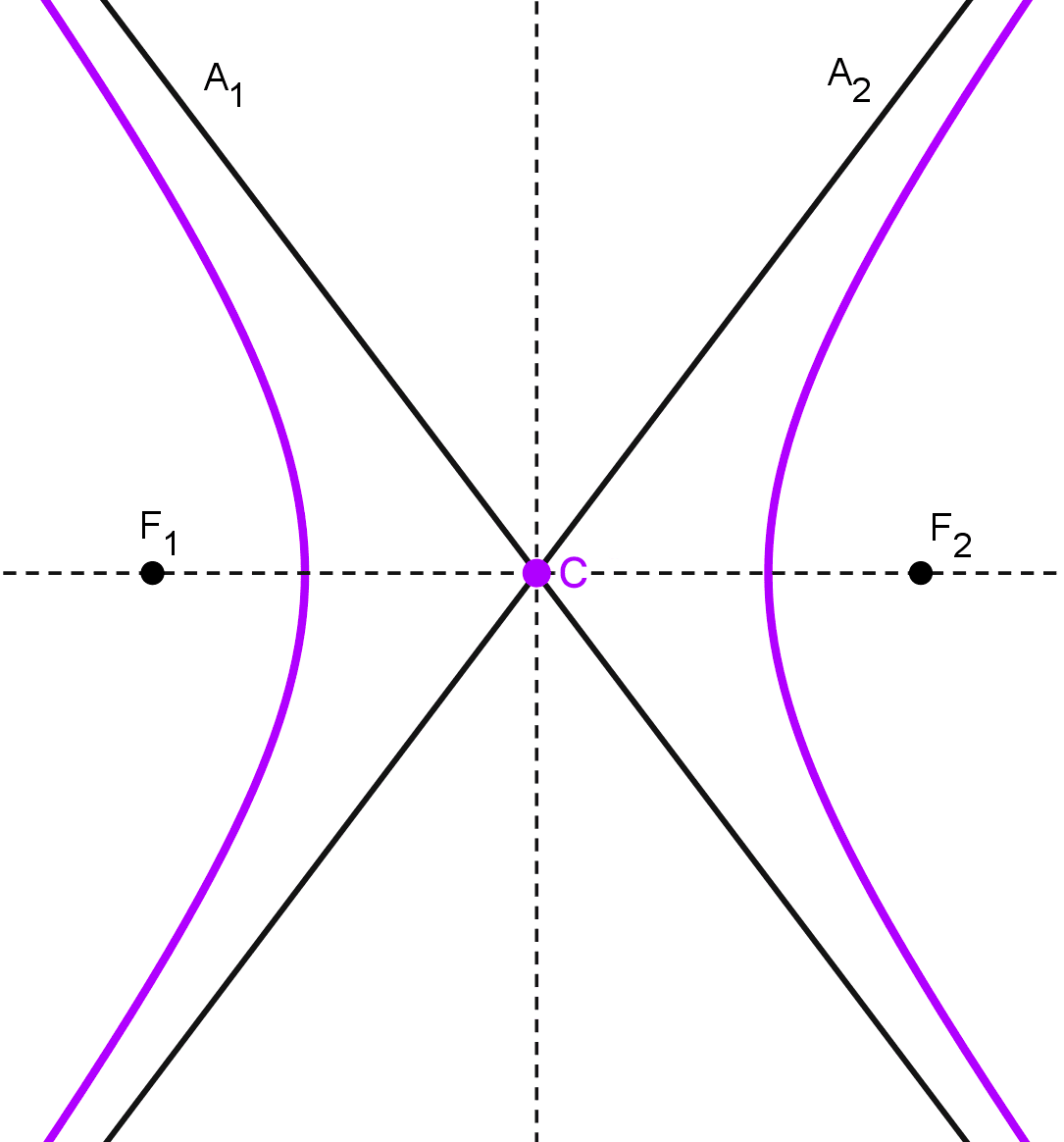
The center can be located at the origin (0, 0) or at any other point in the coordinate plane generically denoted by (h, k).
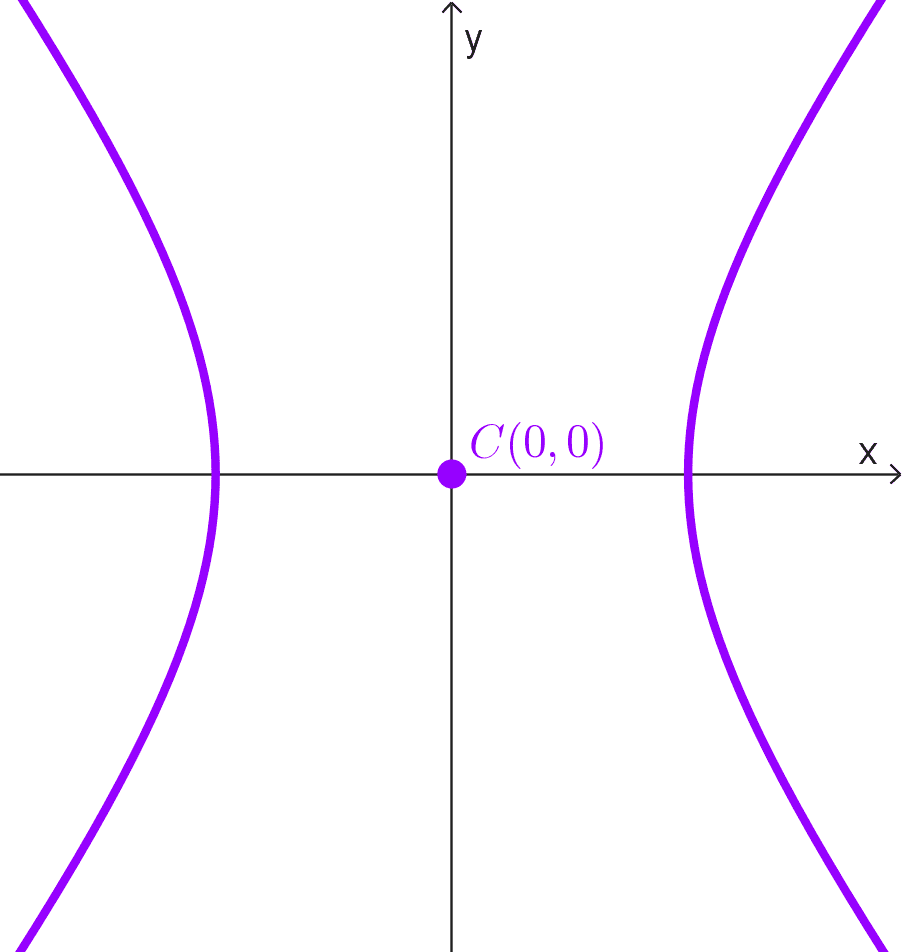

To find the center of a hyperbola, we can look at its standard form, which explicitly displays the coordinates of the center. The equation when the center is at the origin is simpler than when the center is at another point. This can also be seen in the general form, where linear terms Dx and Ey are introduced in the second case.
| Center | Standard Form | General Form |
|---|---|---|
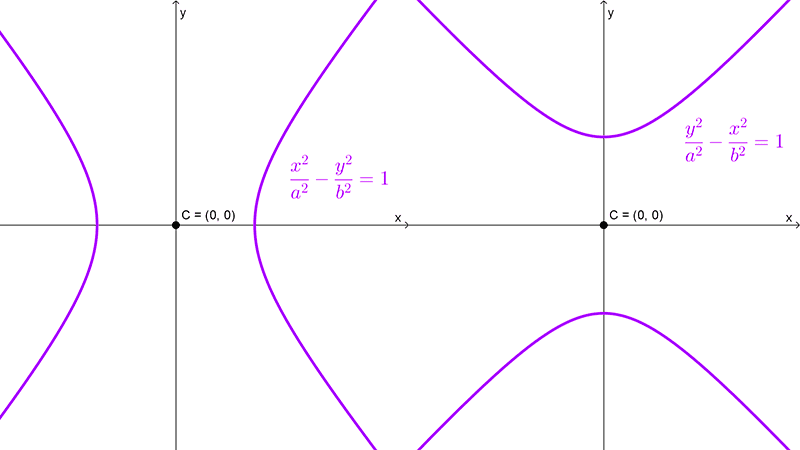
| At the origin, point (0, 0) | \(\dfrac{x^2}{a^2}-\dfrac{y^2}{b^2}=1\) \(\dfrac{y^2}{a^2}-\dfrac{x^2}{b^2}=1\) | Ax² + Cy² + F = 0 A and C have opposite signs. |
| Away from the origin, point (h, k) | \(\dfrac{(x-h)^2}{a^2}-\dfrac{(y-k)^2}{b^2}=1\) \(\dfrac{(y-k)^2}{a^2}-\dfrac{(x-h)^2}{b^2}=1\) | Ax² + Cy² + Dx + Ey + F = 0 A and C have opposite signs. |
In the standard equation of a hyperbola centered at the origin, the variables x and y are squared on their own, whereas if the center is (h, k), those coordinates appear with their signs reversed alongside the corresponding variable.
Important: If you are not yet familiar with what a hyperbola is in mathematics, we recommend reviewing the main article first, where we cover its concept, definition, formulas, and properties.
How to Find the Center
There are several ways to determine the coordinates of the center of a hyperbola depending on the given information:
- If you are given the standard equation, you can inspect it directly to extract the center coordinates. If you have the general form, you can complete the square algebraically to convert it into standard form.
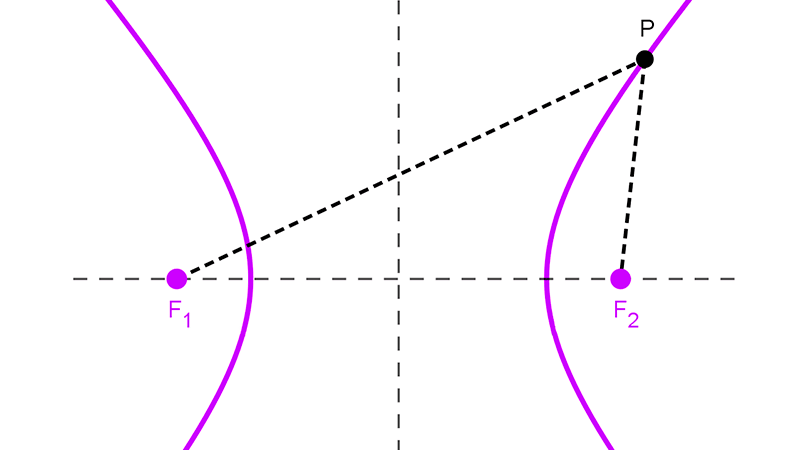
- If you are given the coordinates of the foci, the center is the midpoint between them. The same applies if you have the coordinates of the vertices.
- If you are given the graph, the center is the point of intersection of the asymptotes or of the transverse and conjugate axes.
Worked Examples
Below are step-by-step examples of finding the center of a hyperbola.
Example 1
Find the center of the hyperbola \(\dfrac{x^2}{4}-\dfrac{y^2}{9}=1\)
Solution: We identify that the equation is in standard form. Since the variables are not inside parentheses shifted by any constant, the center of this hyperbola is at the origin, point C(0, 0).

Example 2
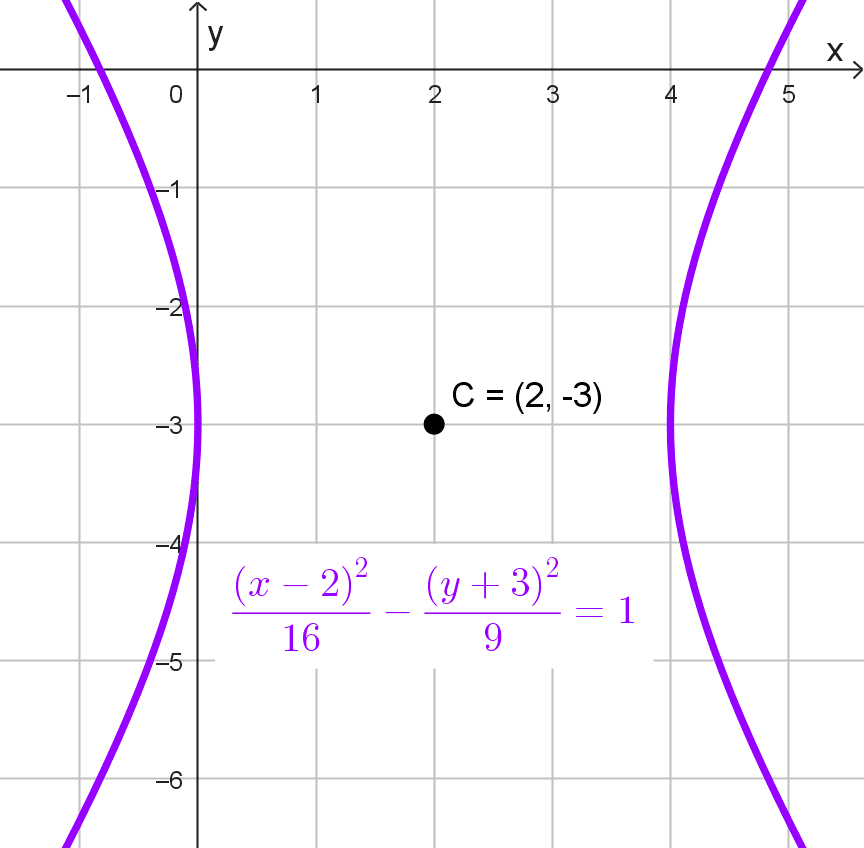
Find the center of the hyperbola with equation \(\dfrac{(x-2)^2}{16}-\dfrac{(y+3)^2}{9}=1\)
Solution: We begin by identifying the standard form. The standard equation for a horizontal hyperbola is:
$$\dfrac{(x-h)^2}{a^2}-\dfrac{(y-k)^2}{b^2}=1$$
where (h, k) represents the coordinates of the center of the hyperbola. Comparing the given equation to standard form, we have:
\(h = 2,\) since the term containing x is \((x-2)\)
\(k = -3,\) since the term containing y is \((y+3)\)
Therefore, the center of the hyperbola is: C(2, -3).
Example 3
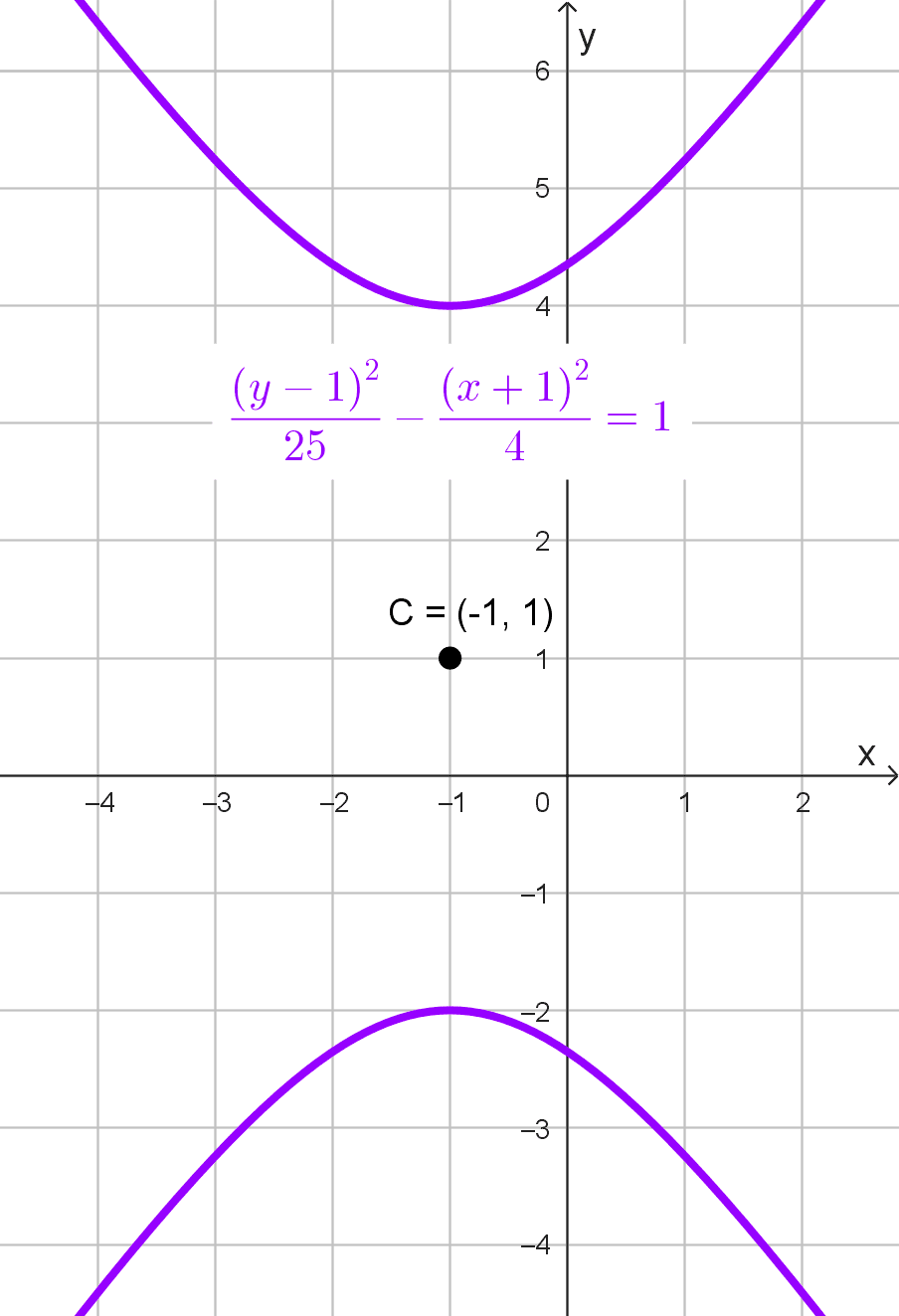
Find the center of \(\dfrac{(y-1)^2}{25}-\dfrac{(x+1)^2}{4}=1\)
Solution: We compare the given equation with the standard form of a vertical hyperbola centered at (h, k):
$$\dfrac{(y-k)^2}{a^2}-\dfrac{(x-h)^2}{b^2}=1$$
From this comparison, we identify that in the given equation:
$$y-k=y-1→k=1$$
$$x-h=x+1→h=-1$$
Remember that \(h\) is always paired with \(x\) and \(k\) is always paired with \(y\). Therefore, the center of the hyperbola is the point \((h, k) = (-1, 1)\).
Example 4
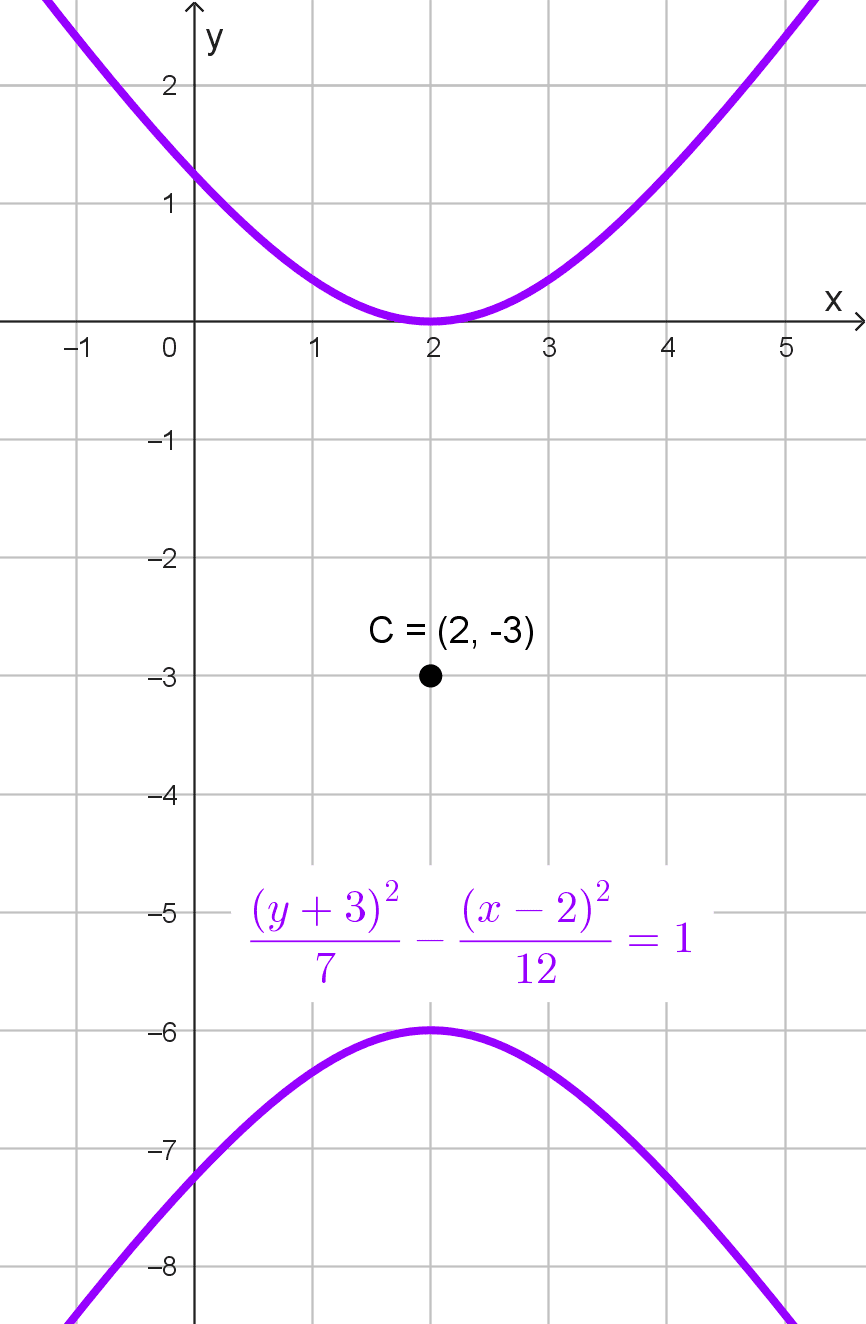
Given the hyperbola \(-7x^2+12y^2+28x+72y-4=0\), find its center.
Solution: In this case, the equation is in general form rather than standard form, but we can complete the square to obtain an equivalent standard equation:
$$\dfrac{(y+3)^2}{7}-\dfrac{(x-2)^2}{12}=1$$
This is the equation of a vertical hyperbola centered away from the origin. We extract the center coordinates from the binomials in parentheses by reversing the signs of the constants paired with each variable:
$$k=-3$$
$$h=-(-2)=2$$
Therefore, the center is the point C(2, -3).
Example 5
Find the center of a hyperbola whose foci are the points F1(-5, 3) and F2(2, 3)
Solution: Since the center is the midpoint between the foci of a hyperbola, we use the midpoint formula to find it:
$$(h,k)=\left( \dfrac{x_1+x_2}{2}, \dfrac{y_1+y_2}{2} \right)$$
Substituting the coordinates of \(F_1(-5, 3) \ \text{and}\ F_2(2, 3):\)
$$(h,k)=\left(\dfrac{-5+2}{2}, \dfrac{3+3}{2} \right)=\left(-\dfrac{3}{2}, \dfrac{6}{2} \right)=\left(-\dfrac{3}{2}, 3\right)$$
Since -3/2 = -1.5, the center of the hyperbola is: C(-3/2, 3), or in decimal form C(-1.5, 3).
Did you find this useful? Rate it!
0.0 / 5 — 0 votes

HOW TO CITE THIS ARTICLE
Machado, D. (2026, November 2). Center of a Hyperbola. Exponty. https://exponty.com/en/hyperbola-center
Focal Distance of a Hyperbola
Vertices of a Hyperbola
Horizontal and Vertical Hyperbolas
Rectangular Hyperbola
Transverse and Conjugate Axes of a Hyperbola
Foci of a Hyperbola
Asymptotes of a Hyperbola
Hyperbola Practice Problems with Solutions
Leave a Reply
Related posts