
Major and Minor Axes of an Ellipse
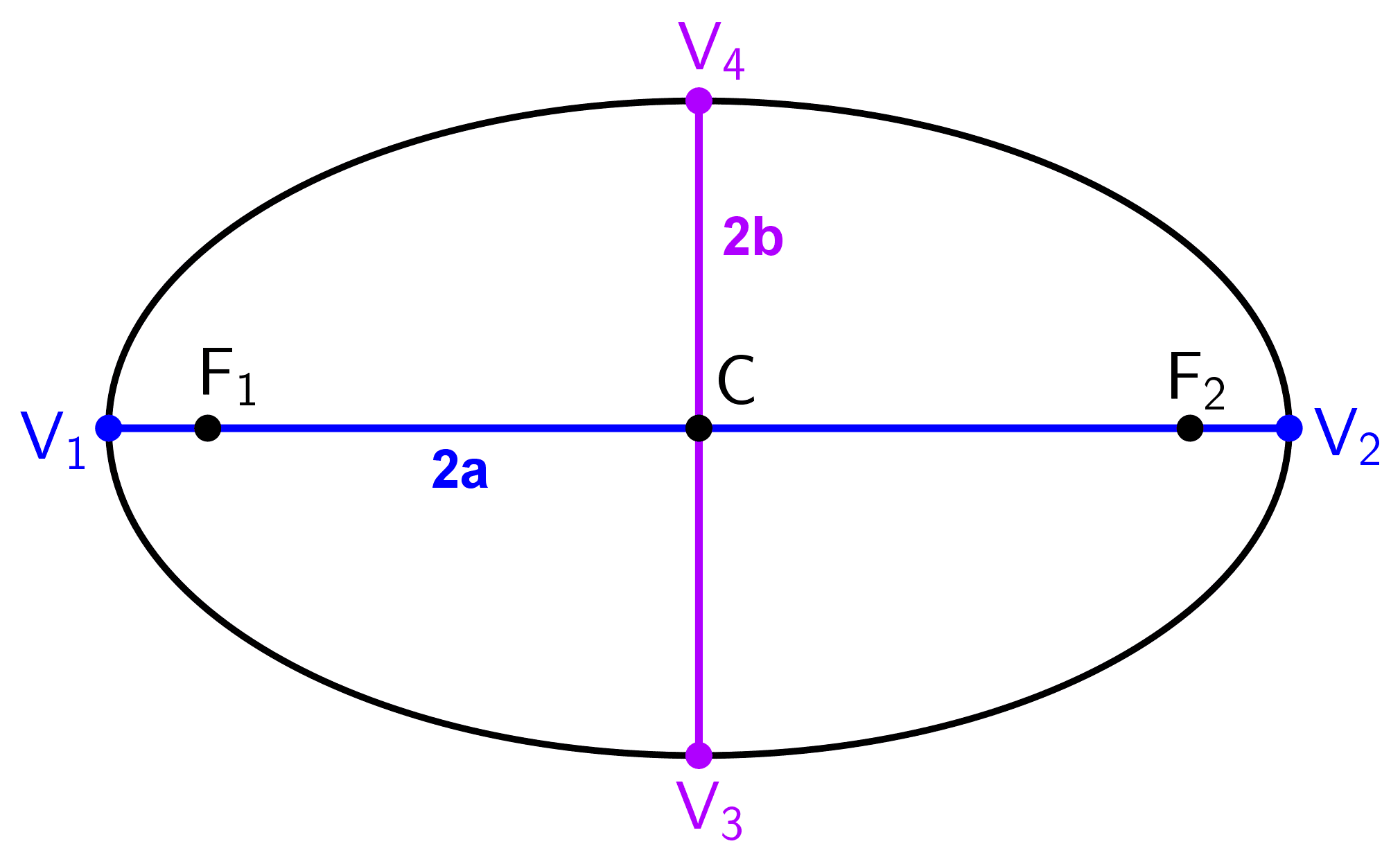
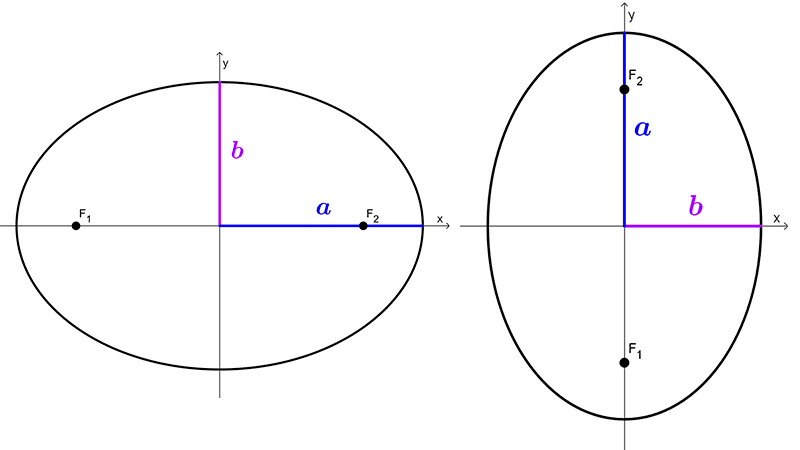
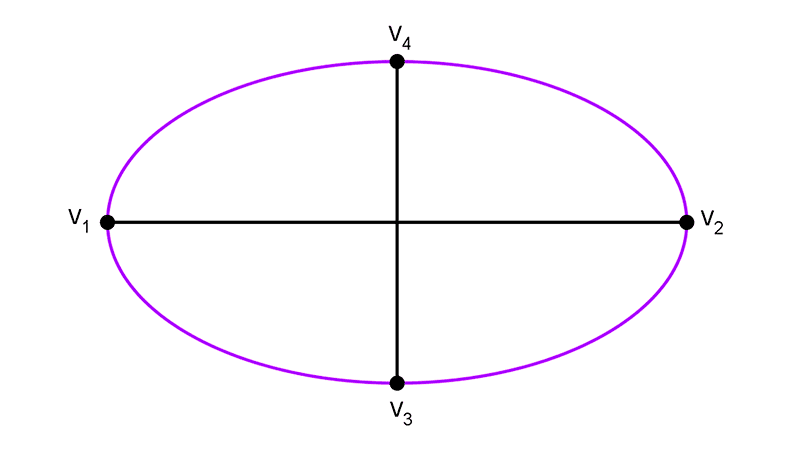
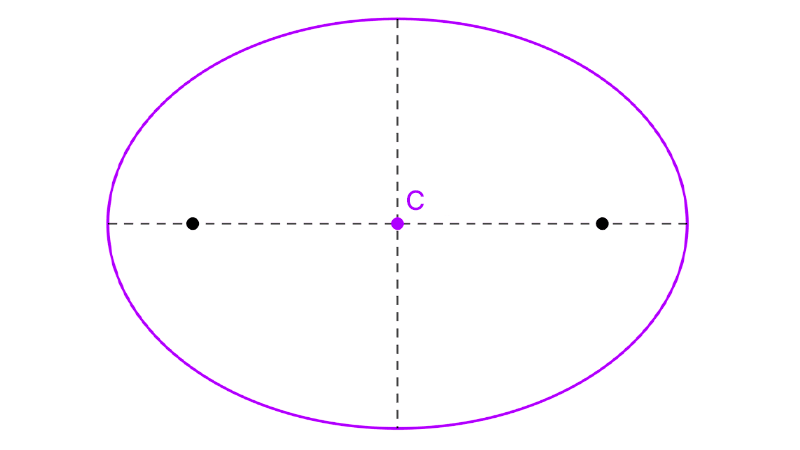
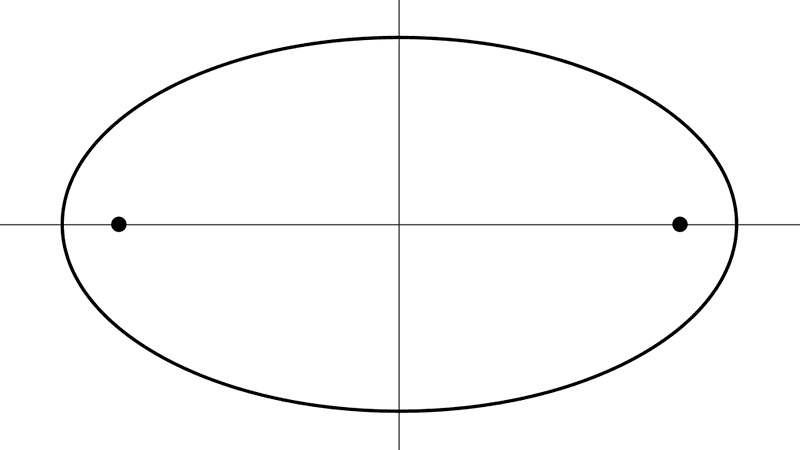
The axes of an ellipse are two line segments that connect the vertices and co-vertices, passing through the center. There are two main axes: the major axis, whose endpoints are the vertices and passes through the foci and the center; and the minor axis, which is perpendicular to the major axis, has the co-vertices as its endpoints, and passes through the center.
Half of the major axis is called the semi-major axis, and its length is denoted by the letter "a"; similarly, half of the minor axis is called the semi-minor axis, and its length is denoted by "b". Because of this, the major axis has a length of 2a and the minor axis has a length of 2b.
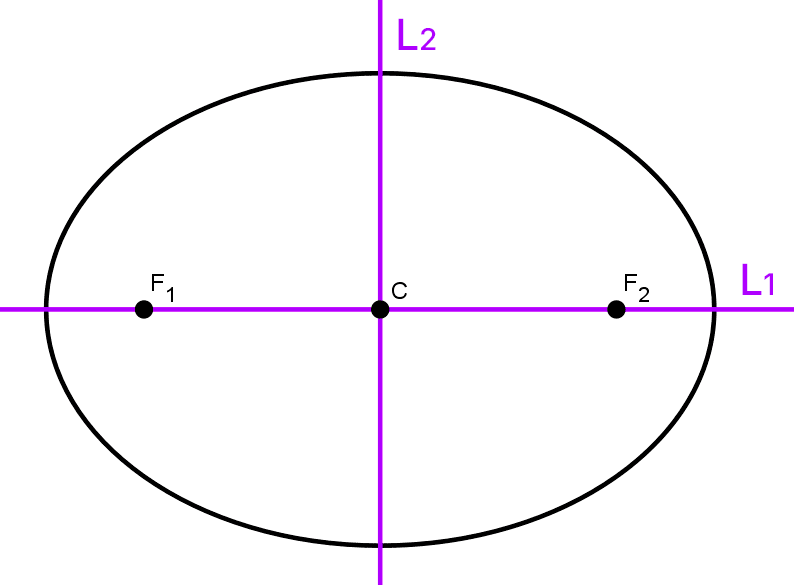
Depending on the orientation of the major axis, the ellipse is horizontal if the major axis is parallel to the x-axis, or vertical if the major axis is parallel to the y-axis. The major axis can also be oblique, resulting in a rotated ellipse, but that case is not covered in this article.
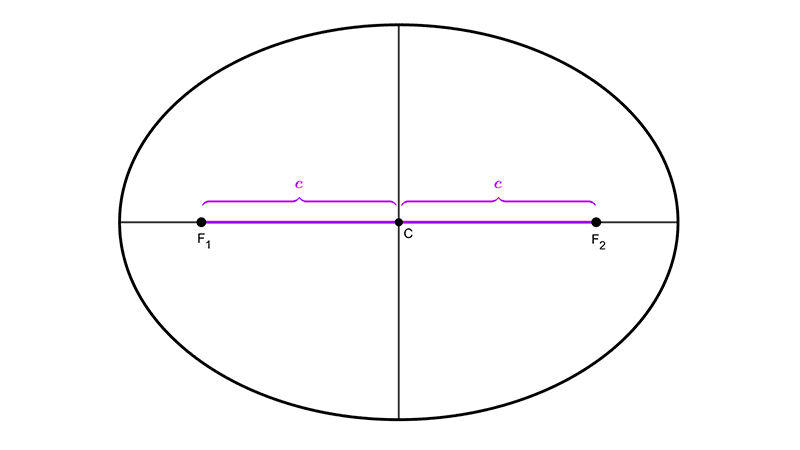
There is a relationship between the lengths of the semi-axes and the distance c (the distance from the center to each focus), which states that the square of the distance c is equal to the difference between the squares of the semi-axis lengths, expressed by the following formula:
c2 = a2 - b2
The semi-axes can have the same length, in which case the ellipse is a circle and the semi-axes become radii of the circle. In this article, we will focus on cases where a > b.
An ellipse also has two axes of symmetry, which are the lines containing the major axis and the minor axis. The axis of symmetry that contains the major axis is also commonly called the focal axis, since it contains the foci.
Below, we will look at examples of how to find the lengths of the axes and semi-axes from the equation.
Note: This article focuses specifically on the axes of an ellipse. If you want a complete overview of the geometric concept, check out our main guide covering definitions, formulas, parts, types, and properties.
How to Find the Axes of an Ellipse
The lengths of the semi-axes appear in the standard form of the ellipse squared as the denominators of each variable term.
| Orientation | Standard Form | Axes and Semi-Axes | Axes of Symmetry |
|---|---|---|---|
| Horizontal ellipse | \(\dfrac{(x-h)^2}{a^2}+\dfrac{(y-k)^2}{b^2}=1\) | The semi-major axis is a; the semi-minor axis is b. The major axis is 2a and the minor axis is 2b. | y = k (major axis) x = h (minor axis) |
| Vertical ellipse | \(\dfrac{(x-h)^2}{b^2}+\dfrac{(y-k)^2}{a^2}=1\) | The semi-major axis is a; the semi-minor axis is b. The major axis is 2a and the minor axis is 2b. | x = h (major axis) y = k (minor axis) |
The larger denominator gives the length of the semi-major axis, denoted by a:
- If the larger denominator is under the term with x, the major axis is parallel to the x-axis, resulting in a horizontal ellipse.
- If the larger denominator is under the term with y, the major axis is parallel to the y-axis, resulting in a vertical ellipse.
Similarly, the smaller denominator gives the length of the semi-minor axis, b. To find the total length of each axis, simply multiply the values of a and b by 2.
The step-by-step process to find the axes is summarized below:
- If the equation is not in standard form, manipulate it algebraically to write it in standard form.
- Take the square root of the larger denominator a2 to find the semi-major axis, a.
- Take the square root of the smaller denominator b2 to find the semi-minor axis, b.
- Multiply a by 2 to find the length of the major axis.
- Multiply b by 2 to find the length of the minor axis.
Worked Examples
Below are step-by-step worked examples to practice finding the axes and semi-axes of an ellipse.
Example 1
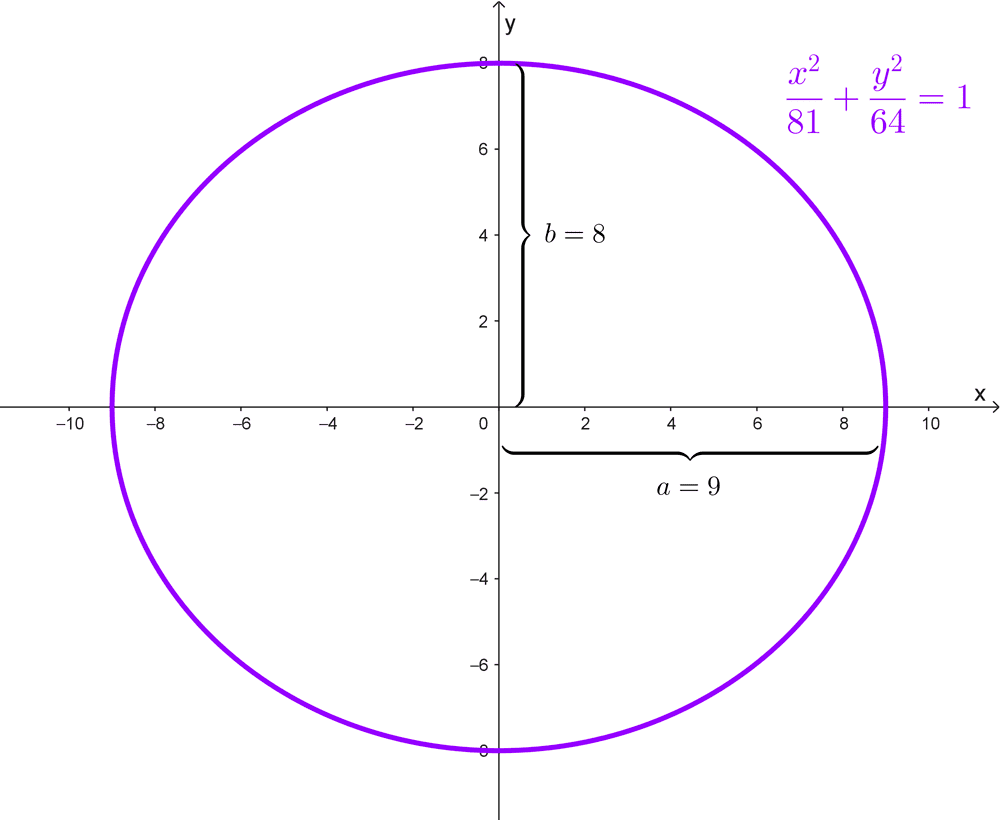
Find the axes of the ellipse given by \(\dfrac{x^2}{81}+\dfrac{y^2}{64}=1\).
Solution: The equation is already in standard form, so we can directly identify the necessary values.
The larger denominator is 81, so \(a^2=81 → a=\sqrt{81}=9.\)
The smaller denominator is 64, so \(b^2=64→b=\sqrt{64}=8.\)
Thus, the semi-major axis is a = 9 and the semi-minor axis is b = 8. Using these values, we determine the lengths of the axes by multiplying by 2:
- Major axis: \(2a=2\cdot 9=18\)
- Minor axis: \(2b=2\cdot 8=16\)
Example 2
Find the axes of the ellipse \(\dfrac{(x-3)^2}{4}+\dfrac{(y+4)^2}{36}=1\).
Solution: The equation is in standard form, allowing us to read the values directly.
$$a^2=36→a=\sqrt{36}=6$$
$$b^2=4→b=\sqrt{4}=2$$
The semi-major axis is a = 6 and the semi-minor axis is b = 2. We find the lengths of the axes by multiplying by 2:
- Major axis: \(2a=2\cdot 6=12\)
- Minor axis: \(2b=2\cdot 2=4\)
To find the axes of symmetry, we identify the center of the ellipse and write the equations of the lines passing through it. From the standard form, the center is (3, -4); therefore, the axes of symmetry are the following lines:
x = 3
y = -4
Example 3
Find the axes of the ellipse with equation \(16x^2+25y^2=100\).
Solution: The equation is not in standard form, so we cannot read the values immediately. Dividing the entire equation by 100 transforms it into standard form:
$$\dfrac{x^2}{25/4}+\dfrac{y^2}{4}=1$$
Now we can identify the semi-axes and compute the length of each axis:
$$a^2=\dfrac{25}{4}→a=\sqrt{\dfrac{25}{4}}=\dfrac{5}{2}$$
$$b^2=4→b=\sqrt{4}=2$$
Therefore:
- Major axis: \(2a=2\cdot \dfrac{5}{2}=5\)
- Minor axis: \(2b=2\cdot 2=4\)
Example 4
Find the axes and semi-axes of the ellipse \(2x^2+4x+7y^2-28y-40=0\).
Solution: As in the previous example, the equation is not in standard form. Completing the square for both variables yields the equivalent standard equation:
$$\dfrac{(x+1)^2}{35}+\dfrac{(y-2)^2}{10}=1$$
From this equation:
$$a^2=35→a=\sqrt{35}$$
$$b^2=10→b=\sqrt{10}$$
Therefore:
- Major axis: \(2a=2\sqrt{35}≈11.83\)
- Minor axis: \(2b=2\sqrt{10}≈6.32\)
Did you find this useful? Rate it!
0.0 / 5 — 0 votes

HOW TO CITE THIS ARTICLE
Machado, D. (2026, October 31). Major and Minor Axes of an Ellipse. Exponty. https://exponty.com/en/major-minor-axis-ellipse
Focal Distance of an Ellipse
Horizontal and Vertical Ellipses
Vertices of an Ellipse
Center of an Ellipse
Foci of an Ellipse
Area of an Ellipse
Ellipse Practice Problems with Solutions
Leave a Reply
Related posts