
Vertex of a Parabola
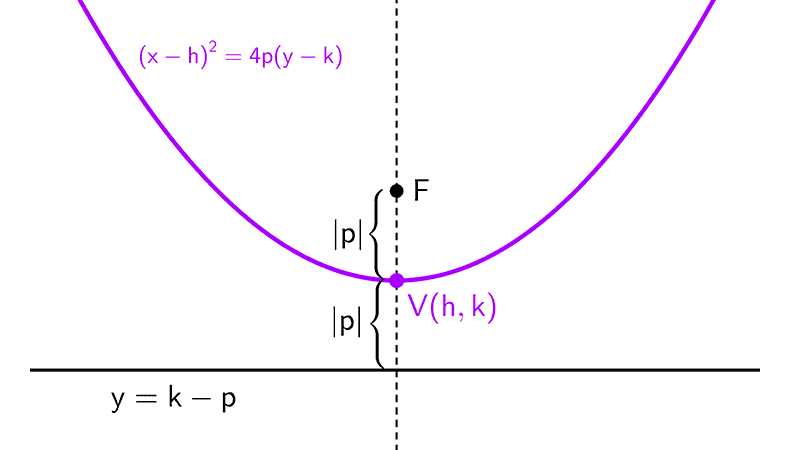
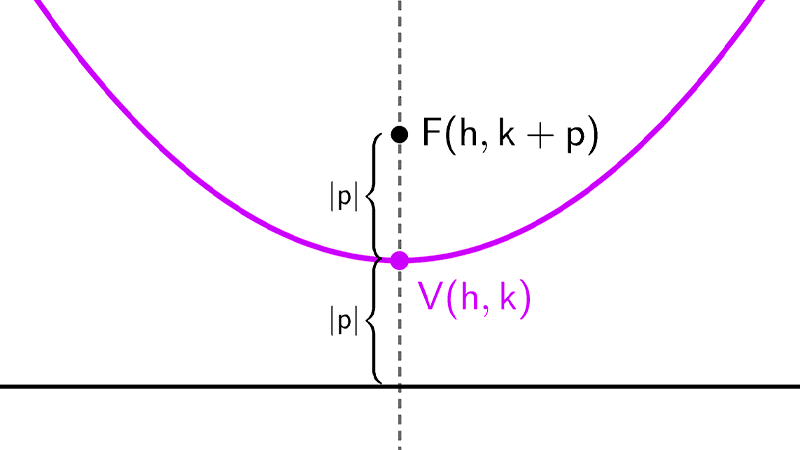
The vertex of a parabola is the point where the parabola intersects its axis of symmetry; it is also the point closest to both the focus and the directrix. The vertex is denoted by the coordinates (h, k) and can be located at the origin or at any other point in the coordinate plane.
For a vertical parabola, the vertex is the maximum or minimum point, depending on whether the parabola opens downward (∩-shaped) or upward (U-shaped), respectively. For a horizontal parabola, the vertex is the point with the highest or lowest x-coordinate, depending on whether it opens to the left (⊃-shaped) or to the right (⊂-shaped), respectively.
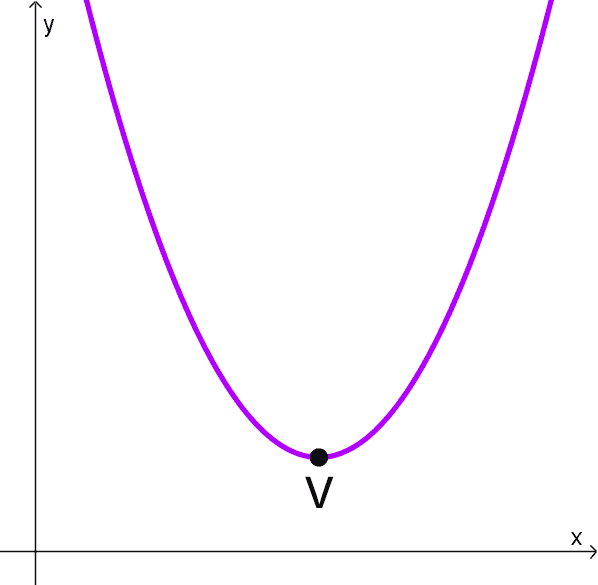
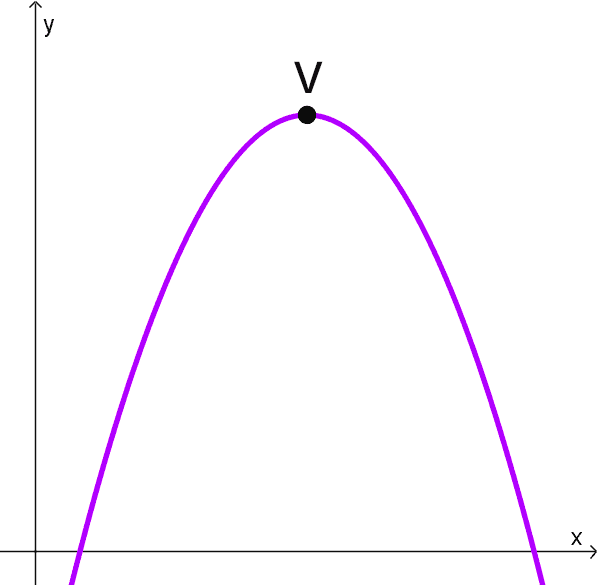
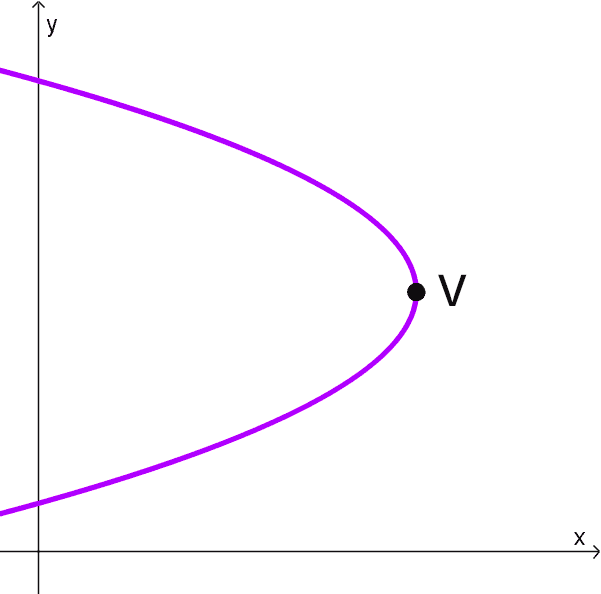
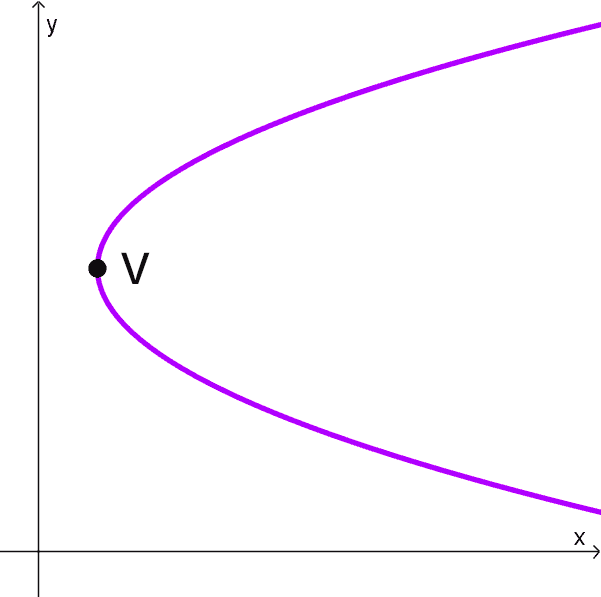
Below, we will explore how to find the vertex based on the orientation of the parabola with step-by-step examples.
Note: This article focuses on a specific element of the parabola. If you want to review the fundamental concepts of this conic section first, feel free to visit our comprehensive guide:
Table of Contents
Vertex of a Vertical Parabola
There are several ways to find the vertex depending on the form of the given equation.
Using the Standard Equation
The standard equation of a vertical parabola with vertex at (h, k) is:
$$(x-h)^2=4p(y-k)$$
where |p| is the distance between the focus and the vertex. Another common way to write it is:
$$y=a(x-h)^2+k ~~\text{where}~~ a=\dfrac{1}{4p}$$
These are known as the "vertex form," as the coordinates of the vertex can be read directly from the equation.
Examples
- In the equation \((x-2)^2=4 (y-3),\) we can directly identify the values of h and k that define the vertex. Here, h is the value subtracted from x inside the squared expression, so h = 2. Similarly, k is the value subtracted from y inside the other term, which gives k = 3. Therefore, the coordinates of the vertex are (2, 3).
- For the equation \((x+2)^2=6y,\) we can rewrite it as \((x-(-2))^2=6 (y-0).\) We identify that h = -2 (due to the plus sign inside the parentheses) and k = 0, since no constant is subtracted from y. Thus, the vertex is located at (-2, 0).
- Consider the equation \((x+1)^2=7 (y+2).\) Comparing it to the standard form, we can write it as \((x-(-1))^2=7 (y-(-2)).\) This reveals that h = -1 and k = -2. Therefore, the vertex of this parabola is at the point (-1, -2).
- In the equation \((x+3)^2=8 (y-4),\) we identify that h = -3, since it is the value subtracted from x to yield (x+3). On the other hand, k = 4, as it is subtracted directly from y. Consequently, the coordinates of the vertex are (-3, 4).
If the vertex is at the origin (0, 0), the equation simplifies to \(x^2=4py.\) For example, the following vertical parabolas all have their vertex at the origin:
- \(y=2x^2\)
- \(y=-5x^2\)
- \(y=\dfrac{1}{4}x^2\)
Using the General Form
The equation of a vertical parabola can also be presented in the general form:
y = ax2 + bx + c
where a, b, and c are real numbers. Since vertical parabolas represent quadratic functions, another common notation is:
f(x) = ax2 + bx + c
In these cases, the vertex has coordinates (h, k) given by the following formulas:
$$h=\dfrac{-b}{2a}$$
$$k=f(h)=-\dfrac{b^2-4ac}{4a}$$
It is not necessary to memorize the second formula because substituting x with h into the parabola's equation directly yields the value of k.
Example 1
Find the vertex of the parabola with equation: \(y=x^2+4x+3\)
Solution
First, identify the coefficients a and b:
- Coefficient a: the number multiplying \(x^2.\) In this case, \(a=1.\)
- Coefficient b: the number multiplying \(x.\) Here, \(b=4.\)
Now calculate the x-coordinate of the vertex (h) using the formula:
$$h=\dfrac{-b}{2a}$$
Substituting the values:
$$h=\dfrac{-4}{2 (1)}=\dfrac{-4}{2}=-2$$
Next, find the y-coordinate of the vertex (k) by substituting \(h=-2\) into the original equation:
$$k=(-2)^2+4 (-2)+3=4-8+3=-1$$
In conclusion, the vertex of the parabola is (-2, -1).

Example 2
Find the vertex of the parabola with equation: \(y=2x^2-8x+5\)
Solution
Start by identifying the coefficients of the quadratic equation. Here, \(a=2\) and \(b=-8.\)
Calculate the x-coordinate of the vertex (h) using the formula:
$$h=\dfrac{-b}{2a}$$
Substituting the values of \(a\) and \(b:\)
$$h=\dfrac{-(-8)}{2 \cdot 2}=\dfrac{8}{4}=2$$
Now, to find the y-coordinate of the vertex (k), substitute \(h=2\) into the original equation:
$$k=2(2)^2-8(2)+5=2(4)-16+5=8-16+5=-3$$
Finally, we conclude that the vertex of the parabola is the point (2, -3).

Resource: If you are solving practice problems and want to check your answers, you can use our free tool:
Example 3
Determine the vertex of the parabola \(y=3x^2-12\)
Solution
First, identify the coefficients of the quadratic equation. Here, \(a=3\) and, since there is no linear term, \(b=0.\)
Calculate the x-coordinate of the vertex (h) using the formula:
$$h=\dfrac{-b}{2a}=\dfrac{-0}{2 \cdot 3}=0$$
Next, find the y-coordinate of the vertex (k) by evaluating \(h=0\) in the original equation:
$$k=3(0)^2-12=0-12=-12$$
Therefore, the vertex of this parabola is at the point (0, -12). In this case, since b = 0, the vertex coincides with the y-intercept of the parabola.

Example 4
Find the coordinates of the vertex of \(y=-x^2+6x-9\)
Solution
The quadratic equation is in the form \(y=ax^2+bx+c.\) In this case:
- \(a=-1\) (coefficient of \(x^2\))
- \(b=6\) (coefficient of \(x\))
- \(c=-9\) (constant term)
To calculate the x-coordinate of the vertex, use the formula:
$$h=\dfrac{-b}{2a}=\dfrac{-6}{2 \cdot (-1)}=\dfrac{-6}{-2}=3$$
Now determine the y-coordinate of the vertex by substituting \(h=3\) into the original equation:
$$k=-(3)^2+6(3)-9=-9+18-9=0$$
Therefore, the vertex of the parabola \(y=-x^2+6x-9\) is located at \((3, 0).\)
Factoring the equation gives \(y=-(x^2-6x+9)=-(x-3)^2,\) which confirms that the vertex is at \((3, 0).\) This form directly shows that the parabola reaches its maximum at that point, since the leading coefficient is negative.

Example 5
Calculate the coordinates of the vertex of the parabola \(x^2+2x+8y+9=0\)
Solution
To find the vertex of the parabola defined by this equation, we first solve for \(y\) to express it in a more convenient form.
Start by isolating the term with \(y:\)
$$8y=-x^2-2x-9$$
Now, divide both sides of the equation by 8 to solve for \(y:\)
$$y=-\dfrac{1}{8}x^2-\dfrac{2}{8}x-\dfrac{9}{8}$$
Simplify the coefficients:
$$y=-\dfrac{1}{8}x^2-\dfrac{1}{4}x-\dfrac{9}{8}$$
With the equation now in the form \(y=ax^2+bx+c,\) identify the coefficients:
$$a=-\dfrac{1}{8}$$
$$b=-\dfrac{1}{4}$$
To find the x-coordinate of the vertex (h), apply the formula:
$$h=\dfrac{-b}{2a}=\dfrac{-\left(-\dfrac{1}{4}\right)}{2 \left(-\dfrac{1}{8}\right)}=\dfrac{\dfrac{1}{4}}{-\dfrac{1}{4}}=-1$$
Now calculate the y-coordinate of the vertex (k) by substituting \(h=-1\) into the rewritten equation:
$$k=-\dfrac{1}{8}(-1)^2-\dfrac{1}{4}(-1)-\dfrac{9}{8}=-\dfrac{1}{8}+\dfrac{1}{4}-\dfrac{9}{8}$$
Express all fractions with a common denominator (8):
$$k=-\dfrac{1}{8}+\dfrac{2}{8}-\dfrac{9}{8}=\left(-1+2-9\right)/8=\dfrac{-8}{8}=-1$$
Therefore, the vertex of the parabola is at the point \((-1, -1).\)

Example 6
Find the vertex of the parabola given by the equation \(x^2+12x+3y+39=0\)
Solution
First, solve for \(y\) to express the equation in the standard form \(y=ax^2+bx+c,\) allowing us to apply the vertex formulas directly.
Start by isolating the term with \(y:\)
$$3y=-x^2-12x-39$$
Now divide the entire equation by 3:
$$y=-\dfrac{1}{3}x^2-4x-13$$
With the equation in standard form, identify the coefficients needed to calculate the vertex:
\(a=-\dfrac{1}{3}\) (coefficient of \(x^2\))
\(b=-4\) (coefficient of \(x\))
First calculate the x-coordinate of the vertex using the formula:
$$h=\dfrac{-b}{2a}=\dfrac{-(-4)}{2 \times (-1/3)}=\dfrac{4}{-2/3}=4 \times (-3/2)=-6$$
Now determine the y-coordinate of the vertex by substituting \(h=-6\) into the equation:
$$k=-\dfrac{1}{3}(-6)^2-4(-6)-13=-\dfrac{1}{3}(36)+24-13=-12+24-13=-1$$
Therefore, the vertex of the parabola is located at the point \((-6, -1).\)

Completing the Square
Another way to find the vertex from the equation y = ax2 + bx + c is by completing the square to reach the standard form, where the coordinates can be identified directly. In fact, the vertex formulas are derived through this exact process.
Derivation
We begin with the equation \(y=ax^2+bx+c\)
First, isolate the terms containing \(x:\)
$$y=ax^2+bx+c$$
$$y-c=ax^2+bx$$
Factor out \(a\) from the terms \(ax^2+bx:\)
$$y-c=a\left(x^2+\dfrac{b}{a}x\right)$$
To complete the square in \(x^2+\dfrac{b}{a}x,\) follow these steps:
Take the coefficient of \(x,\) which is \(\dfrac{b}{a},\) divide it by 2, and square it:
$$\left(\dfrac{\dfrac{b}{a}}{2}\right)^2=\left(\dfrac{b}{2a}\right)^2=\dfrac{b^2}{4a^2}$$
Add and subtract this term inside the parentheses so the equation remains unchanged:
$$y-c=a\left(x^2+\dfrac{b}{a}x+\dfrac{b^2}{4a^2}-\dfrac{b^2}{4a^2}\right)$$
This can be rewritten as:
$$y-c=a\left(\left(x+\dfrac{b}{2a}\right)^2-\dfrac{b^2}{4a^2}\right)$$
Distribute \(a\) to the terms inside the parentheses:
$$y-c=a\left(x+\dfrac{b}{2a}\right)^2-\dfrac{b^2}{4a}$$
Next, move the constant term \(\left(-\dfrac{b^2}{4a}\right)\) to the left side:
$$y-c+\dfrac{b^2}{4a}=a\left(x+\dfrac{b}{2a}\right)^2$$
Simplify the left side:
$$y=a\left(x+\dfrac{b}{2a}\right)^2+c-\dfrac{b^2}{4a}$$
We can write this as:
$$\left(x-\left(-\dfrac{b}{2a}\right)\right)^2=\dfrac{1}{a}\left(y-\left(c-\dfrac{b^2}{4a}\right)\right)$$
The standard form of a vertical parabola is:
$$(x-h)^2=4p(y-k)$$
From this, we can extract:
$$h=-\dfrac{b}{2a}$$
$$k=c-\dfrac{b^2}{4a}=-\dfrac{b^2-4ac}{4a}$$
$$4p=\dfrac{1}{a}$$
Which completes the derivation.
Vertex of a Horizontal Parabola
The standard equation of a horizontal parabola with vertex at (h, k) is:
$$(y-k)^2=4p(x-h)$$
where |p| is the distance between the focus and the vertex. Another way to write it is:
$$x=a(y-k)^2+h ~~\text{where}~~ a=\dfrac{1}{4p}$$
As before, the coordinates of the vertex can be read directly from these forms. If the vertex is at the origin (0, 0), the equation simplifies to: \(y^2=4px.\)
Examples
- The equation \(y^2=-9 (x+1)\) can be expressed as \((y-0)^2=-9 (x-(-1)),\) where we identify that \(h=-1\) and \(k=0\) (since no constant is subtracted from \(y\)). Therefore, the coordinates of the vertex are \((-1, 0).\)
- For the equation \((y-2)^2=4 (x-1),\) comparing it to the standard structure \((y-k)^2=4p (x-h),\) we recognize that \(h=1\) (the value inside the parentheses with \(x\)) and \(k=2\) (the term subtracted from \(y\)). This indicates that the vertex is located at \((1, 2).\)
- The equation \((y+3)^2=-8 (x+2)\) can be rewritten as \((y-(-3))^2=-8 (x-(-2)),\) which allows us to identify directly that \(h=-2\) and \(k=-3.\) Thus, the vertex of the parabola is situated at the point \((-2, -3).\)
Just as before, the standard equation of the parabola can be expanded and rewritten in general form by solving for x:
$$x=ay^2+by+c$$
In this form, the coordinates of the vertex can also be found using formulas:
$$h=-\dfrac{b^2-4ac}{4a}$$
$$k=\dfrac{-b}{2a}$$
Unlike vertical parabolas, it is best to first calculate the value of k and then substitute it into the equation to determine h.
Example 1
Find the vertex of the horizontal parabola \(x=4y^2+3y-6\)
Solution
First, identify the coefficients of the quadratic equation in terms of \(y.\) The equation is in the general form \(x=ay^2+by+c,\) where:
- \(a=4\)
- \(b=3\)
- \(c=-6\)
Now, calculate \(k,\) which is the y-coordinate of the vertex, using the formula:
$$k=\dfrac{-b}{2a}$$
Substituting the values of \(a\) and \(b:\)
$$k=\dfrac{-3}{2 \times 4}=\dfrac{-3}{8}$$
Next, substitute \(k\) into the original equation to find \(h,\) the x-coordinate of the vertex:
$$h=4\left(-\dfrac{3}{8}\right)^2+3\left(-\dfrac{3}{8}\right)-6$$
$$h=\dfrac{9}{16}-\dfrac{9}{8}-6$$
$$h=\dfrac{9}{16}-\dfrac{18}{16}-\dfrac{96}{16}=\dfrac{9-18-96}{16}=\dfrac{-105}{16}$$
Finally, the vertex of the parabola is the point \(\left(-\dfrac{105}{16}, -\dfrac{3}{8}\right),\) approximately \((-6.56, -0.38).\)

Example 2
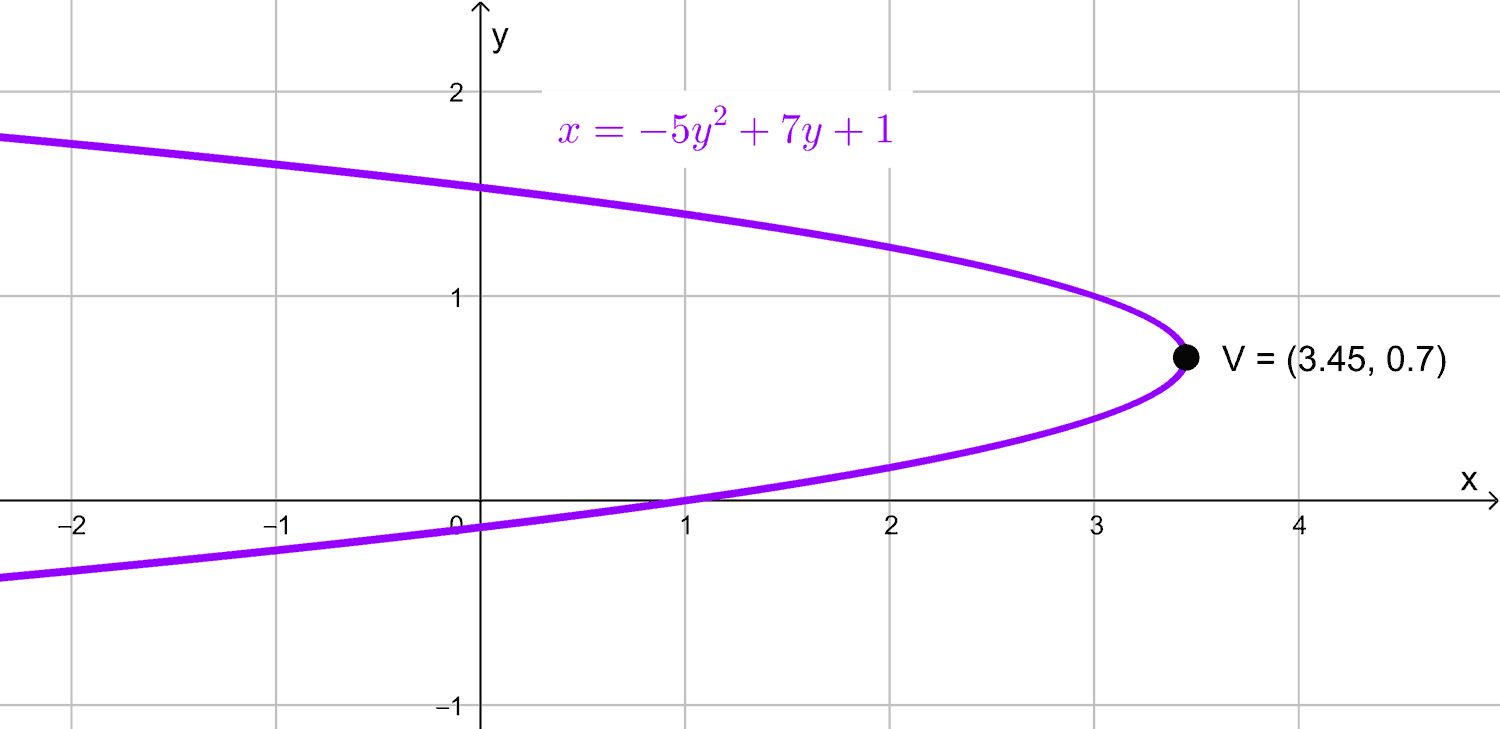
Calculate the coordinates of the vertex of the parabola \(x=-5y^2+7y+1\)
Solution
The given equation represents a horizontal parabola of the form \(x=ay^2+by+c,\) where:
- \(a=-5\)
- \(b=7\)
- \(c=1\)
Calculate \(k\) (the y-coordinate of the vertex):
$$k=\dfrac{-b}{2a}=\dfrac{-7}{2(-5)}=\dfrac{7}{10}$$
Substitute \(k\) into the equation to find \(h\) (the x-coordinate of the vertex):
$$h=-5\left(\dfrac{7}{10}\right)^2+7\left(\dfrac{7}{10}\right)+1$$
Simplify:
\(h=-5 \left(\dfrac{49}{100}\right)+\dfrac{49}{10}+1=-\dfrac{245}{100}+\dfrac{490}{100}+\dfrac{100}{100}\)
Add the fractions:
$$h=\dfrac{-245+490+100}{100}=\dfrac{345}{100}=\dfrac{69}{20}$$
In conclusion, the vertex of the parabola is the point \(\left(\dfrac{69}{20}, \dfrac{7}{10}\right),\) which in decimal notation is \((3.45, 0.7).\)
Example 3
Find the vertex of \(x=-3y^2-2y-3\)
Solution
The equation is in the general form \(x=ay^2+by+c,\) where:
- \(a=-3\)
- \(b=-2\)
- \(c=-3\)
Calculate \(k\) (the y-coordinate of the vertex) using the formula:
$$k=\dfrac{-b}{2a}=\dfrac{-(-2)}{2(-3)}=\dfrac{2}{-6}=-\dfrac{1}{3}$$
Substitute \(k\) into the equation to find \(h\) (the x-coordinate of the vertex):
$$h=-3\left(-\dfrac{1}{3}\right)^2-2\left(-\dfrac{1}{3}\right)-3$$
$$h=-3\left(\dfrac{1}{9}\right)+\dfrac{2}{3}-3=-\dfrac{3}{9}+\dfrac{2}{3}-3$$
$$h=-\dfrac{1}{3}+\dfrac{2}{3}-3=\left(-\dfrac{1}{3}+\dfrac{2}{3}\right)-3=\dfrac{1}{3}-3$$
$$h=\dfrac{1}{3}-\dfrac{9}{3}=-\dfrac{8}{3}$$
The vertex of the parabola is the point \(\left(-\dfrac{8}{3}, -\dfrac{1}{3}\right),\) approximately \((-2.67, -0.33).\)

Did you find this useful? Rate it!
0.0 / 5 — 0 votes

HOW TO CITE THIS ARTICLE
Machado, D. (2026, November 2). Vertex of a Parabola. Exponty. https://exponty.com/en/parabola-vertex
Focal Length of a Parabola
Axis of Symmetry of a Parabola
Directrix of a Parabola
Focus of a Parabola
Parabola Practice Problems with Solutions
Leave a Reply
Related posts