
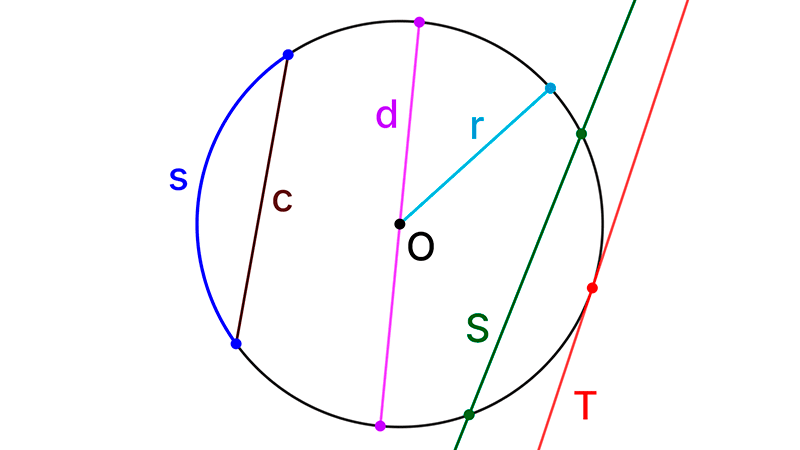
Tangent Line to a Circle
A tangent line to a circle is a straight line that touches the circle at exactly one point, known as the point of tangency. At this point, the line is perpendicular to the radius connecting the center of the circle to the point of tangency.
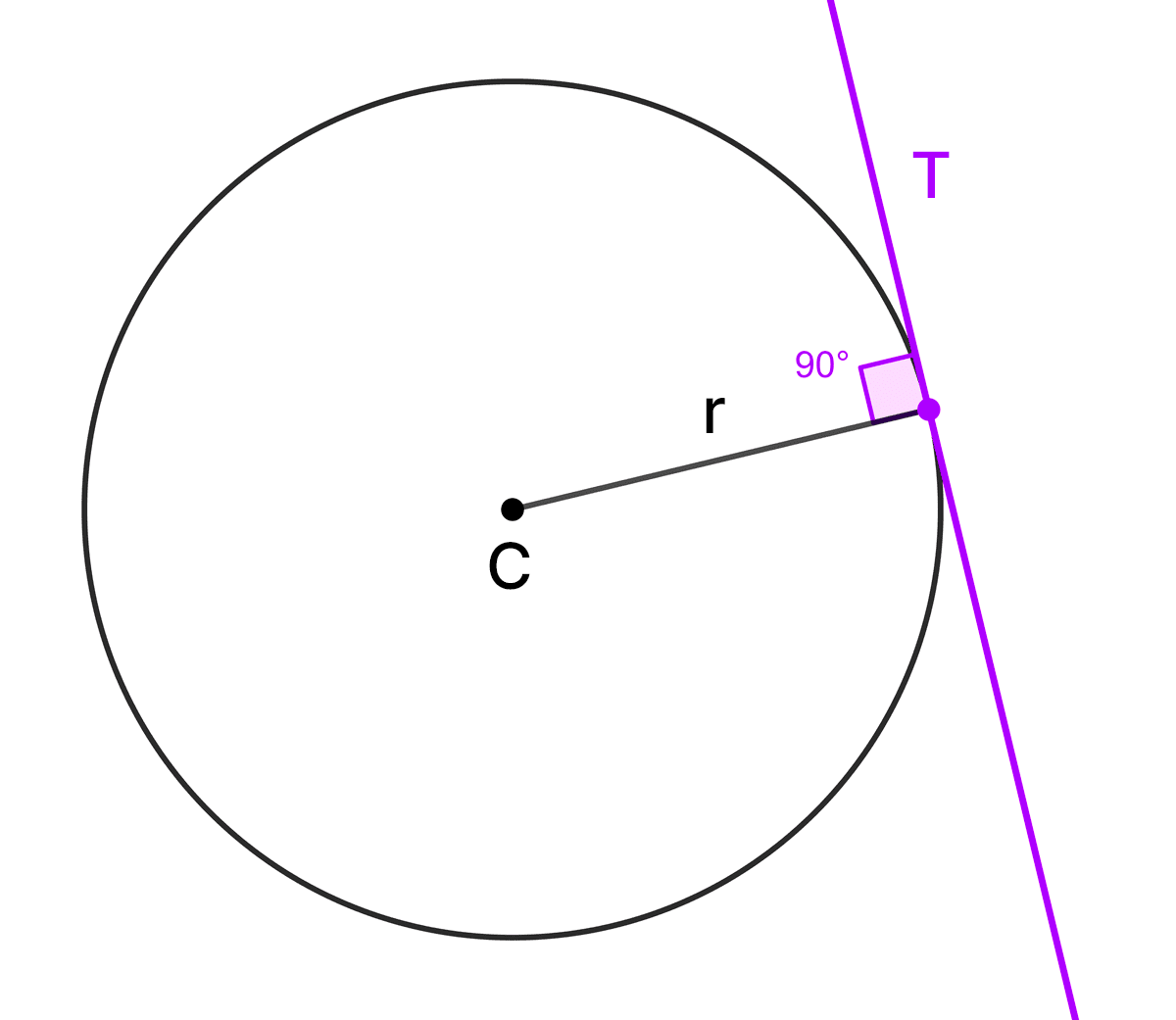
Table of Contents
Equation of a Tangent Line
When studying tangent lines to a circle, three fundamental problems frequently arise in analytic geometry:
- Tangent at a given point on the circle: the point of contact on the circle is known, and the goal is to find the tangent line at that point.
- Tangent with a given slope: the slope of the tangent line is given, and the goal is to determine the lines tangent to the circle that have that specific slope.
- Tangent passing through an external point: a point outside the circle is given, and the goal is to find the tangent lines passing through that point.
Different algebraic approaches are used in each case, but all rely on the same core geometric property: the tangent line and the radius are perpendicular at the point of tangency.
Tangent Line Given the Point of Tangency
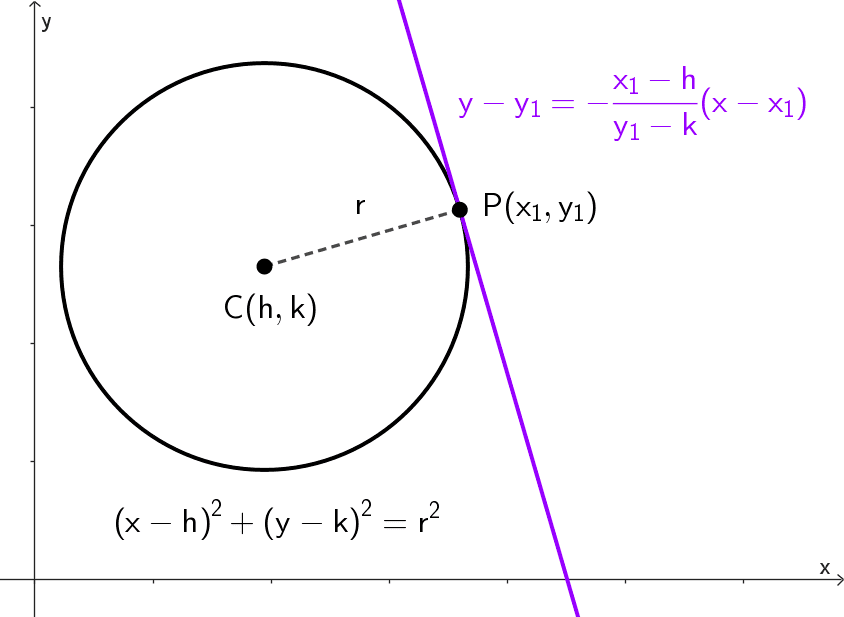
The equation of the line tangent to a circle with center \(C(h, k)\) at the point \(P(x_1, y_1)\) is:
$$y-y_1=-\dfrac{x_1-h}{y_1-k}(x-x_1)$$
Procedure
Given the circle \((x-h)^2+(y-k)^2=r^2\) and a point \(P(x_1, y_1)\) on the circle, the equation of the tangent line at that point can be found as follows:
1) Find the slope of the radius connecting the center \(C(h, k)\) to the point of tangency \(P(x_1, y_1):\)
$$m_r=\dfrac{y_1-k}{x_1-h}$$
2) Because the tangent line is perpendicular to the radius, its slope is the negative reciprocal:
$$m_t=-\dfrac{1}{m_r}$$
3) Write the equation of the tangent line using point-slope form with point \(P(x_1, y_1)\) and slope \(m_t\):
$$y-y_1=-\dfrac{1}{m_r}(x-x_1)$$
Equivalently:
$$y-y_1=-\dfrac{x_1-h}{y_1-k}(x-x_1)$$
Special cases
- If \(m_r=0\) (that is, the point of tangency lies horizontally aligned with the center), the tangent line is vertical (its slope is undefined) and its equation is \(x=x_1.\)
- If \(m_r\) is undefined (that is, \(x_1=h\), meaning the radius is vertical), the slope of the tangent line is 0 (it is horizontal), and its equation is: \(y=y_1.\)
Step-by-Step Examples
Find the equation of the tangent line to the circle at the given point in each case.
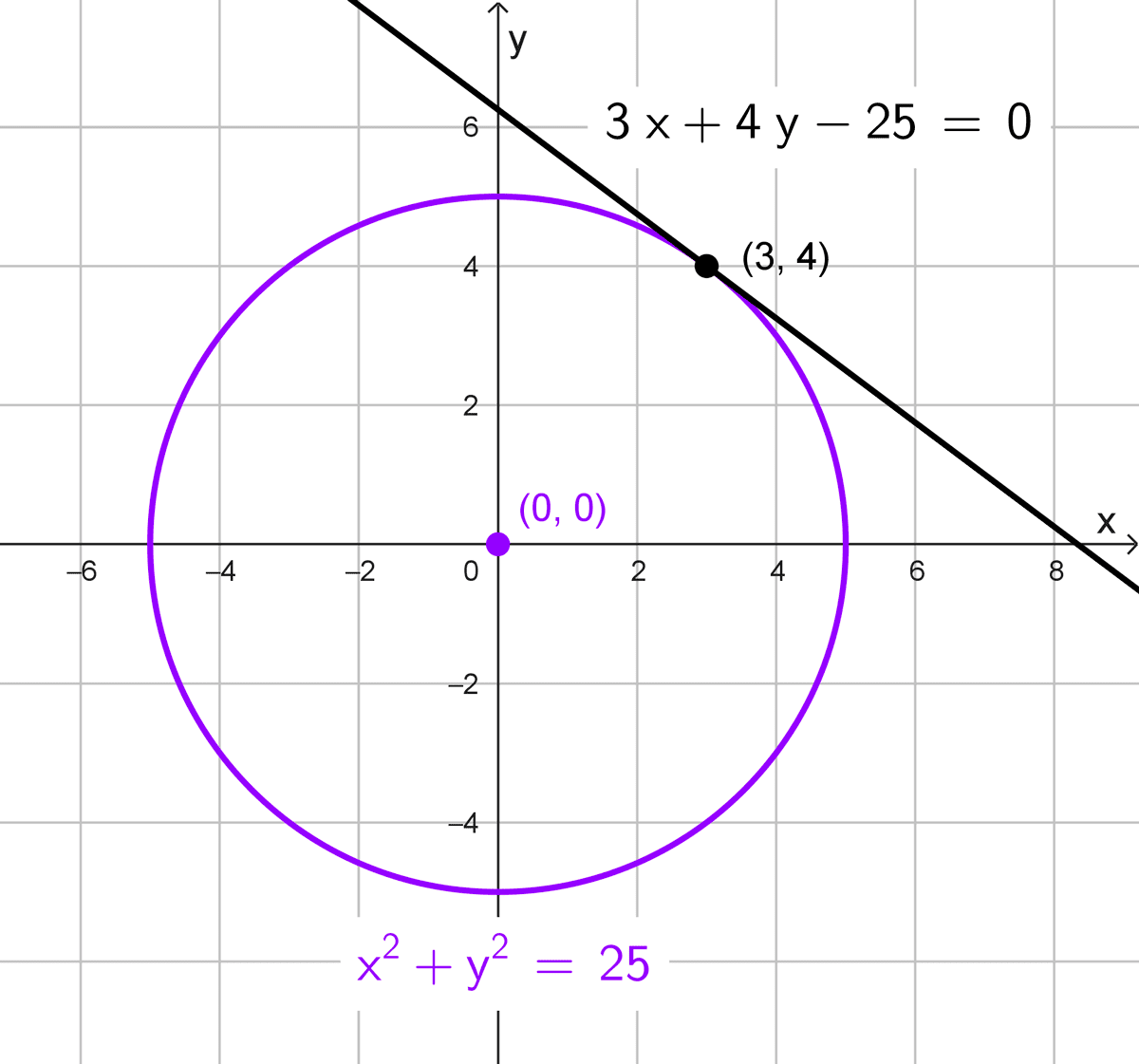
- \(x^2+y^2=25,\) point P(3, 4).
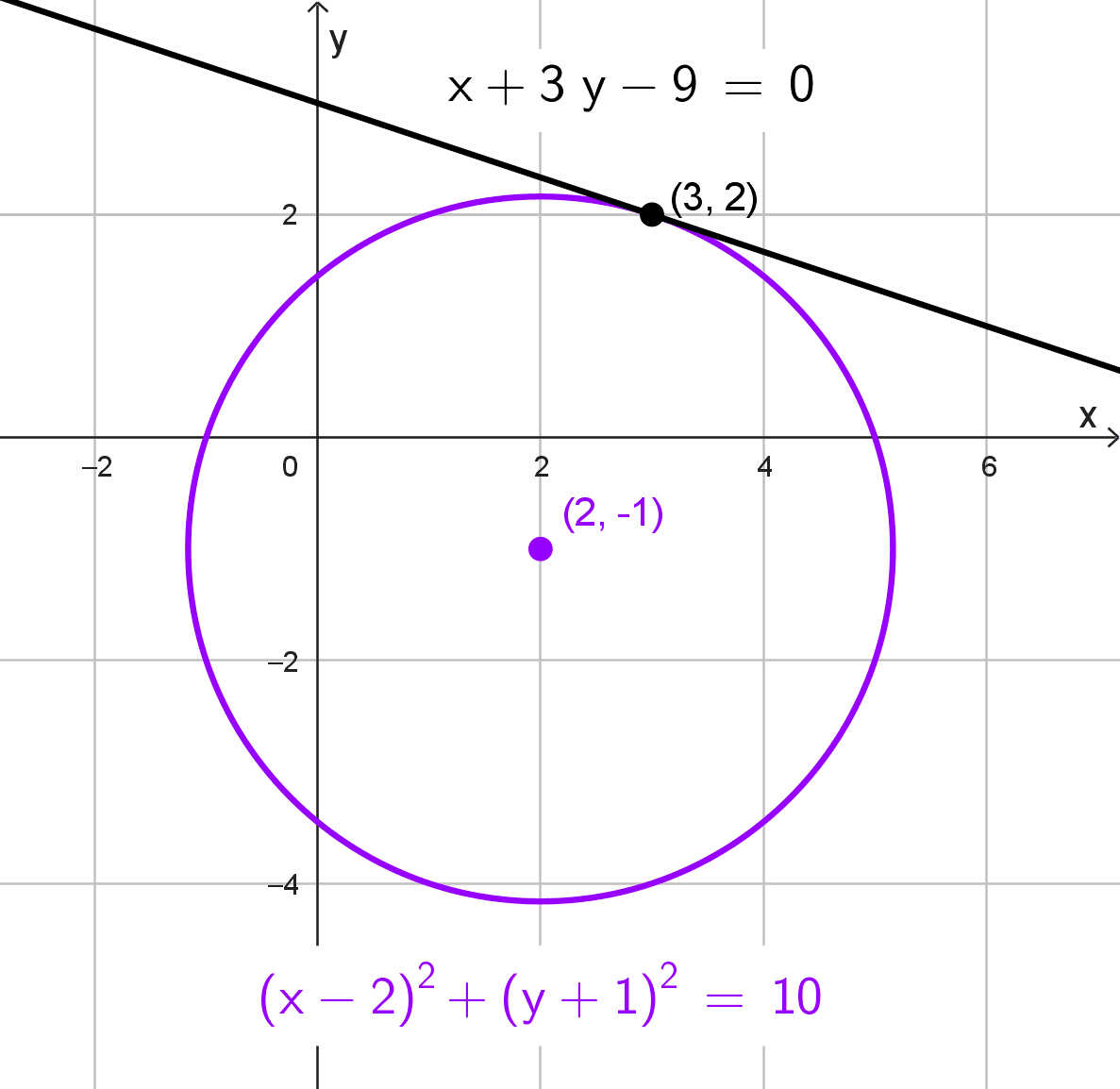
- \((x-2)^2+(y+1)^2=10,\) point P(3, 2).
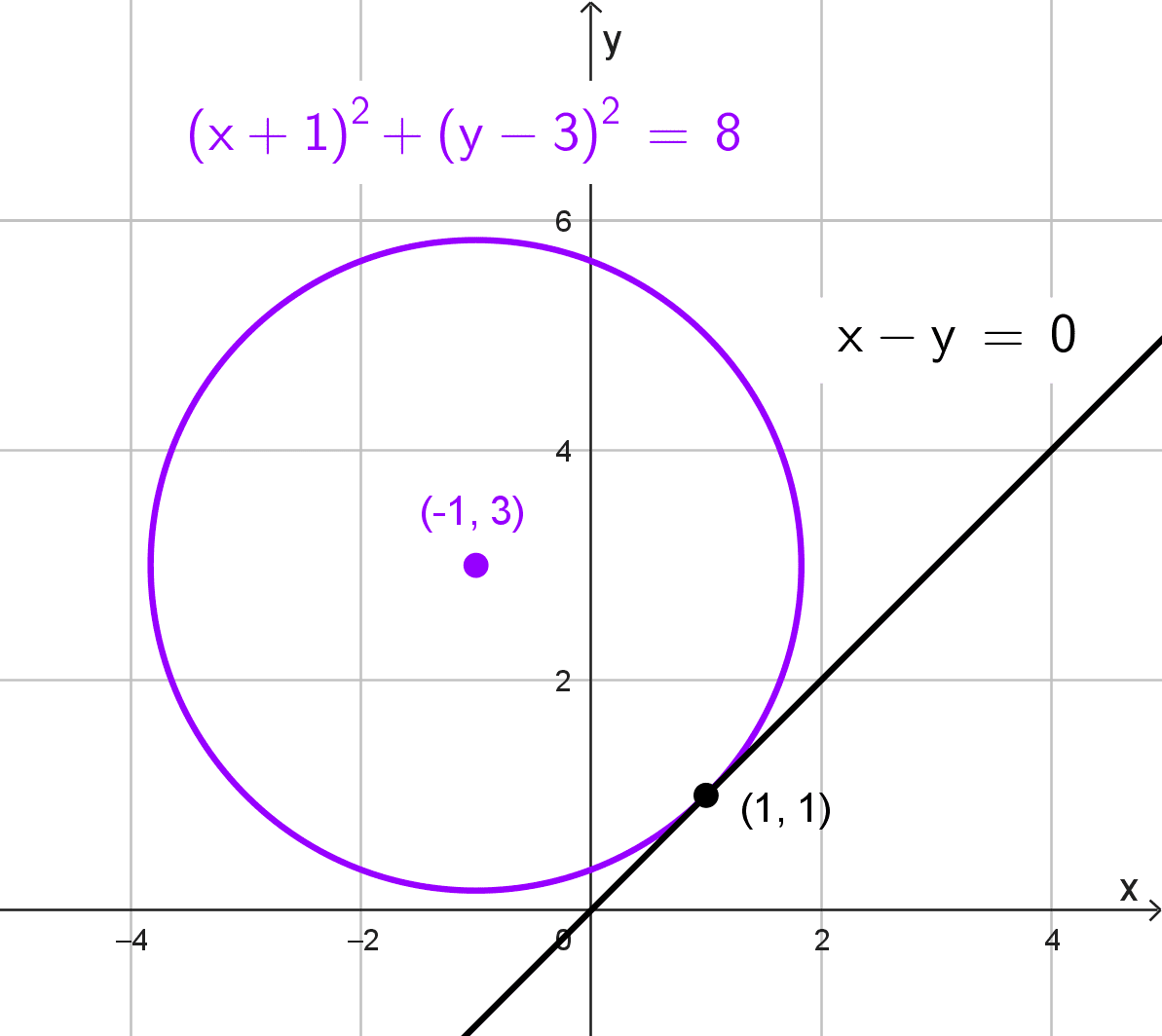
- \((x+1)^2+(y-3)^2=8,\) point P(1, 1).
Solution 1
For the circle \(x^2+y^2=25,\) the center is \(C(0, 0)\) and the radius is \(r=\sqrt{25}=5.\) The point of tangency is \(P(3, 4).\) First, find the slope of the radius \(CP:\)
$$m_r=\dfrac{4-0}{3-0}=\dfrac{4}{3}$$
The tangent line is perpendicular to the radius, so its slope is:
$$m_t=-\dfrac{1}{m_r}=-\dfrac{3}{4}$$
Using point-slope form with point \(P(3, 4)\) and \(m_t:\)
$$y-4=-\dfrac{3}{4}(x-3)$$
Simplifying:
$$4y-16=-3x+9$$
$$3x+4y-25=0$$
Therefore, the general form of the tangent line equation is \(\boxed{3x+4y-25=0}\)
Solution 2
For the circle \((x-2)^2+(y+1)^2=10,\) the center is \(C(2,-1)\) and the radius is \(r=\sqrt{10}.\) The point of tangency is \(P(3, 2).\) Compute the slope of the radius \(CP:\)
$$m_r=\dfrac{2-(-1)}{3-2}=\dfrac{3}{1}=3$$
The slope of the tangent line is:
$$m_t=-\dfrac{1}{m_r}=-\dfrac{1}{3}$$
Using point-slope form with \(P(3, 2):\)
$$y-2=-\dfrac{1}{3}(x-3)$$
Simplifying:
$$3y-6=-x+3$$
$$x+3y-9=0$$
The equation of the tangent line is \(\boxed{x+3y-9=0}\)
Solution 3
For the circle \((x+1)^2+(y-3)^2=8,\) the center is \(C(-1, 3)\) and the radius is \(r=2\sqrt{2}.\) The point of tangency is \(P(1, 1).\) Compute the slope of the radius \(CP:\)
$$m_r=\dfrac{1-3}{1-(-1)}=\dfrac{-2}{2}=-1$$
The slope of the tangent line is:
$$m_t=-\dfrac{1}{m_r}=-\dfrac{1}{-1}=1$$
Using point-slope form with \(P(1, 1):\)
$$y-1=1(x-1)$$
Simplifying:
$$y-1=x-1$$
$$x-y=0$$
The equation of the tangent line is \(\boxed{x-y=0}\)
Tangent Line with a Given Slope
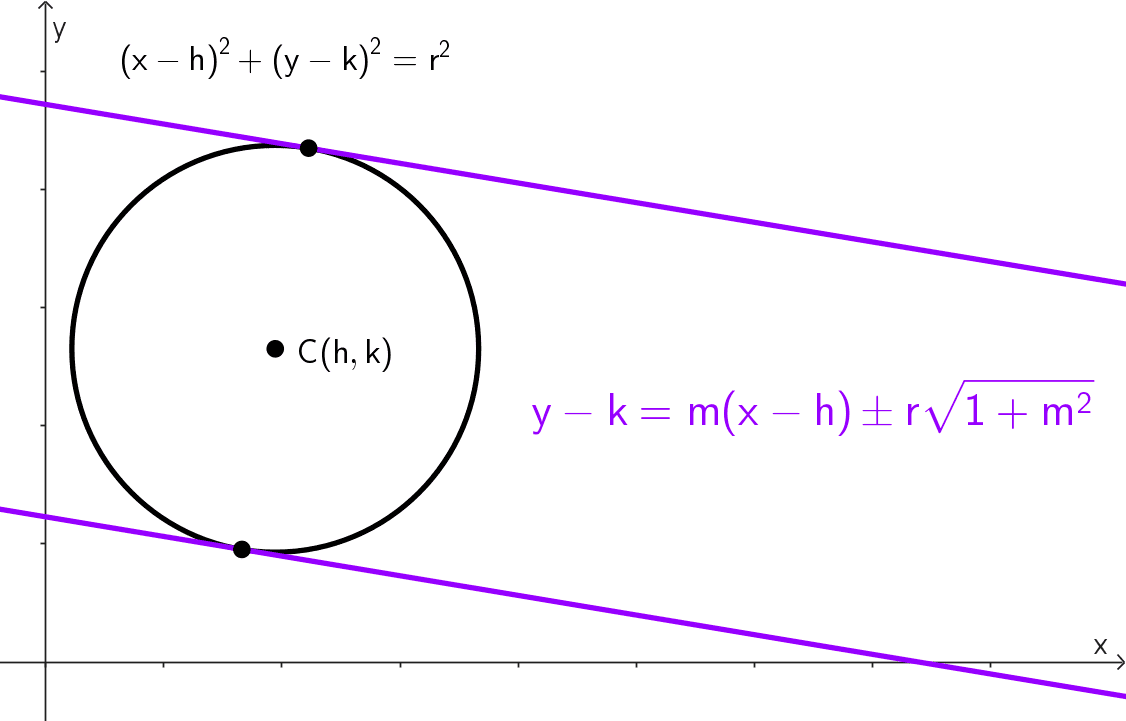
The equation of a line with slope m that is tangent to a circle with center C(h, k) and radius r is:
$$y-k=m (x-h) \pm r \sqrt{1+m^2}$$
In general, there are two lines with slope m tangent to a given circle, corresponding to the two signs of the square root.
Procedure
Given the circle \((x-h)^2+(y-k)^2=r^2\) and a specified slope \(m\), we want to find all tangent lines to the circle with that exact slope.
1) Write the slope-intercept form of a line with slope \(m\):
$$y=mx+b$$
where \(b\) is an unknown parameter to be determined.
2) Apply the tangency condition: for this line to be tangent to the circle, the perpendicular distance from the center \((h, k)\) to the line must equal the radius \(r\). Using the point-to-line distance formula:
$$\dfrac{|mh-k+b|}{\sqrt{1+m^2}}=r$$
3) Solve for \(b:\)
Multiply both sides by \(\sqrt{1+m^2}\):
$$|mh-k+b|=r \sqrt{1+m^2}$$
This yields two equations due to the absolute value:
$$mh-k+b=\pm r \sqrt{1+m^2}$$
Isolating \(b\):
$$b=k-mh \pm r \sqrt{1+m^2}$$
4) Substitute the resulting values of \(b\) back into \(y=mx+b.\) The two tangent lines are:
$$y=mx+\left (k-mh+r \sqrt{1+m^2} \right) \quad \text{and} \quad y=mx+\left (k-mh-r \sqrt{1+m^2} \right)$$
Step-by-Step Examples
Find the equations of the lines tangent to the following circles with the given slope. Also, determine the coordinates of the points of tangency.
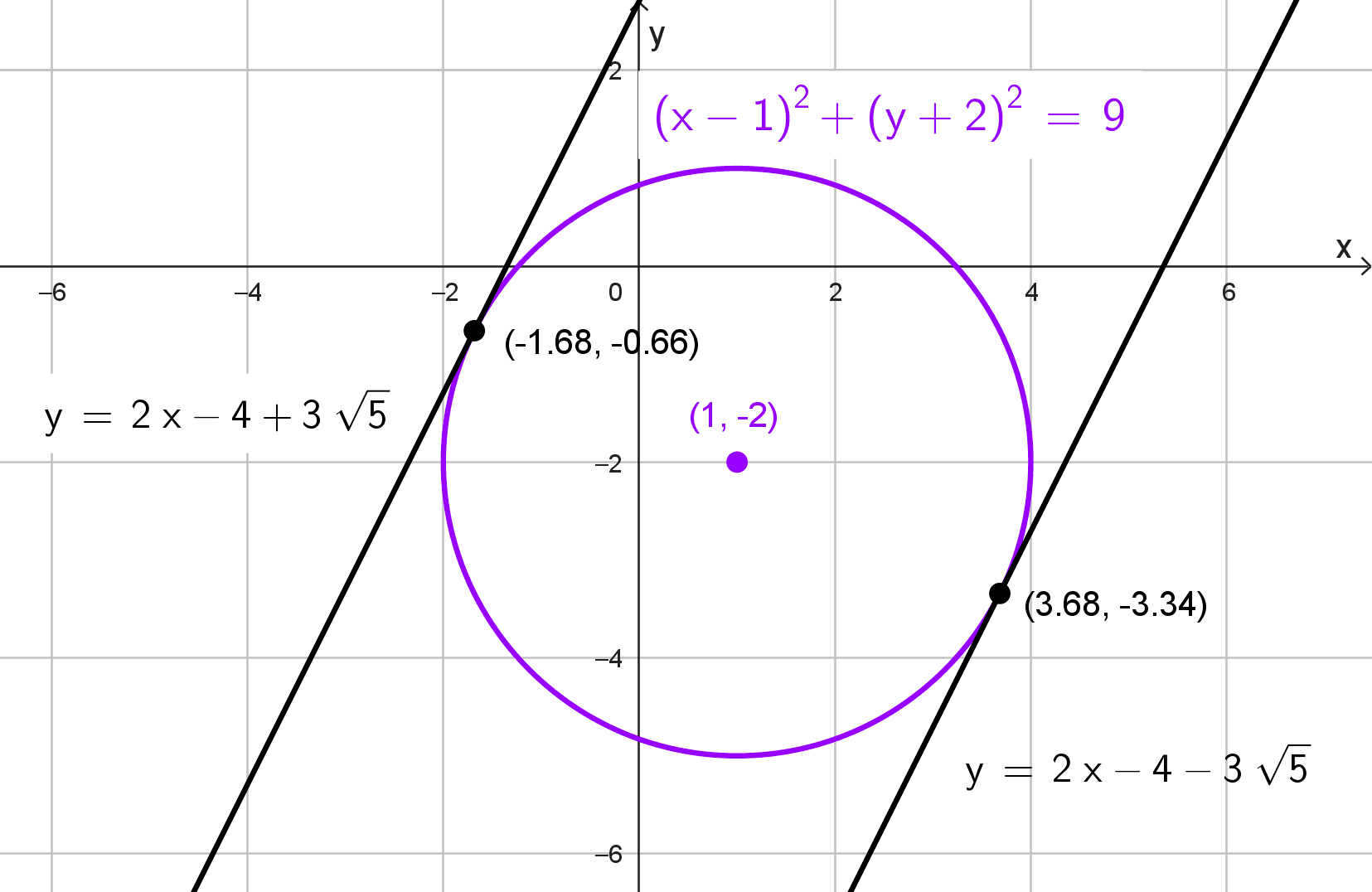
- Circle: \((x-1)^2+(y+2)^2=9,\) slope: \(m=2.\)
- Circle: \(x^2+y^2=16,\) slope: \(m=-\dfrac{3}{4}.\)
- Circle: \(x^2+y^2-6x+4y-3=0,\) slope: \(m=1.\)
- Circle: \((x+3)^2+(y-1)^2=15,\) slope: \(m=-2.\)
Solution 1
For the circle \((x-1)^2+(y+2)^2=9,\) the center is \(C(1,-2)\) and the radius is \(r=3.\) The given slope is \(m=2.\) Apply the formula to find the y-intercept \(b\) for the line \(y=2x+b:\)
$$b=k-mh ± r\sqrt{1+m^2}=-2-2(1) ± 3\sqrt{1+2^2}=-4 ± 3\sqrt{5}$$
The equations of the tangent lines are:
$$y=2x-4+3\sqrt{5} \quad \text{and} \quad y=2x-4-3\sqrt{5}$$
To find the points of tangency, we can find the intersection of each tangent line with the perpendicular line passing through the center.
The perpendicular line has slope \(-\frac{1}{2}\) and passes through \(C(1, -2)\):
$$y+2=-\dfrac{1}{2}(x-1) → x+2y+3=0$$
For \(b=-4+3\sqrt{5}:\)
Substitute \(y=2x-4+3\sqrt{5}\) into \(x+2y+3=0:\)
$$x+2(2x-4+3\sqrt{5})+3=0 → x+4x-8+6\sqrt{5}+3=0$$
$$5x-5+6\sqrt{5}=0 → 5x=5-6\sqrt{5} → x=\dfrac{5-6\sqrt{5}}{5}$$
Now, calculate \(y:\)
$$y=2\left(\dfrac{5-6\sqrt{5}}{5}\right)-4+3\sqrt{5}=\dfrac{10-12\sqrt{5}}{5}-4+3\sqrt{5}$$
$$y=\dfrac{10-12\sqrt{5}-20}{5}+3\sqrt{5}=\dfrac{-10-12\sqrt{5}}{5}+3\sqrt{5}$$
$$y=-2-\dfrac{12\sqrt{5}}{5}+3\sqrt{5}=-2+\left(-\dfrac{12}{5}+3\right)\sqrt{5}$$
$$y=-2+\dfrac{3}{5}\sqrt{5}$$
For \(b=-4-3\sqrt{5}:\)
Substitute \(y=2x-4-3\sqrt{5}\) into \(x+2y+3=0:\)
$$x+2(2x-4-3\sqrt{5})+3=0 → x+4x-8-6\sqrt{5}+3=0$$
$$5x-5-6\sqrt{5}=0 → 5x=5+6\sqrt{5} → x=\dfrac{5+6\sqrt{5}}{5}$$
Calculate \(y:\)
$$y=2\left(\dfrac{5+6\sqrt{5}}{5}\right)-4-3\sqrt{5}=\dfrac{10+12\sqrt{5}}{5}-4-3\sqrt{5}$$
$$y=\dfrac{10+12\sqrt{5}-20}{5}-3\sqrt{5}=\dfrac{-10+12\sqrt{5}}{5}-3\sqrt{5}$$
$$y=-2+\dfrac{12\sqrt{5}}{5}-3\sqrt{5}=-2+\left(\dfrac{12}{5}-3\right)\sqrt{5}$$
$$y=-2-\dfrac{3}{5}\sqrt{5}$$
Points of tangency:
$$\left(\dfrac{5-6\sqrt{5}}{5},-2+\dfrac{3\sqrt{5}}{5}\right) ≈ (-1.68, -0.66)$$
$$\left(\dfrac{5+6\sqrt{5}}{5},-2-\dfrac{3\sqrt{5}}{5}\right) ≈ (3.68, -3.34)$$
Solution 2
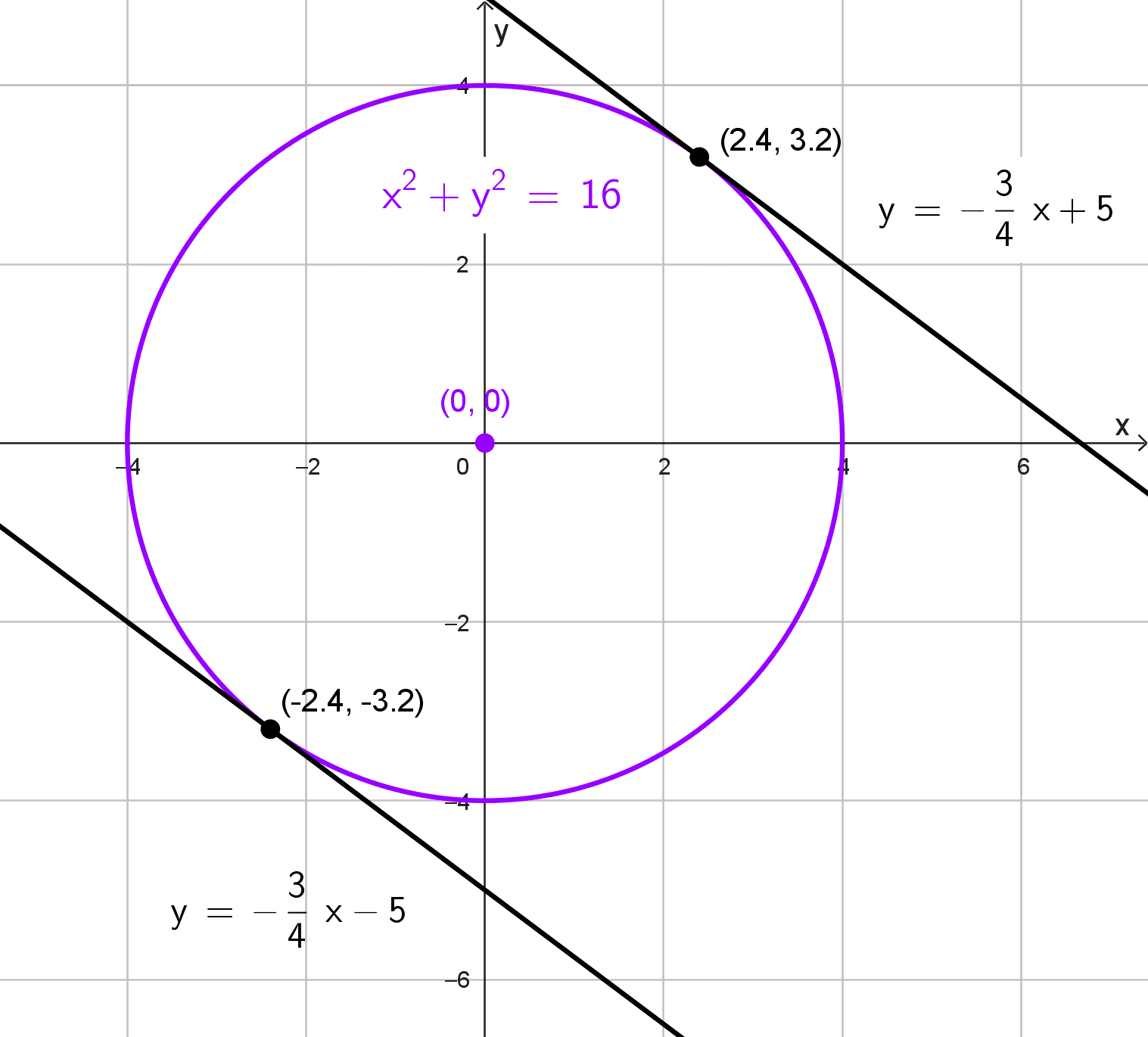
For the circle \(x^2+y^2=16,\) the center is \(C(0, 0)\) and the radius is \(r=4.\) The given slope is \(m=-\dfrac{3}{4}.\) Calculate \(b:\)
$$b=0-\left(-\dfrac{3}{4}\right)(0) ± 4\sqrt{1+\left(-\dfrac{3}{4}\right)^2}=± 4 \cdot \dfrac{5}{4}=± 5$$
The equations of the tangent lines are:
$$y=-\dfrac{3}{4}x+5 \quad \text{and} \quad y=-\dfrac{3}{4}x-5$$
Points of tangency:
For \(b=5,\) the perpendicular line through \(C(0, 0)\) has slope \(\dfrac{4}{3}:\)
$$y=\dfrac{4}{3}x$$
Solving the system with \(y=-\dfrac{3}{4}x+5:\)
$$x=\dfrac{12}{5}=2.4 \quad y=\dfrac{16}{5}=3.2$$
For \(b=-5,\) solving the system gives:
$$x=-\dfrac{12}{5}=-2.4 \quad y=-\dfrac{16}{5}=-3.2$$
Thus, the points of tangency are:
$$\left(\dfrac{12}{5}, \dfrac{16}{5}\right) \quad \text{and} \quad \left(-\dfrac{12}{5},-\dfrac{16}{5}\right)$$
Solution 3
Complete the square for the equation \(x^2+y^2-6x+4y-3=0\):
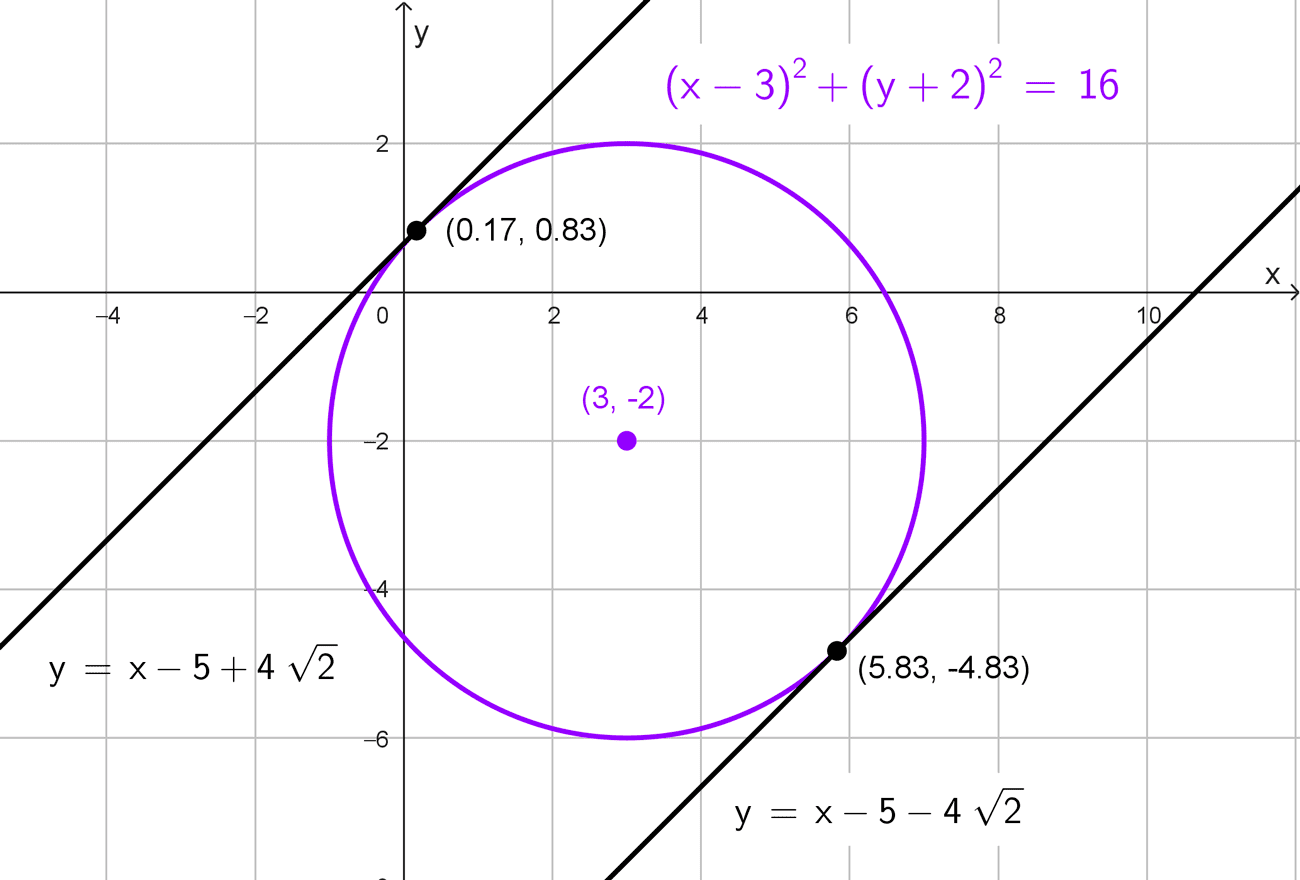
$$(x-3)^2+(y+2)^2=16$$
The center is \(C(3,-2)\) and the radius is \(r=4.\) The given slope is \(m=1.\) Calculate \(b:\)
$$b=-2-1(3) ± 4\sqrt{1+1^2}=-5 ± 4\sqrt{2}$$
The equations of the tangent lines are:
$$y=x-5+4\sqrt{2} \quad \text{and} \quad y=x-5-4\sqrt{2}$$
Points of tangency:
For \(b=-5+4\sqrt{2},\) the perpendicular line has slope \(-1\) and passes through \(C(3,-2):\)
$$y+2=-1(x-3) → x+y-1=0$$
Solving the system with \(y=x-5+4\sqrt{2}:\)
$$x=3-2\sqrt{2}, \quad y=-2+2\sqrt{2}$$
For \(b=-5-4\sqrt{2}:\)
$$x=3+2\sqrt{2}, \quad y=-2-2\sqrt{2}$$
Therefore, the points of tangency are:
$$\left(3-2\sqrt{2},-2+2\sqrt{2}\right)≈(0.17, 0.83)$$
$$\left(3+2\sqrt{2},-2-2\sqrt{2}\right)≈(5.83, -4.83)$$
Solution 4
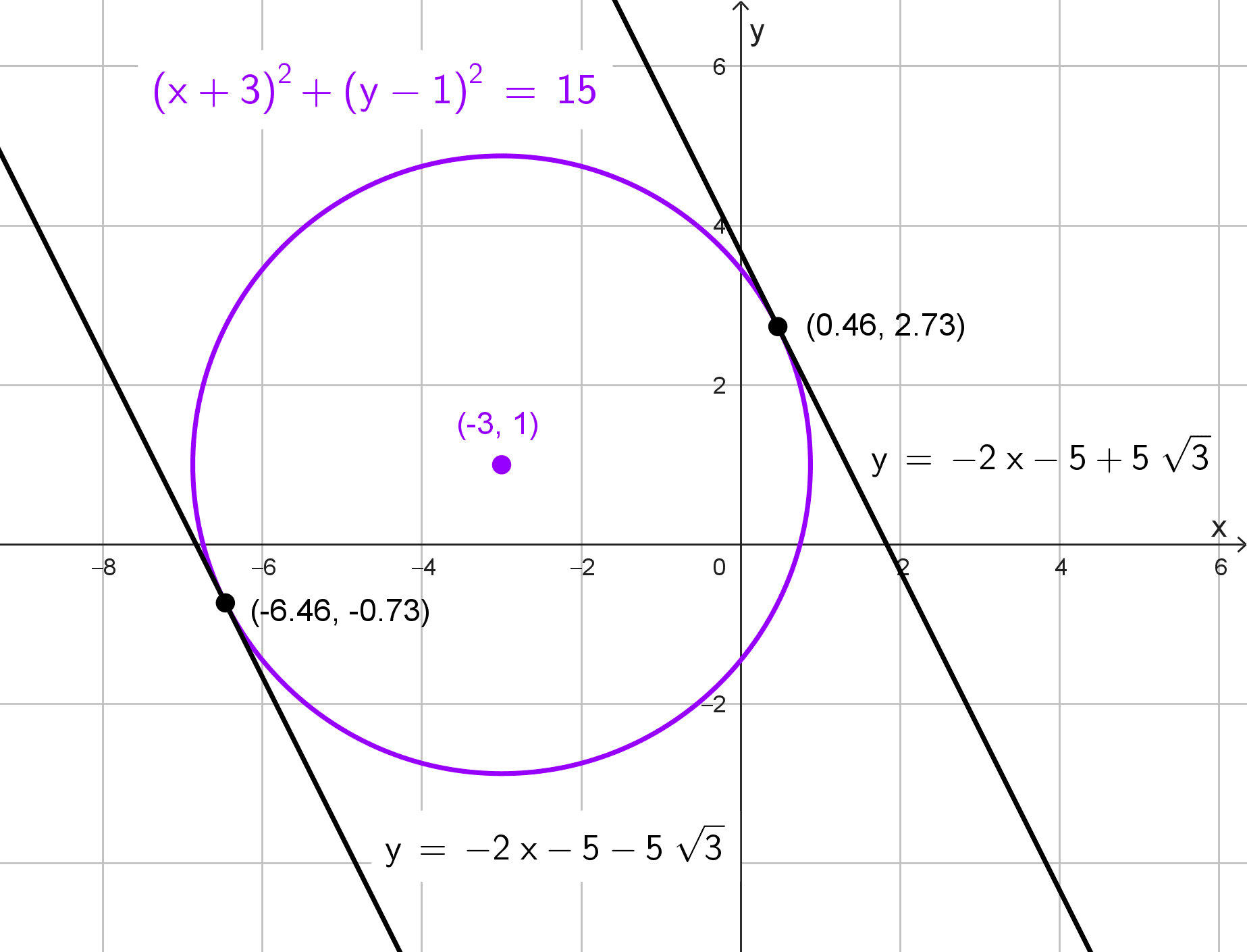
For \((x+3)^2+(y-1)^2=15,\) the center is \(C(-3, 1)\) and the radius is \(r=\sqrt{15}.\) The given slope is \(m=-2.\) Calculate \(b:\)
$$b=1-(-2)(-3) ± \sqrt{15} \cdot \sqrt{1+(-2)^2}=-5 ± \sqrt{75}=-5 ± 5\sqrt{3}$$
The equations of the tangent lines are:
$$y=-2x-5+5\sqrt{3} \quad \text{and} \quad y=-2x-5-5\sqrt{3}$$
Points of tangency
The perpendicular line passing through C(-3, 1) with slope \(\dfrac{1}{2}\) is:
$$y-1=\dfrac{1}{2}(x+3) → x-2y+5=0$$
Solve the linear system between each tangent line and the perpendicular line.
For \(b=-5+5\sqrt{3}:\)
Substitute \(y=-2x-5+5\sqrt{3}\) into \(x-2y+5=0:\)
$$x-2(-2x-5+5\sqrt{3})+5=0 → x+4x+10-10\sqrt{3}+5=0$$
$$5x+15-10\sqrt{3}=0 → 5x=-15+10\sqrt{3} → x=-3+2\sqrt{3}$$
Now calculate \(y:\)
$$y=-2(-3+2\sqrt{3})-5+5\sqrt{3}=6-4\sqrt{3}-5+5\sqrt{3}=1+\sqrt{3}$$
For \(b=-5-5\sqrt{3}:\)
Substitute \(y=-2x-5-5\sqrt{3}\) into \(x-2y+5=0:\)
$$x-2(-2x-5-5\sqrt{3})+5=0 → x+4x+10+10\sqrt{3}+5=0$$
$$5x+15+10\sqrt{3}=0 → 5x=-15-10\sqrt{3} → x=-3-2\sqrt{3}$$
Now calculate \(y:\)
$$y=-2(-3-2\sqrt{3})-5-5\sqrt{3}=6+4\sqrt{3}-5-5\sqrt{3}=1-\sqrt{3}$$
In conclusion, the points of tangency are:
$$\left(-3+2\sqrt{3}, 1+\sqrt{3}\right)≈(0.46, 2.73)$$
$$\left(-3-2\sqrt{3}, 1-\sqrt{3}\right)≈(-6.46, -0.73)$$
Tangent Line from an External Point
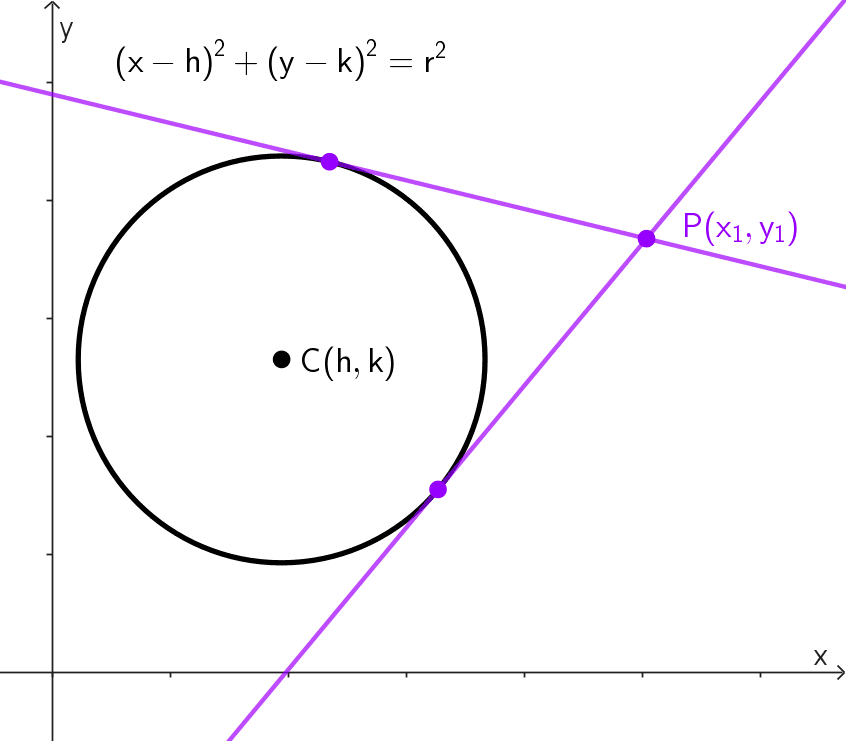
From an external point outside a circle, exactly two distinct tangent lines can be drawn to the circle. Each line touches the circle at a different point of tangency. Given a circle \((x-h)^2+(y-k)^2=r^2\) and an external point \(P(x_1, y_1)\), use the following procedure to find the equations of both tangent lines:
1) Write the point-slope equation of a line passing through \(P(x_1, y_1)\):
$$y=m (x-x_1)+y_1$$
2) Substitute this expression for \(y\) into the equation of the circle:
$$(x-h)^2+\left[m (x-x_1)+y_1-k\right]^2=r^2$$
3) Expand and collect terms into a standard quadratic equation in \(x\). Set the discriminant to zero (\(\Delta = 0\)) to enforce that there is exactly one point of intersection (the condition of tangency).
4) Solve the resulting equation for \(m\) to obtain the slopes of both tangent lines.
5) Substitute each value of \(m\) into \(y-y_1=m (x-x_1)\) to write the equations of the two tangent lines.
Step-by-Step Examples
Find the equations of the lines tangent to the following circles from the specified external point:
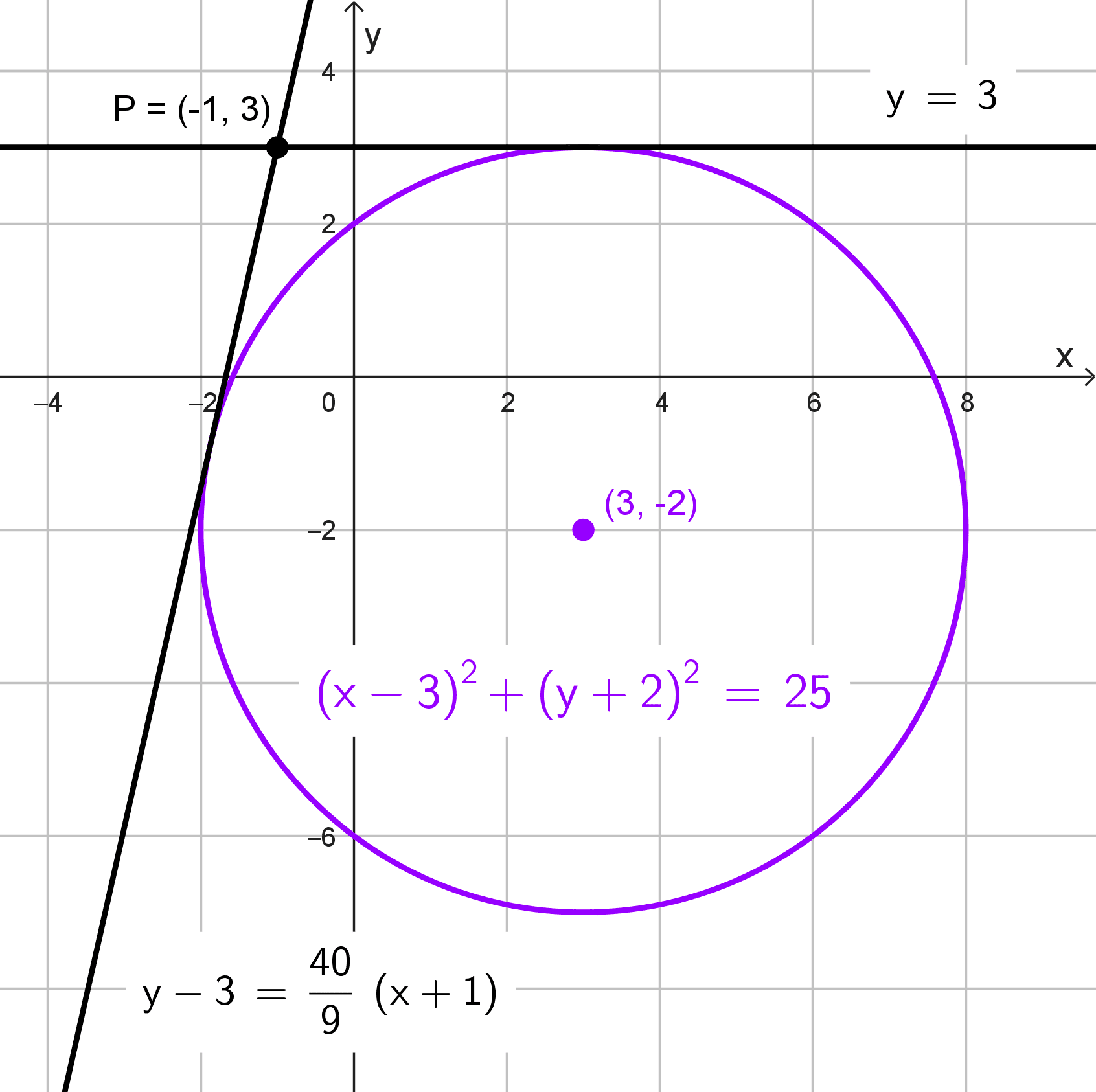
- Circle: \((x+3)^2+(y-2)^2=10;\) point: P(0, 5).
- Circle: \(x^2+y^2-6x+4y-12=0,\) point P(-1, 3).
Solution 1
Given the circle \((x+3)^2+(y-2)^2=10\) and the external point \(P(0, 5),\) any line through \(P\) has equation \(y-5=m(x-0),\) or \(y=mx+5.\) Substitute \(y=mx+5\) into the circle equation:
$$(x+3)^2+(mx+5-2)^2=10$$
Simplify:
$$(x+3)^2+(mx+3)^2=10$$
Expand both binomials:
$$x^2+6x+9+m^2x^2+6mx+9=10$$
Group terms by powers of \(x\):
$$(1+m^2)x^2+(6+6m)x+8=0$$
For the line to be tangent, the quadratic equation must have exactly one real solution, so its discriminant must equal zero. For \(Ax^2+Bx+C=0\), the discriminant is \(\Delta=B^2-4AC,\) where \(A=1+m^2, B=6+6m,\) and \(C=8:\)
$$(6+6m)^2-4(1+m^2)(8)=0$$
Expand:
$$36+72m+36m^2-32-32m^2=0 \quad → \quad 4m^2+72m+4=0$$
Divide by 4:
$$m^2+18m+1=0$$
Solve for \(m\) using the quadratic formula:
$$m=\dfrac{-18±\sqrt{324-4}}{2}=\dfrac{-18±\sqrt{320}}{2}=-9±4\sqrt{5}$$
These values represent the slopes of the tangent lines. Therefore, the equations of the two tangent lines are:
$$y-5=(-9+4\sqrt{5})x \quad \text{and} \quad y-5=(-9-4\sqrt{5})x$$

Solution 2
First, rewrite \(x^2+y^2-6x+4y-12=0\) in standard form by completing the square:
$$x^2-6x+y^2+4y=12 \quad → \quad (x-3)^2-9+(y+2)^2-4=12$$
Simplify:
$$(x-3)^2+(y+2)^2=25$$
The point \(P(-1, 3)\) lies outside the circle. The equation of any line passing through \(P\) is \(y-3=m(x+1).\) Substitute \(y=m(x+1)+3\) into the circle equation:
$$(x-3)^2+\left[m(x+1)+3+2\right]^2=25$$
Simplify:
$$(x-3)^2+\left[m(x+1)+5\right]^2=25$$
Expand:
$$x^2-6x+9+m^2(x+1)^2+10m(x+1)+25=25$$
Expand further:
$$x^2-6x+9+m^2x^2+2m^2x+m^2+10mx+10m=0$$
Group like terms:
$$(1+m^2)x^2+(-6+2m^2+10m)x+(9+m^2+10m)=0$$
Set the discriminant equal to zero:
$$(-6+2m^2+10m)^2-4(1+m^2)(9+m^2+10m)=0$$
Expand and simplify:
$$36+4m^4+100m^2-24m^2-120m+40m^3-36-4m^2-40m-36m^2-4m^4-40m^3=0$$
Combine terms:
$$36m^2-160m=0 \quad → \quad 4m(9m-40)=0$$
The solutions are \(m=0\) and \(m=\dfrac{40}{9}.\) Therefore, the equations of the tangent lines are:
$$y-3=0(x+1) \quad → \quad y=3$$
and
$$y-3=\dfrac{40}{9}(x+1)$$
Did you find this useful? Rate it!
0.0 / 5 — 0 votes

HOW TO CITE THIS ARTICLE
Machado, D. (2026, November 5). Tangent Line to a Circle. Exponty. https://exponty.com/en/circle-tangent-line
Parts of a Circle
Relative Positions of a Line and a Circle
Equation of a Circle Through Three Points
Equations of Circles: Practice Problems with Solutions
Leave a Reply
Related posts