
Parts of a Circle
The parts of a circle—including its key lines and segments—are the center, radius, diameter, chords, secant lines, and tangent lines, among others. Below is a detailed description of each component.
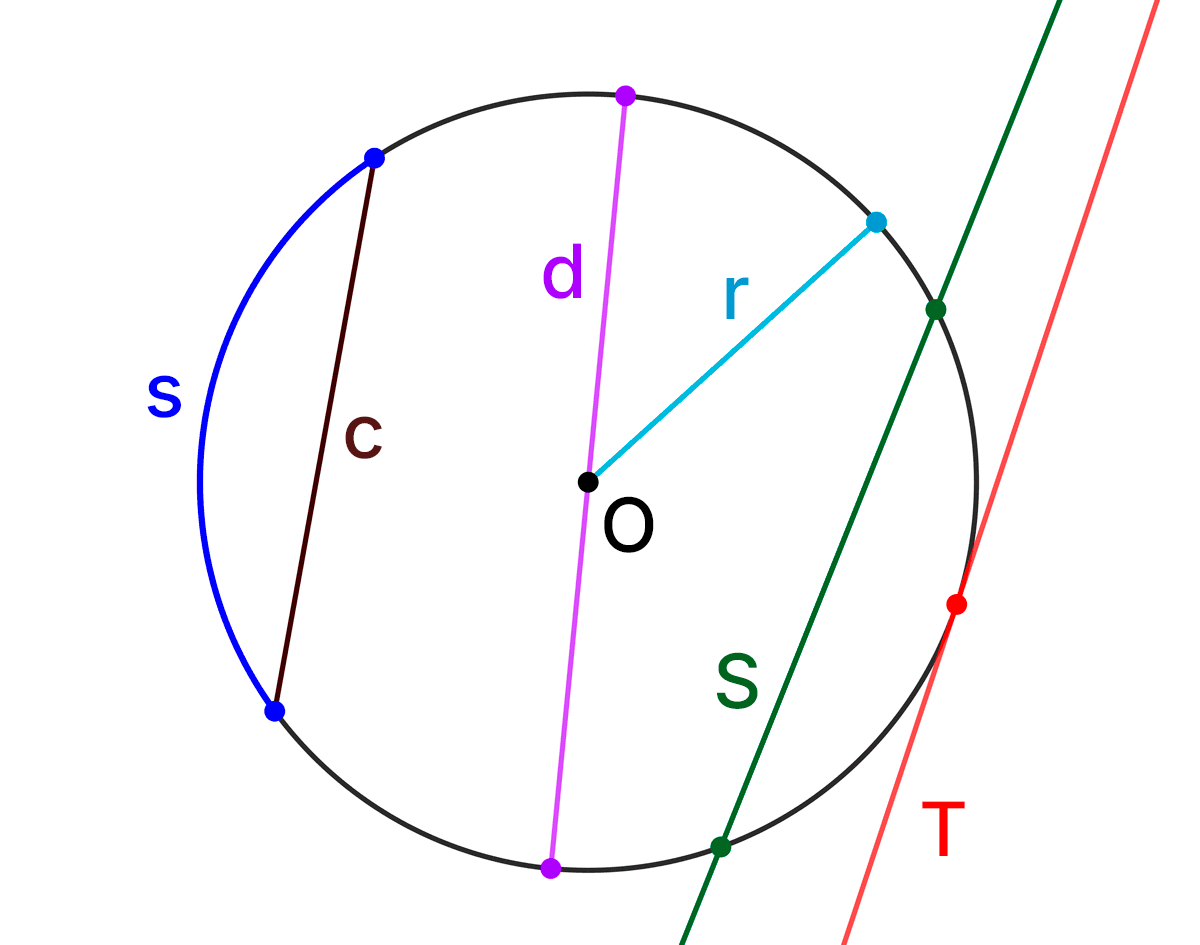
Table of Contents
Center
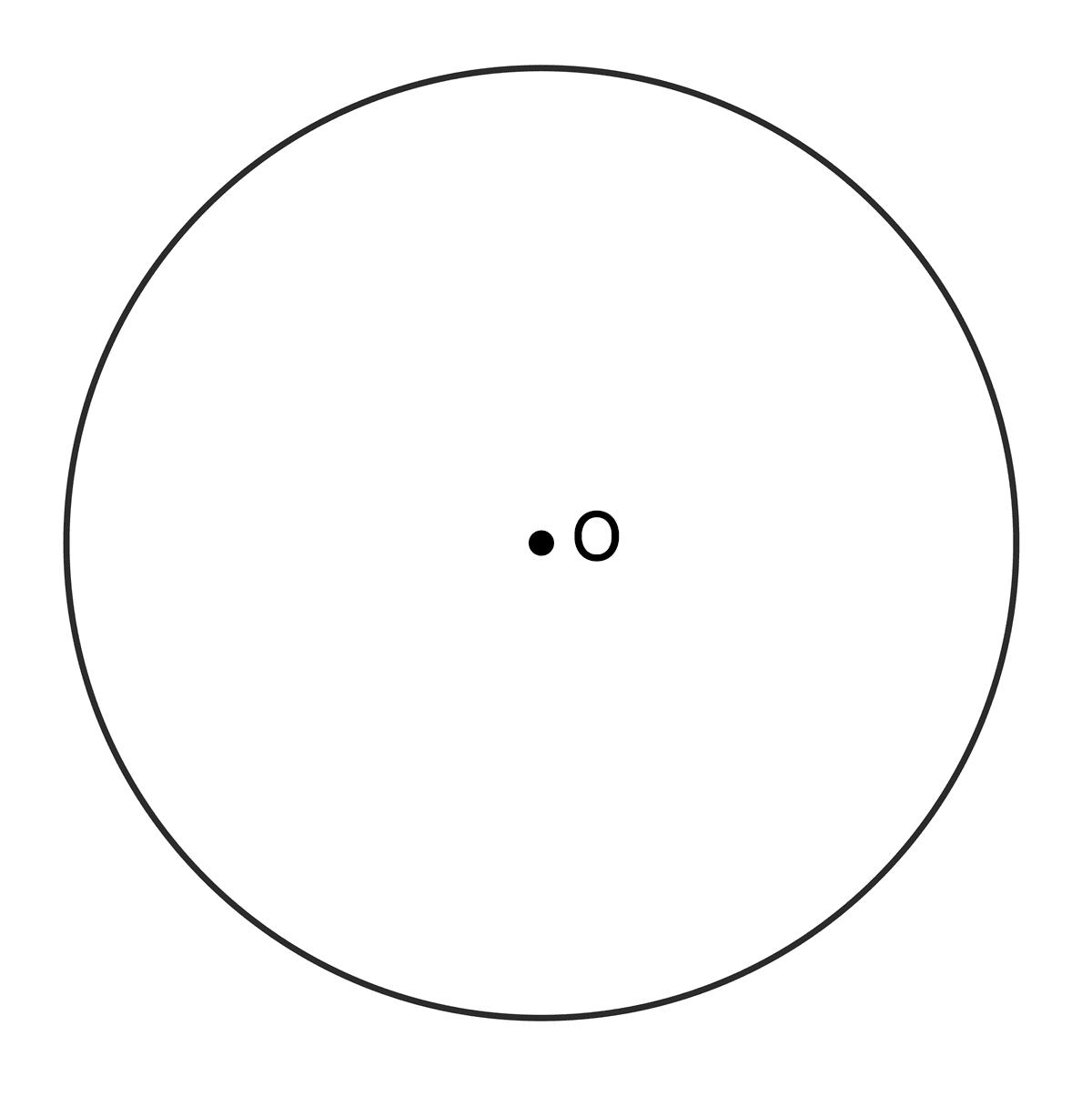
The center of a circle is the point equidistant from all points along the curve. It is commonly denoted as (h, k). It serves as the reference point to define the radius and to write the standard equation of the circle:
$$(x-h)^2+(y-k)^2=r^2$$
Examples
- The circle \((x-2)^2+(y+3)^2=16\) has its center at (2, -3).
- The circle \((x+5)^2+(y-1)^2=25\) has its center at (-5, 1).
- The circle \(x^2+y^2=9\) has its center at (0, 0).
Radius
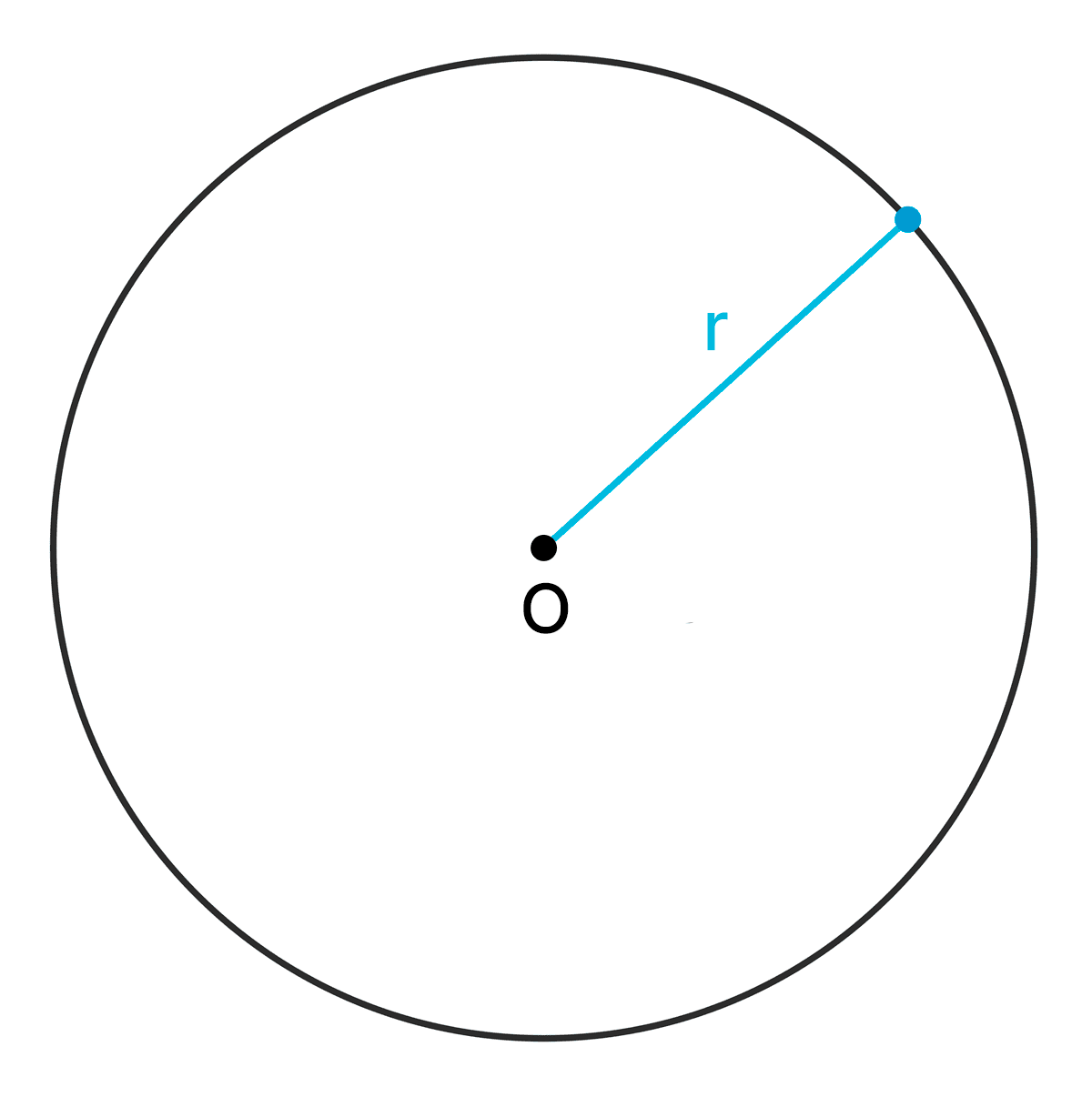
The radius is a line segment connecting the center of the circle to any point on it. If the center of the circle is (h, k) and a point on the circle is P(x, y), the length of the radius r is determined using the distance formula:
$$r=\sqrt{(x-h)^2+(y-k)^2}$$
In fact, the standard equation of a circle with center (h, k) and radius r is derived directly from this definition by squaring both sides:
$$(x-h)^2+(y-k)^2=r^2$$
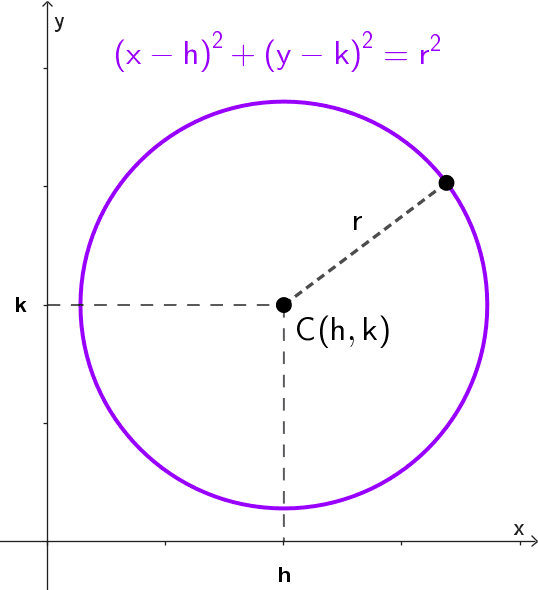
Examples
- The circle \((x-2)^2+(y+3)^2=16\) has a radius of \(r=4\) since \(16=4^2.\)
- \((x-1)^2+(y+4)^2=5\) is the equation of a circle with radius \(r=\sqrt{5}.\)
Diameter
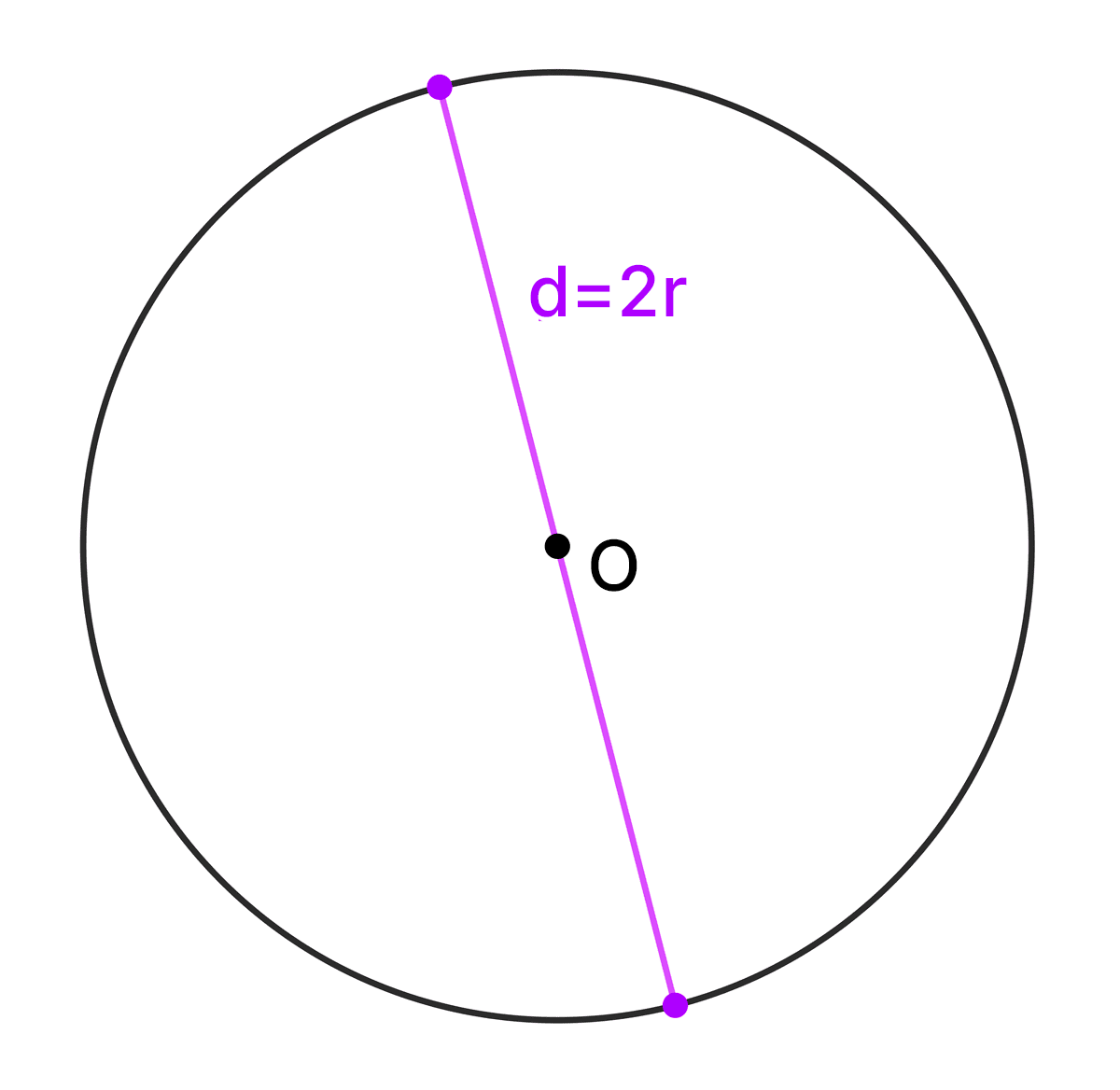
The diameter is a line segment that connects two points on the circle and passes through the center. Its length is twice the radius:
$$d=2r$$
Chord
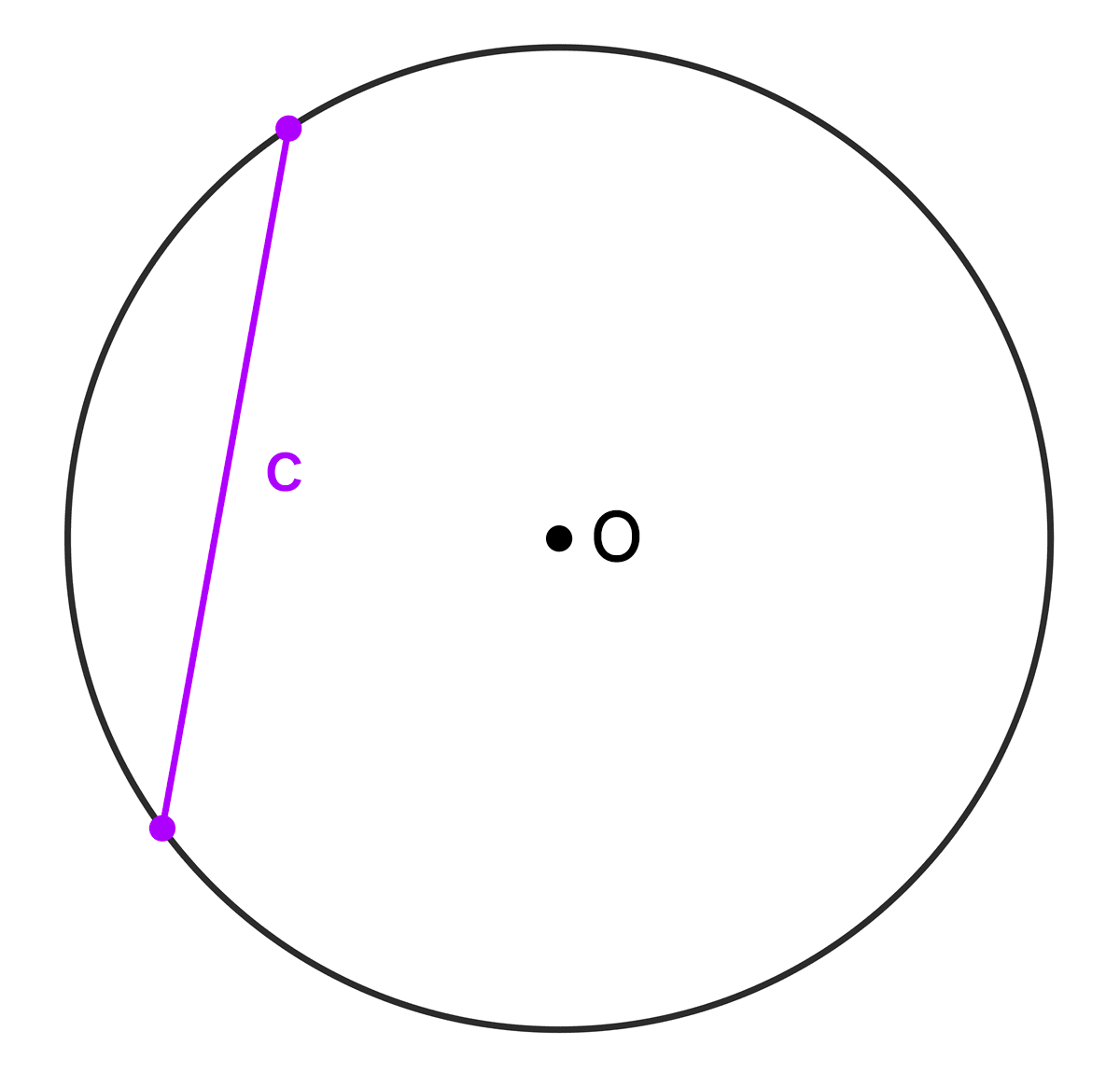
A chord is a line segment that joins any two points on a circle. Unlike the diameter, it does not need to pass through the center, although it can. The diameter is the longest possible chord in a circle.
Given a chord with endpoints \(A(x_1, y_1)\) and \(B(x_2, y_2)\), its length is calculated as:
$$AB=\sqrt{(x_2-x_1)^2+(y_2-y_1)^2}$$
Arc
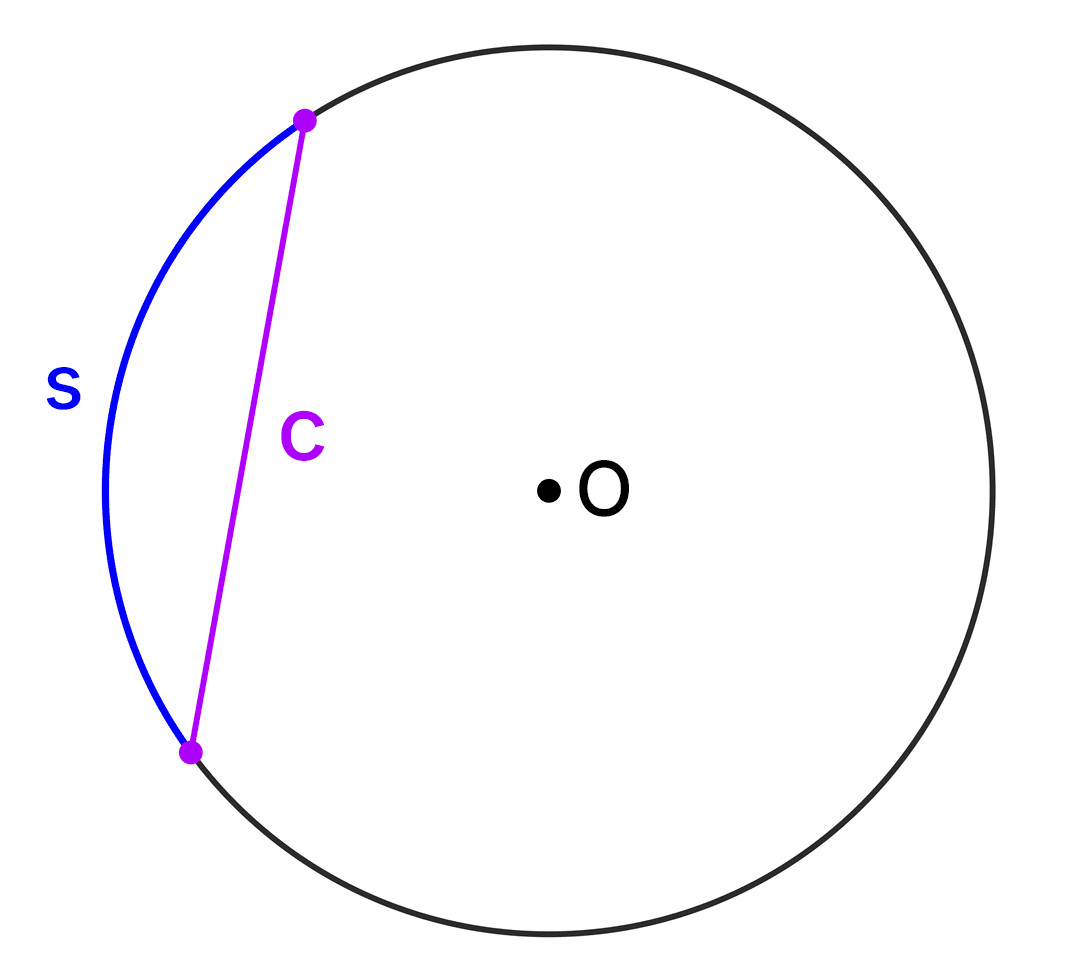
An arc is a curved portion of a circle between two points. While it is not a straight line segment, it is directly related to chords, as every chord defines two arcs. Specifically, when the chord is a diameter, it divides the circle into two equal arcs called semicircles.
Sagitta
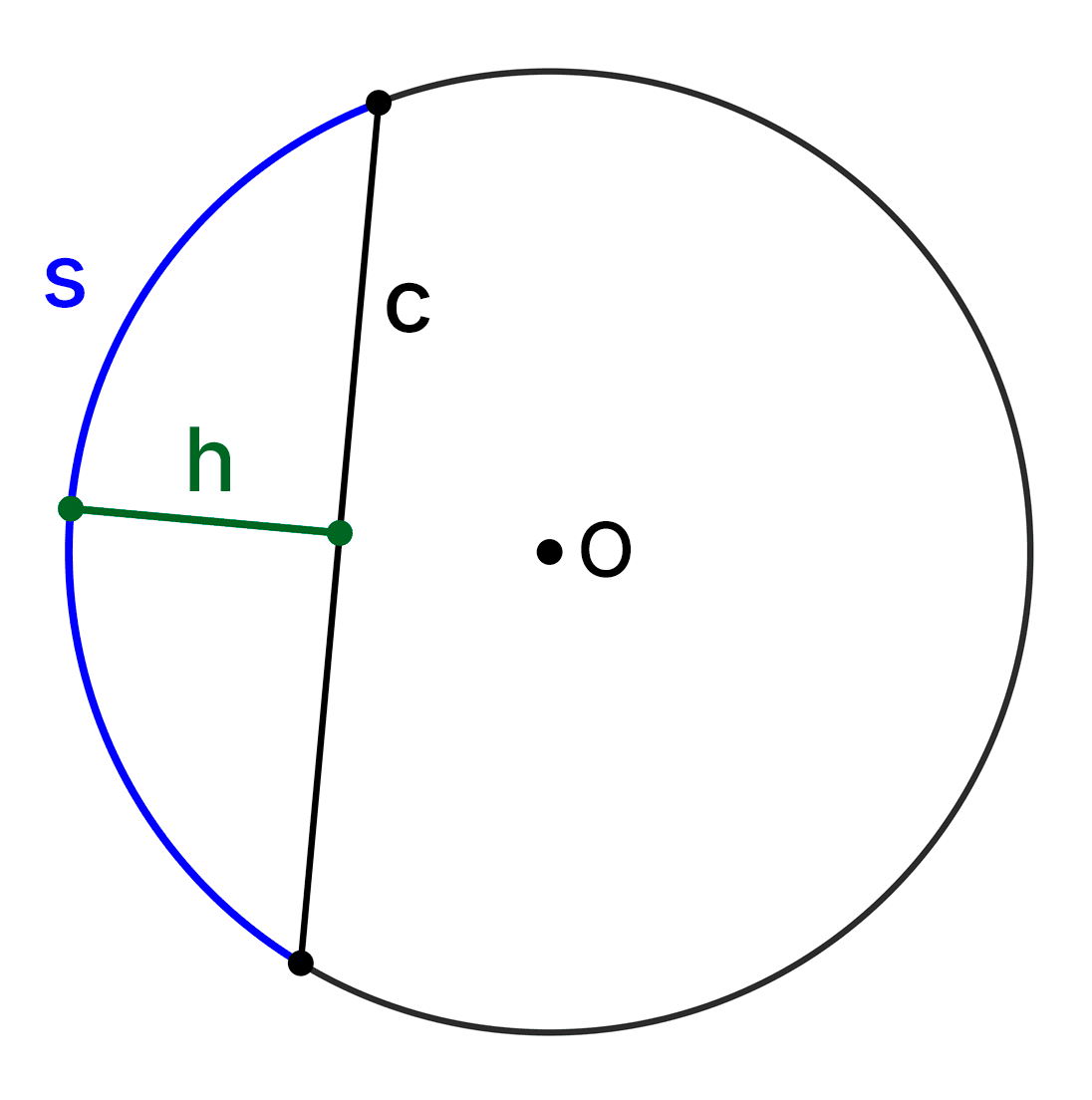
The sagitta (also called the height of an arc) is the line segment connecting the midpoint of an arc to the midpoint of its chord, and it is perpendicular to the chord. Its length represents the maximum distance between the chord and the arc it subtends.
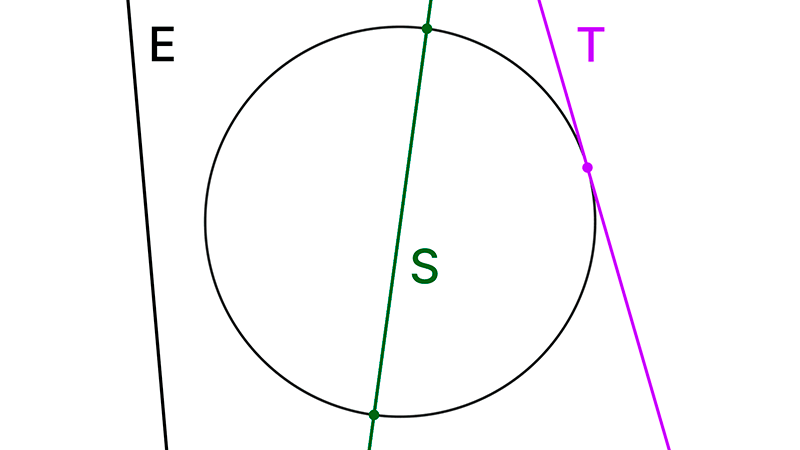
Secant Line
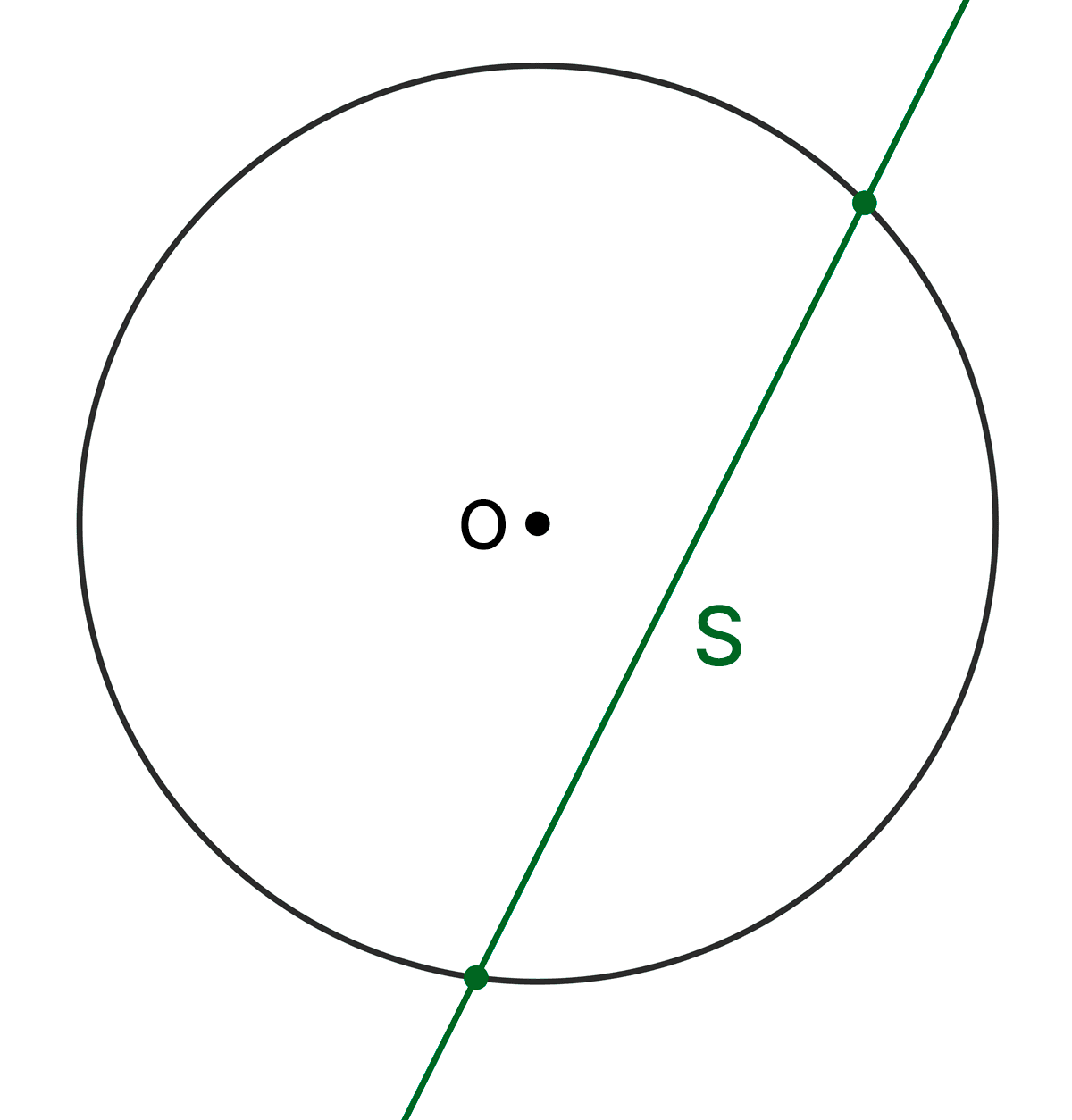
A secant line is a line that intersects a circle at two distinct points. Analytically, the intersection points of a line and a circle are found by solving the system formed by the equation of the line and the equation of the circle. A line is secant if this system yields two distinct real solutions.
Tangent Line
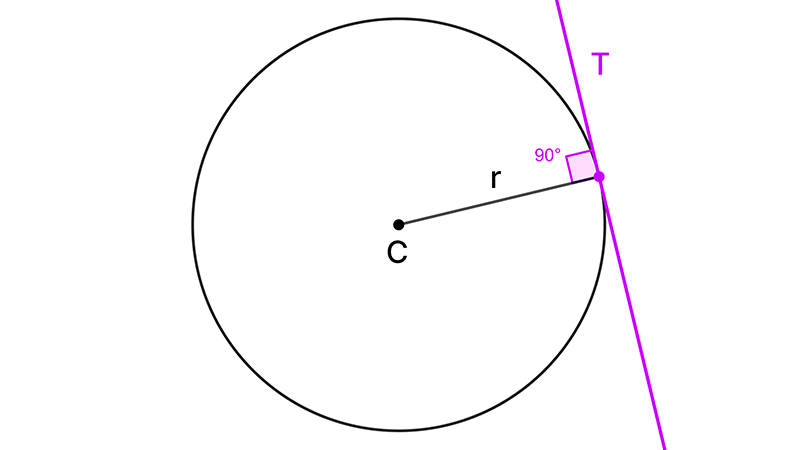
A tangent line is a line that intersects a circle at exactly one point, known as the point of tangency. Analytically, when solving the system of equations between the line and the circle, a line is tangent if the system produces a single real solution (a double root).
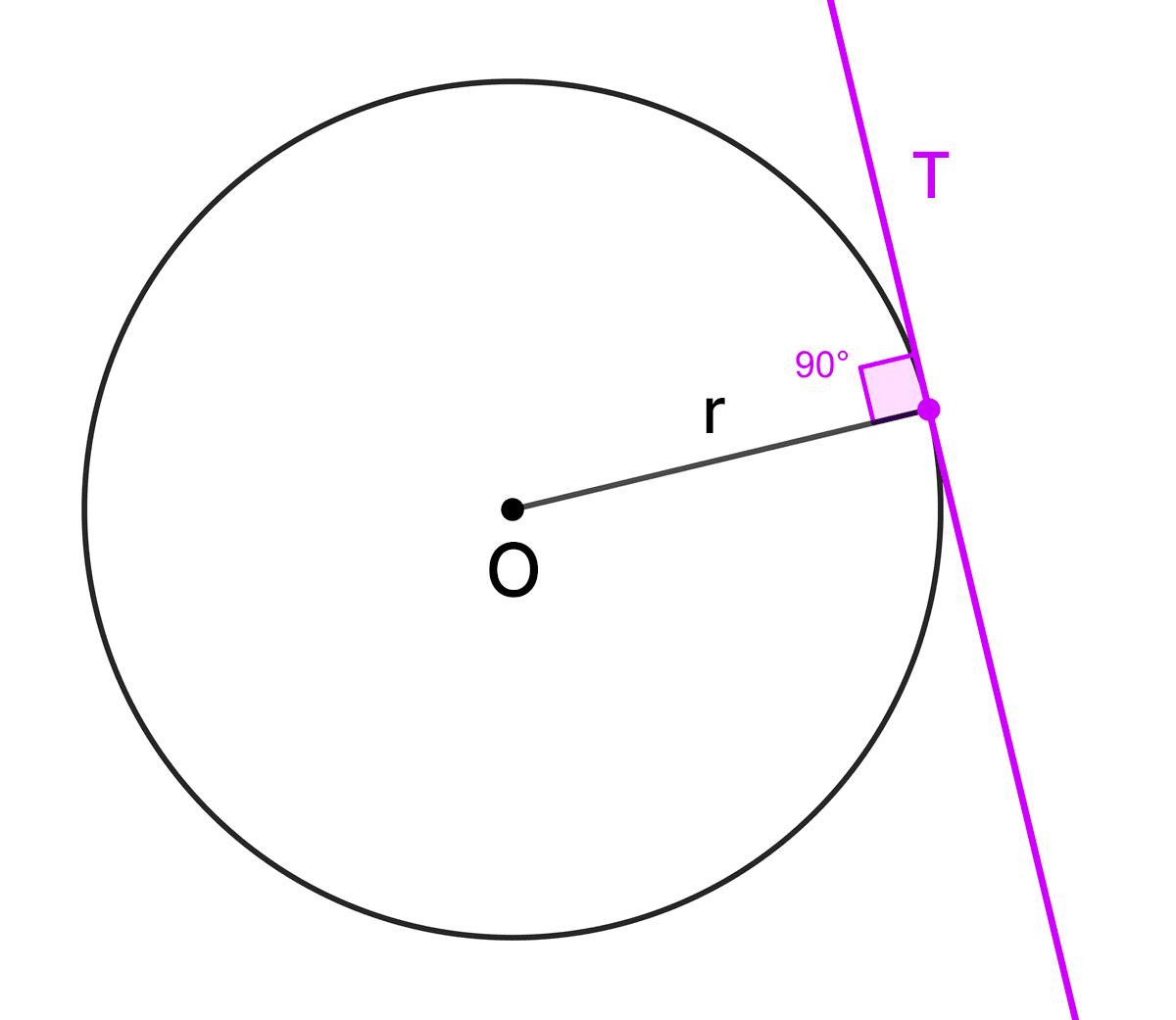
A fundamental property of the tangent line is that it is perpendicular to the radius at the point of tangency. If the point of tangency is \((x_0, y_0)\) and the center is \((h, k)\), the slope of the radius is:
$$m_r=\dfrac{y_0-k}{x_0-h}$$
The slope of the tangent line \(m_t\) is its negative reciprocal:
\(m_t=-\dfrac{1}{m_r}\), provided that \(m_r \neq 0\)
If \(m_r=0\) (horizontal radius), the tangent line is vertical. If \(m_r\) is undefined (vertical radius), the tangent line is horizontal. Given the point of tangency and the slope, the equation of the tangent line is determined using point-slope form:
$$y-y_0=m_t (x-x_0)$$
Did you find this useful? Rate it!
0.0 / 5 — 0 votes

HOW TO CITE THIS ARTICLE
Machado, D. (2026, November 5). Parts of a Circle. Exponty. https://exponty.com/en/circle-parts
Relative Positions of a Line and a Circle
Equation of a Circle Through Three Points
Tangent Line to a Circle
Equations of Circles: Practice Problems with Solutions
Leave a Reply
Related posts