
Vertices of a Hyperbola
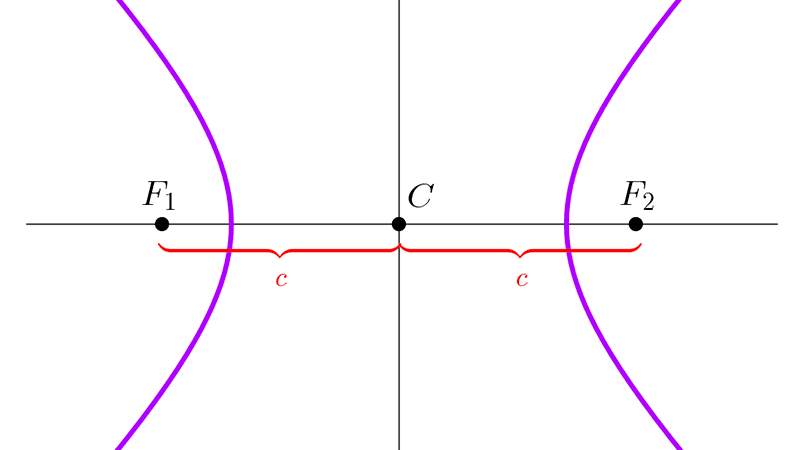
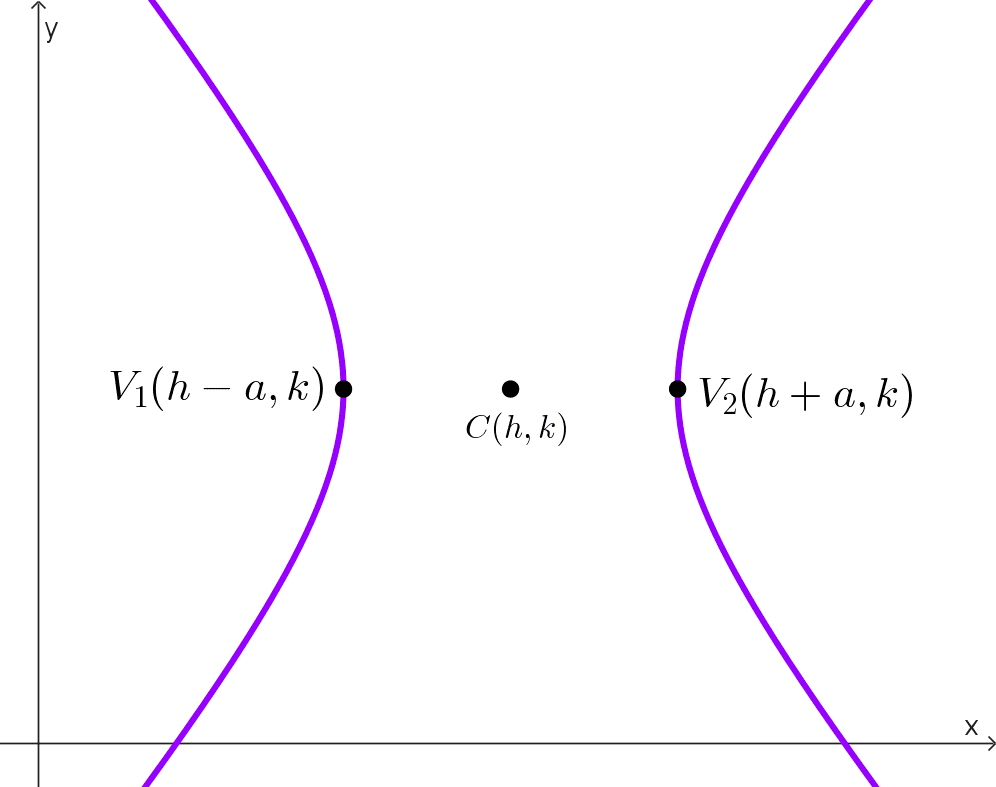
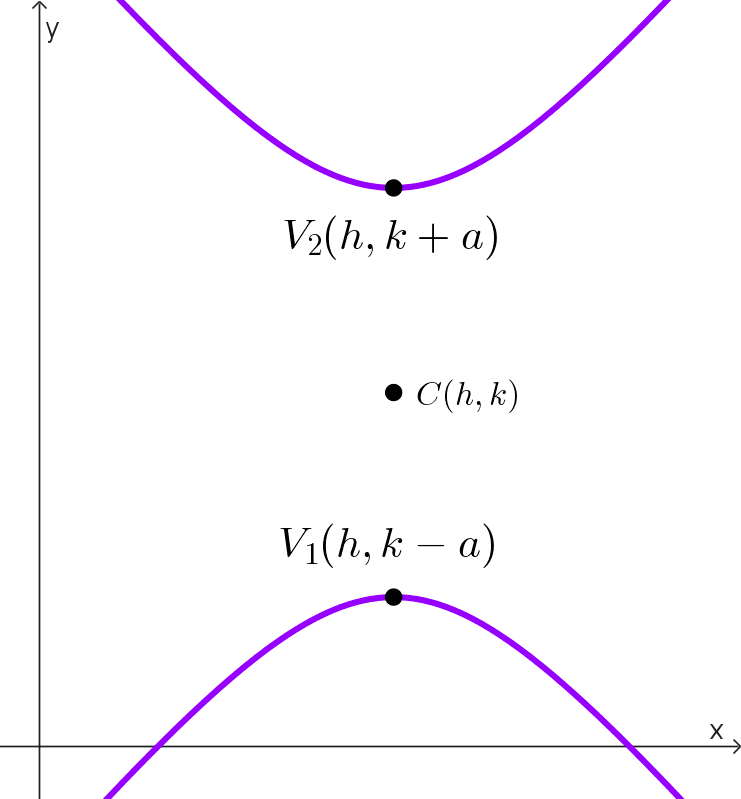
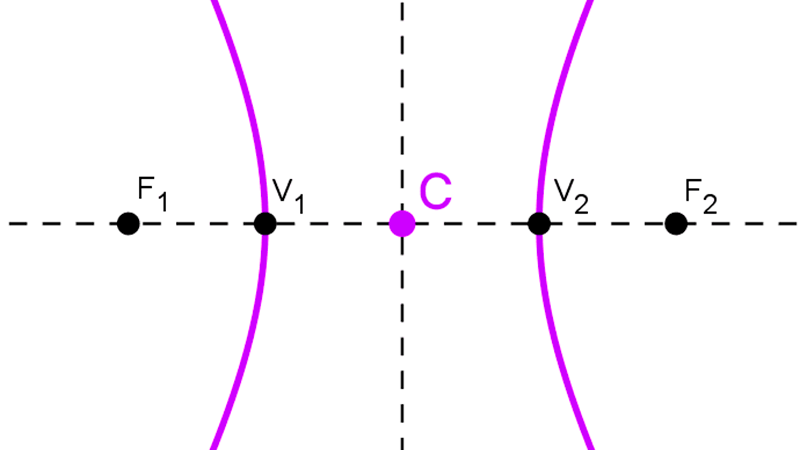
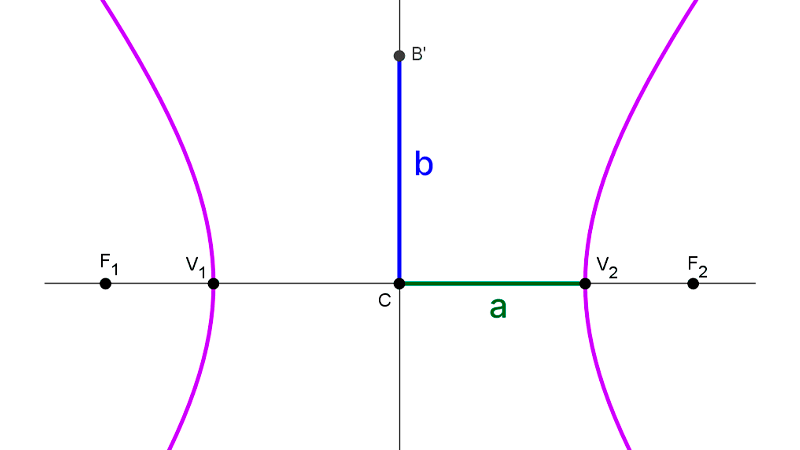
The vertices of a hyperbola are the two points on the curve closest to the center. Both lie on the focal axis, and the line segment connecting them is called the transverse axis. The vertices are separated by a distance of 2a (the total length of the transverse axis).
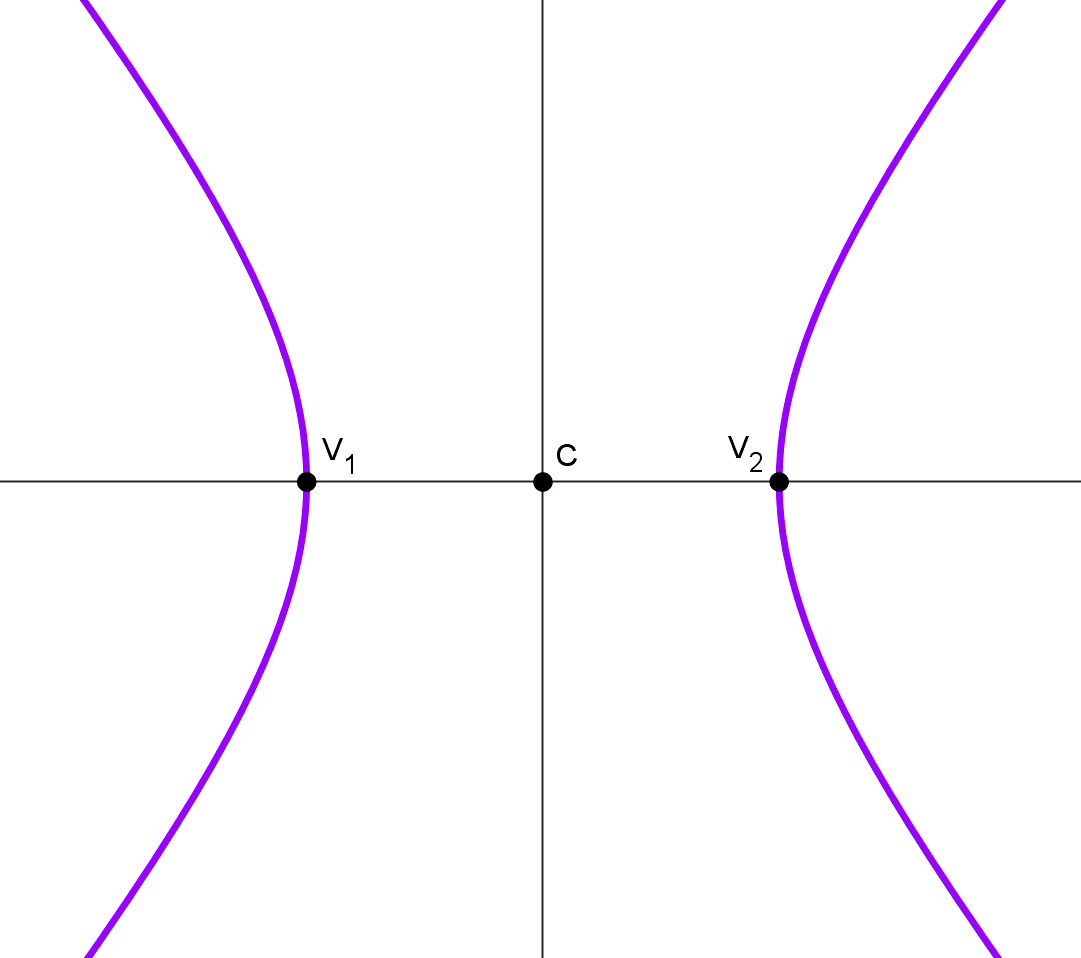
Below, we will look at how to find the vertices of a hyperbola step by step. If you are not yet familiar with the geometric concept of a hyperbola, you may want to review our main guide covering its definition, formulas, and key properties.
Table of Contents
How to Find the Vertices of a Hyperbola
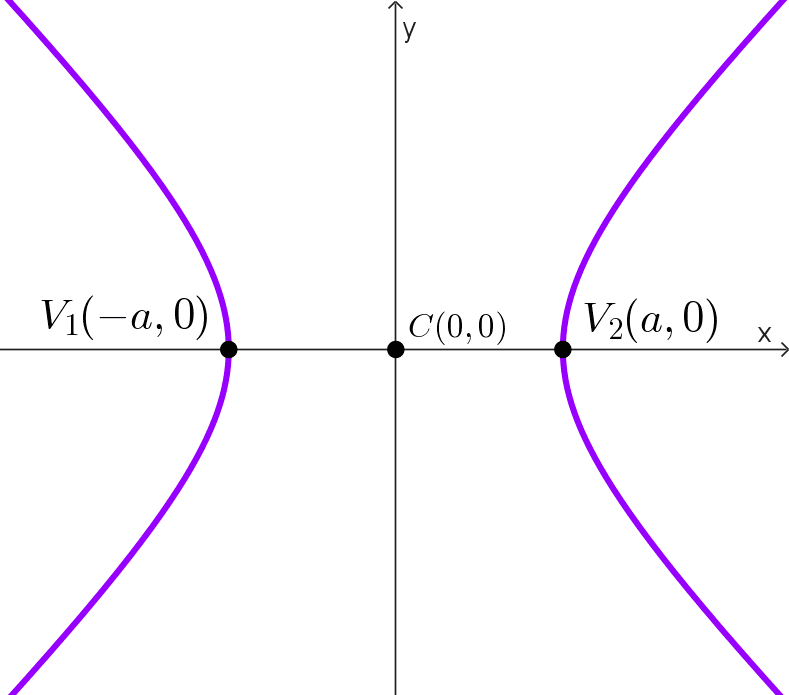
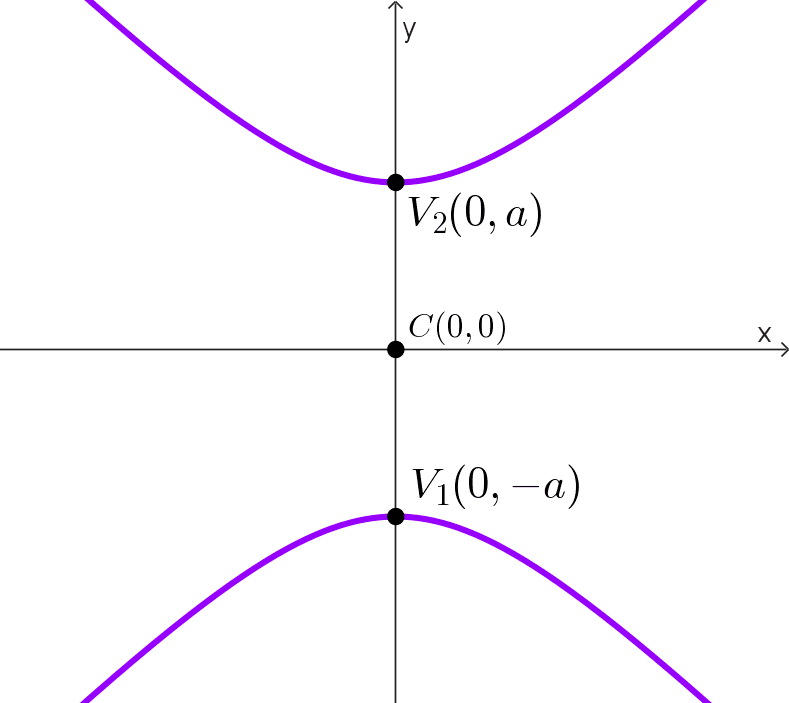
The coordinates of the vertices can be found knowing the center and the value of a (the distance from the center to each vertex), which can be determined directly from the standard form equation.
| Standard Equation | Transverse Axis | Center | Vertices |
|---|---|---|---|
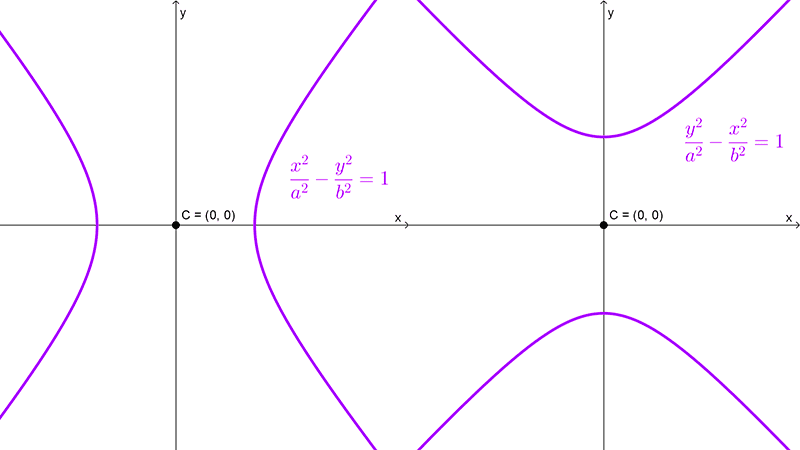
| \(\dfrac{x^2}{a^2}-\dfrac{y^2}{b^2}=1\) | Along the x-axis | (0, 0) | (a, 0) (-a, 0) |
| \(\dfrac{y^2}{a^2}-\dfrac{x^2}{b^2}=1\) | Along the y-axis | (0, 0) | (0, a) (0, -a) |
| \(\dfrac{(x-h)^2}{a^2}-\dfrac{(y-k)^2}{b^2}=1\) | Parallel to the x-axis | (h, k) | (h + a, k) (h - a, k) |
| \(\dfrac{(y-k)^2}{a^2}-\dfrac{(x-h)^2}{b^2}=1\) | Parallel to the y-axis | (h, k) | (h, k + a) (h, k - a) |
Step-by-Step Examples
Example 1
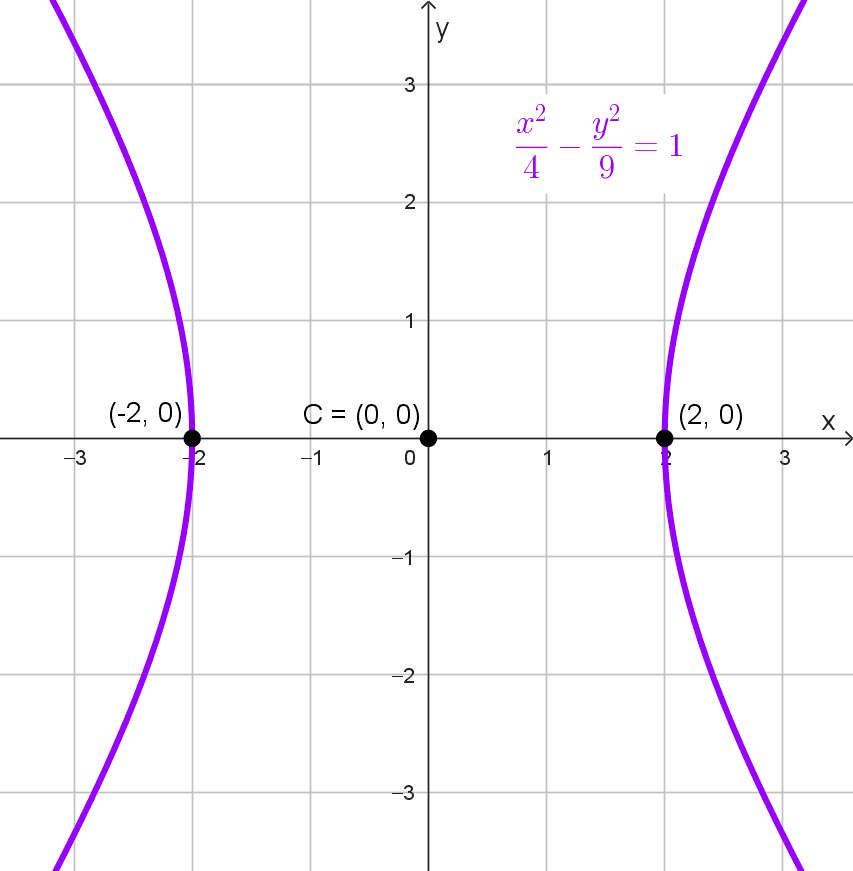
Find the vertices of the hyperbola \(\dfrac{x^2}{4}-\dfrac{y^2}{9}=1\).
Solution: Notice that this is a hyperbola with a horizontal transverse axis because the x2 term is positive. Furthermore, its center is at the origin (0, 0).
For a hyperbola of this form, the vertices lie at a distance of a to the left and right of the center—that is, at the points (±a, 0), where a is the distance from the center to each vertex.
From the equation, we identify \(a^2=4,\) which gives \(a=\sqrt{4}=2.\) Therefore, the vertices of the hyperbola are at (2, 0) and (-2, 0). These points correspond to the endpoints of the transverse axis.
Example 2
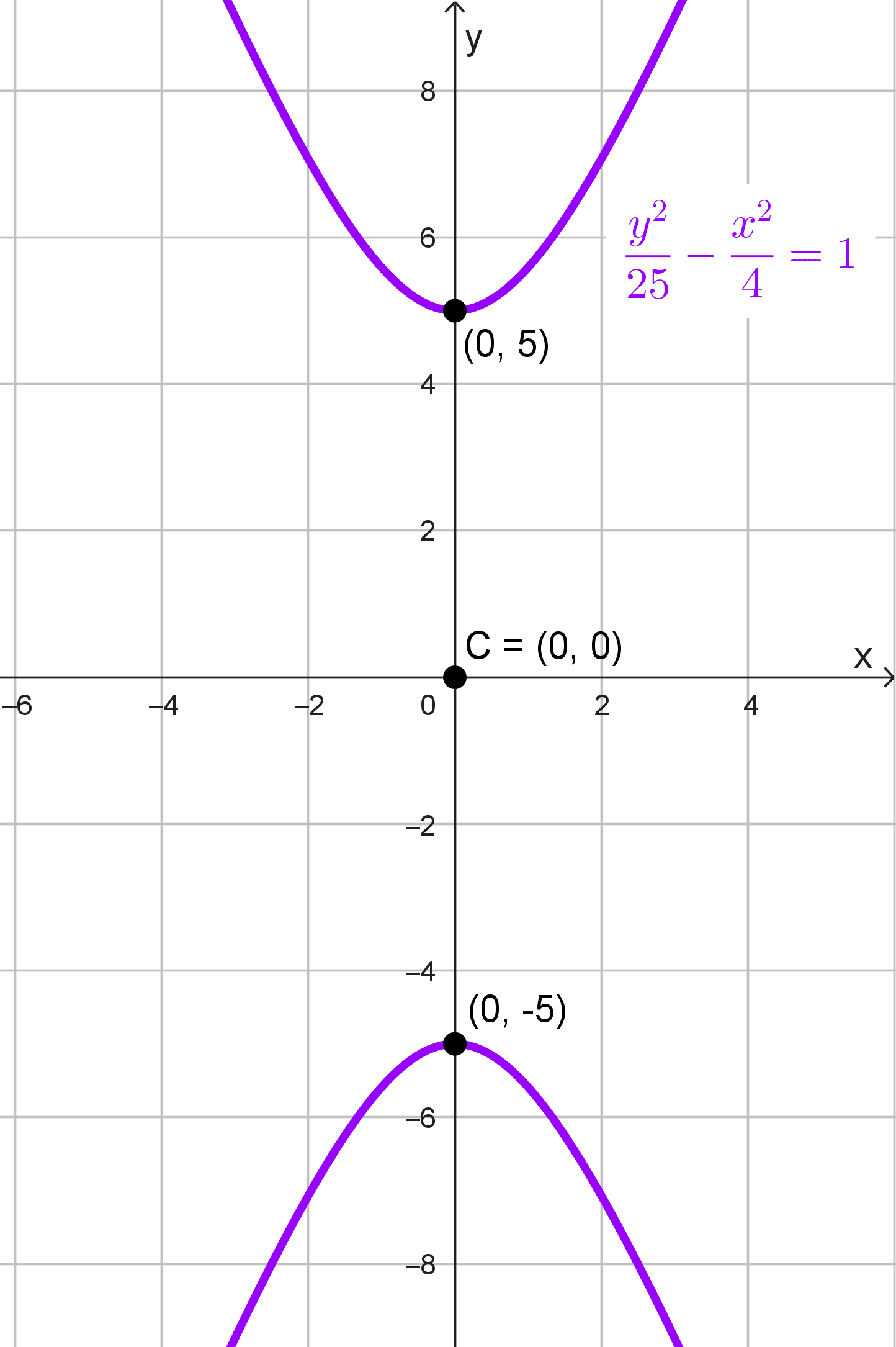
Given the equation of the hyperbola \(\dfrac{y^2}{25}-\dfrac{x^2}{4}=1,\) determine its vertices.
Solution: We begin by noting that this hyperbola has a vertical transverse axis since the positive term is associated with y2. In addition, the center of the hyperbola is at the origin (0, 0).
For a hyperbola with these characteristics, the vertices lie at a distance of a units above and below the center—meaning at the points (0, ±a), where a is the distance from the center to each vertex.
From the given equation, we identify that \(a^2=25,\) which yields \(a=\sqrt{25}=5.\) Therefore, the vertices of the hyperbola are located at (0, 5) and (0, -5).
Example 3
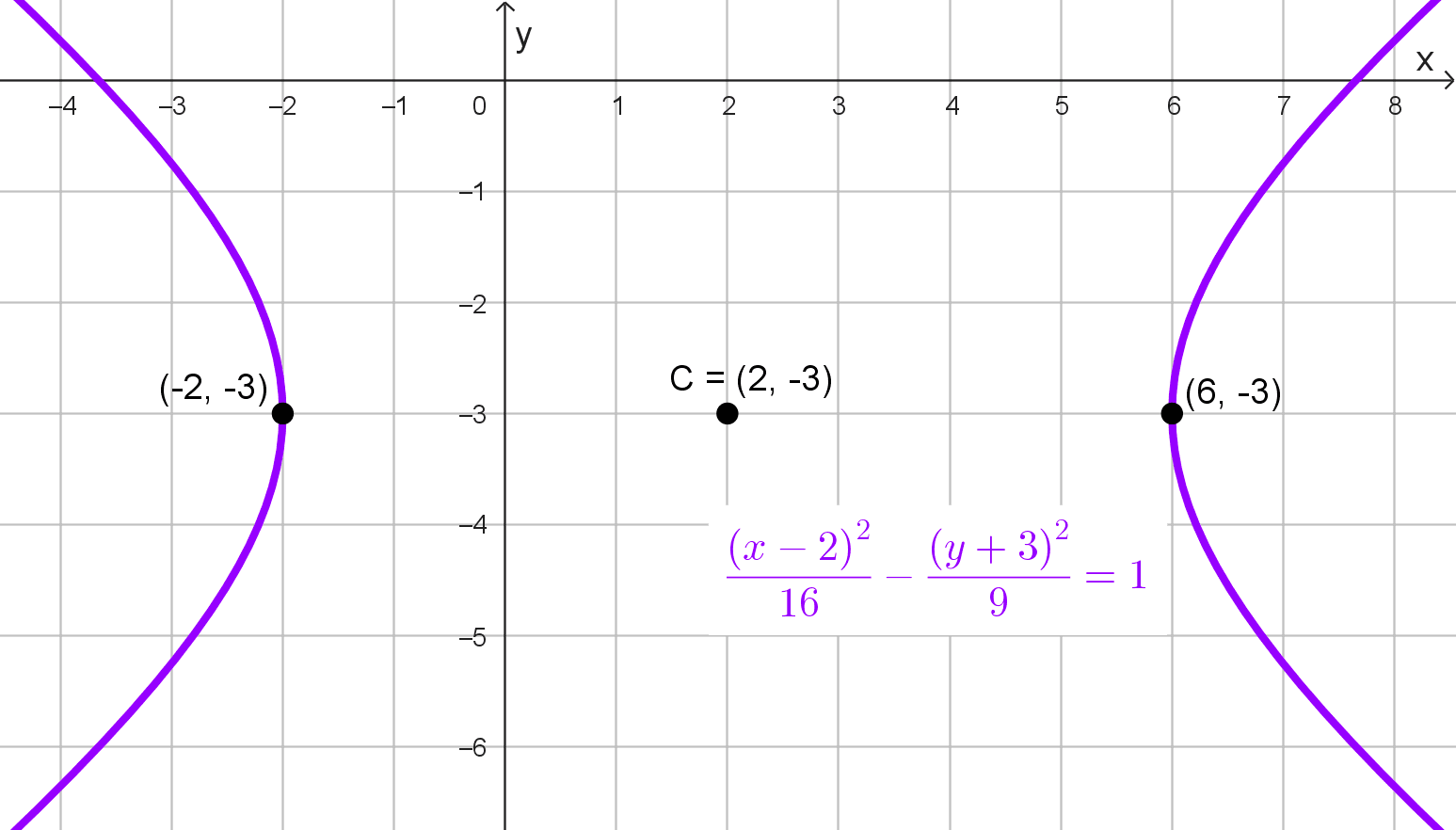
Find the coordinates of the vertices of the hyperbola \(\dfrac{(x-2)^2}{16}-\dfrac{(y+3)^2}{9}=1\).
Solution: This is a horizontal hyperbola because the positive term is associated with \((x-2)^2.\) In addition, the center of the hyperbola is not at the origin, but at the point (2, -3).
For a hyperbola with a horizontal transverse axis, the vertices are located at a distance of a to the left and right of the center—that is, at (h ± a, k), where (h, k) is the center and a is the distance from the center to each vertex.
From the given equation, we find that \(a^2=16,\) which means \(a=\sqrt{16}=4.\) Therefore, the vertices of the hyperbola are located at (2 + 4, -3) and (2 - 4, -3), which gives (6, -3) and (-2, -3).
Example 4
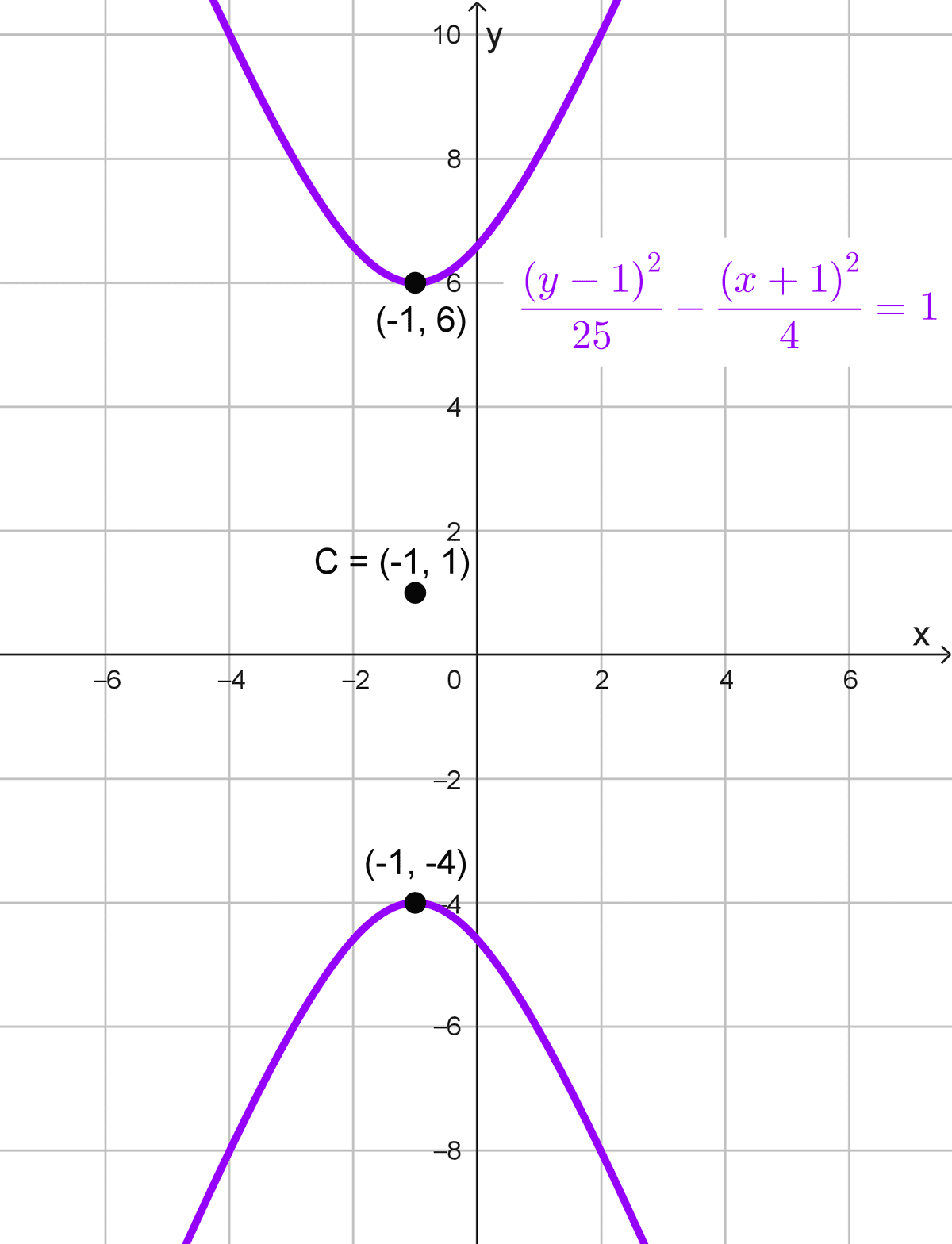
Find the vertices of the hyperbola with equation \(\dfrac{(y-1)^2}{25}-\dfrac{(x+1)^2}{4}=1\).
Solution: From the equation, we observe that this is a vertical hyperbola because the positive term is associated with \((y-1)^2.\) Furthermore, the center of the hyperbola is not at the origin, but at (-1, 1).
For a hyperbola of this type, the vertices lie at a distance of a above and below the center—meaning at (h, k ± a), where (h, k) is the center and a is the distance from the center to each vertex.
From the equation, we find that \(a^2=25,\) so \(a=\sqrt{25}=5.\) Therefore, the vertices of the hyperbola are at (-1, 1 + 5) and (-1, 1 - 5), which results in (-1, 6) and (-1, -4).
Example 5
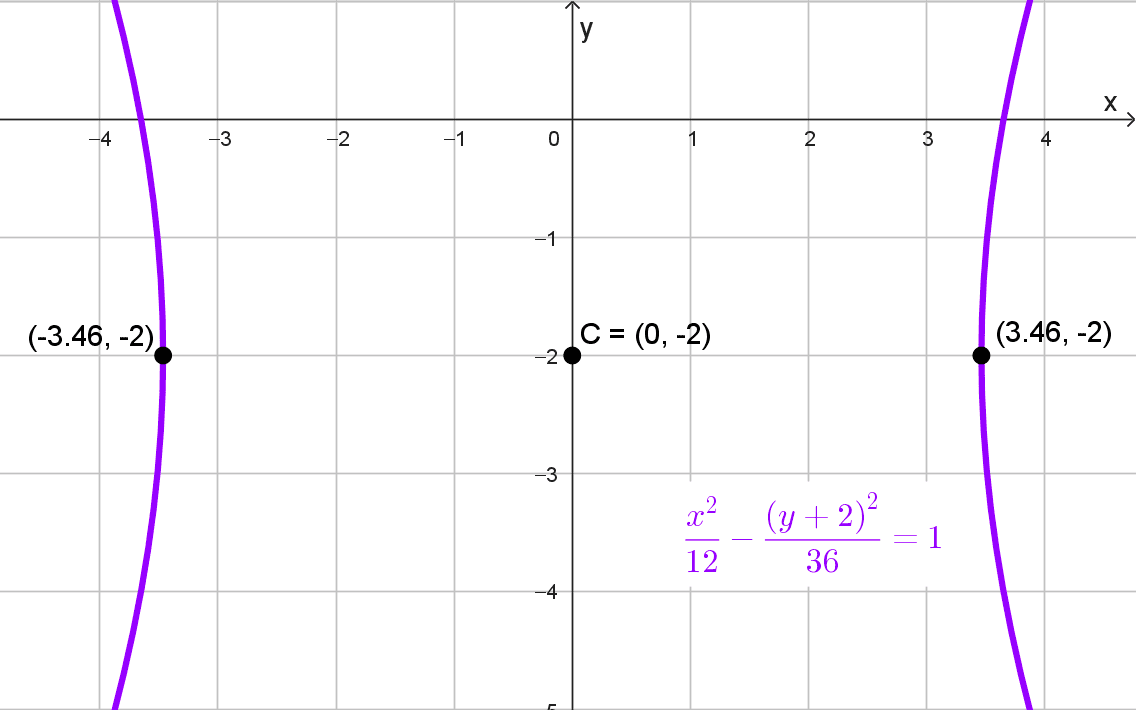
Find the two vertices of the hyperbola \(3x^2-y^2-4y-40=0\).
Solution: The equation is given in general form rather than standard form, so we cannot extract the necessary values immediately. Completing the square gives the equivalent standard equation:
$$\dfrac{x^2}{12}-\dfrac{(y+2)^2}{36}=1$$
Here we see that this is a horizontal hyperbola because the positive term is associated with x2. Additionally, the center of the hyperbola is at (0, -2), as indicated by the translation in y.
For a hyperbola with a horizontal transverse axis, the vertices are located at a distance of a to the left and right of the center—that is, at (h ± a, k), where (h, k) is the center and a is the distance from the center to each vertex.
From the given equation, we identify that \(a^2=12,\) which gives \(a=\sqrt{12}=2\sqrt{3}.\) Therefore, the vertices of the hyperbola are at \((0+2\sqrt{3}, -2)\) and \((0-2\sqrt{3}, -2),\) which means \((2\sqrt{3}, -2) \text{ and } (-2\sqrt{3}, -2).\)
Rounding to two decimal places, the vertices are approximately at (3.46, -2) and (-3.46, -2).
Did you find this useful? Rate it!
0.0 / 5 — 0 votes

HOW TO CITE THIS ARTICLE
Machado, D. (2026, November 2). Vertices of a Hyperbola. Exponty. https://exponty.com/en/hyperbola-vertices
Focal Distance of a Hyperbola
Center of a Hyperbola
Horizontal and Vertical Hyperbolas
Rectangular Hyperbola
Transverse and Conjugate Axes of a Hyperbola
Foci of a Hyperbola
Asymptotes of a Hyperbola
Hyperbola Practice Problems with Solutions
Leave a Reply
Related posts