
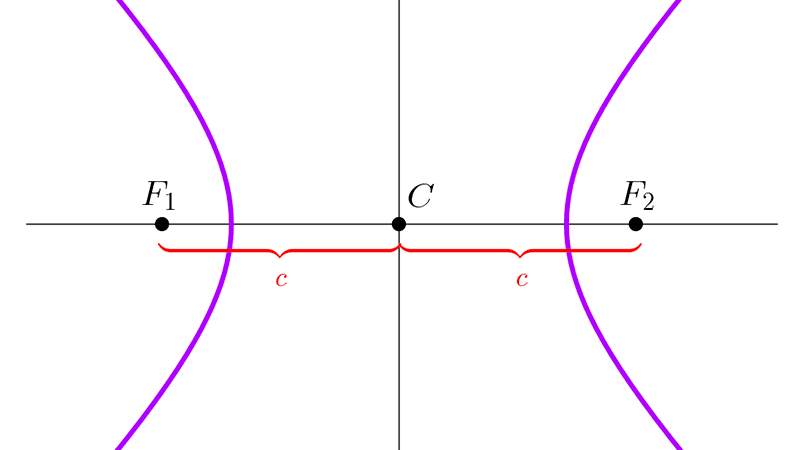
Transverse and Conjugate Axes of a Hyperbola
The axes of a hyperbola are lines or line segments that provide key geometric information about the curve. There are several axes associated with a hyperbola:
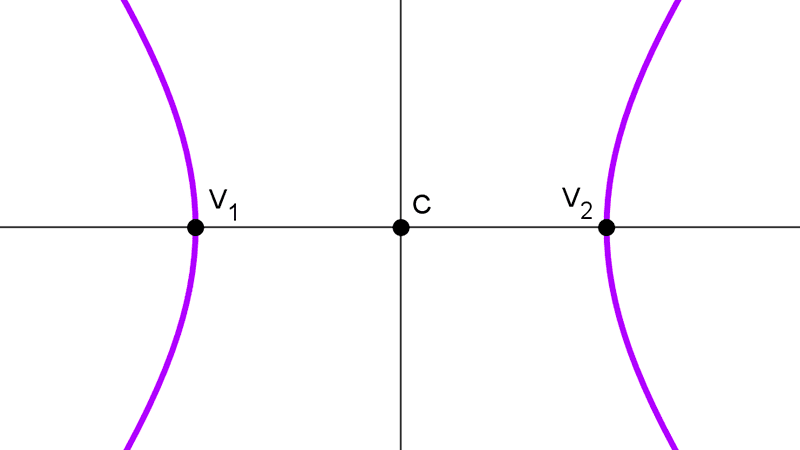
- Transverse axis: the line segment connecting the vertices of the hyperbola that passes through the center. Its length is 2a, where a is the distance from the center to a vertex. Half of this segment is called the semi-transverse axis.
- Conjugate axis: a line segment perpendicular to the transverse axis that passes through the center and has a length of 2b. It serves as a guide for sketching the asymptotes, and half of this segment is called the semi-conjugate axis.
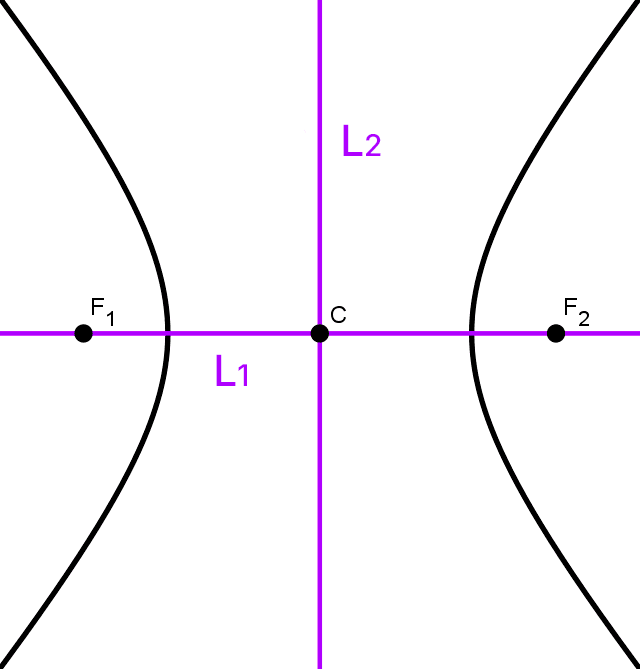
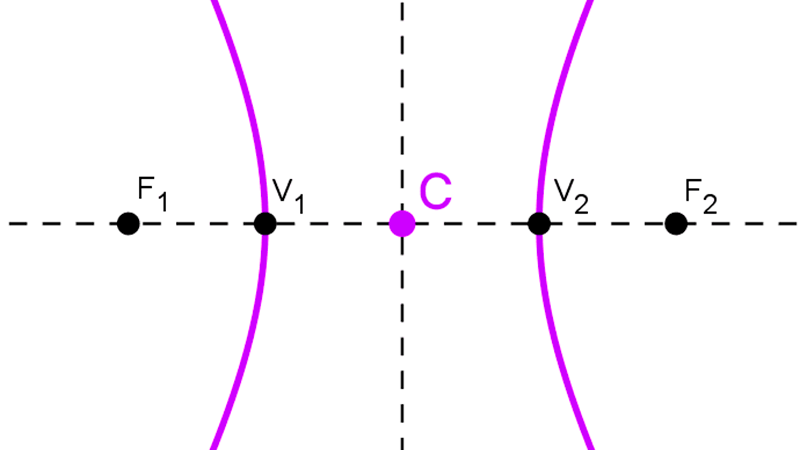
- Focal axis (or principal axis): the line passing through the foci, vertices, and center of the hyperbola. It contains the transverse axis and is an axis of symmetry of the graph.
- Perpendicular axis of symmetry: the line perpendicular to the focal axis that passes through the center. It contains the conjugate axis and serves as a second axis of symmetry of the hyperbola.
Note that the transverse and conjugate axes are line segments, whereas the focal axis and its perpendicular counterpart are lines. Every hyperbola has two axes of symmetry: the focal axis and the perpendicular axis passing through the center.
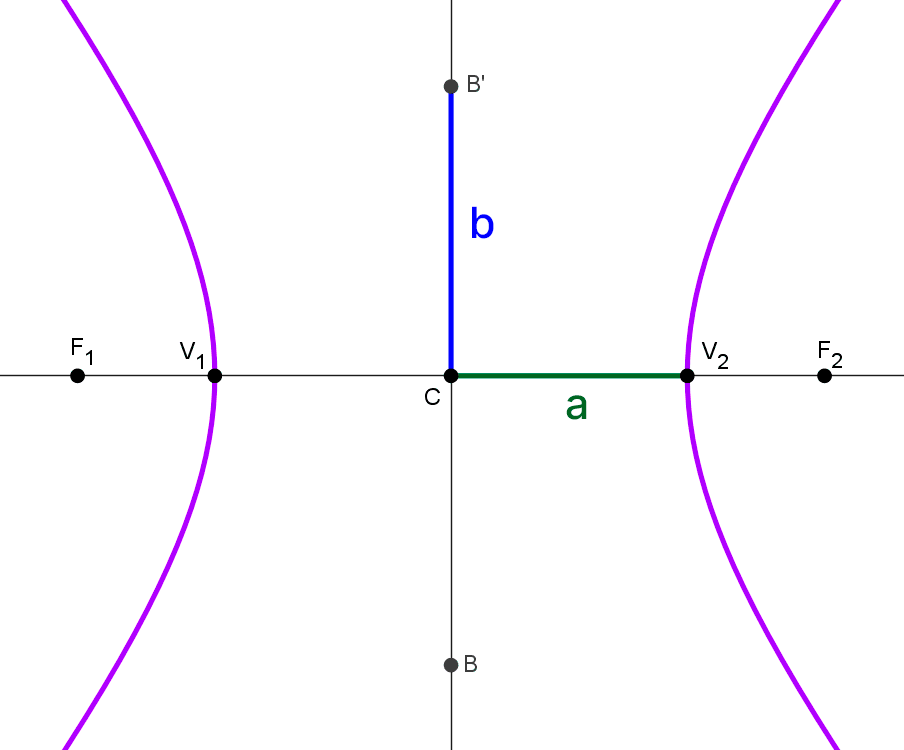
A hyperbola is horizontal or vertical depending on the orientation of its transverse axis. The following relationship links the lengths of the semi-transverse axis (a) and semi-conjugate axis (b) to the focal semi-distance (c):
c2 = a2 + b2
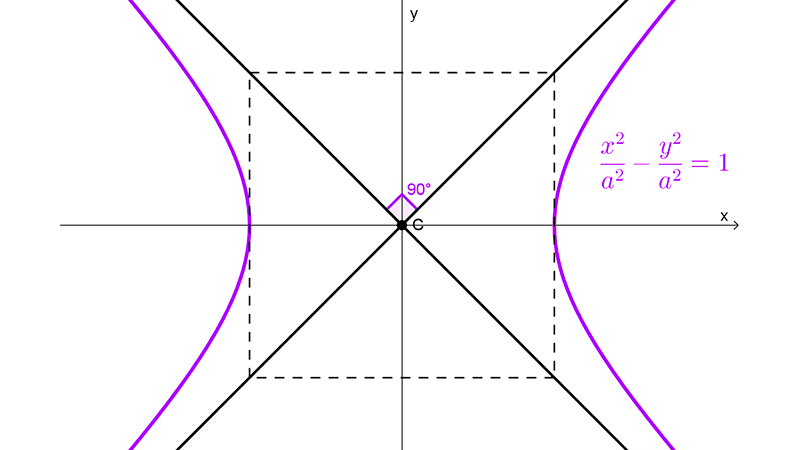
The transverse and conjugate axes can have the same length (a = b); in this case, the curve is called a rectangular hyperbola (or equilateral hyperbola).
Important: If you are new to hyperbolas, we recommend reviewing our main guide first, where we cover the formal definition, standard equations, elements, and properties.
Table of Contents
How to Find the Axes of a Hyperbola
The lengths of the semi-axes appear in the standard equation of the hyperbola squared as the denominators of each variable term.
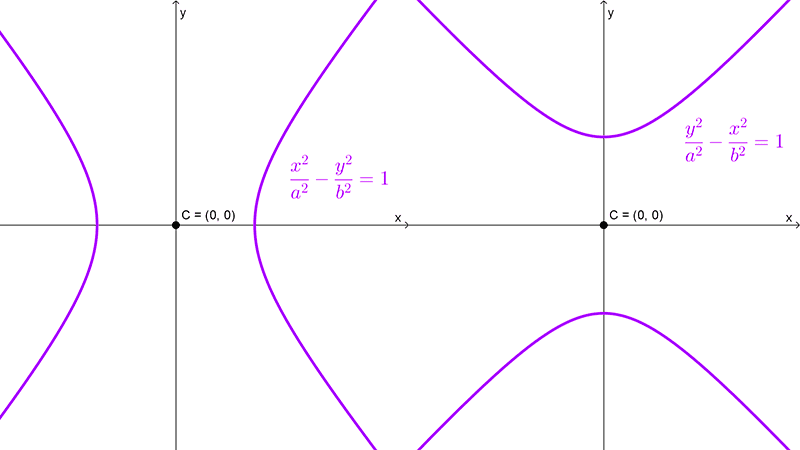
| Orientation | Standard Form | Axes and Semi-Axes | Center | Axes of Symmetry |
|---|---|---|---|---|
| Horizontal hyperbola | \(\dfrac{(x-h)^2}{a^2}-\dfrac{(y-k)^2}{b^2}=1\) | Semi-transverse axis: a Semi-conjugate axis: b Transverse axis length: 2a Conjugate axis length: 2b | (h, k) | Focal axis: y = k Perpendicular axis: x = h |
| Vertical hyperbola | \(\dfrac{(y-k)^2}{a^2}-\dfrac{(x-h)^2}{b^2}=1\) | Semi-transverse axis: a Semi-conjugate axis: b Transverse axis length: 2a Conjugate axis length: 2b | (h, k) | Focal axis: x = h Perpendicular axis: y = k |
The positive term in the standard equation determines the orientation of the transverse axis:
- If the positive term contains the variable x, the transverse axis is parallel to the x-axis, resulting in a horizontal hyperbola.
- If the positive term contains the variable y, the transverse axis is parallel to the y-axis, resulting in a vertical hyperbola.

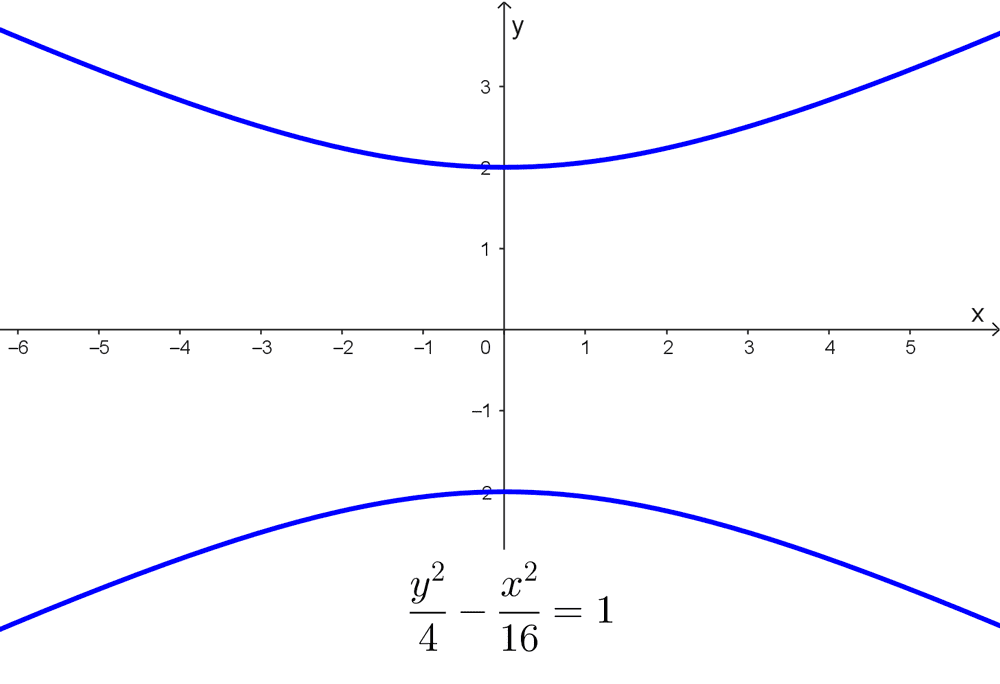
The denominator of the positive term yields the length of the semi-transverse axis (a), while the denominator of the negative term yields the length of the semi-conjugate axis (b). Take the square root of each denominator to find these values.
If the equation is not in standard form, use algebraic manipulation (such as completing the square) to convert it. Multiplying the values of a and b by two yields the lengths of the transverse and conjugate axes, respectively.
Step-by-Step Examples
Example 1
Find the transverse and conjugate axes of the hyperbola \(\dfrac{x^2}{4}-\dfrac{y^2}{9}=1\)
Solution: The equation is in standard form, so we can extract the required values directly. Because the positive term contains the variable x, this is a horizontal hyperbola, meaning its transverse axis (length 2a) is horizontal. The lengths of the semi-axes are found by taking the square root of each denominator.
The denominator of the positive term is 4, so:
$$a^2=4→a=\sqrt{4}=2$$
The denominator of the negative term is 9, so:
$$b^2=9→b=\sqrt{9}=3$$
Calculate the length of each axis by multiplying the semi-axis values by 2:
- Transverse axis: \(2a=2\cdot 2=4\)
- Conjugate axis: \(2b=2\cdot 3=6\)

Example 2
Find the transverse axis, conjugate axis, and axes of symmetry for the hyperbola \(\dfrac{y^2}{25}-\dfrac{x^2}{16}=1\)
Solution: The hyperbola is in standard form and has a vertical orientation because the positive term contains the variable y. We extract the values of the semi-axes:
From the positive term: \(a^2=25→a=\sqrt{25}=5\)
From the negative term: \(b^2=16→b=\sqrt{16}=4\)
Now calculate the full axis lengths by multiplying by 2:
- Transverse axis: \(2a=2\cdot 5=10\)
- Conjugate axis: \(2b=2\cdot 4=8\)
From the equation, the center of the hyperbola is at the origin (0, 0), so the axes of symmetry align with the coordinate axes. Their equations are:
- Focal axis: \(x=0\)
- Perpendicular axis: \(y=0\)
Example 3
Given the hyperbola \(\dfrac{(x-2)^2}{19}-\dfrac{(y+3)^2}{9}=1,\) determine its principal axes and axes of symmetry.
Solution: From the standard equation, we recognize that the hyperbola is horizontal and centered off the origin. We find the lengths of the semi-axes from the denominators:
$$a^2=19→a=\sqrt{19}$$
$$b^2=9→b=\sqrt{9}=3$$
Now calculate the axis lengths by multiplying by 2:
- Transverse axis: \(2a=2\cdot \sqrt{19}≈8.72\)
- Conjugate axis: \(2b=2\cdot 3=6\)
From the equation, the center is the point (h, k) = (2, -3). The axes of symmetry have the forms x = h and y = k, so they are:
- Perpendicular axis: \(x=2\)
- Focal axis: \(y=-3\)

Example 4
Find the semi-axes a and b of the hyperbola \(y^2-2y-2x^2-9=0\)
Solution: In this case, the equation is given in general form, so we cannot extract the values directly. Completing the square yields the equivalent standard form:
$$\dfrac{(y-1)^2}{10}-\dfrac{x^2}{5}=1$$
From this equation, we can identify that the hyperbola is vertical and centered away from the origin. We extract the necessary parameters from the denominators:
$$a^2=10→a=\sqrt{10}$$
$$b^2=5→b=\sqrt{5}$$
Therefore:
- Semi-transverse axis: \(a=\sqrt{10}≈3.16\)
- Semi-conjugate axis: \(b=\sqrt{5}≈2.24\)
Did you find this useful? Rate it!
0.0 / 5 — 0 votes

HOW TO CITE THIS ARTICLE
Machado, D. (2026, November 2). Transverse and Conjugate Axes of a Hyperbola. Exponty. https://exponty.com/en/transverse-conjugate-axis-hyperbola
Focal Distance of a Hyperbola
Center of a Hyperbola
Vertices of a Hyperbola
Horizontal and Vertical Hyperbolas
Rectangular Hyperbola
Foci of a Hyperbola
Asymptotes of a Hyperbola
Hyperbola Practice Problems with Solutions
Leave a Reply
Related posts