
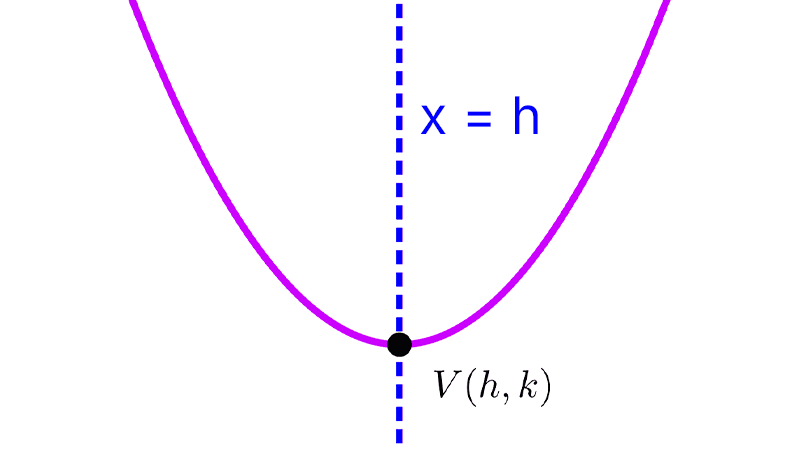
Focal Length of a Parabola
The focal length of a parabola is the distance between its vertex and focus along the axis of symmetry. This value can be determined from the standard equation of the parabola.
A vertical parabola with its vertex at the origin has the equation x2 = 4py, while a horizontal parabola has the equation y2 = 4px. In both cases, the focal length is:
Focal length = |p|
That is, the absolute value of the parameter "p" from the equation. If the vertex is located at any other point, the formula remains the same.
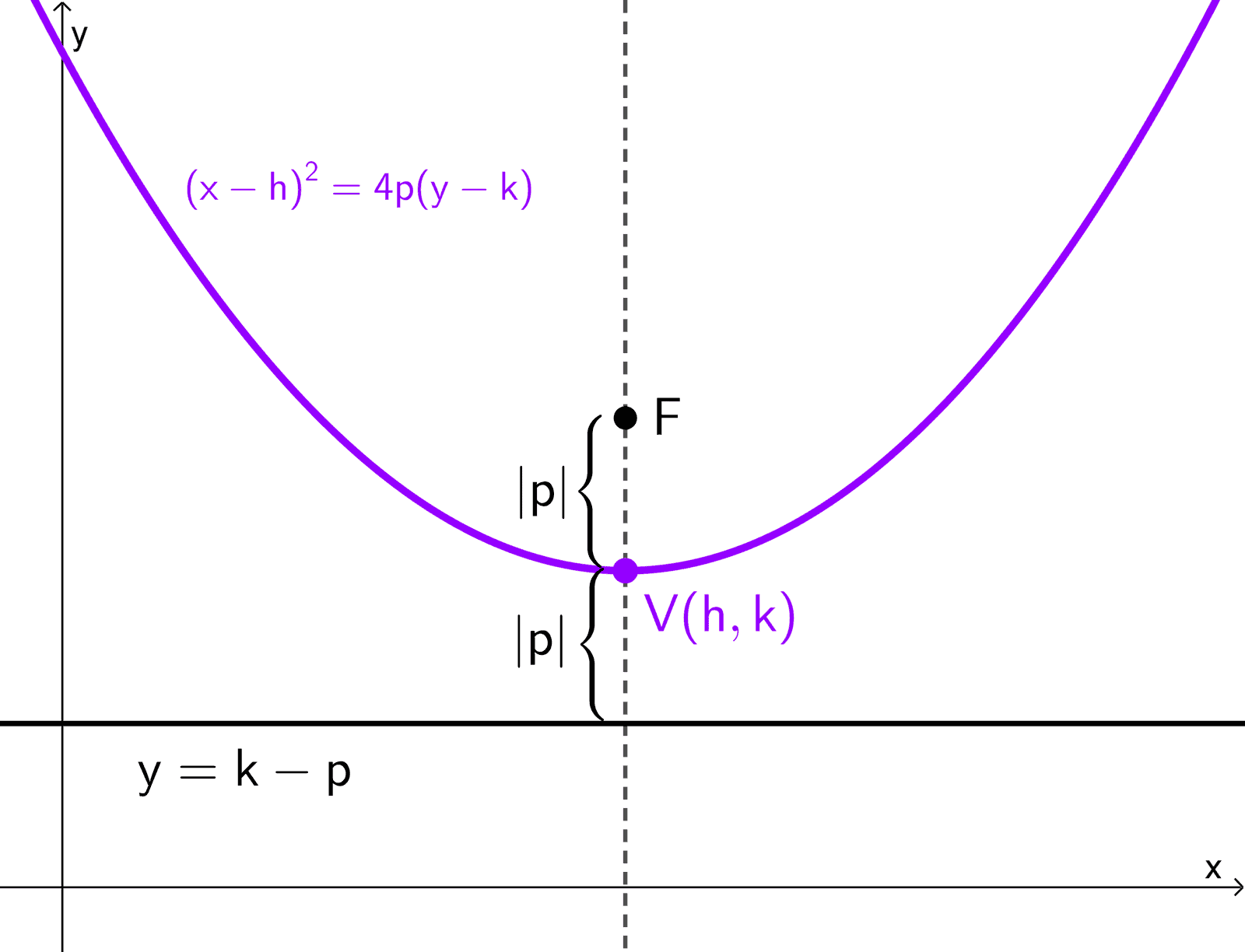

The distance between the vertex and the focus affects the "width" of the parabola:
- If |p| is large, the parabola is wider.
- If |p| is small, the parabola is narrower.
Note: Here we focus on only one element of the parabola. For a comprehensive overview, review the main article on this conic section covering all foundational concepts:
Worked Examples
As shown above, finding the focal length requires identifying the standard form and taking the absolute value of parameter p. However, when given the general form y = ax2 + bx + c (vertical parabolas) or x = ay2 + by + c (horizontal parabolas), the focal length can be found directly by computing |1 / (4a)|, where "a" is the leading coefficient. This follows from the relationship p = 1 / (4a).
| Parabola Equation | Focal Length |
|---|---|
| x2 = 4py y2 = 4px | |p| |
| y = ax2 + bx + c x = ay2 + by + c | |1 / (4a)| |
Practice Problems
Find the focal length of each of the following parabolas:
- \(y^2=-8x\)
- \((x+2)^2=-6(y-3)\)
- \((y-2)^2=4(x-1)\)
- \(x^2=-4 (y-7)\)
- \(y=-2x^2+3x-5\)
- \(-3y^2-x+6y=0\)
Solution 1
Equation: \(y^2=-8x\)
This is a horizontal parabola with its vertex at the origin. The standard form is \(y^2=4px,\) where \(4p=-8.\) Solving for p gives \(p=-2.\) The focal length is calculated as \(|p|,\) resulting in 2.
Solution 2
Equation: \((x+2)^2=-6 (y-3)\)
This is a vertical parabola with its vertex at (-2, 3). The standard form is \((x-h)^2=4p (y-k),\) where \(4p=-6.\) Solving for p yields \(p=-1.5,\) so the focal length is \(|p|=1.5.\)
Solution 3
Equation: \((y-2)^2=4 (x-1)\)
This corresponds to a horizontal parabola with its vertex at (1, 2). Comparing this with the standard form \((y-k)^2=4p (x-h),\) we find that \(4p=4,\) so \(p=1.\) The focal length is \(|p|=1.\)
Solution 4
Equation: \(x^2=-4 (y-7)\)
This is a vertical parabola with its vertex at \((0, 7).\) The equation matches \(x^2=4p (y-k),\) where \(4p=-4.\) Solving for p gives \(p=-1,\) so the focal length is \(|p|=1.\)
Solution 5
Equation: \(y=-2x^2+3x-5\)
This is a vertical parabola in general form with leading coefficient \(a=-2.\) The focal length is calculated directly as:
$$\text{Focal length}=\left| \dfrac{1}{4a} \right|=\left| \dfrac{1}{4(-2)} \right|=\left|-\dfrac{1}{8} \right|=\dfrac{1}{8}=0.125$$
Solution 6
Equation: \(-3y^2-x+6y=0\)
Solve for \(x\) to write the equation in the form \(x=ay^2+by+c:\)
$$x=-3y^2+6y$$
The leading coefficient is \(a=-3.\)
The focal length is calculated as:
$$\text{Focal length}=\left| \dfrac{1}{4a} \right|=\left| \dfrac{1}{4(-3)} \right|=\left|-\dfrac{1}{12} \right|=\dfrac{1}{12} \approx 0.0833$$
Did you find this useful? Rate it!
0.0 / 5 — 0 votes

HOW TO CITE THIS ARTICLE
Machado, D. (2026, November 2). Focal Length of a Parabola. Exponty. https://exponty.com/en/parabola-focal-length
Axis of Symmetry of a Parabola
Directrix of a Parabola
Focus of a Parabola
Vertex of a Parabola
Parabola Practice Problems with Solutions
Leave a Reply
Related posts