
Axis of Symmetry of a Parabola
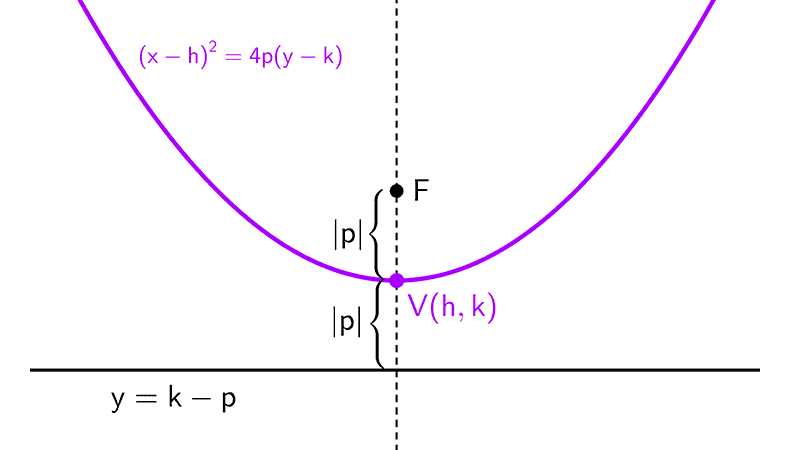
The axis of symmetry is a straight line that passes through the vertex of a parabola, is perpendicular to the directrix, and divides the parabola into two identical mirror halves. Another name for this line is the focal axis, as it also passes through the focus of the parabola.
The axis of symmetry can be vertical or horizontal depending on the orientation of the curve. Because it passes through the vertex, the x- or y-coordinate of the vertex determines the equation of the axis of symmetry:
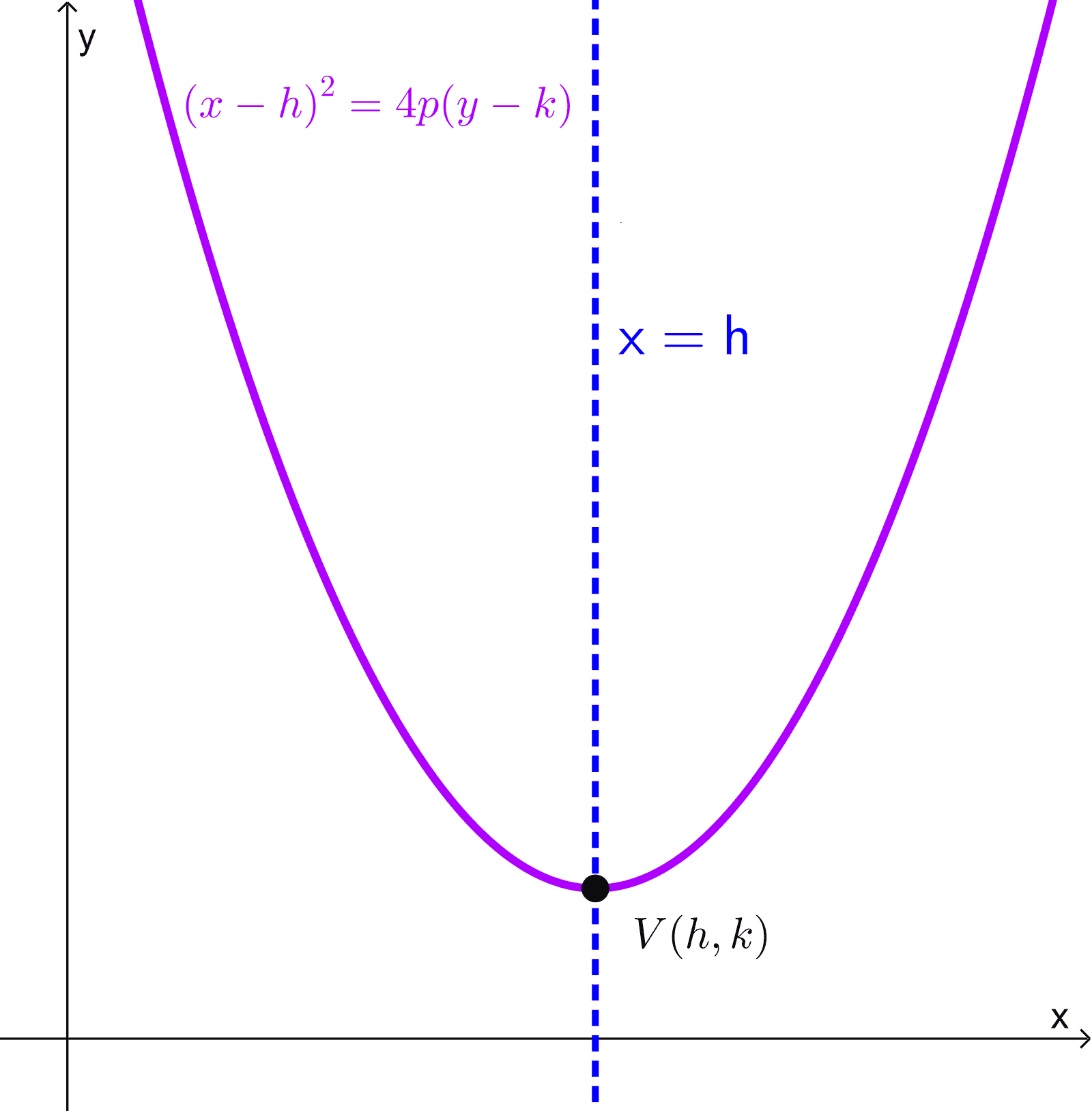
- In vertical parabolas (which open upward or downward) with vertex at (h, k), the axis of symmetry is a vertical line with equation x = h.
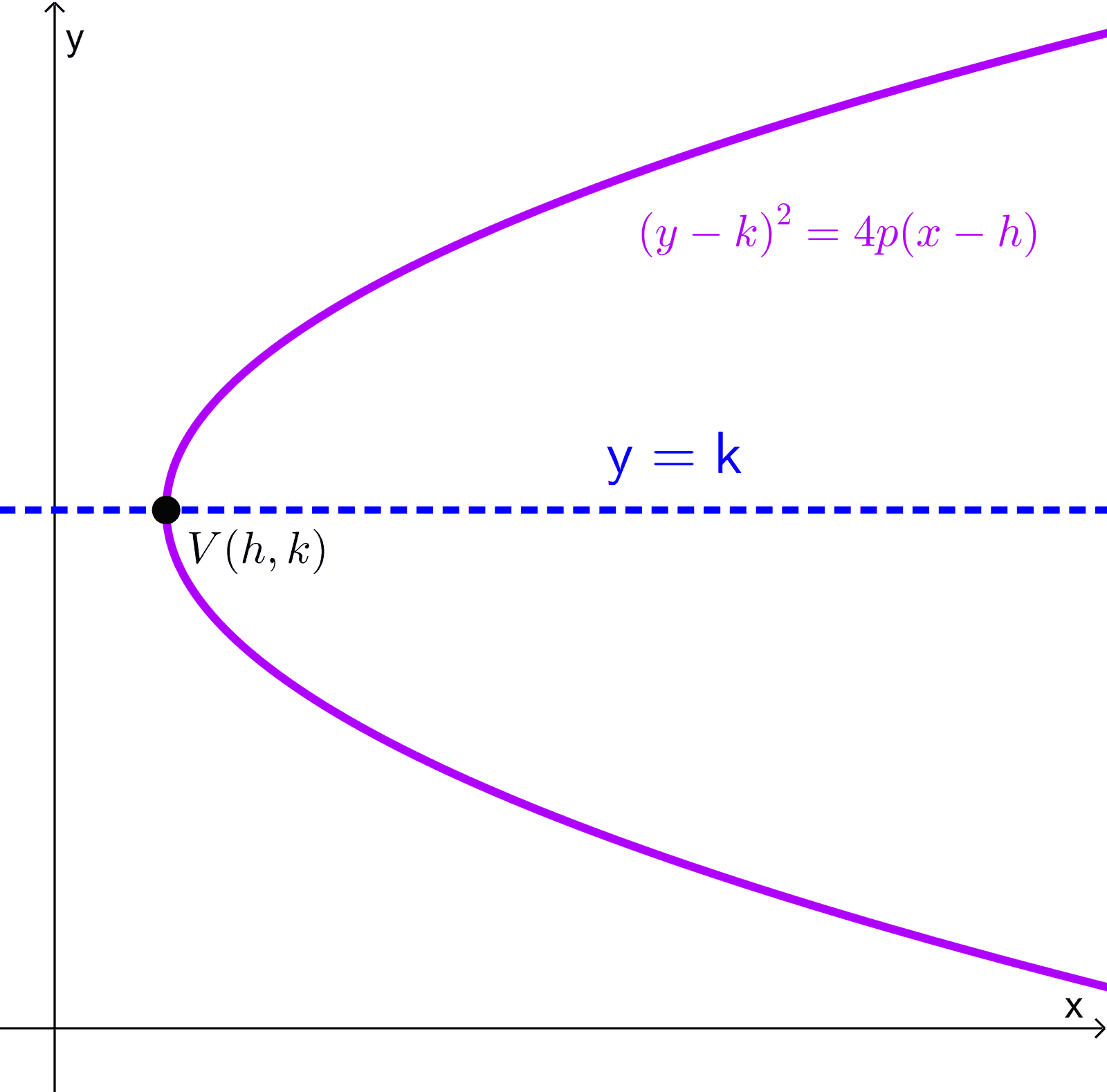
- In horizontal parabolas (which open to the left or right) with vertex at (h, k), the axis of symmetry is a horizontal line with equation y = k.
If the vertex is at the origin, the equation of the axis of symmetry is x = 0 (the y-axis) for vertical parabolas and y = 0 (the x-axis) for horizontal parabolas.
Note: Here, we focus specifically on this single element of the curve. To gain a complete understanding, review our comprehensive guide on this conic section covering all its fundamental theory:
Table of Contents
Equation of the Axis of Symmetry
As noted, finding the axis of symmetry requires determining the vertex of the parabola first. This is straightforward when the equation is written in standard form. The different cases are summarized in the table below:
| Parabola Equation | Vertex | Orientation | Axis of Symmetry |
|---|---|---|---|
| y2 = 4px | (0, 0) | Horizontal | y = 0 |
| x2 = 4py | (0, 0) | Vertical | x = 0 |
| (y - k)2 = 4p (x - h) | (h, k) | Horizontal | y = k |
| (x - h)2 = 4p (y - k) | (h, k) | Vertical | x = h |
Examples
Find the axis of symmetry for each of the following parabolas:
- \(y^2=8x\)
- \((x+1)^2=7(y+2)\)
- \((y-2)^2=4(x-1)\)
- \(x^2-8x+10y+66=0\)
Solution 1
The given equation is: \(y^2=8x\)
First, note that this is a horizontal parabola because the variable y is squared and the variable x is linear. This indicates that the curve opens either to the right or to the left.
Next, we identify the vertex. Since the equation contains no constant shifts added to the variables, the vertex is at the origin (0, 0).
For horizontal parabolas with vertex at (h, k), the axis of symmetry is a horizontal line given by y = k. In this case, since h = 0 and k = 0, the equation of the axis is \(y=0.\)
Solution 2
The given equation is: \((x+1)^2=7(y+2)\)
Analyzing the expression, we observe that it represents a vertical parabola because the variable x is squared and the variable y is linear. This tells us the parabola opens upward or downward.
Now we can obtain the vertex of the parabola. The equation is in the standard conic form \((x-h)^2=4p (y-k),\) where (h, k) represents the vertex. Comparing terms, we find that the vertex is at (-1, -2).
For vertical parabolas with vertex at (h, k), the axis of symmetry is a vertical line with equation x = h. Here, with h = -1, the equation of the axis is:
$$x=-1$$
Solution 3
Given equation: \((y-2)^2=4(x-1)\)
Because the variable y is squared while x appears linearly, this is a horizontal parabola. Identifying the coordinates of the vertex from the equation yields (1, 2).
In horizontal parabolas, the focal axis (or axis of symmetry) is a horizontal line passing through the vertex, with an equation of the form y = k. Since k = 2, the focal axis is given by:
$$y=2$$
Solution 4
Given equation: \(x^2-8x+10y+66=0\)
This equation is expressed in general form rather than standard form. We can complete the square to convert it into standard form:
$$(x-4)^2=-10 (y+5)$$
Since the variable x is squared and y appears linearly, it is a vertical parabola. From this form, we determine that the vertex is at (4, -5).
For a vertical parabola, the axis of symmetry is a vertical line passing through the vertex, parallel to the y-axis, with equation x = h. Since h = 4, the equation of the axis is:
$$x=4$$
When an equation is in general form, specific formulas allow finding the axis of symmetry directly from the coefficients without completing the square. These formulas are covered below.
Vertical Parabolas
The axis of symmetry of a vertical parabola of the form y = ax2 + bx + c is given by the equation:
x = -b / (2a)
This formula is especially useful when working with quadratic functions.
Examples
Find the equation of the axis of symmetry for each of the following vertical parabolas:
- \(y=2x^2+3x-5\)
- \(y=-3x^2+2x+7\)
- \(y=\dfrac{1}{2}x^2+x\)
- \(x^2+10x-y+25=0\)
Solution 1
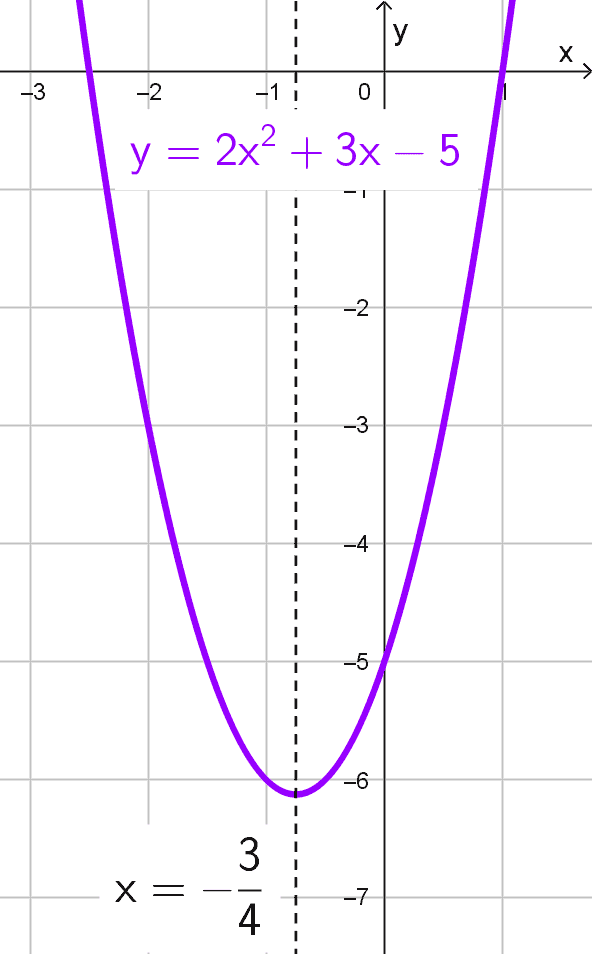
Equation: \(y=2x^2+3x-5\)
First, identify the coefficients of the given quadratic function \(y=2x^2+3x-5.\) In this case, \(a=2,\) \(b=3,\) and \(c=-5.\)
Next, apply the formula for the axis of symmetry of a vertical parabola, x = -b / (2a). Substituting a and b yields:
$$x=\dfrac{-3}{2 \times 2}=-\dfrac{3}{4}$$
Thus, the equation of the axis of symmetry for the parabola \(y=2x^2+3x-5\) is:
$$x=-\dfrac{3}{4}$$
Solution 2
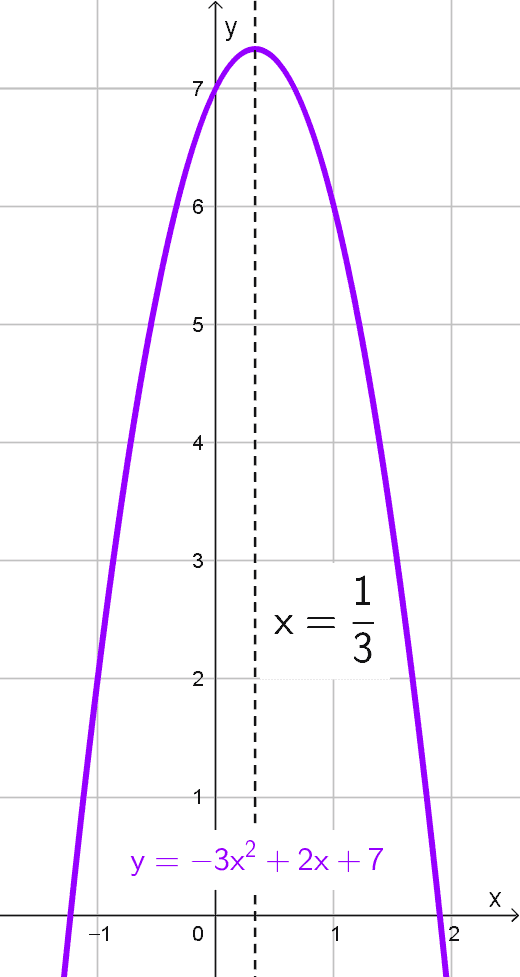
Equation: \(y=-3x^2+2x+7\)
To solve this, identify the coefficients of the quadratic equation \(y=-3x^2+2x+7.\) Here, \(a=-3,\) \(b=2,\) and \(c=7.\)
Now apply the axis of symmetry formula for a vertical parabola and substitute the corresponding values:
$$x=-\dfrac{b}{2a}=-\dfrac{2}{2 \times (-3)}=-\dfrac{2}{-6}=\dfrac{1}{3}$$
Solution 3
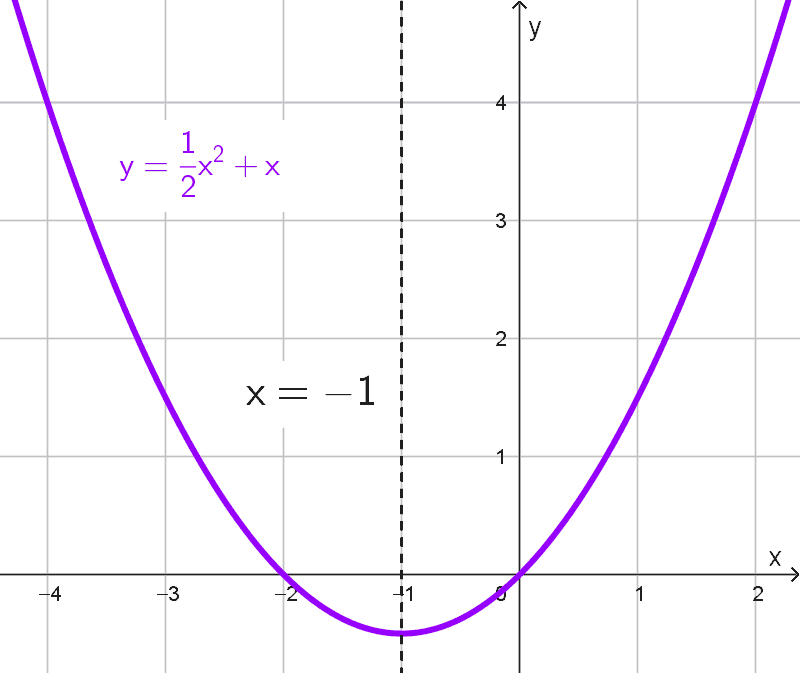
Equation: \(y=\dfrac{1}{2}x^2+x\)
Analyzing the given equation, the coefficients are a = 1/2, b = 1, and c = 0 (the constant term does not affect the calculation of the axis).
Substitute these values into the axis of symmetry formula:
$$x=-\dfrac{b}{2a}=-\dfrac{1}{2 \times (1/2)}=-\dfrac{1}{1}=-1$$
Therefore, the focal axis of the parabola is the vertical line \(x=-1.\)
Solution 4
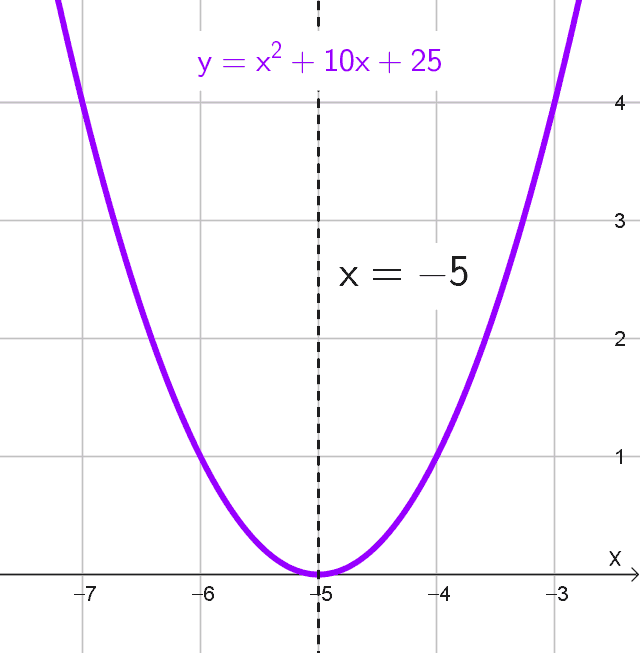
Equation: \(x^2+10x-y+25=0\)
First, isolate y to write the expression as a quadratic function:
$$y=x^2+10x+25$$
Notice that \(x^2+10x+25\) is a perfect square trinomial:
$$y=(x+5)^2$$
In vertex form \(y=(x-h)^2+k,\) the vertex is located at (-5, 0). The axis of symmetry is the vertical line passing through this point:
$$x=-5$$
Note: We can also apply the formula \(x=-b/(2a)\) directly to \(y=x^2+10x+25,\) where \(a=1\) and \(b=10,\) giving the same result: \(x=-\dfrac{10}{2}=-5.\)
Horizontal Parabolas
The axis of symmetry of a horizontal parabola of the form x = ay2 + by + c is given by the equation:
y = -b / (2a)
Examples
Find the axis of symmetry for each of the following horizontal parabolas:
- \(x=y^2+2y-3\)
- \(x=\dfrac{1}{2}y^2-3y+5\)
- \(3y^2-x+6y=0\)
Solution 1
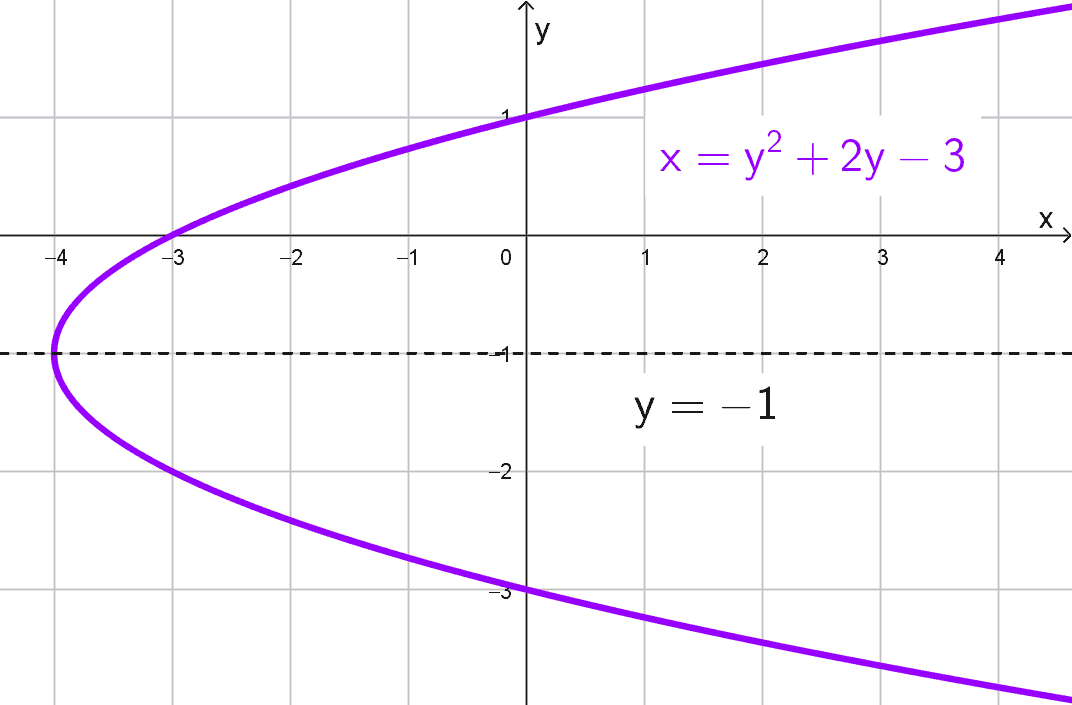
Equation: \(x=y^2+2y-3\)
First, identify the coefficients from the general form \(x=ay^2+by+c.\) Here, \(a=1,\) \(b=2,\) and \(c=-3.\)
Now apply the axis of symmetry formula for a horizontal parabola, \(y=-\dfrac{b}{2a}.\) Substituting the values of a and b:
$$y=-\dfrac{2}{2 \cdot 1}=-1$$
The axis of symmetry of this parabola is the horizontal line \(y=-1.\)
Solution 2
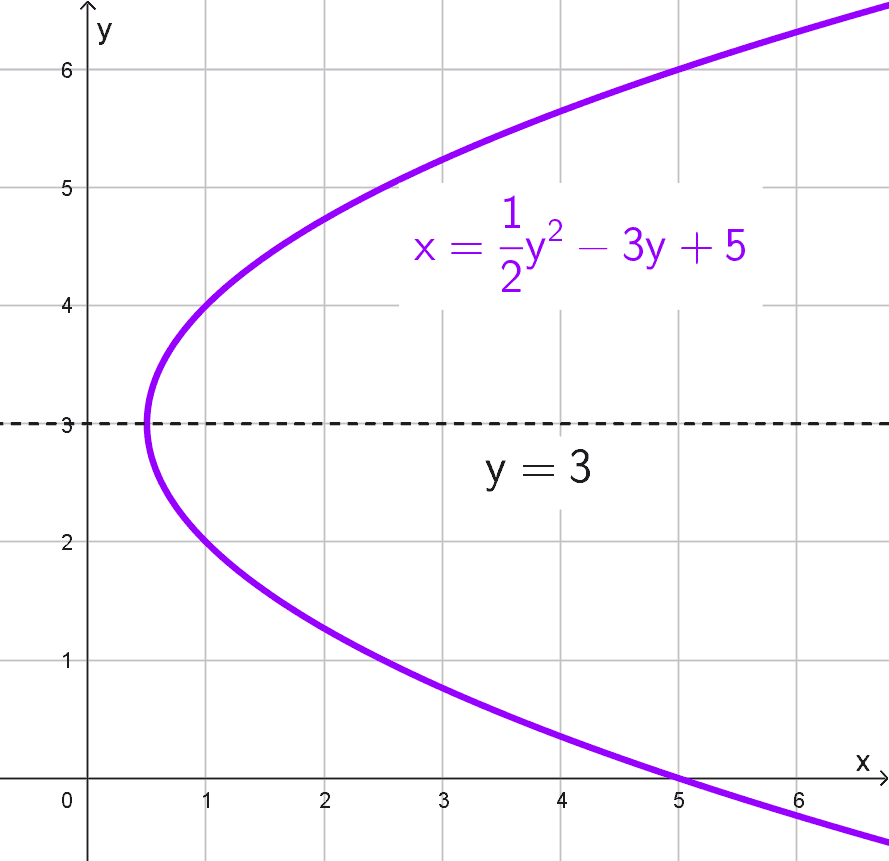
Equation: \(x=\dfrac{1}{2}y^2-3y+5\)
The equation matches the general form with coefficients \(a=\dfrac{1}{2},\) \(b=-3,\) and \(c=5.\)
Using the axis of symmetry formula for a horizontal parabola, substitute these values:
$$y=-\dfrac{b}{2a}=-\dfrac{-3}{2 \cdot (1/2)}=\dfrac{3}{1}=3$$
The axis of symmetry is the horizontal line \(y=3.\)
Solution 3
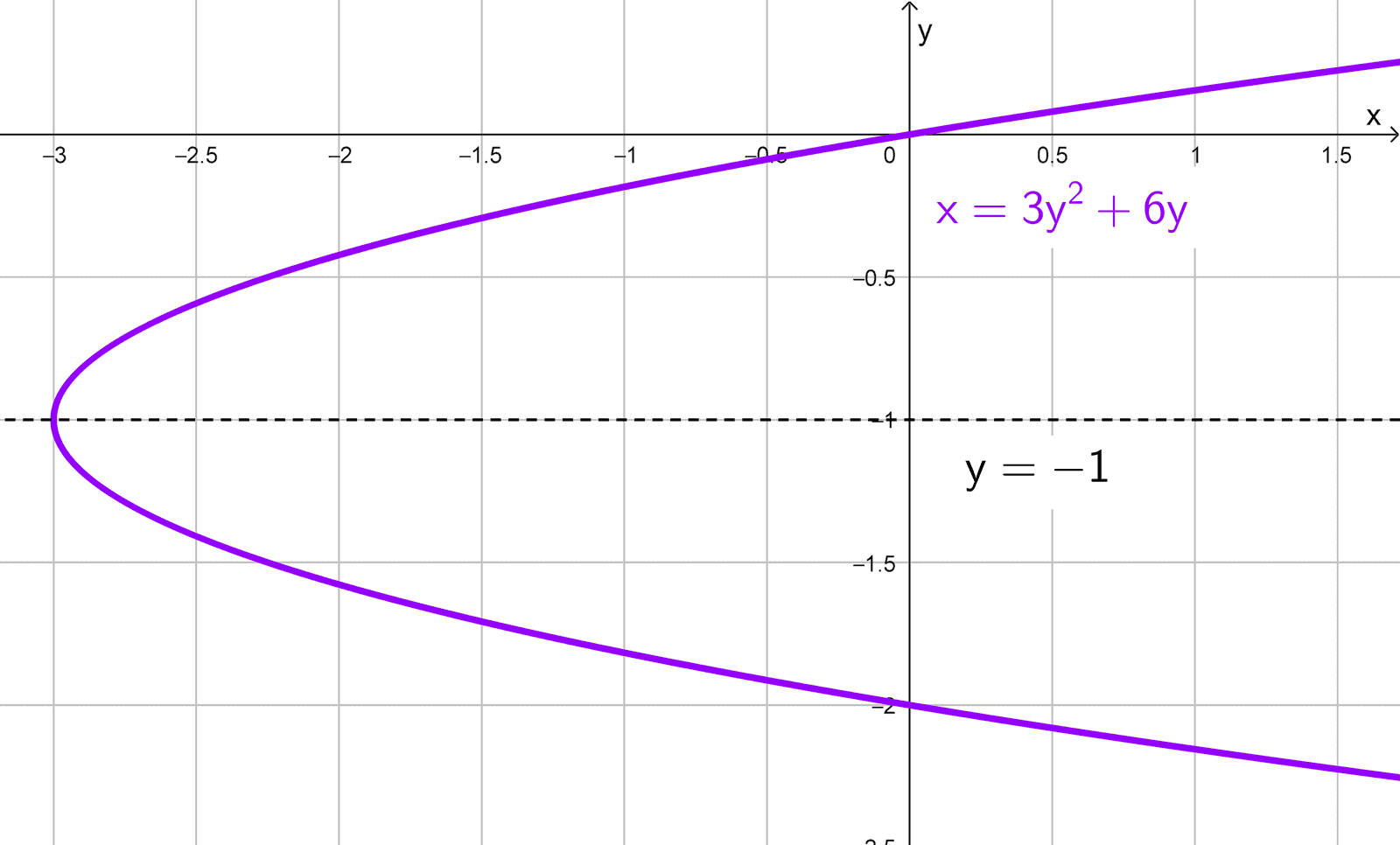
Equation: \(3y^2-x+6y=0\)
Isolate x to write the equation in standard form for a horizontal parabola:
$$x=3y^2+6y$$
The coefficients are \(a=3,\) \(b=6,\) and \(c=0.\) Applying the formula:
$$y=-\dfrac{b}{2a}=-\dfrac{6}{2 \cdot 3}=-\dfrac{6}{6}=-1$$
Therefore, the axis of symmetry is the horizontal line \(y=-1.\)
Summary of Formulas
The formulas to find the axis of symmetry are summarized in the table below:
| Parabola Equation | Orientation | Axis of Symmetry |
|---|---|---|
| y = ax2 + bx + c | Vertical | x = -b / (2a) |
| x = ay2 + by + c | Horizontal | y = -b / (2a) |
Did you find this useful? Rate it!
0.0 / 5 — 0 votes

HOW TO CITE THIS ARTICLE
Machado, D. (2026, November 2). Axis of Symmetry of a Parabola. Exponty. https://exponty.com/en/parabola-symmetry-axis
Focal Length of a Parabola
Directrix of a Parabola
Focus of a Parabola
Vertex of a Parabola
Parabola Practice Problems with Solutions
Leave a Reply
Related posts