
Horizontal and Vertical Ellipses
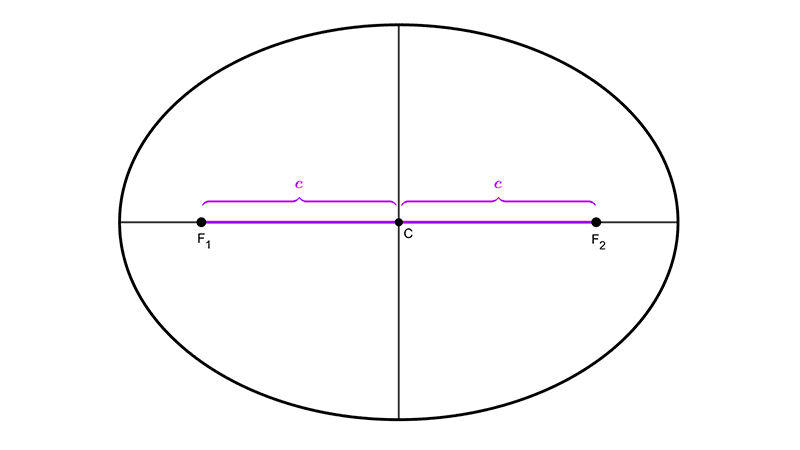
An ellipse can have different orientations depending on the position of the major axis relative to the coordinate axes. When the major axis is parallel to the x-axis, the ellipse is horizontal; if it is parallel to the y-axis, the ellipse is vertical.
Below, we explain horizontal and vertical ellipses and how to identify each case from its standard or general equation. If you are not yet familiar with the geometric definition of an ellipse, we recommend checking out the main article first, where we cover its definition, formulas, parts, and properties.
Table of Contents
Horizontal Ellipse
A horizontal ellipse is one whose major axis is parallel to or lies along the x-axis. The standard equation changes depending on whether the center is at the origin or at another point:
Center at (0, 0): \(\dfrac{x^2}{a^2}+\dfrac{y^2}{b^2}=1\)
Center at (h, k): \(\dfrac{(x-h)^2}{a^2}+\dfrac{(y-k)^2}{b^2}=1\)
where:
- a > b
- The length of the major axis is 2a.
- The length of the minor axis is 2b.
In a horizontal ellipse, the denominator of the term containing the variable x is larger than that of the term containing the variable y. If the center is at the origin, the major axis lies along the x-axis; if the center is at any other point, the major axis is horizontal, parallel to the x-axis.


The elements of a horizontal ellipse can be determined from its standard equation, as shown in the following table:
| Equation | Major Axis | Center | Foci | Vertices / Co-vertices |
|---|---|---|---|---|
| \(\dfrac{x^2}{a^2}+\dfrac{y^2}{b^2}=1\) | Along the x-axis | (0, 0) | (±c, 0) where c = √(a2 - b2) | Vertices: (±a, 0) Co-vertices: (0, ±b) |
| \(\dfrac{(x-h)^2}{a^2}+\dfrac{(y-k)^2}{b^2}=1\) | Parallel to the x-axis | (h, k) | (h ± c, k) where c = √(a2 - b2) | Vertices: (h ± a, k) Co-vertices: (h, k ± b) |
Examples
The following are examples of ellipse equations with a horizontal major axis:
- \(\dfrac{x^2}{16}+\dfrac{y^2}{9}=1\)
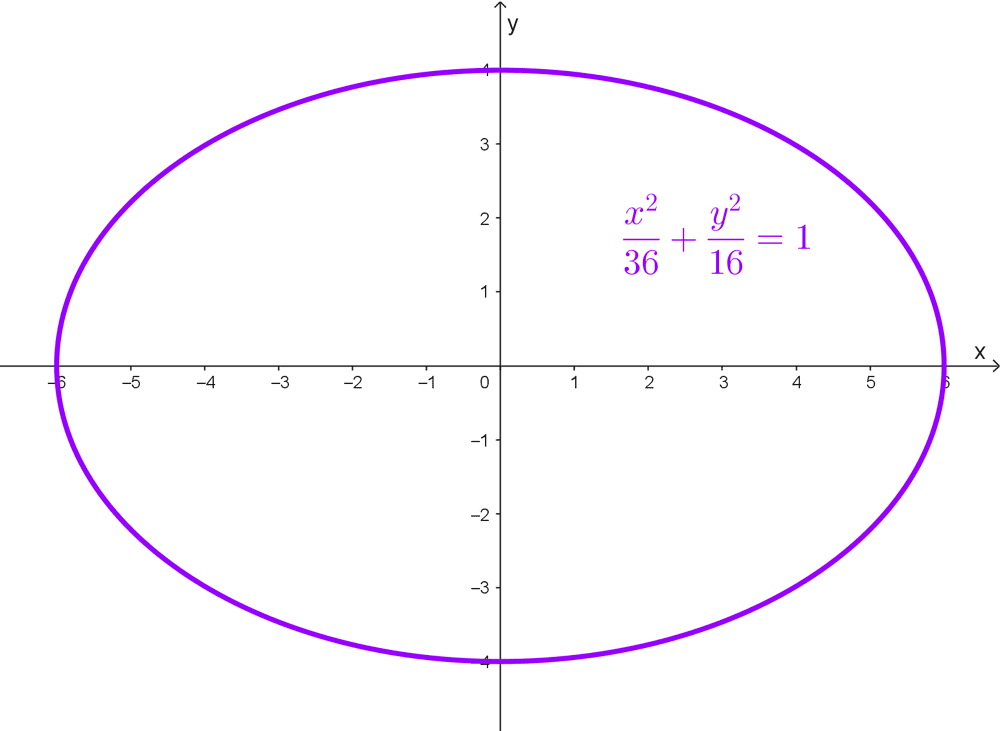
- \(\dfrac{x^2}{36}+\dfrac{y^2}{16}=1\)
- \(\dfrac{(x-5)^2}{25}+\dfrac{(y+2)^2}{9}=1\)
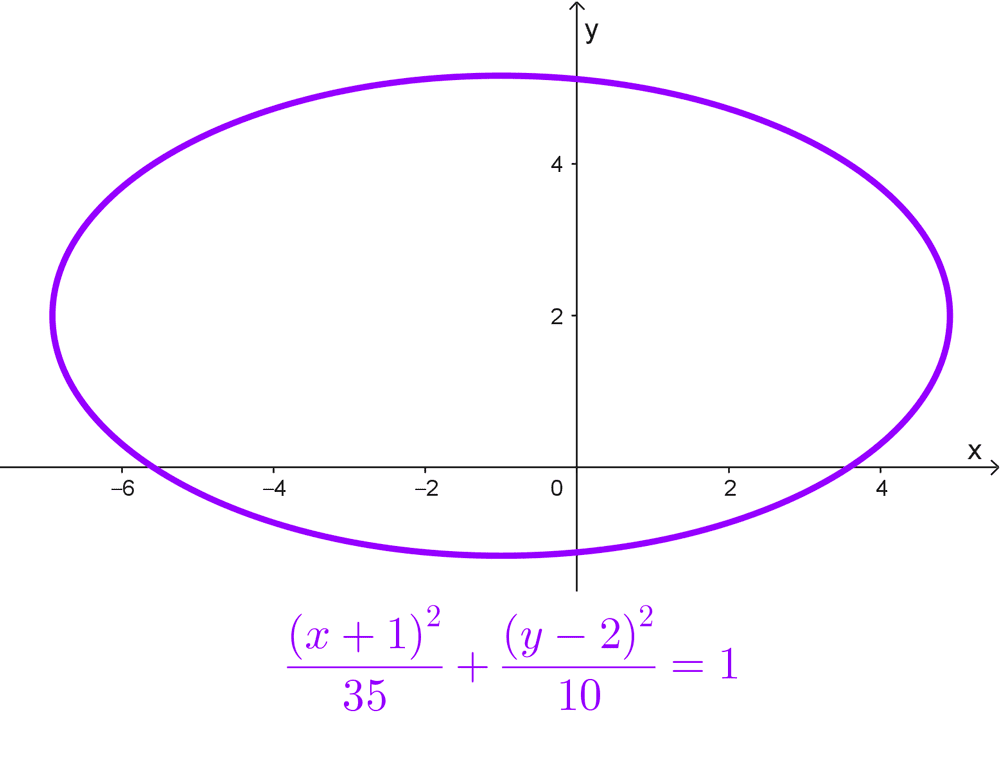
- \(\dfrac{(x+1)^2}{35}+\dfrac{(y-2)^2}{10}=1\)


Vertical Ellipse
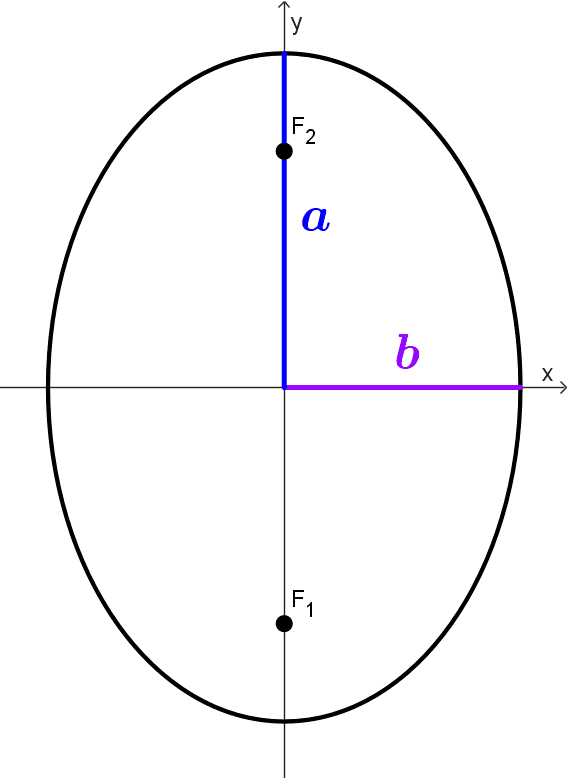
A vertical ellipse is one whose major axis is parallel to or lies along the y-axis. The standard equation differs depending on the center of the ellipse:
Center at (0, 0): \(\dfrac{x^2}{b^2}+\dfrac{y^2}{a^2}=1\)
Center at (h, k): \(\dfrac{(x-h)^2}{b^2}+\dfrac{(y-k)^2}{a^2}=1\)
where:
- a > b
- The length of the major axis is 2a.
- The length of the minor axis is 2b.
In a vertical ellipse, the denominator of the term containing the variable y is larger than that of the term containing the variable x. If the center is at the origin, the major axis lies along the y-axis; if the center is at any other point, the major axis is vertical, parallel to the y-axis.

The elements of a vertical ellipse can be determined from its standard equation, as shown in the following table:
| Equation | Major Axis | Center | Foci | Vertices / Co-vertices |
|---|---|---|---|---|
| \(\dfrac{x^2}{b^2}+\dfrac{y^2}{a^2}=1\) | Along the y-axis | (0, 0) | (0, ±c) where c = √(a2 - b2) | Vertices: (0, ±a) Co-vertices: (±b, 0) |
| \(\dfrac{(x-h)^2}{b^2}+\dfrac{(y-k)^2}{a^2}=1\) | Parallel to the y-axis | (h, k) | (h, k ± c) where c = √(a2 - b2) | Vertices: (h, k ± a) Co-vertices: (h ± b, k) |
Examples
The following are examples of ellipse equations with a vertical major axis:
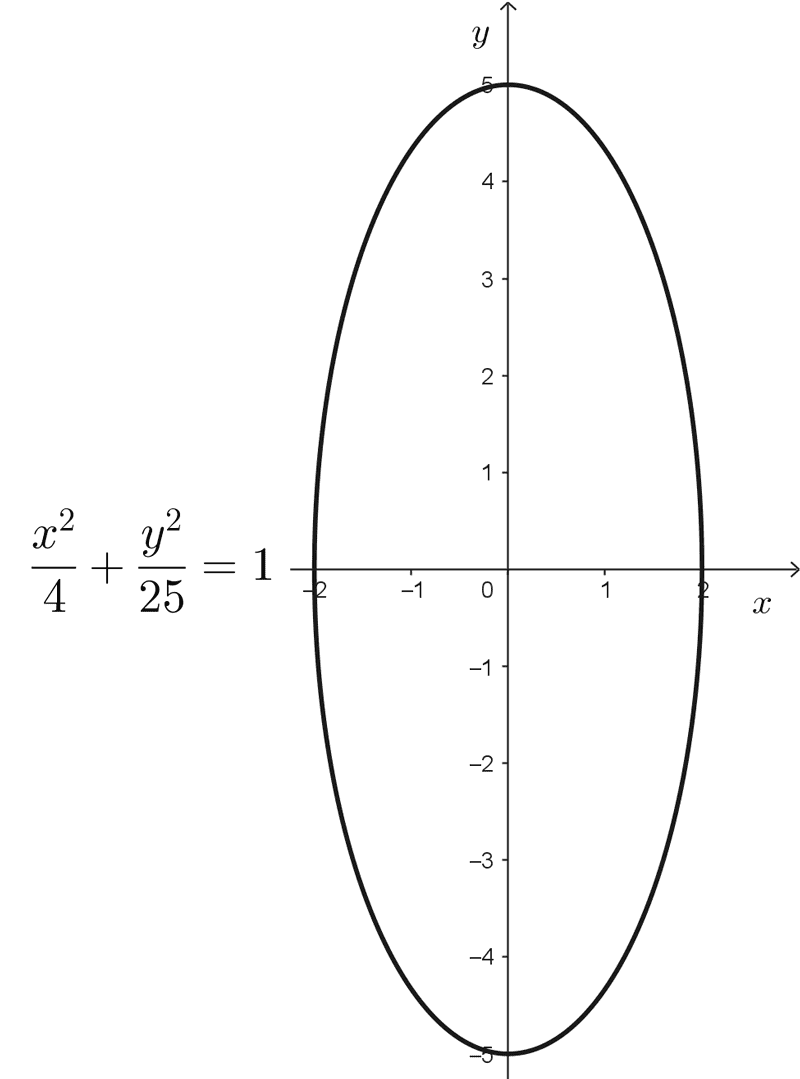
- \(\dfrac{x^2}{4}+\dfrac{y^2}{25}=1\)
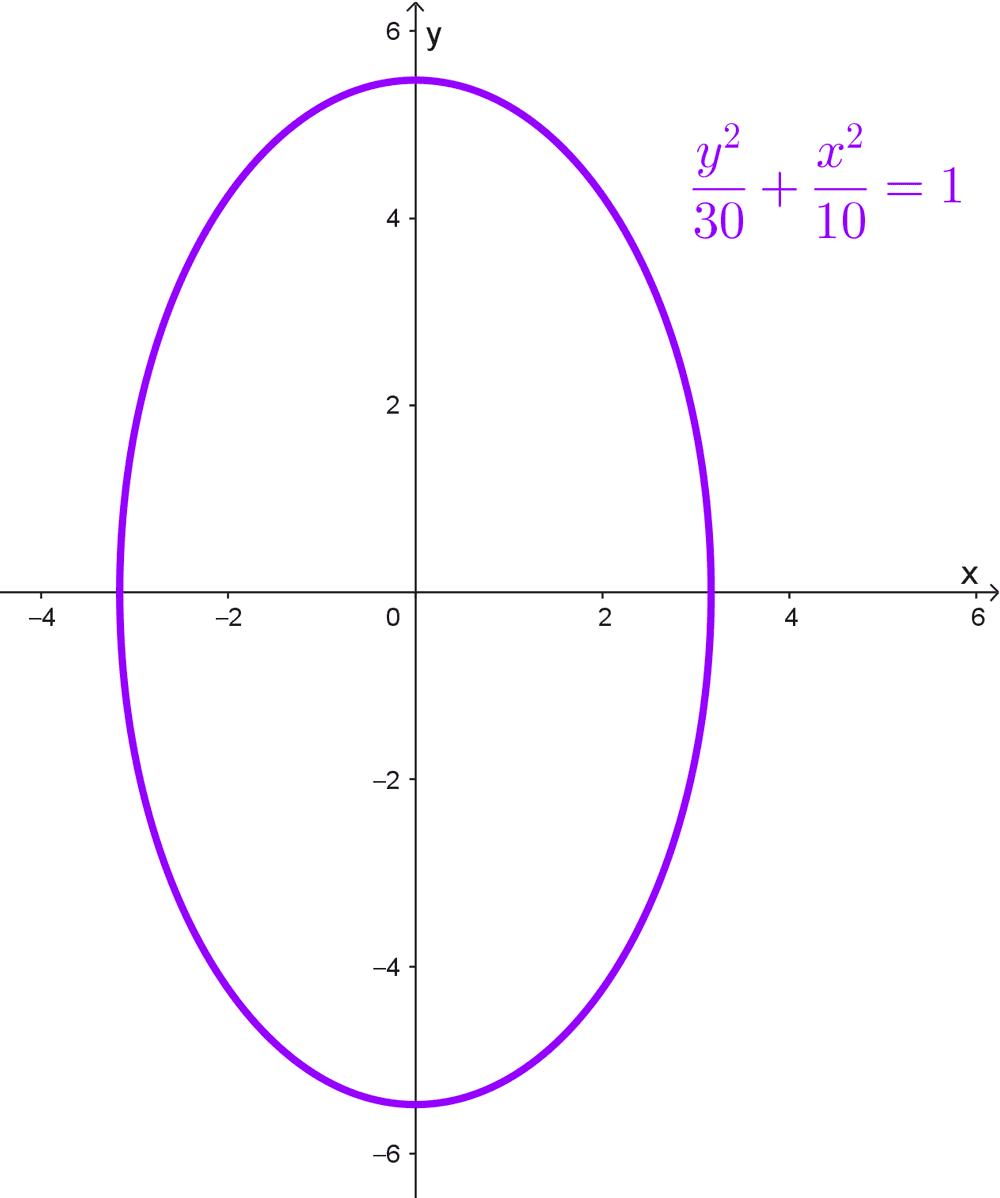
- \(\dfrac{y^2}{30}+\dfrac{x^2}{10}=1\)
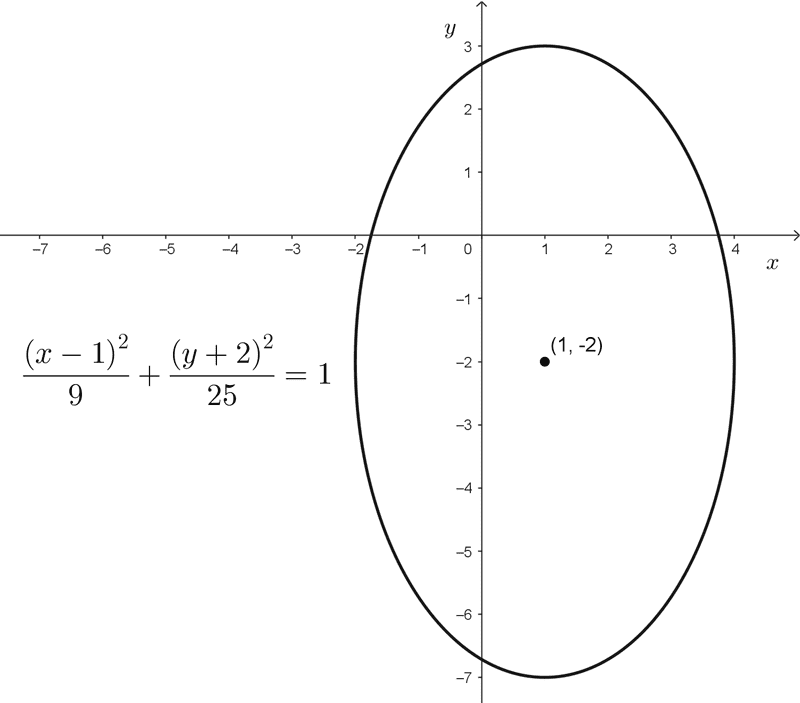
- \(\dfrac{(x-1)^2}{9}+\dfrac{(y+2)^2}{25}=1\)
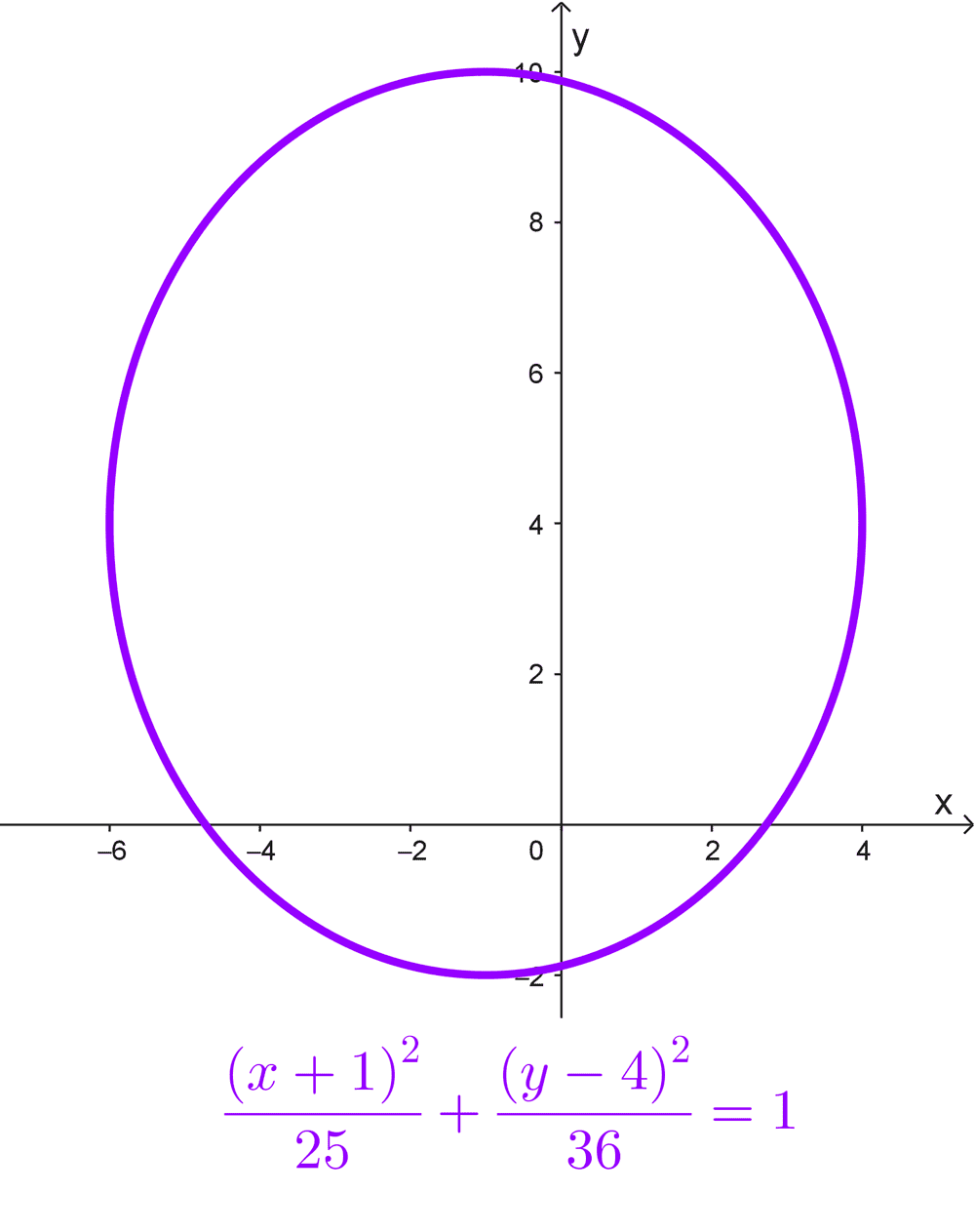
- \(\dfrac{(x+1)^2}{25}+\dfrac{(y-4)^2}{36}=1\)
How to Tell If an Ellipse Is Horizontal or Vertical
Determining the orientation of an ellipse is relatively straightforward when given its standard equation; simply look at the denominators under the variables:
- If the denominator of the term containing the variable x is larger than that of the term containing the variable y, then it is a horizontal ellipse; its major axis and focal axis are parallel to the x-axis.
- If the denominator of the term containing y is larger than that of the term containing x, then it is a vertical ellipse; its major axis and focal axis are parallel to the y-axis.
If you are given the general equation instead of the standard form, you will need to complete the square and rearrange the expression to rewrite it in standard form.
Practice Problems with Solutions
Determine from each equation whether the following ellipses are horizontal or vertical:
- \(\dfrac{x^2}{31}+\dfrac{y^2}{32}=1\)
- \(9x^2+4y^2=25\)
- \(4x^2+9y^2=36\)
- \(16x^2+9y^2=144\)
- \(16x^2+25y^2=100\)
- \(36x^2+25y^2+72x-200y-464=0\)
- \(2x^2+4x+7y^2-28y-40=0\)
- \(x^2+3y^2-6x+6y=0\)
Solutions
Equation 1
$$\dfrac{x^2}{31}+\dfrac{y^2}{32}=1$$
The denominator of y2 is 32, and that of x2 is 31. Since 32 > 31, the larger denominator is under the variable y; therefore, the ellipse is vertical.
Equation 2
$$9x^2+4y^2=25$$
Dividing both sides by 25 and simplifying yields the standard form:
$$\dfrac{9x^2+4y^2}{25}=\dfrac{25}{25}$$
$$\dfrac{9x^2}{25}+\dfrac{4y^2}{25}=1$$
$$\dfrac{x^2}{25/9}+\dfrac{y^2}{25/4}=1$$
Since 25/9 ≈ 2.78 and 25/4 = 6.25, the larger denominator is under y2; therefore, the ellipse has a vertical orientation.
Equation 3
$$4x^2+9y^2=36$$
Dividing both sides by 36 and simplifying:
$$\dfrac{4x^2}{36}+\dfrac{9y^2}{36}=\dfrac{36}{36}$$
$$\dfrac{x^2}{9}+\dfrac{y^2}{4}=1$$
Since 9 > 4, the denominator of the term containing x is larger than that of the term containing y; therefore, the ellipse is horizontal.
Equation 4
$$16x^2+9y^2=144$$
Dividing both sides of the equation by 144 and simplifying gives the standard form:
$$\dfrac{16x^2}{144}+\dfrac{9y^2}{144}=\dfrac{144}{144}$$
$$\dfrac{x^2}{9}+\dfrac{y^2}{16}=1$$
Since 16 > 9, the larger denominator is under y2; therefore, the ellipse is vertical.
Equation 5
$$16x^2+25y^2=100$$
Dividing both sides by 100 and simplifying the coefficients yields:
$$\dfrac{16x^2}{100}+\dfrac{25y^2}{100}=\dfrac{100}{100}$$
$$\dfrac{x^2}{25/4}+\dfrac{y^2}{4}=1$$
Since 25/4 = 6.25 is greater than 4, the larger denominator is under x2; therefore, the ellipse is horizontal.
Equation 6
$$36x^2+25y^2+72x-200y-464=0$$
Completing the square yields the following equivalent expression in standard form:
$$\dfrac{(x+1)^2}{25}+\dfrac{(y-4)^2}{36}=1$$
Since 36 > 25, the larger denominator is under the term containing the variable y; therefore, the ellipse is vertical.
For step-by-step examples on completing the square, visit the following article:
Equation 7
$$2x^2+4x+7y^2-28y-40=0$$
Completing the square gives the standard form:
$$\dfrac{(x+1)^2}{35}+\dfrac{(y-2)^2}{10}=1$$
Since 35 > 10, the larger denominator is in the term containing the variable x, resulting in a horizontal ellipse.
Equation 8
$$x^2+3y^2-6x+6y=0$$
Completing the square gives:
$$\dfrac{(x-3)^2}{12}+\dfrac{(y+1)^2}{4}=1$$
Since 12 > 4, the larger denominator is in the term containing the variable x; therefore, the ellipse has a horizontal major axis.
Did you find this useful? Rate it!
0.0 / 5 — 0 votes

HOW TO CITE THIS ARTICLE
Machado, D. (2026, November 1). Horizontal and Vertical Ellipses. Exponty. https://exponty.com/en/horizontal-and-vertical-ellipses
Focal Distance of an Ellipse
Vertices of an Ellipse
Major and Minor Axes of an Ellipse
Center of an Ellipse
Foci of an Ellipse
Area of an Ellipse
Ellipse Practice Problems with Solutions
Leave a Reply
Related posts