
Area of an Ellipse
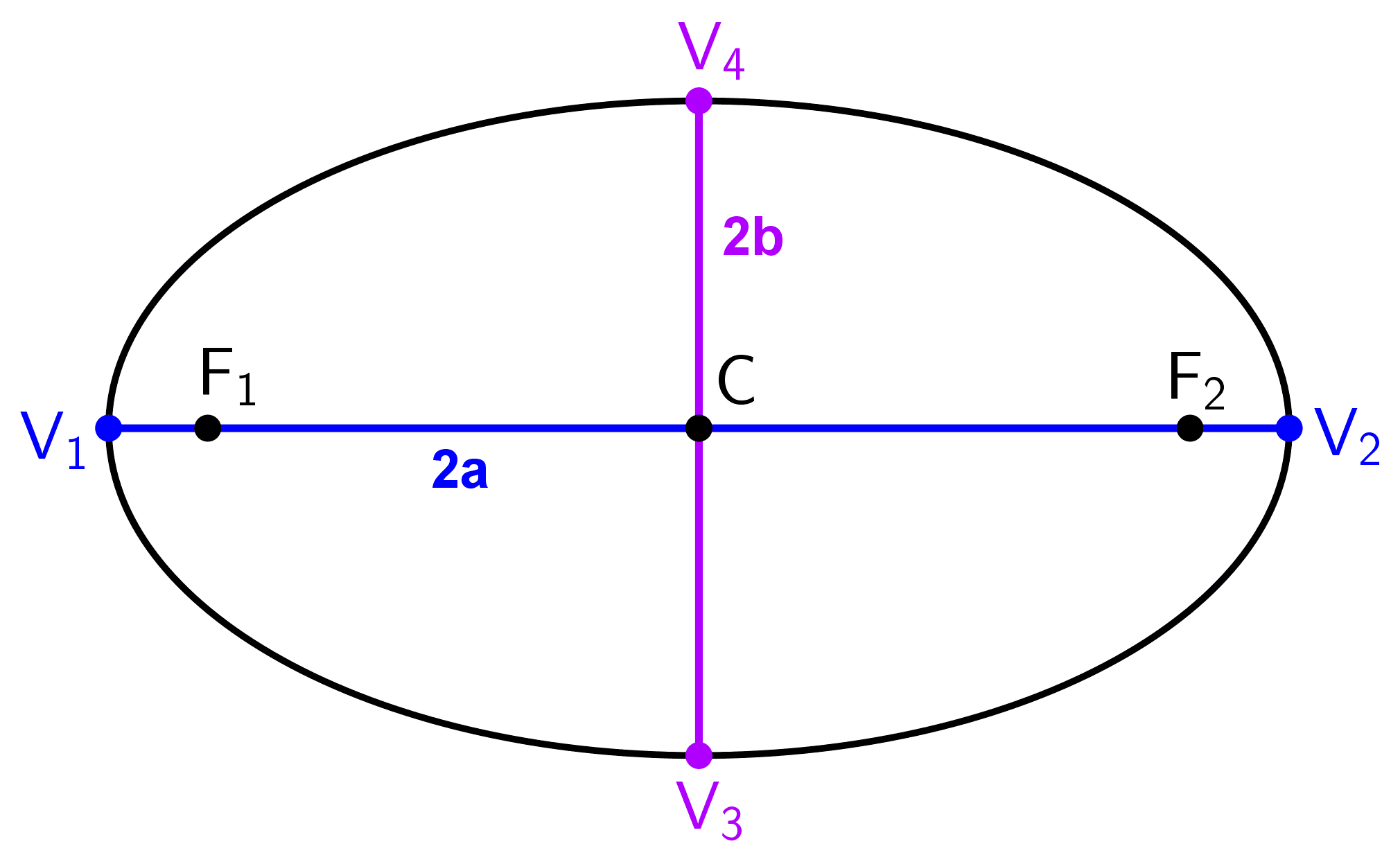
The area of an ellipse is the region of the plane bounded by its curve. It can be calculated as the product of π and the lengths of the semi-axes:
Area = π ⋅ a ⋅ b
where π ≈ 3.1416, a is the semi-major axis, and b is the semi-minor axis. These values can be determined directly from the standard equation of the ellipse.

If the semi-axes are equal in length (a = b), the ellipse becomes a circle. In this case, we denote the semi-axes by the radius r (r = a = b), and the formula reduces to the familiar area of a circle: pi times the radius squared.
Area of a Circle = π ⋅ r2
The formula for the area of an ellipse is derived using integration, an advanced Calculus concept not covered in this article. Below, we will walk through several examples of calculating the area of an ellipse.
Important: This article focuses specifically on the area of an ellipse. If you are not yet familiar with the geometric foundation, we recommend reading our main guide first, where we cover its definition, equations, parts, types, and properties.
Examples
Below, we will solve several practice examples to find the area of an ellipse.
Example 1
Find the area of the ellipse given by the equation \(\dfrac{y^2}{64}+\dfrac{x^2}{16}=1\)
Solution: Since the equation is in standard form, we can identify the lengths of the semi-axes by taking the square roots of the denominators beneath the variables:
$$a^2=64→a=\sqrt{64}=8$$
$$b^2=16→b=\sqrt{16}=4$$
With the semi-axes identified, multiply them by pi to find the area:
$$A=\pi\cdot 8\cdot 4=32\pi≈100.53$$

Note: Remember that area is always measured in square units. For instance, if the semi-axes are given in meters (m), the area will be in square meters (m2).
Example 2
Find the area of the ellipse \(\dfrac{(x+3)^2}{36}+\dfrac{(y-4)^2}{25}=1\)
Solution: In this case, the standard equation shows that the ellipse is centered at (-3, 4) rather than the origin. However, translation does not affect the area of the shape.
Find the lengths of the semi-axes:
$$a^2=36→a=\sqrt{36}=6$$
$$b^2=25→b=\sqrt{25}=5$$
Substitute these values into the area formula:
$$A=\pi \cdot 6\cdot 5=30\pi ≈ 94.25$$

If you want to check your answers, you can use our free tool:
Example 3
Find the area of the ellipse given by \(16x^2+25y^2=100.\)
Solution: Since the equation is not in standard form, we cannot determine the lengths of the semi-axes directly.
Dividing both sides by 100 yields the equivalent standard form:
$$\dfrac{x^2}{25/4}+\dfrac{y^2}{4}=1$$
From here, we find the semi-axes:
$$a^2=\dfrac{25}{4}→a=\sqrt{\dfrac{25}{4}}=\dfrac{5}{2}=2.5$$
$$b^2=4→b=\sqrt{4}=2$$
Using these values, we calculate the area:
$$A=\pi \cdot 2.5\cdot 2=5\pi≈15.71$$

Example 4
Find the area of the ellipse \(2x^2+4x+7y^2-28y-40=0\)
Solution: Here, the equation is given in general form rather than standard form. By completing the square, we can rewrite it in the following equivalent form:
$$\dfrac{(x+1)^2}{35}+\dfrac{(y-2)^2}{10}=1$$
This standard equation shows an ellipse shifted away from the origin, from which the lengths of the semi-axes can be identified directly:
$$a^2=35→a=\sqrt{35}$$
$$b^2=10→b=\sqrt{10}$$
Substitute these values into the area formula:
$$A=\pi \cdot \sqrt{35}\cdot \sqrt{10}≈58.77$$
Therefore, the area enclosed by the ellipse is approximately 58.77 square units.
Did you find this useful? Rate it!
0.0 / 5 — 0 votes

HOW TO CITE THIS ARTICLE
Machado, D. (2026, October 29). Area of an Ellipse. Exponty. https://exponty.com/en/ellipse-area
Focal Distance of an Ellipse
Horizontal and Vertical Ellipses
Vertices of an Ellipse
Major and Minor Axes of an Ellipse
Center of an Ellipse
Foci of an Ellipse
Ellipse Practice Problems with Solutions
Leave a Reply
Related posts