
Parametric Equations of Conic Sections
Any conic section can be represented by a second-degree equation in two variables, x and y. However, there is another way to describe these curves by introducing a third variable on which both x and y depend. In this way, a conic is defined using two equations that give the values of x and y for each value of this third variable, called the parameter. This parameter varies over a given interval.
Let \(x=f(t)\) and \(y=g(t),\) where f and g are two functions defined on an interval I. The set of points \((x,y)=(f(t), g(t))\) is called a plane curve. The equations \(x=f(t), y=g(t),\) where t is in I, are called the parametric equations of the curve. The variable t is called the parameter.
Parametric equations are particularly useful for describing motion along a curve. Suppose a curve is defined by the parametric equations x = f(t), y = g(t), with a ≤ t ≤ b. As t increases through the interval from t = a to t = b, the successive values of t trace out a directed motion along the curve (the orientation of the curve), following the path determined by the corresponding sequence of points (x, y).
To express a conic section in parametric form, we need a pair of equations—one for x and one for y—where both depend on a parameter t, along with an interval over which the parameter varies. There is no single way to parameterize a curve; the simplest and most common parameterizations are presented below.
Table of Contents
Equation of a Circle
The parametric equations of a circle centered at (h, k) with radius r are:
$$\begin{cases} x=h+r \cos(t) \\ y=k+r \sin(t) \end{cases},~\text{where}~0≤ t ≤2π$$
If the center is at the origin, that is, at (0, 0), the equations simplify to:
$$\begin{cases} x=r \cos(t) \\ y=r \sin(t) \end{cases},~\text{where}~0≤ t ≤2π$$
Examples
- \(x=\cos(t),~ y=\sin(t),~ 0≤t≤2π\) is the parameterization of a circle of radius 1 centered at the origin, also called the unit circle.
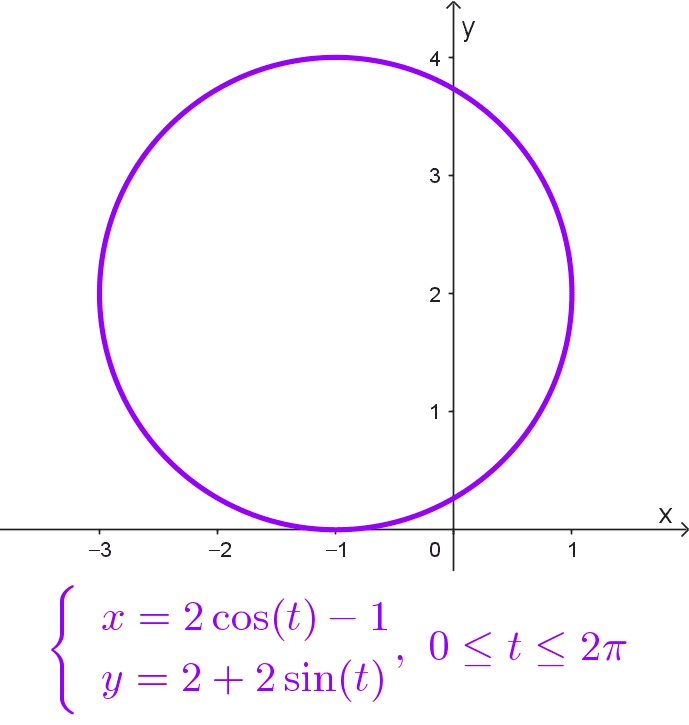
- \(\begin{cases} x=2\cos(t)-1 \\ y=2+2\sin(t) \end{cases},~\text{where}~0≤ t ≤2π\) is a circle centered at (-1, 2) with radius r = 2.
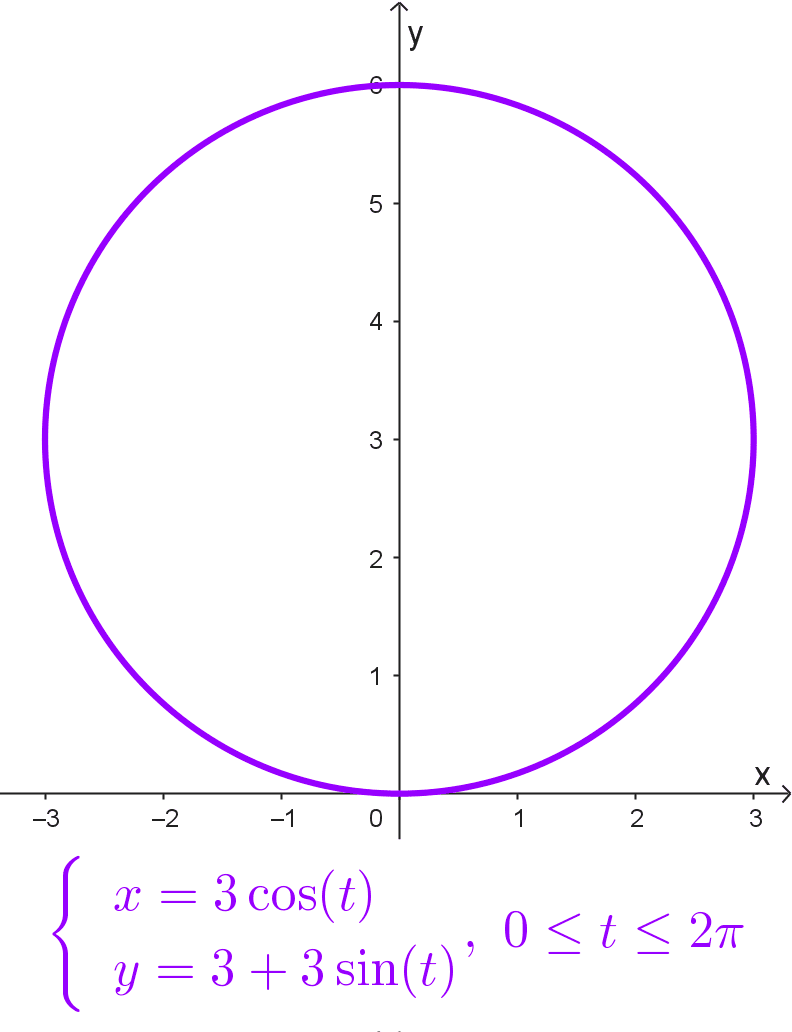
- \(x=3\cos t, y=3+3\sin t, 0≤t≤2π\) is a circle centered at (0, 3) with radius 3.
Consider the first example: x = cos(t), y = sin(t), 0 ≤ t ≤ 2π. It is worth noting that t represents an angle (as the argument of a trigonometric function) measured in radians. The symbol θ could be used instead of t to emphasize this, but it is not necessary.
When t = 0, we are at the start of the interval [0, 2π]. Substituting this value gives:
$$x=\cos(0)=1$$
$$y=\sin(0)=0$$
Therefore, the starting point of the curve is (1, 0).
Moving to t = π/2 (90°):
$$x=\cos(π/2)=\cos(90°)=0$$
$$y=\sin(π/2)=\sin(90°)=1$$
Thus, another point on the curve is (0, 1).
When t = π (180°):
$$x=\cos(π)=\cos(180°)=-1$$
$$y=\sin(π)=\sin(180°)=0$$
So, the next point on the curve is (-1, 0).
Repeating for t = 3π/2 (270°):
$$x=\cos(3π/2)=\cos(270°)=0$$
$$y=\sin(3π/2)=\sin(270°)=-1$$
Another point on the curve is (0, -1).
Finally, when t = 2π (360°), we reach the end of the parameter interval:
$$x=\cos(2π)=\cos(360°)=1$$
$$y=\sin(2π)=\sin(360°)=0$$
Here we return to the starting point: (1, 0). This occurs because the circle is a closed curve, just like the ellipse.
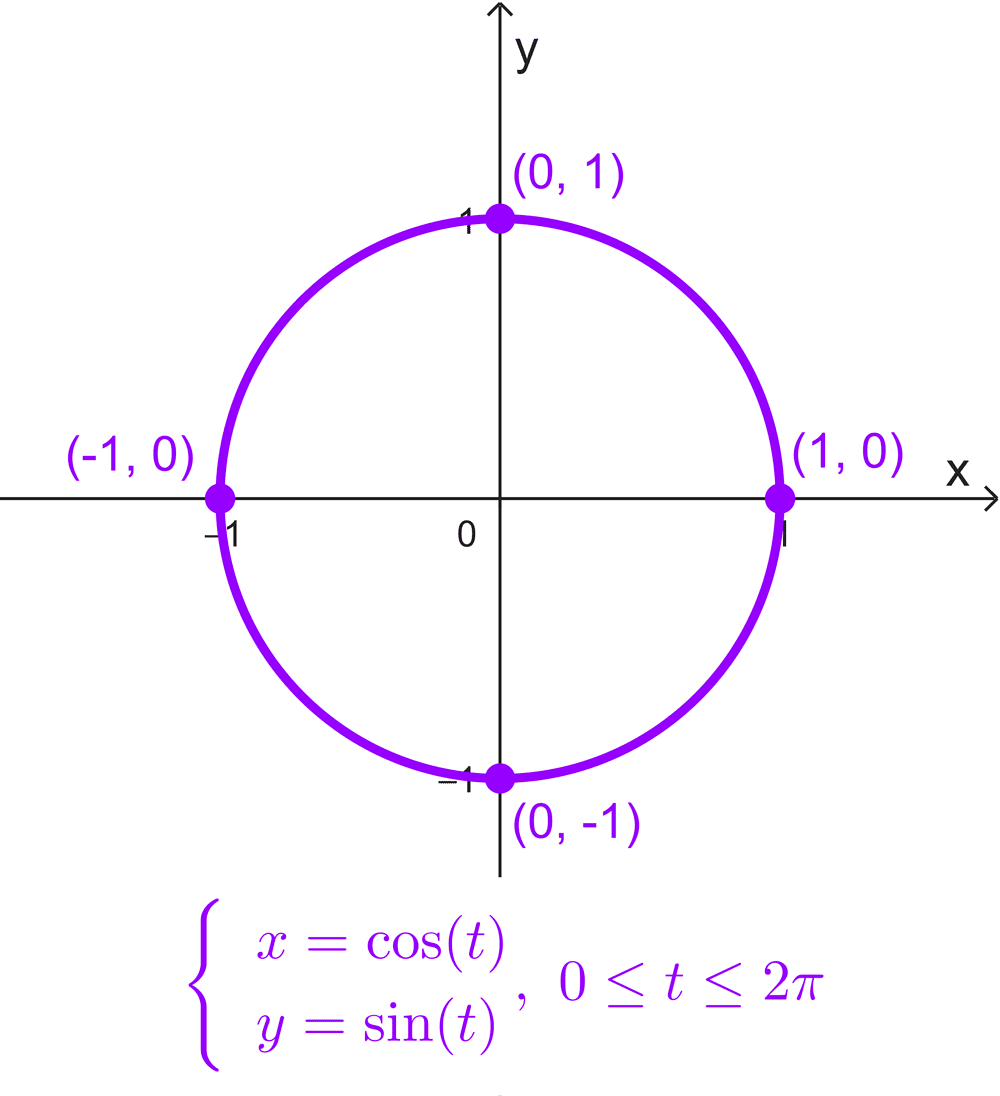
There are intermediate values that trace out the rest of the circle; for this explanation, we have only evaluated the points along the coordinate axes. As shown in the graph, as t increases from 0 to 2π, the point (x, y) moves counterclockwise.
To convert back to the rectangular equation, we eliminate the parameter t. This can be achieved by isolating the trigonometric terms, squaring both sides of each equation, and then adding them together:
Rearrange the equations:
$$x-h=r \cos(t)$$
$$y-k=r \sin(t)$$
Square both sides:
$$(x-h)^2=r^2 \cos^2(t)$$
$$(y-k)^2=r^2 \sin^2(t)$$
Add both equations:
$$(x-h)^2+(y-k)^2=r^2 \cos^2(t)+r^2 \sin^2(t)$$
$$(x-h)^2+(y-k)^2=r^2 (\cos^2(t)+\sin^2(t))$$
Applying the Pythagorean identity, \(\cos^2(t)+\sin^2(t)=1,\) yields:
$$(x-h)^2+(y-k)^2=r^2$$
This is the standard form of the equation of a circle centered at (h, k) with radius r.
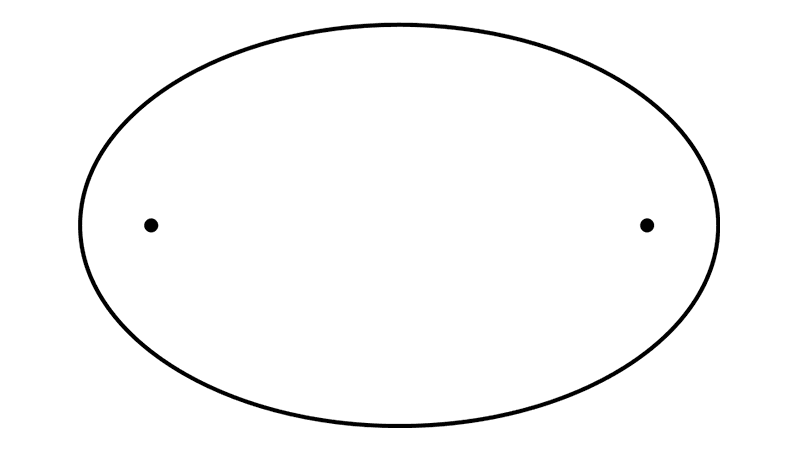
Equation of an Ellipse
The parametric equations of an ellipse centered at (h, k) with a horizontal focal axis (parallel to the x-axis), semi-major axis a, and semi-minor axis b are:
$$\begin{cases} x=h+a\cos(t) \\ y=k+b\sin(t) \end{cases},~\text{where}~0≤ t ≤2π$$
If the ellipse has a vertical focal axis (parallel to the y-axis), then a and b swap positions:
$$\begin{cases} x=h+b\cos(t) \\ y=k+a\sin(t) \end{cases},~\text{where}~0≤ t ≤2π$$
Examples
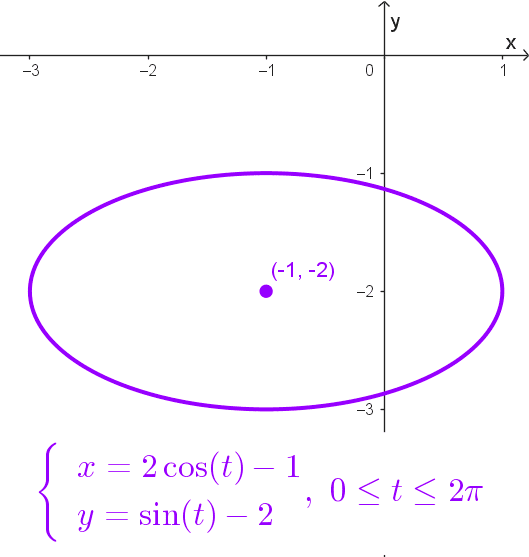
- \(\begin{cases} x=2\cos(t)-1 \\ y=\sin(t)-2 \end{cases},~0≤ t ≤2π\) is the parameterization of an ellipse centered at (-1, -2) with semi-major axis a = 2 and semi-minor axis b = 1. The ellipse has a horizontal orientation because its focal axis is parallel to the x-axis.
- \(\begin{cases} x=2+2\cos(t) \\ y=1+3\sin(t) \end{cases},~0≤ t ≤2π\) is an ellipse centered at (2, 1) with semi-major axis a = 3 and semi-minor axis b = 2. It has a vertical orientation because its focal axis is parallel to the y-axis.

Equation of a Hyperbola
The parametric equations of a horizontally oriented hyperbola centered at (h, k) with semi-axes a and b are:
$$\begin{cases} x=h+a \sec(t) \\ y=k+b\tan(t) \end{cases}$$
where \(0 \le t \le 2\pi,~ t \neq \pi/2,~ 3\pi/2,\) where the secant and tangent functions are undefined.
If the hyperbola is vertically oriented, its parametric equations are:
$$\begin{cases} x=h+b \tan(t) \\ y=k+a\sec(t) \end{cases}$$
where t satisfies the same domain restrictions as above.
Examples
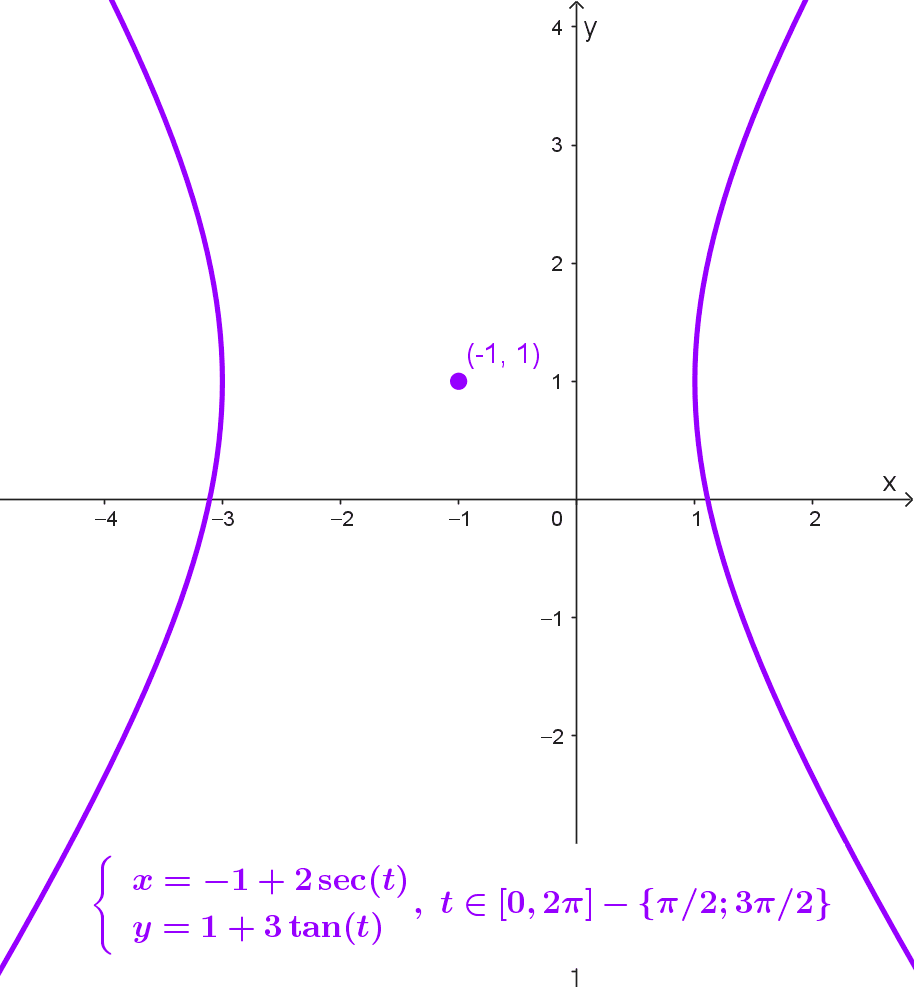
- \(\begin{cases} x=-1+2 \sec(t) \\ y=1+3\tan(t) \end{cases}, ~0 \le t \le 2\pi,~ t \neq \pi/2,~ 3\pi/2\) is a horizontal hyperbola centered at (-1, 1), with transverse semi-axis a = 2 and conjugate semi-axis b = 3.
- \(\begin{cases} x=4+3 \tan(t) \\ y=-1+2\sec(t) \end{cases}, ~0 \le t \le 2\pi,~ t \neq \pi/2,~ 3\pi/2\) is a vertical hyperbola centered at (4, -1), with transverse semi-axis a = 2 and conjugate semi-axis b = 3.

Equation of a Parabola
Recall that the standard equations of a parabola with vertex at (h, k) are:
- If the focal axis is horizontal: \((y-k)^2=4p(x-h)\)
- If the focal axis is vertical: \((x-h)^2=4p(y-k)\)
Rearranging these expressions yields the corresponding parametric equations.
The parametric equations of a horizontally oriented parabola (focal axis parallel to the x-axis) with vertex at (h, k) are:
\(\begin{cases} x=h+pt^2 \\ y=k+2pt \end{cases},\) where t is any real number, \(-\infty < t < \infty\)
If the parabola is vertically oriented (focal axis parallel to the y-axis), the equations are:
$$\begin{cases} x=h+2pt \\ y=k+pt^2 \end{cases}, -\infty < t < \infty$$
Examples
- \(\begin{cases} x=-2+0.5 t^2 \\ y=1+t \end{cases},~ t \in \mathbb{R}\) is a horizontal parabola with vertex at (-2, 1) and p = 0.5 that opens to the right.
- \(\begin{cases} x=2-6t \\ y=-3t^2-2 \end{cases},~ t \in \mathbb{R}\) is a vertical parabola with vertex at (2, -2) and p = -3 that opens downward.
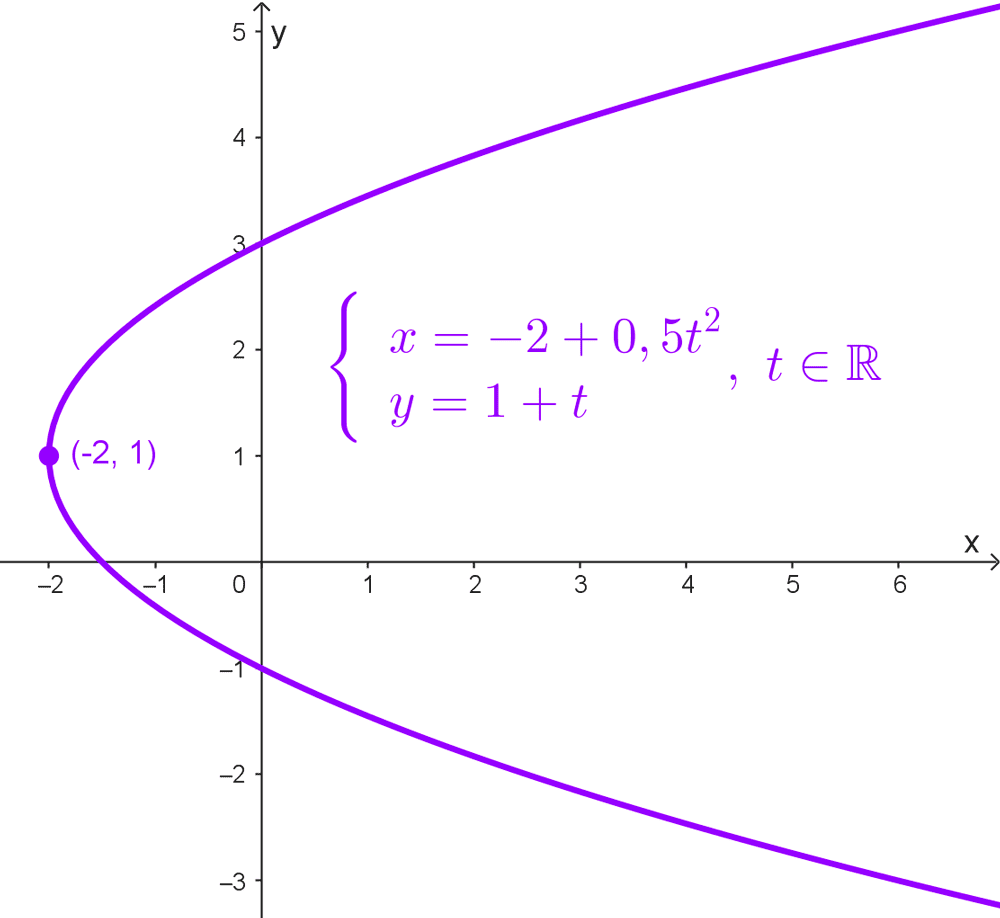
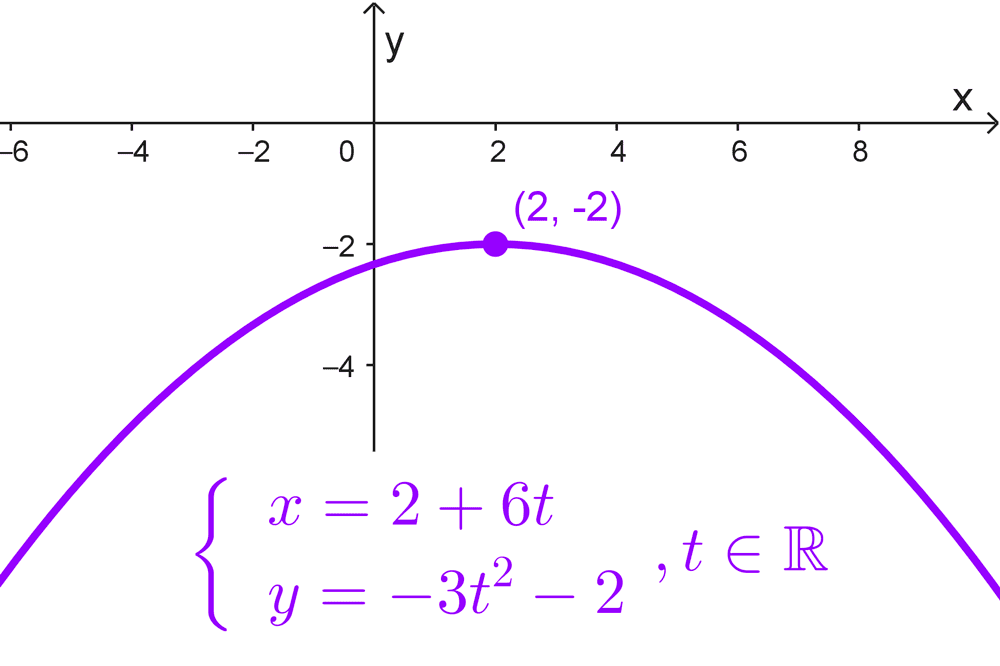
The direction in which the parabola opens is determined by the sign of the parameter p in the equations.
Summary of Equations
Circle
| Center | Rectangular Equation | Parametric Equations |
|---|---|---|
| Circle centered at the origin (0, 0) | x² + y² = r² | x = r cos(t) y = r sin(t) 0 ≤ t ≤ 2π |
| Circle centered at (h, k) | (x - h)² + (y - k)² = r² | x = h + r cos(t) y = k + r sin(t) 0 ≤ t ≤ 2π |
Ellipse
| Orientation | Rectangular Equation | Parametric Equations |
|---|---|---|
| Horizontal ellipse (focal axis parallel to the x-axis) | (x - h)² / a² + (y - k)² / b² = 1 | x = h + a cos(t) y = k + b sin(t) 0 ≤ t ≤ 2π |
| Vertical ellipse (focal axis parallel to the y-axis) | (x - h)² / b² + (y - k)² / a² = 1 | x = h + b cos(t) y = k + a sin(t) 0 ≤ t ≤ 2π |
Hyperbola
| Orientation | Rectangular Equation | Parametric Equations |
|---|---|---|
| Horizontal hyperbola (transverse axis parallel to the x-axis) | (x - h)² / a² - (y - k)² / b² = 1 | x = h + a sec(t) y = k + b tan(t) 0 ≤ t ≤ 2π, t ≠ π/2, 3π/2 |
| Vertical hyperbola (transverse axis parallel to the y-axis) | (y - k)² / a² - (x - h)² / b² = 1 | x = h + b tan(t) y = k + a sec(t) 0 ≤ t ≤ 2π, t ≠ π/2, 3π/2 |
Parabola
| Orientation | Rectangular Equation | Parametric Equations |
|---|---|---|
| Horizontal parabola (focal axis parallel to the x-axis) | (y - k)² = 4p(x - h) | x = h + pt² y = k + 2pt t ∈ ℝ |
| Vertical parabola (focal axis parallel to the y-axis) | (x - h)² = 4p(y - k) | x = h + 2pt y = k + pt² t ∈ ℝ |
Did you find this useful? Rate it!
0.0 / 5 — 0 votes

HOW TO CITE THIS ARTICLE
Machado, D. (2026, October 29). Parametric Equations of Conic Sections. Exponty. https://exponty.com/en/parametric-equations-conic-sections
Polar Equations of Conic Sections
History of Conic Sections
Applications of Conic Sections
Eccentricity of Conic Sections
Degenerate Conic Sections
General Equation of Conic Sections
Conic Sections Practice Problems with Solutions
Parabola
Hyperbola
Ellipse
Leave a Reply
Related posts