
Polar Equations of Conic Sections
In this article, we explain the polar equations of conic sections and how to identify and graph a conic from its polar equation with step-by-step examples.
Table of Contents
Polar Coordinates
In a Cartesian coordinate system (also called rectangular coordinates), we can locate any point in the plane using numbers x and y called coordinates, which represent directed distances from the coordinate axes.
The x-coordinate indicates the horizontal distance from the y-axis (to the right or to the left). The y-coordinate indicates the vertical distance from the x-axis (upward or downward). For example, the point (2, -5) is located two units to the right of the y-axis and five units below the x-axis.
Polar coordinates provide an alternative way to locate points in a plane: instead of using horizontal and vertical distances, we use a distance from the origin and an angle.
A point P in the plane is represented by an ordered pair in the polar coordinate system:
- Radius (r): the directed distance from the origin (also called the pole) to the point.
- Angle (θ): the directed angle formed by the positive x-axis and the ray from the origin through the point. This angle is measured in radians or degrees. The positive x-axis is called the polar axis.
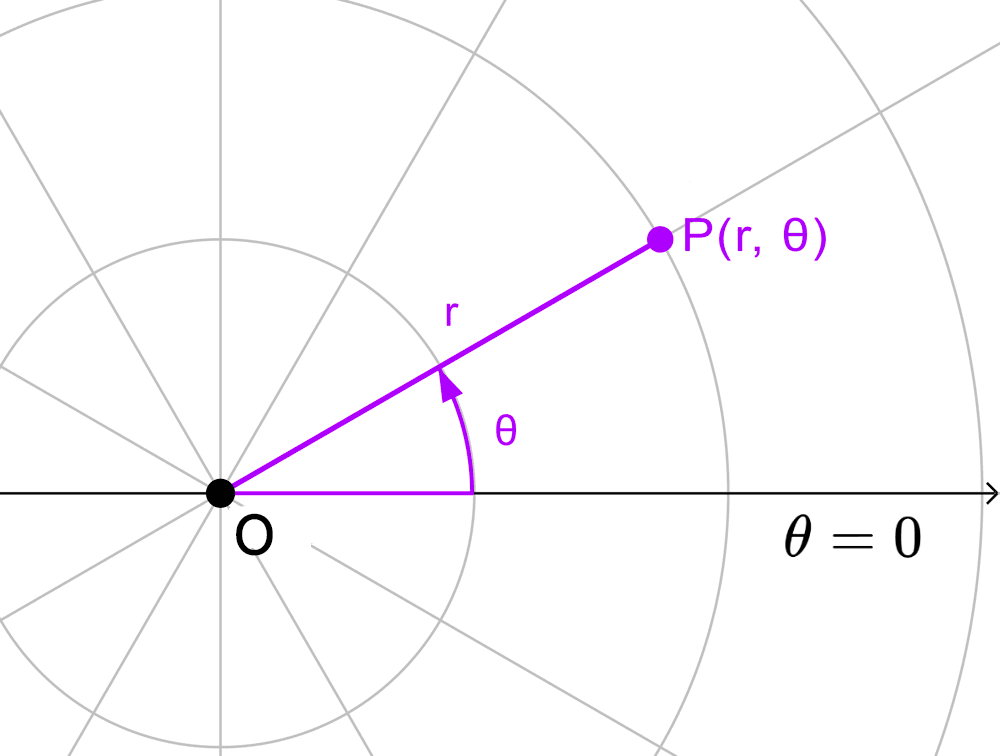
Polar coordinates can be converted to rectangular coordinates using the following equations:
x = r ⋅ cos(θ)
y = r ⋅ sin(θ)
Conversely, to convert from rectangular coordinates to polar coordinates:
$$r = \sqrt{x^2+y^2}$$
$$θ=\arctan(y/x)$$
When finding the angle θ, we must take into account the quadrant in which the point lies to determine the correct angle.
Conic sections can also be described in polar coordinates, but doing so requires an alternative, unified definition.
General Definition of a Conic Section
Recall that a parabola is defined as the set of points equidistant from a fixed line called the directrix and a fixed point called the focus. This focus-directrix definition can actually be generalized to all conic sections, allowing us to define an ellipse, a hyperbola, or a parabola using a single directrix and focus.
Definition: a conic section is the locus of all points in the plane whose distance to a fixed point (the focus) is a constant ratio to their distance to a fixed line (the directrix). This constant ratio is called the eccentricity, denoted by e, and its value determines the type of conic section.
That is, given a directrix D and a fixed focus F, a conic is the set of points P satisfying:
$$\dfrac{d(F,P)}{d(D,P)}=e$$
- If e = 1, the conic is a parabola.
- If e < 1, the conic is an ellipse.
- If e > 1, the conic is a hyperbola.
Notice that when e = 1, \(d(F,P)=d(D,P),\) which matches the standard geometric definition of a parabola.
Polar Equation of a Conic Section
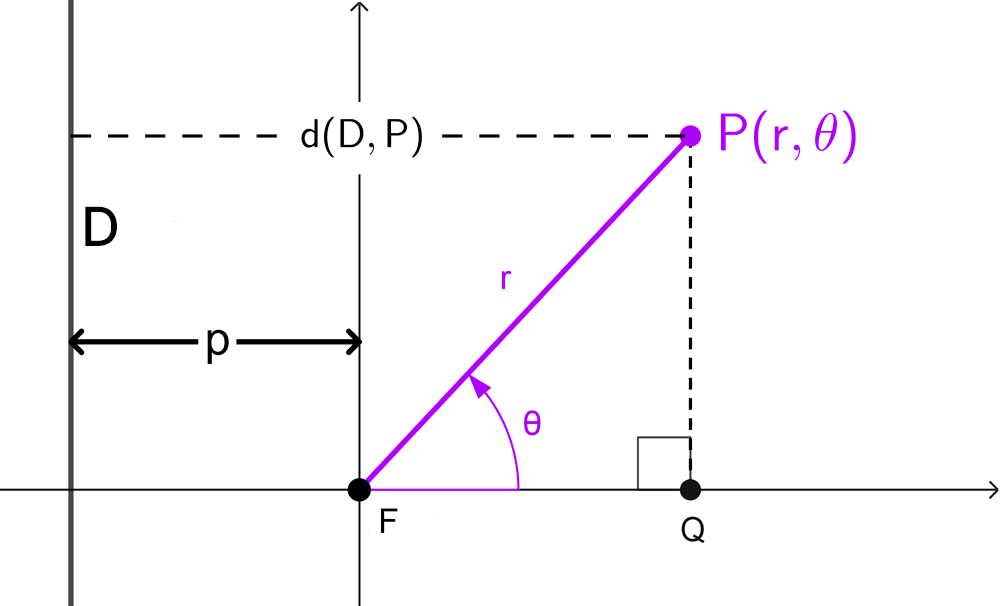
Conic sections are conveniently represented in polar coordinates using this focus-directrix definition. Just as with rectangular coordinates, we choose a strategic position for the focus F and the directrix D: the focus F is placed at the pole (origin), and the directrix D is either parallel or perpendicular to the polar axis.
Consider a directrix D perpendicular to the polar axis located at a distance of p units to the left of the pole, which serves as the focus F. If P = (r, θ) is any point on the conic, applying the definition gives:
\(\dfrac{d(F, P)}{d(D,P)}=e~\) or \(~d(F,P)=e\cdot d(D,P)\)
Now, let Q be the projection of P onto the polar axis to determine d(D, P):
$$d(D,P)=p+d(O,Q)=p+r \cos θ$$
Returning to the first equation:
$$d(F,P)=e\cdot d(D,P)$$
$$r=e(p+r \cos θ)$$
$$r=ep + er \cos θ$$
$$r-er \cosθ=ep$$
$$r(1-e \cosθ)=ep$$
$$r=\dfrac{ep}{1-e \cos θ}$$
This yields the polar equation of the conic.
The polar equation of a conic section with a focus at the pole, eccentricity e, and a directrix perpendicular to the polar axis at a distance p to the left of the pole is:
$$r=\dfrac{ep}{1-e \cos θ}$$
If, instead, the directrix is perpendicular to the polar axis but located at a distance of p units to the right of the pole, the sign in the denominator changes:
$$r=\dfrac{ep}{1+e \cos \theta}$$
When using a directrix parallel to the polar axis, the same geometric derivation applies, but with the sine function replacing the cosine function. The term e ⋅ sin θ is preceded by a plus sign when the directrix lies above the pole, and by a minus sign when it lies below the pole. These equations are summarized in the following table:
| Equation | Description |
|---|---|
| \(r=\dfrac{ep}{1-e \cos \theta}\) | Directrix perpendicular to the polar axis, p units to the left of the pole. |
| \(r=\dfrac{ep}{1+e \cos \theta}\) | Directrix perpendicular to the polar axis, p units to the right of the pole. |
| \(r=\dfrac{ep}{1-e \sin \theta}\) | Directrix parallel to the polar axis, p units below the pole. |
| \(r=\dfrac{ep}{1+e \sin \theta}\) | Directrix parallel to the polar axis, p units above the pole. |
| Eccentricity | Conic Section |
|---|---|
| e = 1 | Parabola; axis of symmetry is perpendicular to the directrix. |
| e < 1 | Ellipse; major axis is perpendicular to the directrix. |
| e > 1 | Hyperbola; transverse axis is perpendicular to the directrix. |
Polar Equations of Each Conic Section
Below, we examine the standard form and examples for each conic section in polar form.
Circle
The polar equation of a circle centered at the pole is r = k, where k is the radius of the circle (a positive real number). In this case, the equation depends solely on the radius and is independent of the angle θ.
Examples
- r = 1 is a circle of radius 1 (the unit circle).
- r = 4 is a circle of radius 4.
- r = 1/2 is a circle of radius 1/2.
- r = √2 is a circle of radius √2.


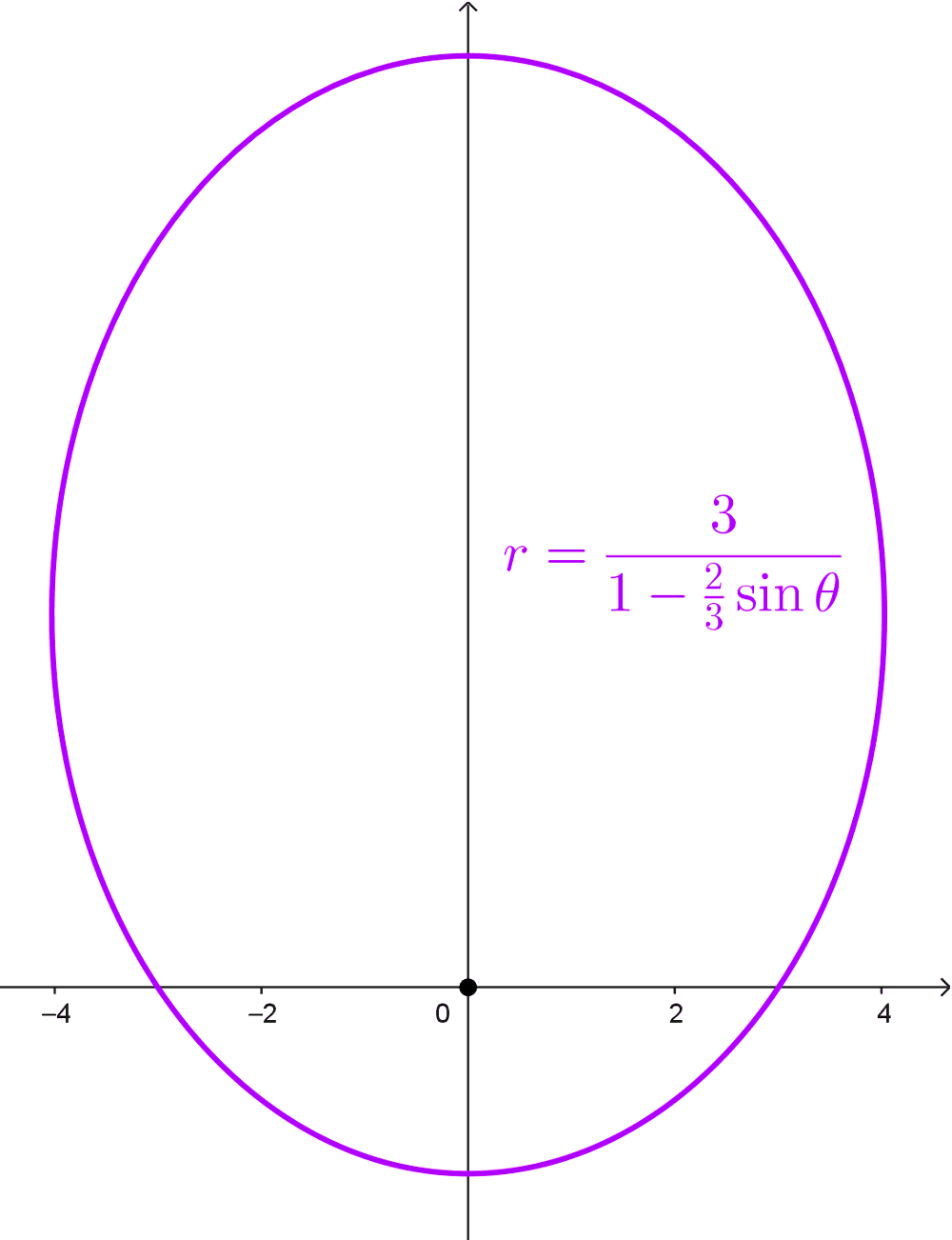
Ellipse
The polar equation of an ellipse with a directrix perpendicular to the polar axis at p units to the right or left of the pole is:
$$r=\dfrac{ep}{1±e \cos \theta}$$
If the directrix is parallel to the polar axis and located p units above or below the pole, the equation is:
$$r=\dfrac{ep}{1±e \sin \theta}$$
The eccentricity e satisfies 0 < e < 1 for every ellipse.
Examples
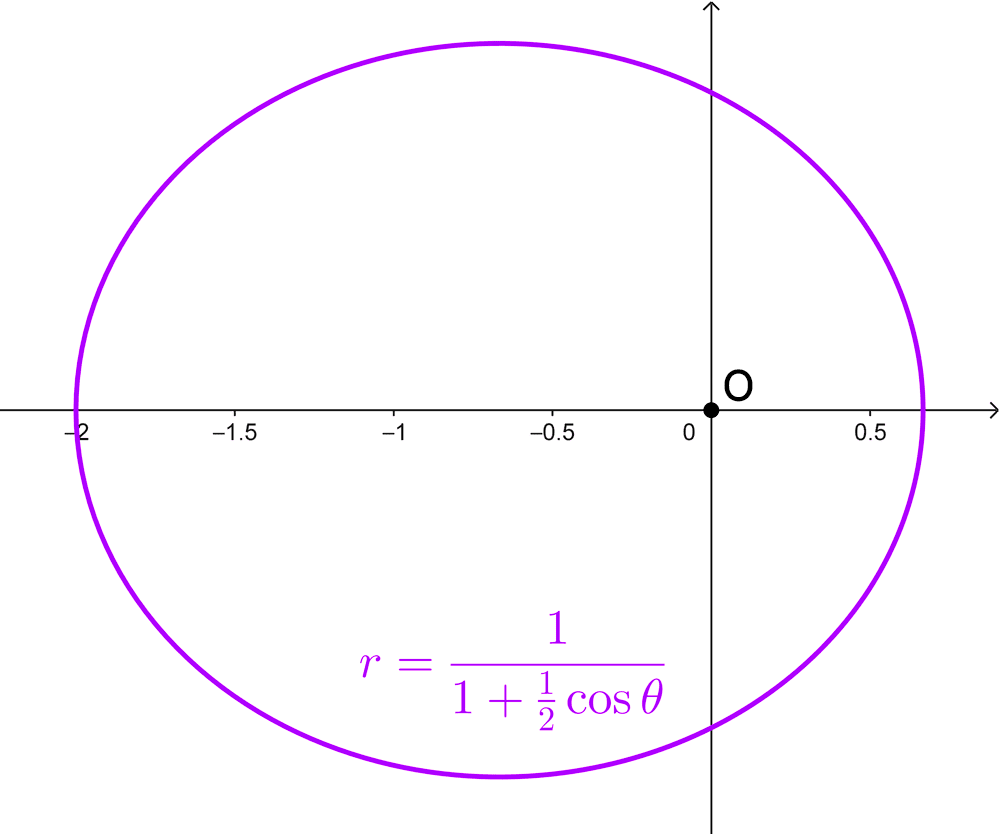
- \(r=\dfrac{1}{1+\frac{1}{2} \cos θ}\)
- \(r=\dfrac{3}{1-\frac{2}{3} \sin θ}\)
- \(r=\dfrac{35}{7-\cos θ}\)
- \(r(4+\sin θ)=4\)
Hyperbola
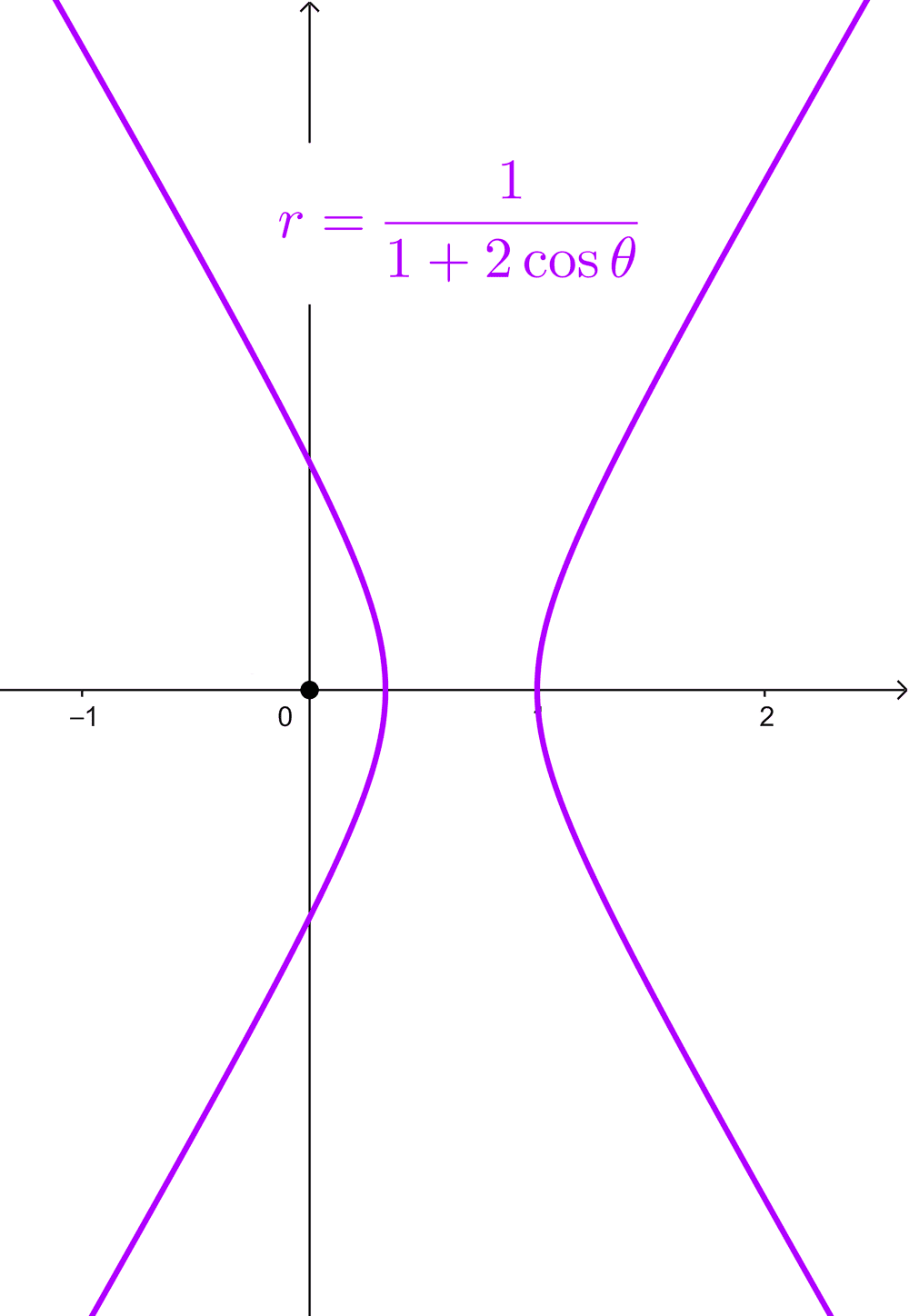
The polar equation of a hyperbola with a directrix perpendicular to the polar axis at p units to the right or left of the pole is:
$$r=\dfrac{ep}{1±e \cos \theta}$$
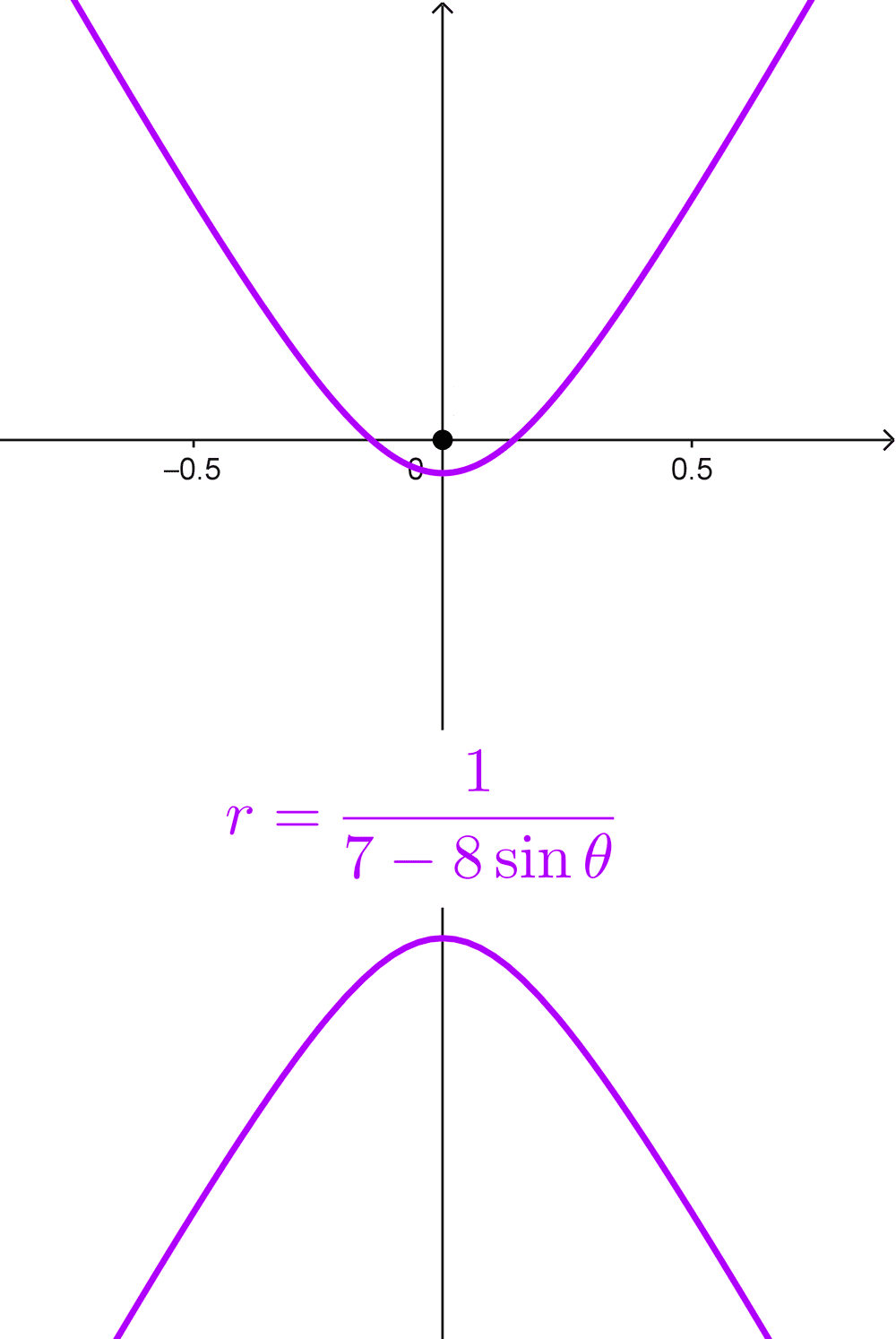
If the directrix is parallel to the polar axis and located p units above or below the pole, the equation is:
$$r=\dfrac{ep}{1±e \sin \theta}$$
The eccentricity e is strictly greater than 1 (e > 1) for every hyperbola.
Examples
- \(r=\dfrac{1}{1+2\cos θ}\)
- \(r=\dfrac{1}{7-8\sin θ}\)
- \(r=\dfrac{6}{1-3\cosθ}\)
- \(r(4\cos θ+3)=2\)
Parabola
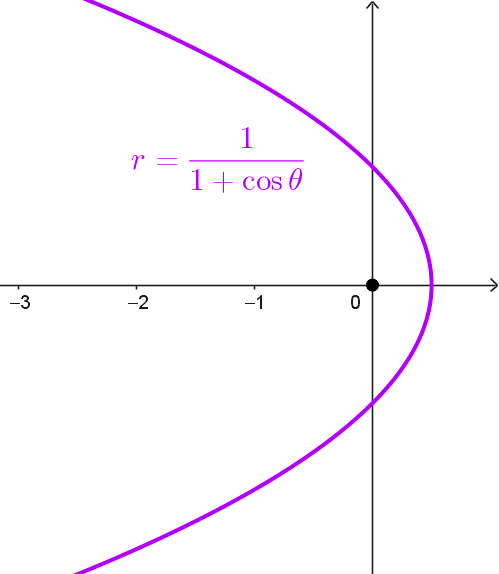
The polar equation of a parabola with a directrix perpendicular to the polar axis at p units to the right or left of the pole is:
$$r=\dfrac{p}{1±\cos \theta}$$
If the directrix is parallel to the polar axis and located p units above or below the pole, the equation is:
$$r=\dfrac{p}{1±\sin \theta}$$
Notice that eccentricity does not appear explicitly in the equation because e = 1 for any parabola.
Examples
- \(r=\dfrac{1}{1+\cos θ}\)
- \(r=\dfrac{2}{2-2\sin θ}\)
- \(r=\dfrac{5}{1-\cos θ}\)
- \(r(\sin θ+1)=10\)
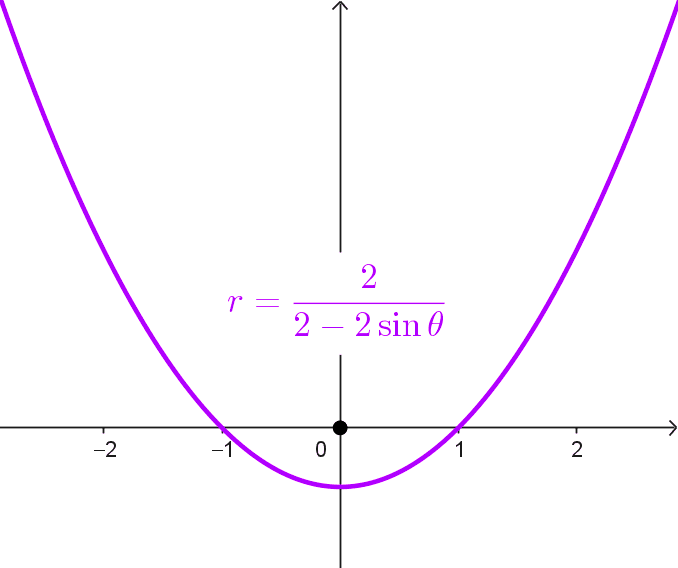
Note: in polar coordinates, representations of conics are not unique. This occurs because an angle can be expressed in infinitely many ways. For example, the equation \(r=\dfrac{1}{1+\cos θ}\) represents the same conic as \(r=\dfrac{1}{1+\cos (θ+360°)}.\)
How to Identify and Graph a Conic in Polar Form
To graph a conic section given in polar form, we must first determine its key characteristics: the type of conic (from its eccentricity), the orientation of its directrix (parallel or perpendicular to the polar axis), and the distance p from the pole to the directrix.
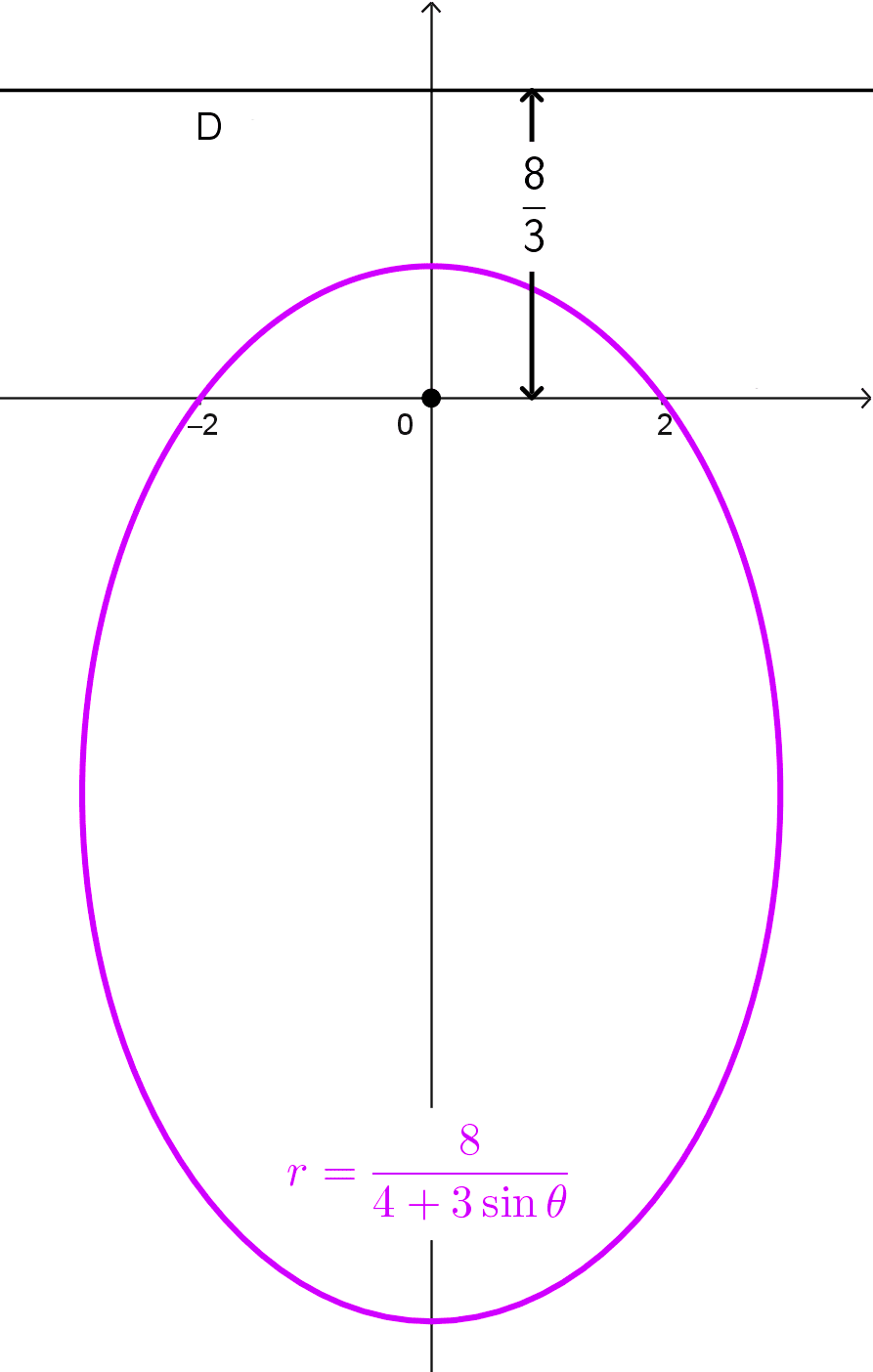
For example, consider the polar equation \(r=\dfrac{8}{4+3\sin θ}\).
To begin, this equation is not in standard form; we must rewrite it to match the standard form \(r=\dfrac{ep}{1±e\sin θ}. \)
In the denominator of \(r=\dfrac{8}{4+3\sin θ}\), the constant term is 4 instead of 1. We can create a 1 by dividing both numerator and denominator by 4:
$$r=\dfrac{\frac{8}{4}}{\frac{4+3\sin θ}{4}}$$
$$r=\dfrac{\frac{8}{4}}{\frac{4}{4}+\frac{3\sin θ}{4}}$$
$$r=\dfrac{2}{1+\frac{3}{4}\sin θ}$$
With the constant term of the denominator equal to 1, we identify the eccentricity as the coefficient of the trigonometric function:
$$e=\dfrac{3}{4}$$
Since 3/4 < 1, the equation represents an ellipse.
Next, we find the parameter p using the numerator and the value of eccentricity:
$$ep=2$$
$$\dfrac{3}{4}p=2$$
$$p=2\cdot \dfrac{4}{3}$$
$$p=\dfrac{8}{3}$$
We now have enough information to graph the polar equation:
- It is an ellipse, because the eccentricity is e = 3/4, which is less than 1.
- The directrix is parallel to the polar axis because the denominator contains a sine function. Consequently, the ellipse has a vertical major axis.
- The directrix lies 8/3 units from the pole, since p = 8/3.
- The directrix is located above the pole because the sine term has a positive coefficient (+).
Steps to Identify a Conic in Polar Form
1) If the equation is not in standard form, manipulate it algebraically to obtain one of the following forms:
$$r=\dfrac{ep}{1±e \cos \theta}$$
$$r=\dfrac{ep}{1±e \sin \theta}$$
This is typically done by dividing both the numerator and the denominator by the constant term of the denominator.
2) Once in standard form, read off the eccentricity e, which is the coefficient of the sine or cosine function in the denominator. If e < 1, it is an ellipse; if e > 1, it is a hyperbola; if no coefficient appears (e = 1), it is a parabola.
3) Find the parameter p by setting the numerator equal to ep and solving for p.
Example 1
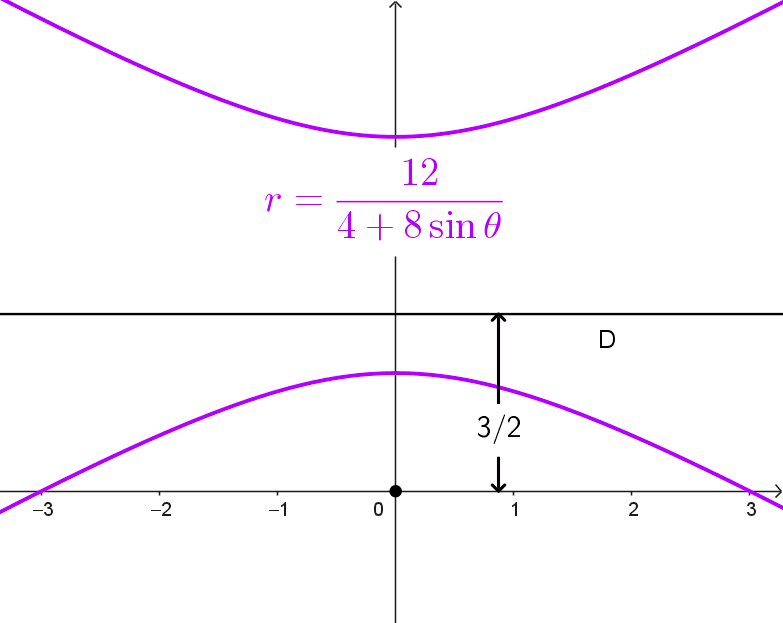
Identify and graph the conic with polar equation: \(r=\dfrac{12}{4+8\sinθ}\)
Solution: First, rewrite the equation in the standard form \(r=\dfrac{ep}{1±e\sinθ}.\)
Since the constant term in the denominator is 4 instead of 1, divide both numerator and denominator by 4:
$$r=\dfrac{\frac{12}{4}}{\frac{4+8\sinθ}{4}}$$
$$r=\dfrac{3}{1+2\sinθ}$$
Now that the equation is in standard form \(r=\dfrac{ep}{1+e\sinθ},\) we identify the eccentricity. The coefficient of sin θ is 2, so:
$$e=2$$
Since e > 1, the conic is a hyperbola.
Next, find the parameter p from the numerator. Since ep = 3:
$$2p=3$$
$$p=\dfrac{3}{2}$$
Conclusion:
- The equation represents a hyperbola because e = 2 > 1.
- The directrix is parallel to the polar axis because the trigonometric function is sin θ; the hyperbola has a vertical transverse axis.
- The directrix is located 3/2 units from the pole.
- Because the coefficient of sin θ is positive (+), the directrix lies above the pole.
Example 2
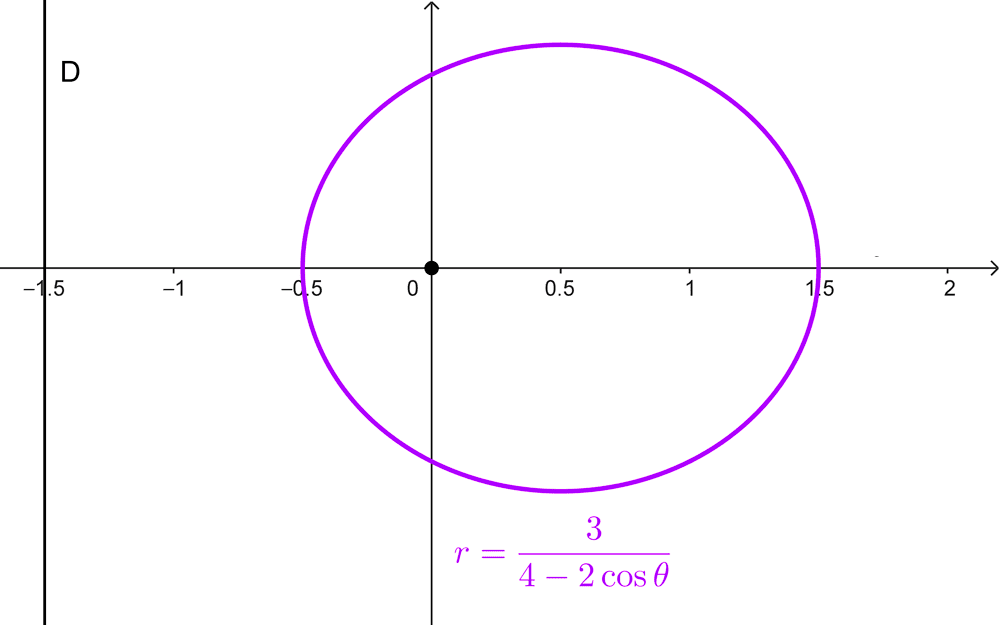
Given the polar equation \(r=\dfrac{3}{4-2\cosθ}\), identify the conic and sketch its graph.
Solution: We want to write the equation in standard form \(r=\dfrac{ep}{1±e\cosθ},\) so we divide both numerator and denominator by the constant term of the denominator, which is 4:
$$r=\dfrac{\frac{3}{4}}{\frac{4-2\cosθ}{4}}$$
$$r=\dfrac{\frac{3}{4}}{1-\frac{2}{4}\cosθ}$$
$$r=\dfrac{\frac{3}{4}}{1-\frac{1}{2}\cosθ}$$
The coefficient of cos θ in the denominator is 1/2, so the eccentricity is:
$$e=\dfrac{1}{2}$$
Since e < 1, the conic is an ellipse.
Next, find the parameter p from the numerator. Since \(ep=\dfrac{3}{4}\):
$$\dfrac{1}{2}p=\dfrac{3}{4}$$
$$p=2\cdot\dfrac{3}{4}=\dfrac{3}{2}$$
Conclusions:
- The equation represents an ellipse because e = 1/2 < 1.
- The directrix is perpendicular to the polar axis because the trigonometric function is cos θ; the ellipse has a horizontal major axis.
- The directrix is located 3/2 units from the pole.
- Because the coefficient of cos θ is negative (-), the directrix lies to the left of the pole.
Example 3
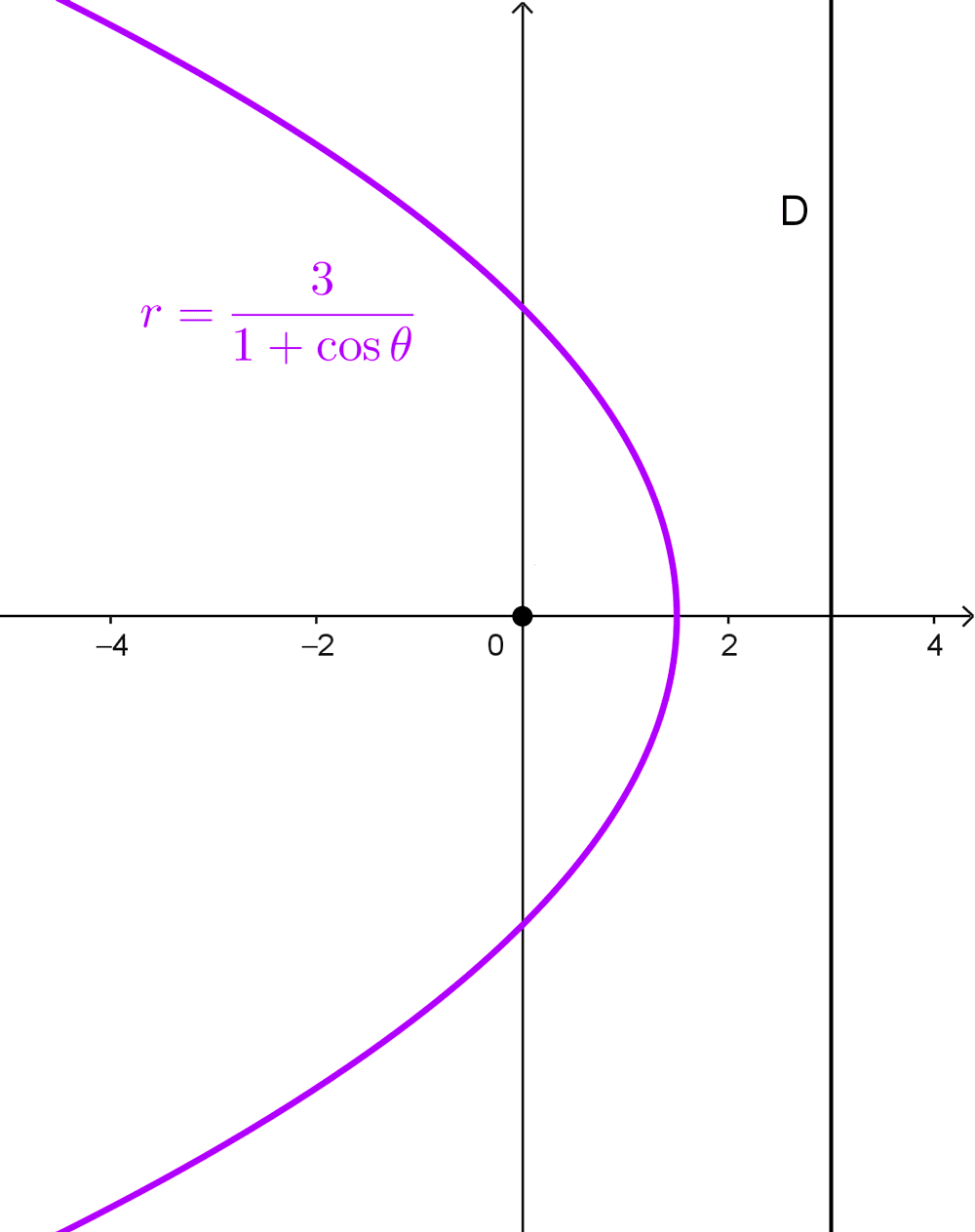
Identify and graph the following equation: \(r=\dfrac{3}{1+\cosθ}\)
Solution: In this case, the equation is already in the standard form \(r=\dfrac{ep}{1+e\cosθ},\) so no algebraic manipulation is needed.
The coefficient of cos θ is 1, so the eccentricity is:
$$e=1$$
Since e = 1, the conic is a parabola.
Find the parameter p from the numerator. Since ep = 3 and e = 1:
$$p=3$$
Conclusions:
- The equation represents a parabola because e = 1.
- The directrix is perpendicular to the polar axis because the trigonometric function is cos θ; the parabola has a horizontal axis of symmetry.
- The directrix is located 3 units from the pole.
- Because the coefficient of cos θ is positive (+), the directrix lies to the right of the pole.
Converting from Polar to Rectangular Coordinates
We can convert the polar equation of a conic (in variables r and θ) into general rectangular form (in variables x and y) using the standard conversion formulas:
$$r^2=x^2+y^2 → r=\sqrt{x^2+y^2}$$
$$x= r\cdot \cos θ$$
$$y= r\cdot \sin θ$$
Start with the standard polar equation:
$$r=\dfrac{ep}{1±e \cos \theta}$$
Multiply both sides by the denominator and apply the distributive property:
$$r(1±e \cos \theta)=ep$$
$$r±r e\cos \theta = ep$$
$$r±e (r\cos \theta) = ep$$
Substitute r and r ⋅ cos θ with their rectangular equivalents:
$$\sqrt{x^2+y^2}±ex=ep$$
Isolate the radical and factor out e:
$$\sqrt{x^2+y^2}=ep\mp ex$$
$$\sqrt{x^2+y^2}=e(p\mp x)$$
Square both sides of the equation:
$$x^2+y^2=e^2 (p\mp x)^2$$
Expanding this expression yields the general equation of the conic in terms of eccentricity e and parameter p, representing a conic whose focal axis lies along the x-axis.
If we start with the sine form instead of cosine, we obtain:
$$x^2+y^2=e^2 (p\mp y)^2$$
This represents a conic whose focal axis lies along the y-axis.
Key Takeaways
1) The standard polar equations of conic sections are:
$$r=\dfrac{ep}{1±e \cos \theta}$$
$$r=\dfrac{ep}{1±e \sin \theta}$$
Where p is the distance from the pole to the directrix, and e is the eccentricity of the conic.
2) The eccentricity determines the type of conic section:
- If e = 1, it is a parabola.
- If e < 1, it is an ellipse.
- If e > 1, it is a hyperbola.
3) The difference between Cartesian and polar coordinates for conics is that rectangular form uses directed distances (x and y) parallel to coordinate axes, whereas polar form uses a directed distance r from the pole and a directional angle θ measured from the polar axis.
4) To graph a conic in polar coordinates, first rewrite the equation into standard form to determine its eccentricity e, the orientation of its directrix (parallel or perpendicular to the polar axis), and the distance p from the pole to the directrix.
Did you find this useful? Rate it!
0.0 / 5 — 0 votes

HOW TO CITE THIS ARTICLE
Machado, D. (2026, October 29). Polar Equations of Conic Sections. Exponty. https://exponty.com/en/polar-equations-of-conics
Parametric Equations of Conic Sections
History of Conic Sections
Applications of Conic Sections
Eccentricity of Conic Sections
Degenerate Conic Sections
General Equation of Conic Sections
Conic Sections Practice Problems with Solutions
Parabola
Hyperbola
Ellipse
Leave a Reply
Related posts