
Eccentricity of Conic Sections
The eccentricity of a conic section is a numerical value that measures its shape and how much it deviates from being circular. Denoted by "e" or "ε (epsilon)", it describes how stretched or flattened the curve appears.
Table of Contents
Eccentricity of an Ellipse
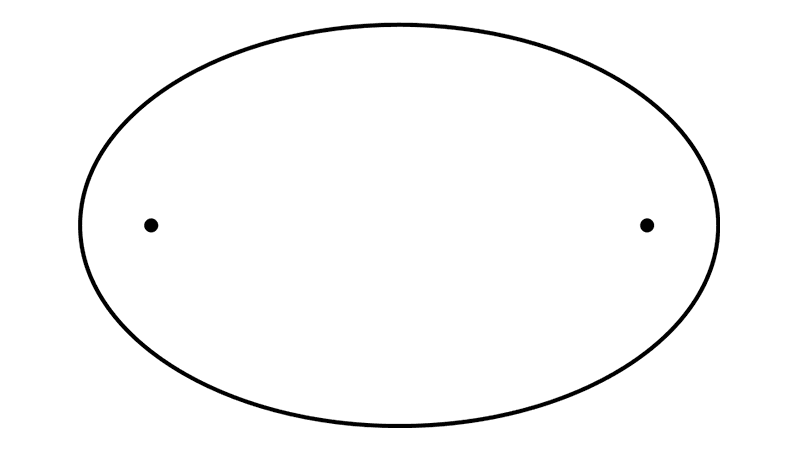
The eccentricity of an ellipse measures how "round" or "flattened" it is. It is defined as the ratio of the distance from the center to a focus c to the length of the semi-major axis a (distance from the center to a vertex):
e = distance to focus / semi-major axis = c / a
Since \(c=\sqrt{a^2-b^2},\) there is an alternative formula to calculate eccentricity using only the lengths of the semi-axes:
$$e= \sqrt{1-\dfrac{b^2}{a^2}}$$
Because every ellipse satisfies c < a, its eccentricity is always strictly less than 1, falling in the range (0 ≤ e < 1).
- When the eccentricity is close to 0, the ellipse closely resembles a circle. When e = 0, the ellipse becomes a circle. In this case, both foci coincide at the center (c = 0), which also means both semi-axes are equal.
- When the eccentricity approaches 1, the foci move farther from the center, causing the ellipse to become longer and more flattened.
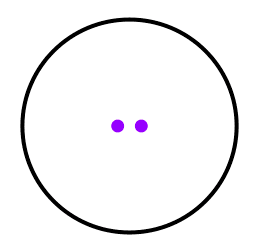
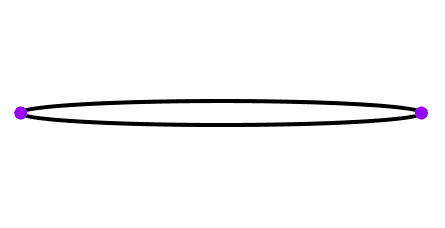
The eccentricity can never equal 1; this would mean the foci coincide with the vertices, which cannot happen in an ellipse. However, the closer e is to 1, the flatter the ellipse appears, eventually resembling a straight line segment.
Worked Examples
Below are step-by-step examples on how to find the eccentricity of an ellipse.
Example 1
Find the eccentricity of the following ellipse: \(\dfrac{x^2}{64}+\dfrac{y^2}{9}=1\)
Solution: We can find the eccentricity either by calculating the focal distance first or by using the formula with only the semi-axes. We will use the first approach.
First, from the standard equation we see that \(a^2=64 → a=8\) and \(b^2=9,\) meaning this is a horizontal ellipse. Now we find the focal distance using the relation:
$$c=\sqrt{a^2-b^2}$$
$$c=\sqrt{64-9}$$
$$c=\sqrt{55}$$
$$c≈7.42$$
Next, we apply the eccentricity formula:
$$e=\dfrac{c}{a}=\dfrac{\sqrt{55}}{8}$$
$$e≈0.93$$

Example 2
Determine the eccentricity of the following ellipse: \(\dfrac{y^2}{25}+\dfrac{x^2}{16}=1\)
Solution: From the equation, this is a vertical ellipse with a2 = 25 and b2 = 16. We will compute the eccentricity using the alternate formula:
$$e= \sqrt{1-\dfrac{b^2}{a^2}}$$
$$e=\sqrt{1-\dfrac{16}{25}}$$
$$e=\sqrt{\dfrac{9}{25}}$$
$$e=\dfrac{3}{5}=0.6$$

Example 3
Find the eccentricity of the ellipse \(\dfrac{(x-1)^2}{15}+\dfrac{y^2}{14}=1\)
Solution: This is a horizontal ellipse with a2 = 15 and b2 = 14. We use the second formula since it requires fewer steps:
$$e=\sqrt{1-\dfrac{b^2}{a^2}}$$
$$e=\sqrt{1-\dfrac{14}{15}}$$
$$e=\sqrt{\dfrac{1}{15}}$$
$$e≈0.26$$

Example 4
Calculate the eccentricity of \(2x^2+4x+7y^2-28y-40=0\)
Solution: The equation is given in general form rather than standard form. We must first manipulate it algebraically to find the values of a and b.
By completing the square, we can rewrite the equation in standard form:
$$\dfrac{(x+1)^2}{35}+\dfrac{(y-2)^2}{10}=1$$
From this equation, we identify \(a^2=35\) and \(b^2=10,\) confirming that this is an ellipse with a horizontal major axis. We now find its eccentricity:
$$e=\sqrt{1-\dfrac{b^2}{a^2}}$$
$$e=\sqrt{1-\dfrac{10}{35}}$$
$$e=\sqrt{\dfrac{5}{7}}$$
$$e≈0.85$$

Eccentricity of a Parabola
Every parabola has an eccentricity equal to 1, regardless of its shape or orientation.
Worked Examples
Determine the eccentricity of the following parabolas:
- \(3y+4=(x-2)^2-5\)
- \(x+5=-2(y-1)^2+3\)
- \(y=-\dfrac{1}{2}(x+3)^2+4\)
Solution: Every parabola has an eccentricity of e = 1.
Eccentricity of a Hyperbola
In a hyperbola, eccentricity measures how wide or "open" its branches are. If a is the length of the semi-transverse axis (distance from the center to a vertex) and b is the length of the semi-conjugate axis, the eccentricity is given by:
$$e=\sqrt{1+\dfrac{b^2}{a^2}}$$
Just as with the ellipse, it can also be calculated using the distance from the center to a focus (c) and the distance from the center to a vertex (a):
e = c / a
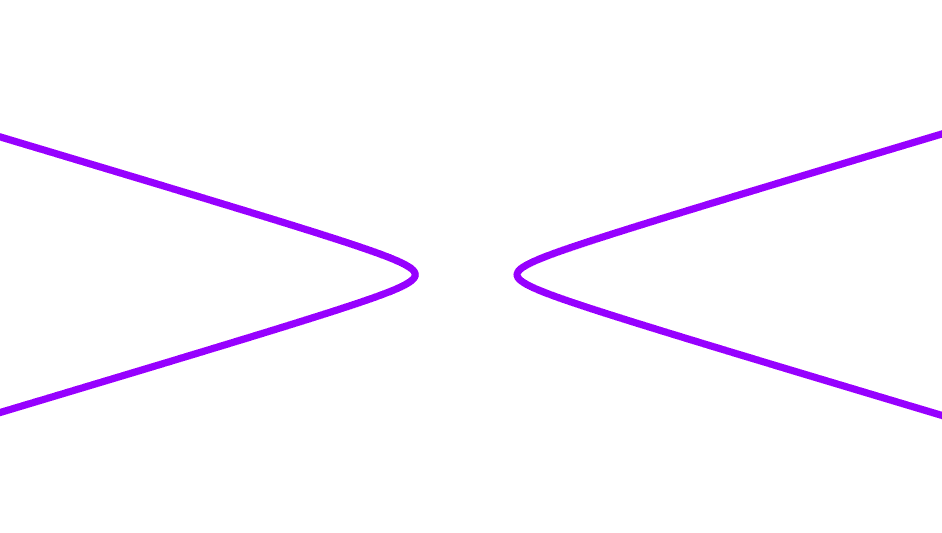
For any hyperbola, the eccentricity is always strictly greater than 1, because the foci are farther from the center than the vertices (c > a). As the eccentricity increases, the branches open wider and flatten out. As e approaches 1, the branches become narrower and tightly curved around the vertices.

Worked Examples
Find the eccentricity of the following hyperbolas.
- \((x-3)^2-\dfrac{(y+2)^2}{4}=1\)
- \(\dfrac{(y-1)^2}{9}-\dfrac{(x+5)^2}{16}=1\)
- \(\dfrac{x^2}{7}-\dfrac{(y-4)^2}{8}=1\)
Solutions
1) From \((x-3)^2-\dfrac{(y+2)^2}{4}=1,\) we have \(a^2=1\) and \(b^2=4,\) since the positive term determines the value of a.
Using these values, we calculate the eccentricity:
$$e=\sqrt{1+\dfrac{b^2}{a^2}}=\sqrt{1+\dfrac{4}{1}}=\sqrt{5}≈2.24$$
2) For \(\dfrac{(y-1)^2}{9}-\dfrac{(x+5)^2}{16}=1,\) the positive term contains the y variable, so \(a^2=9\) and \(b^2=16.\)
We compute the eccentricity:
$$e=\sqrt{1+\dfrac{b^2}{a^2}}=\sqrt{1+\dfrac{16}{9}}=\sqrt{\dfrac{25}{9}}=\dfrac{5}{3}\approx 1.67$$
3) For \(\dfrac{x^2}{7}-\dfrac{(y-4)^2}{8}=1,\) the positive term is \(\dfrac{x^2}{7},\) giving \(a^2=7\) and \(b^2=8.\)
Now we evaluate the eccentricity:
$$e=\sqrt{1+\dfrac{b^2}{a^2}}=\sqrt{1+\dfrac{8}{7}}=\sqrt{\dfrac{15}{7}}\approx 1.46$$
As expected for hyperbolas, all calculated eccentricities are strictly greater than 1.
Summary of Formulas
| Conic Section | Eccentricity | Formulas |
|---|---|---|
| Circle | e = 0 | - |
| Ellipse | 0 ≤ e < 1 | e = c / a \(e=\sqrt{1-\dfrac{b^2}{a^2}}\) |
| Parabola | e = 1 | - |
| Hyperbola | e > 1 | e = c / a \(e=\sqrt{1+\dfrac{b^2}{a^2}}\) |
Did you find this useful? Rate it!
0.0 / 5 — 0 votes

HOW TO CITE THIS ARTICLE
Machado, D. (2026, October 28). Eccentricity of Conic Sections. Exponty. https://exponty.com/en/eccentricity-conic-sections
Parametric Equations of Conic Sections
Polar Equations of Conic Sections
History of Conic Sections
Applications of Conic Sections
Degenerate Conic Sections
General Equation of Conic Sections
Conic Sections Practice Problems with Solutions
Parabola
Hyperbola
Ellipse
Leave a Reply
Related posts