
Degenerate Conic Sections
In analytic geometry, a degenerate conic section (or degenerate conic) is one that fails to exhibit the standard properties that characterize conic sections. This occurs when the determinant associated with the conic vanishes (δ = 0), causing the conic to reduce to simpler geometric figures such as a point or lines.
From a geometric perspective, a degenerate conic section can be visualized as the intersection of a plane with a double-napped right circular cone when the plane passes through the vertex of the cone.
Degenerate conic sections are classified into three main types:
- Point: when the plane intersects the cone only at the vertex without cutting through either nappe.
- Line (two coincident lines): when the plane is tangent to the cone along a generator and passes through the vertex. Because the two lines coincide, they appear as a single line.
- Pair of intersecting lines: when the plane passes through the vertex and cuts through both nappes of the cone.
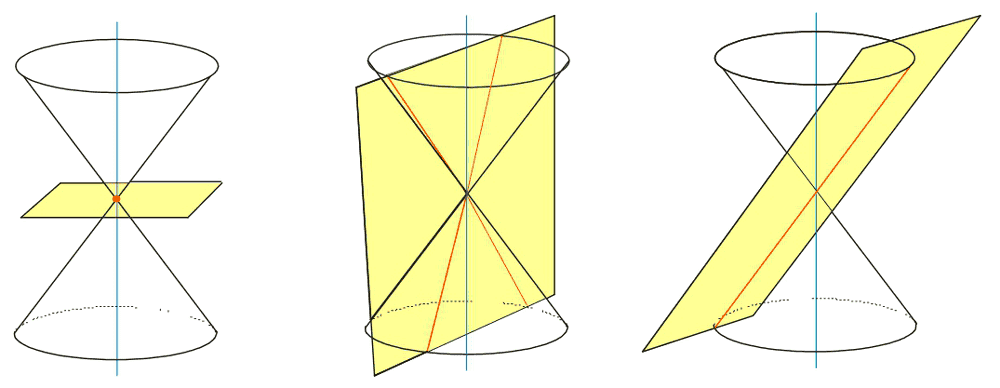
Each conic section has its corresponding degenerate cases, as shown in the following table:
| Conic Section | Degenerate Case | Degenerate Equation |
|---|---|---|
| Ellipse | A single real point | (x - h)² + (y - k)² = 0 The graph is the point (h, k) |
| Hyperbola | Two intersecting lines forming an X. | (x - h)² / a² - (y - k)² / b² = 0 (y - k)² / a² - (x - h)² / b² = 0 The graph consists of two lines intersecting at (h, k). |
| Parabola | Two parallel or coincident lines, real or imaginary. | (x - h)² = a (y - k)² = a When a > 0, the lines are real and parallel. When a < 0, the lines are imaginary. When a = 0, the lines are coincident. |
Table of Contents
Examples
Degenerate Ellipses
The following are equations of ellipses that degenerate into a single point.
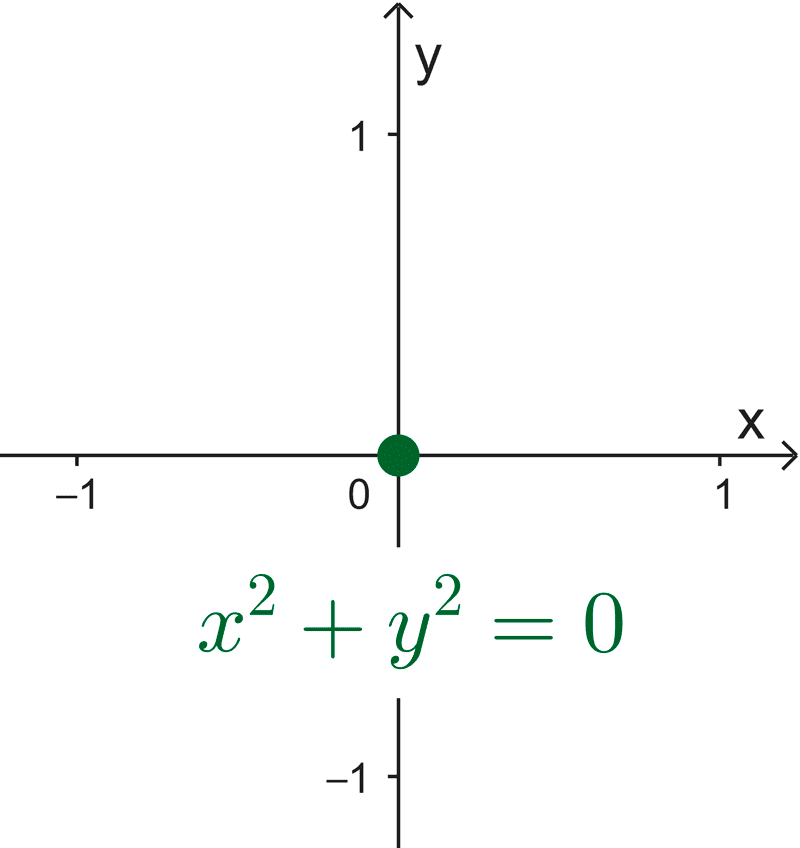
- \(x^2+y^2=0\)
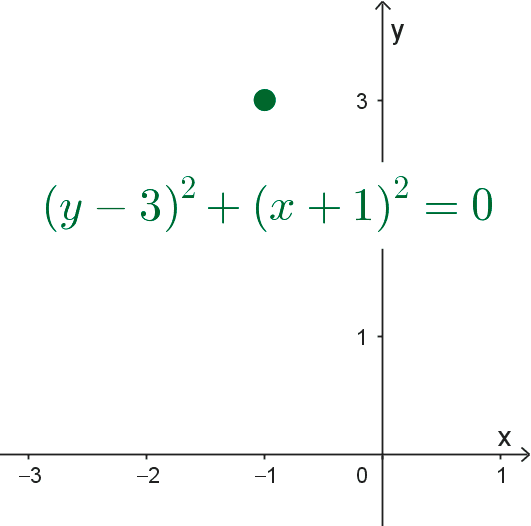
- \((y-3)^2+(x+1)^2=0\)
- \(x^2+(y+6)^2=0\)
- \(-(x+4)^2-y^2=0\)
- \((x-2)^2=-(y+4)^2\)
An equation of the form \((x-h)^2+(y-k)^2=c\), where c is negative, corresponds to an imaginary ellipse rather than a degenerate case. For instance, the equation \(x^2+y^2=-1\) represents an ellipse with no real points. The following are graphs of degenerate ellipses:
Degenerate Hyperbolas
The following are equations of hyperbolas that degenerate into two intersecting lines.
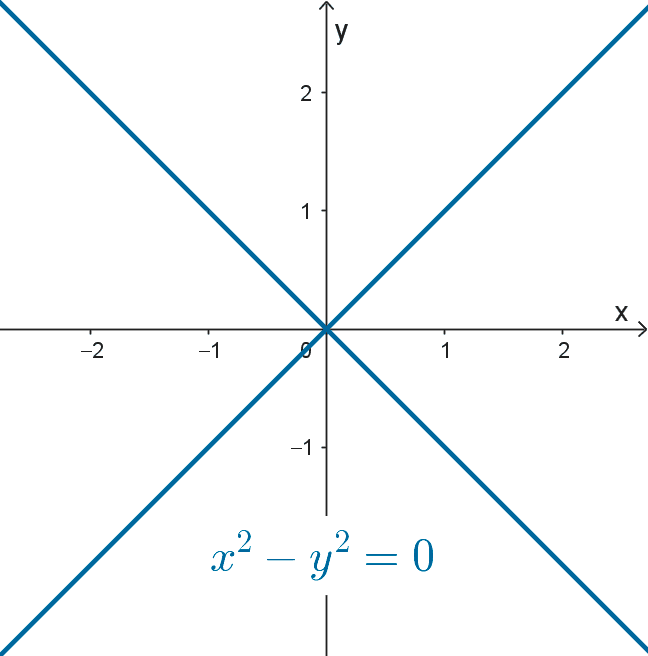
- \(x^2-y^2=0\)
- \((x+5)^2-(y+1)^2 = 0\)
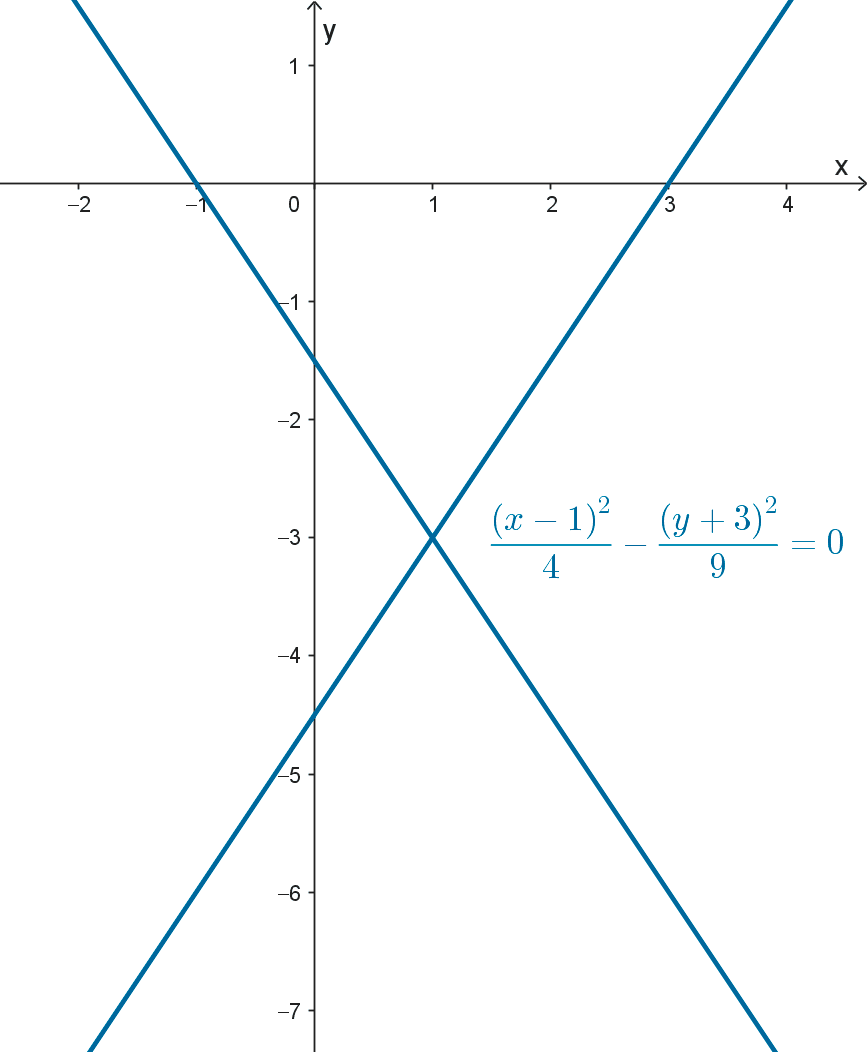
- \(\dfrac{(x-1)^2}{4}-\dfrac{(y+3)^2}{9}=0\)
- \(\dfrac{(y-2)^2}{16}-\dfrac{(x+5)^2}{25}=0\)
- \(\dfrac{(x+3)^2}{1}=\dfrac{(y-4)^2}{2}\)
An equation of the form \(\dfrac{(x-h)^2}{a^2}-\dfrac{(y-k)^2}{b^2}=0\) represents two intersecting lines whose slopes are b/a and -b/a. The following are graphs of degenerate hyperbolas:
Degenerate Parabolas
The following are equations of parabolas that degenerate into parallel or coincident lines. These can be real or imaginary.
- \(x^2=0\) (coincident lines)
- \(y^2=-6\) (imaginary lines)
- \((y-2)^2=3\)
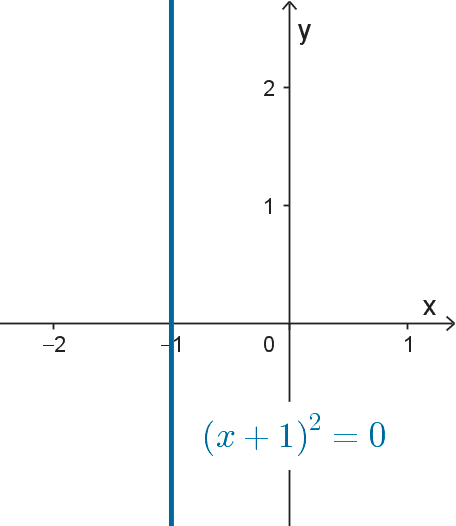
- \((x+1)^2=0\)
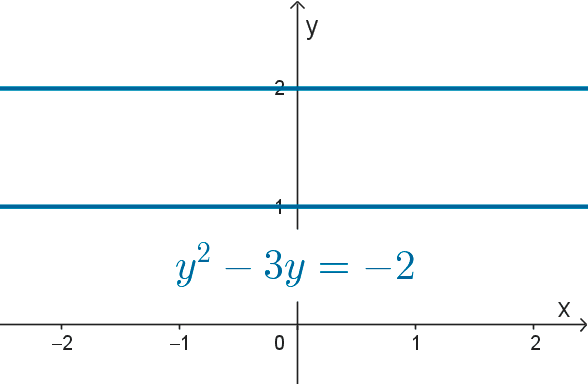
- \(y^2-3y=-2\)
- \(x^2=5\)
In equations of the form (x-h)² = a or (y-k)² = a, the parallel lines are separated by a distance \(2 \sqrt{a}.\) The following are graphs of degenerate parabolas:
Note: In the general second-degree equation Ax2 + Bxy + Cy2 + Dx + Ey + F = 0, if A, B, and C are all zero, the formula reduces to Dx + Ey + F = 0, which represents a straight line in the plane. However, this type of linear equation does not represent a conic section, and therefore is not a degenerate case. For an equation of the form Ax2 + Bxy + Cy2 + Dx + Ey + F = 0 to represent a conic section (either non-degenerate or degenerate), A, B, and C cannot all be zero simultaneously—that is, at least one of these coefficients must be non-zero, which does not hold for Dx + Ey + F = 0.
How to Identify a Degenerate Conic Section
There are two primary methods for determining whether an equation represents a degenerate conic section: an algebraic approach and a matrix invariant approach.
Analyzing the Equation
The first method consists of analyzing the conic's equation directly. If the xy-term does not appear, you can complete the square and determine whether the resulting standard form corresponds to a degenerate case. On the other hand, if the xy-term is present, you can factor the expression or solve for one variable in terms of the other using the quadratic formula to reveal its geometric nature.
Example 1
Determine the nature of the equation \(2x^2+7xy+3y^2+x-7y-6=0.\)
Solution: To analyze the curve, treat the equation as a quadratic in x and apply the quadratic formula. Rewriting the terms gives:
$$2x^2+(7y+1)x+(3y^2-7y-6)=0$$
$$x=\dfrac{-(7y+1)\pm\sqrt{(7y+1)^2-4\cdot2\cdot(3y^2-7y-6)}}{4}$$
$$x=\dfrac{-(7y+1)\pm\sqrt{49y^2+14y+1-24y^2+56y+48}}{4}$$
$$x=\dfrac{-(7y+1)\pm\sqrt{25y^2+70y+49}}{4}$$
$$x=\dfrac{-(7y+1)\pm(5y+7)}{4}$$
Therefore,
$$x=\dfrac{-y+3}{2}\quad \text{and}\quad x=-3y-2$$
are the solutions. This means the given equation can be written in factored form as:
$$(2x+y-3)(x+3y+2)=0$$
If the coordinates of a point make either factor equal to zero, the entire product is zero, satisfying the original equation. Consequently, the graph consists of two intersecting lines whose equations are:
$$2x+y-3=0\quad \text{and}\quad x+3y+2=0$$
This is a degenerate hyperbola.
Example 2
Analyze the equation \(y^2-4xy+4x^2-2x+y-12=0.\)
Solution: Solving the equation for y in terms of x yields the two linear equations:
$$y-2x-3=0\quad \text{and}\quad y-2x+4=0$$
Consequently, the graph of the given equation consists of two parallel lines, representing a degenerate parabola.
Determinant Analysis
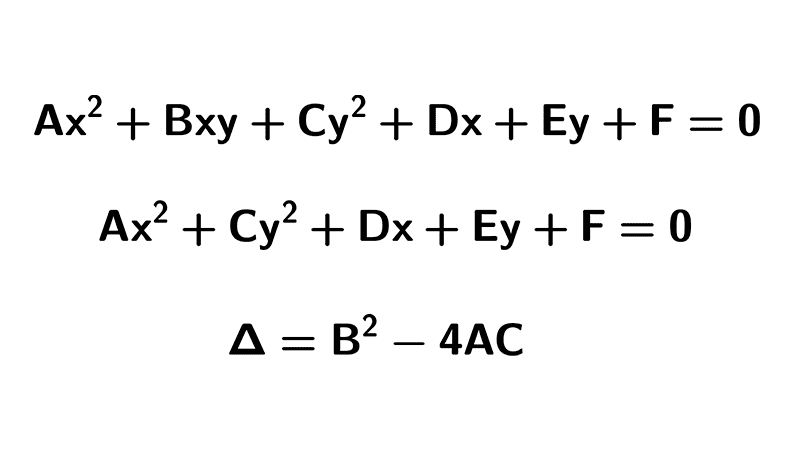
The second method for identifying a degenerate conic involves analyzing the equation using the invariant method. The general second-degree equation representing any conic section, whether regular or degenerate, has the form: Ax2 + Bxy + Cy2 + Dx + Ey + F = 0.
To determine whether the conic is non-degenerate or degenerate, compute the determinant of the matrix associated with the quadratic equation:
$$δ = \begin{vmatrix} 2A & B & D \\ B & 2C & E \\ D & E & 2F \\ \end{vmatrix}$$
Expanding this determinant yields:
$$δ = 8ACF-2AE^2-2B^2F+2BED-2CD^2$$
The value of this determinant indicates whether the conic is non-degenerate or degenerate:
- If δ ≠ 0: the conic is non-degenerate (regular), meaning the equation represents a standard smooth curve such as a circle, ellipse, parabola, or hyperbola.
- If δ = 0: the conic is degenerate, meaning the equation represents a point, a pair of intersecting lines, or a pair of parallel or coincident lines.
Once a conic is found to be degenerate (δ = 0), the next step is to classify the specific type of degeneration using the discriminant:
Δ = B2 - 4AC
This value classifies the degenerate conic as follows:
- B2 - 4AC > 0: the conic is a degenerate hyperbola, which manifests as a pair of real intersecting lines.
- B2 - 4AC < 0: the conic is a degenerate ellipse, which appears as a single real point in the plane.
- B2 - 4AC = 0: the conic is a degenerate parabola, which appears as two parallel or coincident lines (either real or imaginary).
In summary, the procedure to determine whether an equation of the form Ax2 + Bxy + Cy2 + Dx + Ey + F = 0 represents a degenerate conic is:
- Compute the determinant \(δ = \begin{vmatrix} 2A & B & D \\ B & 2C & E \\ D & E & 2F \\ \end{vmatrix}.\) If the result is zero, the conic is degenerate; if it is non-zero, the conic is regular.
- Compute the discriminant Δ = B2 - 4AC. If positive, it corresponds to a degenerate hyperbola; if negative, to a degenerate ellipse; if zero, to a degenerate parabola.
| Determinant | Discriminant | Conic Section |
|---|---|---|
| δ = 0 | B2 - 4AC > 0 | Degenerate hyperbola: pair of real intersecting lines. |
| δ = 0 | B2 - 4AC < 0 | Degenerate ellipse: a single real point. |
| δ = 0 | B2 - 4AC = 0 | Degenerate parabola: two parallel or coincident lines (real or imaginary). |
Example 1
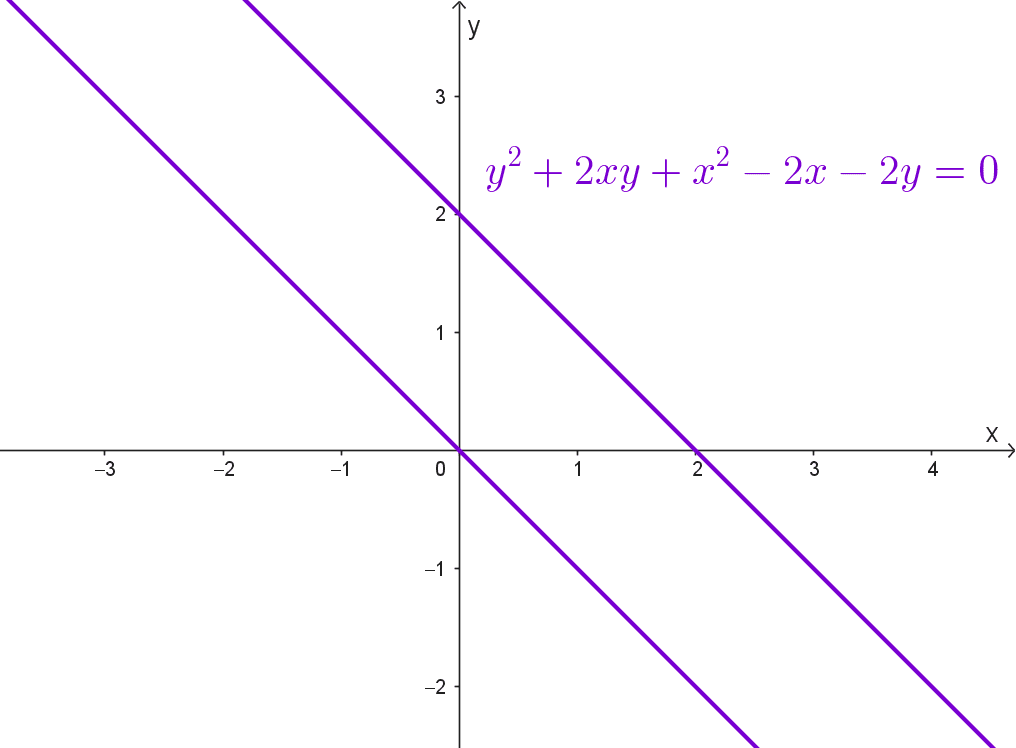
Analyze the equation \(y^2+2xy+x^2-2x-2y=0.\)
Solution: Begin by identifying the coefficients corresponding to the general conic form \(Ax^2+Bxy+Cy^2+Dx+Ey+F=0.\) Here, the coefficients are A=1, B=2, C=1, D=-2, E=-2, and F=0.
First, calculate the determinant of the matrix associated with the quadratic equation to determine whether the conic is regular or degenerate:
$$\delta=\begin{vmatrix} 2A & B & D \\ B & 2C & E \\ D & E & 2F \end{vmatrix}=\begin{vmatrix} 2(1) & 2 & -2 \\ 2 & 2(1) & -2 \\ -2 & -2 & 2(0) \end{vmatrix}$$
Expanding the determinant:
$$\delta=8\cdot1\cdot0-2\cdot1\cdot(-2)^2-2\cdot2^2\cdot0+2\cdot2\cdot(-2)\cdot(-2)-2\cdot1\cdot(-2)^2=0$$
Since δ = 0, the conic is degenerate. Next, identify the type of degeneration by computing the discriminant:
$$\Delta=B^2-4AC=2^2-4(1)(1)=4-4=0$$
Because Δ = 0, the conic is classified as a degenerate parabola. This means the equation represents two parallel or coincident lines.
Example 2
Determine whether the equation \(2x^2-xy-y^2+2x+y=0\) represents a regular or degenerate conic, and determine its type.
Solution: First, identify the coefficients in the general form \(Ax^2+Bxy+Cy^2+Dx+Ey+F=0.\) Here, A=2, B=-1, C=-1, D=2, E=1, and F=0.
Calculate the determinant of the matrix associated with the quadratic equation:
$$\delta= \begin{vmatrix} 2A & B & D \\ B & 2C & E \\ D & E & 2F \end{vmatrix}=\begin{vmatrix} 2(2) & -1 & 2 \\ -1 & 2(-1) & 1 \\ 2 & 1 & 2(0) \end{vmatrix}$$
Expanding the determinant:
$$\delta=8\cdot(-2)\cdot0-2\cdot2\cdot1^2-2\cdot(-1)^2\cdot0+2\cdot(-1)\cdot1\cdot2-2\cdot(-1)\cdot2^2$$
Simplifying:
$$\delta=0-4-0-4+8=0$$
Since δ = 0, the conic is degenerate. To classify the type of degeneration, compute the discriminant:
$$\Delta=B^2-4AC=(-1)^2-4(2)(-1)=1+8=9$$
Because Δ = 9 > 0, the conic is a degenerate hyperbola, which manifests as a pair of real intersecting lines.

Example 3
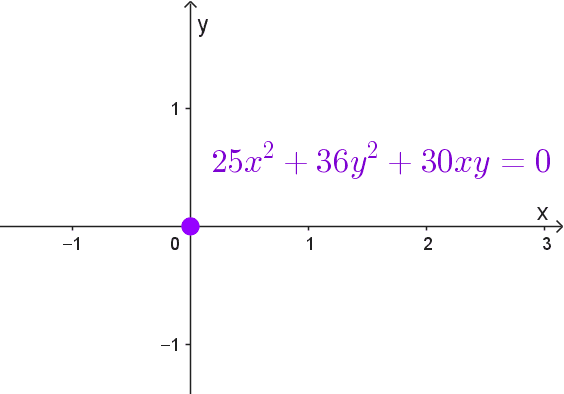
Analyze the equation \(25x^2 + 36y^2 + 30xy = 0.\)
Solution: Begin by identifying the coefficients in the general form: A=25, B=30, C=36, D=0, E=0, and F=0.
Calculate the determinant of the matrix associated with the conic to verify whether it is regular or degenerate:
$$\delta=\begin{vmatrix} 2A & B & D \\ B & 2C & E \\ D & E & 2F \end{vmatrix} =\begin{vmatrix} 2(25) & 30 & 0 \\ 30 & 2(36) & 0 \\ 0 & 0 & 2(0) \end{vmatrix}$$
Expanding this determinant:
$$\delta=(50)(72)(0)-2(25)(0)^2-2(30)^2(0)+2(30)(0)(0)-2(36)(0)^2=0$$
Simplifying gives δ = 0, indicating that the conic is degenerate. Next, evaluate the type of degeneration by calculating the discriminant:
$$\Delta=B^2-4AC=(30)^2-4(25)(36)=900-3600=-2700$$
Because Δ = -2700 < 0, the conic is a degenerate ellipse. This type of degeneration appears as a single point in the plane.
Did you find this useful? Rate it!
0.0 / 5 — 0 votes

HOW TO CITE THIS ARTICLE
Machado, D. (2026, October 28). Degenerate Conic Sections. Exponty. https://exponty.com/en/degenerate-conic-sections
Parametric Equations of Conic Sections
Polar Equations of Conic Sections
History of Conic Sections
Applications of Conic Sections
Eccentricity of Conic Sections
General Equation of Conic Sections
Conic Sections Practice Problems with Solutions
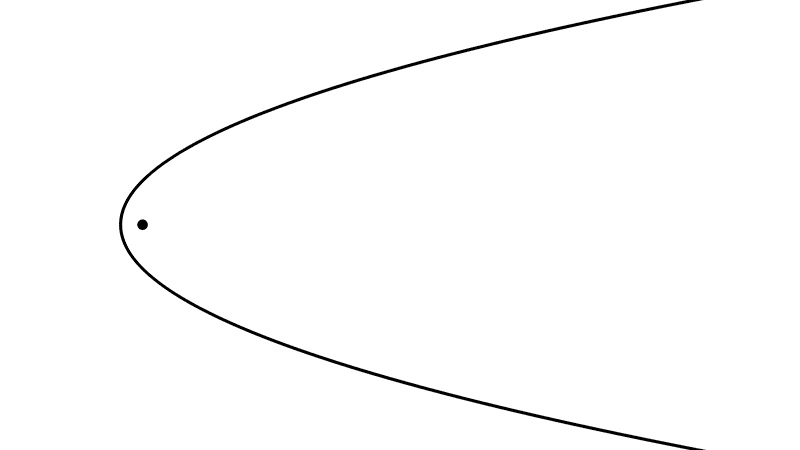
Parabola
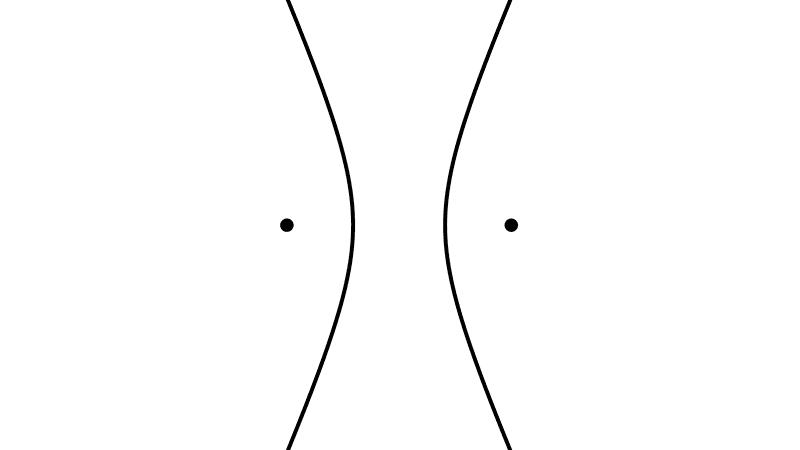
Hyperbola
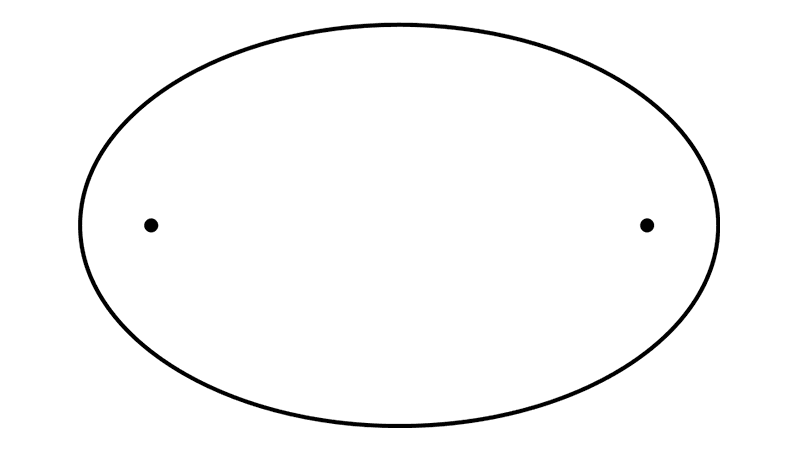
Ellipse
Leave a Reply
Related posts