
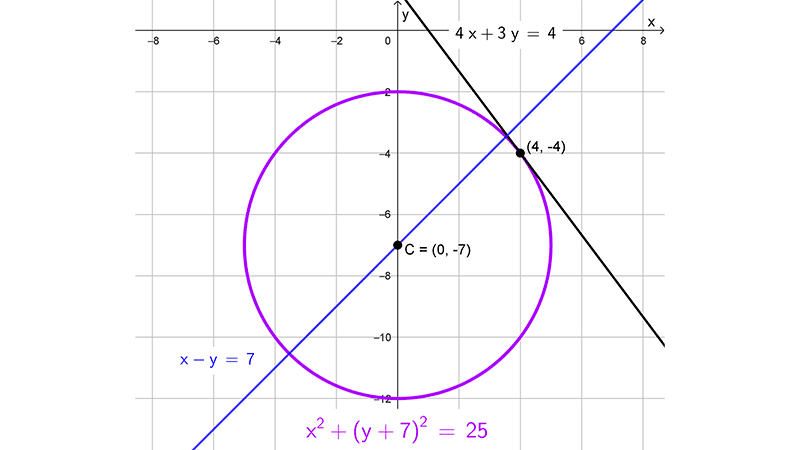
Circle
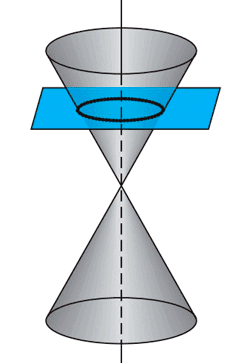
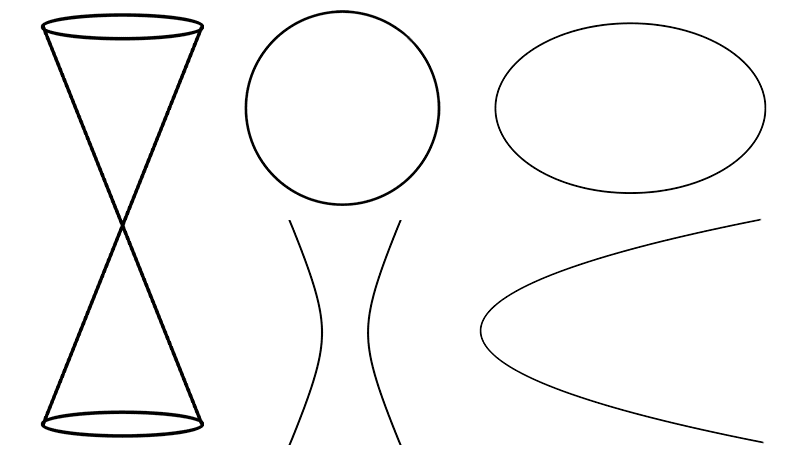
A circle is a two-dimensional geometric shape formed by all points that are at a fixed distance, called the radius, from a fixed point known as the center. Its graph is a smooth, continuous, and closed curve. A circle can also be defined as a conic section formed by intersecting a right circular cone with a plane perpendicular to its axis.
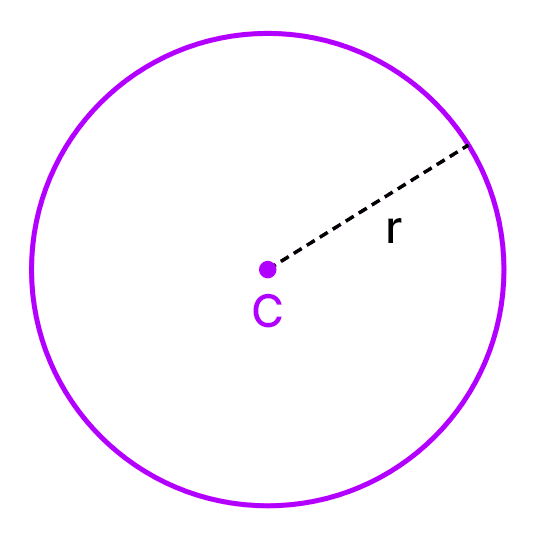
The standard equation of a circle with center at the origin (0, 0) and radius r is:
x2 + y2 = r2
If the center is not at the origin, but at another point (h, k) in the Cartesian plane, the standard form becomes:
(x - h)2 + (y - k)2 = r2
The derivation of these equations is covered later in this article.
Below, we will explore key concepts about the circle in mathematics: examples, parts and key features, derivations of its equations, and properties, among other topics.
Table of Contents
Examples
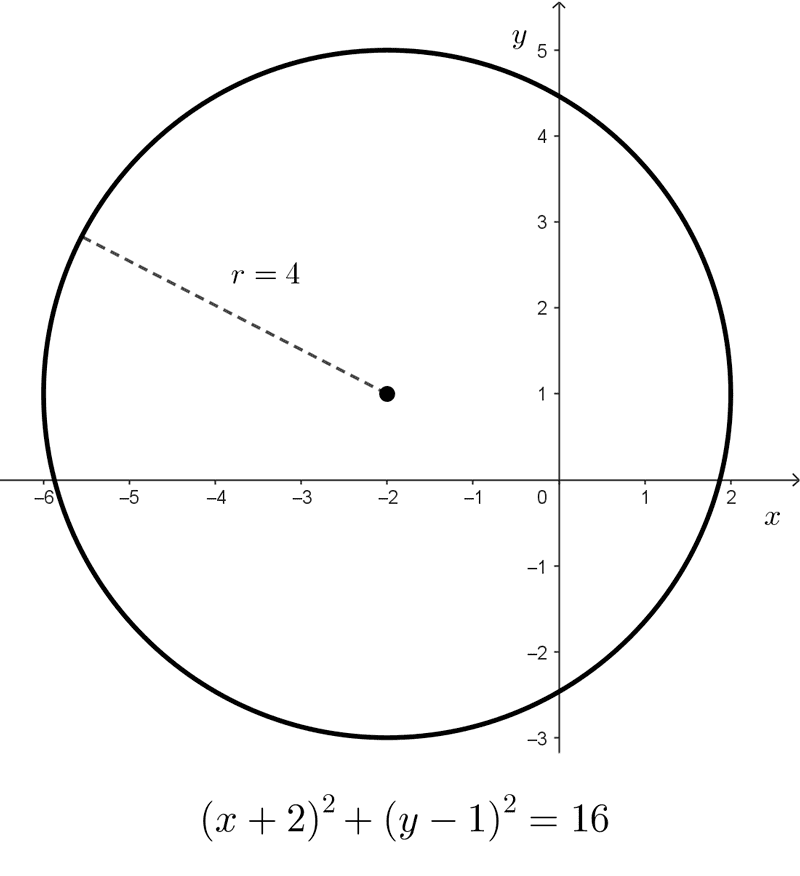
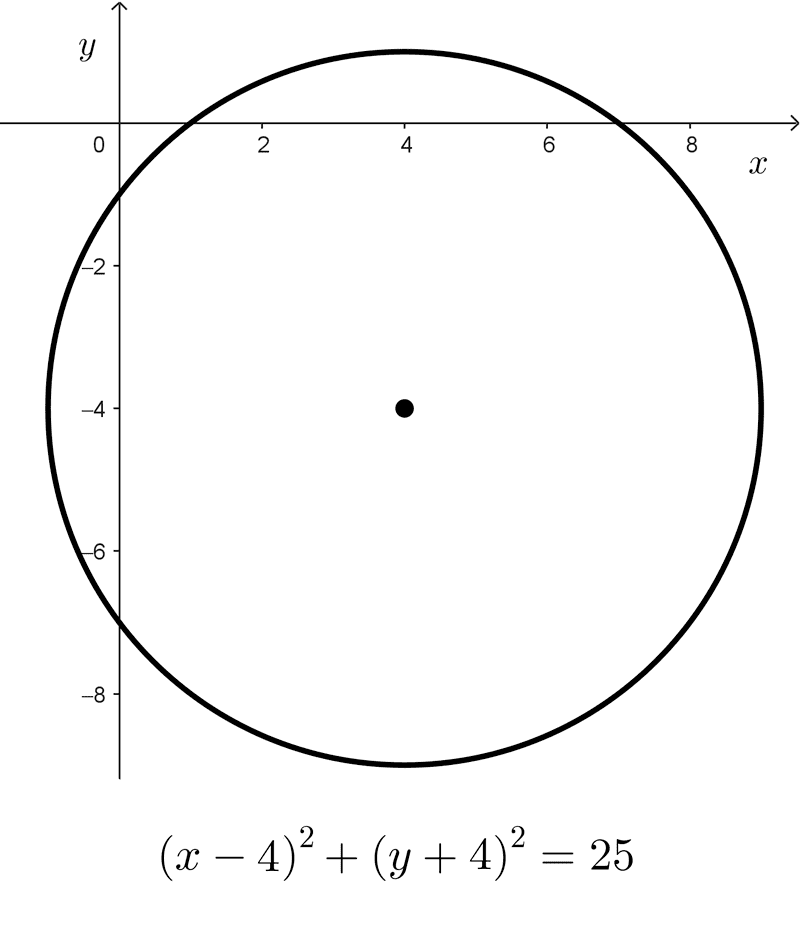
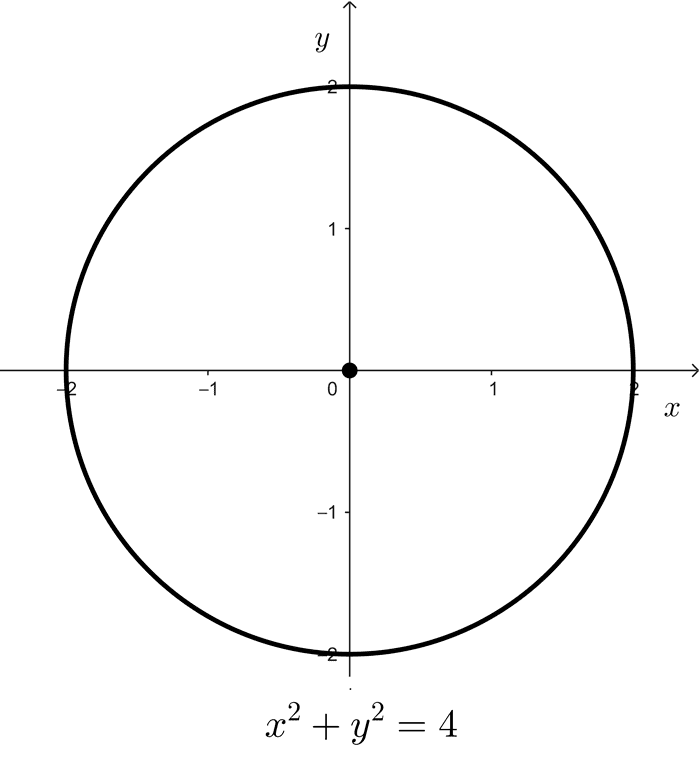
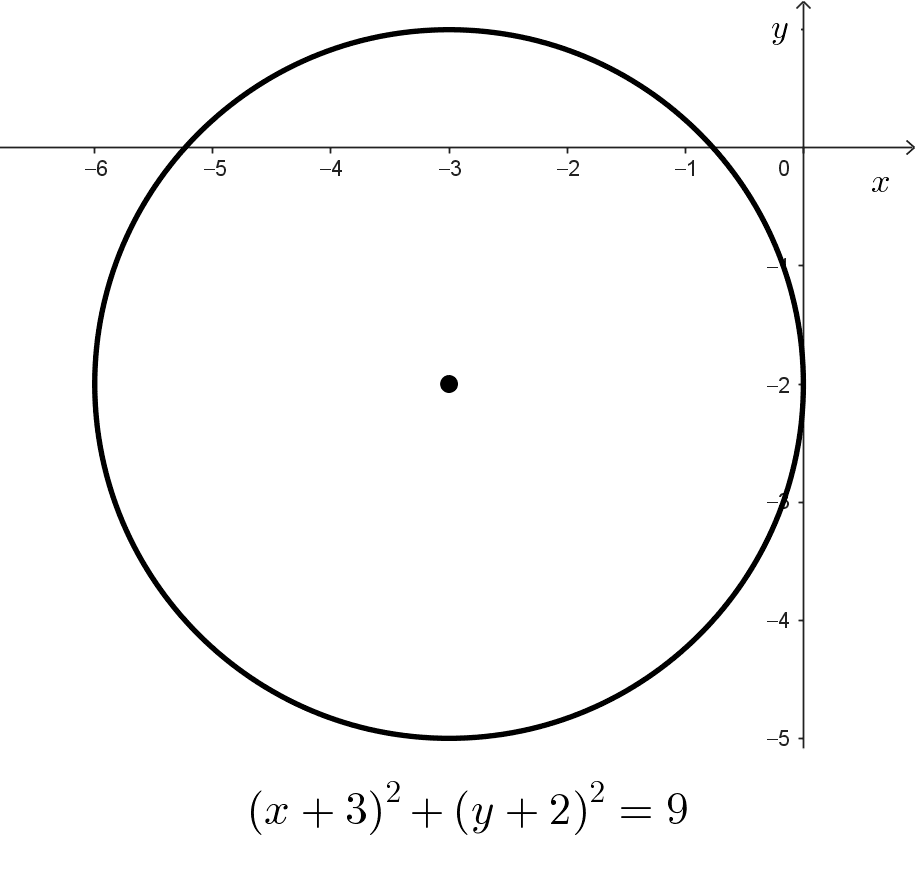
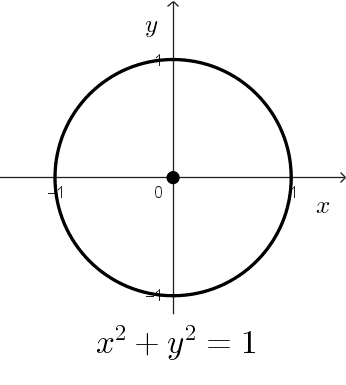
Here are several examples of circles along with their graphs:
- (x + 2)2 + (y - 1)2 = 16 is a circle with center at (-2, 1) and radius 4 (remember that the radius is squared in the equation).
- (x - 4)2 + (y + 4)2 = 25 is a circle with center at (4, -4) and radius 5.
- (x - 1)2 + y2 = 9 is a circle with center at (1, 0) and radius 3.
- x2 + y2 = 4 is a circle with center at (0, 0) and radius 2.
- (x + 3)2 + (y + 2)2 - 9 = 0, which rearranges to (x+3)2 + (y+2)2 = 9, is a circle with center at (-3, -2) and radius 3.
- x2 + y2 = 1 is a circle with center at (0, 0) and radius 1, also known as the unit circle.
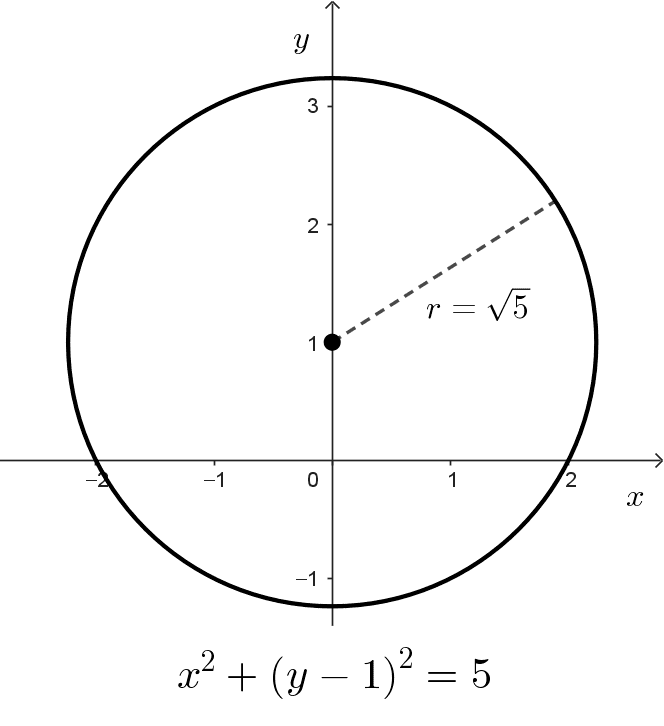
- x2 + (y - 1)2 = 5 is a circle with center at (0, 1) and radius √5≈2.24.
- (x - 2)2 + y2 = 10 is a circle with center at (2, 0) and radius √10≈3.16.
Parts of a Circle
The primary elements of a circle are:
- Center: The fixed point equidistant from all points on the circle. It is typically denoted by C and its location is defined by its coordinates (h, k) in the Cartesian plane.
- Radius: The distance from the center of the circle to any point on its curve. It is a constant, positive quantity denoted by the letter r.
These are considered the essential elements because they are sufficient to uniquely define a circle.
Other key components of a circle include:
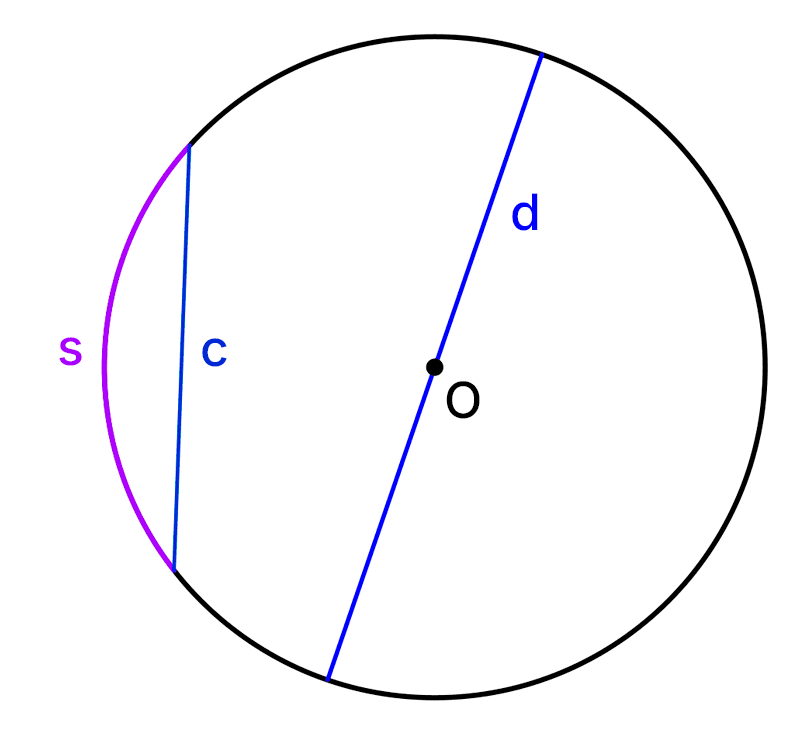
- Diameter: A line segment passing through the center that connects two points on the circle. It is denoted by "d", and its length is twice the radius (d = 2r). Every diameter divides the circle into two equal parts called semicircles.
- Circumference: The total distance around the circle. It is related to the radius and pi by the formula: C = 2πr.
- Chord: A line segment connecting any two points on the circle, not necessarily passing through the center. The diameter is the longest possible chord.
- Arc: A portion or segment of the circle between two points.
- Sector: The region bounded by two radii and the arc between them.
If the radius equals zero, the circle collapses into a single point (the center), which is classified as a degenerate conic (point circle). A radius can never be negative.
In Euclidean geometry, circles are often represented by stating their center and radius—for instance, a circle with center O and radius r is written as C(O, r). In analytic geometry, circles are defined algebraically using equations in the Cartesian coordinate system.
General Form of the Equation
The general form of the equation of a circle is x2 + y2 + Dx + Ey + F = 0, provided that D2 + E2 - 4F > 0.
The general equation can be obtained by expanding and rearranging the standard form. For example:
- The equation \((x+2)^2+(y-1)^2=16\) in general form is: \(x^2+y^2+4x-2y-11=0.\)
- Expanding \(x^2+(y-4)^2=5\) yields the general equation: \(x^2+y^2-8y+11=0.\)
- The circle \((x-3)^2+(y+4)^2=25\) has the general form: \(x^2+y^2-6x+8y=0.\)
Converting Between Standard Form and General Form
- To convert from standard form to general form, expand the squared binomials and combine like terms.
- To convert from general form to standard form, complete the square for both the x and y terms. This allows you to identify the center (h, k) and the radius r directly from the coefficients D, E, and F.
Not every equation of the form x2 + y2 + Dx + Ey + F = 0 represents a real circle. For the graph to exist in the real coordinate plane, the condition D2 + E2 - 4F > 0 must hold true. If this condition is not met, the equation does not yield a circle.
Properties
Here are the fundamental properties of a circle:
- Equidistance from the Center: Every point on the circle lies at the exact same distance from the center point. This distance is the radius.
- Congruence: All circles with identical radii are congruent. They will match point-for-point if placed on top of one another.
- Relationship Between Radius and Diameter: The diameter is always twice the length of the radius: d = 2r.
- Circumference: The perimeter of a circle is calculated using the formula C = 2πr, where π is approximately equal to 3.14159.
- Area: The area of the region enclosed by a circle is given by the formula A = πr2.
Key Formulas
The following table summarizes the most common formulas used when working with circles:
| Equation | Center | Radius |
|---|---|---|
| x² + y² = r² | (0, 0) | r |
| (x - h)² + (y - k)² = r² | (h, k) | r |
- Circumference: C = 2πr
- Diameter: d = 2r
- Area: A = πr2
Real-World Applications of Circles
Circles have countless practical applications in everyday life, engineering, and product design. Here are some notable examples:
- Gear Design: Gears feature teeth spaced evenly around a circular rim, enabling smooth, consistent mechanical motion and torque transfer across machinery components.
- Wheel Dynamics: The circular shape of wheels guarantees smooth, continuous rolling without vertical jumps—a vital feature for vehicles and industrial transport. Geometric formulas involving π allow engineers to calculate circumference and area precisely when sizing parts.
- Circular Motion in Physics: Objects traveling along curved trajectories follow circular paths. Fundamental physics principles such as angular velocity, centripetal acceleration, and rotational period are derived directly from the geometric properties of the circle.
- Architecture and Civil Engineering: Architectural designs regularly use circular segments in arches and domes. These shapes distribute compressive loads evenly across structural supports, improving both stability and aesthetics.
- Structural Engineering: In tunnels, pipes, and bridge arches, circular cross-sections distribute internal and external pressures uniformly, preventing localized stress concentrations and enhancing load-bearing safety.
Derivations of Circle Equations
Derivation of the Standard Form Equation
In formal geometric terms, a circle is defined as follows:
A circle is the set (or locus) of all points in a plane that are at a fixed distance r from a given point C(h, k).
To derive the equation, let P(x, y) represent an arbitrary point on the circle.
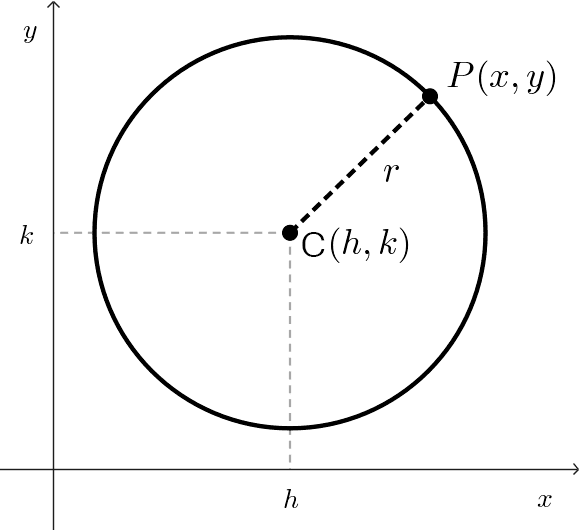
Expressing the definition symbolically, we have:
\(d(P, C)=r\)
Applying the distance formula between two points to the left-hand side:
\(\sqrt{(x-h)^2+(y-k)^2}=r\)
Squaring both sides of the equation yields:
\((x-h)^2+(y-k)^2=r^2\)
This is the standard form equation of a circle with center at (h, k) and radius r.
From this general setup, we can determine the specific case where the center lies at the origin (0, 0). Setting h = 0 and k = 0 gives:
\(x^2+y^2=r^2\)
which is the standard equation of a circle centered at the origin with radius r.
Identifying the Center and Radius
- Center: In the equation (x-h)2 + (y-k)2 = r2, the center is the coordinate point (h, k). Note that the values inside the parentheses have opposite signs. For example, if given (x+2)2 + (y-3)2 = 16, then h = -2 and k = 3, placing the center at (-2, 3).
- Radius: The term r2 on the right-hand side represents the square of the radius. To find the actual radius, take the positive square root of this value. For example, in (x+2)2 + (y-3)2 = 16, we have r2 = 16, so r = √16 = 4.
Derivation of the General Form Equation
To derive the general form of the circle's equation, start with the standard form centered at (h, k) with radius r:
\((x-h)^2+(y-k)^2=r^2\)
Expand both binomial expressions:
\(x^2-2hx+h^2+y^2-2ky+k^2=r^2\)
Rearrange the terms:
\(x^2+y^2-2hx-2ky+h^2+k^2=r^2\)
Collect all constant terms on the left side:
\(x^2+y^2-2hx-2ky+(h^2+k^2-r^2)=0\)
To write this in standard general format, define the constant coefficients as \(D=-2h,\) \(E=-2k,\) and \(F=h^2+k^2-r^2.\) This results in the general form of the circle equation: \(x^2+y^2+Dx+Ey+F=0.\)
Additional Resources
How to Graph a Circle
Graphing Manually
To draw a circle by hand, you will need a compass, pencil, ruler, and paper. First, plot and mark the point that will serve as the center. Next, set your compass to the desired radius using your ruler.
Place the needle tip of the compass firmly on the marked center point. Holding the top hinge of the compass steadily, rotate the pencil end a full 360 degrees to trace the complete circle.
Graphing with Software
When graphing circles digitally, two widely used tools are GeoGebra and Desmos.
GeoGebra allows you to plot circles using either their center and a point, or by inputting their algebraic equations directly. It provides a dynamic and precise coordinate workspace. In Desmos, you can simply type the circle equation in either standard form or general form, and the tool will immediately render the graph in the Cartesian coordinate plane.
Related Content on Circles
Did you find this useful? Rate it!
0.0 / 5 — 0 votes

HOW TO CITE THIS ARTICLE
Machado, D. (2026, October 27). Circle. Exponty. https://exponty.com/en/circle
Leave a Reply
Related posts