
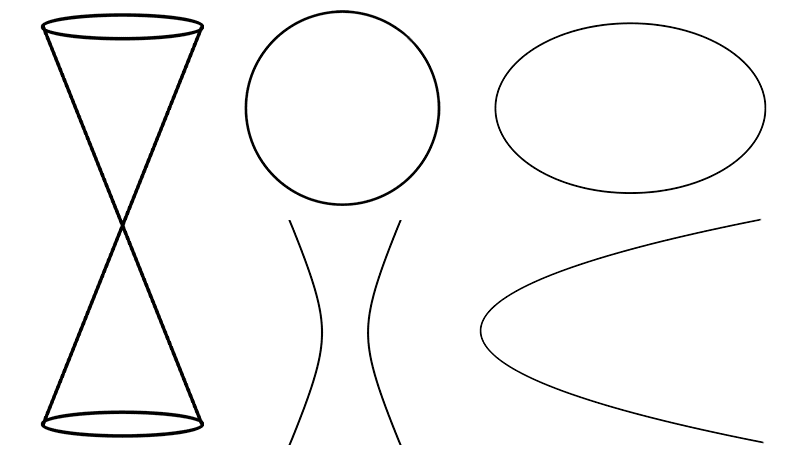
Conic Sections Practice Problems with Solutions
In this article, we will go through conic sections practice problems in Analytic Geometry with step-by-step solutions for all skill levels. If you are not yet familiar with the theory behind each conic, we recommend reviewing the following articles first:
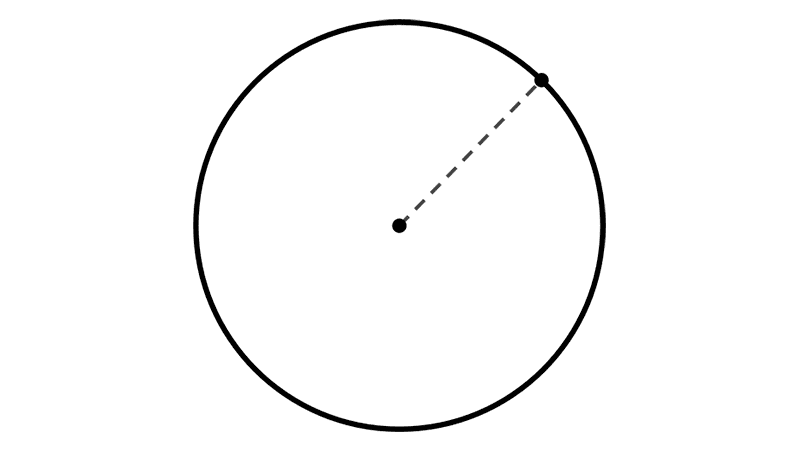
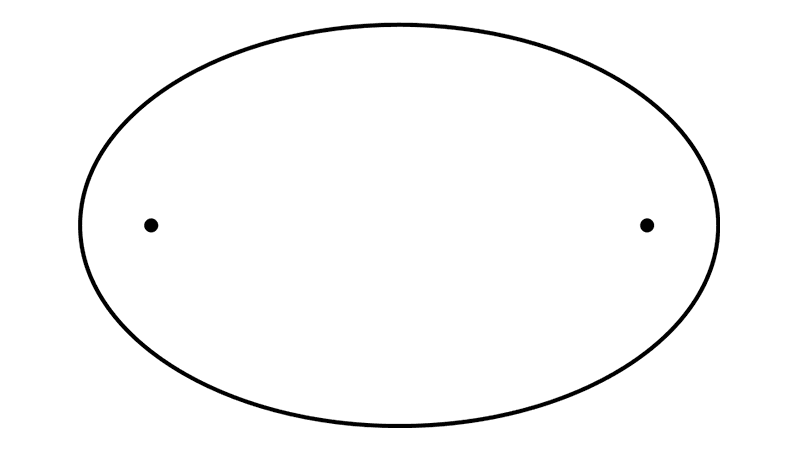
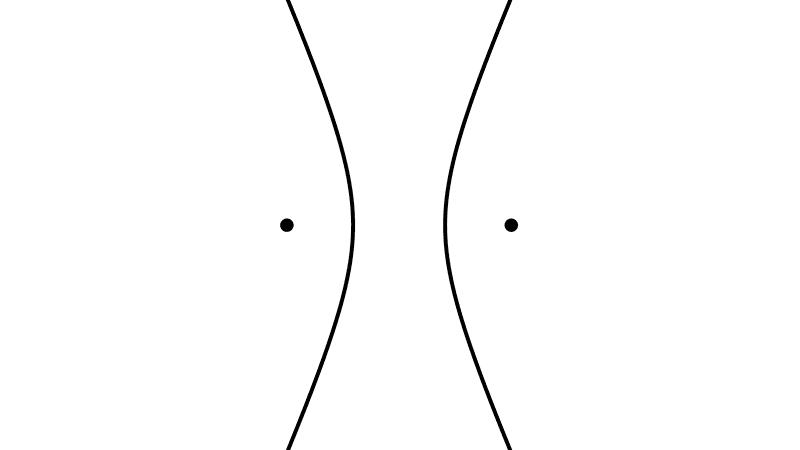
Table of Contents
Practice Problems by Conic Section
The following articles contain worked problems for each specific conic section.
Circle
Problem 1: Find the standard form equation of the circle that satisfies the given conditions in each case, and sketch its graph.
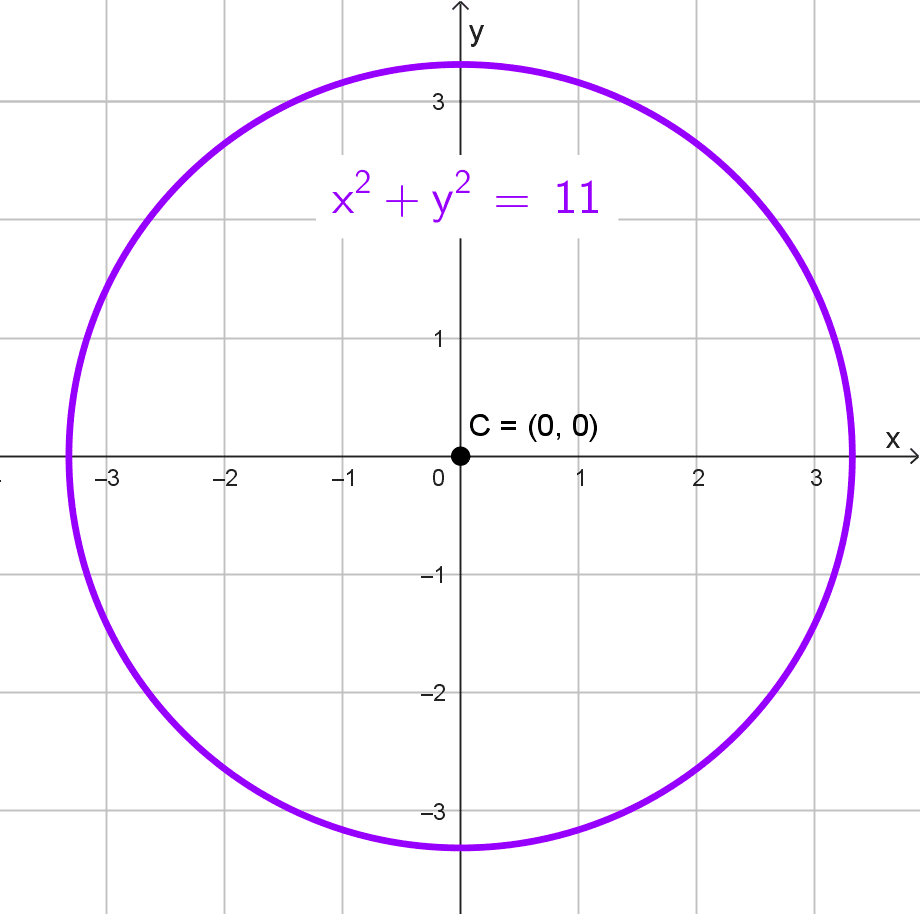
- Center at the origin and diameter 2√11.
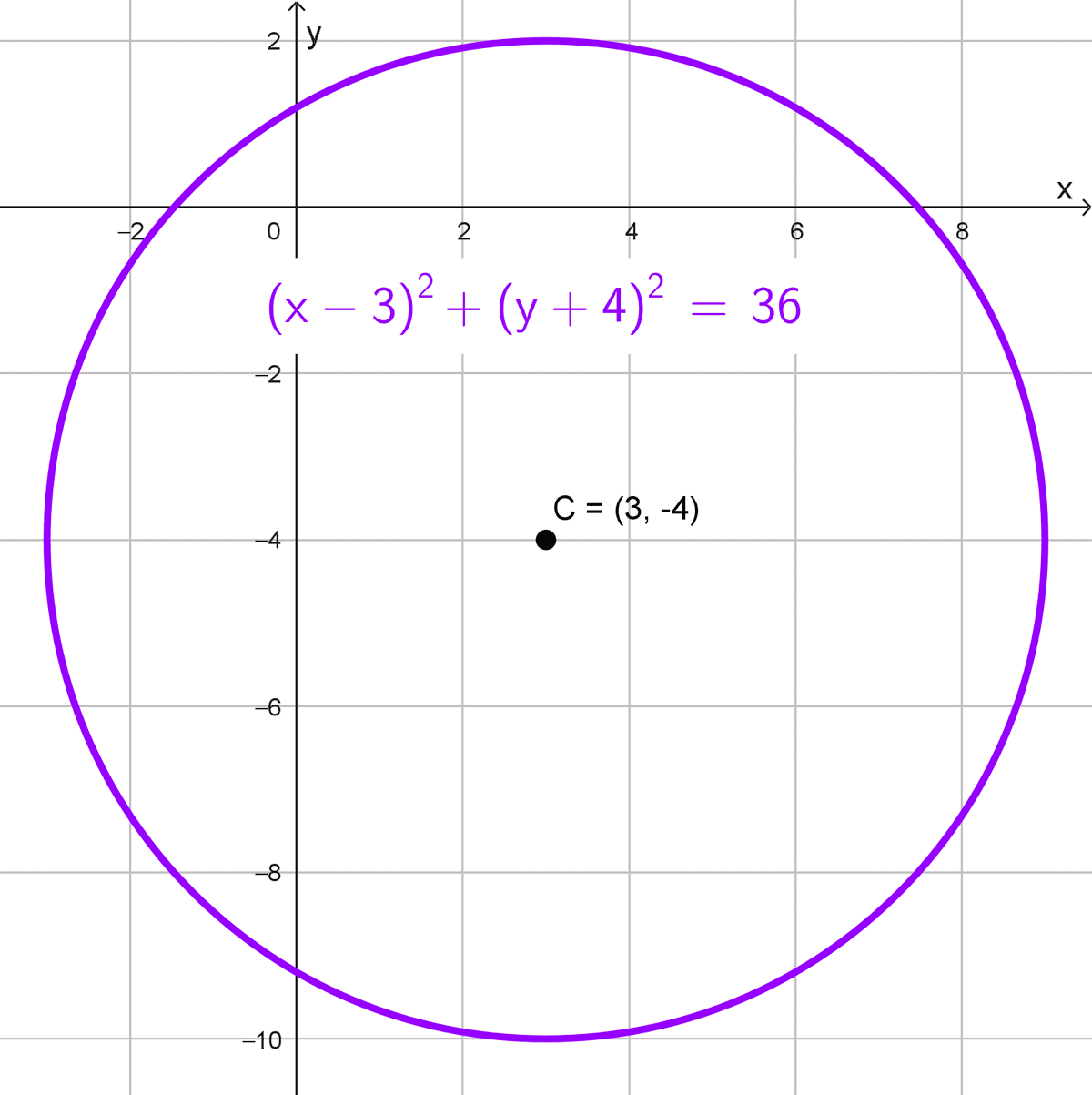
- Center (3, -4), radius 6.
Solutions
Solution 1
The standard equation of a circle centered at the origin (0, 0) is \(x^2+y^2=r^2,\) where r is the radius. Since the diameter is \(2\sqrt{11},\) the radius is half of this value:
$$r=\dfrac{2\sqrt{11}}{2}=\sqrt{11}$$
Substituting into the equation, we get:
$$x^2+y^2=(\sqrt{11})^2 → x^2+y^2=11$$
Solution 2
For a circle with center at \((h, k)=(3,-4)\) and radius \(r=6,\) the standard equation is:
$$(x-h)^2+(y-k)^2=r^2$$
Substituting the given values:
$$(x-3)^2+(y+4)^2=6^2$$
$$(x-3)^2+(y+4)^2=36$$
These problems and solutions were taken from our circle practice problems article.
Ellipse
Problem 2: Given the following data, find the standard form equation of each ellipse, all its key features, and sketch its graph.
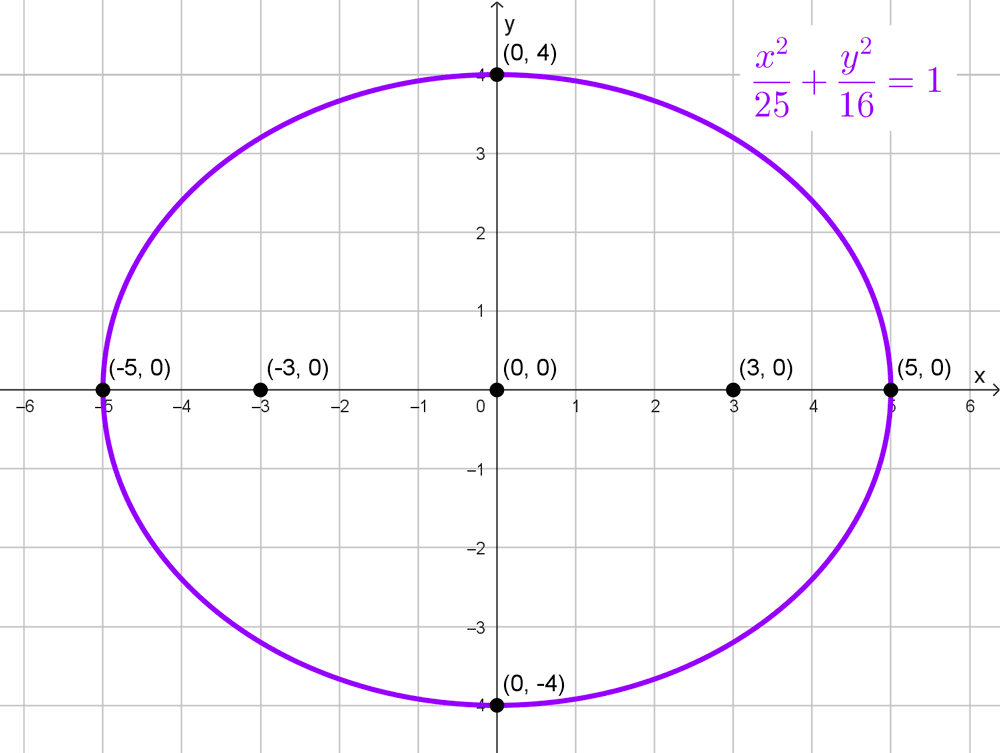
- Center at the origin, focus at (0, 3), and semi-major axis equal to 5.
- Major axis along the y-axis, vertex at (0, 5), co-vertex at (3, 0), and center at the origin.
Solutions
Solution 1
Given values:
- Center: (0, 0)
- Focus: (0, 3)
- Semi-major axis: a = 5
Since the center and focus lie on the y-axis, this is a vertical ellipse, which means its standard equation is of the form:
$$\dfrac{x^2}{b^2}+\dfrac{y^2}{a^2}=1$$
We know one semi-axis; we can determine the other using the relationship between \(a, b,\) and \(c\). First, we find the semi-focal distance \(c,\) which is the distance between the center and the focus; in this case, \(c = 3\).
Now, we apply the relationship for an ellipse:
$$c^2=a^2-b^2→b^2=a^2-c^2$$
Thus:
$$b^2=5^2-3^2=25-9=16$$
With these values, we can write the standard form equation of the ellipse:
$$\dfrac{x^2}{16}+\dfrac{y^2}{25}=1$$
Knowing the values of \(a, b,\) and \(c,\) we can determine all other features of the ellipse.
Key Features of the Ellipse:
- Foci: (0, 3) and (0, -3)
- Center: (0, 0)
- Semi-axes: a = 5, b = 4
- Focal distance: 2c = 6
- Vertices: (0, 5) and (0, -5)
- Co-vertices: (4, 0) and (-4, 0)
- Latus rectum: \(L_R=\dfrac{2b^2}{a}=\dfrac{2\cdot 16}{5}=6.4\)
- Eccentricity: \(e=\dfrac{c}{a}=\dfrac{3}{5}=0.6\)
Solution 2
Given values:
- Center: (0, 0)
- Vertex: (0, 5)
- Co-vertex: (3, 0)
- Major axis along the y-axis.
The major axis lies on the y-axis, so the standard equation of the ellipse is:
$$\dfrac{x^2}{b^2}+\dfrac{y^2}{a^2}=1$$
where \(a\) is the semi-major axis and \(b\) is the semi-minor axis.
The vertex at (0, 5) indicates that the length of the semi-major axis is \(a = 5\).
The co-vertex at (3, 0) indicates that the length of the semi-minor axis is \(b = 3\).
We use the fundamental relationship for ellipses:
$$c^2=a^2-b^2$$
Substituting the values:
$$c^2=5^2-3^2=25-9=16$$
Therefore:
$$c=\sqrt{16}=4$$
With \(a^2=25\) and \(b^2=9,\) the standard equation of the ellipse is:
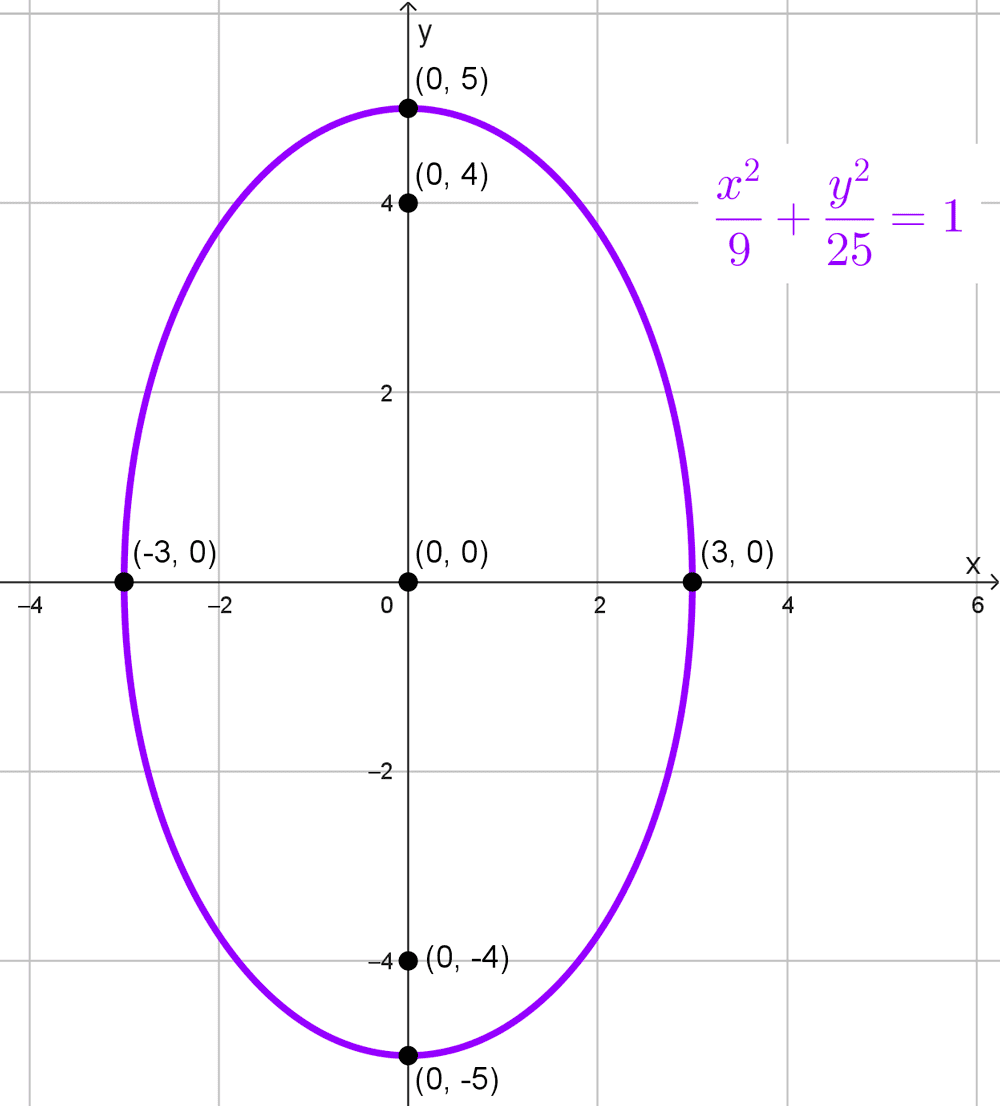
$$\dfrac{x^2}{9}+\dfrac{y^2}{25}=1$$
Key Features of the Ellipse:
- Center: (0, 0)
- Foci: (0, 4) and (0, -4), since c = 4 and they lie on the y-axis.
- Semi-axes: a = 5, b = 3
- Vertices: (0, 5) and (0, -5)
- Co-vertices: (3, 0) and (-3, 0)
- Focal distance: 2c = 8
- Latus rectum: \(L_R=\dfrac{2b^2}{a}=\dfrac{2\cdot9}{5}=\dfrac{18}{5}=3.6\)
- Eccentricity: \(e=\dfrac{c}{a}=\dfrac{4}{5}=0.8\)
These problems and solutions were taken from our ellipse practice problems article.
Hyperbola
Problem 3: Find the standard equations of the hyperbolas that satisfy the given conditions, identify all their key features, and sketch their graphs.
- C(4, -1); focus at (7, -1); vertex at (6, -1).
- Foci at (3, 7) and (7, 7); vertex at (6, 7).
Solution 1
Given Data:
- Center of the hyperbola: C (4, -1)
- Focus: (7, -1)
- Vertex: (6, -1)
We observe that the center, focus, and vertex all share the same y-coordinate, which indicates that the hyperbola is horizontally oriented. Therefore, the standard equation of the hyperbola is:
$$\dfrac{(x-h)^2}{a^2}-\dfrac{(y-k)^2}{b^2}=1$$
where \((h, k)\) is the center of the hyperbola.
The center is C (4, -1), so \(h=4\) and \(k=-1\).
The distance between the center and the vertex is \(a\). Since the vertex is (6, -1):
$$a=6-4=2$$
The distance between the center and the focus is \(c\). Since the focus is (7, -1):
$$c=7-4=3$$
For a hyperbola, the relation between the parameters is:
$$c^2=a^2+b^2$$
Substituting the known values:
$$3^2=2^2+b^2 → 9=4+b^2 → b^2=5 → b=\sqrt{5}$$
Substituting \(h, k, a,\) and \(b\) into the equation:
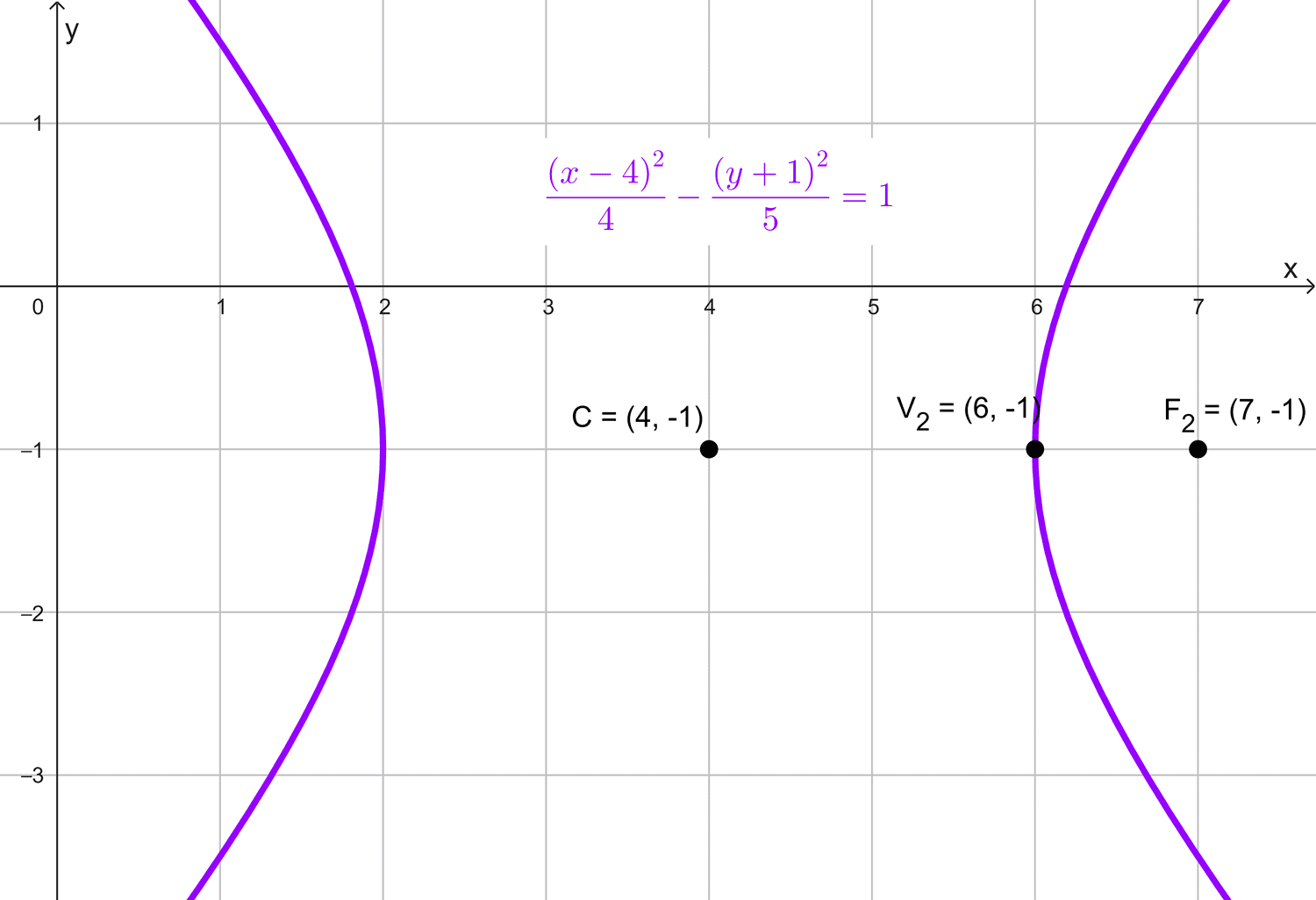
$$\dfrac{(x-4)^2}{4}-\dfrac{(y+1)^2}{5}=1$$
For a horizontal hyperbola, the equations of the asymptotes are:
$$y-k=\pm \dfrac{b}{a}(x-h)$$
Substituting the values:
$$y+1=\pm \dfrac{\sqrt{5}}{2}(x-4)$$
The eccentricity \(e\) of a hyperbola is given by:
$$e=\dfrac{c}{a}$$
Substituting the known values:
$$e=\dfrac{3}{2}=1.5$$
The length of the latus rectum \(L_R\) is calculated as:
$$L_R=\dfrac{2b^2}{a}$$
Substituting the known values:
$$L_R=\dfrac{2 \cdot 5}{2}=5$$
Key Features of the Hyperbola:
- Center: (4, -1)
- Foci: (7, -1) and (1, -1)
- Vertices: (6, -1) and (2, -1)
- Semi-transverse axis: \(a=2\)
- Semi-conjugate axis: \(b=\sqrt{5}\)
- Asymptotes: \(y+1=\pm \dfrac{\sqrt{5}}{2}(x-4)\)
- Eccentricity: \(e=1.5\)
- Latus rectum: \(L_R=5\)
Equation: \(\dfrac{(x-4)^2}{4}-\dfrac{(y+1)^2}{5}=1\)
Solution 2
Given Data:
- Foci: (3, 7) and (7, 7)
- Vertex: (6, 7)
We observe that both foci and the vertex share the same y-coordinate (\(y = 7\)), which indicates that the hyperbola is horizontally oriented. Therefore, its standard equation is:
$$\dfrac{(x-h)^2}{a^2}-\dfrac{(y-k)^2}{b^2}=1$$
where \((h, k)\) is the center of the hyperbola.
The center is the midpoint between the foci. Given the foci (3, 7) and (7, 7), the center is calculated as:
$$h=\dfrac{3+7}{2}=5, \quad k=\dfrac{7+7}{2}=7$$
Thus, the center is C (5, 7).
The distance between the center and the vertex is \(a\). With vertex (6, 7) and center (5, 7):
$$a=6-5=1$$
The distance between the center and one of the foci is \(c\). With focus (7, 7) and center (5, 7):
$$c=7-5=2$$
For a hyperbola, \(c^2=a^2+b^2.\) Substituting the known values:
$$2^2=1^2+b^2 → 4=1+b^2 → b^2=3 → b=\sqrt{3}$$
Substituting \(h=5, k=7, a=1,\) and \(b=\sqrt{3}\) into the equation, we obtain:
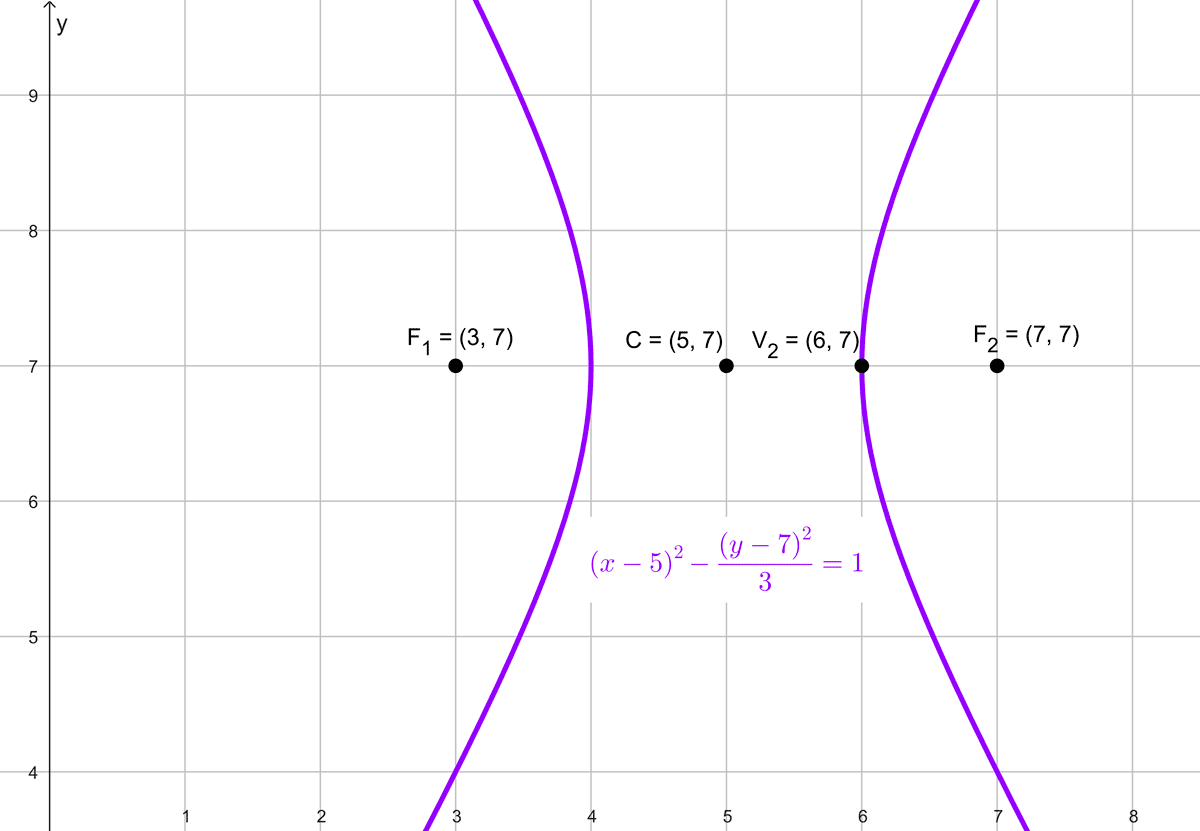
$$\dfrac{(x-5)^2}{1}-\dfrac{(y-7)^2}{3}=1$$
Simplifying, the equation becomes:
$$(x-5)^2-\dfrac{(y-7)^2}{3}=1$$
For a horizontal hyperbola, the equations of the asymptotes are:
$$y-k=\pm \dfrac{b}{a}(x-h)$$
Substituting the known values:
$$y-7=\pm \dfrac{\sqrt{3}}{1}(x-5) → y-7=\pm \sqrt{3}(x-5)$$
The eccentricity of the hyperbola is:
$$e=\dfrac{c}{a}=\dfrac{2}{1}=2$$
The length of the latus rectum is:
$$L_R=\dfrac{2b^2}{a}=\dfrac{2 \cdot 3}{1}=6$$
Key Features of the Hyperbola:
- Center: (5, 7)
- Foci: (7, 7) and (3, 7)
- Vertices: (6, 7) and (4, 7)
- Semi-transverse axis: \(a=1\)
- Semi-conjugate axis: \(b=\sqrt{3}\)
- Asymptotes: \(y-7=\pm \sqrt{3}(x-5)\)
- Eccentricity: \(e=2\)
- Latus rectum: \(L_R=6\)
Equation: \((x-5)^2-\dfrac{(y-7)^2}{3}=1\)
These problems and solutions were taken from our hyperbola practice problems article.
Parabola
Problem 4: Find the standard equations of the parabolas from the given data and sketch their graphs:
- Vertex at (3, 1) and focus at (3, -1).
- V(-4, 3) and F(-1, 3).
Solutions
Solution 1
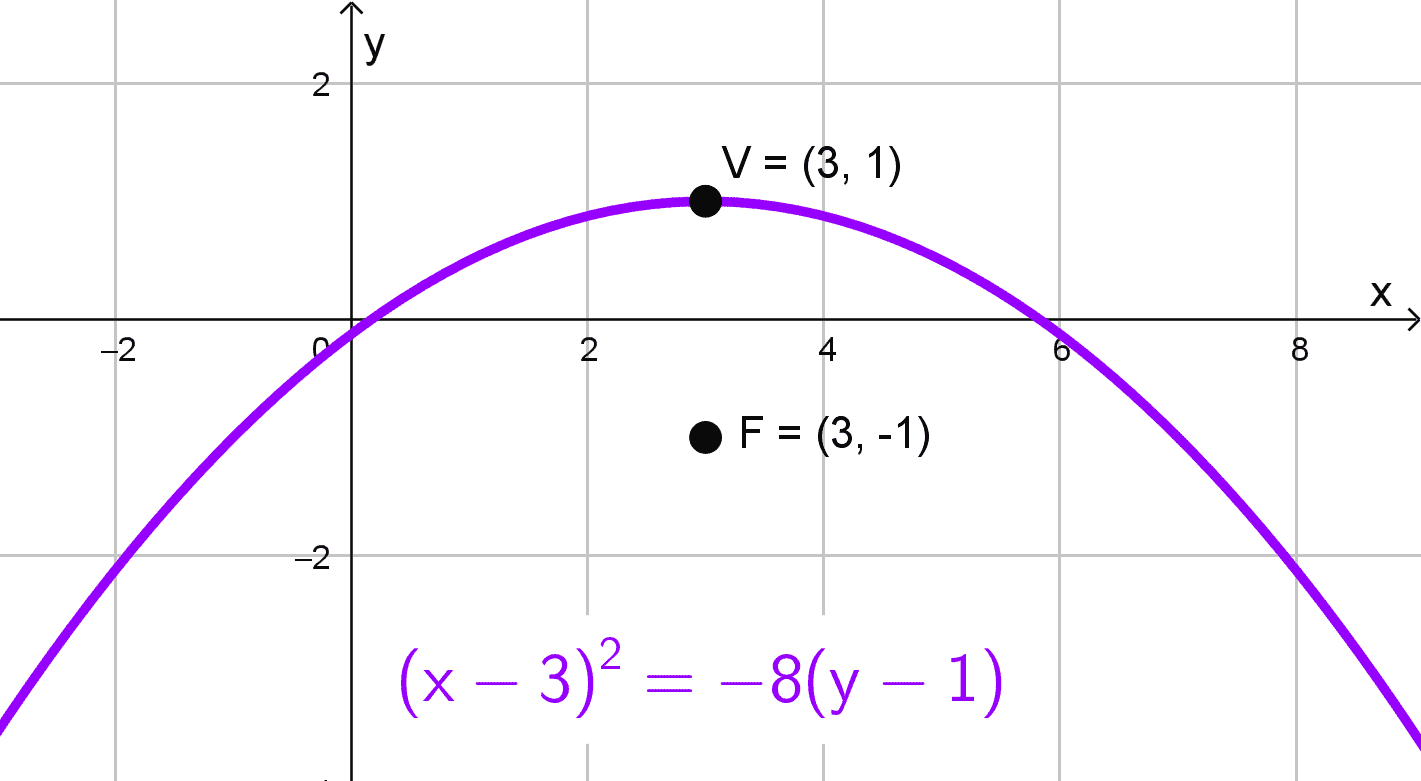
First, identify the coordinates of the vertex \(V(3, 1)\) and focus \(F(3, -1)\). Both points share the same x-coordinate, which means the axis of symmetry is vertical. We calculate the parameter \(p\) as the difference between the y-coordinates of the focus and the vertex:
$$p=-1-1=-2$$
Since \(p\) is negative, the parabola opens downward (which is also evident because the focus lies below the vertex). Using the standard form for a vertical parabola:
$$(x-h)^2=4p (y-k)$$
where \((h, k)\) is the vertex, we substitute the known values:
$$(x-3)^2=4 (-2)(y-1)$$
Simplifying, we obtain the equation:
$$(x-3)^2=-8 (y-1)$$
Solution 2
Here, the vertex is at \(V (-4, 3)\) and the focus is at \(F (-1, 3)\). Both points have the same y-coordinate, so the axis of symmetry is horizontal. We determine the parameter \(p\) as the difference between the x-coordinates of the focus and vertex:
$$p=-1-(-4)=3$$
Since \(p\) is positive, the parabola opens to the right. The standard form for a horizontal parabola is:
$$(y-k)^2=4p (x-h)$$
Substituting the given coordinates:
$$(y-3)^2=4 (3)(x-(-4))$$
Simplifying, we arrive at:
$$(y-3)^2=12 (x+4)$$
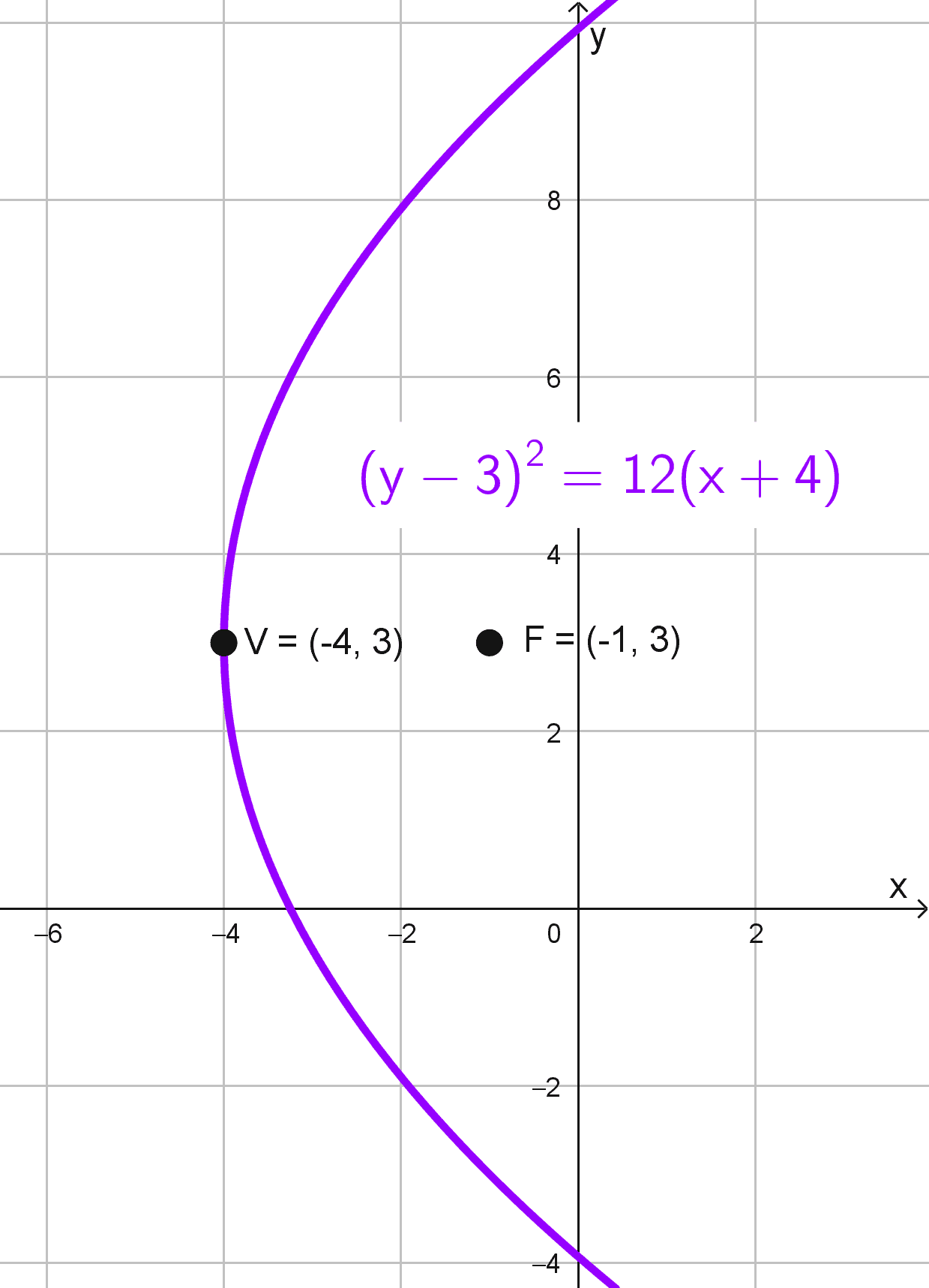
These problems and solutions were taken from our parabola practice problems article.
Identifying Conic Sections from General Form Equations
Problem 5: Analyze the following equations and determine which type of conic section each represents, or if it represents no real geometric locus:
- \(x^2+y^2-2x-2y=0\)
- \(5x^2-2y^2-10x+8y-13=0\)
- \(y^2+9x+9=0\)
- \(x^2+y^2+4x+5=0\)
- \(16x^2+9y^2-64x-54y+1=0\)
- \(-7x^2+12y^2+28x+72y-4=0\)
- \(x^2+y^2-6x-8y+40=0\)
- \(x^2+6x-8y+41=0\)
Resource: If you are working through practice problems and want to verify your results, you can use our free tool:
Solutions
Solution 1
We begin by analyzing the equation \(x^2+y^2-2x-2y=0.\) It contains quadratic terms in both \(x\) and \(y\) with equal coefficients for \(x^2\) and \(y^2,\) suggesting a circle. To confirm, we complete the square for both variables.
Group the \(x\) and \(y\) terms:
$$x^2-2x+y^2-2y=0$$
Complete the square for \(x\):
$$x^2-2x=(x^2-2x+1)-1=(x-1)^2-1$$
Do the same for \(y\):
$$y^2-2y=(y^2-2y+1)-1=(y-1)^2-1$$
Substitute back into the equation:
$$(x-1)^2-1+(y-1)^2-1=0$$
Simplify by combining the constants:
$$(x-1)^2+(y-1)^2-2=0 → (x-1)^2+(y-1)^2=2$$
This is the standard equation of a circle centered at \((1, 1)\) with radius \(\sqrt{2}.\) Therefore, this equation represents a real circle.
Solution 2
Analyze the equation \(5x^2-2y^2-10x+8y-13=0.\) It contains quadratic terms in \(x\) and \(y\) with opposite signs (\(5\) and \(-2\)), suggesting a hyperbola. We complete the square to verify.
Group the \(x\) and \(y\) terms:
$$5x^2-10x-2y^2+8y=13$$
Factor out the leading coefficients of \(x^2\) and \(y^2\):
$$5(x^2-2x)-2(y^2-4y)=13$$
Complete the square for \(x\):
$$x^2-2x=(x^2-2x+1)-1=(x-1)^2-1$$
For \(y\):
$$y^2-4y=(y^2-4y+4)-4=(y-2)^2-4$$
Substitute into the equation:
$$5[(x-1)^2-1]-2[(y-2)^2-4]=13$$
Simplify:
$$5(x-1)^2-5-2(y-2)^2+8=13$$
$$5(x-1)^2-2(y-2)^2+3=13$$
$$5(x-1)^2-2(y-2)^2=10$$
Divide the entire equation by 10 to obtain standard form:
$$\dfrac{(x-1)^2}{2}-\dfrac{(y-2)^2}{5}=1$$
This is the standard equation of a hyperbola centered at \((1, 2),\) with a horizontal transverse axis parallel to the x-axis, where \(a^2=2\) and \(b^2=5\).
Solution 3
Examine the equation \(y^2+9x+9=0.\) Notice there is only one squared term (\(y^2\)) and a linear term in \(x,\) which indicates a parabola. Rearrange into standard form:
$$y^2=-9x-9$$
$$y^2=-9(x+1)$$
This represents a horizontal parabola opening to the left, with vertex at \((-1, 0)\) and parameter \(p=-\dfrac{9}{4}\).
Solution 4
Analyze the equation \(x^2+y^2+4x+5=0.\) It contains squared terms in \(x\) and \(y\) with equal coefficients (both 1), suggesting a circle. We complete the square for \(x\) (there is no linear term in \(y\)):
Group terms in \(x\):
$$x^2+4x+y^2=-5$$
Complete the square for \(x\):
$$x^2+4x=(x^2+4x+4)-4=(x+2)^2-4$$
Substitute into the equation:
$$(x+2)^2-4+y^2=-5$$
$$(x+2)^2+y^2=-1$$
This equation states that the sum of two real squares equals \(-1,\) which is impossible in the real number system. Therefore, the equation represents no real geometric locus.
Solution 5
Examine the equation \(16x^2+9y^2-64x-54y+1=0.\) The coefficients of \(x^2\) and \(y^2\) are positive and unequal, which suggests an ellipse. We complete the square:
Group the \(x\) and \(y\) terms:
$$16x^2-64x+9y^2-54y=-1$$
Factor out the coefficients:
$$16(x^2-4x)+9(y^2-6y)=-1$$
Complete the square for \(x\):
$$x^2-4x=(x^2-4x+4)-4=(x-2)^2-4$$
For \(y\):
$$y^2-6y=(y^2-6y+9)-9=(y-3)^2-9$$
Substitute back into the equation:
$$16[(x-2)^2-4]+9[(y-3)^2-9]=-1$$
$$16(x-2)^2-64+9(y-3)^2-81=-1$$
$$16(x-2)^2+9(y-3)^2-145=-1$$
$$16(x-2)^2+9(y-3)^2=144$$
Divide by 144 to obtain standard form:
$$\dfrac{(x-2)^2}{9}+\dfrac{(y-3)^2}{16}=1$$
This is the standard equation of a vertical ellipse centered at \((2, 3),\) with semi-major axis \(a=4\) (parallel to the y-axis) and semi-minor axis \(b=3\).
Solution 6
Analyze the equation \(-7x^2+12y^2+28x+72y-4=0.\) The quadratic terms have coefficients with opposite signs, indicating a hyperbola. We complete the square:
Rearrange the terms:
$$-7x^2+28x+12y^2+72y=4$$
Factor out the coefficients:
$$-7(x^2-4x)+12(y^2+6y)=4$$
Complete the square for \(x\):
$$x^2-4x=(x^2-4x+4)-4=(x-2)^2-4$$
For \(y\):
$$y^2+6y=(y^2+6y+9)-9=(y+3)^2-9$$
Substitute back into the equation:
$$-7[(x-2)^2-4]+12[(y+3)^2-9]=4$$
$$-7(x-2)^2+28+12(y+3)^2-108=4$$
$$-7(x-2)^2+12(y+3)^2-80=4$$
$$-7(x-2)^2+12(y+3)^2=84$$
Divide by 84 and rearrange:
$$\dfrac{(y+3)^2}{7}-\dfrac{(x-2)^2}{12}=1$$
This is the standard equation of a hyperbola centered at \((2, -3),\) with a vertical transverse axis parallel to the y-axis, where \(a^2=7\) and \(b^2=12\).
Solution 7
Analyze the equation \(x^2+y^2-6x-8y+40=0.\) The squared terms have equal coefficients (1 for \(x^2\) and \(y^2\)), suggesting a potential circle. We complete the square for both variables:
Group the \(x\) and \(y\) terms:
$$x^2-6x+y^2-8y=-40$$
Complete the square for \(x\):
$$x^2-6x=(x^2-6x+9)-9=(x-3)^2-9$$
For \(y\):
$$y^2-8y=(y^2-8y+16)-16=(y-4)^2-16$$
Substitute into the equation:
$$(x-3)^2-9+(y-4)^2-16=-40$$
$$(x-3)^2+(y-4)^2-25=-40$$
$$(x-3)^2+(y-4)^2=-15$$
The sum of squares equals a negative number (-15), which has no solution in the real numbers. Therefore, this equation represents no real geometric locus.
Solution 8
Analyze the equation \(x^2+6x-8y+41=0.\) Since there is only one squared term (\(x^2\)) and a linear term in \(y,\) it represents a parabola. Rearrange the terms:
$$x^2+6x=8y-41$$
Complete the square for \(x\):
$$x^2+6x=(x^2+6x+9)-9=(x+3)^2-9$$
Substitute back:
$$(x+3)^2-9=8y-41$$
$$(x+3)^2=8y-32$$
$$(x+3)^2=8(y-4)$$
This is the standard equation of a parabola opening upward, with vertex at \((-3, 4)\) and focal parameter \(p=2\).
Did you find this useful? Rate it!
0.0 / 5 — 0 votes

HOW TO CITE THIS ARTICLE
Machado, D. (2026, October 27). Conic Sections Practice Problems with Solutions. Exponty. https://exponty.com/en/conic-sections-practice-problems
Leave a Reply
Related posts