
Parabola Practice Problems with Solutions
In this article, we present step-by-step solved parabola practice problems covering all educational levels. If you are not yet familiar with the fundamental concepts, we recommend reviewing our main guide first, where we cover the basic theory:
Table of Contents
Finding the Equation of a Parabola from Given Data
The following practice problems involve finding the standard or general equation of a parabola given specific geometric properties.
Vertex at the Origin
Problem 1: Find the equation of each parabola using the given information:
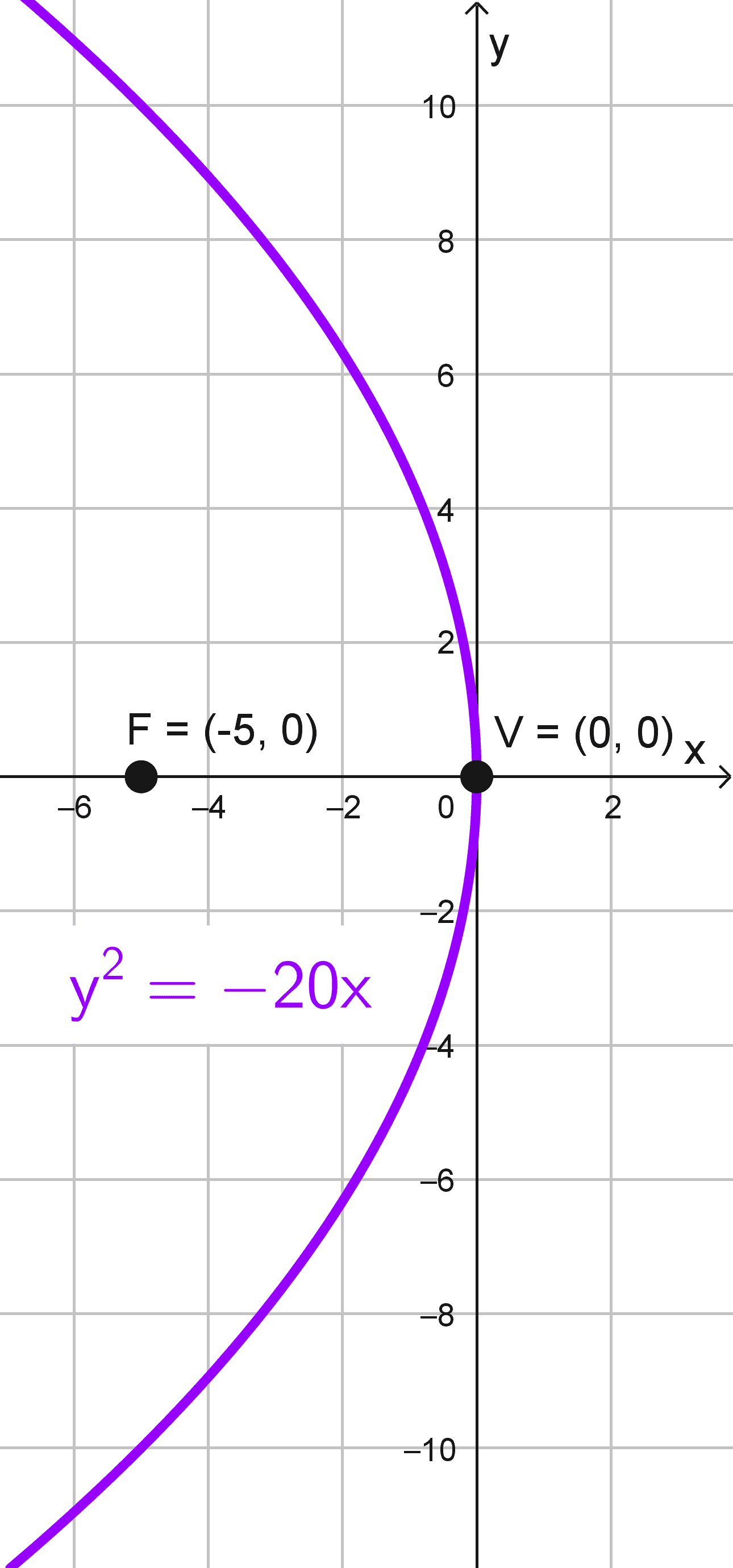
- Vertex at the origin and focus at (-5, 0).
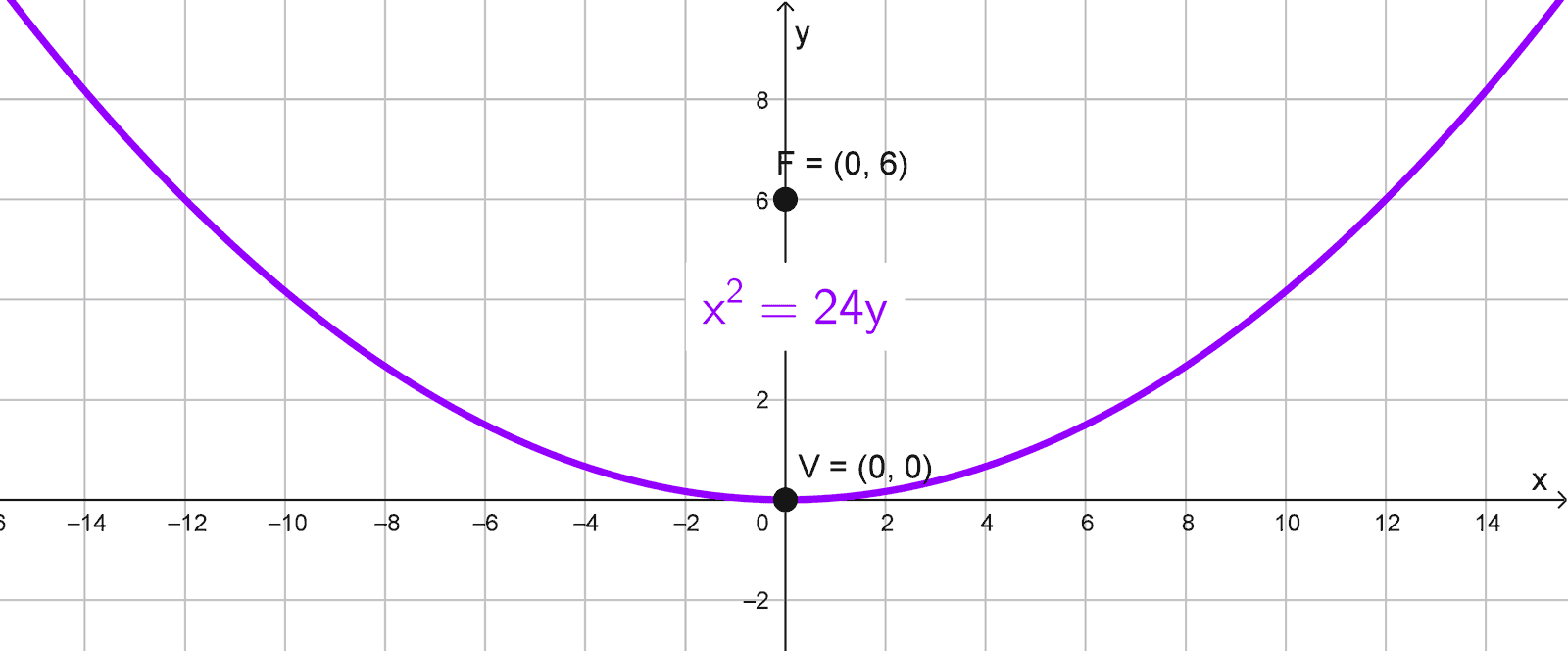
- V(0, 0) and F(0, 6).
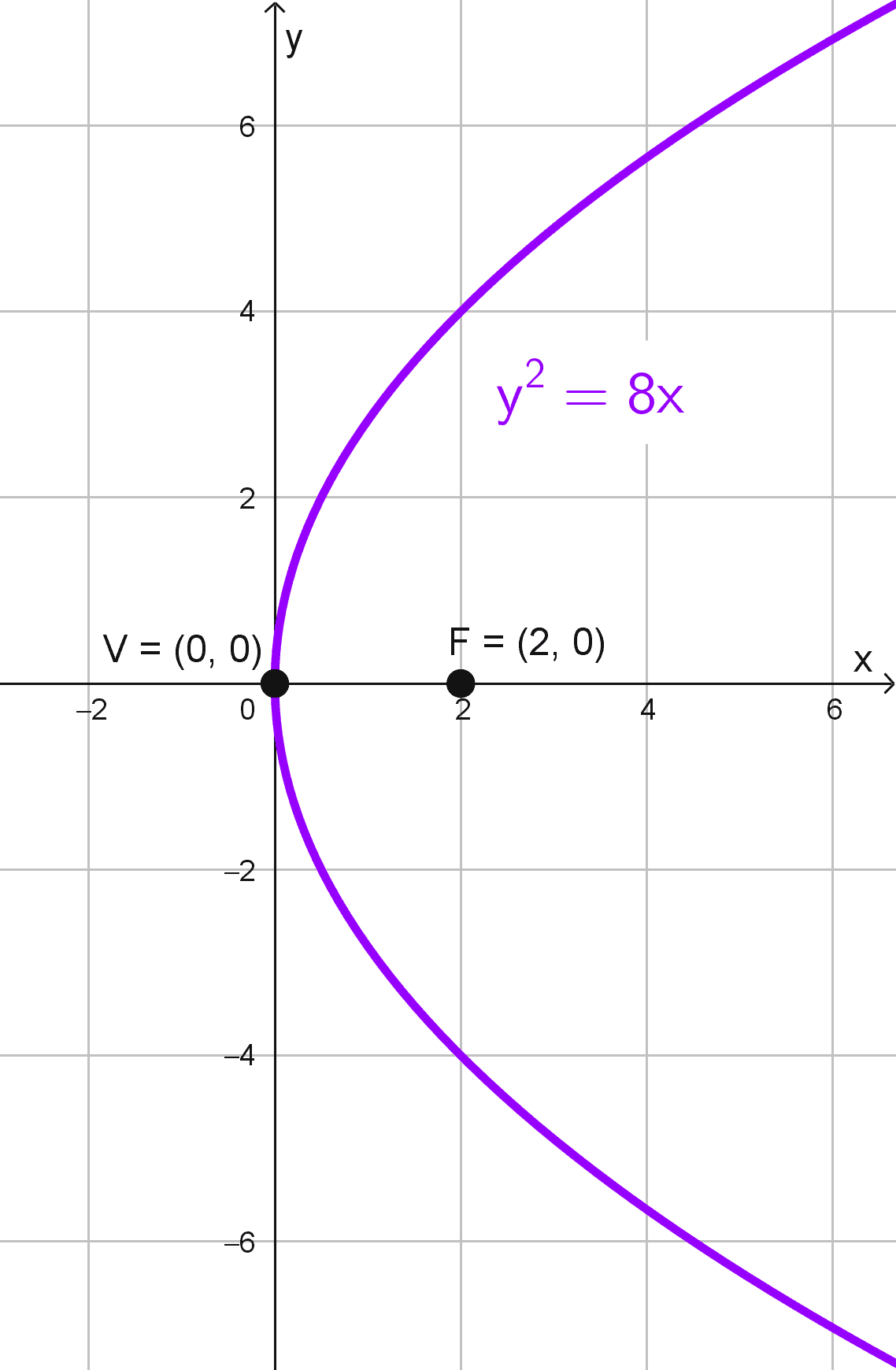
- Vertex at (0, 0) and focus at (2, 0).
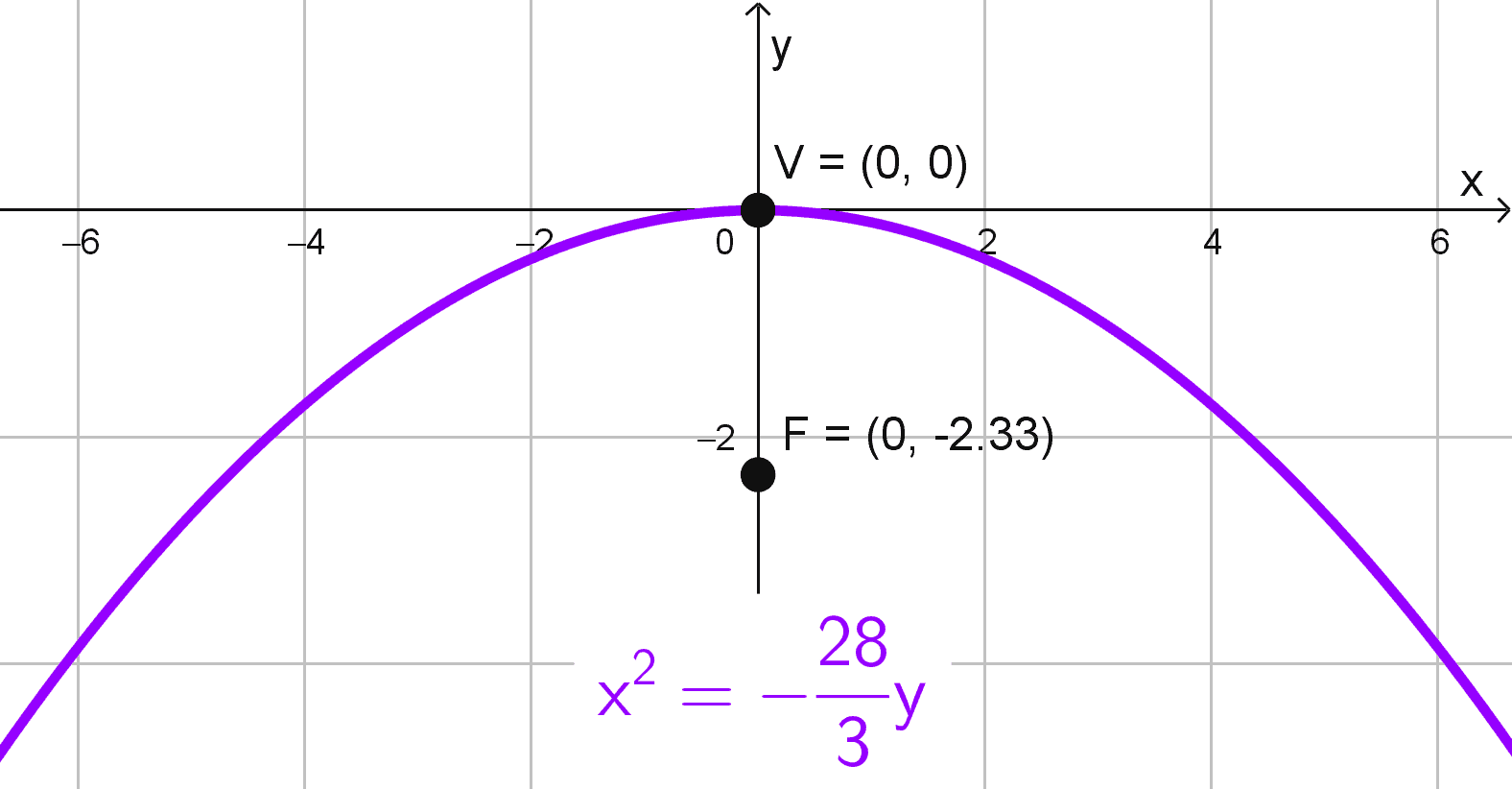
- Vertex at the origin and focus at (0, -7/3).
- Focus at (0, -1), directrix line y = 1.
- Vertex at (0, 0) and directrix line 2y - 5 = 0.
- Focus at (4/3, 0) and directrix line 3x + 4 = 0.
- Vertex at the origin, axis of symmetry along the x-axis, passing through the point (-2, 6).
Solutions
Solution 1
The vertex is at the origin (0, 0) and the focus is at (-5, 0). Since both points lie on the x-axis, the parabola opens horizontally, and its equation has the standard form \(y^2=4px.\) Given that the focus is at (-5, 0), the value of the parameter \(p\) is \(-5,\) as the focus of a horizontal parabola is located at (p, 0).
Substituting into the equation, we obtain:
$$y^2=4(-5)x → y^2=-20x$$
Solution 2
The vertex is at (0, 0) and the focus is at (0, 6). Because both points lie on the y-axis, the parabola opens vertically, and its equation follows the form \(x^2=4py.\) Since the focus is at (0, 6), we find that \(p=6,\) as the focus of a vertical parabola is at \((0, p)\).
Substituting into the equation, we get:
$$x^2=4(6)y → x^2=24y$$
Solution 3
With the vertex at (0, 0) and the focus at (2, 0), the parabola opens horizontally. Its standard equation is \(y^2=4px.\) Since the focus is at (2, 0), we have \(p=2.\)
Substituting, we find:
$$y^2=4(2)x → y^2=8x$$
Solution 4
The vertex is at (0, 0) and the focus is at (0, -7/3). Because it opens vertically, the equation of the parabola is \(x^2=4py.\) Since the focus is at \((0, -7/3),\) we find that \(p=-\dfrac{7}{3},\) as the focus of a vertical parabola is at \((0, p)\).
Substituting, we obtain:
$$x^2=4\left(-\dfrac{7}{3}\right)y → x^2=-\dfrac{28}{3}y$$
Solution 5
Since the directrix y = 1 is a horizontal line and the focus (0, -1) lies on the y-axis, the parabola has a vertical axis of symmetry and opens vertically.
The vertex is the midpoint between the focus and the directrix, which in this case is the origin (0, 0). The distance |p| is the distance from the vertex to the focus, so \(|p|=1.\) Since the focus lies below the vertex, the parameter p is negative, giving \(p=-1.\)
The standard equation of a vertical parabola with vertex at the origin is:
$$x^2=4py$$
Substituting \(p=-1,\) we get:
$$x^2=-4y$$

Solution 6
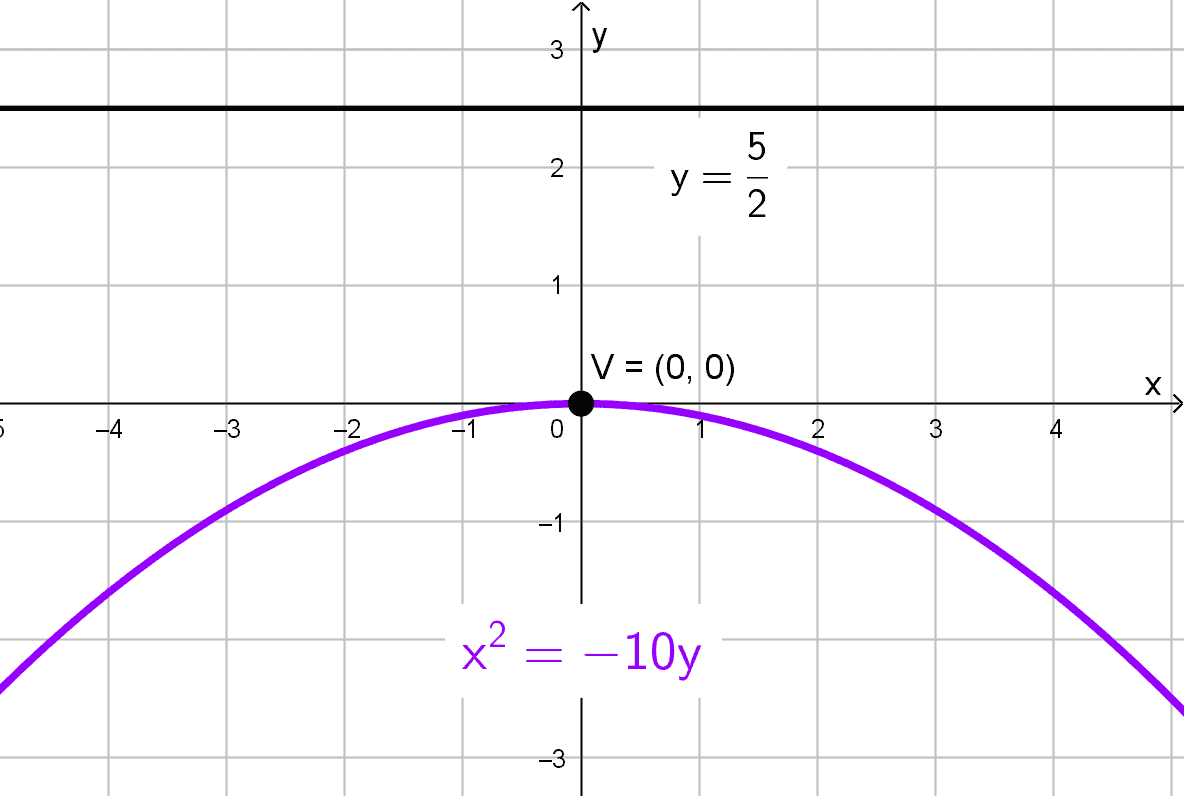
The vertex is at (0, 0) and the directrix is the line \(2y-5=0,\) which can be rewritten as \(y=\dfrac{5}{2}.\) Since the directrix is a horizontal line, the parabola opens vertically. The directrix equation is \(y=-p,\) so \(p=-5/2.\)
The standard equation of the parabola is:
$$x^2=4py$$
Substituting \(p=-\dfrac{5}{2},\) we find:
$$x^2=4\left(-\dfrac{5}{2}\right)y → x^2=-10y$$
Solution 7
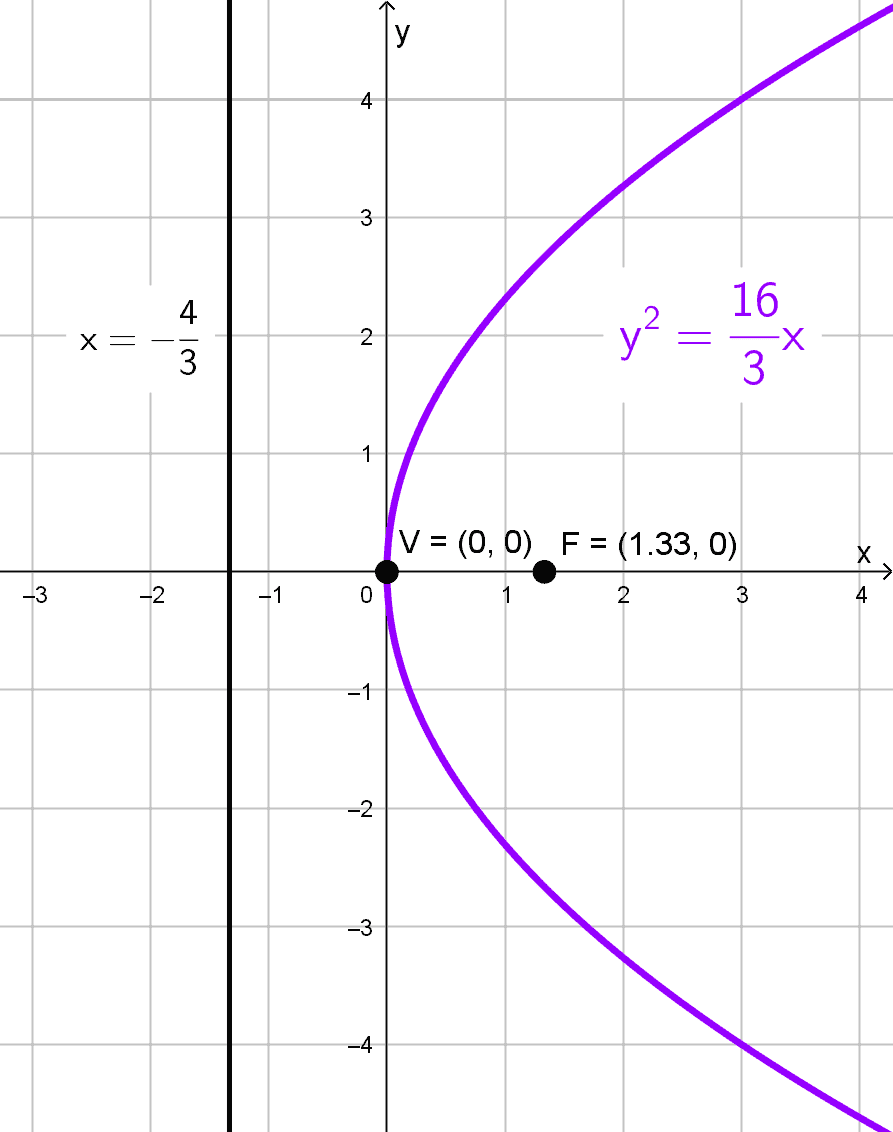
The focus is at \(\left (\dfrac{4}{3}, 0\right)\) and the directrix is the line \(3x+4=0,\) equivalent to \(x=-\dfrac{4}{3}.\) Because the directrix is a vertical line, the parabola opens horizontally.
The vertex is the midpoint between the focus and the directrix, which here is the origin (0, 0). The distance \(|p|\) is the distance from the vertex to the focus (or from the vertex to the directrix), meaning \(|p|=\dfrac{4}{3}.\) Since the focus lies to the right of the vertex, \(p\) is positive, so \(p=\dfrac{4}{3}.\)
The standard equation of a horizontal parabola with vertex at the origin is:
$$y^2=4px$$
Substituting \(p=\dfrac{4}{3},\) we obtain:
$$y^2=4\left(\dfrac{4}{3}\right)x → y^2=\dfrac{16}{3}x$$
Solution 8
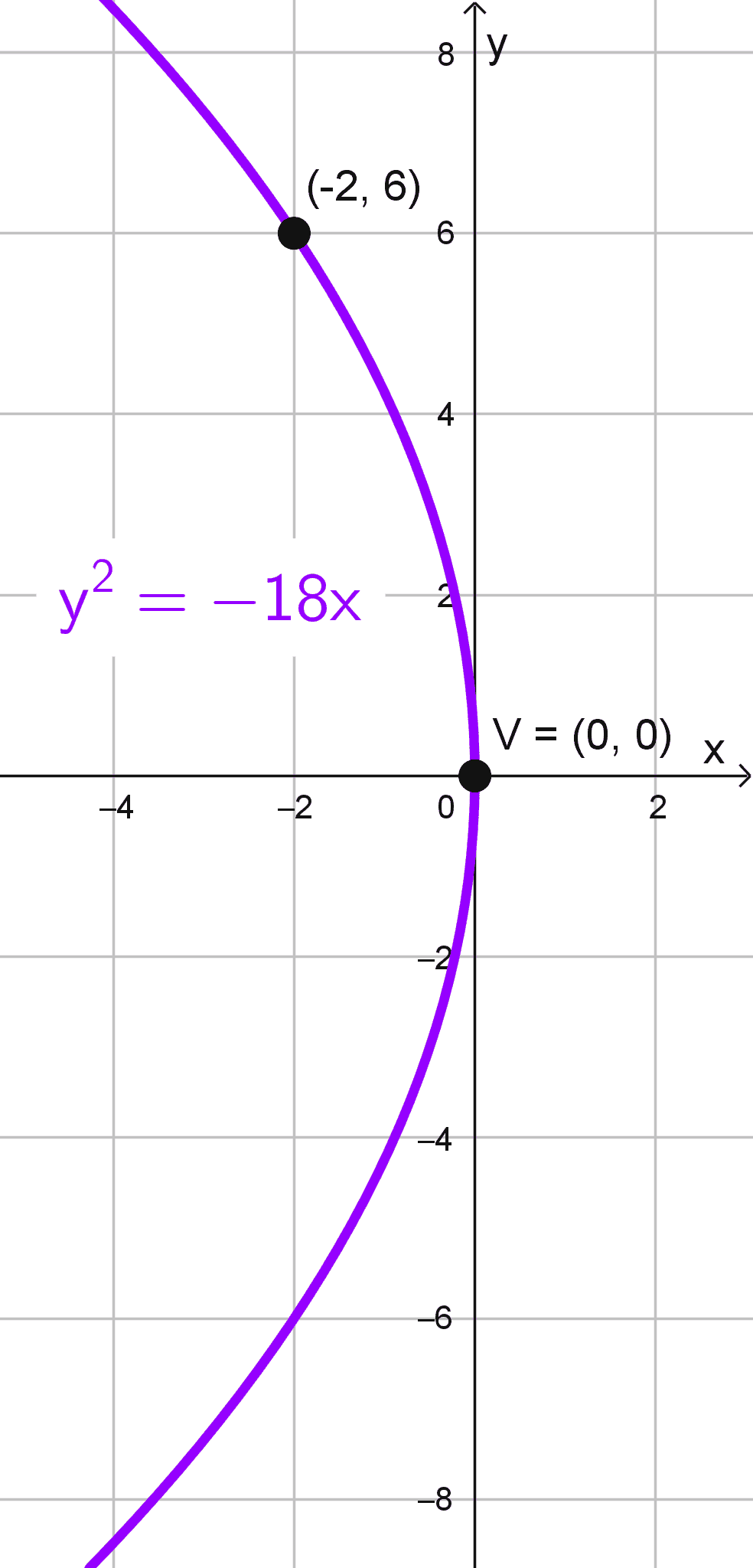
The vertex is at the origin (0, 0), its axis of symmetry coincides with the x-axis (meaning the parabola opens horizontally), and it passes through the point (-2, 6).
The standard equation of a horizontal parabola with vertex at the origin is:
$$y^2=4px$$
Substituting the point \((-2, 6)\) into the equation to solve for \(p:\)
$$6^2=4p(-2) → 36=-8p → p=-\dfrac{9}{2}$$
Finally, the equation of the parabola is:
$$y^2=4\left(-\dfrac{9}{2}\right)x → y^2=-18x$$
Vertex Away from the Origin
Problem 2: Determine the equation of each parabola given the following properties:
- Vertex at (3, 1) and focus at (3, -1).
- V(-4, 3) and F(-1, 3).
- Vertex at (3, 2) and focus at (5, 2).
- V(-3, -2) and F(-3, 1/3).
- Directrix line y - 1 = 0 and focus at (4, -3).
- F(7, 3) and directrix line y + 2 = 0.
- Vertex at (1, -3) and directrix line y + 5 = 0.
- Vertex at (-3, 5), length of the latus rectum is 24 units, and the axis of symmetry is parallel to the y-axis (two solutions).
Solutions
Solution 1
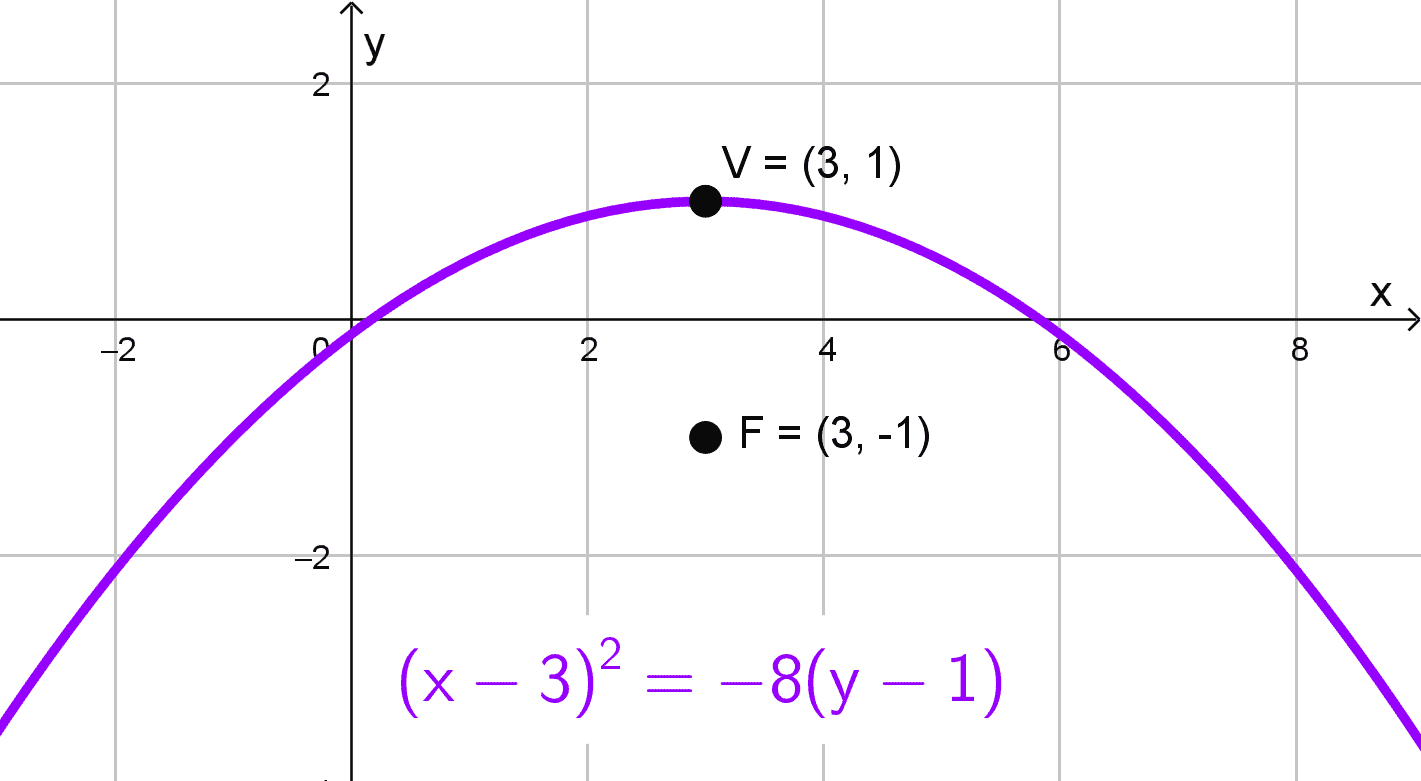
First, we identify the coordinates of the vertex V(3, 1) and the focus F(3, -1). Notice that both points share the same x-coordinate, which indicates that the axis of symmetry is vertical. We compute the parameter \(p\) as the difference between the y-coordinates of the focus and the vertex:
$$p=-1-1=-2$$
Since \(p\) is negative, the parabola opens downward. We can also see this because the focus lies below the vertex. Using the standard form of a parabola with a vertical axis:
$$(x-h)^2=4p(y-k)$$
where \((h, k)\) is the vertex, we substitute the known values:
$$(x-3)^2=4(-2)(y-1)$$
Simplifying, we obtain the equation:
$$(x-3)^2=-8(y-1)$$
Solution 2
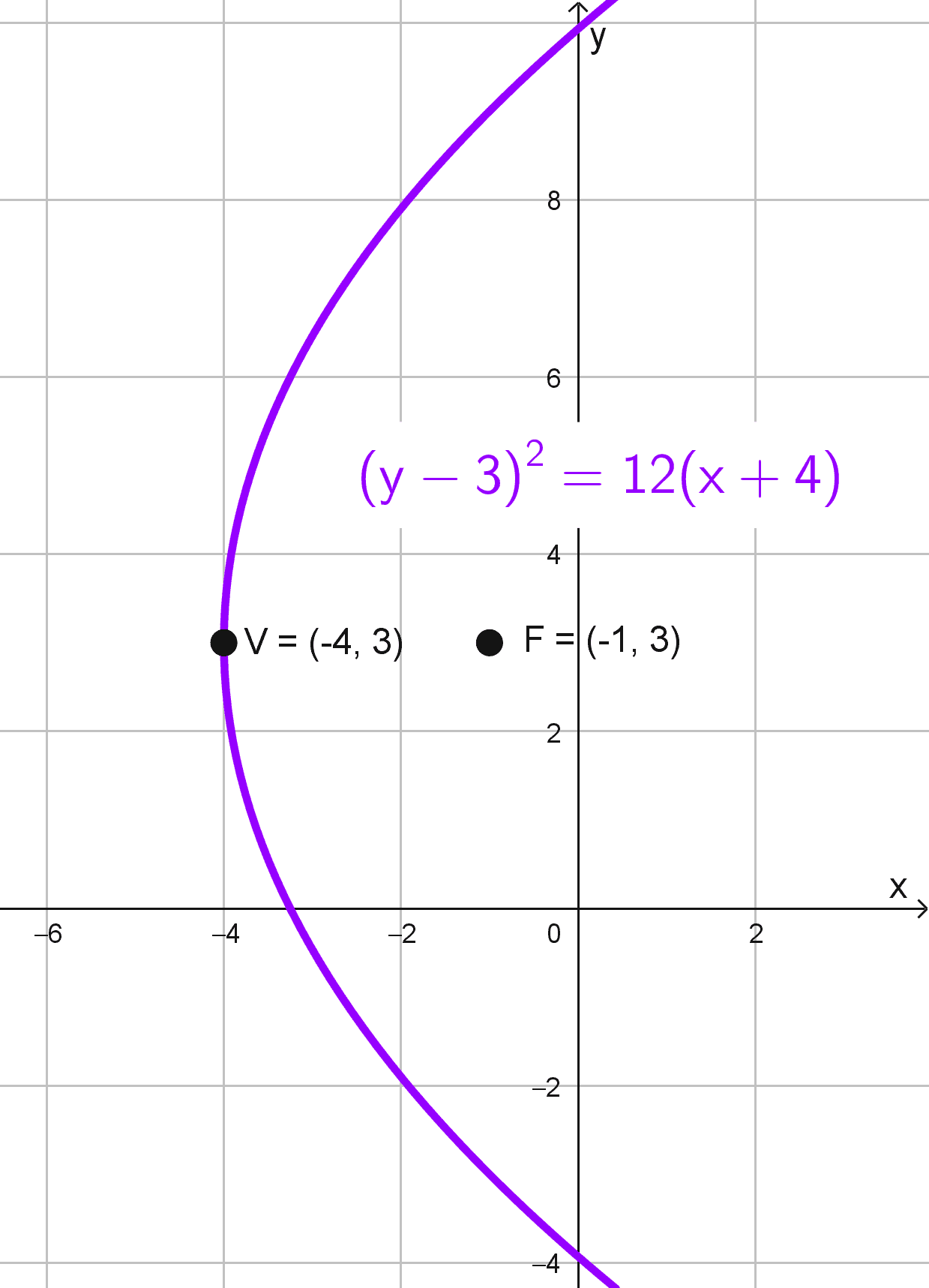
In this case, the vertex is at \(V(-4, 3)\) and the focus is at \(F(-1, 3).\) Both points have the same y-coordinate, so the axis of symmetry is horizontal. We find \(p\) as the difference between the x-coordinates of the focus and the vertex:
$$p=-1-(-4)=3$$
Because \(p\) is positive, the parabola opens to the right. The standard form for a parabola with a horizontal axis is:
$$(y-k)^2=4p(x-h)$$
Substituting the known values:
$$(y-3)^2=4(3)(x-(-4))$$
Simplifying gives:
$$(y-3)^2=12(x+4)$$
Solution 3
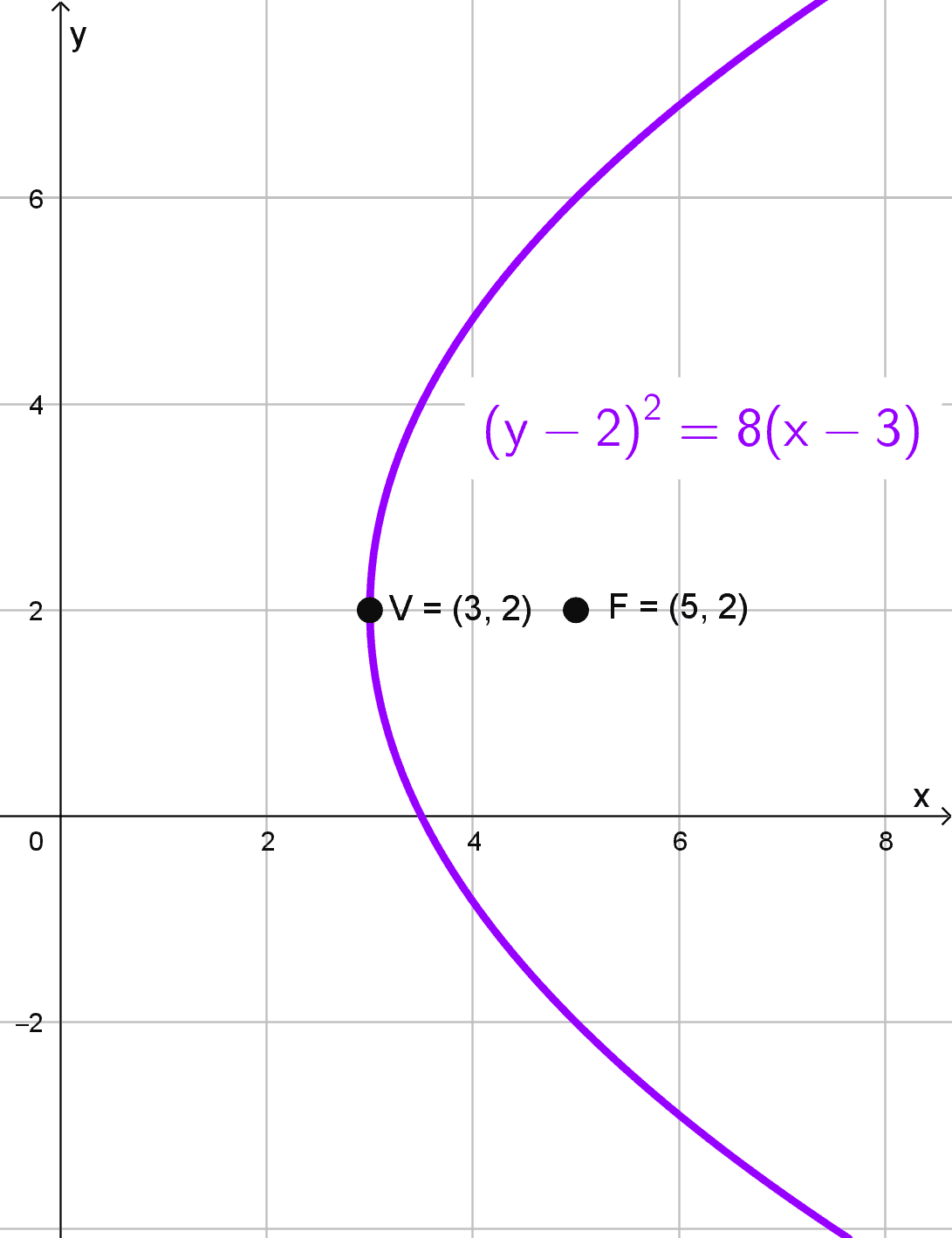
Starting with the vertex \(V(3, 2)\) and the focus \(F(5, 2),\) both points have the same y-coordinate, meaning the axis of symmetry is horizontal. We calculate \(p\) by subtracting the x-coordinates:
$$p=5-3=2$$
Since \(p\) is positive, the parabola opens to the right. Applying the standard equation for horizontal parabolas:
$$(y-k)^2=4p(x-h)$$
Substituting the values:
$$(y-2)^2=4(2)(x-3)$$
Finally, the equation is:
$$(y-2)^2=8(x-3)$$
Solution 4
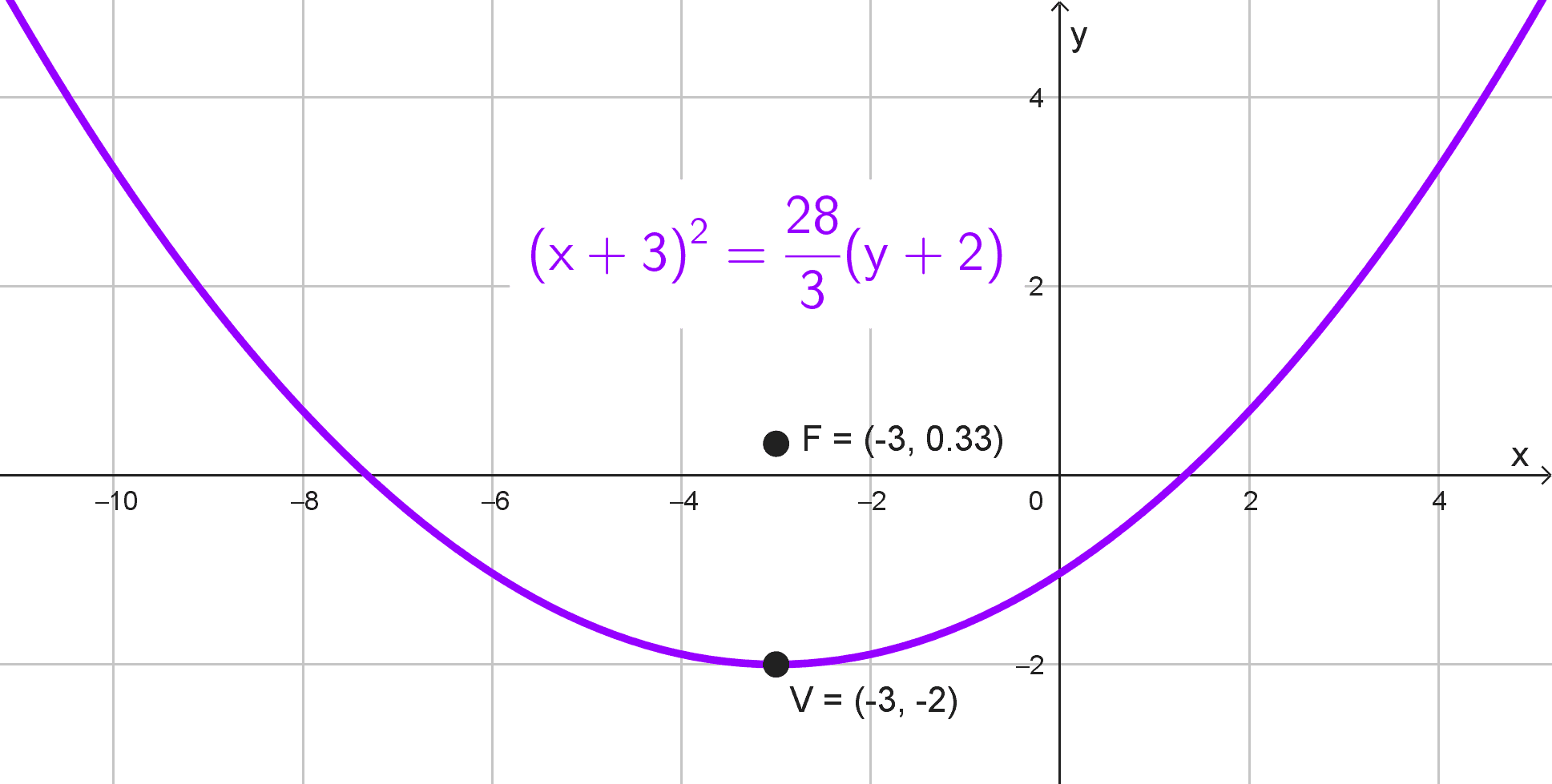
We are given the vertex \(V(-3, -2)\) and the focus \(F(-3, 1/3).\) Both points share the same x-coordinate, indicating a vertical axis. We calculate \(p\) as the difference between the y-coordinates of the focus and the vertex:
$$p=\dfrac{1}{3}-(-2)=\dfrac{1}{3}+2=\dfrac{7}{3}$$
Because \(p\) is positive, the parabola opens upward. We use the standard form for vertical parabolas:
$$(x-h)^2=4p(y-k)$$
Substituting the known values:
$$(x-(-3))^2=4\left (\dfrac{7}{3}\right)(y-(-2))$$
Simplifying, we obtain:
$$(x+3)^2=\dfrac{28}{3}(y+2)$$
Solution 5
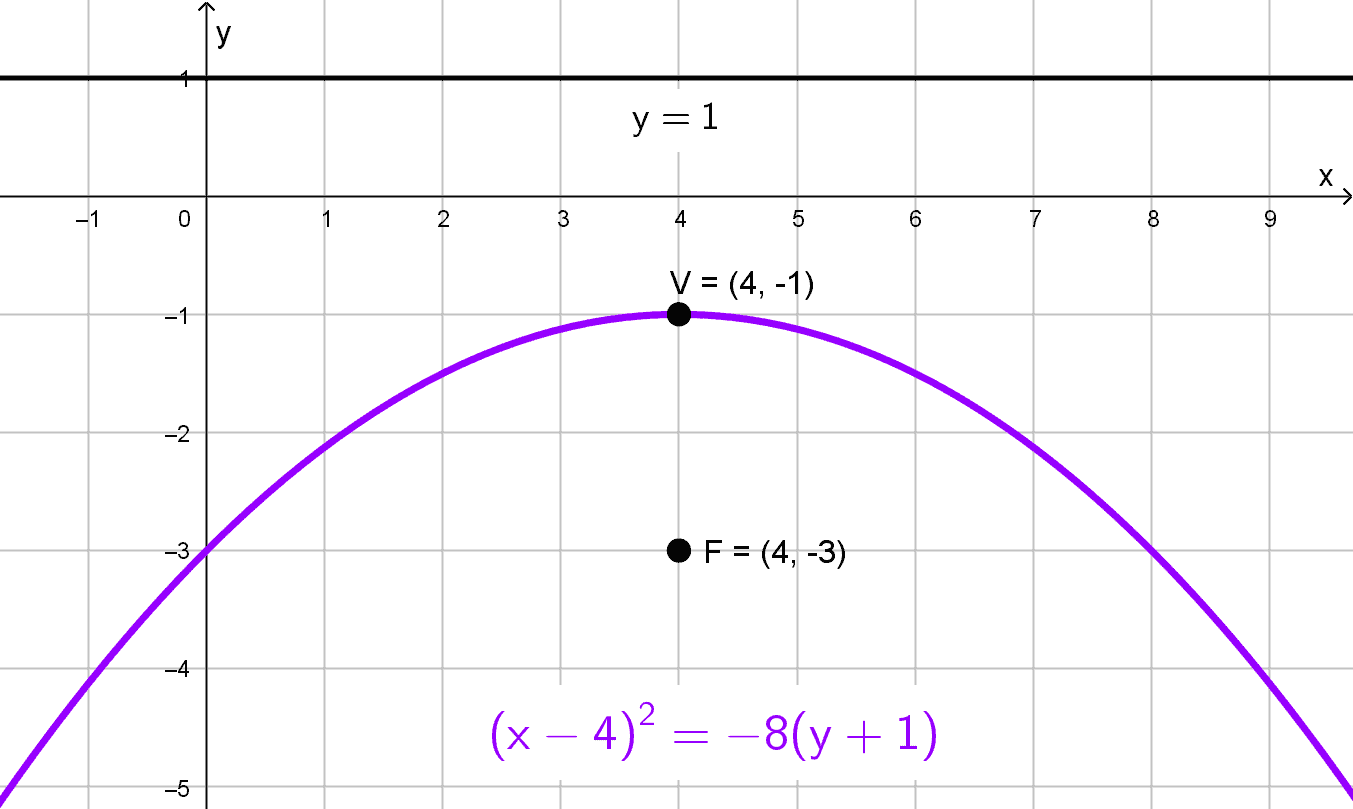
First, identify the directrix \(y-1=0\) (that is, \(y=1\)) and the focus \(F(4, -3).\) Since the directrix is a horizontal line, the axis of the parabola is vertical. We find the vertex V as the midpoint between the focus and the directrix.
The vertical distance between the focus \((4, -3)\) and the directrix \(y=1\) is:
$$\text{Distance}=|-3-1|=4$$
Therefore, the vertex lies halfway between them:
$$V \left(4, \dfrac{1+(-3)}{2}\right)=V(4, -1)$$
We calculate |p| as the distance from the vertex to the focus:
$$|p|=|-3-(-1)|=2$$
Because the focus lies below the vertex, the parabola opens downward, meaning \(p\) is negative: \(p=-2.\)
Using the standard form of a vertical parabola:
$$(x-h)^2=4p(y-k)$$
Substituting \(V(4, -1)\) and \(p=-2:\)
$$(x-4)^2=4(-2)(y-(-1))$$
Simplifying, we get:
$$(x-4)^2=-8(y+1)$$
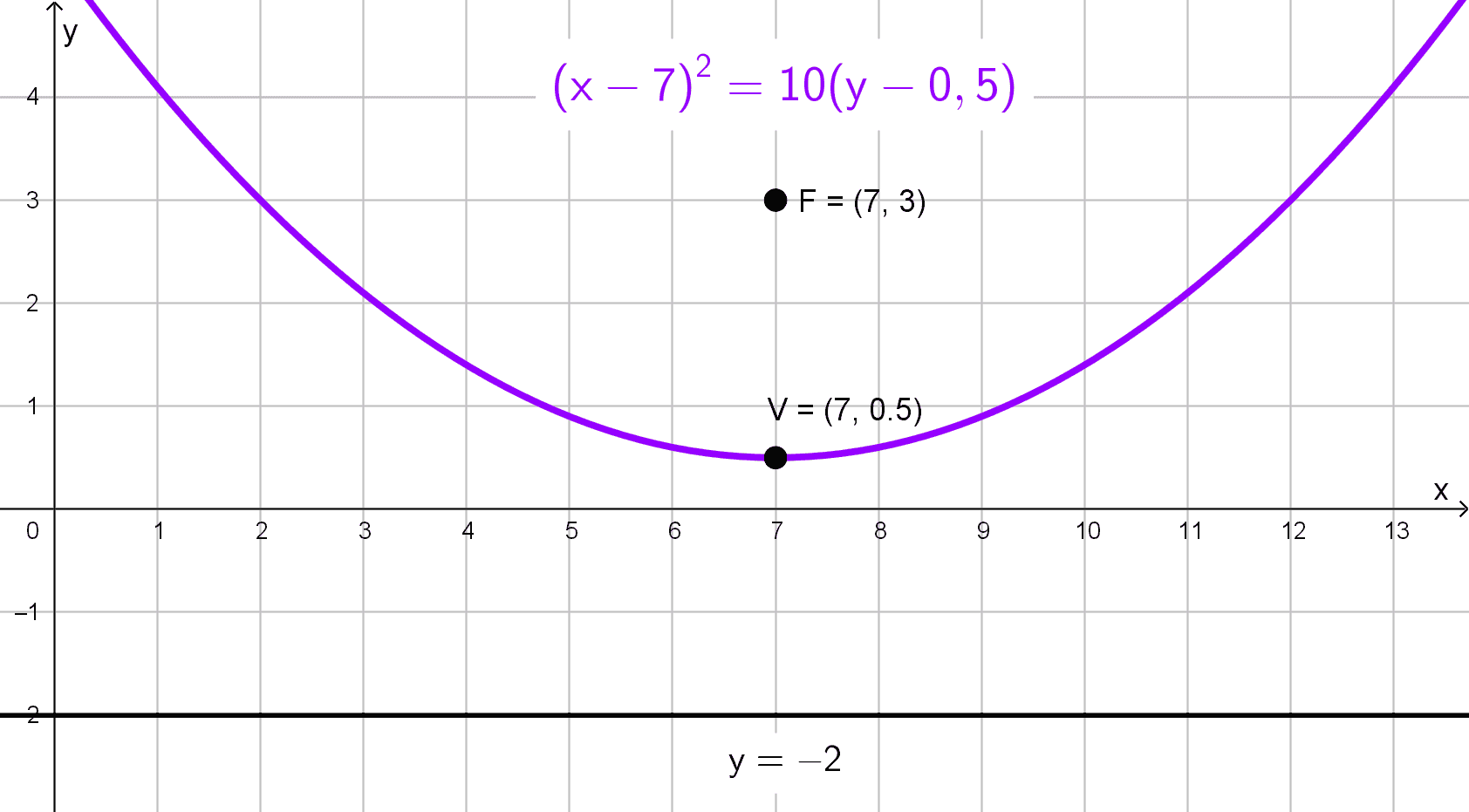
Solution 6
We have the focus \(F(7, 3)\) and the directrix \(y+2=0\) (that is, \(y=-2\)). Because the directrix is horizontal, the axis of the parabola is vertical.
We calculate the vertex as the midpoint between the focus and the directrix:
$$V\left(7, \dfrac{3+(-2)}{2}\right)=V(7, 0.5)$$
We determine \(|p|\) as the distance from the vertex to the focus:
$$|p|=|3-0.5|=2.5$$
Since the focus is above the vertex, p is positive: \(p=2.5.\)
Applying the standard equation for a vertical parabola:
$$(x-h)^2=4p(y-k)$$
Substituting \(V(7, 0.5)\) and \(p=2.5:\)
$$(x-7)^2=4(2.5)(y-0.5)$$
Simplifying, the equation is:
$$(x-7)^2=10(y-0.5)$$
Solution 7
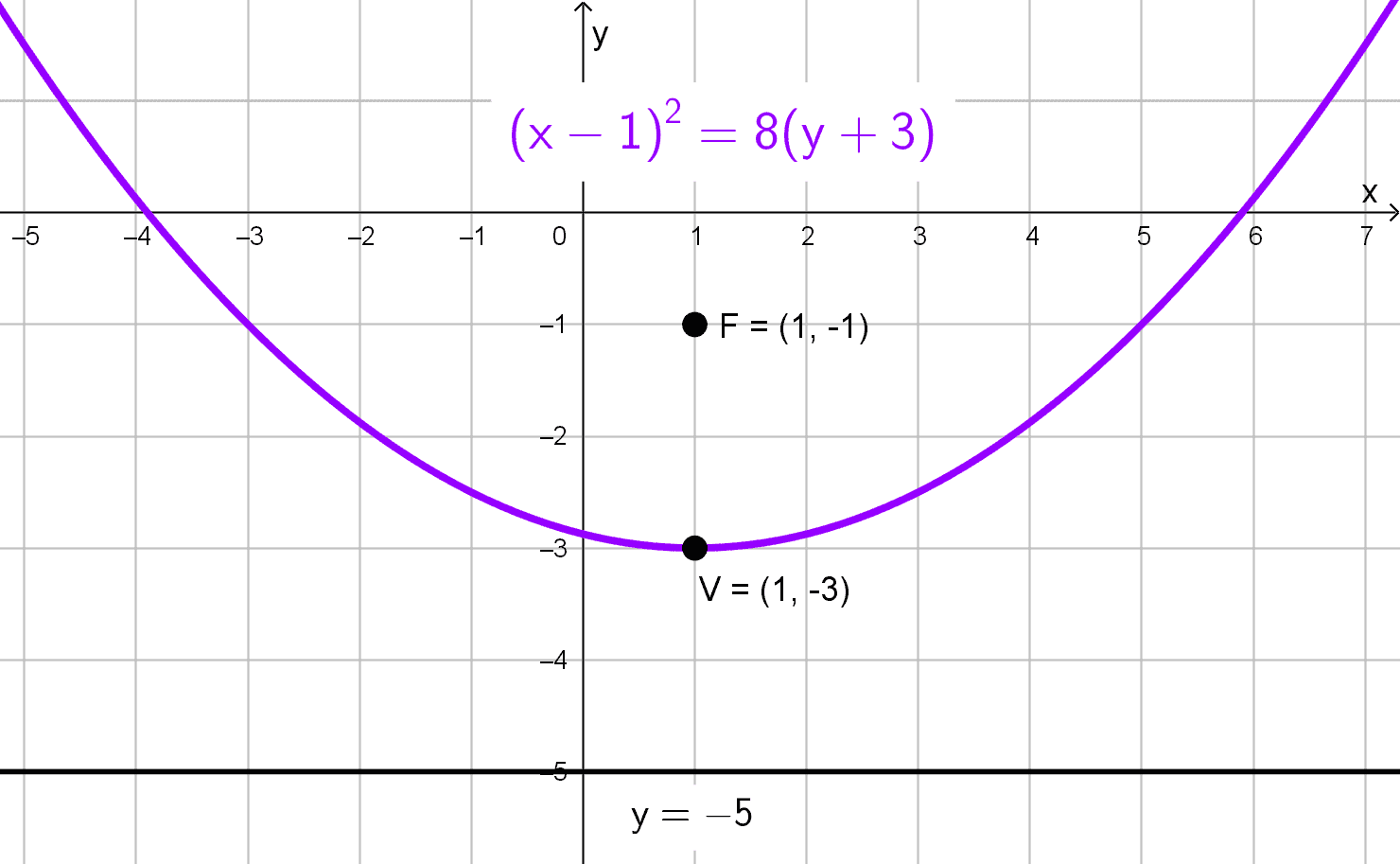
The vertex is at \(V(1, -3)\) and the directrix is \(y+5=0\) (\(y=-5\)). Since the directrix is horizontal, the axis of symmetry is vertical.
We compute \(|p|\) as the distance from the vertex to the directrix:
$$|p|=|-3-(-5)|=2$$
Since the focus must lie on the opposite side of the directrix relative to the vertex, and the vertex is at \(y=-3\) (above the directrix \(y=-5\)), the parabola opens upward. Therefore, \(p=2.\)
Using the standard form for a vertical parabola:
$$(x-h)^2=4p(y-k)$$
Substituting \(V(1, -3)\) and \(p=2:\)
$$(x-1)^2=4(2)(y-(-3))$$
Simplifying gives:
$$(x-1)^2=8(y+3)$$
Solution 8
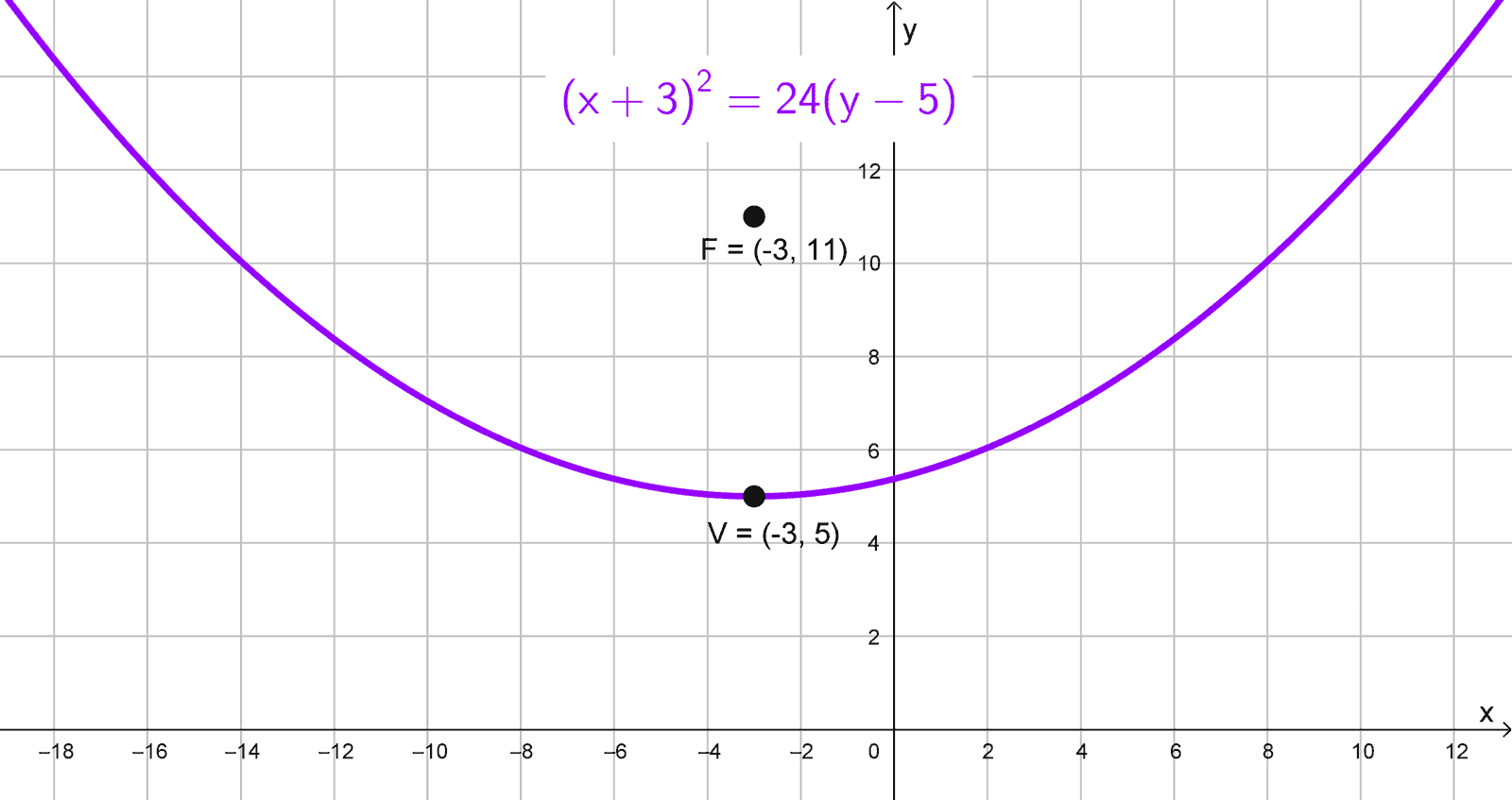
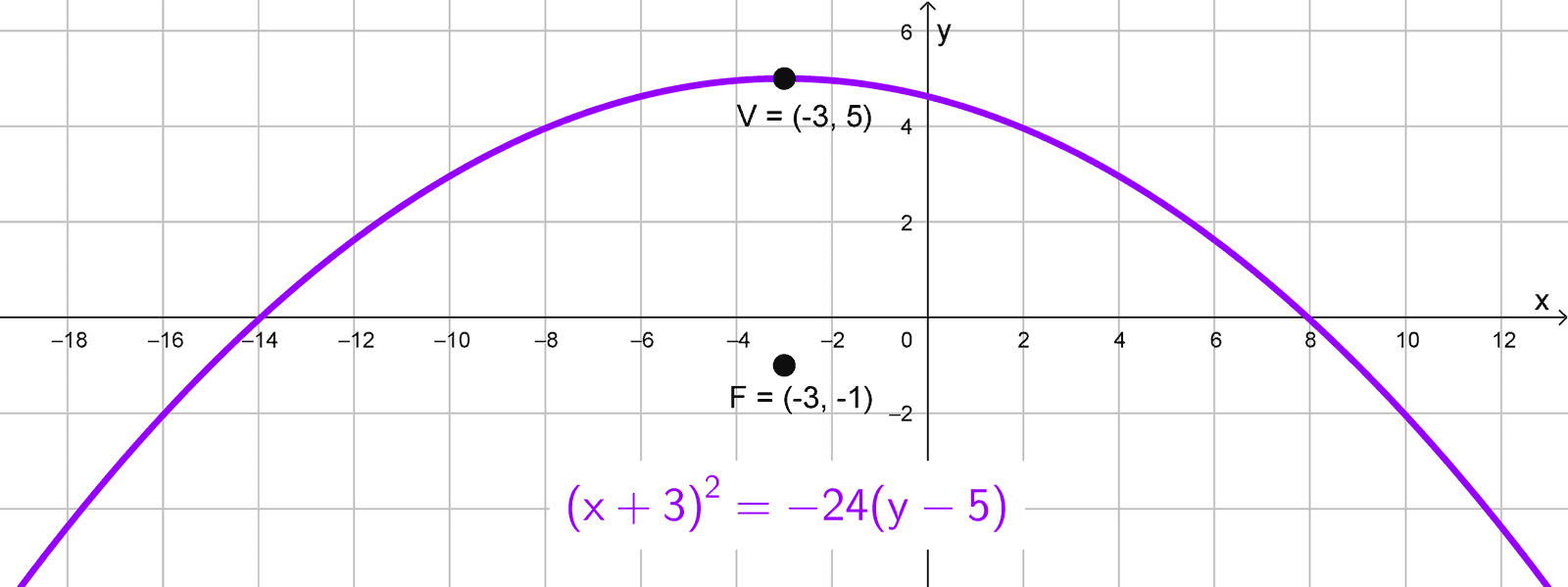
The vertex is at \(V(-3, 5),\) the length of the latus rectum is \(24\) units, and the axis is parallel to the y-axis (a vertical axis). We know that the length of the latus rectum is \(|4p|,\) so:
$$|4p|=24 → |p|=6$$
This yields two possibilities:
1) If \(p=6\) (the parabola opens upward):
$$(x+3)^2=4(6)(y-5) → (x+3)^2=24(y-5)$$
2) If \(p=-6\) (the parabola opens downward):
$$(x+3)^2=4(-6)(y-5) → (x+3)^2=-24(y-5)$$
Therefore, the two possible equations are:
$$(x+3)^2=24(y-5) \quad \text{and} \quad (x+3)^2=-24(y-5)$$
Parabola Passing Through Three Points
Problem 3: Write the general equation of the parabola satisfying each set of conditions:
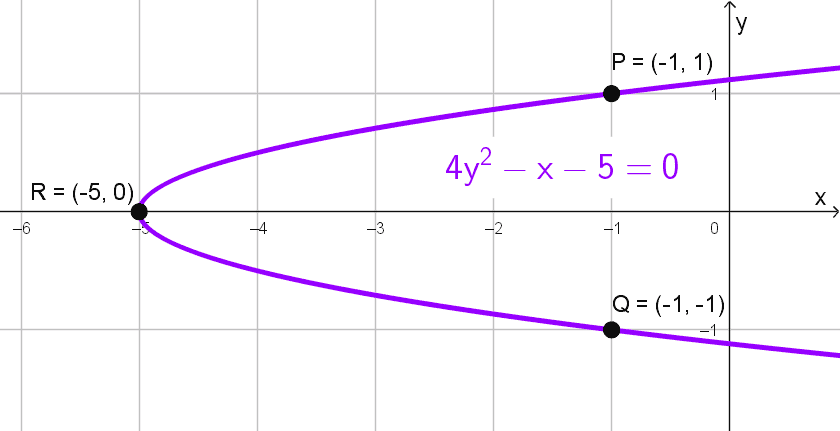
- Axis of symmetry parallel to the x-axis, passing through the points P(-1, 1), Q(-1, -1), and R(-5, 0).
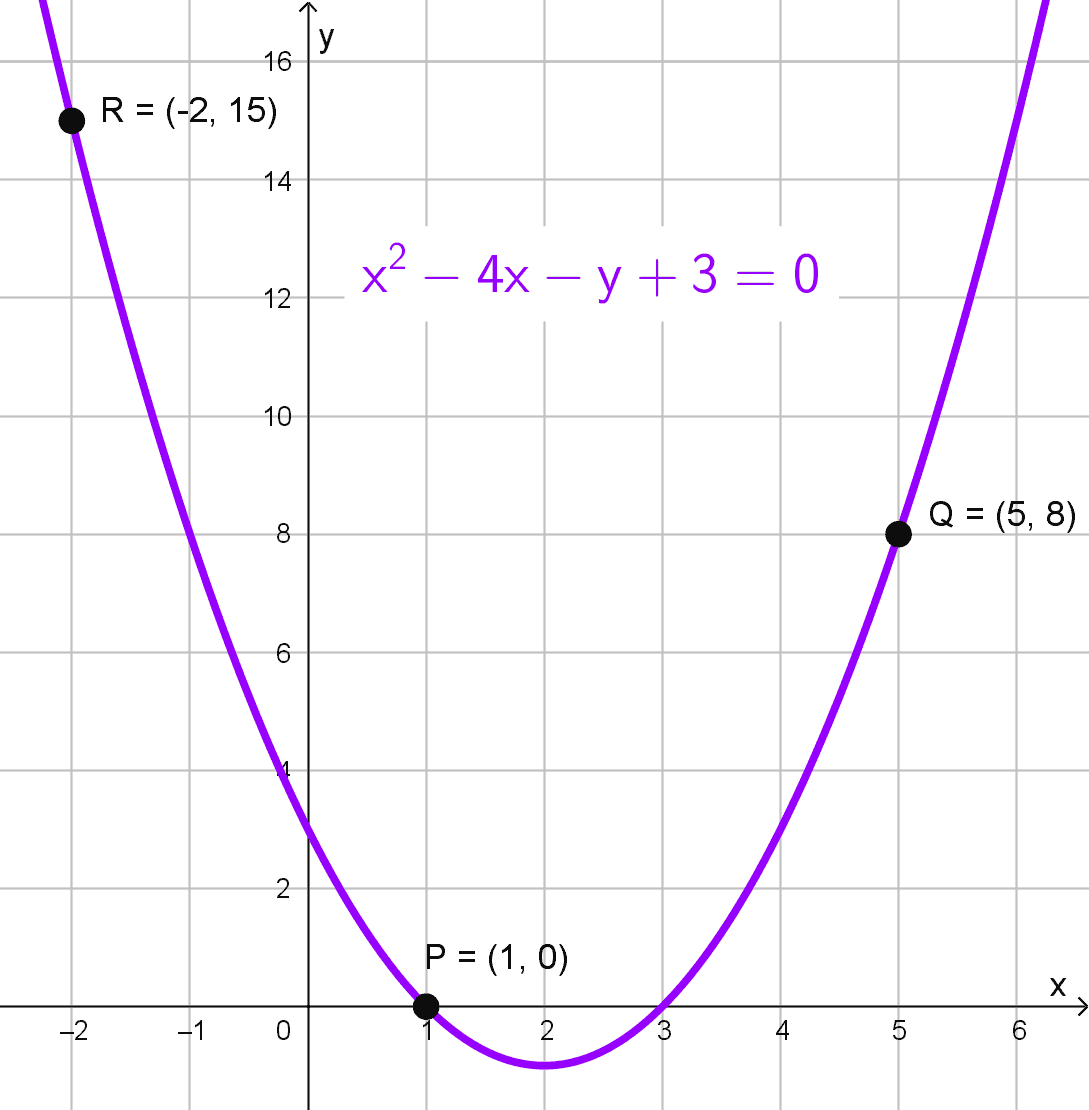
- Focal axis parallel to the y-axis, passing through the points P(1, 0), Q(5, 8), and R(-2, 15).
Solutions
Solution 1
First, since the axis of symmetry is parallel to the x-axis, the parabola opens horizontally and its general equation has the form:
$$y^2+Dx+Ey+F=0$$
We substitute the given points into this equation to set up a system of linear equations. Starting with point \(P(-1, 1):\)
$$(1)^2+D(-1)+E(1)+F=0$$
$$1-D+E+F=0 \quad \text{(1)}$$
Next, we use point \(Q(-1, -1):\)
$$(-1)^2+D(-1)+E(-1)+F=0$$
$$1-D-E+F=0 \quad \text{(2)}$$
Finally, we substitute point \(R(-5, 0):\)
$$(0)^2+D(-5)+E(0)+F=0$$
$$-5D+F=0 \quad \text{(3)}$$
Subtracting equation (2) from equation (1) eliminates D and F:
$$(1-D+E+F)-(1-D-E+F)=0$$
$$2E=0$$
$$E=0$$
Substituting \(E=0\) into equation (1):
$$1-D+0+F=0$$
$$-D+F=-1 \quad \text{(4)}$$
From equation (3), solve for F:
$$F=5D$$
Substitute F into equation (4):
$$-D+5D=-1$$
$$4D=-1$$
$$D=-\dfrac{1}{4}$$
With \(D=-\dfrac{1}{4},\) we find \(F:\)
$$F=5\left(-\dfrac{1}{4}\right)=-\dfrac{5}{4}$$
The general equation of the parabola is:
$$y^2-\dfrac{1}{4}x-\dfrac{5}{4}=0$$
Multiplying by 4 to clear fractions:
$$4y^2-x-5=0$$
Solution 2
Here the parabola has its focal axis parallel to the y-axis, so its general equation is of the form:
$$x^2+Dx+Ey+F=0$$
We substitute the given points to build a system of equations. Starting with point \(P(1, 0):\)
$$(1)^2+D(1)+E(0)+F=0$$
$$1+D+F=0 \quad \text{(1)}$$
Next, we use point \(Q(5, 8):\)
$$(5)^2+D(5)+E(8)+F=0$$
$$25+5D+8E+F=0 \quad \text{(2)}$$
Finally, substitute point \(R(-2, 15):\)
$$(-2)^2+D(-2)+E(15)+F=0$$
$$4-2D+15E+F=0 \quad \text{(3)}$$
From equation (1), solve for \(F:\)
$$F=-1-D$$
Substitute \(F=-1-D\) into equations (2) and (3):
For equation (2):
$$25+5D+8E-1-D=0$$
$$24+4D+8E=0$$
Simplifying:
$$6+D+2E=0 \quad \text{(4)}$$
For equation (3):
$$4-2D+15E-1-D=0$$
$$3-3D+15E=0$$
Simplifying:
$$1-D+5E=0 \quad \text{(5)}$$
Now solve the system formed by (4) and (5). Solve for \(D\) in (5):
$$D=1+5E$$
Substitute \(D=1+5E\) into equation (4):
$$6+(1+5E)+2E=0$$
$$7+7E=0$$
$$E=-1$$
Now find \(D:\)
$$D=1+5(-1)=-4$$
Finally, compute \(F:\)
$$F=-1-(-4)=3$$
The general equation of the parabola is:
$$x^2-4x-y+3=0$$
Finding the Equation from a Graph
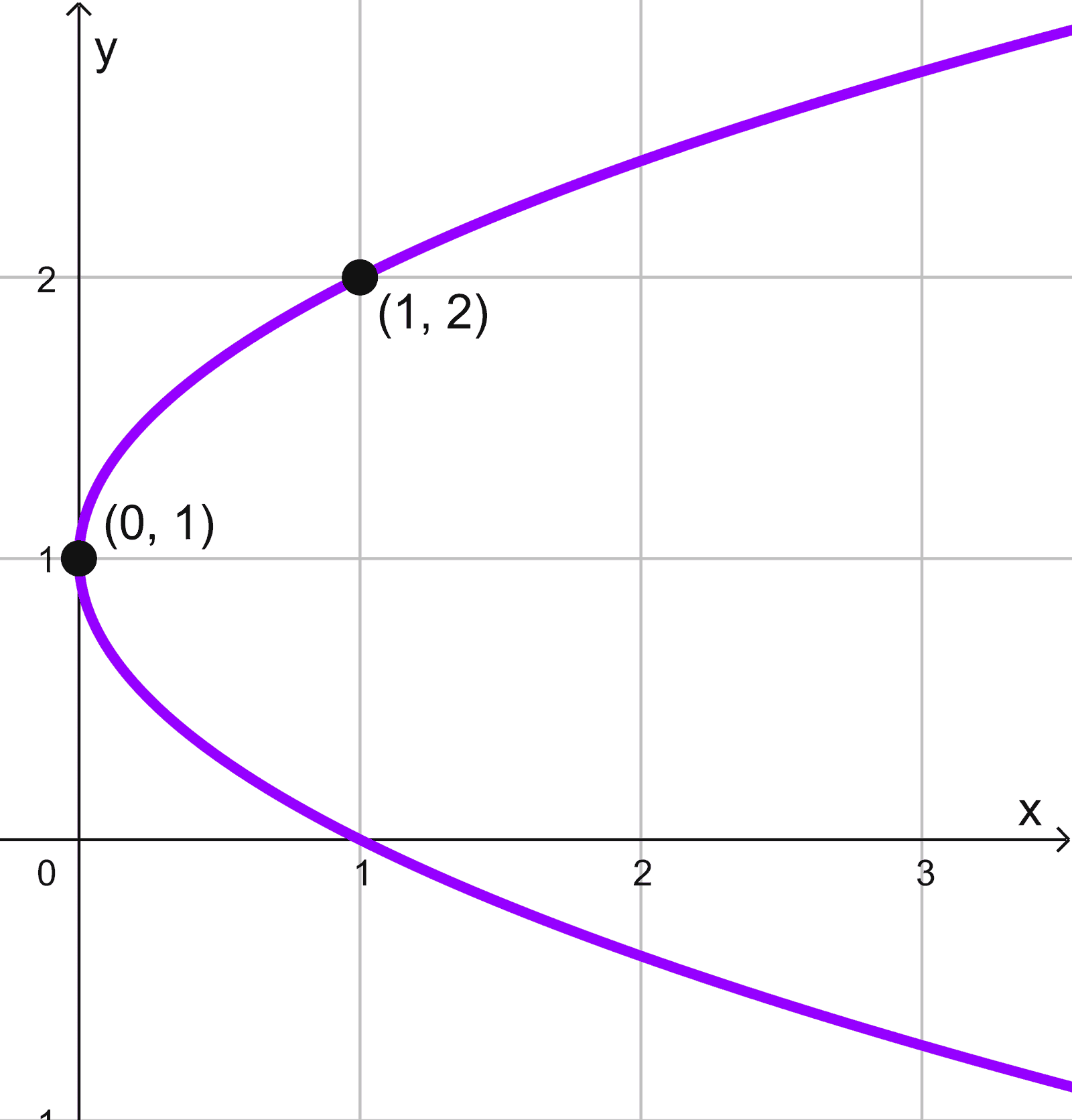
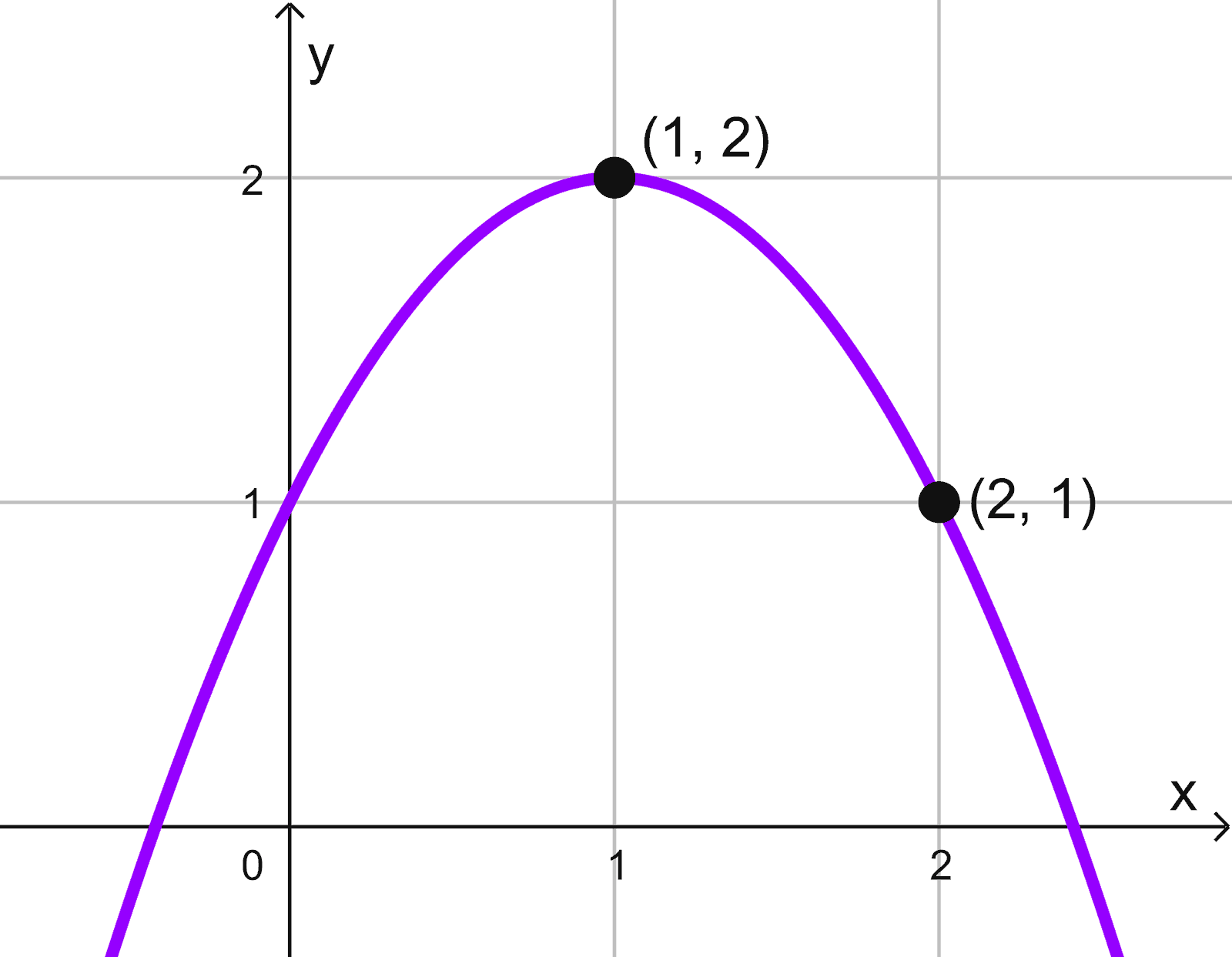
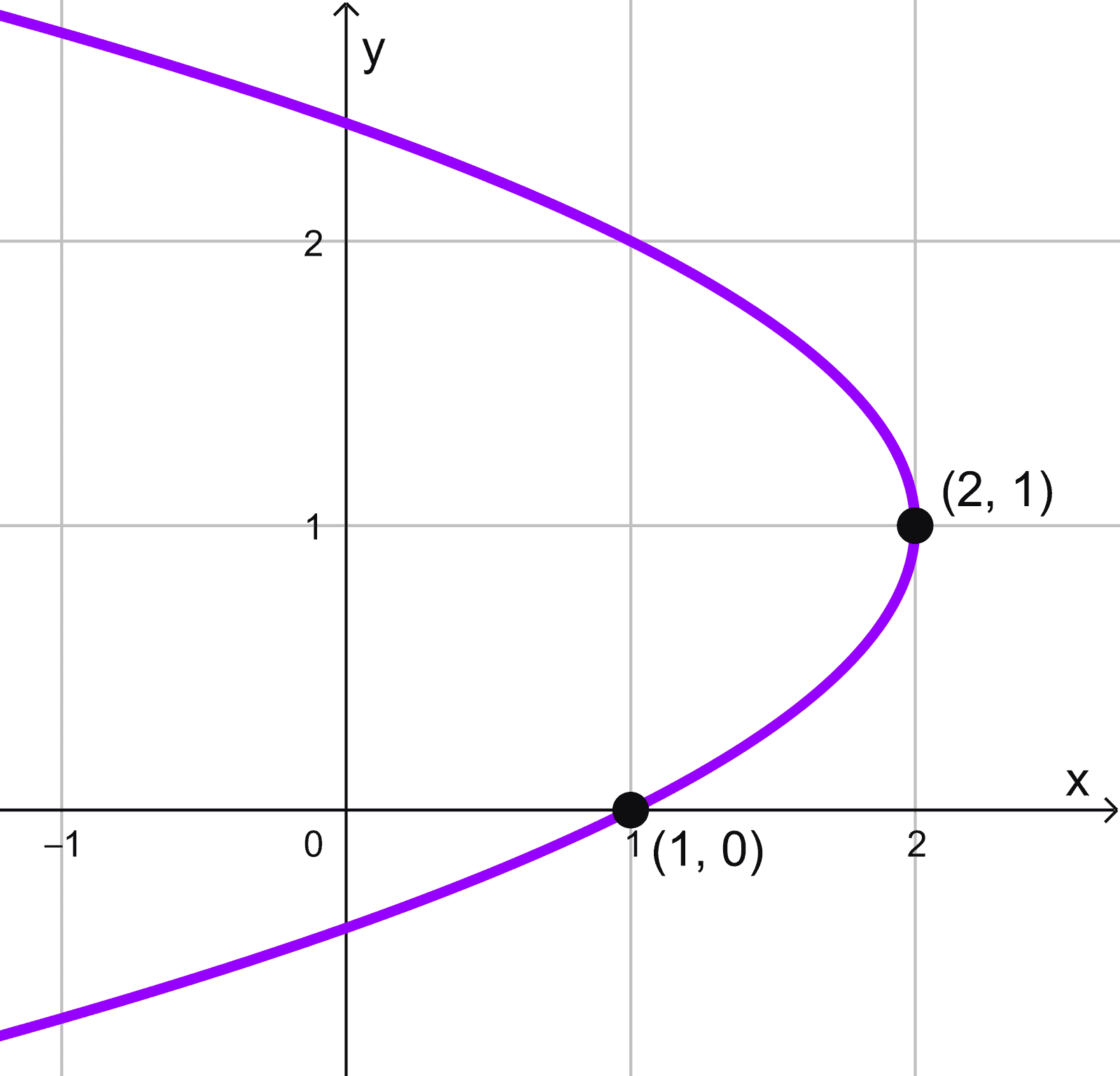
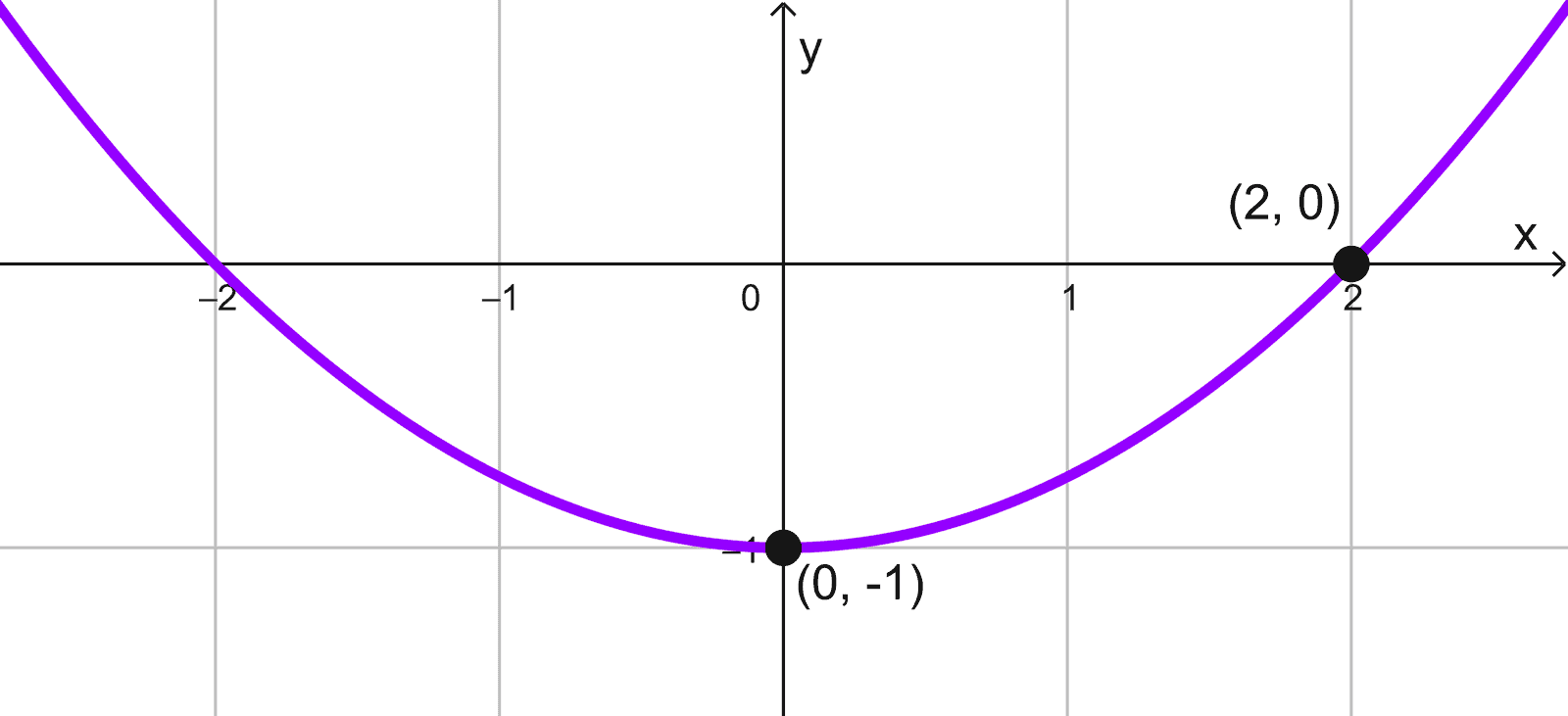
Problem 4: Find the equation of each parabola shown in the following graphs:
Solutions
Solution A
The parabola opens to the right, so its equation has the standard form:
$$(y-k)^2=4p(x-h)$$
where \((h, k)\) is the vertex. Here, the vertex is at \((0, 1),\) so we substitute \(h=0\) and \(k=1:\)
$$(y-1)^2=4px$$
Now, we use the point \((1, 2)\) that lies on the parabola to solve for \(p.\) Substituting \(x=1\) and \(y=2:\)
$$(2-1)^2=4p(1) → 1=4p → p=\dfrac{1}{4}$$
Finally, we substitute \(p\) back into the equation:
$$(y-1)^2=4 \left( \dfrac{1}{4} \right) x → (y-1)^2=x$$
Solution B
The parabola opens downward with vertex at (1, 2). Its standard equation is:
$$(x-h)^2=4p(y-k)$$
Substituting the vertex \((h, k)=(1, 2):\)
$$(x-1)^2=4p(y-2)$$
To find \(p,\) we use the point \((2, 1):\)
$$(2-1)^2=4p(1-2) → 1=-4p → p=-\dfrac{1}{4}$$
Substituting \(p\) into the equation gives:
$$(x-1)^2=4 \left(-\dfrac{1}{4} \right)(y-2) → (x-1)^2=-(y-2)$$
Solution C
We see that the parabola opens to the left and has its vertex at (2, 1). Its standard form is:
$$(y-k)^2=4p(x-h)$$
Substituting the vertex \((h, k)=(2, 1):\)
$$(y-1)^2=4p(x-2)$$
We find \(p\) using the point \((1, 0):\)
$$(0-1)^2=4p(1-2) → 1=-4p → p=-\dfrac{1}{4}$$
The final equation is:
$$(y-1)^2=4 \left( -\dfrac{1}{4} \right)(x-2) → (y-1)^2=-(x-2)$$
Solution D
The parabola opens upward with its vertex at (0, -1). Its standard form is:
$$(x-h)^2=4p(y-k)$$
Substituting \((h, k)=(0, -1):\)
$$x^2=4p(y+1)$$
We determine \(p\) using the point \((2, 0):\)
$$2^2=4p(0+1) → 4=4p → p=1$$
The resulting equation is:
$$x^2=4(1)(y+1) → x^2=4(y+1)$$
Finding the Elements of a Parabola from Its Equation
Problem 5: For each given equation: find the focus, vertex, directrix equation, length of the latus rectum, equation of the axis of symmetry, and sketch their graphs.
- \(x^2=4y\)
- \(y^2=8x\)
- \(y^2=-16x\)
- \(x^2=-4y\)
- \((y-2)^2=8(x+1)\)
- \((x+4)^2=16(y+2)\)
- \((x-3)^2=-(y+1)\)
- \((y+1)^2=-4(x-2)\)
- \(4x^2-12x-16y+41=0\)
- \(16y^2+8y-24x+49=0\)
- \(x^2+2x=-4y+19\)
- \(8y+56=-y^2-20x\)
Solutions
Solution 1
For the equation \(x^2=4y,\) we identify a vertical parabola because the variable x is squared. The vertex is at the origin \((0, 0).\) Comparing it to the standard form \(x^2=4py,\) we find \(4p=4,\) so \(p=1.\) Since p is positive, the parabola opens upward.
The focus is at \((0, p)=(0, 1).\) The directrix is the horizontal line \(y=-p,\) which is \(y=-1.\) The length of the latus rectum is \(|4p|=4.\) The axis of symmetry coincides with the y-axis, with equation \(x=0.\)
Summary of elements:
- Vertex: \((0, 0)\)
- Focus: \((0, 1)\)
- Directrix: \(y=-1\)
- Latus rectum: \(L_R=4\)
- Axis of symmetry: \(x=0\)

Solution 2
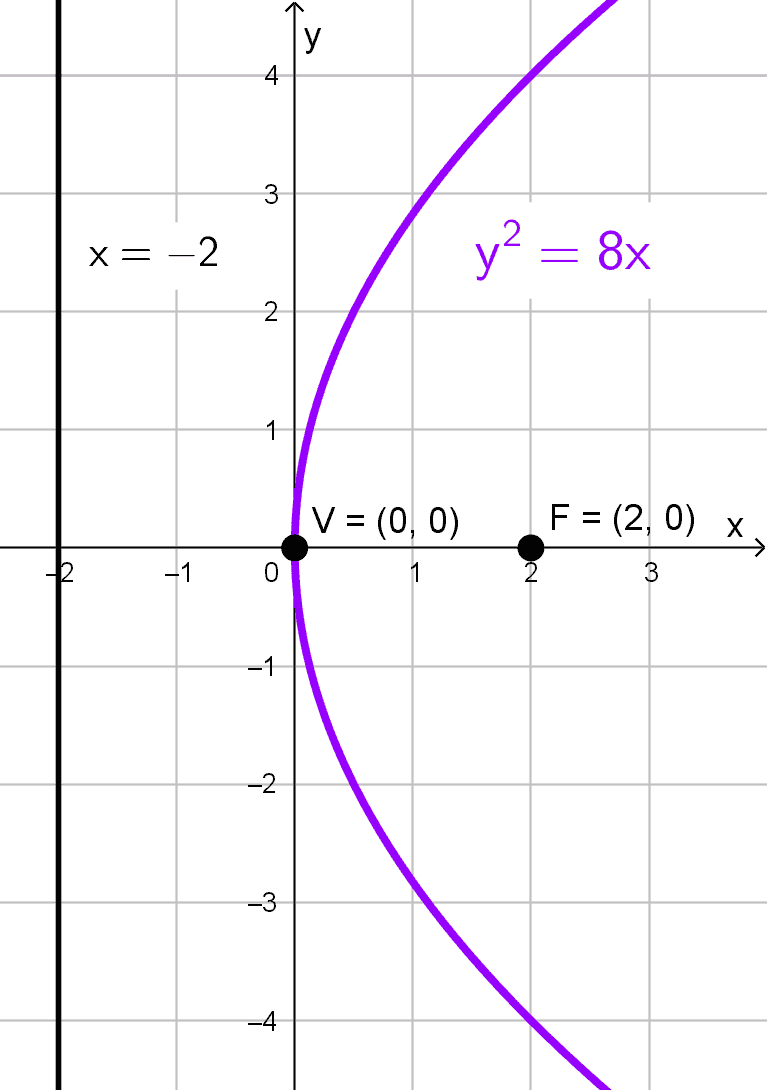
The equation \(y^2=8x\) represents a horizontal parabola with vertex at \((0, 0),\) since the variable y is squared. Comparing it to the standard form \(y^2=4px,\) we have \(4p=8,\) so \(p=2.\) Since \(p>0,\) the parabola opens to the right.
The focus is located at \((p, 0)=(2, 0).\) The directrix is the vertical line \(x=-p,\) which is \(x=-2.\) The length of the latus rectum is \(|4p|=8.\) The axis of symmetry is the x-axis, with equation \(y=0.\)
Summary of elements:
- Vertex: \((0, 0)\)
- Focus: \((2, 0)\)
- Directrix: \(x=-2\)
- Latus rectum: \(L_R=8\)
- Axis of symmetry: \(y=0\)
Solution 3
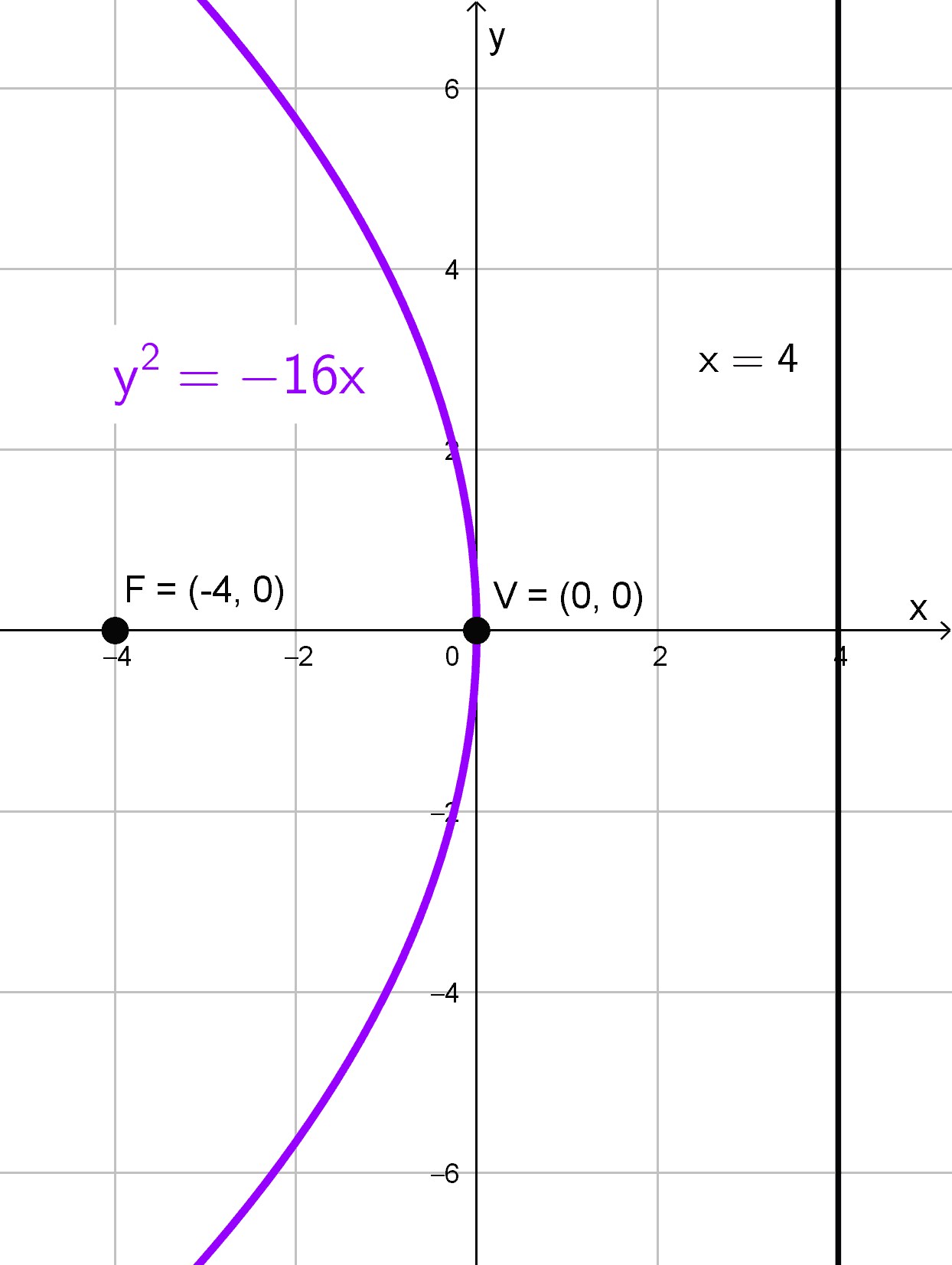
In the equation \(y^2=-16x,\) we recognize a horizontal parabola opening to the left because its parameter is negative. Comparing with \(y^2=4px,\) we get \(4p=-16,\) which gives \(p=-4.\)
The focus is at \((p, 0)=(-4, 0).\) The directrix is the line \(x=-p,\) so \(x=4.\) The length of the latus rectum is \(|4p|=16.\) The axis of symmetry is \(y=0.\)
Summary of elements:
- Vertex: \((0, 0)\)
- Focus: \((-4, 0)\)
- Directrix: \(x=4\)
- Latus rectum: \(L_R=16\)
- Axis of symmetry: \(y=0\)
Solution 4
The equation \(x^2=-4y\) describes a vertical parabola with vertex at the origin. Comparing it to \(x^2=4py,\) we find that \(4p=-4,\) so \(p=-1.\) Since \(p<0,\) the parabola opens downward.
The focus is at \((0, p)=(0, -1).\) The directrix is \(y=-p,\) meaning \(y=1.\) The length of the latus rectum is \(|4p|=4.\) The axis of symmetry is \(x=0.\)
Elements:
- Vertex: \((0, 0)\)
- Focus: \((0, -1)\)
- Directrix: \(y=1\)
- Latus rectum: \(L_R=4\)
- Axis of symmetry: \(x=0\)

Solution 5
For the equation \((y-2)^2=8(x+1),\) we identify a horizontal parabola with vertex away from the origin, at \((-1, 2).\) Comparing with the standard form \((y-k)^2=4p(x-h),\) we find \(4p=8,\) so \(p=2.\) Since the parameter is positive, the parabola opens to the right.
We calculate the focus at \((h+p, k)=(-1+2, 2)=(1, 2).\) The directrix is the vertical line \(x=h-p,\) which is \(x=-1-2=-3.\) The length of the latus rectum is \(|4p|=8.\) The axis of symmetry is parallel to the x-axis and passes through the vertex, with equation \(y=2.\)
- Vertex: \((-1, 2)\)
- Focus: \((1, 2)\)
- Directrix: \(x=-3\)
- Latus rectum: \(L_R=8\)
- Axis of symmetry: \(y=2\)

Solution 6
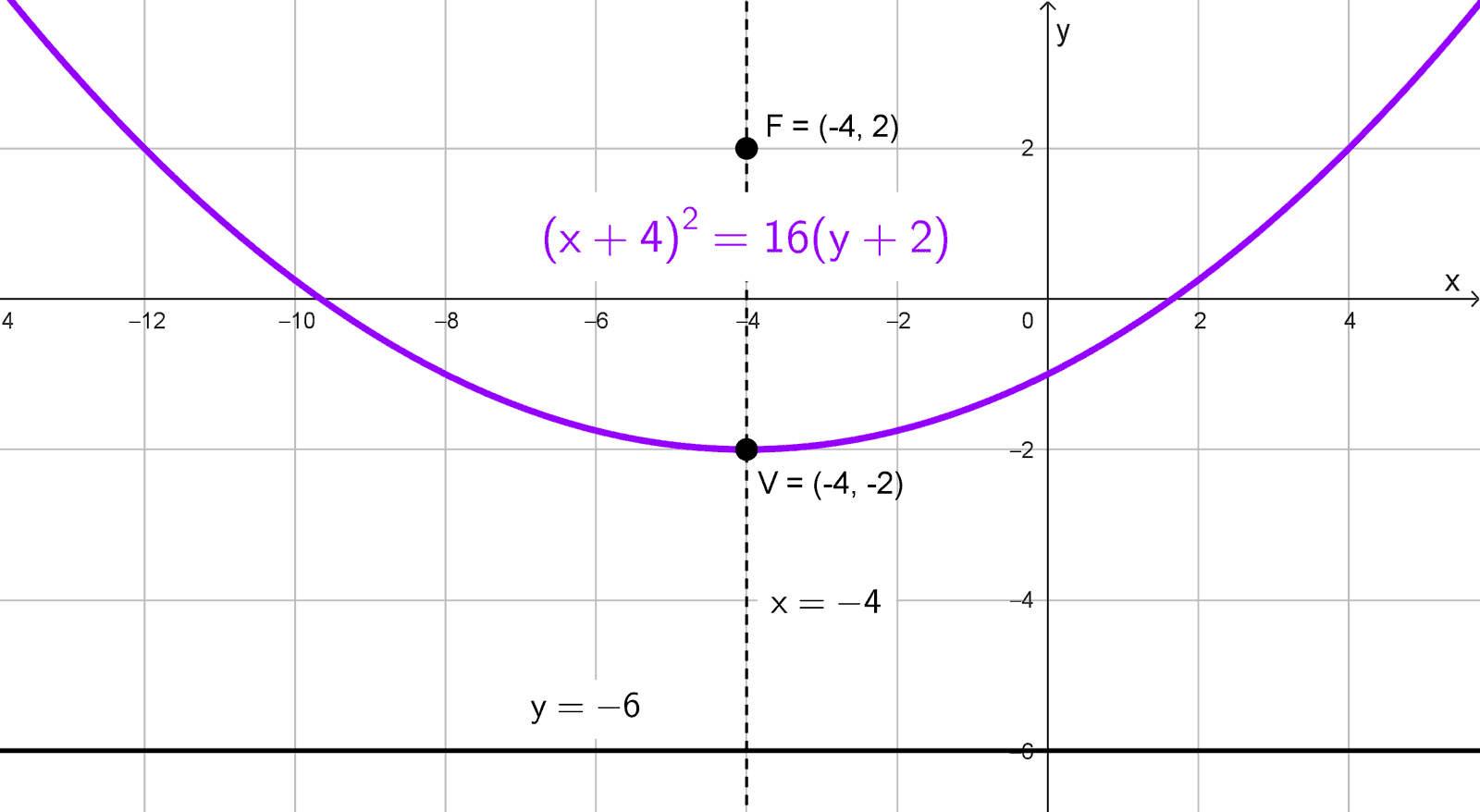
The equation \((x+4)^2=16(y+2)\) represents a vertical parabola with vertex at \((-4, -2).\) Comparing it with \((x-h)^2=4p(y-k),\) we find that \(4p=16,\) so \(p=4.\) Since p is positive, the parabola opens upward.
The focus is located at \((h, k+p)=(-4, -2+4)=(-4, 2).\) The directrix is the horizontal line \(y=k-p,\) so \(y=-2-4=-6.\) The length of the latus rectum is \(|4p|=16.\) The axis of symmetry is parallel to the y-axis, with equation \(x=-4.\)
- Vertex: \((-4, -2)\)
- Focus: \((-4, 2)\)
- Directrix: \(y=-6\)
- Latus rectum: \(L_R=16\)
- Axis of symmetry: \(x=-4\)
Solution 7
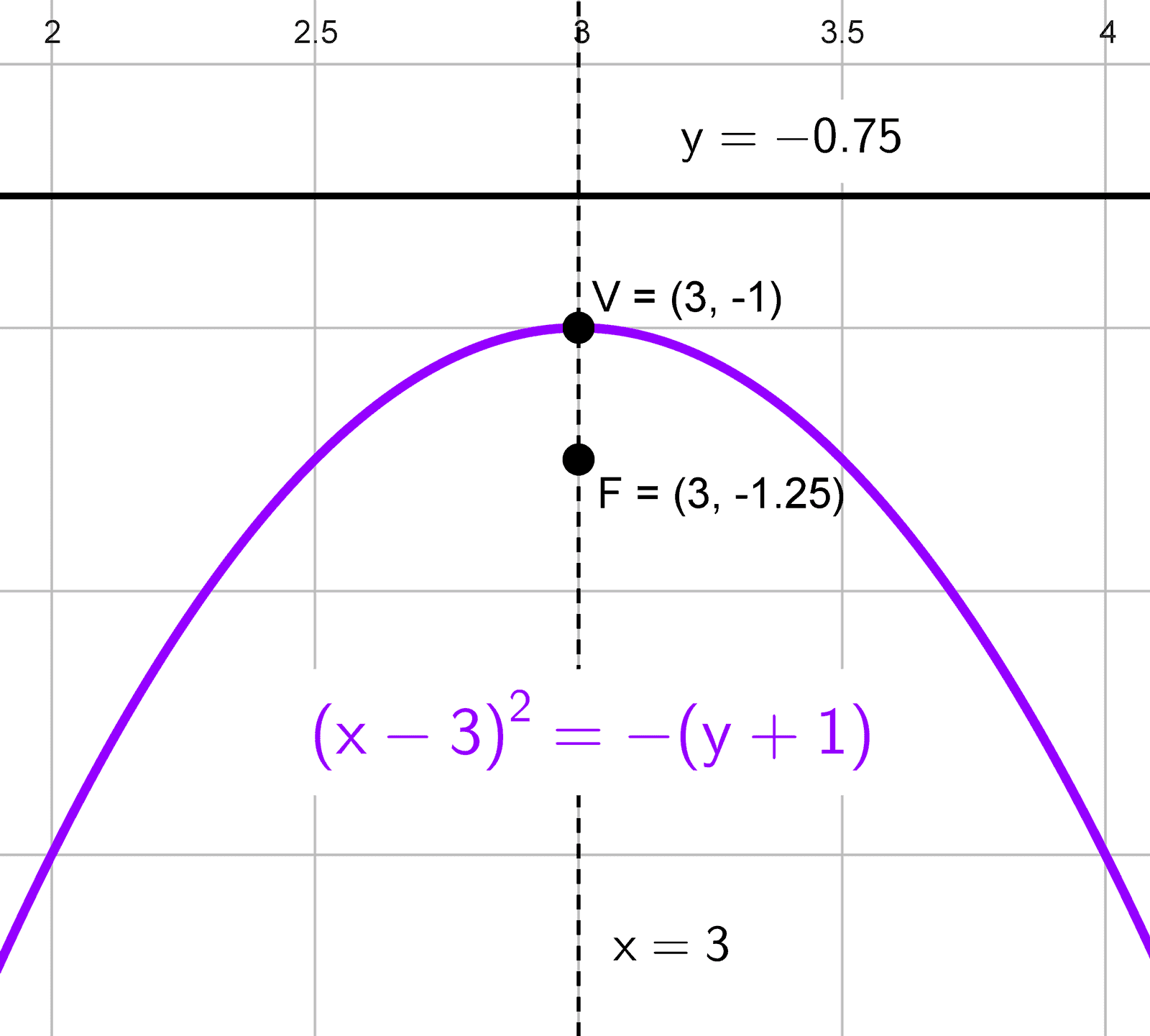
In the equation \((x-3)^2=-(y+1),\) we identify a vertical parabola that opens downward, with vertex at \((3, -1).\) Comparing with \((x-h)^2=4p(y-k),\) we obtain \(4p=-1,\) giving \(p=-0.25.\) The negative sign confirms downward opening.
The focus is at \((h, k+p)=(3, -1-0.25)=(3, -1.25).\) The directrix is \(y=k-p,\) so \(y=-1-(-0.25)=-0.75.\) The length of the latus rectum is \(|4p|=1.\) The axis of symmetry is \(x=3.\)
- Vertex: \((3, -1)\)
- Focus: \((3, -1.25)\)
- Directrix: \(y=-0.75\)
- Latus rectum: \(L_R=1\)
- Axis of symmetry: \(x=3\)
Solution 8
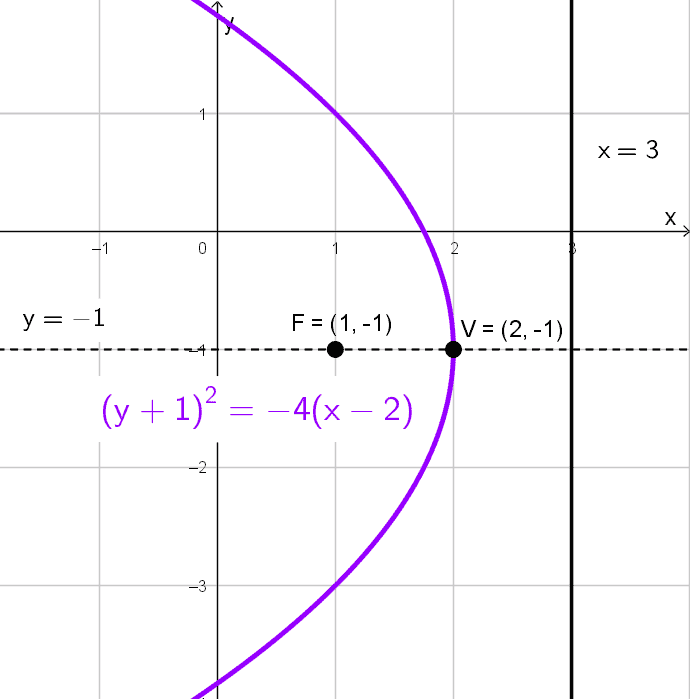
The equation \((y+1)^2=-4(x-2)\) represents a horizontal parabola with vertex at \((2, -1).\) Comparing it to \((y-k)^2=4p(x-h),\) we get \(4p=-4,\) so \(p=-1.\) Since \(p<0,\) the parabola opens to the left.
The focus is at \((h+p, k)=(2-1, -1)=(1, -1).\) The directrix is \(x=h-p,\) so \(x=2-(-1)=3.\) The length of the latus rectum is \(|4p|=4.\) The axis of symmetry is \(y=-1.\)
- Vertex: \((2, -1)\)
- Focus: \((1, -1)\)
- Directrix: \(x=3\)
- Latus rectum: \(L_R=4\)
- Axis of symmetry: \(y=-1\)
Solution 9
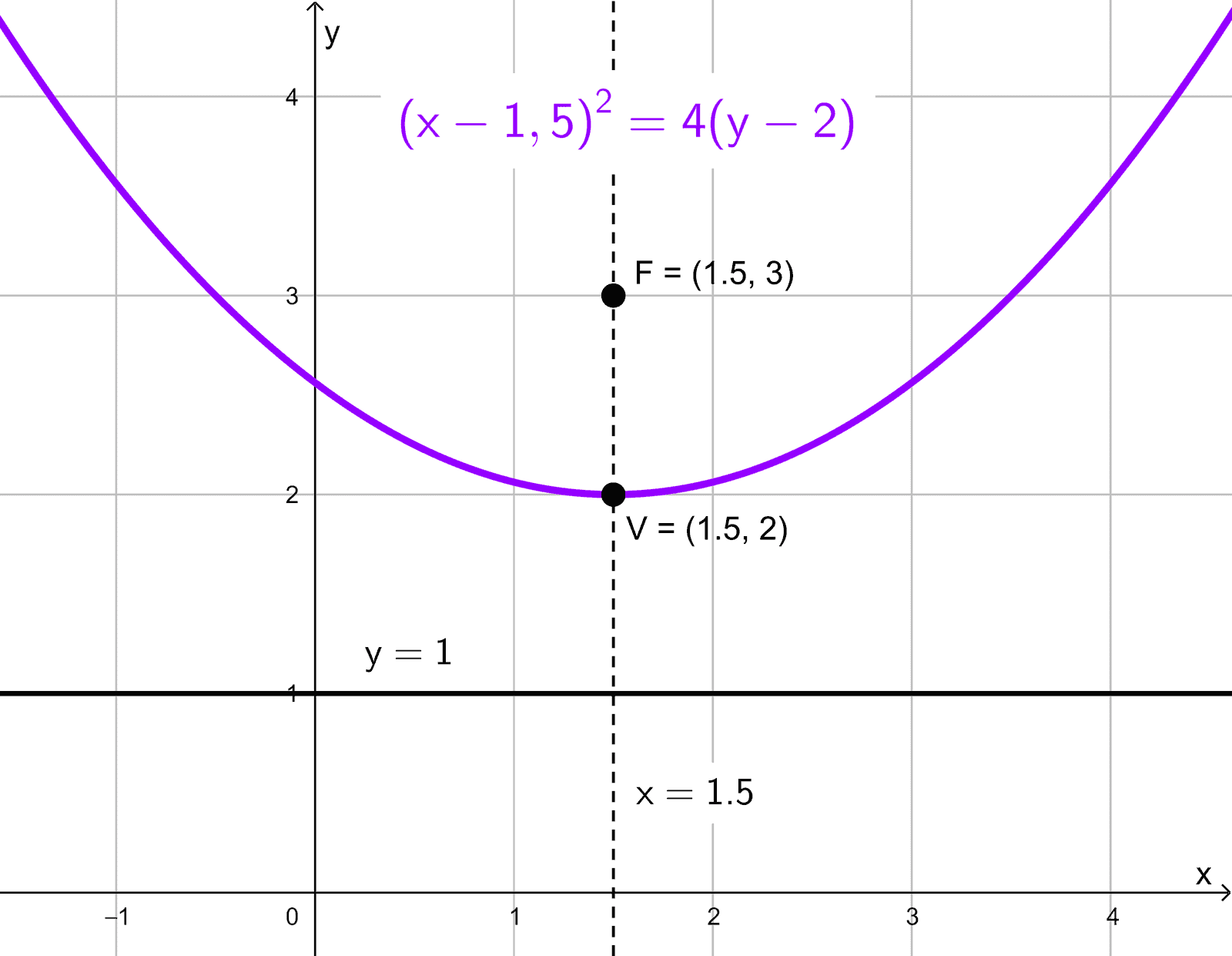
The given equation is \(4x^2-12x-16y+41=0.\) It is not in standard form, so we must complete the square and rearrange it. By completing the square, the standard form equation is \((x-1.5)^2=4(y-2).\)
This equation corresponds to a vertical parabola with vertex at \((1.5, 2).\) Comparing with the standard form \((x-h)^2=4p(y-k),\) we identify that \(4p=4,\) so \(p=1.\) Because \(p\) is positive, the parabola opens upward.
The focus is at \((h, k+p)=(1.5, 2+1)=(1.5, 3).\) The directrix is the horizontal line \(y=k-p,\) which is \(y=2-1=1.\) The length of the latus rectum is \(|4p|=4.\) The axis of symmetry is parallel to the y-axis, with equation \(x=1.5.\)
Elements:
- Vertex: \((1.5, 2)\)
- Focus: \((1.5, 3)\)
- Directrix: \(y=1\)
- Latus rectum: \(L_R=4\)
- Axis of symmetry: \(x=1.5\)
Solution 10
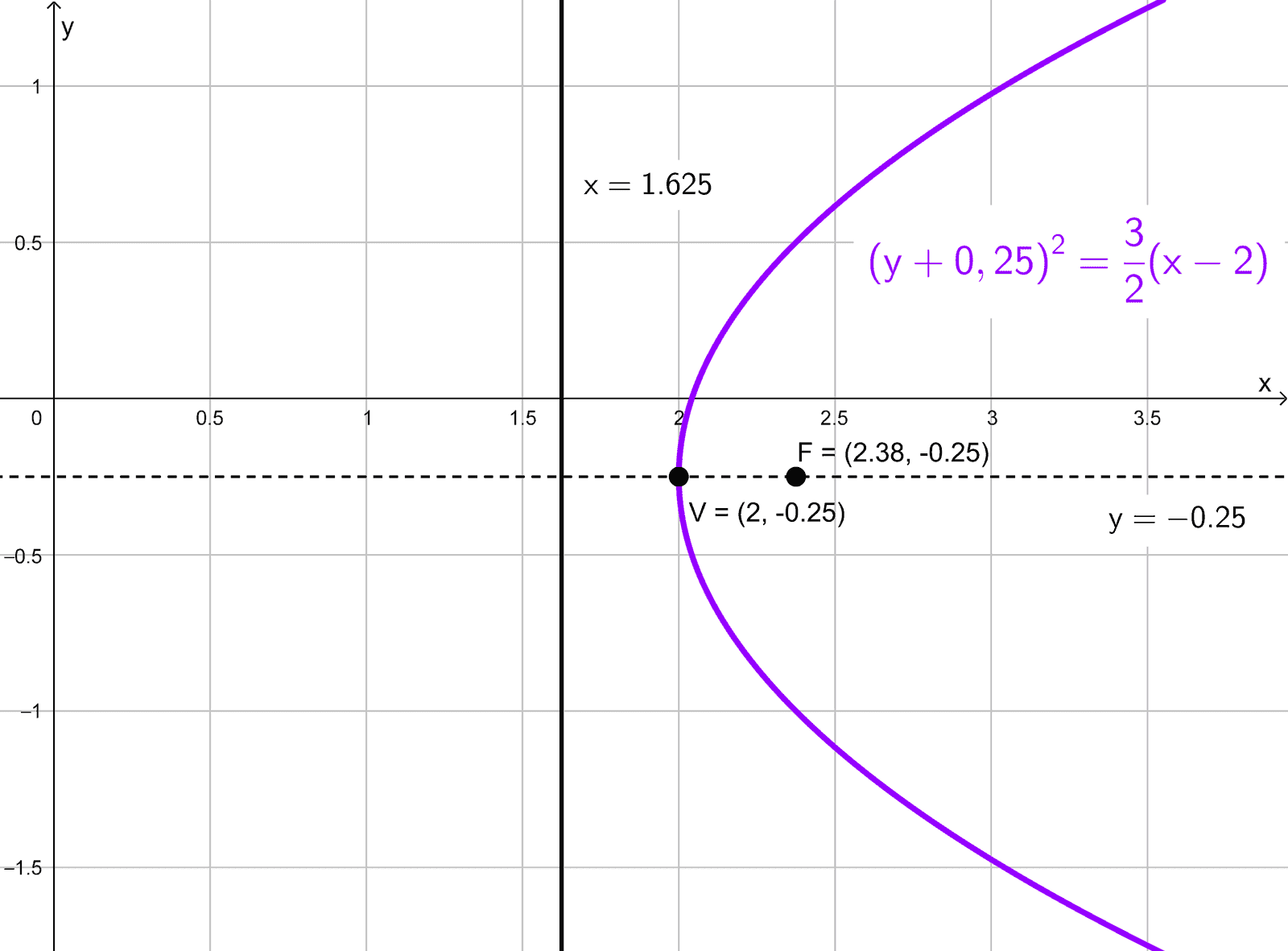
The given equation is \(16y^2+8y-24x+49=0.\) Completing the square yields the standard form \((y+0.25)^2=\dfrac{3}{2}(x-2).\)
This equation represents a horizontal parabola with vertex at \((2, -0.25).\) Comparing with \((y-k)^2=4p(x-h),\) we find \(4p=\dfrac{3}{2},\) which implies \(p=\dfrac{3}{8}.\) Since \(p\) is positive, the parabola opens to the right.
The focus is at \((h+p, k)=(2+\dfrac{3}{8}, -0.25)=(2.375, -0.25).\) The directrix is the vertical line \(x=h-p,\) so \(x=2-\dfrac{3}{8}=1.625.\) The length of the latus rectum is \(|4p|=\dfrac{3}{2}.\) The axis of symmetry is parallel to the x-axis, with equation \(y=-0.25.\)
Elements:
- Vertex: \((2, -0.25)\)
- Focus: \((2.375, -0.25)\)
- Directrix: \(x=1.625\)
- Latus rectum: \(L_R=\dfrac{3}{2}\)
- Axis of symmetry: \(y=-0.25\)
Solution 11
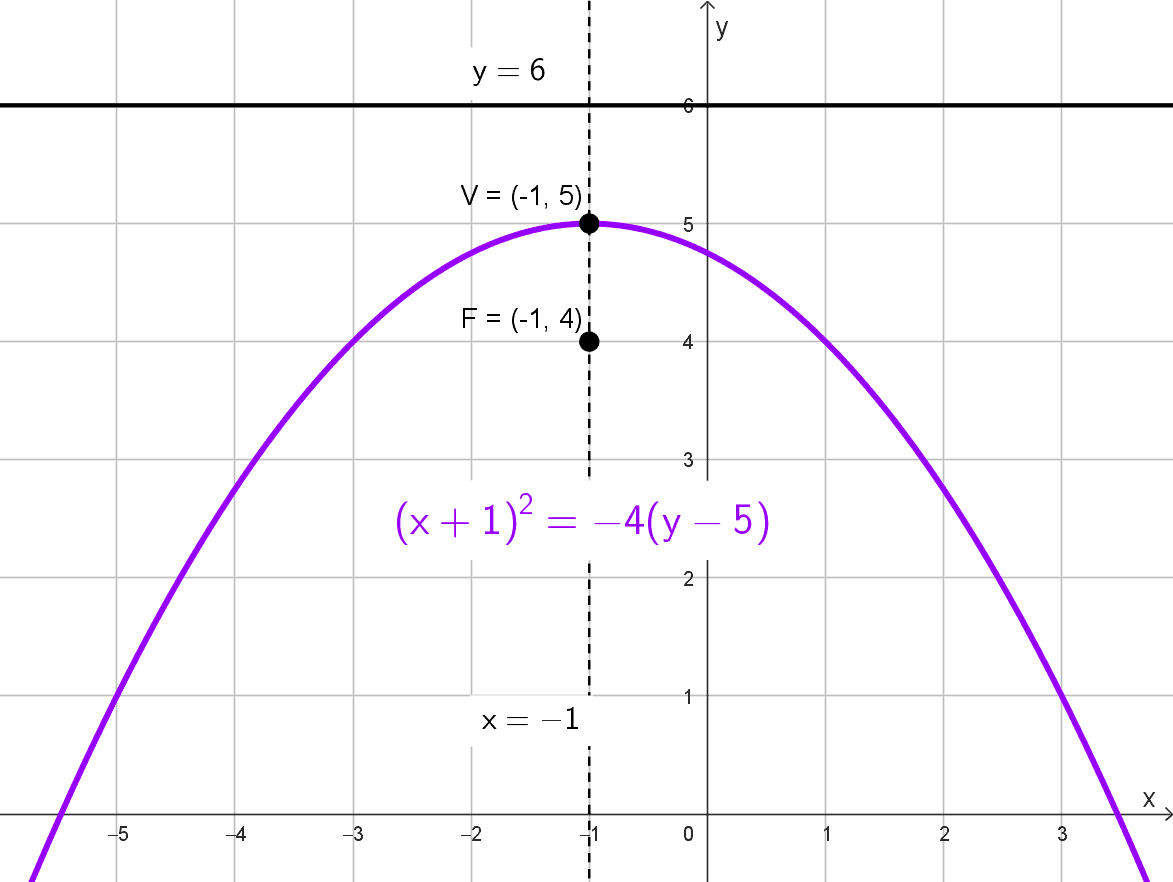
The given equation is \(x^2+2x=-4y+19.\) Completing the square yields the equivalent standard form \((x+1)^2=-4(y-5).\)
This equation describes a vertical parabola with vertex at \((-1, 5).\) Comparing it to \((x-h)^2=4p(y-k),\) we find \(4p=-4,\) so \(p=-1.\) The negative sign of \(p\) indicates that the parabola opens downward.
The focus is at \((h, k+p)=(-1, 5-1)=(-1, 4).\) The directrix is \(y=k-p,\) so \(y=5-(-1)=6.\) The length of the latus rectum is \(|4p|=4.\) The axis of symmetry is \(x=-1.\)
Elements:
- Vertex: \((-1, 5)\)
- Focus: \((-1, 4)\)
- Directrix: \(y=6\)
- Latus rectum: \(L_R=4\)
- Axis of symmetry: \(x=-1\)
Solution 12
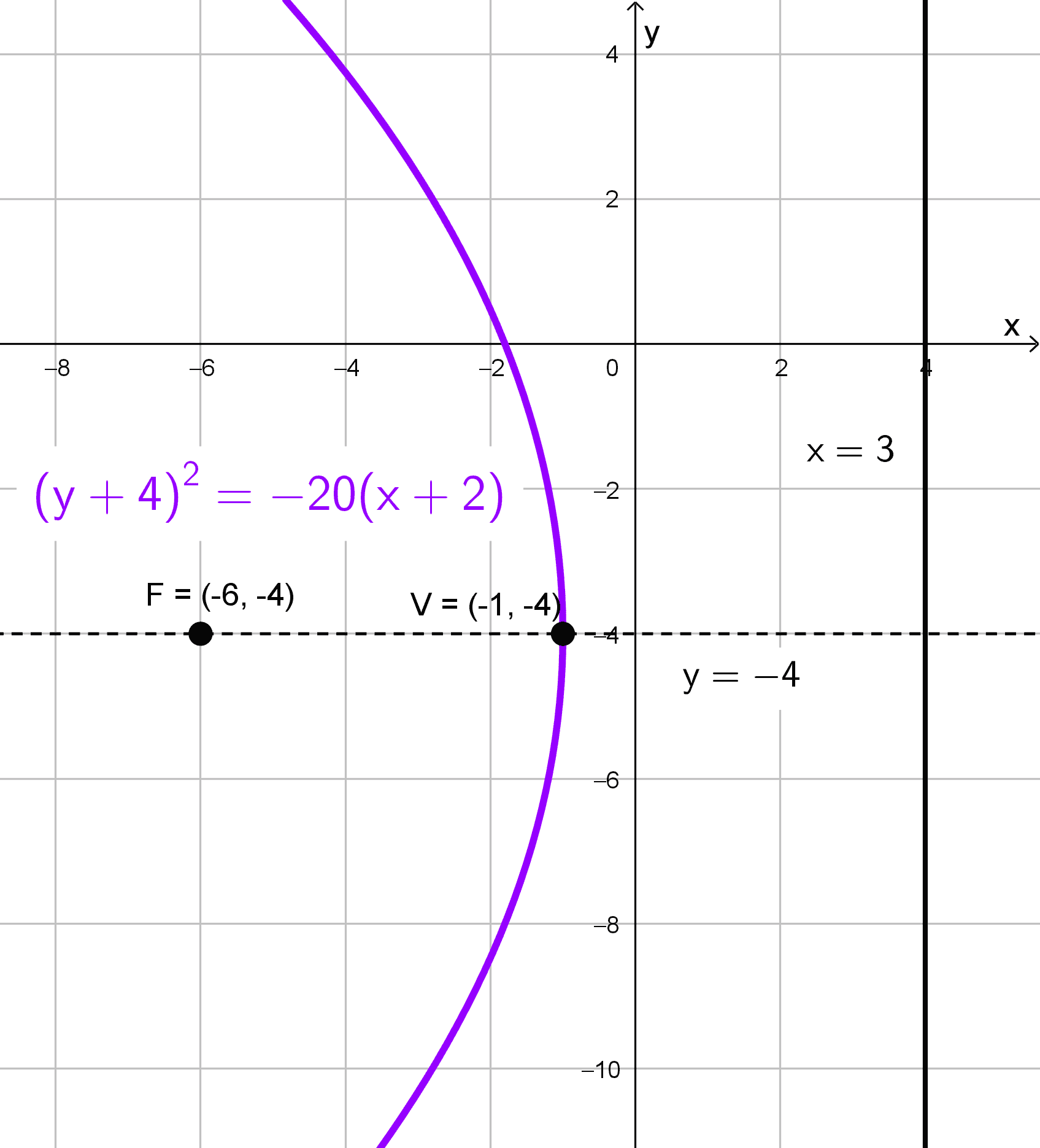
The equation is \(8y+56=-y^2-20x.\) Rearranging terms and completing the square gives \((y+4)^2=-20(x+2).\)
This equation corresponds to a horizontal parabola with vertex at \((-2, -4).\) Comparing it with \((y-k)^2=4p(x-h),\) we find \(4p=-20,\) so \(p=-5.\) The negative value of \(p\) indicates that the parabola opens to the left.
The focus is at \((h+p, k)=(-2-5, -4)=(-7, -4).\) The directrix is \(x=h-p,\) so \(x=-2-(-5)=3.\) The length of the latus rectum is \(|4p|=20.\) The axis of symmetry is \(y=-4.\)
Elements:
- Vertex: \((-2, -4)\)
- Focus: \((-7, -4)\)
- Directrix: \(x=3\)
- Latus rectum: \(L_R=20\)
- Axis of symmetry: \(y=-4\)
Resource: If you are working through practice problems and want to check your answers, you can use our free tool:
Converting from General Form to Standard Form
Problem 6: Convert the following parabolic equations into standard form:
- \(4x^2-12x-16y+41=0\)
- \(16y^2+8y-24x+49=0\)
- \(x^2+2x=-4y+19\)
- \(8y+56=-y^2-20x\)
Solutions
Solution 1
Start with the equation \(4x^2-12x-16y+41=0.\) First, group the terms containing \(x\) and complete the square:
$$4x^2-12x=4(x^2-3x)$$
To complete the square, add and subtract \(\left (\dfrac{3}{2}\right)^2=2.25\) inside the parentheses:
$$4\left(x^2-3x+2.25-2.25\right)=4\left((x-1.5)^2-2.25\right)=4(x-1.5)^2-9$$
Substituting back into the original equation:
$$4(x-1.5)^2-9-16y+41=0 → 4(x-1.5)^2-16y+32=0$$
Isolate the \(y\) term:
$$4(x-1.5)^2+32=16y → y=\dfrac{1}{4}(x-1.5)^2+2$$
The standard form is:
$$(x-1.5)^2=4(y-2)$$
where the vertex is at \((1.5, 2)\) and \(4p=4\) implies \(p=1.\)
Solution 2
Given the equation \(16y^2+8y-24x+49=0,\) group the \(y\) terms and complete the square:
$$16y^2+8y=16\left(y^2+0.5y\right)$$
Add and subtract \(\left (\dfrac{0.5}{2}\right)^2=0.0625:\)
$$16\left(y^2+0.5y+0.0625-0.0625\right)=16\left((y+0.25)^2-0.0625\right)=16(y+0.25)^2-1$$
Substituting into the original equation:
$$16(y+0.25)^2-1-24x+49=0 → 16(y+0.25)^2-24x+48=0$$
Isolate the \(x\) term:
$$16(y+0.25)^2+48=24x → x=\dfrac{2}{3}(y+0.25)^2+2$$
The standard form is:
$$(y+0.25)^2=\dfrac{3}{2}(x-2)$$
with vertex at \((2, -0.25)\) and \(4p=\dfrac{3}{2}\) implying \(p=\dfrac{3}{8}.\)
Solution 3
The equation \(x^2+2x=-4y+19\) can be rearranged as \(x^2+2x+4y-19=0.\) Complete the square for \(x:\)
$$x^2+2x=(x^2+2x+1)-1=(x+1)^2-1$$
Substituting:
$$(x+1)^2-1+4y-19=0 → (x+1)^2+4y-20=0$$
Isolate the \(y\) term:
$$(x+1)^2=-4y+20 → (x+1)^2=-4(y-5)$$
The standard form reveals a vertex at \((-1, 5)\) and \(4p=-4\) implies \(p=-1.\)
Solution 4
Rearrange \(8y+56=-y^2-20x\) as \(y^2+8y+20x+56=0.\) Complete the square for \(y:\)
$$y^2+8y=(y^2+8y+16)-16=(y+4)^2-16$$
Substituting:
$$(y+4)^2-16+20x+56=0 → (y+4)^2+20x+40=0$$
Isolate the \(x\) term:
$$(y+4)^2=-20x-40 → (y+4)^2=-20(x+2)$$
The standard form has a vertex at \((-2, -4)\) and \(4p=-20\) implies \(p=-5.\)
Converting from Standard Form to General Form
Problem 7: Convert the following parabolic equations into general form:
- \((y-2)^2=8(x+1)\)
- \((x+4)^2=16(y+2)\)
- \((x-3)^2=-(y+1)\)
- \((y+1)^2=-4(x-2)\)
Solutions
Solution 1
Start with \((y-2)^2=8(x+1).\) To convert to general form, expand the binomial and distribute the terms:
$$y^2-4y+4=8x+8$$
Next, move all terms to one side of the equation to set it equal to zero:
$$y^2-4y+4-8x-8=0$$
Combine constant terms:
$$y^2-8x-4y-4=0$$
Solution 2
Start with \((x+4)^2=16(y+2).\) Expand the squared binomial:
$$x^2+8x+16=16y+32$$
Move all terms to one side:
$$x^2+8x+16-16y-32=0$$
Combine constants:
$$x^2+8x-16y-16=0$$
Solution 3
Consider \((x-3)^2=-(y+1).\) Expand the square:
$$x^2-6x+9=-y-1$$
Move all terms to one side:
$$x^2-6x+9+y+1=0$$
Simplify:
$$x^2-6x+y+10=0$$
Solution 4
Start with \((y+1)^2=-4(x-2).\) Expand the binomial:
$$y^2+2y+1=-4x+8$$
Collect all terms on one side:
$$y^2+2y+1+4x-8=0$$
Simplify:
$$y^2+4x+2y-7=0$$
Parabola Word Problems
Below are real-world application word problems involving parabolas in science and engineering.
Problem 8
The two support towers of a suspension bridge are 400 meters apart and rise 90 meters above the roadbed. The main cable (which forms a parabola) is tangent to the roadbed at the center of the bridge. Determine the height of the cable above the roadbed at 30 meters and at 75 meters from the center of the bridge. (Assume the roadbed is horizontal).
Solution
To model this situation, place the coordinate system with the origin at the center of the bridge, where the cable touches the roadbed. The parabola has its vertex at \((0, 0)\) and opens upward, so its equation is:
$$y=ax^2$$
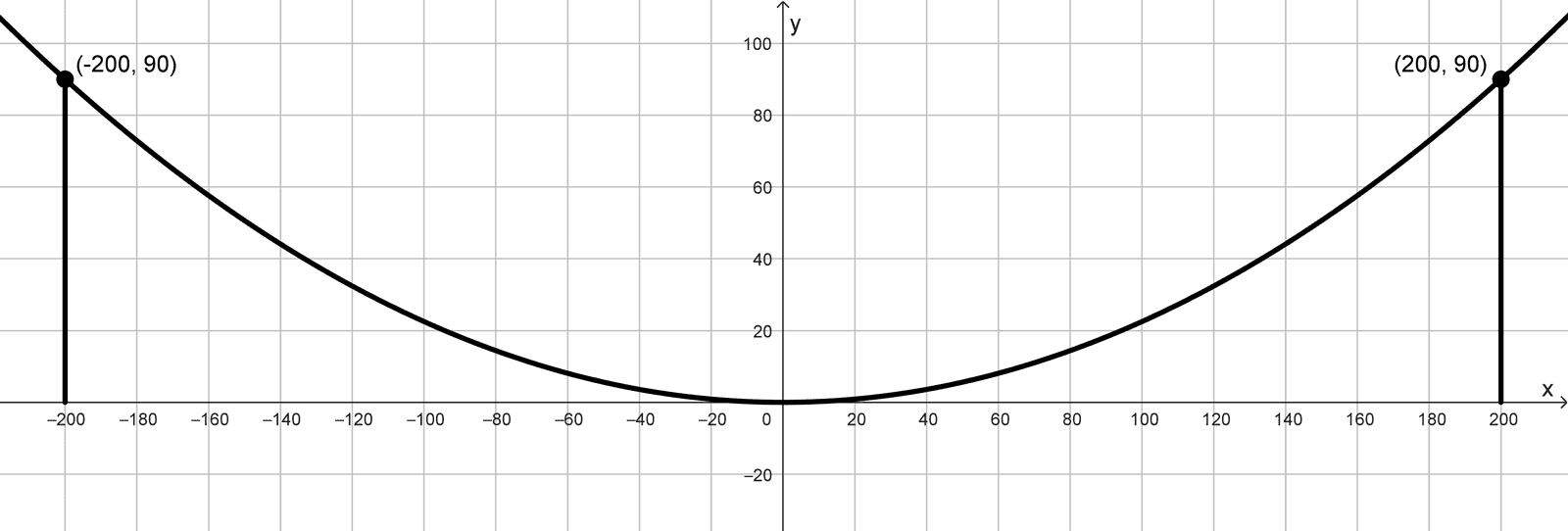
Since the towers are 400 meters apart, each tower is located at \(x=200\) and \(x=-200.\) The height of the towers is 90 meters, meaning the points \((200, 90)\) and \((-200, 90)\) lie on the parabola. Substituting one of these points into the equation:
$$90=a(200)^2 → a=\dfrac{90}{40000}=\dfrac{9}{4000}$$
Thus, the equation of the cable is:
$$y=\dfrac{9}{4000}x^2$$
To find the height of the cable 30 meters from the center, substitute \(x=30:\)
$$y=\dfrac{9}{4000}(30)^2=\dfrac{9 \times 900}{4000}=\dfrac{8100}{4000}=2.025 \text{ meters}$$
For \(x=75\) meters:
$$y=\dfrac{9}{4000}(75)^2=\dfrac{9 \times 5625}{4000}=\dfrac{50625}{4000}=12.65625 \text{ meters}$$
Final answer:
- At 30 meters from the center: \(\boxed{2.03 \text{ meters}}\) (rounded to the nearest hundredth).
- At 75 meters from the center: \(\boxed{12.66 \text{ meters}}\) (rounded to the nearest hundredth).
Problem 9
The entrance of a storage warehouse is shaped like a parabolic arch. The height at the center of the entrance is 4 meters, and the width at the base is 6 meters. A rectangular container needs to be moved into the warehouse. If the container is 3 meters tall, what is the maximum possible width it can have to fit through the entrance?
Solution
To model the parabolic arch of the entrance, place the coordinate system with the origin at the vertex of the parabola (the highest point of the arch). Since the maximum height is 4 meters and the width at the base is 6 meters, the endpoints of the base are at \((-3, -4)\) and \((3, -4),\) representing a total width of 6 meters (3 meters on each side).
The equation of a parabola with vertex at \((0, 0)\) opening downward is:
$$y=ax^2 \quad \text{where} \quad a<0$$
Since the parabola passes through \((3, -4),\) substitute to solve for \(a:\)
$$-4=a(3)^2 → a=-\dfrac{4}{9}$$
Thus, the equation of the arch is:
$$y=-\dfrac{4}{9}x^2$$
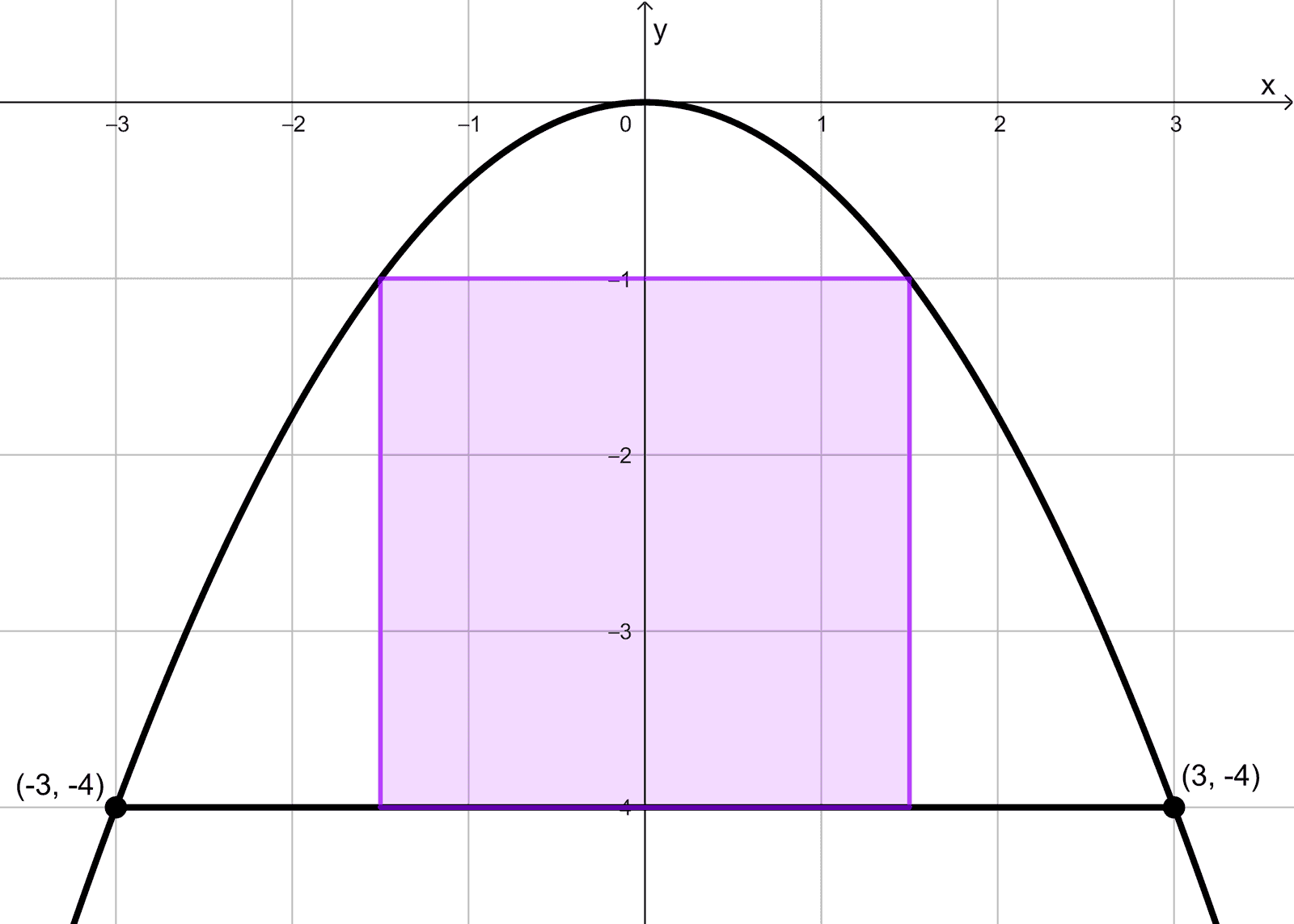
The container has a height of 3 meters. To find its maximum width, we need to determine the horizontal distance (\(x\)) from the center where the arch has an effective clearance of 3 meters. Because the vertex is at \(y=0\) and the base is at \(y=-4,\) a height of 3 meters corresponds to \(y=-1\) (leaving \(4-3=1\) meter of space at the top).
Substituting \(y=-1\) into the equation:
$$-1=-\dfrac{4}{9}x^2 → x^2=\dfrac{9}{4} → x=\pm \dfrac{3}{2}$$
This means the corners of the container would touch the arch at \(x=-1.5\) and \(x=1.5.\) Therefore, the maximum allowable width of the container is:
$$2 \times 1.5=3 \text{ meters}$$
Problem 10
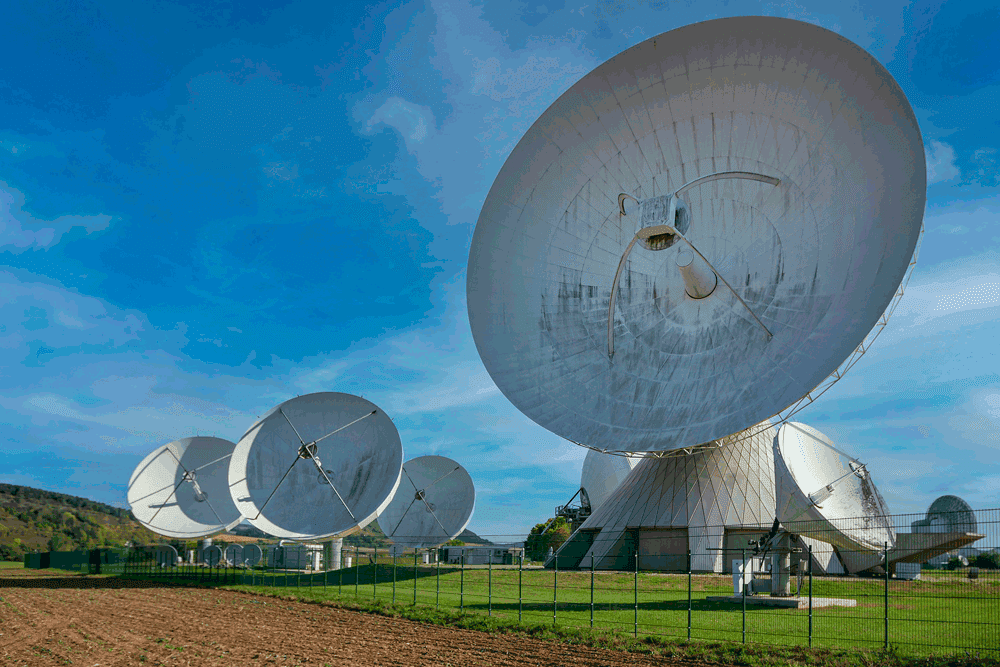
The diameter of a satellite dish is 1.5 meters and its depth is 25 centimeters. At what height above the vertex should the receiver be placed?
Solution
A parabolic satellite dish is designed to reflect incoming parallel waves directly toward a single point. This relies on the reflective property of parabolas: any ray parallel to the axis of symmetry reflecting off the parabolic surface passes directly through the focus. Therefore, the receiver must be positioned at the focus to collect the incoming signals efficiently.
To determine where to place the receiver, we model the cross-section of the dish as a parabola. Assume the vertex is at the origin \((0, 0)\) and the parabola opens upward. The standard equation is:
$$y=\dfrac{1}{4p}x^2$$
where \(p\) is the distance from the vertex to the focus.
Given values:
- Diameter of the dish: 1.5 meters → radius = 0.75 meters.
- Depth: 25 centimeters = 0.25 meters.
The depth corresponds to the y-value when \(x=0.75\) (at the outer rim of the dish). Substituting into the equation:
$$0.25=\dfrac{1}{4p}(0.75)^2$$
Solving for \(p:\)
$$0.25=\dfrac{0.5625}{4p} \quad → \quad 4p=\dfrac{0.5625}{0.25}=2.25 \quad → \quad p=\dfrac{2.25}{4}=0.5625 \text{ meters}$$
Therefore, the receiver should be placed 56.25 centimeters (0.5625 meters) above the vertex of the dish.
Did you find this useful? Rate it!

Leave a Reply