
Ellipse Practice Problems with Solutions
In this article, we will work through step-by-step ellipse practice problems in mathematics for all skill levels. If you are not yet familiar with the core definitions and key properties, be sure to review our main guide first, where we cover the definition, formulas, parts, characteristics, and basic examples:
Table of Contents
Finding the Equation of an Ellipse from Given Information
The following practice problems involve finding either the standard form or the general form of an ellipse given specific geometric properties, such as its foci, a point on the curve, axis lengths, or vertices.
Finding the Equation Given the Foci and a Point
Recall that an ellipse is the set of all points where the sum of the distances to two fixed points, called the foci, is constant and equal to the length of the major axis, 2a. In the following examples, we will determine the equation knowing only the coordinates of the foci and one point on the ellipse.
Problem 1
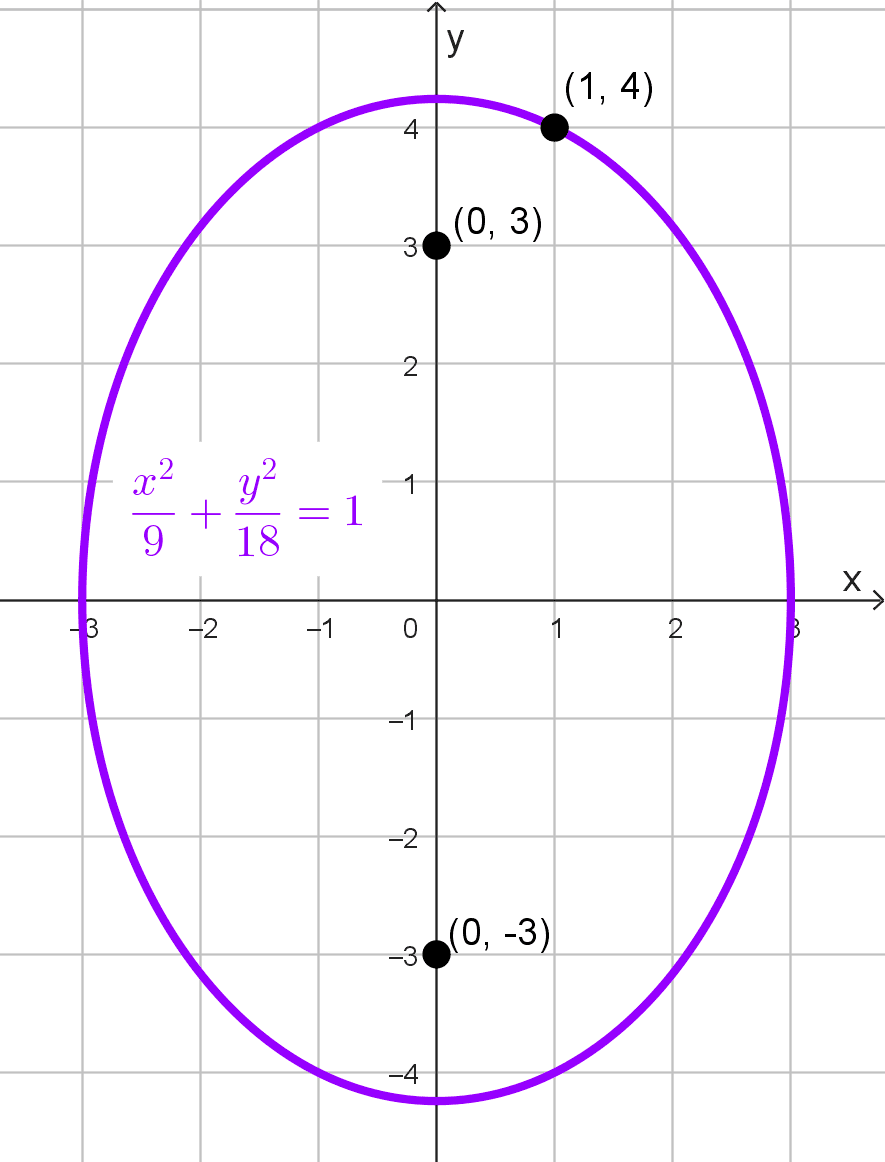
Find the standard equation of the ellipse with foci at F1(0, -3) and F2(0, 3) that passes through the point P(1, 4).
Solution
We begin with the geometric definition of an ellipse:
$$d(F_1,P)+d(F_2,P)=2a$$
Using the distance formula, we find the distance from each focus to the given point.
Distance from \(F_1(0,-3)\) to \(P(1,4):\)
$$d(F_1,P)=\sqrt{(1-0)^2+(4-(-3))^2}=\sqrt{1^2+(4+3)^2}=\sqrt{1+49}=\sqrt{50}=5\sqrt{2}$$
Distance from \(F_2(0,3)\) to \(P(1,4):\)
$$d(F_2,P)=\sqrt{(1-0)^2+(4-3)^2}=\sqrt{1^2+1^2}=\sqrt{1+1}=\sqrt{2}$$
Now, compute 2a:
$$2a=d(F_1,P)+d(F_2,P)=5\sqrt{2}+\sqrt{2}=6\sqrt{2}$$
Therefore:
$$a=\dfrac{6\sqrt{2}}{2}=3\sqrt{2}$$
The center of the ellipse is the midpoint between the foci:
$$\text{Center}=\left(0,\dfrac{-3+3}{2}\right)=(0,0)$$
Because the foci lie on the y-axis, the ellipse is vertically oriented. Its standard form equation is:
$$\dfrac{x^2}{b^2}+\dfrac{y^2}{a^2}=1$$
The focal distance 2c equals the distance between the two foci:
$$2c=6 \implies c=3$$
Next, we use the fundamental relationship for an ellipse:
$$c^2=a^2-b^2 \implies b^2=a^2-c^2$$
Since \(a=3\sqrt{2},\) we have:
$$a^2=(3\sqrt{2})^2=9\cdot2=18$$
Substitute \(a^2\) and \(c^2:\)
$$b^2=a^2-c^2=18-9=9$$
Finally, substitute \(a^2=18\) and \(b^2=9\) into the standard equation:
$$\dfrac{x^2}{b^2}+\dfrac{y^2}{a^2}=1$$
$$\dfrac{x^2}{9}+\dfrac{y^2}{18}=1$$
Problem 2
Find the standard equation of the ellipse with foci F1(-2, 0) and F2(2, 0) that passes through the point P(3, 1).
Solution
We apply the geometric definition of an ellipse:
$$d(F_1, P)+d(F_2,P)=2a$$
Calculate the distance from each focus to point P using the distance formula:
Distance from F1(-2, 0) to P(3, 1):
$$d(F_1, P)=\sqrt{(3-(-2))^2+(1-0)^2}=\sqrt{(3+2)^2+1^2}=\sqrt{25+1}=\sqrt{26}$$
Distance from F2(2, 0) to P(3, 1):
$$d(F_2, P)=\sqrt{(3-2)^2+(1-0)^2}=\sqrt{1^2+1^2}=\sqrt{2}$$
Summing both distances yields the value of 2a:
$$2a=d(F_1, P)+d(F_2,P)=\sqrt{26}+\sqrt{2}$$
Next, find the center of the ellipse as the midpoint between the foci, which is the origin (0, 0). Because the foci lie along the x-axis, this is a horizontal ellipse with the following standard form:
$$\dfrac{x^2}{a^2}+\dfrac{y^2}{b^2}=1$$
The distance between the foci is 4 units, so:
$$2c=4 \implies c=2$$
Using the relationship between a, b, and c:
$$c^2=a^2-b^2 \implies b^2=a^2-c^2$$
Since \(2a=\sqrt{26}+\sqrt{2},\) we have \(a=\dfrac{\sqrt{26}+\sqrt{2}}{2}.\)
Now calculate \(b^2:\)
$$b^2=a^2-c^2$$
$$=\left(\dfrac{\sqrt{26}+\sqrt{2}}{2}\right)^2-(2)^2$$
$$=\dfrac{(\sqrt{26}+\sqrt{2})^2}{4}-4$$
Substituting \(a^2\) and \(b^2\) gives the standard equation:
$$\dfrac{x^2}{a^2}+\dfrac{y^2}{b^2}=1$$
$$\dfrac{x^2}{\dfrac{(\sqrt{26}+\sqrt{2})^2}{4}}+\dfrac{y^2}{\dfrac{(\sqrt{26}+\sqrt{2})^2}{4}-4}=1$$
Simplifying the denominators:
$$\dfrac{x^2}{7+\sqrt{13}}+\dfrac{y^2}{3+\sqrt{13}}=1$$
Problem 3
Find the standard equation of the ellipse with foci at (2, 3) and (2, 7) that passes through the point (4, 5).
Solution
We use the definition of an ellipse:
$$d(F_1,P)+d(F_2,P)=2a$$
Calculate the distance from each focus to point P(4, 5):
Distance from F1(2, 3) to P(4, 5):
$$d(F_1,P)=\sqrt{(4-2)^2+(5-3)^2}=\sqrt{2^2+2^2}=\sqrt{4+4}=\sqrt{8}=2\sqrt{2}$$
Distance from F2(2, 7) to P(4, 5):
$$d(F_2,P)=\sqrt{(4-2)^2+(5-7)^2}=\sqrt{2^2+(-2)^2}=\sqrt{4+4}=\sqrt{8}=2\sqrt{2}$$
Compute 2a:
$$2a=d(F_1,P)+d(F_2,P)=2\sqrt{2}+2\sqrt{2}=4\sqrt{2}$$
Therefore:
$$a=\dfrac{4\sqrt{2}}{2}=2\sqrt{2}$$
The center is the midpoint between the foci:
$$\text{Center}=\left(\dfrac{2+2}{2},\dfrac{3+7}{2}\right)=(2,5)$$
Because the foci share the same x-coordinate (x = 2), the ellipse is oriented vertically. Its standard form equation is:
$$\dfrac{(x-h)^2}{b^2}+\dfrac{(y-k)^2}{a^2}=1$$
where the center is \((h, k)=(2, 5).\)
The distance between the foci gives 2c:
$$2c=7-3=4 \implies c=2$$
Using the relationship \(c^2=a^2-b^2 \implies b^2=a^2-c^2:\)
$$a^2=(2\sqrt{2})^2=4\cdot2=8$$
$$c^2=2^2=4$$
Substitute these values to solve for \(b^2:\)
$$b^2=a^2-c^2=8-4=4$$
Substituting \(h=2, k=5, a^2=8,\) and \(b^2=4\) into the standard form yields:
$$\dfrac{(x-2)^2}{4}+\dfrac{(y-5)^2}{8}=1$$
Finding the Equation Given the Axes and Key Features
In this section, we determine the standard equation when given the foci and an axis length, or given the center and both axis lengths.
Problem 4
Determine the standard equation of the ellipse with foci at (2, 0) and (2, -6) whose major axis has a length of 10.
Solution
The center is the midpoint between the two foci:
$$\text{Center}=\left(\dfrac{2+2}{2},\dfrac{0+(-6)}{2}\right)=(2, -3)$$
Since the foci share the coordinate x = 2, the major axis is vertical. The standard form is:
$$\dfrac{(x-h)^2}{b^2}+\dfrac{(y-k)^2}{a^2}=1$$
where (h, k) = (2, -3).
The major axis has length 10, meaning 2a = 10, which gives \(a=5\) and \(a^2=25.\) The distance between the foci is \(2c=6 \implies c=3 \implies c^2=9.\)
Find \(b^2\) using the characteristic equation:
$$b^2=a^2-c^2$$
$$b^2=25-9$$
$$b^2=16$$
Substitute the center and axis parameters into the standard equation:
$$\dfrac{(x-h)^2}{b^2}+\dfrac{(y-k)^2}{a^2}=1$$
$$\dfrac{(x-2)^2}{16}+\dfrac{(y+3)^2}{25}=1$$
Problem 5
Find the standard equation of the ellipse whose vertices are (-2, 4) and (4, 4), with one focus located at (3, 4).
Solution
The center is the midpoint between the vertices:
$$\text{Center}=\left(\dfrac{-2+4}{2},\dfrac{4+4}{2}\right)=(1,4)$$
Because the vertices vary along the x-coordinate, the major axis is horizontal. The standard form is:
$$\dfrac{(x-h)^2}{a^2}+\dfrac{(y-k)^2}{b^2}=1$$
where \((h,k)=(1,4).\)
The distance between the vertices equals the length of the major axis, 2a:
$$2a=\sqrt{(4-(-2))^2+(4-4)^2}=6 \implies a=3 \implies a^2=9$$
The distance from the center to a focus is c. Given one focus at (3, 4):
$$c=\sqrt{(3-1)^2+(4-4)^2}=2 \implies c^2=4$$
We find \(b^2\) using the relationship \(b^2=a^2-c^2:\)
$$b^2=9-4=5$$
Finally, substitute \(h, k, a^2,\) and \(b^2\) into the standard form:
$$\dfrac{(x-h)^2}{a^2}+\dfrac{(y-k)^2}{b^2}=1$$
$$\dfrac{(x-1)^2}{9}+\dfrac{(y-4)^2}{5}=1$$
Finding the Equation of an Ellipse Passing Through Four Points
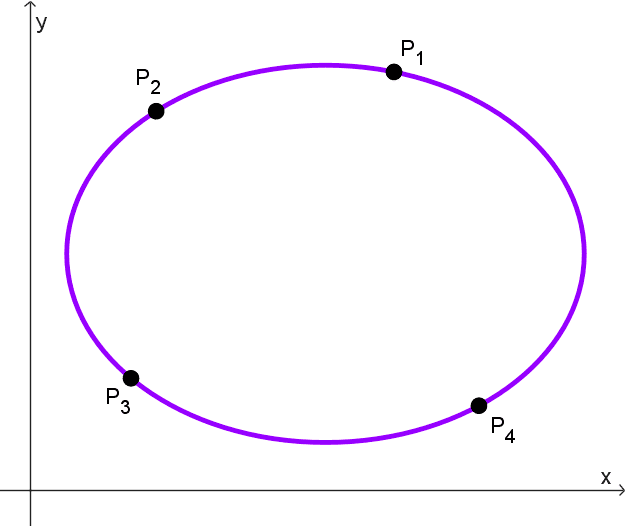
To find the general equation of an ellipse passing through four given points, substitute each point into the general equation (setting A = 1) to set up a system of linear equations in four variables. Solving the system yields the unknown coefficients.
Problem 6
Find the general equation of the ellipse passing through the points (0, -1), (2, 0), (4, -1), and (2, -2).
Solution
Substitute each point into the general form equation of an ellipse setting A = 1: x2 + Cy2 + Dx + Ey + F = 0.
For point (0, -1):
$$(0)^2+(-1)^2C+(0)D+(-1)E+F=0 \implies C-E+F=0$$
For point (2, 0):
$$(2)^2+(0)^2C+(2)D+(0)E+F=0 \implies 2D+F=-4$$
For point (4, -1):
$$(4)^2+(-1)^2C+(4)D+(-1)E+F=0 \implies C+4D-E+F=-16$$
For point (2, -2):
$$(2)^2+(-2)^2C+(2)D+(-2)E+F=0 \implies 4C+2D-2E+F=-4$$
This yields a system of four linear equations:
$$\begin{cases}C-E+F=0 \\2D+F=-4 \\C+4D-E+F=-16 \\4C+2D-2E+F=-4 \end{cases}$$
Solving the system gives:
$$C=4, \quad D=-4, \quad E=8, \quad \text{and} \quad F=4$$
Substituting these values back into the general form:
$$x^2+Cy^2+Dx+Ey+F=0$$
produces the equation of the ellipse:
$$x^2+4y^2-4x+8y+4=0$$
Problem 7
Determine the equation of the ellipse passing through the points \((0, 3), (2, 0), (1, 3\sqrt{3}/2),\) and \((1/2, 3\sqrt{15}/4).\)
Solution
Substitute each point into the general equation taking A = 1:
For point (0, 3):
$$(0)^2+(3)^2C+(0)D+(3)E+F=0 \implies 9C+3E+F=0$$
For point (2, 0):
$$(2)^2+(0)^2C+(2)D+(0)E+F=0 \implies 2D+F=-4$$
For point \((1, 3\sqrt{3}/2):\)
$$(1)^2+\left(\dfrac{3\sqrt{3}}{2}\right)^2C+(1)D+\left(\dfrac{3\sqrt{3}}{2}\right)E+F=0 \implies 27C+4D+6\sqrt{3}E+4F=-4$$
For point \((1/2, 3\sqrt{15}/4):\)
$$\left(\dfrac{1}{2}\right)^2+\left(\dfrac{3\sqrt{15}}{4}\right)^2C+\left(\dfrac{1}{2}\right)D+\left(\dfrac{3\sqrt{15}}{4}\right)E+F=0 \implies 135C+8D+12\sqrt{15}E+16F=-4$$
Solving the four-variable linear system gives:
$$C=\dfrac{4}{9}, \quad D=0, \quad E=0, \quad F=-4$$
Substitute these values into the equation:
$$x^2+Cy^2+Dx+Ey+F=0$$
$$x^2+\dfrac{4}{9}y^2-4=0$$
Multiplying the entire equation by 9 yields the general form:
$$9x^2+4y^2-36=0$$
Helpful Tool: If you are practicing these problems and want to check your answers, use our free online solver:
Finding the Equation of an Ellipse from Its Graph
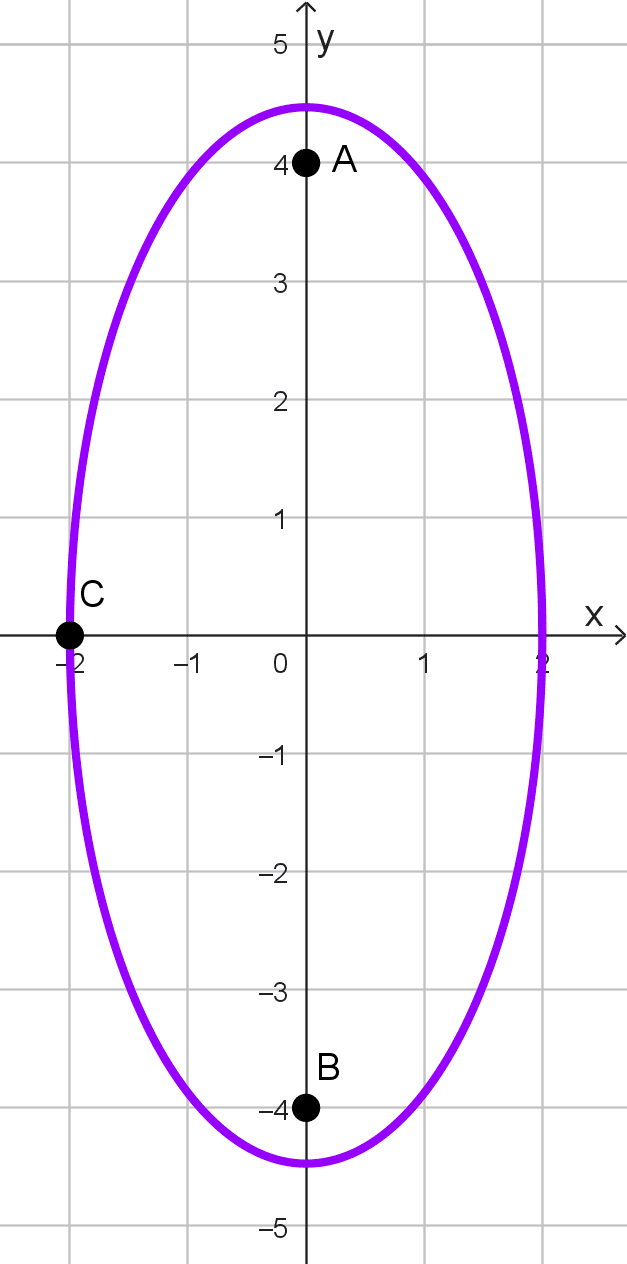
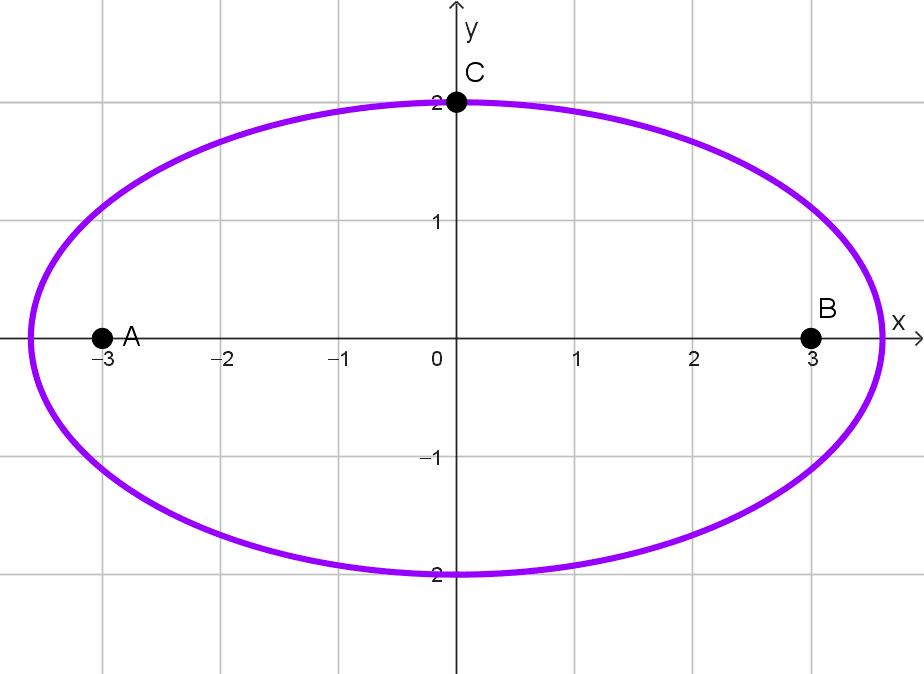
Problem 8: Identify the key geometric elements and write the standard equation for each ellipse shown below:
Solutions
Ellipse A
From the graph, we can observe the following:
- The ellipse is vertically oriented, with foci on the y-axis at (0, -4) and (0, 4).
- The axes of symmetry lie along the coordinate axes.
- The center is at the origin (0, 0).
- A co-vertex is located at (-2, 0), which means the semi-minor axis length is b = 2.
- The focal distance is 2c = 8, so c = 4.
Using the fundamental relationship, find the square of the semi-major axis:
$$c^2=a^2-b^2 \implies a^2=c^2+b^2$$
$$a^2=(4)^2+(2)^2=16+4=20$$
With a center at the origin and a vertical major axis, the standard form is:
$$\dfrac{x^2}{b^2}+\dfrac{y^2}{a^2}=1$$
Substituting the values gives:
$$\dfrac{x^2}{4}+\dfrac{y^2}{20}=1$$
Ellipse B
From the graph, we observe:
- The ellipse is horizontally oriented, with foci on the x-axis at (-3, 0) and (3, 0).
- The axes of symmetry lie along the coordinate axes.
- The center is at the origin (0, 0).
- A co-vertex is located at (0, 2), which means the semi-minor axis length is b = 2.
- The focal distance is 2c = 6, so c = 3.
Using the relationship between a, b, and c:
$$a^2=c^2+b^2=3^2+2^2=9+4=13$$
Writing the standard form equation:
$$\dfrac{x^2}{a^2}+\dfrac{y^2}{b^2}=1$$
$$\dfrac{x^2}{13}+\dfrac{y^2}{4}=1$$
Mixed Practice Problems: Finding Equations and Key Elements
Problem 9: Given each set of conditions below, find the standard equation of the ellipse, determine all its key features (center, foci, vertices, co-vertices, focal distance, focal width, and eccentricity), and graph the curve.
- Center at the origin, a focus at (3, 0), and semi-major axis length equal to 5.
- Major axis on the y-axis, a vertex at (0, 5), a co-vertex at (3, 0), and center at the origin.
- Vertices at (1, -6) and (9, -6), with a focal width (latus rectum) of 9/2.
- Foci at (3, 8) and (3, 2), with a minor axis length of 8.
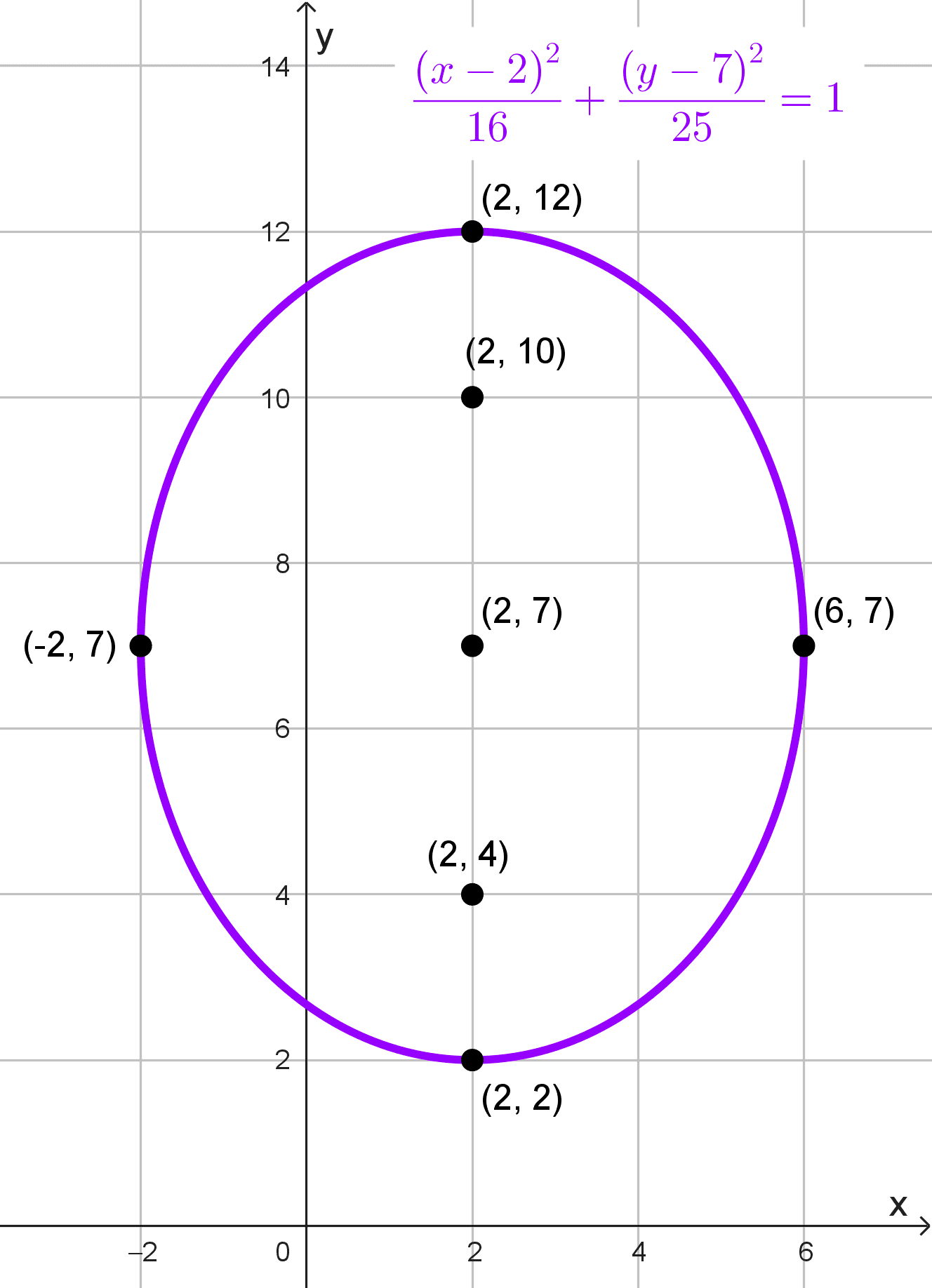
- Foci at (2, 4) and (2, 10), with a vertex at (2, 12).
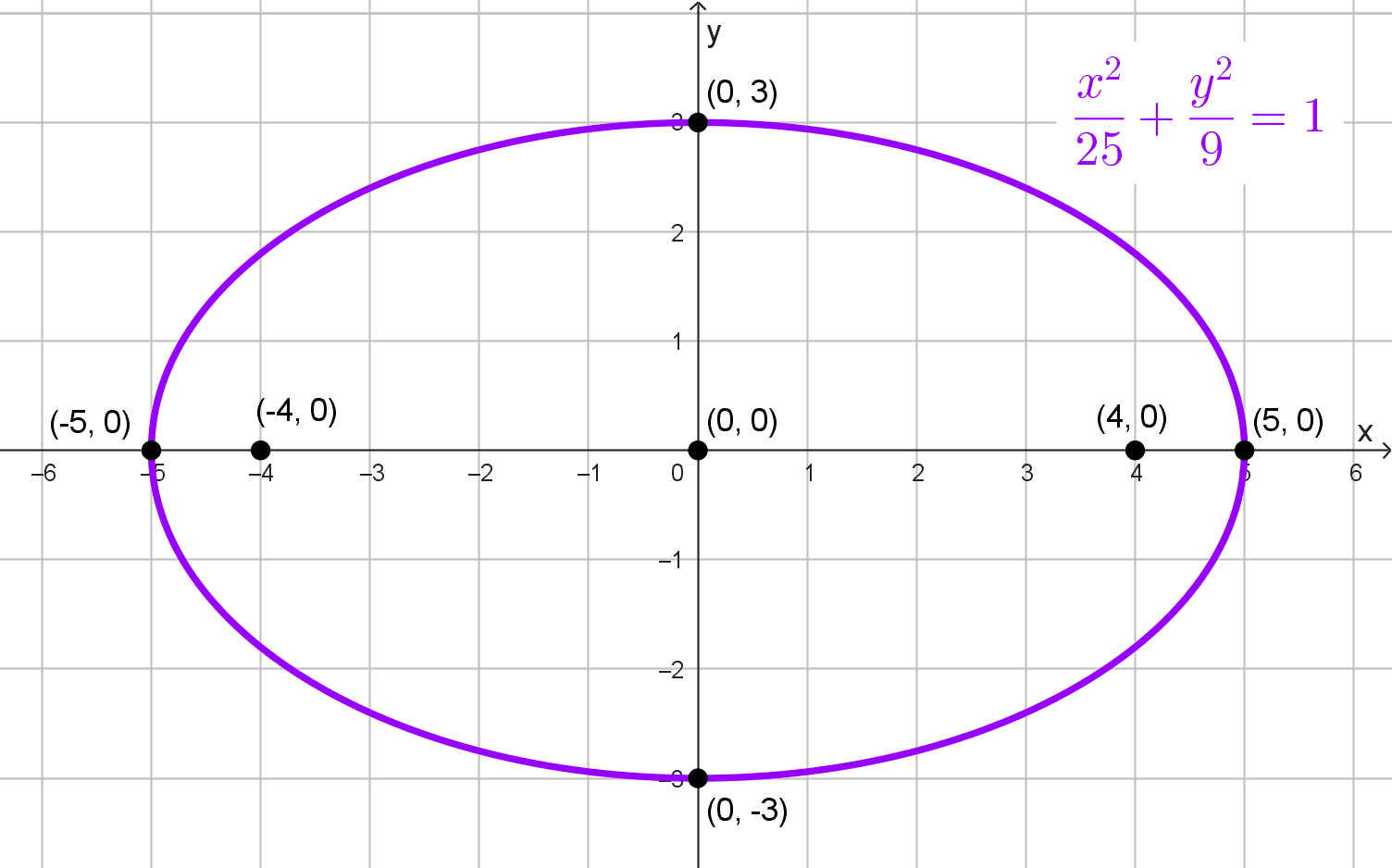
- Vertices at (-5, 0) and (5, 0), with b = 3.
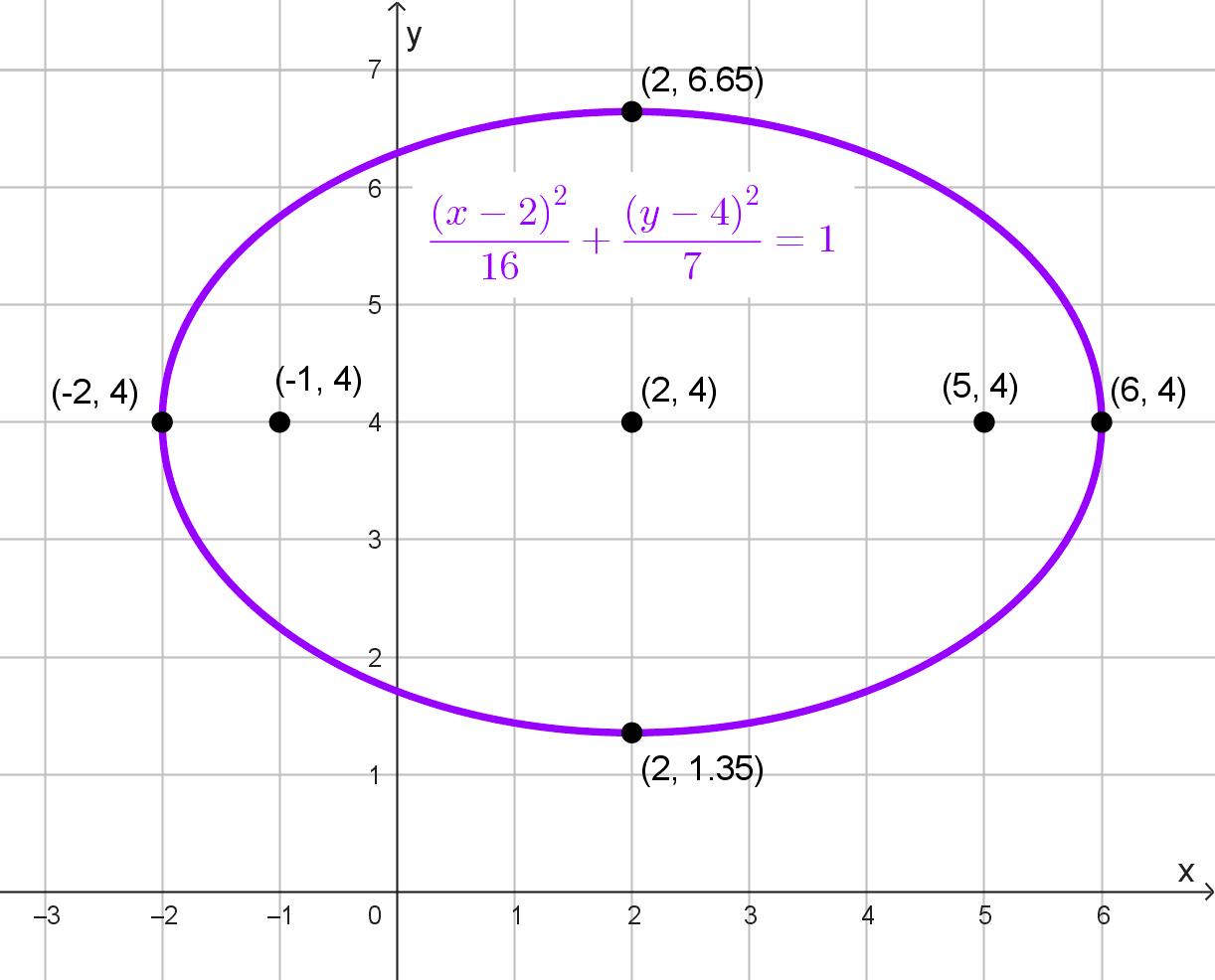
- Vertices at V(6, 4) and V'(-2, 4), with foci at F(5, 4) and F'(-1, 4).
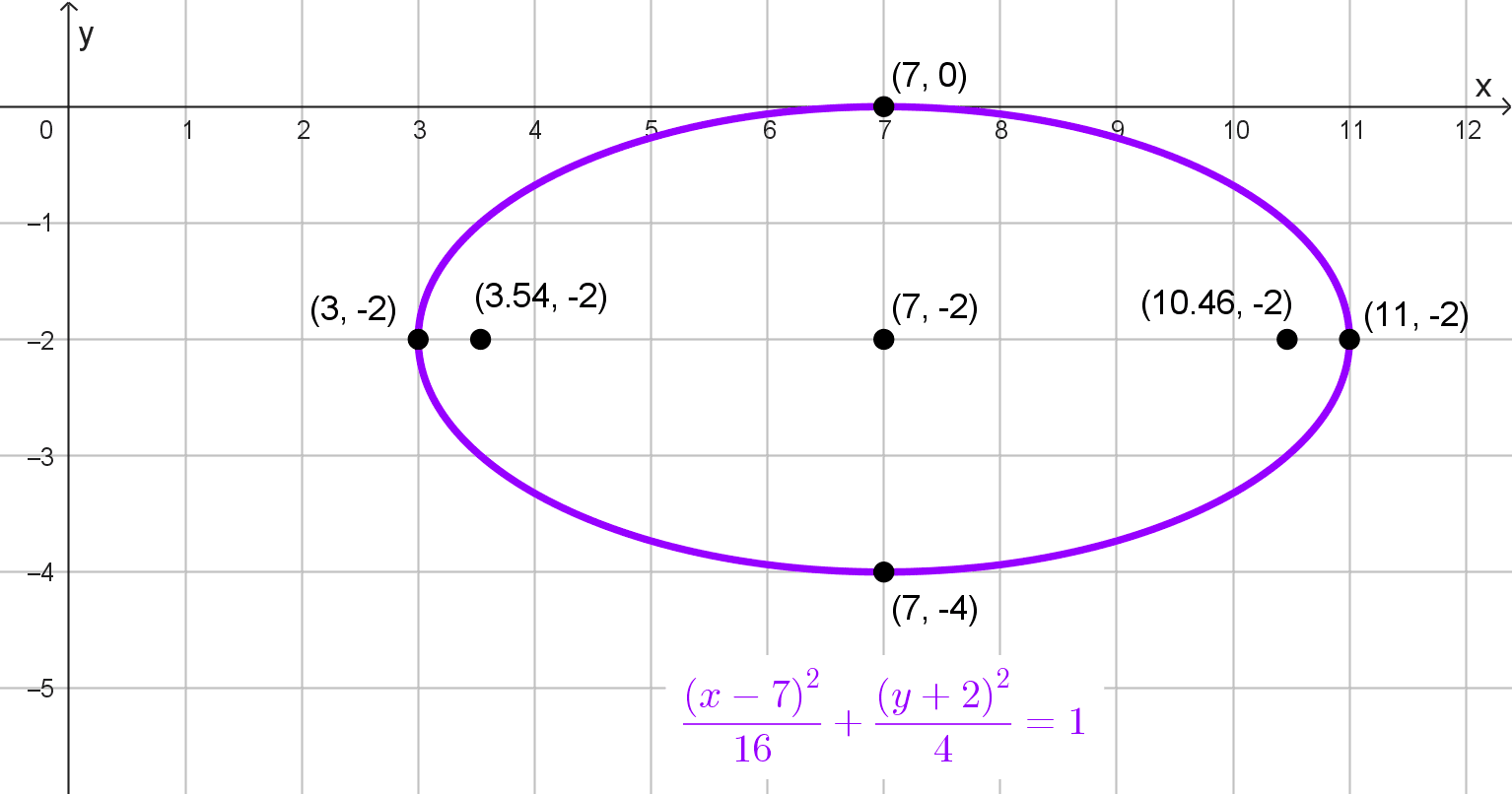
- Center C(7, -2), major axis = 8, minor axis = 4, with focal axis parallel to the x-axis.
- Vertices at (-4, 5) and (16, 5), with an eccentricity of 4/5.
- Eccentricity equal to 2/3 and foci located at (0, 0) and (0, -4).
Solutions
Solution 1
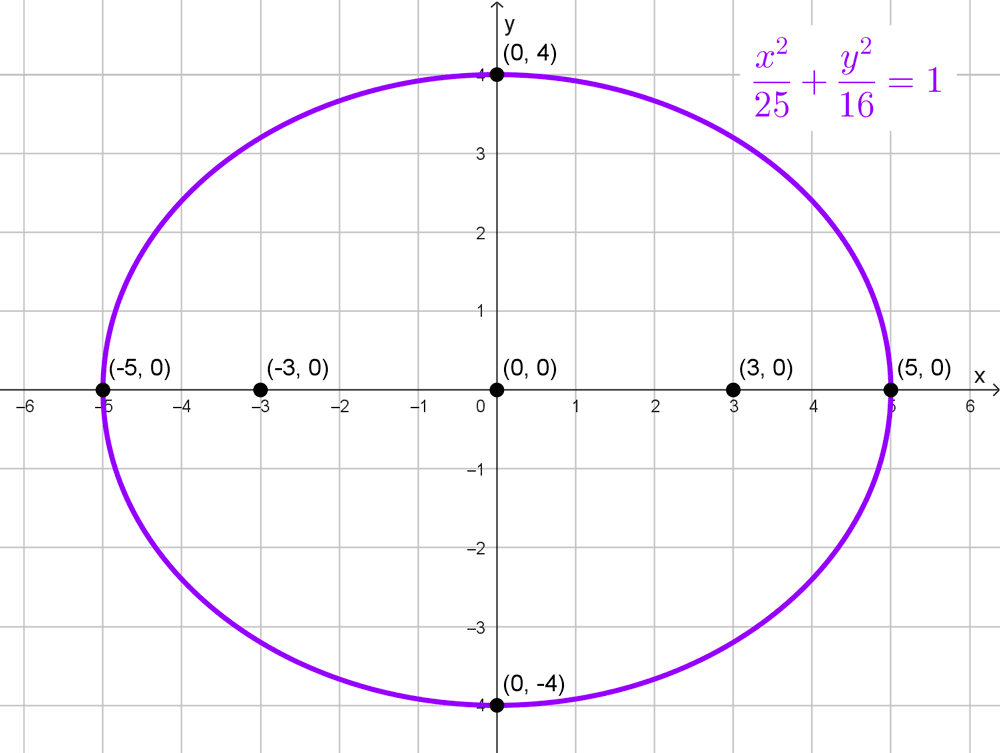
Given information:
- Center: (0, 0)
- Focus: (3, 0)
- Semi-major axis length: a = 5
Because the center and focus lie on the x-axis, the ellipse is horizontally oriented, giving the standard equation form:
$$\dfrac{x^2}{a^2}+\dfrac{y^2}{b^2}=1$$
The distance from the center to the focus gives c = 3. We use the ellipse equation relation to find b:
$$c^2=a^2-b^2 \implies b^2=a^2-c^2$$
$$b^2=5^2-3^2=25-9=16$$
Substituting into standard form:
$$\dfrac{x^2}{25}+\dfrac{y^2}{16}=1$$
Key Elements:
- Foci: (3, 0) and (-3, 0)
- Center: (0, 0)
- Semi-axes: a = 5, b = 4
- Focal distance: 2c = 6
- Vertices: (5, 0) and (-5, 0)
- Co-vertices: (0, 4) and (0, -4)
- Latus rectum (focal width): \(L_R=\dfrac{2b^2}{a}=\dfrac{2\cdot 16}{5}=6.4\)
- Eccentricity: \(e=\dfrac{c}{a}=\dfrac{3}{5}=0.6\)
Solution 2
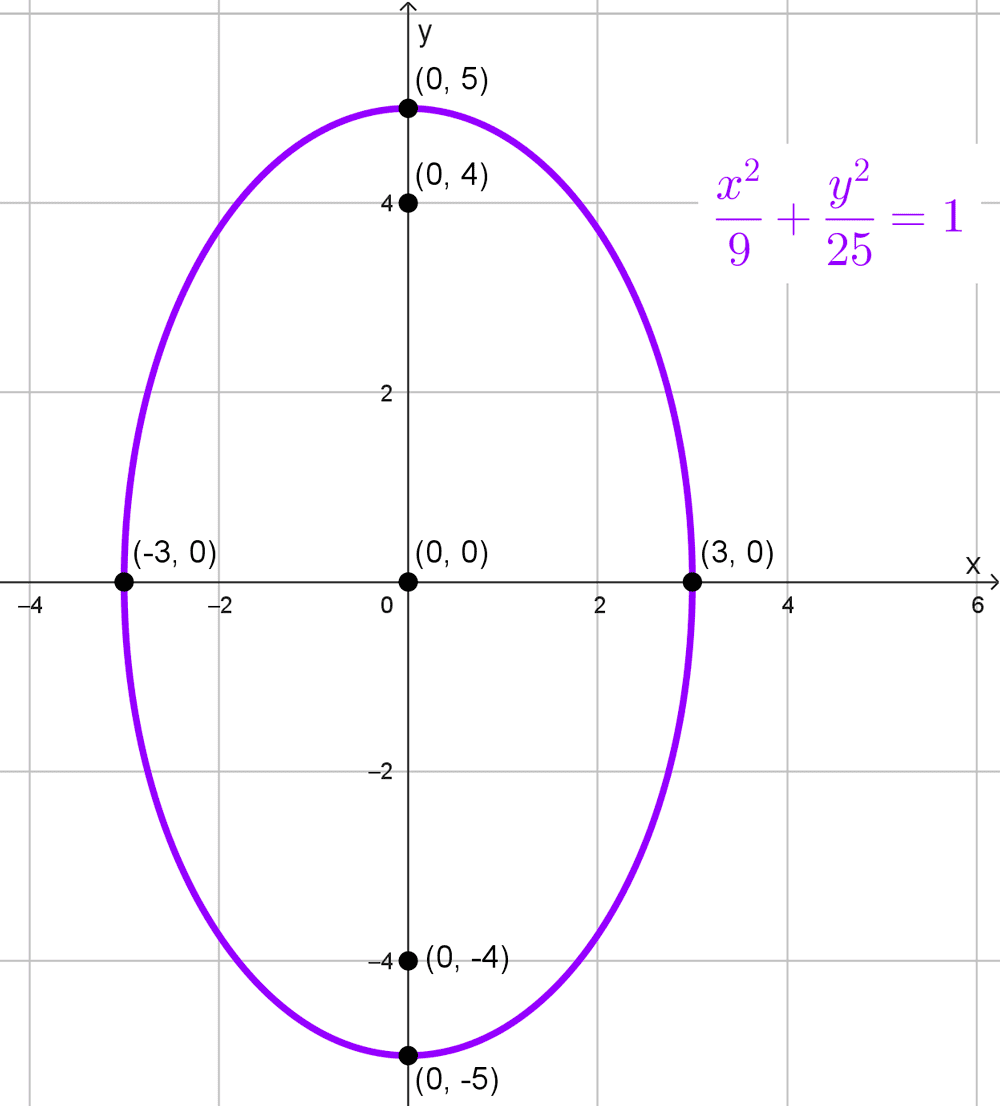
Given information:
- Center: (0, 0)
- Vertex: (0, 5)
- Co-vertex: (3, 0)
- Major axis along the y-axis
The major axis is along the y-axis, so the standard equation is:
$$\dfrac{x^2}{b^2}+\dfrac{y^2}{a^2}=1$$
The vertex at (0, 5) gives a = 5, and the co-vertex at (3, 0) gives b = 3.
Using the ellipse relationship:
$$c^2=a^2-b^2=5^2-3^2=25-9=16 \implies c=4$$
With \(a^2=25\) and \(b^2=9,\) the standard equation is:
$$\dfrac{x^2}{9}+\dfrac{y^2}{25}=1$$
Key Elements:
- Center: (0, 0)
- Foci: (0, 4) and (0, -4)
- Semi-axes: a = 5, b = 3
- Vertices: (0, 5) and (0, -5)
- Co-vertices: (3, 0) and (-3, 0)
- Focal distance: 2c = 8
- Latus rectum (focal width): \(L_R=\dfrac{2b^2}{a}=\dfrac{2\cdot9}{5}=\dfrac{18}{5}=3.6\)
- Eccentricity: \(e=\dfrac{c}{a}=\dfrac{4}{5}=0.8\)
Solution 3
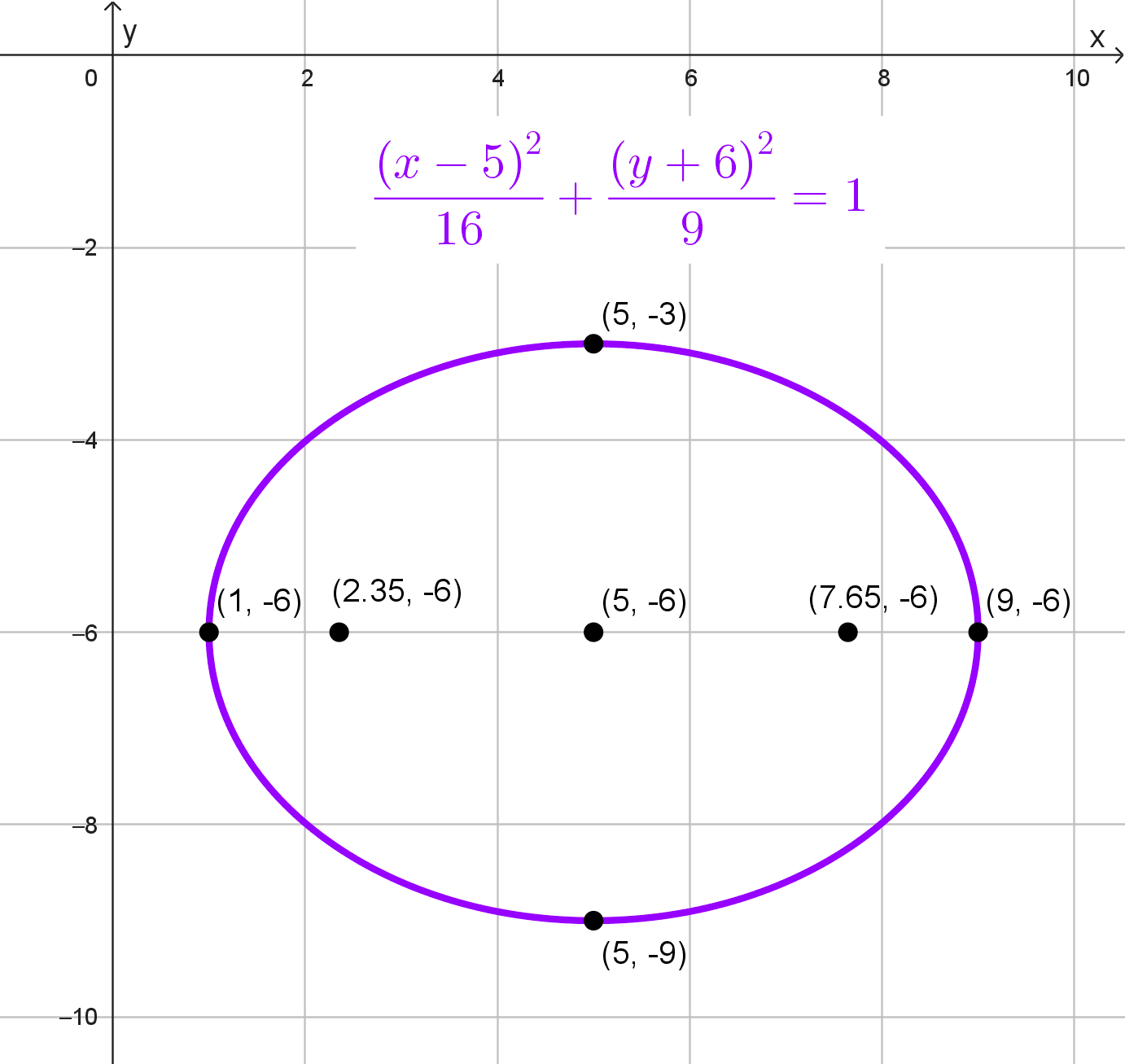
Given information:
- Vertices: (1, -6) and (9, -6)
- Latus rectum (focal width): 9/2
The vertices lie along a horizontal line (y = -6). The center is the midpoint between the vertices:
$$\text{Center}=\left(\dfrac{1+9}{2},-6\right)=(5,-6)$$
Because the major axis is parallel to the x-axis, the standard form is:
$$\dfrac{(x-h)^2}{a^2}+\dfrac{(y-k)^2}{b^2}=1$$
The distance between the center and either vertex gives the semi-major axis length a:
$$a=9-5=4 \implies a^2=16$$
Using the formula for the latus rectum:
$$L_R=\dfrac{2b^2}{a}$$
$$\dfrac{2b^2}{4}=\dfrac{9}{2} \implies b^2=\dfrac{9}{2}\cdot 2=9 \implies b=3$$
Next, determine c:
$$c^2=a^2-b^2=16-9=7 \implies c=\sqrt{7}$$
With \(a^2=16, b^2=9,\) and center at (5, -6), the equation is:
$$\dfrac{(x-5)^2}{16}+\dfrac{(y+6)^2}{9}=1$$
Key Elements:
- Center: (5, -6)
- Foci: \((5-\sqrt{7},-6)\) and \((5+\sqrt{7},-6)\)
- Semi-axes: a = 4, b = 3
- Vertices: (1, -6) and (9, -6)
- Co-vertices: \((5, -3)\) and \((5, -9)\)
- Focal distance: \(2c=2\sqrt{7}\)
- Latus rectum: \(L_R=9/2\)
- Eccentricity: \(e=\dfrac{c}{a}=\dfrac{\sqrt{7}}{4}\approx 0.66\)
Solution 4
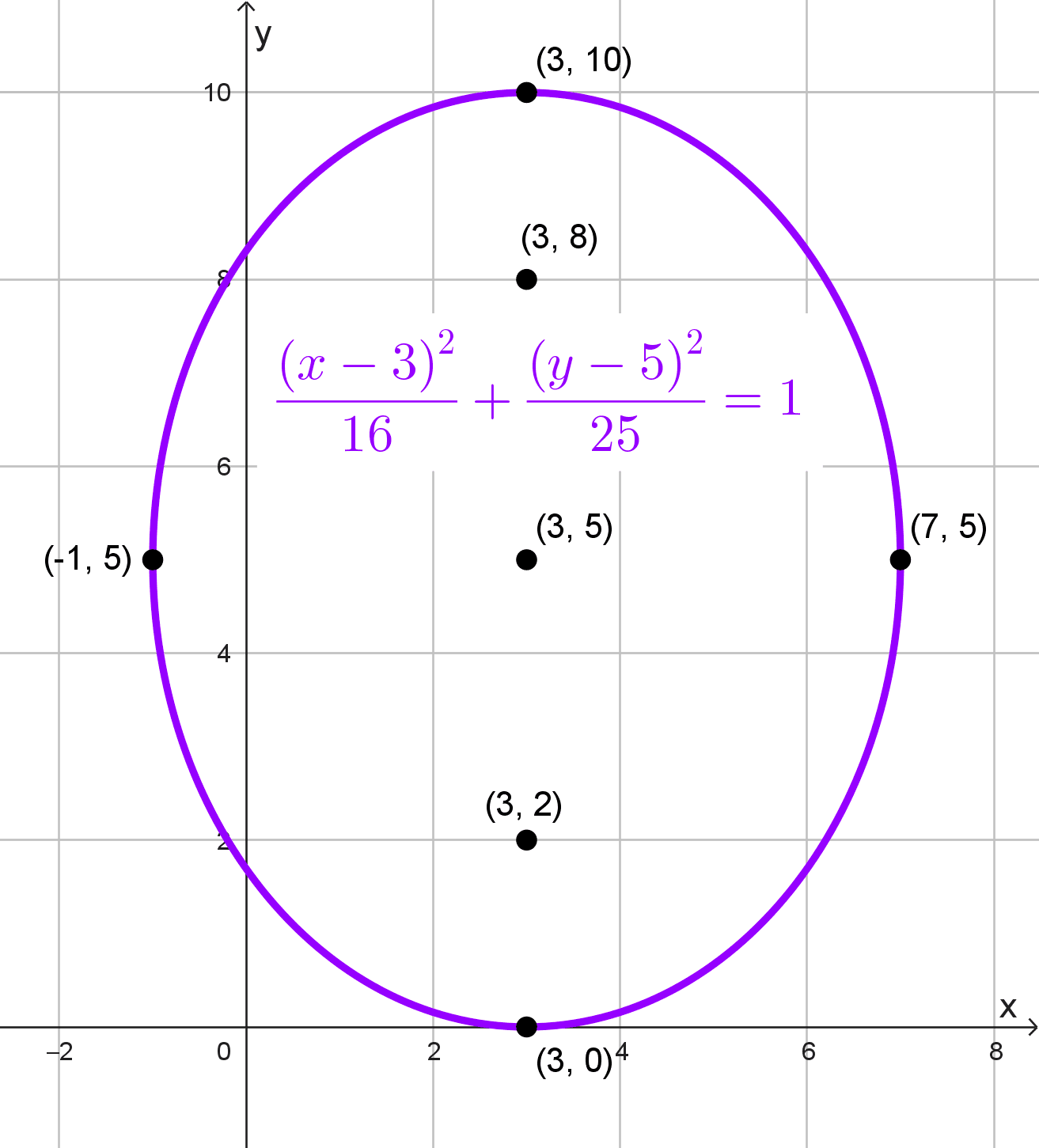
Given information:
- Foci: (3, 8) and (3, 2)
- Minor axis length: 2b = 8
The center is the midpoint between the foci:
$$\text{Center}=\left(\dfrac{3+3}{2},\dfrac{8+2}{2}\right)=(3,5)$$
Because the foci share the same x-coordinate, the ellipse is vertically oriented. The standard form is:
$$\dfrac{(x-h)^2}{b^2}+\dfrac{(y-k)^2}{a^2}=1$$
The distance between the foci is 2c:
$$2c=8-2=6 \implies c=3$$
Since the minor axis length is 2b = 8, we have \(b=4 \implies b^2=16.\)
Now calculate \(a^2:\)
$$a^2=c^2+b^2=3^2+4^2=9+16=25 \implies a=5$$
Substituting into standard form:
$$\dfrac{(x-3)^2}{16}+\dfrac{(y-5)^2}{25}=1$$
Key Elements:
- Center: (3, 5)
- Foci: (3, 8) and (3, 2)
- Semi-axes: a = 5, b = 4
- Vertices: (3, 10) and (3, 0)
- Co-vertices: (7, 5) and (-1, 5)
- Focal distance: 2c = 6
- Latus rectum: \(L_R=\dfrac{2b^2}{a}=\dfrac{2\cdot 16}{5}=6.4\)
- Eccentricity: \(e=\dfrac{c}{a}=\dfrac{3}{5}=0.6\)
Solution 5
Given information:
- Foci: (2, 4) and (2, 10)
- Vertex: (2, 12)
The center is the midpoint between the foci:
$$\text{Center}=\left(\dfrac{2+2}{2},\dfrac{4+10}{2}\right)=(2,7)$$
The foci share the coordinate x = 2, so the ellipse is vertically oriented:
$$\dfrac{(x-h)^2}{b^2}+\dfrac{(y-k)^2}{a^2}=1$$
The distance from the center (2, 7) to the vertex (2, 12) gives a:
$$a=12-7=5 \implies a^2=25$$
The distance between the foci gives 2c:
$$2c=10-4=6 \implies c=3 \implies c^2=9$$
Using \(b^2=a^2-c^2:\)
$$b^2=25-9=16 \implies b=4$$
Substituting into standard form:
$$\dfrac{(x-2)^2}{16}+\dfrac{(y-7)^2}{25}=1$$
Key Elements:
- Center: (2, 7)
- Foci: (2, 10) and (2, 4)
- Semi-axes: a = 5, b = 4
- Vertices: (2, 12) and (2, 2)
- Co-vertices: (6, 7) and (-2, 7)
- Focal distance: 2c = 6
- Latus rectum: \(L_R=\dfrac{2b^2}{a}=\dfrac{2\cdot 16}{5}=6.4\)
- Eccentricity: \(e=\dfrac{c}{a}=\dfrac{3}{5}=0.6\)
Solution 6
Given information:
- Vertices: (-5, 0) and (5, 0)
- Semi-minor axis length: b = 3
The center is the midpoint between the vertices:
$$\text{Center}=\left(\dfrac{-5+5}{2},\dfrac{0+0}{2}\right)=(0,0)$$
The vertices lie along the x-axis, so the ellipse is horizontal:
$$\dfrac{x^2}{a^2}+\dfrac{y^2}{b^2}=1$$
The distance from the center to a vertex is a = 5, so \(a^2=25.\)
Compute c using the relation \(c^2=a^2-b^2:\)
$$c^2=25-3^2=25-9=16 \implies c=4$$
Substitute \(a^2=25\) and \(b^2=9\) into the standard equation:
$$\dfrac{x^2}{25}+\dfrac{y^2}{9}=1$$
Key Elements:
- Center: (0, 0)
- Foci: (-4, 0) and (4, 0)
- Semi-axes: a = 5, b = 3
- Vertices: (-5, 0) and (5, 0)
- Co-vertices: (0, 3) and (0, -3)
- Focal distance: 2c = 8
- Latus rectum: \(L_R=\dfrac{2b^2}{a}=\dfrac{2\cdot 9}{5}=3.6\)
- Eccentricity: \(e=\dfrac{c}{a}=\dfrac{4}{5}=0.8\)
Solution 7
Given information:
- Vertices: V(6, 4) and V'(-2, 4)
- Foci: F(5, 4) and F'(-1, 4)
The center is the midpoint between the vertices:
$$\text{Center}=\left(\dfrac{6+(-2)}{2}, \dfrac{4+4}{2}\right)=(2, 4)$$
Both vertices and foci share y = 4, so the ellipse is horizontally oriented:
$$\dfrac{(x-h)^2}{a^2}+\dfrac{(y-k)^2}{b^2}=1$$
The distance from the center to a vertex gives a:
$$a=6-2=4 \implies a^2=16$$
The distance from the center to a focus gives c:
$$c=5-2=3 \implies c^2=9$$
Compute \(b^2:\)
$$b^2=a^2-c^2=16-9=7 \implies b=\sqrt{7}$$
The standard equation is:
$$\dfrac{(x-2)^2}{16}+\dfrac{(y-4)^2}{7}=1$$
Key Elements:
- Center: (2, 4)
- Foci: (5, 4) and (-1, 4)
- Semi-axes: \(a=4, b=\sqrt{7}\)
- Vertices: (6, 4) and (-2, 4)
- Co-vertices: \((2, 4+\sqrt{7})\) and \((2, 4-\sqrt{7})\)
- Focal distance: 2c = 6
- Latus rectum: \(L_R=\dfrac{2b^2}{a}=\dfrac{2\cdot 7}{4}=3.5\)
- Eccentricity: \(e=\dfrac{c}{a}=\dfrac{3}{4}=0.75\)
Solution 8
Given information:
- Center: C(7, -2)
- Major axis length: 2a = 8
- Minor axis length: 2b = 4
- Focal axis parallel to the x-axis (horizontal orientation)
Find the semi-axis lengths:
$$a=\dfrac{8}{2}=4$$
$$b=\dfrac{4}{2}=2$$
Calculate c:
$$c^2=a^2-b^2=4^2-2^2=16-4=12 \implies c=\sqrt{12}=2\sqrt{3}$$
The standard equation of this horizontal ellipse is:
$$\dfrac{(x-7)^2}{4^2}+\dfrac{(y+2)^2}{2^2}=1$$
which simplifies to:
$$\dfrac{(x-7)^2}{16}+\dfrac{(y+2)^2}{4}=1$$
Key Elements:
- Center: (7, -2)
- Foci: \((7+2\sqrt{3},-2)\) and \((7-2\sqrt{3},-2)\)
- Semi-axes: a = 4, b = 2
- Vertices: (11, -2) and (3, -2)
- Co-vertices: (7, 0) and (7, -4)
- Focal distance: \(2c=4\sqrt{3}\)
- Latus rectum: \(L_R=\dfrac{2b^2}{a}=\dfrac{2\cdot 4}{4}=2\)
- Eccentricity: \(e=\dfrac{c}{a}=\dfrac{2\sqrt{3}}{4}=\dfrac{\sqrt{3}}{2}\approx 0.866\)
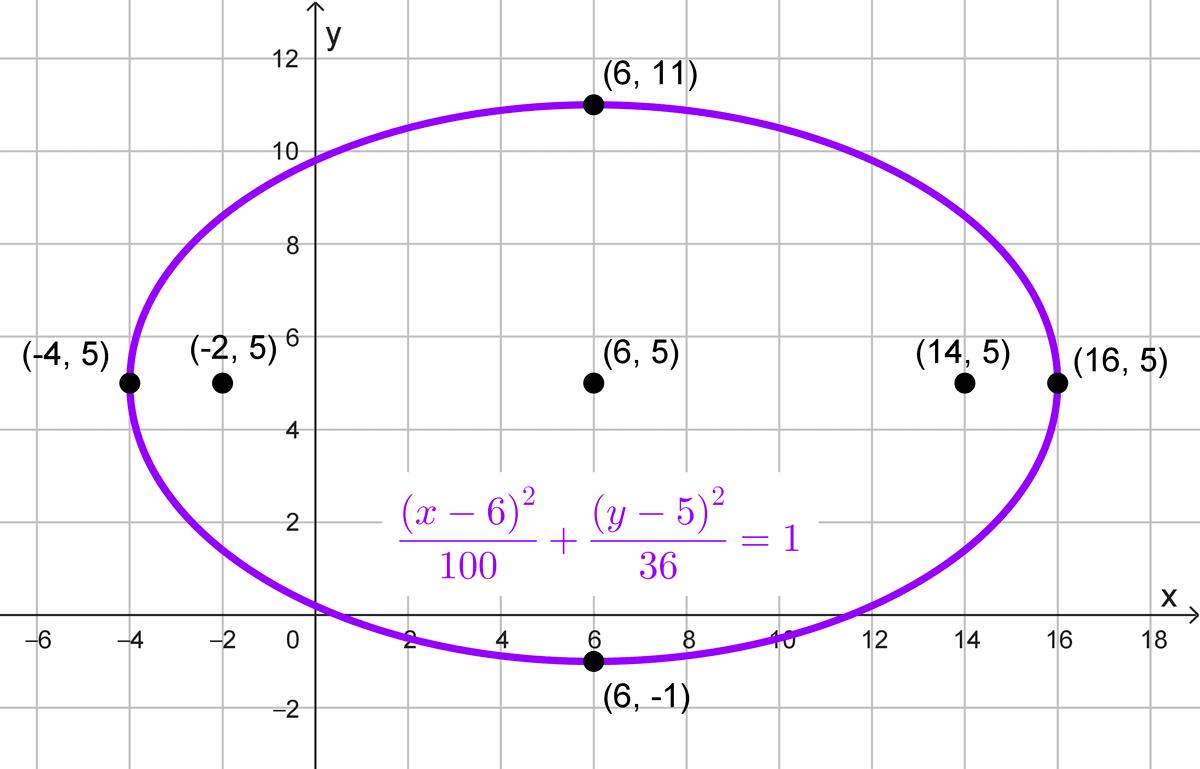
Solution 9
Given information:
- Vertices: (-4, 5) and (16, 5)
- Eccentricity: e = 4/5
The center is the midpoint between the vertices:
$$\text{Center}=\left(\dfrac{-4+16}{2}, \dfrac{5+5}{2}\right)=(6, 5)$$
The vertices share the coordinate y = 5, indicating a horizontal ellipse:
$$\dfrac{(x-h)^2}{a^2}+\dfrac{(y-k)^2}{b^2}=1$$
The distance from the center to a vertex is a:
$$a=16-6=10 \implies a^2=100$$
Using the eccentricity relation \(e=\dfrac{c}{a}:\)
$$\dfrac{4}{5}=\dfrac{c}{10} \implies c=\dfrac{4}{5}\cdot 10=8$$
Find \(b^2:\)
$$b^2=a^2-c^2=100-8^2=100-64=36 \implies b=6$$
Substituting into standard form:
$$\dfrac{(x-6)^2}{100}+\dfrac{(y-5)^2}{36}=1$$
Key Elements:
- Center: (6, 5)
- Foci: (14, 5) and (-2, 5)
- Semi-axes: a = 10, b = 6
- Vertices: (-4, 5) and (16, 5)
- Co-vertices: (6, 11) and (6, -1)
- Focal distance: 2c = 16
- Latus rectum: \(L_R=\dfrac{2b^2}{a}=\dfrac{2\cdot 36}{10}=7.2\)
- Eccentricity: \(e=4/5=0.8\)
Solution 10
Given information:
- Eccentricity: e = 2/3
- Foci: (0, 0) and (0, -4)
The center is the midpoint between the foci:
$$\text{Center}=\left(\dfrac{0+0}{2}, \dfrac{0+(-4)}{2}\right)=(0,-2)$$
Since the foci lie along the vertical line x = 0, the ellipse is vertically oriented:
$$\dfrac{(x-h)^2}{b^2}+\dfrac{(y-k)^2}{a^2}=1$$
The distance from the center to either focus gives c = 2. Using \(e=\dfrac{c}{a}:\)
$$\dfrac{2}{3}=\dfrac{2}{a} \implies a=3 \implies a^2=9$$
Now calculate \(b^2:\)
$$b^2=a^2-c^2=9-2^2=9-4=5$$
Substituting into standard form:
$$\dfrac{x^2}{5}+\dfrac{(y+2)^2}{9}=1$$
Key Elements:
- Center: (0, -2)
- Foci: (0, 0) and (0, -4)
- Semi-axes: \(a=3, b=\sqrt{5}\approx 2.24\)
- Vertices: (0, 1) and (0, -5)
- Co-vertices: \((\sqrt{5},-2)\approx (2.24,-2)\) and \((-\sqrt{5},-2)\approx (-2.24,-2)\)
- Focal distance: 2c = 4
- Latus rectum: \(L_R=\dfrac{2b^2}{a}=\dfrac{2\cdot 5}{3}=\dfrac{10}{3}\approx 3.33\)
- Eccentricity: \(e=\dfrac{2}{3}\approx 0.67\)

Finding the Elements of an Ellipse from Its Equation
The following practice problems involve determining the geometric elements of an ellipse directly from its standard or general equation.
Finding a (semi-major axis length), b (semi-minor axis length), and c (focal distance from the center) is the key step, as every other feature derives from these values:
| Standard Equation | Major Axis | Center | Foci | Vertices / Co-vertices |
|---|---|---|---|---|
| \(\dfrac{x^2}{a^2}+\dfrac{y^2}{b^2}=1\) | Along x-axis | (0, 0) | (±c, 0) | (±a, 0) (0, ±b) |
| \(\dfrac{x^2}{b^2}+\dfrac{y^2}{a^2}=1\) | Along y-axis | (0, 0) | (0, ±c) | (0, ±a) (±b, 0) |
| \(\dfrac{(x-h)^2}{a^2}+\dfrac{(y-k)^2}{b^2}=1\) | Parallel to x-axis | (h, k) | (h ± c, k) | (h ± a, k) (h, k ± b) |
| \(\dfrac{(x-h)^2}{b^2}+\dfrac{(y-k)^2}{a^2}=1\) | Parallel to y-axis | (h, k) | (h, k ± c) | (h, k ± a) (h ± b, k) |
The distance from the center to each focus is computed by \(c=\sqrt{a^2-b^2}.\) When given a general form equation, complete the square to write it in standard form first.
The latus rectum (focal width) and eccentricity are determined using the same formulas regardless of orientation:
Latus Rectum (Focal Width): \(L_R=\dfrac{2b^2}{a}\)
Eccentricity: \(e=\dfrac{c}{a}~~\) or \(~~e=\dfrac{\sqrt{a^2-b^2}}{a}\)
Problem 10
Determine the center, foci, semi-axis lengths, vertices, co-vertices, latus rectum, and eccentricity for each ellipse below, then graph the equation.
- \(\dfrac{x^2}{16}+\dfrac{y^2}{9}=1\)
- \(\dfrac{x^2}{4}+\dfrac{y^2}{25}=1\)
- \(\dfrac{(x+3)^2}{36}+\dfrac{(y-4)^2}{16}=1\)
- \(\dfrac{(x-1)^2}{9}+\dfrac{(y+2)^2}{25}=1\)
- \(\dfrac{(x-1)^2}{36}+\dfrac{(y-\frac{5}{2})^2}{49}=1\)
- \(\dfrac{x^2}{25}+\dfrac{(y+5)^2}{16}=1\)
- \(3x^2+4y^2=12\)
- \(25x^2+16y^2=400\)
- \(4x^2+9y^2-16x-32=0\)
- \(16x^2+9y^2-64x-54y+1=0\)
- \(8x^2+25y^2-48x+50y+47=0\)
- \(36x^2+25y^2+72x-200y-464=0\)
Solutions
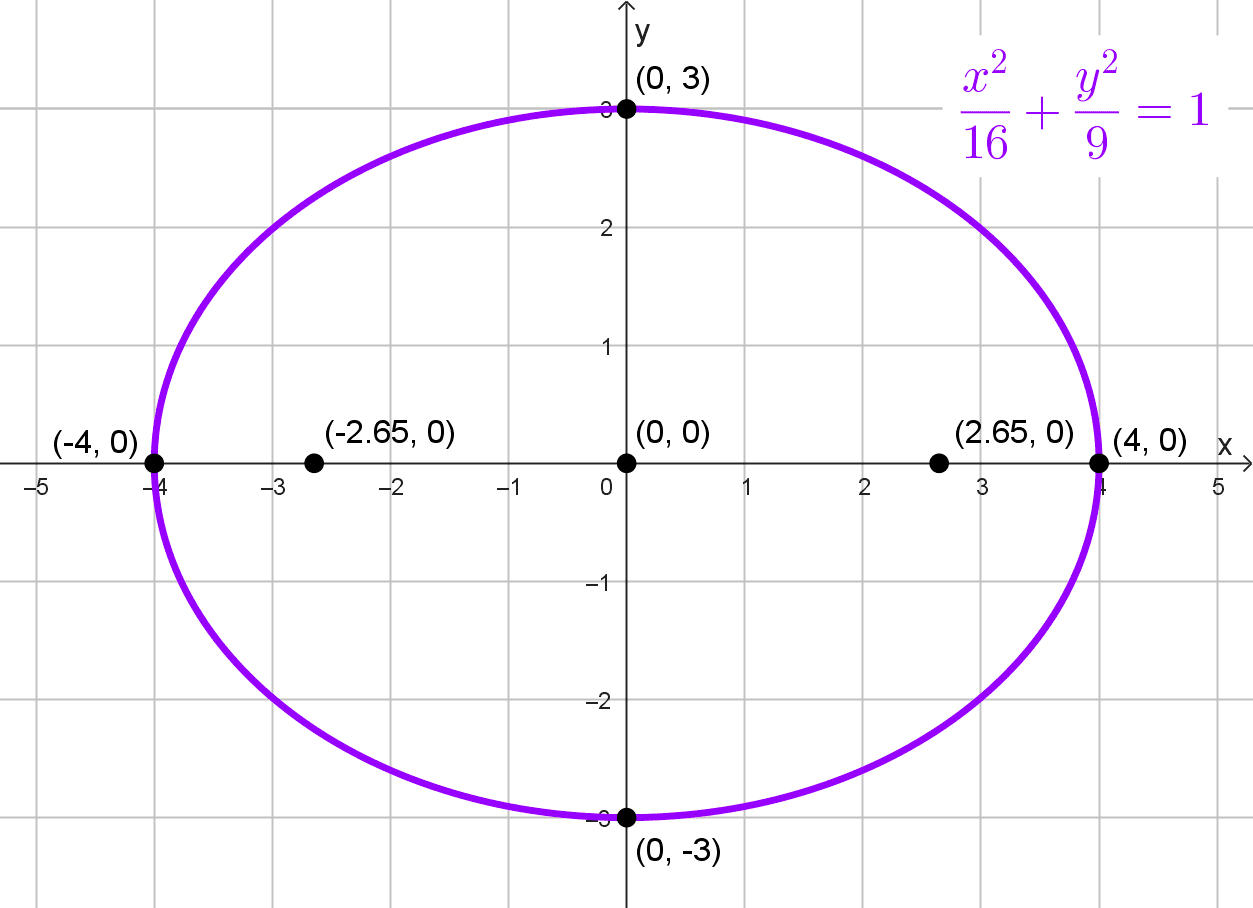
Solution 1
Equation: \(\dfrac{x^2}{16}+\dfrac{y^2}{9}=1\)
The equation is in standard form. The center is at the origin (0, 0), and because the larger denominator lies beneath x2, the ellipse is horizontal.
Extract the semi-axis lengths:
$$a^2=16 \implies a=4$$
$$b^2=9 \implies b=3$$
Compute c:
$$c=\sqrt{a^2-b^2}=\sqrt{16-9}=\sqrt{7}$$
Because the major axis is horizontal, the foci lie at a distance of \(\sqrt{7}\) units to the left and right of the center: \((-\sqrt{7}, 0)\) and \((\sqrt{7}, 0).\)
The vertices are located at (-4, 0) and (4, 0), while the co-vertices are at (0, 3) and (0, -3).
Compute the latus rectum and eccentricity:
$$L_R=\dfrac{2b^2}{a}=\dfrac{2\cdot 9}{4}=4.5$$
$$e=\dfrac{c}{a}=\dfrac{\sqrt{7}}{4}\approx 0.66$$
Key Elements:
- Foci: \((-\sqrt{7}, 0)\) and \((\sqrt{7}, 0)\)
- Center: (0, 0)
- Semi-axes: a = 4, b = 3
- Focal distance: \(2c = 2\sqrt{7}\)
- Vertices: (-4, 0) and (4, 0)
- Co-vertices: (0, 3) and (0, -3)
- Latus rectum: \(L_R=4.5\)
- Eccentricity: \(e\approx 0.66\)
Solution 2
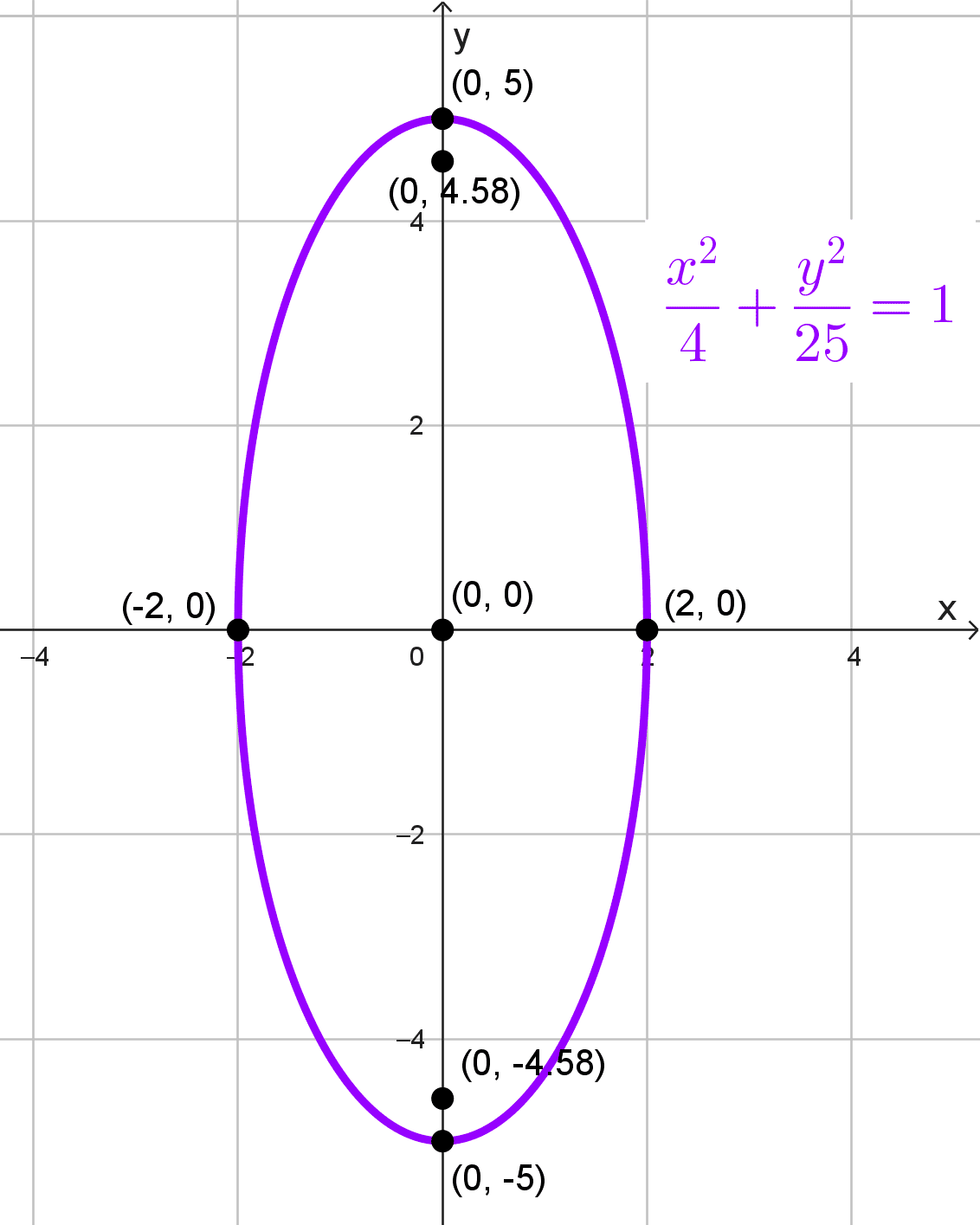
Equation: \(\dfrac{x^2}{4}+\dfrac{y^2}{25}=1\)
The center is (0, 0). The ellipse is vertical because the larger denominator is under \(y^2.\)
Extract the semi-axis values:
$$a^2=25 \implies a=5$$
$$b^2=4 \implies b=2$$
Find the focal distance from the center:
$$c=\sqrt{a^2-b^2}=\sqrt{25-4}=\sqrt{21}$$
Because the major axis is vertical, the foci are located at \((0,-\sqrt{21})\) and \((0, \sqrt{21}).\)
The vertices are at (0, -5) and (0, 5), and the co-vertices are at (-2, 0) and (2, 0).
Calculate the latus rectum and eccentricity:
$$L_R=\dfrac{2b^2}{a}=\dfrac{2 \cdot 4}{5}=\dfrac{8}{5}=1.6$$
$$e=\dfrac{c}{a}=\dfrac{\sqrt{21}}{5}\approx 0.92$$
Key Elements:
- Foci: \((0,-\sqrt{21})\) and \((0, \sqrt{21})\)
- Center: (0, 0)
- Semi-axes: a = 5, b = 2
- Focal distance: \(2c=2\sqrt{21}\)
- Vertices: (0, -5) and (0, 5)
- Co-vertices: (-2, 0) and (2, 0)
- Latus rectum: \(L_R=1.6\)
- Eccentricity: \(e\approx 0.92\)
Solution 3
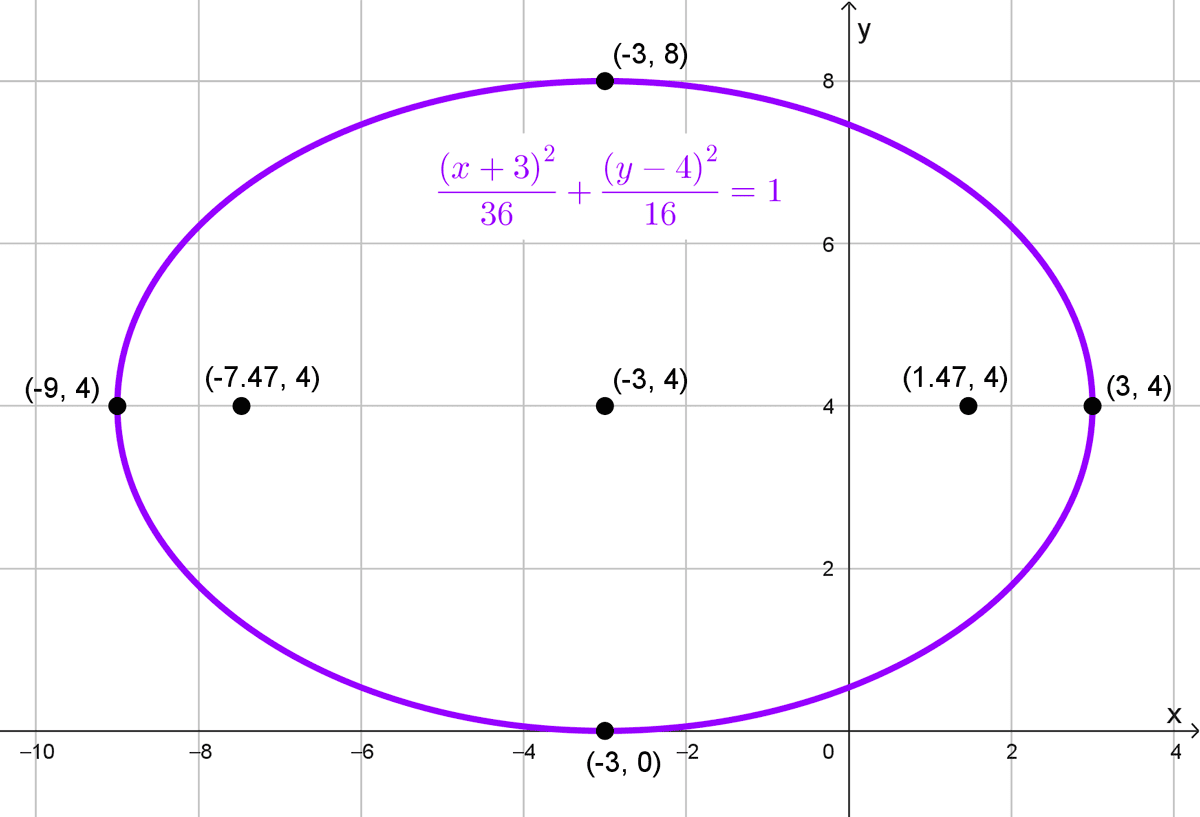
Equation: \(\dfrac{(x+3)^2}{36}+\dfrac{(y-4)^2}{16}=1\)
The center is (-3, 4). The ellipse is horizontal because the larger denominator is under \((x+3)^2.\)
Semi-axis lengths:
$$a^2=36 \implies a=6$$
$$b^2=16 \implies b=4$$
Focal distance from center:
$$c=\sqrt{a^2-b^2}=\sqrt{36-16}=\sqrt{20}=2\sqrt{5}$$
The foci are located at \((-3-2\sqrt{5}, 4)\) and \((-3+2\sqrt{5}, 4).\)
Vertices: \((-3-6, 4)=(-9, 4)\) and \((-3+6, 4)=(3, 4)\)
Co-vertices: \((-3, 4-4)=(-3, 0)\) and \((-3, 4+4)=(-3, 8)\)
Latus rectum: \(L_R=\dfrac{2b^2}{a}=\dfrac{2 \cdot 16}{6}=\dfrac{32}{6}\approx 5.33\)
Eccentricity: \(e=\dfrac{c}{a}=\dfrac{2\sqrt{5}}{6}=\dfrac{\sqrt{5}}{3}\approx 0.75\)
Key Elements:
- Foci: \((-3-2\sqrt{5}, 4)\) and \((-3+2\sqrt{5}, 4)\)
- Center: (-3, 4)
- Semi-axes: a = 6, b = 4
- Focal distance: \(2c=4\sqrt{5}\)
- Vertices: (-9, 4) and (3, 4)
- Co-vertices: (-3, 0) and (-3, 8)
- Latus rectum: \(L_R\approx 5.33\)
- Eccentricity: \(e\approx 0.75\)
Solution 4
Equation: \(\dfrac{(x-1)^2}{9}+\dfrac{(y+2)^2}{25}=1\)
The center is (1, -2). The ellipse is vertical because the larger denominator is under \((y+2)^2.\)
Semi-axis lengths:
$$a^2=25 \implies a=5$$
$$b^2=9 \implies b=3$$
Focal distance:
$$c=\sqrt{a^2-b^2}=\sqrt{25-9}=\sqrt{16}=4$$
The foci are located at (1, -6) and (1, 2).
Vertices: (1, -7) and (1, 3)
Co-vertices: (-2, -2) and (4, -2)
Latus rectum: \(L_R=\dfrac{2b^2}{a}=\dfrac{2 \cdot 9}{5}=3.6\)
Eccentricity: \(e=\dfrac{c}{a}=\dfrac{4}{5}=0.8\)
Key Elements:
- Foci: (1, -6) and (1, 2)
- Center: (1, -2)
- Semi-axes: a = 5, b = 3
- Focal distance: 2c = 8
- Vertices: (1, -7) and (1, 3)
- Co-vertices: (-2, -2) and (4, -2)
- Latus rectum: \(L_R=3.6\)
- Eccentricity: \(e=0.8\)
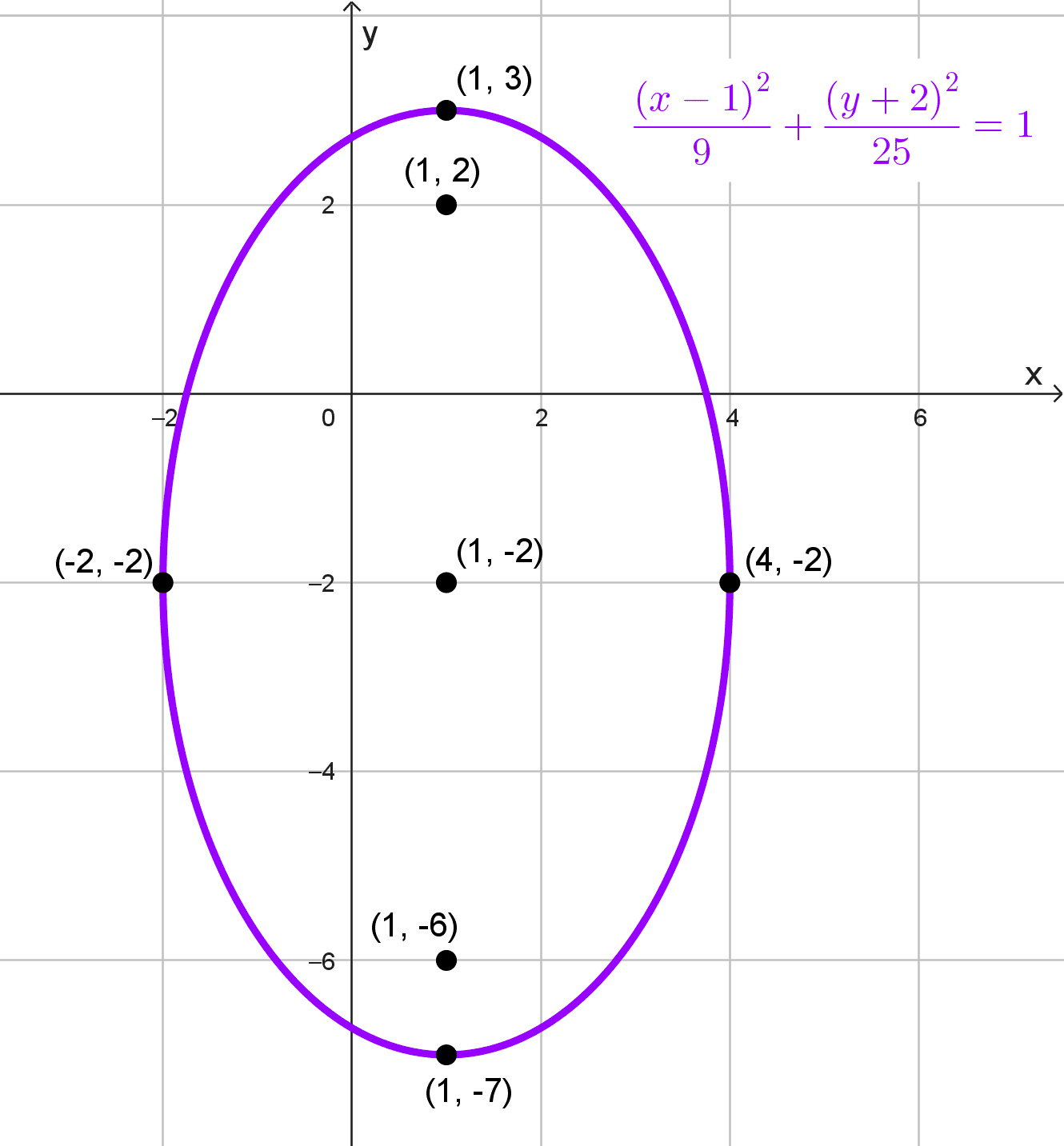
Solution 5
Equation: \(\dfrac{(x-1)^2}{36}+\dfrac{(y-\frac{5}{2})^2}{49}=1\)
The center is (1, 5/2). The ellipse is vertical because the larger denominator is under \(\left(y-\dfrac{5}{2}\right)^2.\)
Semi-axis lengths:
$$a^2=49 \implies a=7$$
$$b^2=36 \implies b=6$$
Focal distance from center:
$$c=\sqrt{a^2-b^2}=\sqrt{49-36}=\sqrt{13}$$
Foci:
$$\left(1, \dfrac{5}{2}-\sqrt{13}\right) \quad \text{and} \quad \left(1, \dfrac{5}{2}+\sqrt{13}\right)$$
Vertices:
$$\left(1, \dfrac{5}{2}-7\right)=\left(1,-\dfrac{9}{2}\right)$$
$$\left(1, \dfrac{5}{2}+7\right)=\left(1, \dfrac{19}{2}\right)$$
Co-vertices:
$$\left(1-6, \dfrac{5}{2}\right)=\left(-5, \dfrac{5}{2}\right)$$
$$\left(1+6, \dfrac{5}{2}\right)=\left(7, \frac{5}{2}\right)$$
Latus rectum:
$$L_R=\dfrac{2b^2}{a}=\dfrac{2 \cdot 36}{7}=\dfrac{72}{7}\approx 10.29$$
Eccentricity:
$$e=\dfrac{c}{a}=\dfrac{\sqrt{13}}{7}\approx 0.52$$
Key Elements:
- Foci: \(\left(1, \dfrac{5}{2}-\sqrt{13}\right)\) and \(\left(1, \dfrac{5}{2}+\sqrt{13}\right)\)
- Center: (1, 5/2)
- Semi-axes: a = 7, b = 6
- Focal distance: \(2c=2\sqrt{13}\)
- Vertices: \(\left(1,-\dfrac{9}{2}\right)\) and \(\left(1, \dfrac{19}{2}\right)\)
- Co-vertices: \(\left(-5, \dfrac{5}{2}\right)\) and \(\left(7, \dfrac{5}{2}\right)\)
- Latus rectum: \(L_R\approx 10.29\)
- Eccentricity: \(e\approx 0.52\)
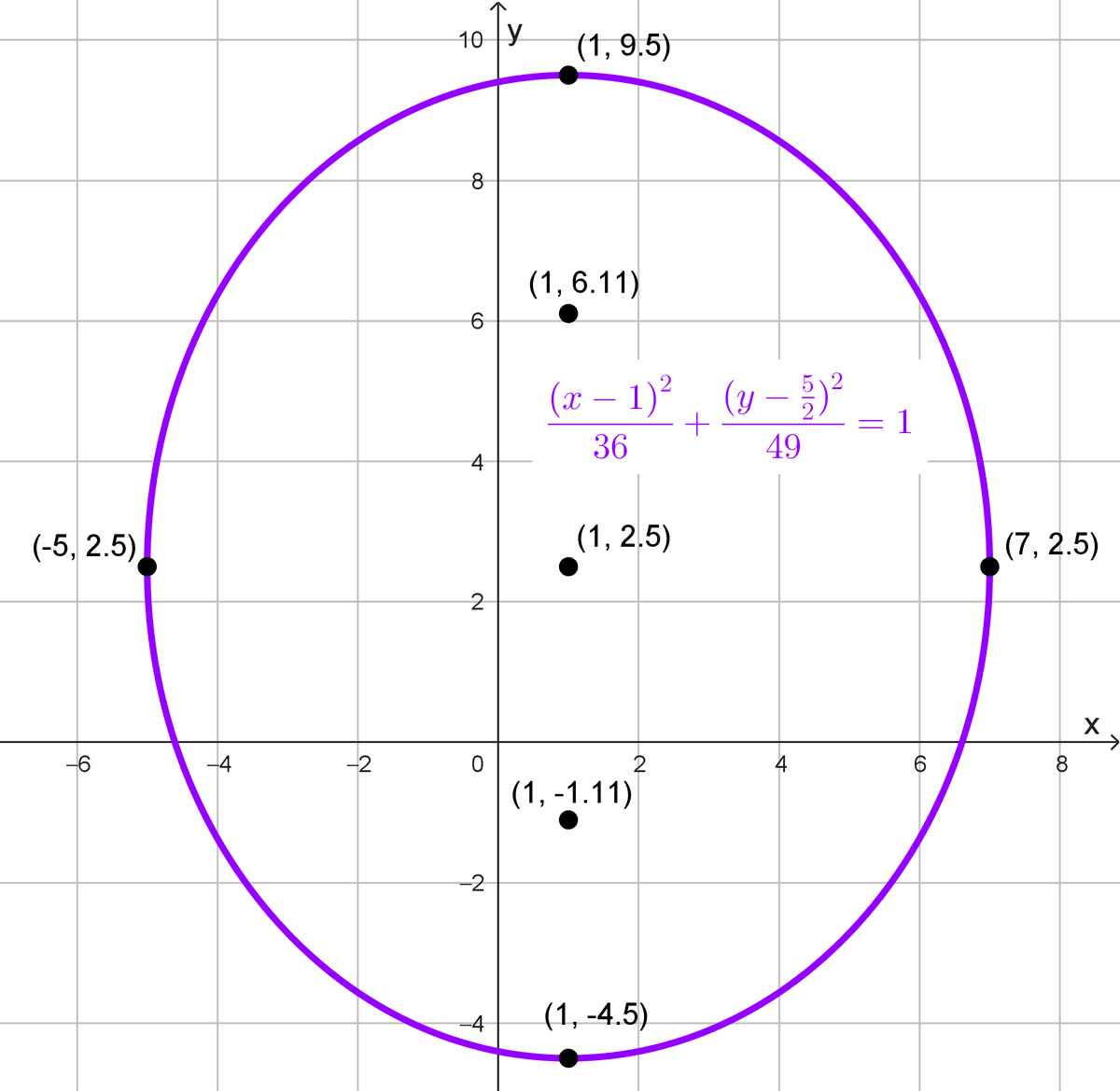
Solution 6
Equation: \(\dfrac{x^2}{25}+\dfrac{(y+5)^2}{16}=1\)
The center is (0, -5). The ellipse is horizontal because the larger denominator is under \(x^2.\)
Semi-axis lengths:
$$a^2=25 \implies a=5$$
$$b^2=16 \implies b=4$$
Focal distance from center:
$$c=\sqrt{a^2-b^2}=\sqrt{25-16}=\sqrt{9}=3$$
Foci: (-3, -5) and (3, -5)
Vertices: (-5, -5) and (5, -5)
Co-vertices: (0, -9) and (0, -1)
Latus rectum: \(L_R=\dfrac{2b^2}{a}=\dfrac{2 \cdot 16}{5}=6.4\)
Eccentricity: \(e=\dfrac{c}{a}=\dfrac{3}{5}=0.6\)
Key Elements:
- Foci: (-3, -5) and (3, -5)
- Center: (0, -5)
- Semi-axes: a = 5, b = 4
- Focal distance: 2c = 6
- Vertices: (-5, -5) and (5, -5)
- Co-vertices: (0, -9) and (0, -1)
- Latus rectum: \(L_R=6.4\)
- Eccentricity: e = 0.6
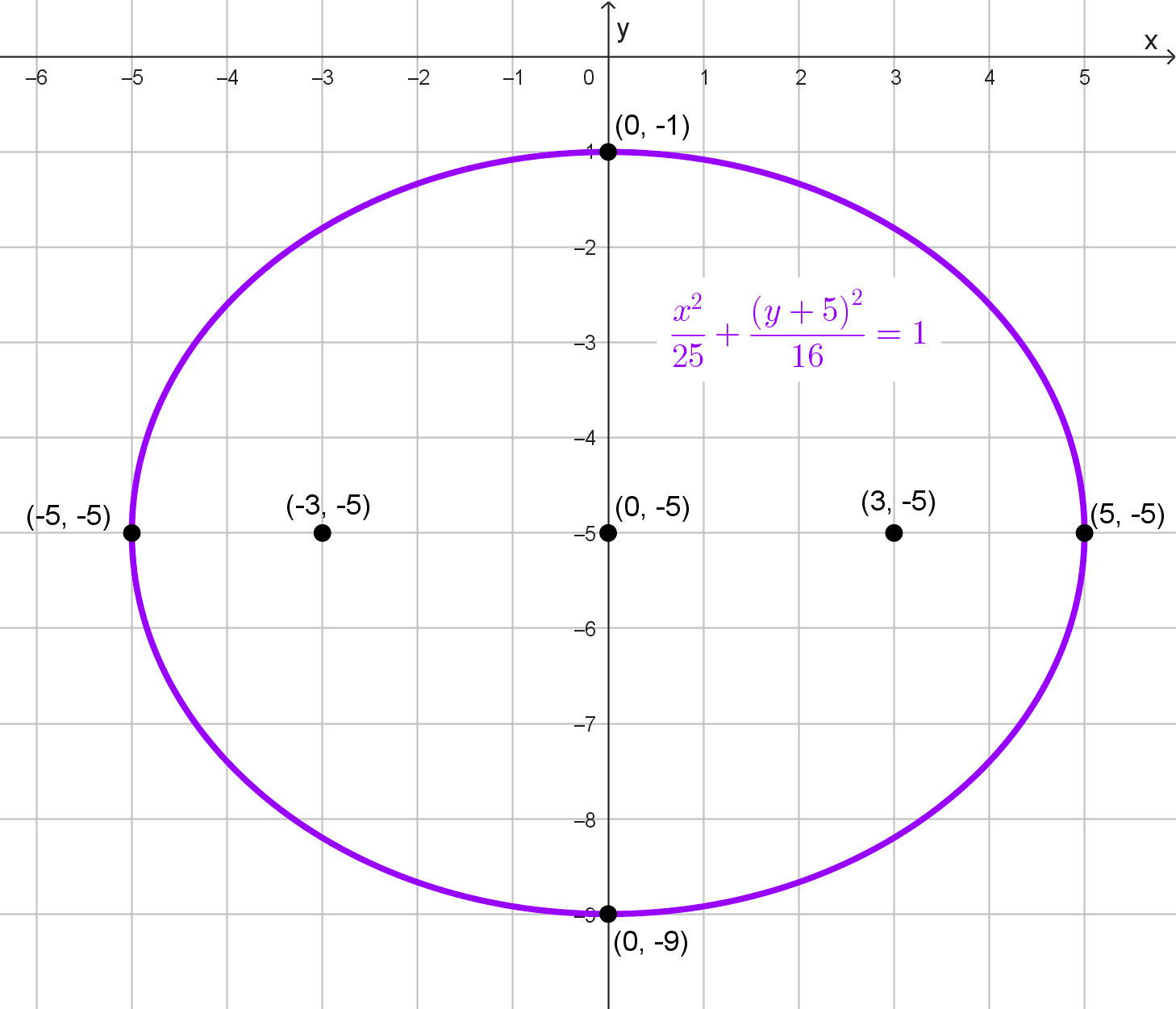
Solution 7
Equation: \(3x^2+4y^2=12\)
This equation is not in standard form. Divide every term by 12:
$$\dfrac{x^2}{4}+\dfrac{y^2}{3}=1$$
The center is (0, 0), and the ellipse is horizontal because the larger denominator is under \(x^2.\)
Semi-axis lengths:
$$a^2=4 \implies a=2$$
$$b^2=3 \implies b=\sqrt{3}$$
Focal distance from center:
$$c=\sqrt{a^2-b^2}=\sqrt{4-3}=1$$
Foci: (-1, 0) and (1, 0)
Vertices: (-2, 0) and (2, 0)
Co-vertices: \((0,-\sqrt{3})\) and \((0, \sqrt{3})\)
Latus rectum: \(L_R=\dfrac{2b^2}{a}=\dfrac{2 \cdot 3}{2}=3\)
Eccentricity: \(e=\dfrac{c}{a}=\dfrac{1}{2}=0.5\)
Key Elements:
- Foci: (-1, 0) and (1, 0)
- Center: (0, 0)
- Semi-axes: \(a=2, b=\sqrt{3}\)
- Focal distance: 2c = 2
- Vertices: (-2, 0) and (2, 0)
- Co-vertices: \((0,-\sqrt{3})\) and \((0, \sqrt{3})\)
- Latus rectum: \(L_R=3\)
- Eccentricity: \(e=0.5\)
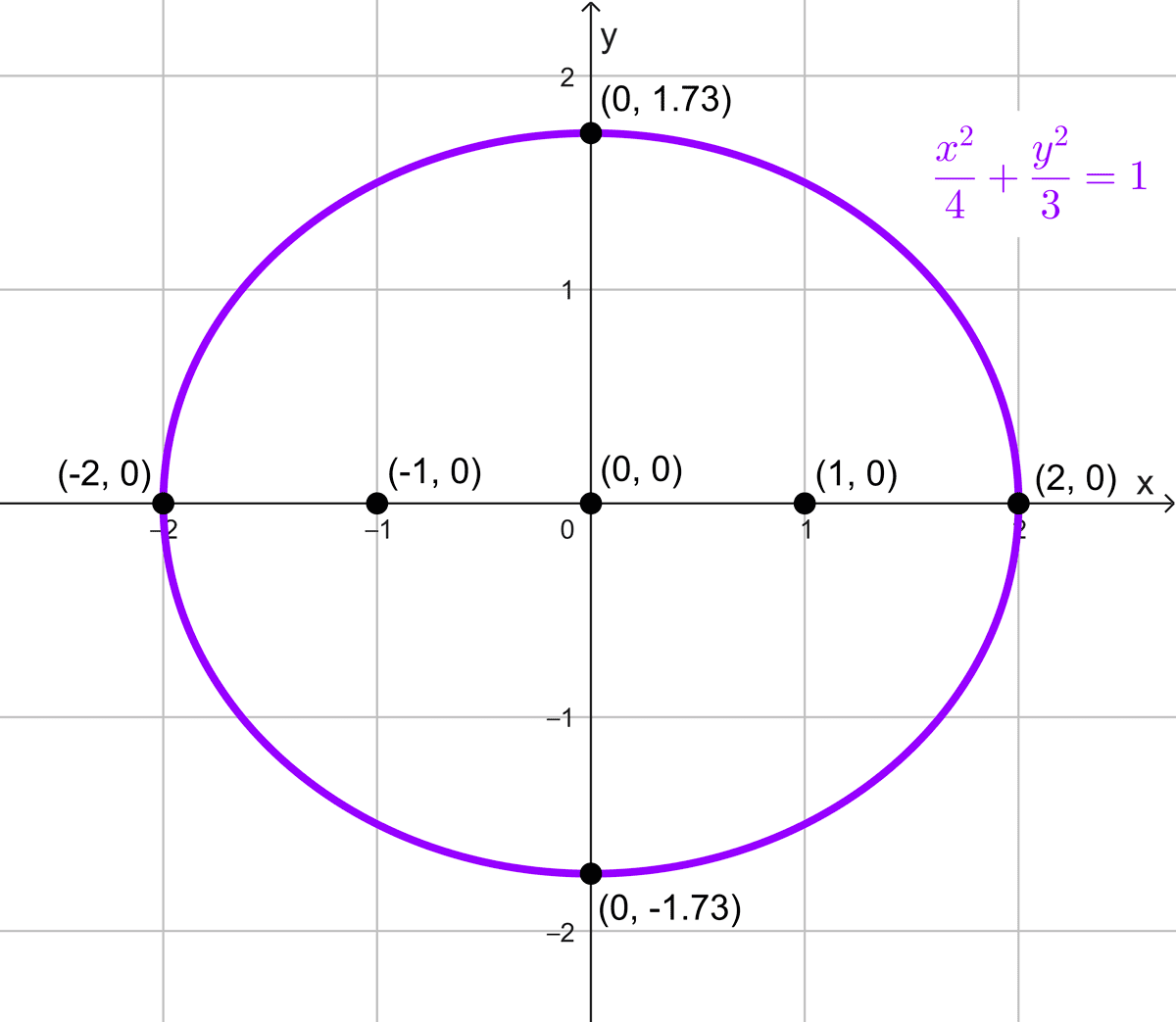
Solution 8
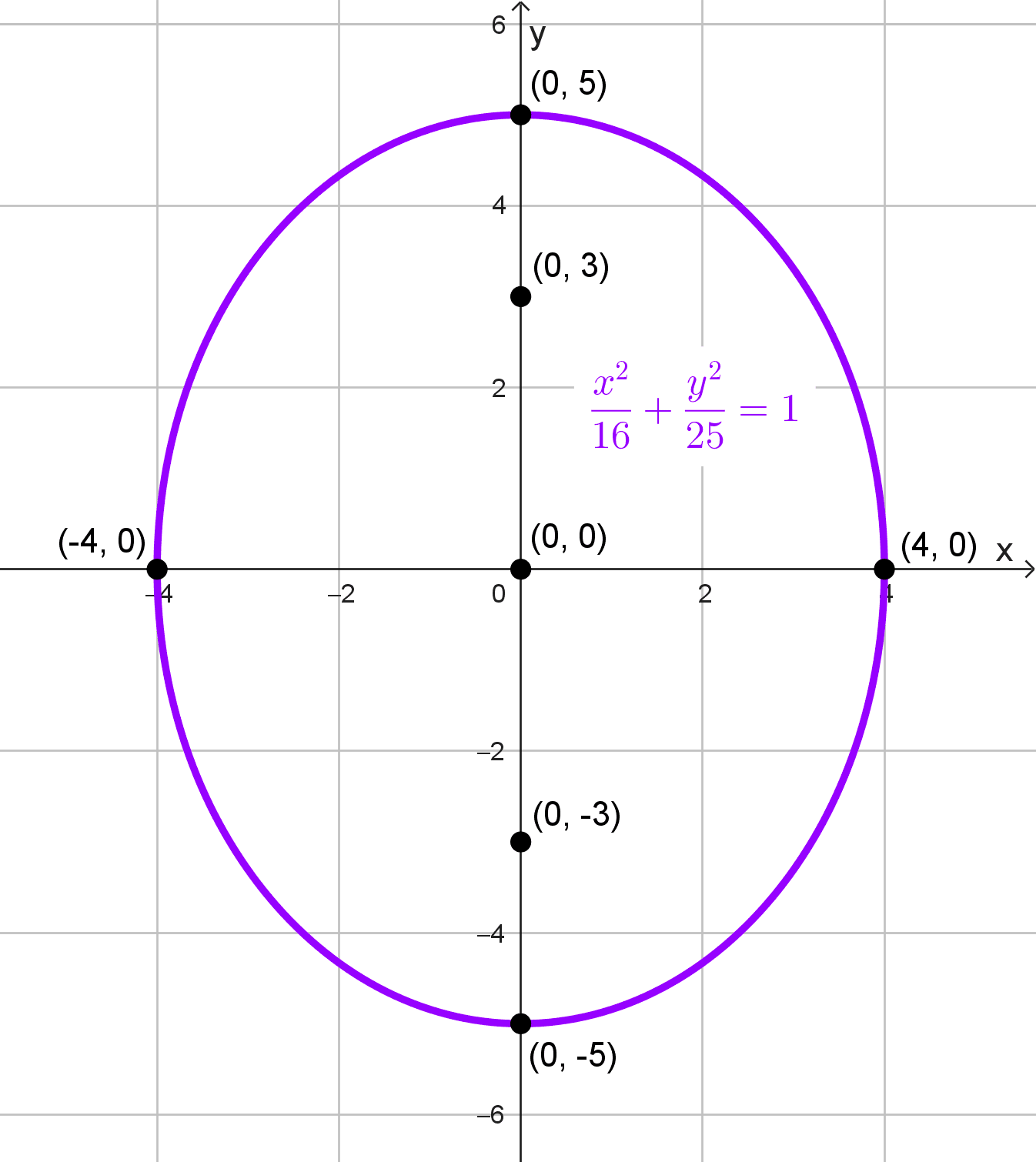
Equation: \(25x^2+16y^2=400\)
Divide by 400 to obtain the standard form:
$$\dfrac{x^2}{16}+\dfrac{y^2}{25}=1$$
The center is (0, 0). The ellipse is vertical because the larger denominator is under \(y^2.\)
Semi-axis lengths:
$$a^2=25 \implies a=5$$
$$b^2=16 \implies b=4$$
Focal distance from center:
$$c=\sqrt{a^2-b^2}=\sqrt{25-16}=\sqrt{9}=3$$
Foci: (0, -3) and (0, 3)
Vertices: (0, -5) and (0, 5)
Co-vertices: (-4, 0) and (4, 0)
Latus rectum: \(L_R=\dfrac{2b^2}{a}=\dfrac{2 \cdot 16}{5}=6.4\)
Eccentricity: \(e=\dfrac{c}{a}=\dfrac{3}{5}=0.6\)
Key Elements:
- Foci: (0, -3) and (0, 3)
- Center: (0, 0)
- Semi-axes: a = 5, b = 4
- Focal distance: 2c = 6
- Vertices: (0, -5) and (0, 5)
- Co-vertices: (-4, 0) and (4, 0)
- Latus rectum: \(L_R=6.4\)
- Eccentricity: e = 0.6
Solution 9
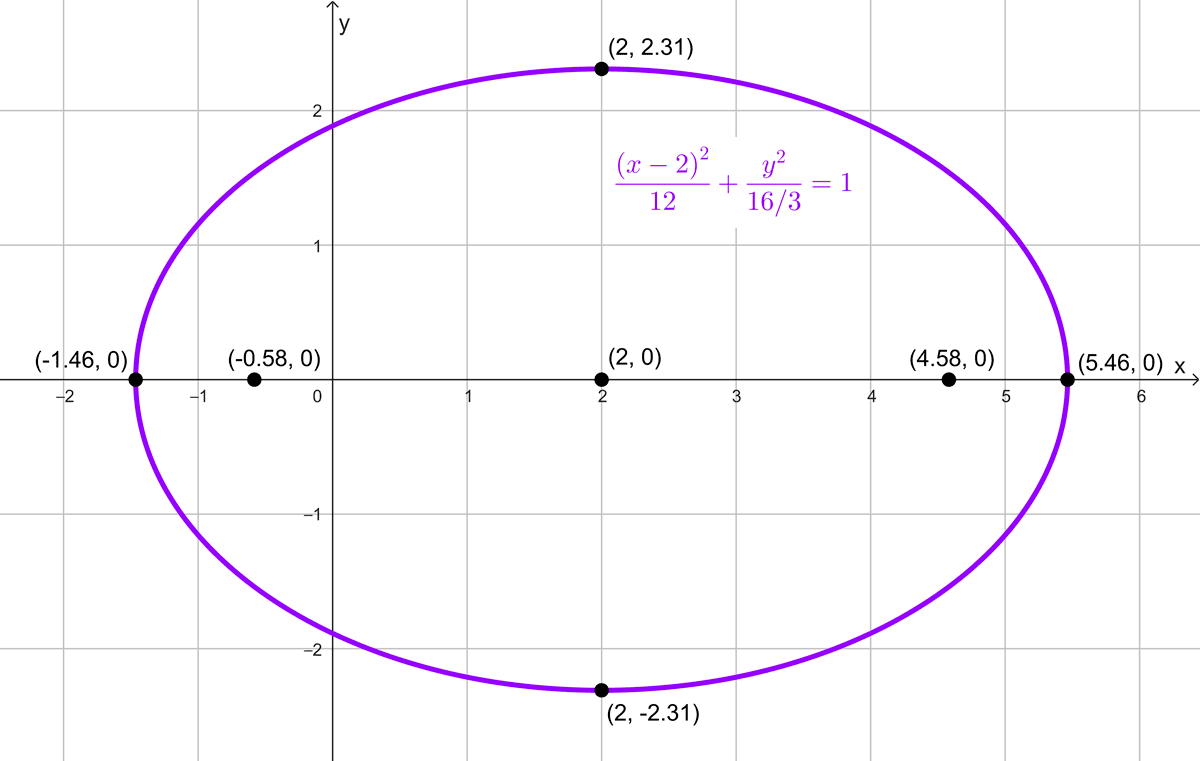
Equation: \(4x^2+9y^2-16x-32=0\)
Completing the square (detailed in the next section) yields the standard equation:
$$\dfrac{(x-2)^2}{12}+\dfrac{y^2}{16/3}=1$$
The center is (2, 0). The ellipse is horizontal because 12 is greater than 16/3.
Semi-axis lengths:
$$a^2=12 \implies a=2\sqrt{3}$$
$$b^2=\dfrac{16}{3} \implies b=\dfrac{4}{\sqrt{3}}=\dfrac{4\sqrt{3}}{3}$$
Focal distance from center:
$$c=\sqrt{a^2-b^2}=\sqrt{12-\dfrac{16}{3}}=\sqrt{\dfrac{20}{3}}=\dfrac{2\sqrt{15}}{3}$$
Foci:
$$\left(2-\dfrac{2\sqrt{15}}{3}, 0\right) \quad \text{and} \quad \left(2+\dfrac{2\sqrt{15}}{3}, 0\right)$$
Vertices:
$$(2-2\sqrt{3}, 0) \quad \text{and} \quad (2+2\sqrt{3}, 0)$$
Co-vertices:
$$\left(2,-\dfrac{4\sqrt{3}}{3}\right) \quad \text{and} \quad \left(2, \dfrac{4\sqrt{3}}{3}\right)$$
Latus rectum:
$$L_R=\dfrac{2b^2}{a}=\dfrac{2 \cdot \dfrac{16}{3}}{2\sqrt{3}}=\dfrac{16\sqrt{3}}{9}$$
Eccentricity:
$$e=\dfrac{c}{a}=\dfrac{\dfrac{2\sqrt{15}}{3}}{2\sqrt{3}}=\dfrac{\sqrt{5}}{3}\approx 0.75$$
Key Elements:
- Foci: \(\left(2-\dfrac{2\sqrt{15}}{3}, 0\right)\) and \(\left(2+\dfrac{2\sqrt{15}}{3}, 0\right)\)
- Center: (2, 0)
- Semi-axes: \(a=2\sqrt{3}, b=\dfrac{4\sqrt{3}}{3}\)
- Focal distance: \(2c=\dfrac{4\sqrt{15}}{3}\)
- Vertices: \((2-2\sqrt{3}, 0)\) and \((2+2\sqrt{3}, 0)\)
- Co-vertices: \(\left(2,-\dfrac{4\sqrt{3}}{3}\right)\) and \(\left(2, \dfrac{4\sqrt{3}}{3}\right)\)
- Latus rectum: \(L_R=\dfrac{16\sqrt{3}}{9}\)
- Eccentricity: \(e\approx 0.75\)
Solution 10
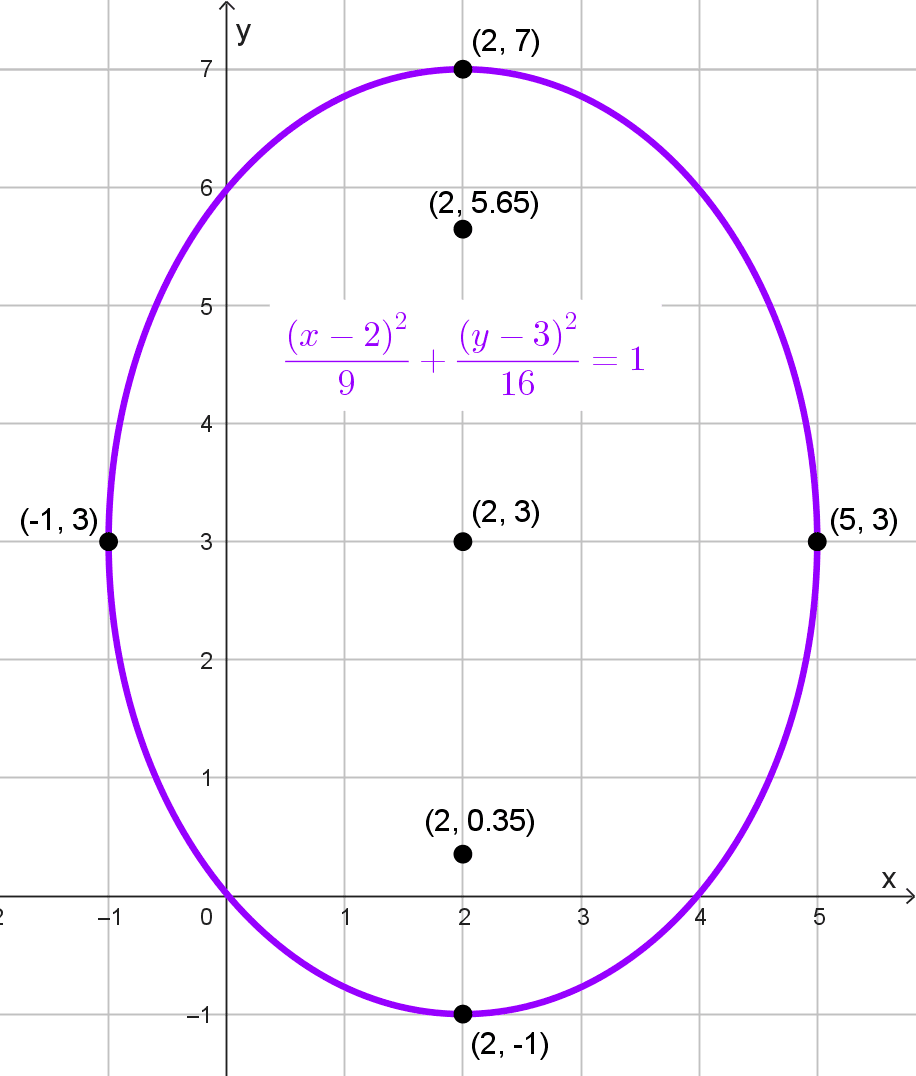
Equation: \(16x^2+9y^2-64x-54y+1=0\)
Completing the square produces the standard form:
$$\dfrac{(x-2)^2}{9}+\dfrac{(y-3)^2}{16}=1$$
The center is (2, 3). The ellipse is vertical because the larger denominator is under \((y-3)^2.\)
Semi-axis lengths:
$$a^2=16 \implies a=4$$
$$b^2=9 \implies b=3$$
Focal distance from center:
$$c=\sqrt{a^2-b^2}=\sqrt{16-9}=\sqrt{7}$$
Foci:
$$(2, 3-\sqrt{7}) \quad \text{and} \quad (2, 3+\sqrt{7})$$
Vertices: (2, -1) and (2, 7)
Co-vertices: (-1, 3) and (5, 3)
Latus rectum: \(L_R=\dfrac{2b^2}{a}=\dfrac{2 \cdot 9}{4}=4.5\)
Eccentricity: \(e=\dfrac{c}{a}=\dfrac{\sqrt{7}}{4}\approx 0.66\)
Key Elements:
- Foci: \((2, 3-\sqrt{7})\) and \((2, 3+\sqrt{7})\)
- Center: (2, 3)
- Semi-axes: a = 4, b = 3
- Focal distance: \(2c=2\sqrt{7}\)
- Vertices: (2, -1) and (2, 7)
- Co-vertices: (-1, 3) and (5, 3)
- Latus rectum: \(L_R=4.5\)
- Eccentricity: \(e\approx 0.66\)
Solution 11
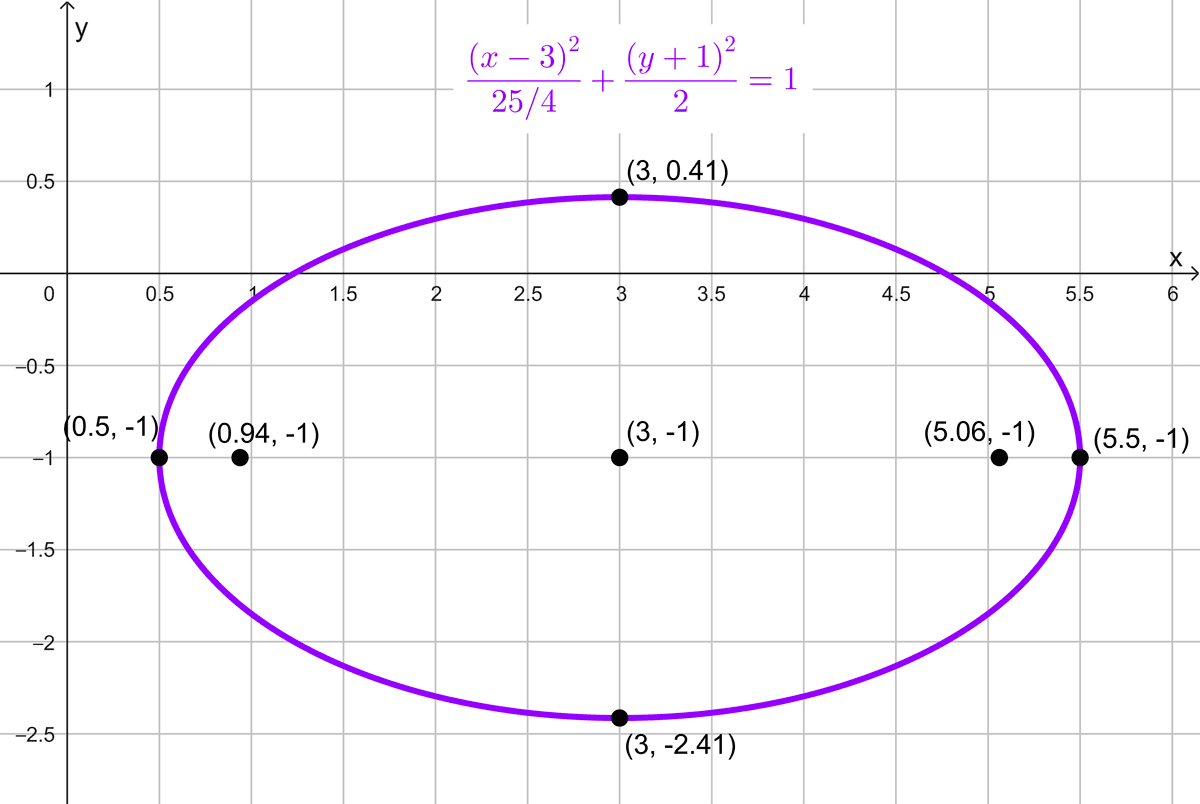
Equation: \(8x^2+25y^2-48x+50y+47=0\)
Completing the square gives the standard equation:
$$\dfrac{(x-3)^2}{25/4}+\dfrac{(y+1)^2}{2}=1$$
The center is (3, -1). Since 25/4 > 2, the ellipse is horizontal.
Semi-axis lengths:
$$a=\sqrt{\dfrac{25}{4}}=\dfrac{5}{2}=2.5$$
$$b=\sqrt{2}$$
Focal distance from center:
$$c=\sqrt{a^2-b^2}=\sqrt{\dfrac{25}{4}-2}=\sqrt{\dfrac{17}{4}}=\dfrac{\sqrt{17}}{2}$$
Foci:
$$\left(3-\dfrac{\sqrt{17}}{2}, -1\right) \quad \text{and} \quad \left(3+\dfrac{\sqrt{17}}{2}, -1\right)$$
Vertices: (0.5, -1) and (5.5, -1)
Co-vertices: \((3, -1-\sqrt{2})\) and \((3, -1+\sqrt{2})\)
Latus rectum: \(L_R=\dfrac{2b^2}{a}=\dfrac{2 \cdot 2}{2.5}=1.6\)
Eccentricity: \(e=\dfrac{c}{a}=\dfrac{\sqrt{17}/2}{2.5}=\dfrac{\sqrt{17}}{5}\approx 0.82\)
Key Elements:
- Center: (3, -1)
- Foci: \(\left(3-\dfrac{\sqrt{17}}{2}, -1\right)\) and \(\left(3+\dfrac{\sqrt{17}}{2}, -1\right)\)
- Semi-axes: \(a=2.5, b=\sqrt{2}\)
- Focal distance: \(2c=\sqrt{17}\)
- Vertices: (0.5, -1) and (5.5, -1)
- Co-vertices: \((3, -1-\sqrt{2})\) and \((3, -1+\sqrt{2})\)
- Latus rectum: \(L_R=1.6\)
- Eccentricity: \(e\approx 0.82\)
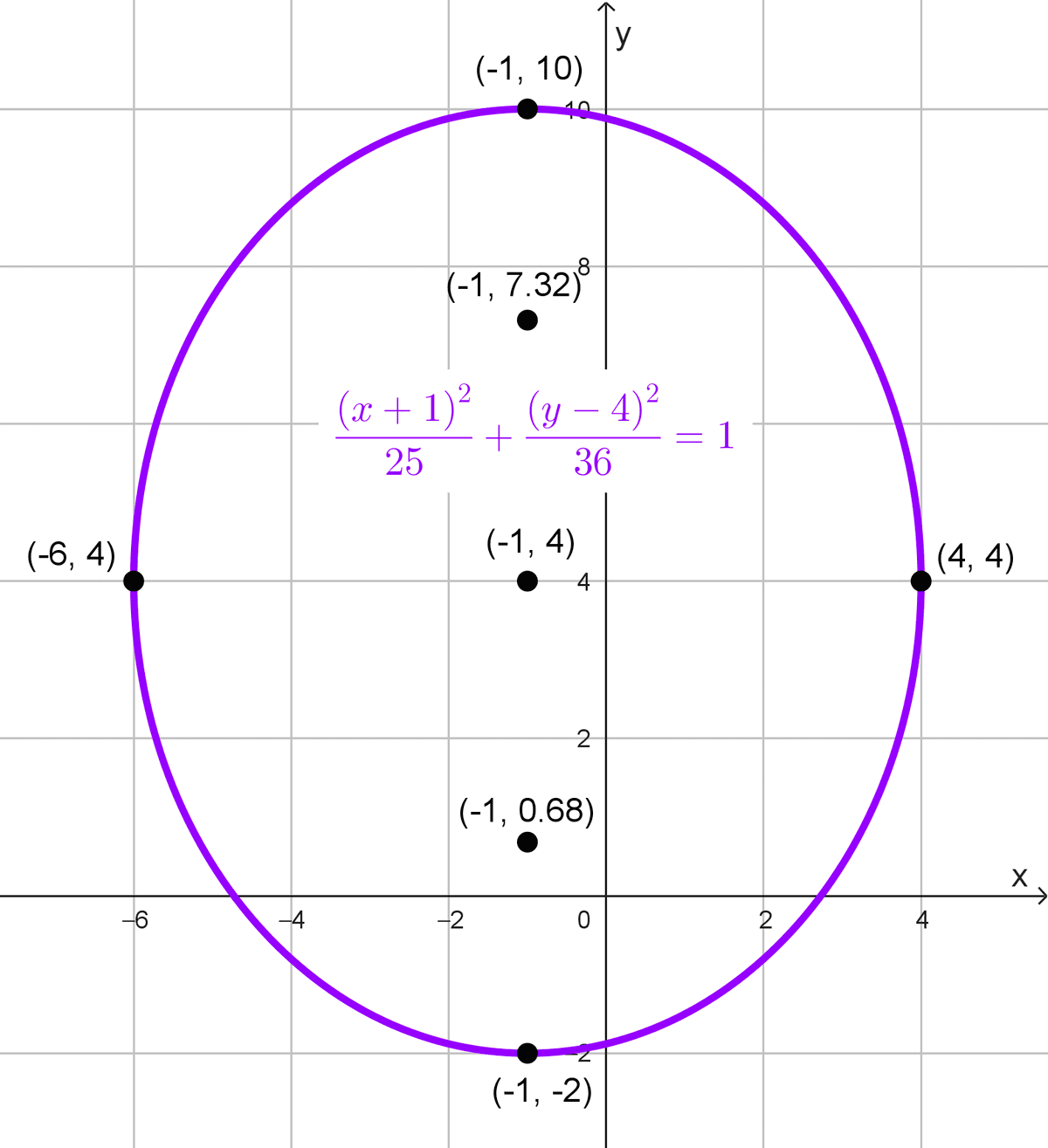
Solution 12
Equation: \(36x^2+25y^2+72x-200y-464=0\)
Completing the square yields the standard form:
$$\dfrac{(x+1)^2}{25}+\dfrac{(y-4)^2}{36}=1$$
The center is (-1, 4). The ellipse is vertical because the larger denominator is under \((y-4)^2.\)
Semi-axis lengths:
$$a=\sqrt{36}=6$$
$$b=\sqrt{25}=5$$
Focal distance from center:
$$c=\sqrt{a^2-b^2}=\sqrt{36-25}=\sqrt{11}$$
Foci: \((-1, 4-\sqrt{11})\) and \((-1, 4+\sqrt{11})\)
Vertices: (-1, -2) and (-1, 10)
Co-vertices: (-6, 4) and (4, 4)
Latus rectum: \(L_R=\dfrac{2b^2}{a}=\dfrac{2 \cdot 25}{6}=\dfrac{50}{6}\approx 8.33\)
Eccentricity: \(e=\dfrac{c}{a}=\dfrac{\sqrt{11}}{6}\approx 0.55\)
Key Elements:
- Center: (-1, 4)
- Foci: \((-1, 4-\sqrt{11})\) and \((-1, 4+\sqrt{11})\)
- Semi-axes: a = 6, b = 5
- Focal distance: \(2c=2\sqrt{11}\)
- Vertices: (-1, -2) and (-1, 10)
- Co-vertices: (-6, 4) and (4, 4)
- Latus rectum: \(L_R\approx 8.33\)
- Eccentricity: \(e\approx 0.55\)
Converting from General Form to Standard Form
Writing an ellipse in standard form makes it straightforward to read its center, semi-axis lengths, and vertices. When starting with general form, complete the square for x and y to put the equation into standard form.
Problem 11
Convert each of the following general equations of an ellipse into standard form.
- \(3x^2+4y^2=12\)
- \(25x^2+16y^2=400\)
- \(4x^2+9y^2-16x-32=0\)
- \(16x^2+9y^2-64x-54y+1=0\)
- \(8x^2+25y^2-48x+50y+47=0\)
- \(36x^2+25y^2+72x-200y-464=0\)
- \(2x^2+4x+7y^2-28y-40=0\)
Solutions
Solution 1
Equation: \(3x^2+4y^2=12\)
This equation contains squared terms in x and y with no linear terms, indicating that the center is at the origin.
In standard form, the right-hand side must equal 1. Divide both sides by 12:
$$\dfrac{3x^2}{12}+\dfrac{4y^2}{12}=\dfrac{12}{12}$$
Simplify each fraction:
$$\dfrac{x^2}{4}+\dfrac{y^2}{3}=1$$
The equation is now in standard form.
Solution 2
Equation: \(25x^2+16y^2=400\)
Because there are no linear terms in x or y, the center is at (0, 0).
Divide the entire equation by 400 so that the right side equals 1:
$$\dfrac{25x^2}{400}+\dfrac{16y^2}{400}=\dfrac{400}{400}$$
Simplify each fraction:
$$\dfrac{x^2}{16}+\dfrac{y^2}{25}=1$$
Solution 3
Equation: \(4x^2+9y^2-16x-32=0\)
There is a linear term in x, which indicates the center is not at the origin, but no linear term in y.
Rearrange the equation and move the constant to the right side:
$$4x^2-16x+9y^2=32$$
Factor out 4 from the x-terms:
$$4(x^2-4x)+9y^2=32$$
Complete the square for the x-terms. Take half the coefficient of x (-4/2 = -2) and square it ((-2)2 = 4). Add and subtract 4 inside the brackets:
$$4[(x^2-4x+4)-4]+9y^2=32$$
Write the perfect square trinomial:
$$4[(x-2)^2-4]+9y^2=32$$
Distribute the 4:
$$4(x-2)^2-16+9y^2=32$$
Add 16 to both sides:
$$4(x-2)^2+9y^2=48$$
Divide both sides by 48 to make the right side equal to 1:
$$\dfrac{4(x-2)^2}{48}+\dfrac{9y^2}{48}=\dfrac{48}{48}$$
Simplify each coefficient:
$$\dfrac{(x-2)^2}{12}+\dfrac{y^2}{16/3}=1$$
Solution 4
Equation: \(16x^2+9y^2-64x-54y+1=0\)
This equation has linear terms in both variables, so we must complete the square for both x and y.
Group the x and y terms and move the constant term to the right side:
$$16x^2-64x+9y^2-54y=-1$$
Factor out the leading coefficients from each variable group:
$$16[x^2-4x]+9[y^2-6y]=-1$$
Complete the square:
For x, half of -4 is -2, and (-2)2 = 4:
$$16[(x^2-4x+4)-4]=16[(x-2)^2-4]$$
For y, half of -6 is -3, and (-3)2 = 9:
$$9[(y^2-6y+9)-9]=9[(y-3)^2-9]$$
Substitute these expressions back into the equation:
$$16[(x-2)^2-4]+9[(y-3)^2-9]=-1$$
Distribute 16 and 9:
$$16(x-2)^2-64+9(y-3)^2-81=-1$$
Add 64 and 81 to the right side:
$$16(x-2)^2+9(y-3)^2=144$$
Divide the entire equation by 144:
$$\dfrac{16(x-2)^2}{144}+\dfrac{9(y-3)^2}{144}=\dfrac{144}{144}$$
Simplify:
$$\dfrac{(x-2)^2}{9}+\dfrac{(y-3)^2}{16}=1$$
Solution 5
Equation: \(8x^2+25y^2-48x+50y+47=0\)
Group the x and y terms and move 47 to the right side:
$$8x^2-48x+25y^2+50y=-47$$
Factor out the leading coefficients:
$$8[x^2-6x]+25[y^2+2y]=-47$$
Complete the square for x (half of -6 squared is 9):
$$8[(x^2-6x+9)-9]=8[(x-3)^2-9]$$
Complete the square for y (half of 2 squared is 1):
$$25[(y^2+2y+1)-1]=25[(y+1)^2-1]$$
Substitute into the equation:
$$8[(x-3)^2-9]+25[(y+1)^2-1]=-47$$
Distribute 8 and 25:
$$8(x-3)^2-72+25(y+1)^2-25=-47$$
Combine and add constant terms to the right side:
$$8(x-3)^2+25(y+1)^2=50$$
Divide through by 50:
$$\dfrac{8(x-3)^2}{50}+\dfrac{25(y+1)^2}{50}=\dfrac{50}{50}$$
Simplify the fractions:
$$\dfrac{(x-3)^2}{25/4}+\dfrac{(y+1)^2}{2}=1$$
Solution 6
Equation: \(36x^2+25y^2+72x-200y-464=0\)
Group terms and move the constant:
$$36x^2+72x+25y^2-200y=464$$
Factor out coefficients:
$$36[x^2+2x]+25[y^2-8y]=464$$
Complete the square for x:
$$36[(x^2+2x+1)-1]=36[(x+1)^2-1]$$
Complete the square for y:
$$25[(y^2-8y+16)-16]=25[(y-4)^2-16]$$
Substitute and distribute:
$$36(x+1)^2-36+25(y-4)^2-400=464$$
Add 36 and 400 to the right side:
$$36(x+1)^2+25(y-4)^2=900$$
Divide by 900:
$$\dfrac{36(x+1)^2}{900}+\dfrac{25(y-4)^2}{900}=\dfrac{900}{900}$$
Simplify coefficients:
$$\dfrac{(x+1)^2}{25}+\dfrac{(y-4)^2}{36}=1$$
Solution 7
Equation: \(2x^2+4x+7y^2-28y-40=0\)
Group terms and move 40 to the right side:
$$2x^2+4x+7y^2-28y=40$$
Factor out leading coefficients:
$$2[x^2+2x]+7[y^2-4y]=40$$
Complete the square for x and y:
$$2[(x^2+2x+1)-1]=2[(x+1)^2-1]$$
$$7[(y^2-4y+4)-4]=7[(y-2)^2-4]$$
Substitute and distribute:
$$2(x+1)^2-2+7(y-2)^2-28=40$$
Add 2 and 28 to the right side:
$$2(x+1)^2+7(y-2)^2=70$$
Divide by 70:
$$\dfrac{2(x+1)^2}{70}+\dfrac{7(y-2)^2}{70}=\dfrac{70}{70}$$
Simplify:
$$\dfrac{(x+1)^2}{35}+\dfrac{(y-2)^2}{10}=1$$
Converting from Standard Form to General Form
To convert an ellipse equation from standard form to general form, multiply both sides by the common denominator to eliminate fractions, expand the squared binomials, and rearrange all terms into the form Ax2 + Cy2 + Dx + Ey + F = 0.
Problem 12
Convert each standard form equation into general form.
- \(\dfrac{x^2}{16}+\dfrac{y^2}{9}=1\)
- \(\dfrac{x^2}{4}+\dfrac{y^2}{25}=1\)
- \(\dfrac{(x+3)^2}{36}+\dfrac{(y-4)^2}{16}=1\)
- \(\dfrac{(x-1)^2}{9}+\dfrac{(y+2)^2}{25}=1\)
- \(\dfrac{(x-1)^2}{36}+\dfrac{(y-\frac{5}{2})^2}{49}=1\)
- \(\dfrac{x^2}{25}+\dfrac{(y+5)^2}{16}=1\)
Solutions
Solution 1
Equation 1
$$\dfrac{x^2}{16}+\dfrac{y^2}{9}=1$$
Multiply both sides by \(16\cdot 9=144\) to clear denominators:
$$144 \cdot \left(\dfrac{x^2}{16}\right)+144 \cdot \left(\dfrac{y^2}{9}\right)=144 \cdot 1$$
Distribute and simplify:
$$9x^2+16y^2=144$$
Subtract 144 to set the equation equal to 0:
$$9x^2+16y^2-144=0$$
This is the general form.
Solution 2
Equation 2
$$\dfrac{x^2}{4}+\dfrac{y^2}{25}=1$$
Multiply through by \(4 \cdot 25=100:\)
$$100 \cdot \left(\dfrac{x^2}{4}\right)+100 \cdot \left(\dfrac{y^2}{25}\right)=100 \cdot 1$$
$$25x^2+4y^2=100$$
Set equal to zero:
$$25x^2+4y^2-100=0$$
Solution 3
Equation 3
$$\dfrac{(x+3)^2}{36}+\dfrac{(y-4)^2}{16}=1$$
Multiply through by \(36 \cdot 16=576:\)
$$16(x+3)^2+36(y-4)^2=576$$
Expand the squared binomials:
$$16(x^2+6x+9)+36(y^2-8y+16)=576$$
$$16x^2+96x+144+36y^2-288y+576=576$$
Rearrange into general form:
$$16x^2+36y^2+96x-288y+144+576-576=0$$
$$16x^2+36y^2+96x-288y+144=0$$
Simplify by dividing by 4:
$$4x^2+9y^2+24x-72y+36=0$$
Solution 4
Equation 4
$$\dfrac{(x-1)^2}{9}+\dfrac{(y+2)^2}{25}=1$$
Multiply through by \(9 \cdot 25=225:\)
$$25(x-1)^2+9(y+2)^2=225$$
Expand both binomials:
$$25(x^2-2x+1)+9(y^2+4y+4)=225$$
$$25x^2-50x+25+9y^2+36y+36=225$$
Rearrange and combine constants:
$$25x^2+9y^2-50x+36y+25+36-225=0$$
$$25x^2+9y^2-50x+36y-164=0$$
Solution 5
$$\dfrac{(x-1)^2}{36}+\dfrac{(y-\frac{5}{2})^2}{49}=1$$
Multiply through by \(36 \cdot 49=1764:\)
$$49(x-1)^2+36\left(y-\dfrac{5}{2}\right)^2=1764$$
Expand each squared term:
$$49(x^2-2x+1)+36\left(y^2-5y+\dfrac{25}{4}\right)=1764$$
$$49x^2-98x+49+36y^2-180y+225=1764$$
Combine like terms:
$$49x^2+36y^2-98x-180y+49+225-1764=0$$
$$49x^2+36y^2-98x-180y-1490=0$$
Solution 6
$$\dfrac{x^2}{25}+\dfrac{(y+5)^2}{16}=1$$
Multiply through by \(25 \cdot 16=400:\)
$$16x^2+25(y+5)^2=400$$
Expand the binomial:
$$16x^2+25(y^2+10y+25)=400$$
$$16x^2+25y^2+250y+625=400$$
Rearrange into general form:
$$16x^2+25y^2+250y+625-400=0$$
$$16x^2+25y^2+250y+225=0$$
Real-World Word Problems
The following problems illustrate practical applications of ellipses. By Kepler's First Law, planets and moons travel in elliptical orbits with the central body located at one focus, making orbital mechanics one of the most classic real-world applications of conic sections.
Problem 13
The orbit of the Moon around Earth is an ellipse, with Earth situated at one focus. The distance from the center of Earth to the center of the Moon ranges from a minimum of 356,000 km to a maximum of 406,000 km. Find the eccentricity of the Moon's orbit and the lengths of the major and minor axes.
Solution
Given Data
- Minimum distance (perigee): dmin = 356,000 km
- Maximum distance (apogee): dmax = 406,000 km
In an elliptical orbit:
- The major axis length (2a) is the sum of the perigee and apogee distances.
- The focal distance (2c) is the distance between the two foci.
- The eccentricity is defined as \(e=\dfrac{c}{a}.\)
The total length of the major axis is:
$$2a=d_{\text{min}}+d_{\text{max}}$$
$$2a=356000+406000=762000 \ \text{km}$$
Therefore, the semi-major axis length is:
$$a=\dfrac{2a}{2}=\dfrac{762000}{2}=381000 \ \text{km}$$
The focal length c is given by:
$$c=a-d_{\text{min}}$$
$$c=381000-356000=25000 \ \text{km}$$
Compute the eccentricity:
$$e=\dfrac{c}{a}$$
$$e=\dfrac{25000}{381000}\approx 0.0656$$
Calculate the semi-minor axis length b:
$$b=\sqrt{a^2-c^2}$$
$$b=\sqrt{(381000)^2-(25000)^2}$$
$$b=\sqrt{145161000000-625000000}=\sqrt{144536000000}\approx 380179 \ \text{km}$$
Final Results:
- Minor axis length: \(2b \approx 760358 \ \text{km}\)
- Eccentricity: \(e \approx 0.0656\)
- Major axis length: \(2a = 762000 \ \text{km}\)
Problem 14
Determine the semi-minor axis length of Mercury's orbit if its eccentricity is 0.206 and its semi-major axis measures 0.387 astronomical units (AU).
Solution
The semi-major axis is a = 0.387 AU and the eccentricity is \(e=\dfrac{c}{a}=0.206:\)
$$\dfrac{c}{0.387}=0.206 \implies c=0.079722 \ \text{AU}$$
Using \(b=\sqrt{a^2-c^2}:\)
$$b=\sqrt{(0.387)^2-(0.079722)^2}\approx 0.3787 \ \text{AU}$$
Therefore, the semi-minor axis length is approximately 0.3787 AU.
Problem 15
Saturn's orbit around the Sun is an ellipse with the Sun at one focus. The closest distance Saturn reaches to the Sun (perihelion) is approximately 8.29 AU, and the farthest distance (aphelion) is approximately 10.03 AU. Find an equation for Saturn's orbit.
Solution
Given information:
- Perihelion: dmin = 8.29 AU
- Aphelion: dmax = 10.03 AU
Centering the coordinate system at the center of the ellipse, with the major axis along the x-axis, the standard equation is:
$$\dfrac{x^2}{a^2}+\dfrac{y^2}{b^2}=1$$
where:
- a is the semi-major axis length.
- b is the semi-minor axis length.
- c is the focal distance, with \(c=\sqrt{a^2-b^2}.\)
The major axis length (2a) is the sum of perihelion and aphelion:
$$2a=d_{\text{min}}+d_{\text{max}}=8.29+10.03=18.32 \ \text{AU}$$
Therefore, the semi-major axis is:
$$a=\dfrac{18.32}{2}=9.16 \ \text{AU}$$
The focal distance c is:
$$c=a-d_{\text{min}}=9.16-8.29=0.87 \ \text{AU}$$
Calculate the semi-minor axis b:
$$b=\sqrt{a^2-c^2}=\sqrt{(9.16)^2-(0.87)^2}=\sqrt{83.9056-0.7569}=\sqrt{83.1487}\approx 9.12 \ \text{AU}$$
With a = 9.16 and b ≈ 9.12, the standard equation centered at (0, 0) is:
$$\dfrac{x^2}{9.16^2}+\dfrac{y^2}{9.12^2}=1$$
$$\dfrac{x^2}{83.91}+\dfrac{y^2}{83.17}=1$$
This equation models Saturn's orbit around the Sun in astronomical units (AU).
Problem 16
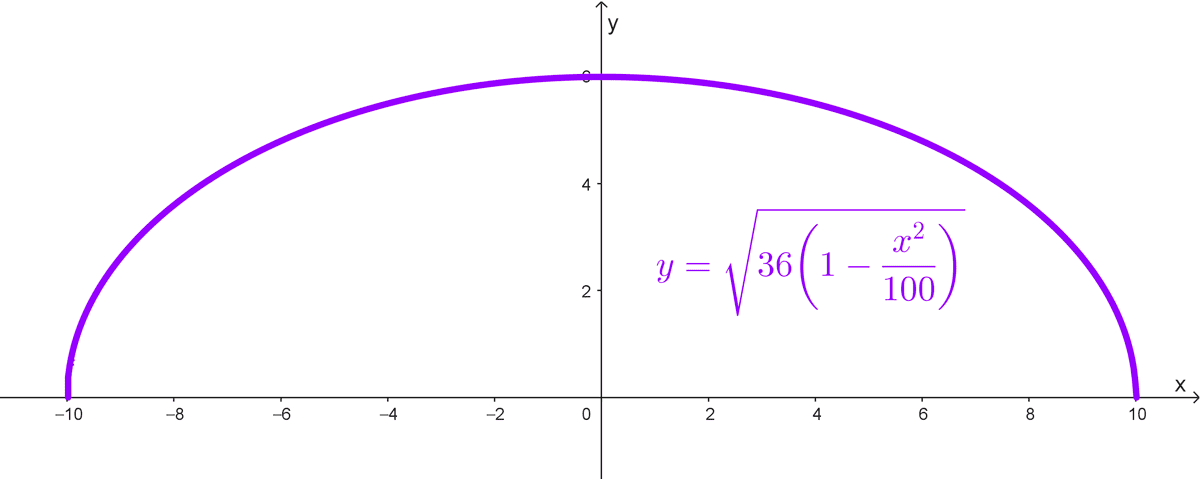
The entrance arch of a theater is shaped like a semi-ellipse, measuring 20 meters wide at the base and 6 meters high at the center. Find an equation for the ellipse. What is the height of the arch at a distance of 4 meters from the center?
Solution
Given information:
- Width of the base: 2a = 20 m, so a = 10 m.
- Maximum height at the center: b = 6 m (semi-minor vertical axis).
Placing the center at the origin (0, 0) with a horizontal major axis, the equation of the full ellipse is:
$$\dfrac{x^2}{a^2}+\dfrac{y^2}{b^2}=1$$
Because the arch is the upper half of the ellipse, we only consider the positive values of y.
Substituting a = 10 and b = 6:
$$\dfrac{x^2}{10^2}+\dfrac{y^2}{6^2}=1$$
$$\dfrac{x^2}{100}+\dfrac{y^2}{36}=1$$
Solving for the upper half (y ≥ 0):
$$y=\sqrt{36 \left(1-\dfrac{x^2}{100}\right)}$$
To find the height 4 meters from the center, substitute x = 4:
$$y=\sqrt{36 \left(1-\dfrac{4^2}{100}\right)}$$
$$y=\sqrt{30.24}\approx 5.5 \ \text{m}$$
Final Results:
- Arch equation (upper semi-ellipse): \(y=\sqrt{36 \left(1-\dfrac{x^2}{100}\right)}\)
- Height 4 meters from the center: \(y \approx 5.5 \ \text{m}\)
Did you find this useful? Rate it!

Leave a Reply