
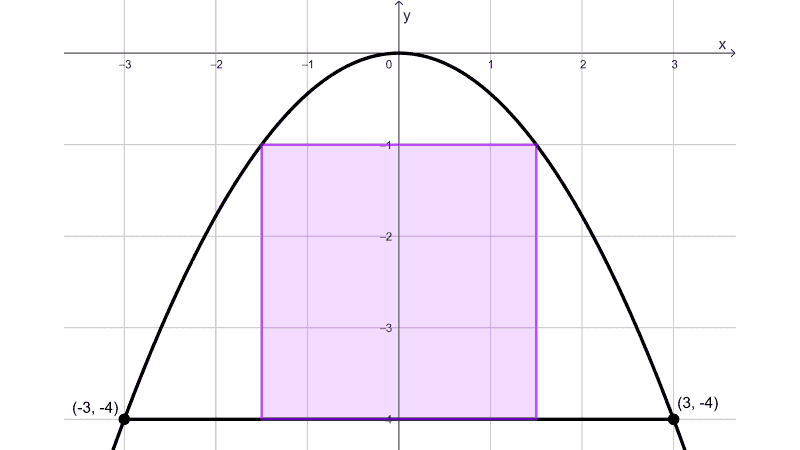
Parabola
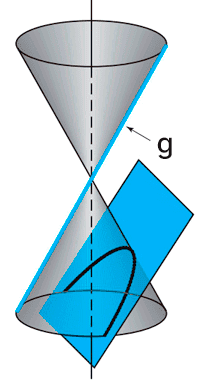
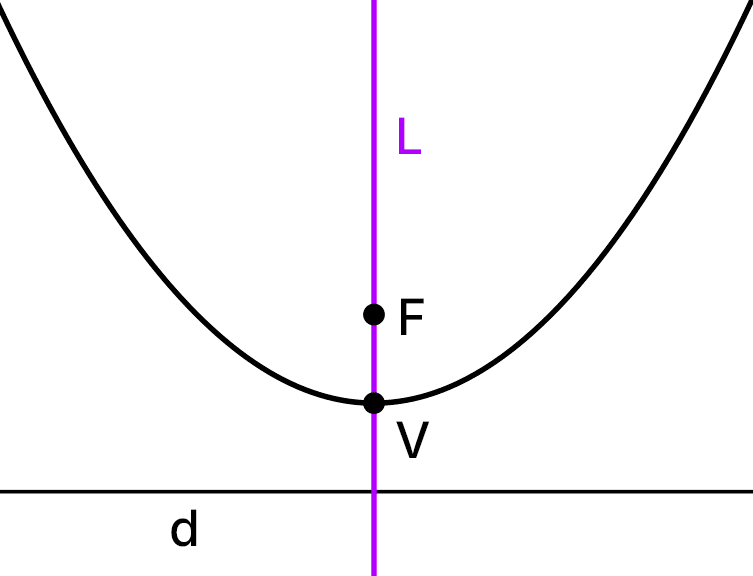
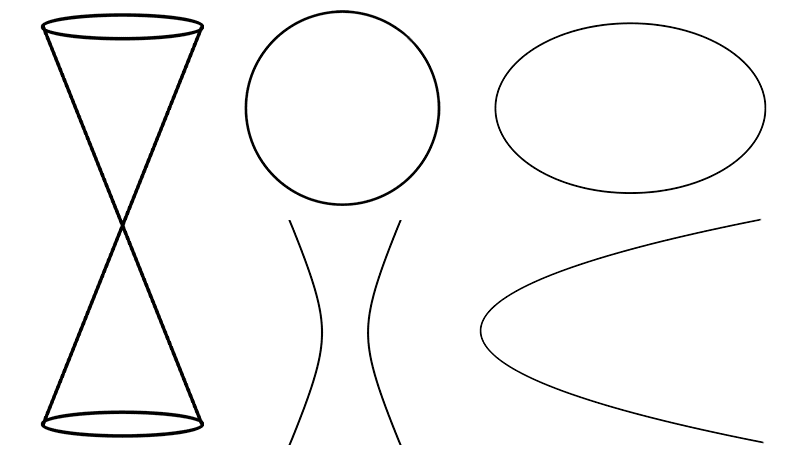
A parabola is an open, continuous plane curve defined as the set of all points that are equidistant from a fixed point called the focus and a fixed line called the directrix. A parabola can also be defined as a conic section formed by the intersection of a right circular cone with a plane parallel to one of its generator lines.
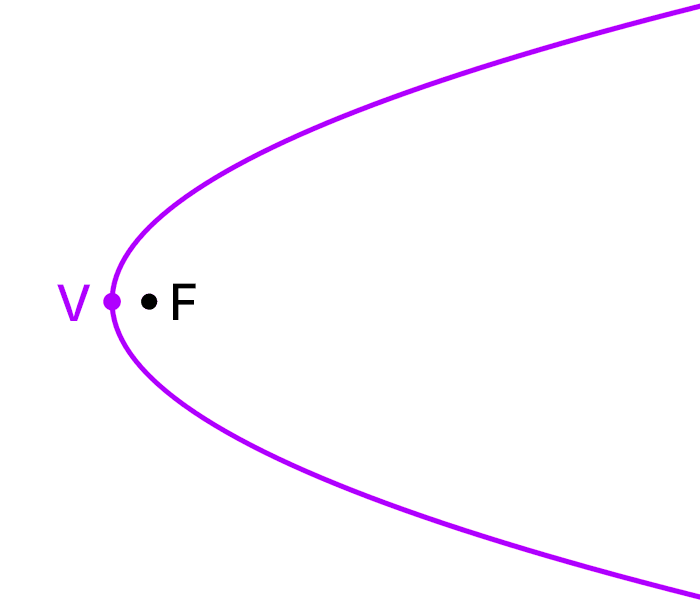
Below, we will explore key aspects of the parabola in mathematics: its primary parts and elements, equations, examples, geometric properties, and real-world applications, among other topics.
Table of Contents
Parts of a Parabola
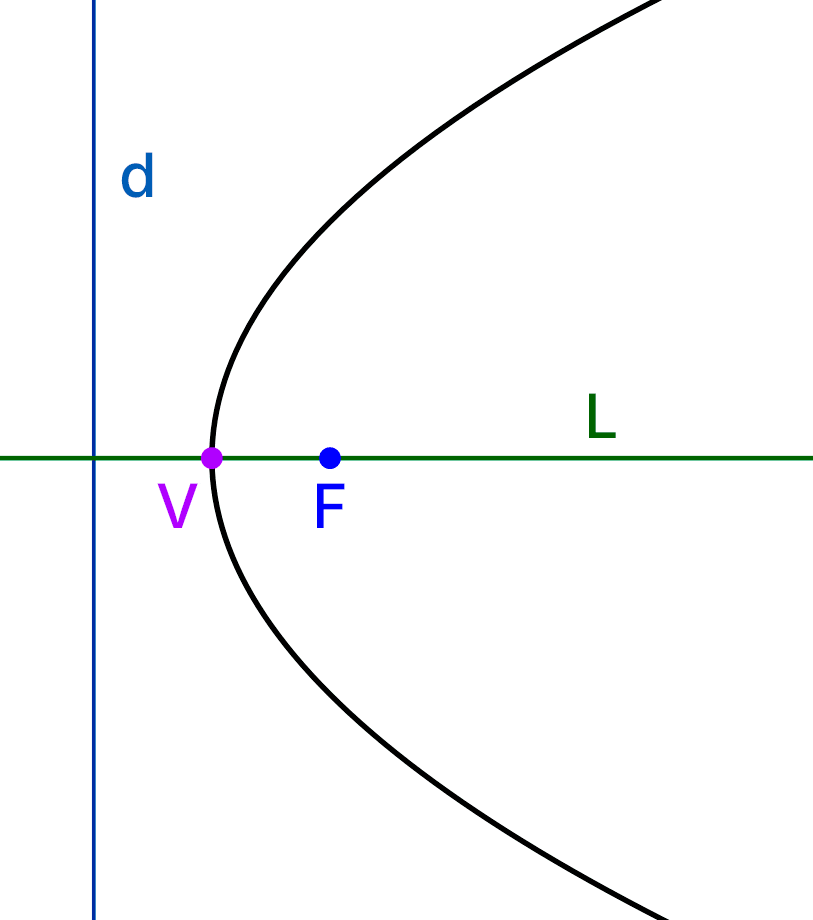
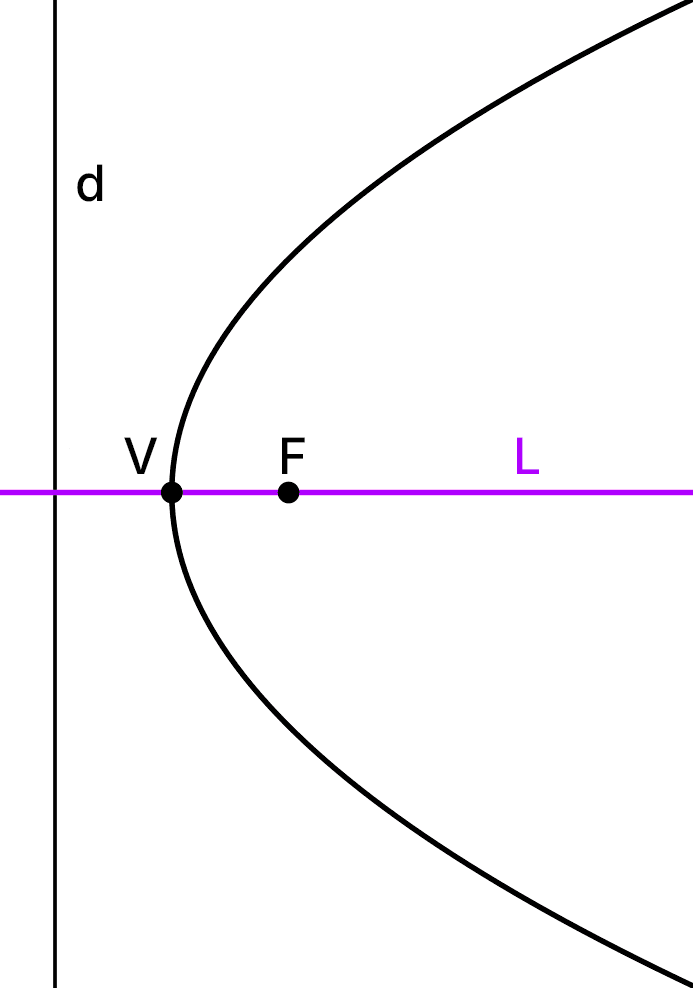
The essential components of a parabola are:
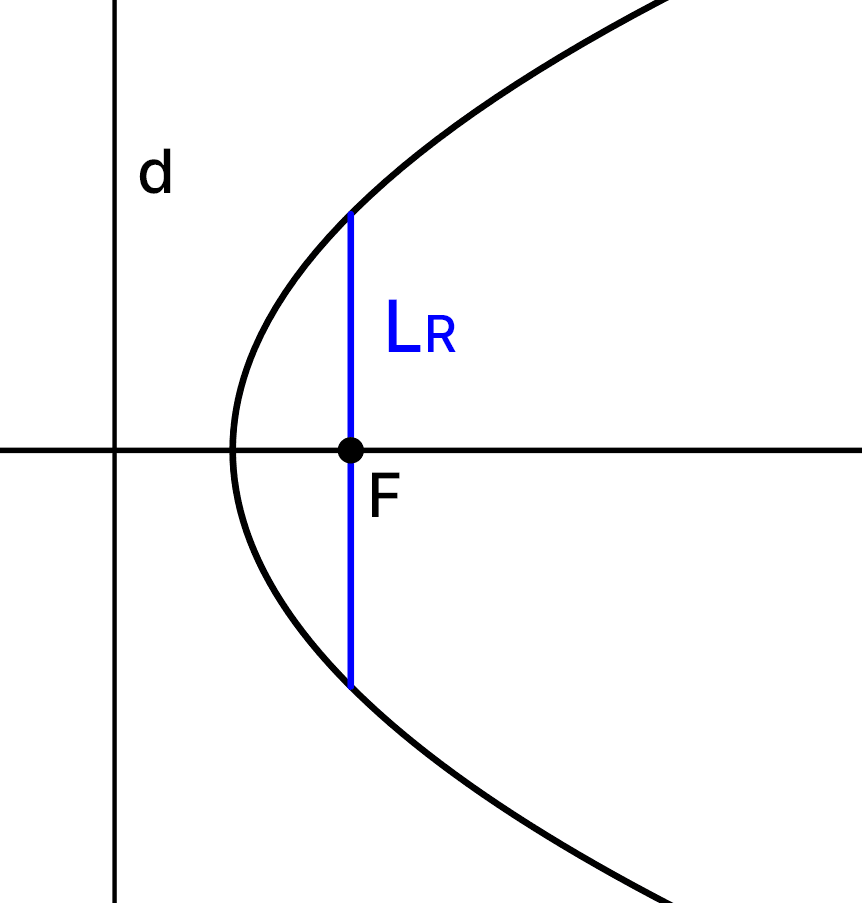
- Focus: The fixed point in the plane used in the geometric definition of the parabola.
- Directrix: The fixed straight line used in the definition. Every point on the parabola lies at an equal distance from the focus and the directrix.
- Vertex: The point on the parabola that is closest to both the focus and the directrix; it is the midpoint of the segment connecting the focus to the directrix.
- Focal Length: The distance between the vertex and the focus (denoted by |p|).
- Axis of Symmetry: The line passing through the vertex and focus, perpendicular to the directrix. It divides the parabola into two symmetrical halves.
- Latus Rectum (Focal Diameter): The line segment passing through the focus, perpendicular to the axis of symmetry, with endpoints on the parabola. Its length is L = |4p|, where |p| is the focal length.
Standard Form Equation
The standard equation of a parabola in Cartesian coordinates varies depending on the orientation of its axis of symmetry (horizontal or vertical) and the position of its vertex (at the origin or translated away from it).
Parabolas with Vertex at the Origin (0, 0)
1) Horizontal Axis of Symmetry: y2 = 4px
- If p > 0, the parabola opens to the right.
- If p < 0, the parabola opens to the left.
2) Vertical Axis of Symmetry: x2 = 4py
- If p > 0, the parabola opens upward.
- If p < 0, the parabola opens downward.
In all four cases, p represents the directed distance from the vertex to the focus, and its absolute value, |p|, is the focal length. Complete derivations of these standard formulas are provided later in this article.
Examples
Here are several examples of parabolas centered at the origin:
- y2 = 4x is a horizontal parabola that opens to the right.
- y2 = -6x is a horizontal parabola that opens to the left.
- x2 = 8y is a vertical parabola that opens upward.
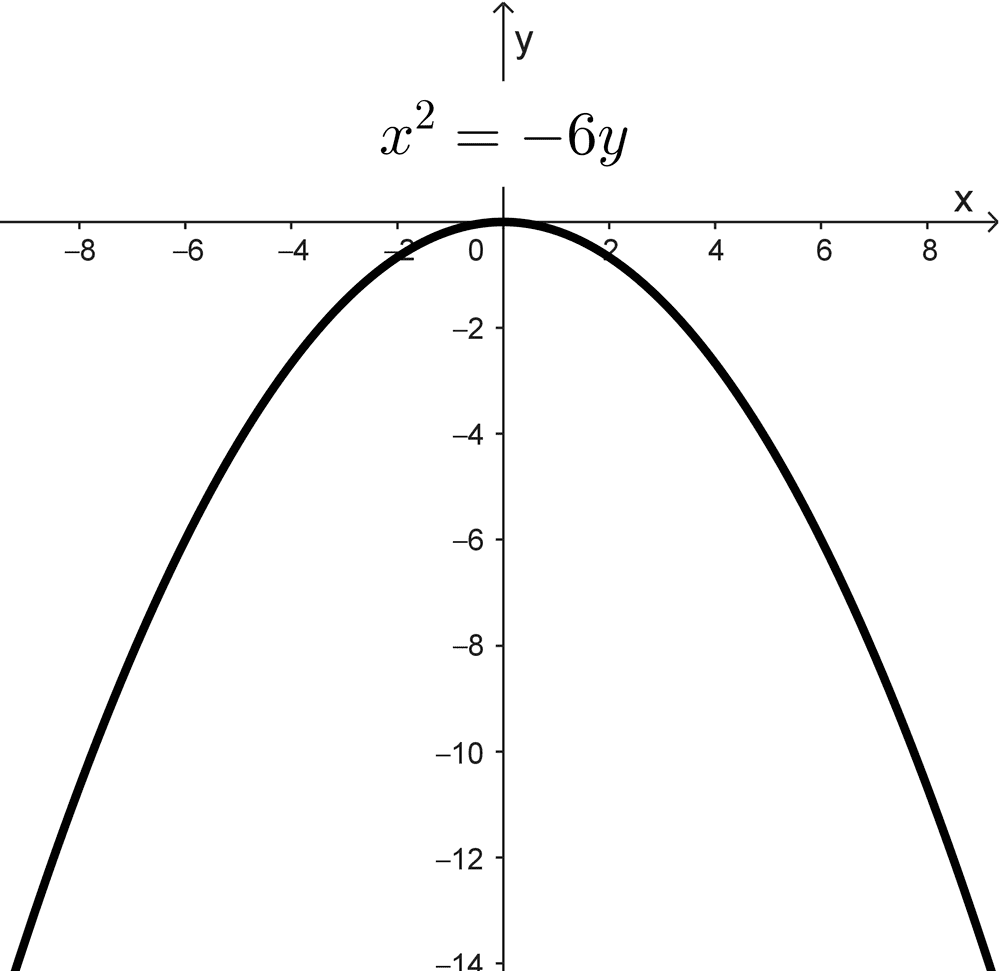
- x2 = -6y is a vertical parabola that opens downward.


Parabolas with Vertex at (h, k)
1) Horizontal Axis of Symmetry: (y - k)2 = 4p (x - h)
- If p > 0, the parabola opens to the right.
- If p < 0, the parabola opens to the left.
2) Vertical Axis of Symmetry: (x - h)2 = 4p (y - k)
- If p > 0, the parabola opens upward.
- If p < 0, the parabola opens downward.
Examples
Here are several examples of parabolas with their vertex shifted away from the origin:
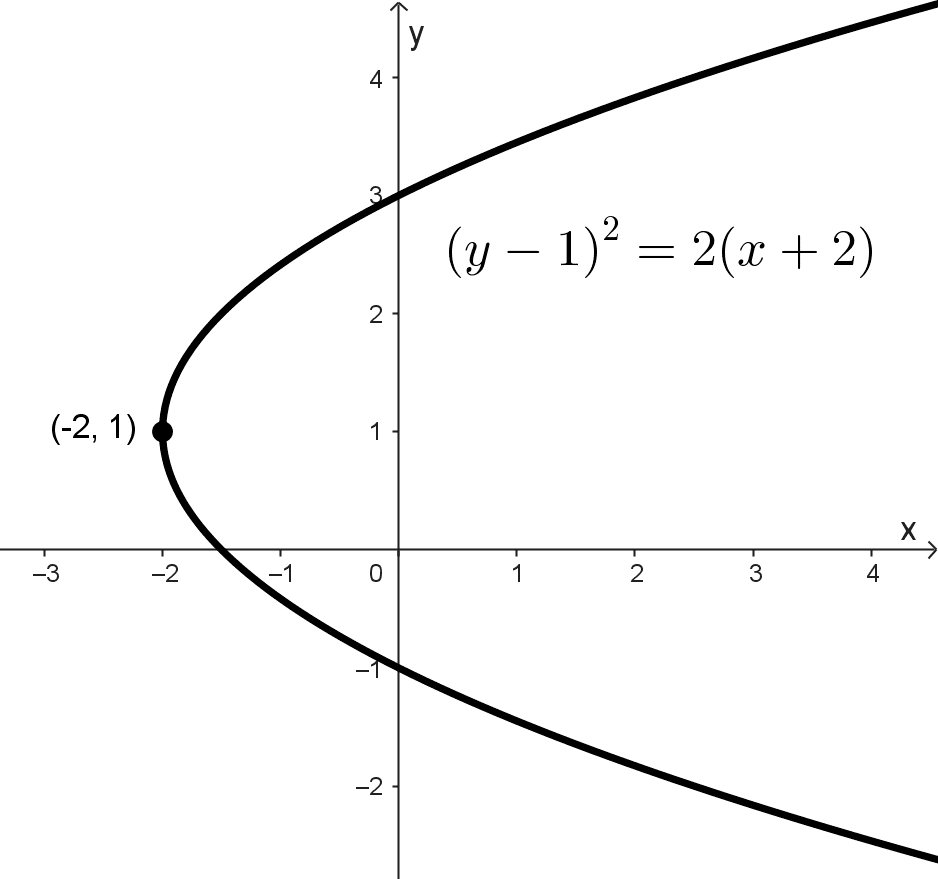
- (y - 1)2 = 2 (x + 2) is a horizontal parabola with vertex at (-2, 1) opening to the right.
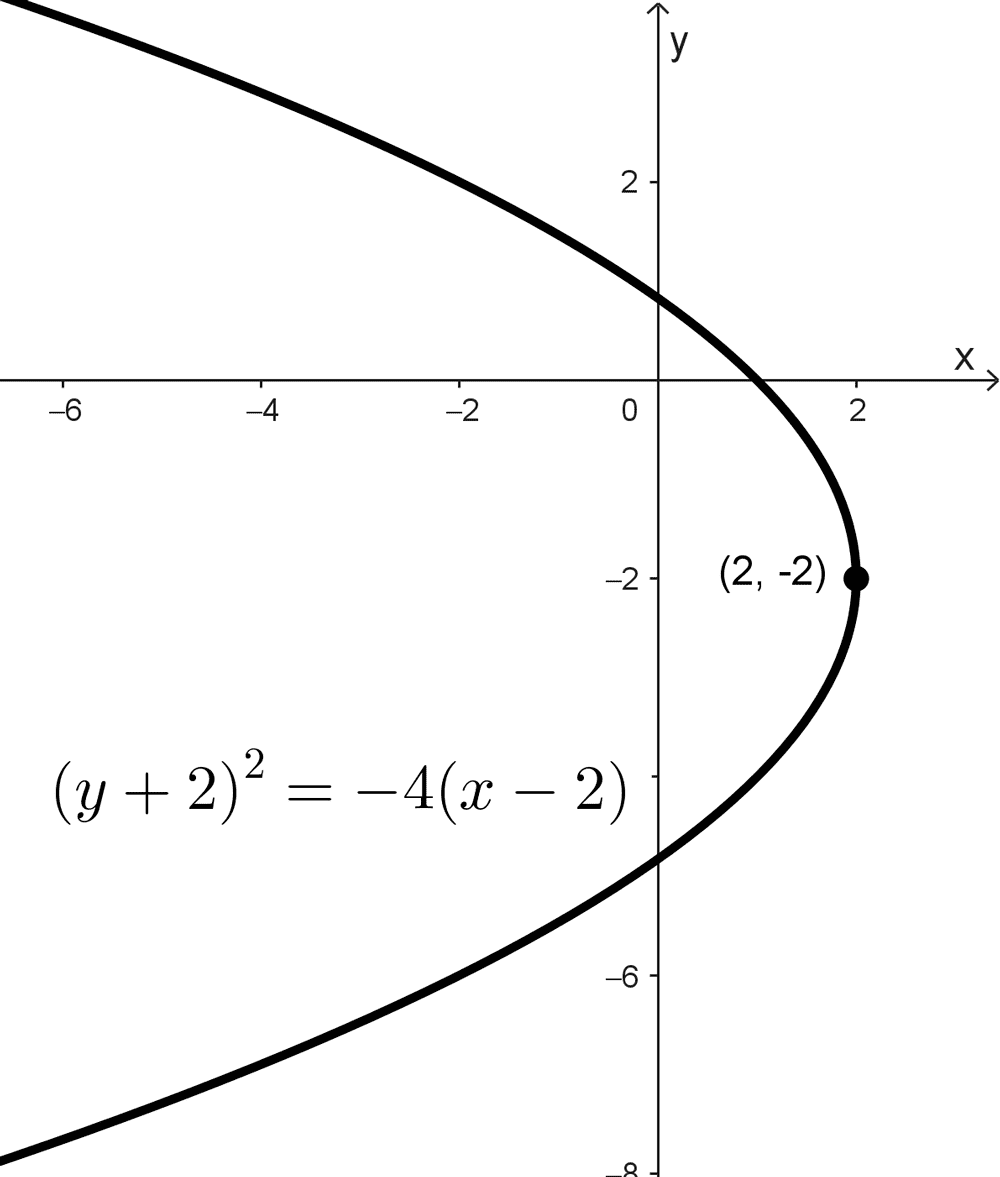
- (y + 2)2 = -4 (x - 2) is a horizontal parabola with vertex at (2, -2) opening to the left.
- x2 = 5 (y + 3) is a vertical parabola opening upward with vertex at (0, -3).
- (x - 1)2 = -4 (y - 2) represents a vertical parabola opening downward with vertex at (1, 2).


All defining features of a parabola (vertex, focus, directrix, axis of symmetry, and latus rectum) can be identified directly from its standard equation. To practice finding these components step by step, visit our dedicated guide:
Properties of a Parabola
The parabola exhibits several unique geometric and physical properties:
- Symmetry: Every parabola is symmetrical with respect to its axis of symmetry, which passes through the vertex and focus and is perpendicular to the directrix. For every point on one side of the curve, there is a corresponding symmetric point on the opposite side at an equal distance from the axis.
- Vertex: The midpoint of the segment joining the focus to the intersection of the axis of symmetry with the directrix. In vertical parabolas, the vertex is the absolute maximum point (if it opens downward) or minimum point (if it opens upward). In horizontal parabolas, it represents the extreme rightmost or leftmost point.
- Eccentricity: The eccentricity of any parabola is strictly equal to 1 (e = 1). By definition, the distance from any point on the curve to the focus equals its perpendicular distance to the directrix.
- Latus Rectum: The length of the focal chord perpendicular to the axis of symmetry is always |4p|, where |p| is the focal length. This segment determines the width or degree of opening of the parabola at the focus.
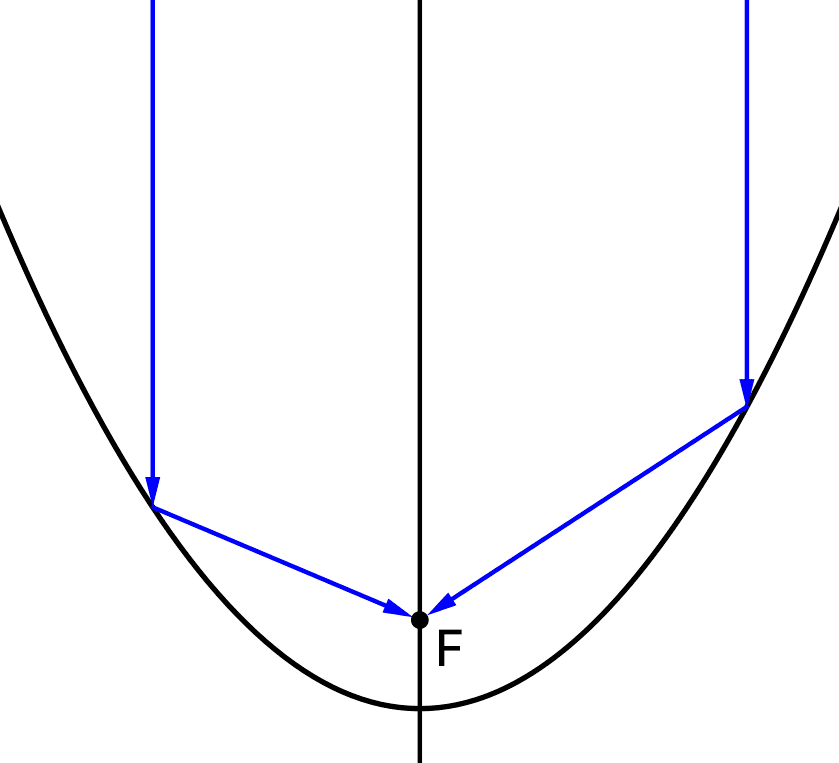
- Reflective Property: Any light ray or wave traveling parallel to the axis of symmetry reflects off the parabolic curve and passes directly through the focus. Conversely, any ray originating at the focus reflects off the curve and exits parallel to the axis of symmetry. This fundamental property makes the parabola essential in the design of satellite dishes, car headlights, and solar concentrators.
Real-World Applications
The geometric properties of the parabola give rise to practical applications across science and engineering:
- Optics: Parabolic reflectors are used in searchlights, car headlights, and reflecting telescopes to focus parallel light rays onto a single focal point or produce a concentrated parallel beam from a source located at the focus.
- Acoustics: Parabolic microphones collect sound waves across their curved dish and reflect them directly into a receiver placed at the focus, isolating distant sounds in sports broadcasting and wildlife recording.
- Astronomy: Radio telescopes and optical reflecting telescopes utilize large parabolic mirrors or dishes to collect weak signals from distant celestial bodies and concentrate them at the focus for precise imaging.
- Structural Engineering and Architecture: Parabolic arches and suspension bridge cables distribute structural loads efficiently across long spans, minimizing bending stress and enhancing stability.
- Ballistics and Physics: In the absence of air resistance, projectiles launched under uniform gravitational acceleration follow a parabolic trajectory. This principle governs motion analysis in kinematics and ballistics.
- Economics and Business Modeling: Certain supply and demand curves, as well as profit and revenue optimization models, are formulated using quadratic functions whose graphs are parabolas.
General Form Equation
The general form of the equation of a parabola is Ax2 + Cy2 + Dx + Ey + F = 0, where the product of the quadratic coefficients is zero: A ⋅ C = 0, and the axis of symmetry is parallel to a coordinate axis. If the axis of symmetry is rotated relative to the Cartesian axes, the general quadratic equation is Ax2 + Bxy + Cy2 + Dx + Ey + F = 0, where the discriminant satisfies B2 - 4AC = 0.
The condition A ⋅ C = 0 ensures that exactly one quadratic term is present in the equation. When there is no rotation (B = 0), the orientation of the parabola depends on which quadratic term appears:
- If A = 0, C ≠ 0, and D ≠ 0, the equation contains y2 but not x2: Cy2 + Dx + Ey + F = 0. This represents a horizontal parabola whose axis of symmetry is parallel to the x-axis, opening to the left or right.
- If C = 0, A ≠ 0, and E ≠ 0, the equation contains x2 but not y2: Ax2 + Dx + Ey + F = 0. This represents a vertical parabola whose axis of symmetry is parallel to the y-axis, opening upward or downward.
Examples of parabolas in general form:
- \(y^2-8x=0\)
- \(x^2-4x-4y+16=0\)
- \(y^2-4y-4x+8=0\)
- \(x^2-10x+6y+19=0\)
- \(y^2-12x-10y+73=0\)
- \(x^2-8x+10y+66=0\)
Summary of Standard Equations
| Standard Equation | Axis of Symmetry | Direction of Opening | Vertex | Focus | Directrix |
|---|---|---|---|---|---|
| y2 = 4px | x-axis (y = 0) | Right if p > 0 Left if p < 0 | (0, 0) | (p, 0) | x = -p |
| x2 = 4py | y-axis (x = 0) | Upward if p > 0 Downward if p < 0 | (0, 0) | (0, p) | y = -p |
| (y - k)2 = 4p (x - h) | Parallel to x-axis y = k | Right if p > 0 Left if p < 0 | (h, k) | (h + p, k) | x = h - p |
| (x - h)2 = 4p (y - k) | Parallel to y-axis x = h | Upward if p > 0 Downward if p < 0 | (h, k) | (h, k + p) | y = k - p |
Equation Derivations
Below are step-by-step proofs of the primary equations for a parabola.
Derivation of the Standard Form Equation
To derive the standard equation, consider a parabola with its vertex at the origin (0, 0), opening to the right, with its axis of symmetry along the x-axis.
Let the focus be located at F(p, 0) and the directrix be the vertical line x = -p.
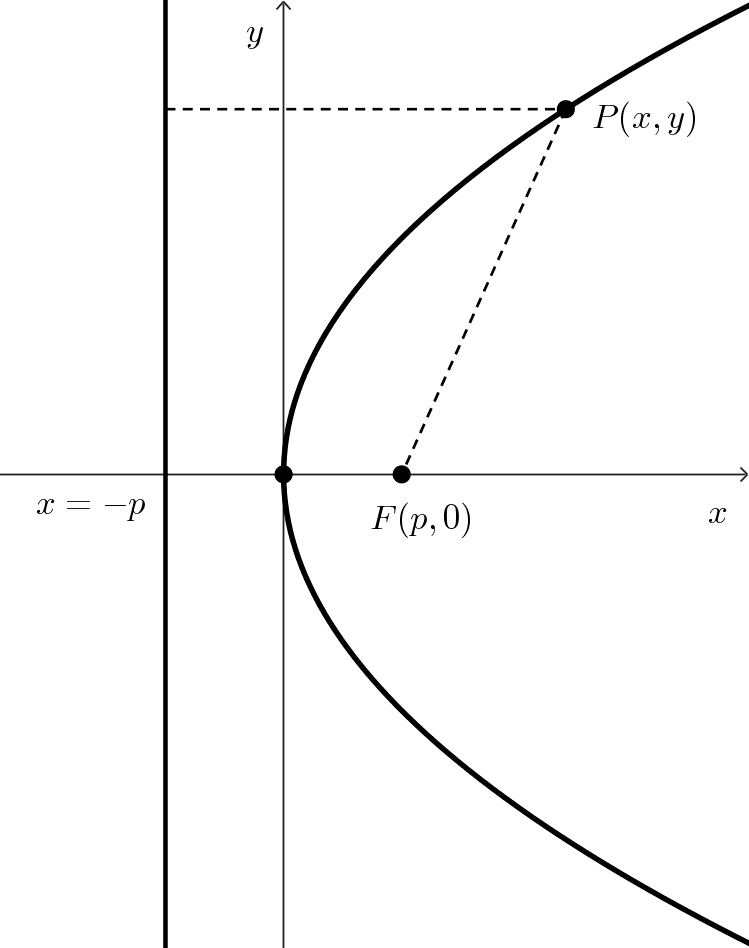
The distance from an arbitrary point P(x, y) to the focus F(p, 0) is: \(\sqrt{(x-p)^2+y^2}\)
The perpendicular distance from P(x, y) to the directrix line x = -p is: \(|x+p|\)
By the geometric definition of a parabola, the distance from P to the focus equals its distance to the directrix:
\(\sqrt{(x-p)^2+y^2}=|x+p|\)
Because the parabola opens to the right, \(x \ge 0\) and \(p > 0,\) which implies \(x + p > 0.\) Thus, the absolute value bars can be removed directly:
\(\sqrt{(x-p)^2+y^2}=x+p\)
Squaring both sides eliminates the radical:
\((x-p)^2+y^2=(x+p)^2\)
Expanding both sides:
\(x^2-2px+p^2+y^2=x^2+2px+p^2\)
Subtracting \(x^2\) and \(p^2\) from both sides:
\(-2px+y^2=2px\)
\(y^2=4px\)
Thus, the standard form equation of a horizontal parabola centered at the origin is:
\(y^2=4px\)
When p > 0, the parabola opens to the right; when p < 0, it opens to the left. An identical argument with the focus on the y-axis yields the vertical orientation:
Vertical parabola opening upward or downward: \(x^2=4py\)
Translating the vertex to an arbitrary point (h, k) applies horizontal and vertical shifts, replacing x with x - h and y with y - k in the equations above.
Derivation of the General Form Equation
To derive the general form, begin with the standard equation for a parabola with vertex at (h, k). For a horizontal parabola:
\((y-k)^2=4p(x-h)\)
Expanding this equation:
\(y^2-2ky+k^2=4px-4ph\)
Rearranging all terms onto the left side:
\(y^2-2ky+k^2-4px+4ph=0\)
\(y^2-2ky-4px+(k^2+4ph)=0\)
This matches the general second-degree form:
\(Ax^2+Cy^2+Dx+Ey+F=0\)
where:
- \(A=0\)
- \(C=1\)
- \(D=-4p\)
- \(E=-2k\)
- \(F=k^2+4ph\)
Similarly, for a vertical parabola: \((x-h)^2=4p(y-k),\) expanding yields:
\(x^2-2hx-4py+(h^2+4pk)=0\)
which matches the general equation with:
\(A=1\)
\(C=0\)
\(D=-2h\)
\(E=-4p\)
\(F=h^2+4pk\)
Additional Resources
Connection Between Parabolas and Quadratic Functions
Expanding the standard equation of a vertical parabola yields the form \(y=ax^2+bx+c,\) which represents a standard quadratic function whose graph in the Cartesian plane is a parabola.
Only vertical parabolas represent functions of x. By the vertical line test, horizontal parabolas are not functions because a single x-value can correspond to two distinct y-values.
For a parabola given by the quadratic function \(y=f(x)=ax^2+bx+c,\) the coordinates of the vertex are: \(\left(-\dfrac{b}{2a},f\left(-\dfrac{b}{2a}\right)\right)\)
The axis of symmetry is the vertical line \(x=-\dfrac{b}{2a}.\)
The leading coefficient a dictates the direction of opening and width of the curve: if a > 0, it opens upward; if a < 0, it opens downward. Larger values of |a| make the parabola narrower, while smaller values make it wider.
The x-intercepts (or real roots) are found using the quadratic formula:
\(x=\dfrac{-b\pm\sqrt{b^2-4ac}}{2a}\)
The discriminant \(b^2-4ac\) determines the number of real x-intercepts: two if positive, one if zero (tangent to the x-axis at the vertex), and none if negative.
Content on Parabolas
Did you find this useful? Rate it!
0.0 / 5 — 0 votes

HOW TO CITE THIS ARTICLE
Machado, D. (2026, October 27). Parabola. Exponty. https://exponty.com/en/parabola
Leave a Reply
Related posts